Mario Impemba is part of the broadcast team in Boston now. The former TV voice of the Detroit Tigers is scheduled to work 51 regular-season games with Joe Castiglione in the Red Sox radio booth this year. The new job is different in more ways than one.
The last time Impemba did radio on a full-time basis was in 2001 when he called games for the Anaheim Angels. He did do a handful of radio games during the 2016 season — Detroit’s broadcast teams flip-flopped a few times that year — but television has long been his comfort zone. No big deal. While the mediums are different animals, the 56-year-old Detroit-area native is making a smooth segue.
“It’s kind of like riding a bike,” Impemba told me in late April. “It was seven years in Anaheim, and prior to that I did eight years in the minor leagues, so I cut my broadcasting teeth in radio. Transitioning back isn’t a big challenge. At the same time, I’m shifting abruptly after doing one medium for [17] years. It took a few games of telling myself, OK, you can’t just say ‘groundball to short; one out.’ On radio you have to describe the mechanics of the play.”
Much like the athletes making the plays being described, broadcasters have honed their skills through years and years of repetition. Be it a grounder to third or a fly to right, there is no shortage of familiarity with what’s happening between the white lines. Read the rest of this entry »
Generally speaking, doing more of one thing means doing less of another. A positive development can come at the expense of some other attribute and unintended consequences can make that positive thing decidedly less so. It’s one thing to strike out less often. Putting more balls in play provides the potential for positive outcomes. It’s another thing to strike out less often and walk more often. Doing those things in concert can have a great effect on getting on base and not making outs, which is almost always the point of every plate appearance from a hitter’s perspective. Sometimes, doing both doesn’t lead to positive results, and Rafael Devers found that out the first month of the season. Instead of going back, though, he’s moved forward and is hitting better than ever.
The 2018 season wasn’t a great one for Devers statistically. He wasn’t terrible, posting a slightly lower than average 8% walk rate and 24% strikeout rate, as well as better than average power with a .193 ISO, but a .281 BABIP meant a .240 batting average a sub-.300 on-base percentage and a below-average 90 wRC+. In his 2017 debut, Devers’ numbers were mostly the same, but a .342 BABIP meant a 110 wRC+. The Statcast data indicates that the difference between 2017 and 2018 was mostly luck, and Devers’ batted ball profile in terms of ground balls, line drives, and pulled balls were all pretty similar in 2017 and 2018, giving credence to Devers being a bit lucky in 2017, with 2018 his natural level if all else remained the same.
Devers wasn’t content with remaining the same, so he spent the offseason working on his weight and now focuses more on not striking out and incorporating video of pitchers in his preparation. While all those changes are admirable, they failed to make a difference the first month of the season. On April 25, Devers had completed 101 of his 201 plate appearances this season. True to his word, Devers struck out a lot less, lowering his strikeout rate down to 16% on the season and saw his walk rate rise to 12%. Devers also saw his BABIP rise to .338 so the lowered strikeouts and increased walks caused his batting average to stand at a healthy .276 with a very good .370 OBP. Unfortunately, Devers had yet to hit a home run and only had six doubles, leaving his ISO at a meager .069 and his wRC+ right at 90, the same as where it was the previous season. Read the rest of this entry »
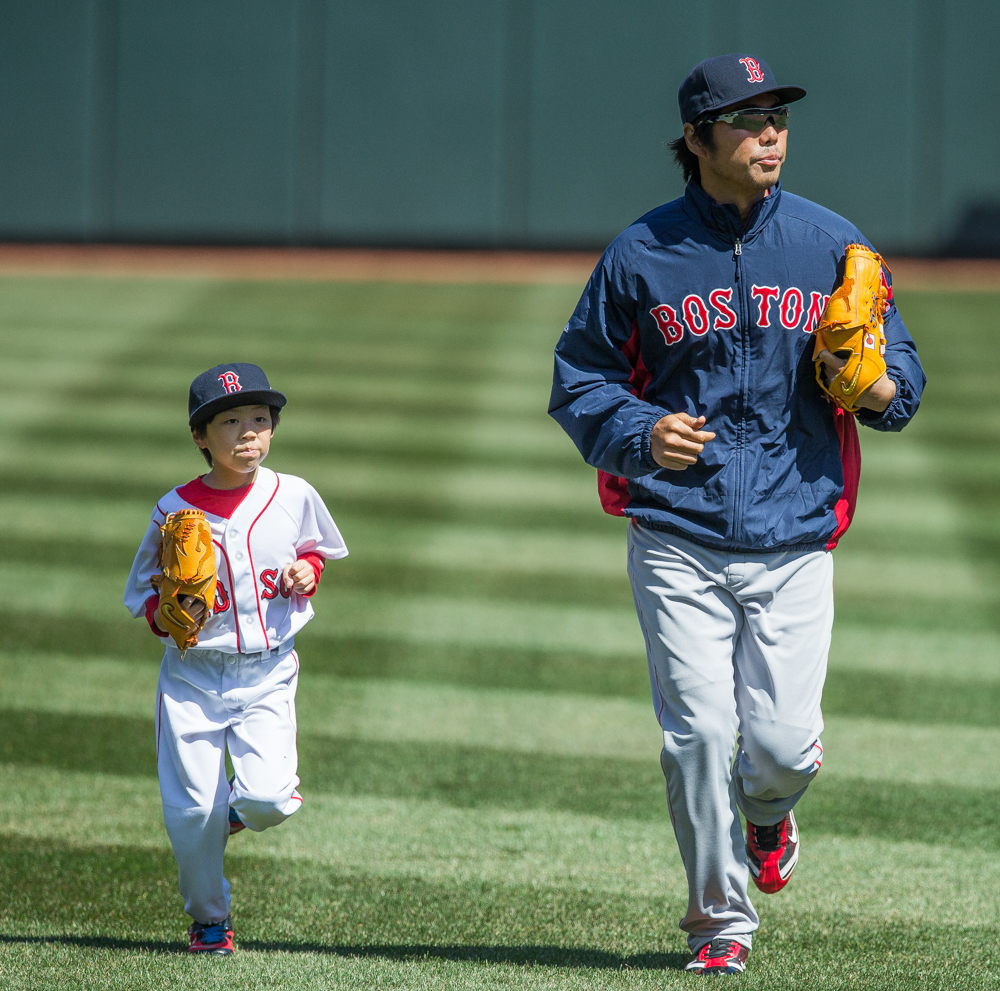
A World Series champion in 2013, Koji Uehara has called it quits. Photo by Keith Allison.
On May 20, Koji Uehara announced his retirement from professional baseball. The news was significant for several reasons. First, it was announced during the season. Uehara admitted that he “already decided that I would quit this year, and in my mind I felt three months would be make or break.” He also cited that his fastball just doesn’t have enough to compete in NPB anymore and remarked that him being in the organization would reduce chances for other youngsters. It sounds like, all-around, Uehara has resigned to his fate of being a very old man by baseball standards. It’s sad to hear, but that’s just reality.
Second, it simply feels like an end of an era. The man pitched professionally since 1999. Sure, most major league fans weren’t familiar with him until he signed with the Baltimore Orioles in 2009, but even then, he was 33 years old. Personally, I became familiar with Uehara from his dominance in Japan and his exceptional 2006 World Baseball Classic performance (which is never to be forgotten by Korean baseball junkies like myself).
To understand Uehara’s career, it’s essential to look at his time in Japan. His interest in going to the big leagues goes all the way back to his amateur days. As an ace of the Osaka University of Health and Sports Sciences, Uehara was courted by the then-Anaheim Angels. It was said that the Angels prepared an amount of 300 million yen (just below $3 million in current currency rate) for the righty. Uehara was intrigued by it, but the Yomiuri Giants, who had coveted him for a long time, managed to convince him to stay in Japan, selecting him in the 1998 NPB Draft. Among the notable names selected in the event were other future big leaguers Kosuke Fukudome, Kyuji Fujikawa, and Daisuke Matsuzaka.
In 1999, his first professional season, Uehara set NPB ablaze with ridiculous numbers. As a 23-year old fresh out of college, the righty went 20-4 with a 2.09 ERA and 179 strikeouts versus 24 walks in 197.2 innings. He also threw a whopping 12 complete games (!) in 25 starts. He had the most wins and strikeouts and the best winning percentage and ERA, making him the quadruple-crown winner among all pitchers. He, of course, won the 1999 NPB Rookie of the Year, a Golden Glove, Sawamura Award (the NPB’s equivalent of the Cy Young Award), was named to the Best Nine, etc. Basically, Uehara had an entrance of the ages. Here’s a peek at his dominance from that season:
As a starting pitcher, he didn’t reach the same kind of brilliance he showed as a rookie, but he was still great. In 2002 for instance, he won another Sawamura Award by going 17-5 with a 2.60 ERA and 182 strikeouts versus 23 walks in 204 innings. He also garnered some stateside attention in fall 2002. In the first game of the MLB-NPB exhibition series, Uehara struck out reigning NL MVP Barry Bonds thrice. His pitching prowess also impressed former AL MVP Jason Giambi. “He had a great forkball,” he said. “He threw it hard enough that you couldn’t sit on it, and he made quality pitches all night.” Read the rest of this entry »
When the Red Sox called up Michael Chavis on April 19, they were 6-13 and had no shortage of troubles. Every member of their rotation save for David Price was regularly being lit up like a pinball machine, and their no-name bullpen was shaky as well. Reigning AL MVP Mookie Betts was hardly himself offensively, and both Jackie Bradley Jr. and Steve Pearce were impossibly cold. Amidst all of that, the team’s hole at second base was just one more problem, albeit similar to last year, when even replacement-level play in the absence of the injured Dustin Pedroia did little to prevent them from winning a franchise-record 108 games as well as the World Series.
Just over one month since Chavis’ arrival, the Red Sox are now over .500 (25-22). Their pitching has come around, as has Betts, and their leading hitter in terms of both slugging percentage (.592) and wRC+ (156) is Chavis, a 23-year-old righty-swinging rookie with “a bit of a beer-keg physique” (h/t Baseball Prospectus), one who had never played second base before this season. His nine homers (in 113 PA) is tied with J.D. Martinez for second on the team behind Mitch Moreland’s 12. He homered in Boston’s wins both Sunday against the Astros and Monday against the Blue Jays. Here’s the former, in which he drove a Wade Miley cut fastball 420 feet, a towering shot over the Green Monster:
Long blasts are hardly a rarity for Chavis. Despite his late arrival, he’s tied for fourth in the majors with six homers of at least 420 feet, and he had another estimated at 419 feet. His average home run distance of 426 feet ranks seventh among players with at least 50 batted ball events (he has 68). Monday’s 389-footer off of the Blue Jays’ Edwin Jackson was just his second homer shorter than 400 feet.
Two months ago, Chavis barely registered as a player likely to make an impact on the 2019 Red Sox, in part because he had just eight games of Triple-A experience to that point along with 100 games at Double-A. Our preseason forecasts estimated he’d get just 14 big league plate appearances. Now he’s one of the players who has helped to salvage their season. So what gives? Read the rest of this entry »
It remains one of the game’s unsolved mysteries. A batter hits a pop-up near the mound and the person closest to it — a professional athlete wearing a glove — isn’t expected to catch the ball. Moreover, he’s not supposed to catch the ball. That job belongs to any one of several teammates, all of whom has traversed a greater distance. As often as not they’re climbing a slope to get under the descending baseball.
Chaos can ensue as the infielders and the catcher converge. The multiple “I’ve got its,” are drowned out by crowd noise and suddenly what should be a routine out becomes an adventure. We’ve all seen it. A bumper-car-like collision occurs and the catch is made clumsily… or not at all.
Just last week, Red Sox right-hander Rick Porcello was charged with an error when he failed to catch a pop up in front of the mound. Not because of ineptitude, but rather because he was veritably mugged by his catcher as the ball was about to arrive comfortably in his glove.
Why aren’t pitchers expected to handle simple pop-ups? They’re perfectly capable, so it makes sense that they should be catching them. Right?
“I don’t know why, and yes, they should be,’ said Seattle’s Perry Hill, whom many consider the game’s best infield instructor. “They’re on on the field of play when the ball is in play, so they should be able to make a play. It’s practiced in spring training. That little short pop-up that nobody can get to. The third baseman is playing way back. The first baseman is way back. The pitcher is the closest guy to the ball. He’ll catch that ball.”
Marcus Walden is a 30-year-old rookie with a 5-0 record, a 1.46 ERA, and a spiked-grip slider that helped rescue him from minor-league purgatory. The story behind the pitch is one of avoidance-turned-desperation, with a healthy dose of studiousness thrown in for good measure. Walden has thrown his slider 41.6% of the time this year in 24.2 innings out of the Boston bullpen.
The righty’s journey to the big leagues was a meandering one. Drafted by the Blue Jays in 2007, Walden subsequently saw time in the A’s, Reds, and Twins organizations. He also spent a summer toiling in the independent Atlantic League. The Red Sox signed him off the scrap heap prior to the 2017 season, but even then his prospect status was tenuous at best. Twenty-six pitchers saw action for the AL East club that year, yet Walden remained in Triple-A.
Walden finally made his MLB debut last April, but his time at the top was short-lived. Sent down in May, he stayed on the Pawtucket roster throughout the remainder of the campaign. This year has been a different story. Walden has been one of Boston’s best relievers — his aforementioned numbers are augmented by a 10.95 K/9 and a 2.46 FIP — and again, his slider is a big reason why. I talked to Walden about his signature offering prior to a recent game.
———
David Laurila: Your go-to pitch is a slider. What is the story behind it?
Marcus Walden: “I didn’t start pitching until my senior year of high school. My freshman year [at Fresno City College] — the one year I went to school — I was throwing a four-seam fastball and a slider. Now I’ve gone back to that same style of a slider, although with a little bit different grip that I learned from Chandler Shepherd, in 2017. And watching Craig Kimbrel was a big help. I watched him closely, especially in spring training of ’17 and ’18 when he was throwing his live BPs. I talked to him a little. It was, ‘All right. What kind of shape are we trying to make with this pitch?’ He throws a knuckle slider, and that’s what I throw now.”
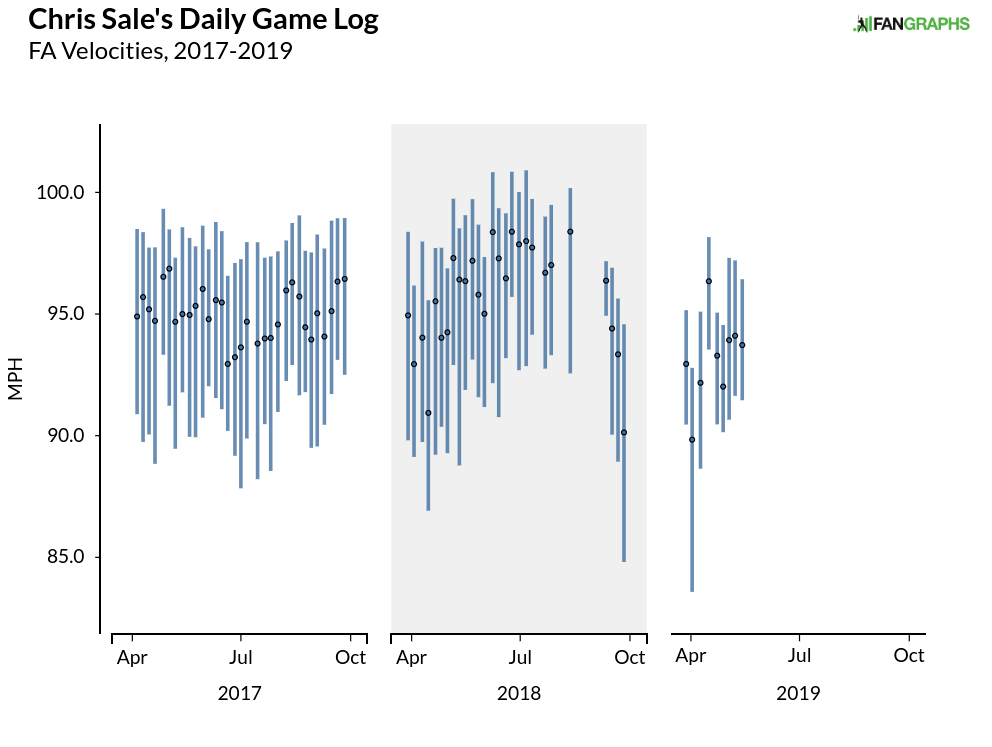
There was a fair bit of consternation regarding Chris Sale at the start of the season. In his first start of the year, he gave up three homers in three innings against the Mariners. Concern mounted when his fastball averaged 89 mph against Oakland in his next start and he struck out just a single batter. The Red Sox told everyone not to worry because dialing back was part of a plan. Sale did nothing to help his cause with a lackluster start against the Blue Jays the next time out, but his fastball averaged over 95 mph against the Yankees in his fourth outing, and over Sale’s last six starts, he’s got 65 strikeouts against seven walks in 38 innings with a 1.92 FIP and a 2.61 ERA. He’s struck out 31 batters in his last two starts, including 17 Rockies in just seven innings on Tuesday. Chris Sale, ravager of batters is back, but his velocity is still down, so he’s adjusted how he attacks hitters.
The game against the Yankees could be looked at as the turning point in Sale’s season thus far — the results certainly back that point up — but that was more of an isolated incident when it comes to the velocity we’ve grown accustomed to the past few years. The graph below shows Sale’s fastball velocity in each start over the past few seasons as well as a band which shows the max velocity for Sale in any given start.
When the Red Sox indicated they had a plan for Sale at the beginning of the year amidst his struggles, pointing to 2018 was the biggest piece of evidence. Sale started the 2018 season with lower velocities and then ramped it up as the season wore on before Sale wore out. This season might require a slower, less inclined ramp to make sure that Sale is still pitching strongly at the end of the season. Where skepticism might remain is whether Sale can be anything close to his prior great self if he spends half the season at 92-93 mph instead of a few ticks higher. If the last few starts are any indication, Sale will be just fine. Read the rest of this entry »
Tanner Houck is off to a book-ended beginning to his second full professional season. Boston’s first-round pick in the 2017 draft allowed seven runs in his first start, and in his fifth, he allowed five. In between, he authored three beauties. Pitching for the Portland Sea Dogs, the 22-year-old righty held Double-A opponents to 10 hits, and a lone marker, over 16 innings.
Houck relies heavily on a worm-killing two-seamer. It’s the pitch that wowed scouts when he was at the University of Missouri, and while it’s once again his go-to, that wasn’t the case over the first half of last season. The Red Sox had Houck put his signature pitch in his back pocket and primarily throw four-seamers against Carolina League competition. The reasoning was sound, but the results weren’t particularly pretty. A fish out of water without his sinker, Houck got hit around.
Come midseason, the Boston brain trust decided that Houck should go back to his old bread and butter. The news came as a relief. His best pitch back at the forefront of his arsenal, Houck proceeded to reestablish himself as one of the organization’s top prospects.
Houck, who takes the hill today in an 11 a.m. matinee, sat down for an in-depth discussion of his two-seamer, and what he gained from last year’s four-seam experiment, at the outset of the current campaign.
———
David Laurila: How would you describe the transition away from, and back to, your two-seamer?
Tanner Houck: “Honestly, [transitioning back] was just like riding a bike. It was getting back to my staple — back to who I am — and to how my career is going to be going forward. It was enjoyable. At the same time, not having thrown a four-seam in college, learning that side of the coin was really big for me. I’m still throwing one now, and it makes the two-seam that much better. Being able to ride a four-seam through the zone — not sink it — in certain counts has definitely helped. I’m able to give the hitter two different looks with relatively the same pitch.”
Earlier this week, I made my on-the-record guesses for what would happen with some of April’s underachieving hitters. Now we’ll turn to look at the disappointing pitchers and the potential for more helpings of crow for me to eat come October.
Last year, through the late-season shoulder problems, I counseled people not to panic so soon on Sale. He’s Chris Freaking Sale after all. When the White Sox put him in the rotation in 2012, there was a lot of doom-and-gloom about how his pitching motion and his frame meant he wouldn’t survive long as a starting pitcher. But from 2012-17, Sale was one of the most durable starters in baseball and now he drinks overflowing pints out of the skulls of those pundits.
But now, I am quite worried, especially in the short-term. He’s shown he can occasionally dial it up as he did in the Yankees matchup, hitting 96-97 through most of the game. But his velocity is generally down, severely so in most games. He went three months without a start below an average of 95 mph last year. This year he’s only had individual pitches passing this mark in a single game (the Yankees one).
If this is the Sale that we have now, I do expect him to adjust in the long-term. But the Sale of 2018 had a highly edited repertoire. He’s essentially a fastball-changeup-slider pitcher who is amazing at changing the look of these pitches. He could throw his fastball anywhere between 88-98 and have it look like five different pitches depending where it was. In 2019, he’s Pavarotti with an octave taken away. His fastball is more one-note and hitters have realized it; of every 10 fastballs that batters swing at, one in 10 of those swings-and-misses from previous years are now being hit.
“But Dan, he’s just being cautious because of his shoulder!” That makes me even more worried if 10 months later, he’s still having to pitch in a way that makes him a less effective pitcher because of a shoulder issue. Elbow problems are bad, but shoulder problems are a whole new level of scary, like going from a haunted house at an elementary school carnival to a Saw movie. I’m hopeful in the long-term, but it’s a problem for Boston getting back into the race. Read the rest of this entry »
For the first month of every baseball season, I’m a bit notorious for simply answering “April” as the convenient, one-stop-shop for questions relating to why someone’s favorite player is hitting .150. Once we start heading into May, telling people to be patient when 1/6th of the season is already over becomes an increasingly unujustifiable task. While rebuilding teams are in a place at which they can be patient, avoiding judgment is tricky for contenders, especially when every division leader is in first place by fewer than three games.
So let’s get out the guillotine and guess who can be saved and who is a lost cause.
I remain quite torn about the state of doneness of the Hebrew Hammer. On one hand, he can still hit the ball with authority as seen by the fact that his average exit velocity, dipping under 90 mph, isn’t all that different from the numbers in 2016 and 2017, years in which Braun was still a contributor offensively. If you dig deeper into his pitch-by-pitch stats, Braun appears to be going dead-red for fastballs, and despite a career-low contact rate, he is actually making contact with fastballs at better-than-career-average rates (14.6% whiff/swing rate in 2019 vs. 19.8% career). But other than fastballs, he’s making much worse contact, missing almost half the changeups and sliders he’s offered at (career rate under 30%).
It makes me wonder about Braun’s bat speed. To my naked eye, it looks like he’s trying to compensate for decreased bat speed by making contact with his bread-and-butter pitch (Braun was one of the best fastball hitters in baseball in his prime). He also suggested he was changing his swing in order to hit more home runs. It’s unfortunate that swing speed isn’t one of the things you can get easily, but Alex Chamberlain identified stats that correlate with swing speed when reverse-engineering the scanty data available a few years ago. Isolated power, xwOBA, and contact rate all have a relationship, and in each of the three, Braun is at his career’s nadir.
I think there’s still hope for Braun, but if his bat is slowing down, I wonder if he’s taking the wrong approach in trying to hit for more power. A player with slower bat speed but who is also pulling the ball more (57% compared to 38% career) seems like one trying to cheat on the fastballs. I don’t think Braun’s as doomed as some on this list, but I think that he’d be better off not trying to capture his early-career power because it’s making him a one-dimensional hitter. Read the rest of this entry »