
Mookie Betts’ Versatility Has Enriched His MVP Case
With apologies to Matt Olson, Freddie Freeman, and Corbin Carroll, the race for the NL MVP Award has essentially boiled down to two players: Ronald Acuña Jr. and Mookie Betts. It’s an incredibly close one, with the pair producing such similar batting lines that they’re tied for the NL lead with a 169 wRC+. Betts has the edge in both the FanGraphs and Baseball Reference versions of WAR, Acuña has the edge in several counting stats, and each player has added some unique additional flavors into the mix.
For Acuña, those largely center around his prolific baserunning. Aided by the new rules — particularly the limits on pickoff throws — and unhindered by a drop in sprint speed in the wake of his 2021 ACL tear, he’s stolen 68 bases, the highest total in the majors since 2010. With his 40th homer coming against the Nationals on Friday, he has just the fifth 40–40 season ever, and now the most steals of any player in that club, surpassing Alex Rodriguez’s 46 from 1998 (to go with 42 homers). With one week remaining, he needs two steals to become the first player ever to combine 40 homers and 70 steals in the same campaign, in what’s arguably the greatest power-speed combo season anybody has seen.
There’s certainly value to such an accomplishment, though we’re entering the realm of intangibility. We’re already crediting the value of his homers and steals within the context of the rest of his offensive stat line, but things like wOBA, wRC+, and WAR don’t tell us how much to care about a player reaching round-numbered milestones like these, even if they’re without precedent. Even less clear-cut is the attempt to examine the extent to which Acuña’s baserunning has helped his teammates, mainly by giving them more fastballs to hit. Colleague Esteban Rivera established that yes, players do see more fastballs when he’s on first, but their performances against those fastballs wasn’t uniformly better. “Acuña is most likely helping his teammates see more heaters,” he concluded. “What they do with those pitches, though, is completely up to them.”
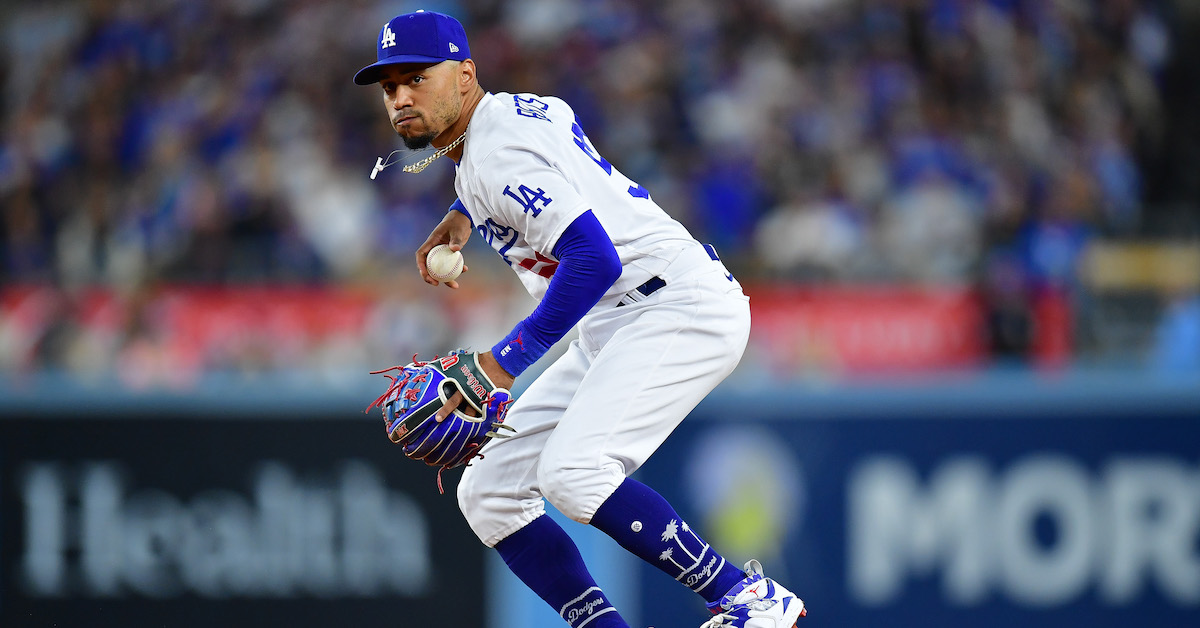
Betts isn’t without his own cool counting stat achievements. His two-run double off Ross Stripling on Saturday night gave him 105 RBIs out of the leadoff spot, a record (Acuña is third at 101). Meanwhile, he’s hit 12 leadoff homers, one shy of the single-season record set by Alfonso Soriano in 2003, and his career-high 39 homers are two shy of the post-World War II record for the most by a player listed at 5-foot-9 or shorter, currently held by Roy Campanella. But bigger (if more difficult to measure) impact he’s made is with his sudden burst of Zobristian versatility: In the wake of Gavin Lux tearing his right ACL in late February, Betts has started 69 games in the infield — 56 at second base and another 12 at shortstop — in his most infield play in nearly a decade.
Betts played 14 games at second base as a rookie with the Red Sox in 2014, after Dustin Pedroia suffered a season-ending injury, but added just 15 more from ’15 to ’22, some of them only for a few innings. He hadn’t played shortstop professionally since 2013, and then just 13 games in Low-A and two innings in the Arizona Fall League. Despite his lack of recent experience, the 30-year-old superstar — a six-time Gold Glove winner in right field — has looked like a natural from the outset.
To backtrack a bit, recall that after their 111-win team fizzled in the postseason, the Dodgers let shortstop Trea Turner and 15 other players depart in an exodus of free agents last winter, then stayed out of the premium free-agent pool in the name of trimming payroll. They entered this season with Lux as their likely shortstop, backed up by Miguel Rojas, a 34-year-old defense-first veteran coming off a dismal 73-wRC+ season with the Marlins. Lux’s move to shortstop put second base in the hands of 23-year-old rookie Miguel Vargas, with Max Muncy bounced to third base to replace the departed Justin Turner, and Chris Taylor part of the mix in an outfield that had lost Cody Bellinger. There the Dodgers were hoping Trayce Thompson could continue his late-2022 resurgence alongside going-on–26-year-old rookie James Outman, 34-year-old Jason Heyward, there on a minor league deal after being cut by the Cubs, and 35-year-old David Peralta, signed to a one-year deal.
Particularly when the Dodgers appeared ready to roll with Rojas as the regular shortstop, it all looked atypically shaky. Via our Depth Charts projections, we forecast the Dodgers for a second-place finish in the NL West behind the Padres with just 88 wins, their first preseason projection below 90 wins since we introduced our Playoff Odds in 2014. Still, based upon our Depth Charts, the loss of Lux only projected to cost the Dodgers about half a win. Here’s a snapshot of how we forecast those positions as of the day Lux got injured (before we made our playing time adjustments), and then again via our Positional Power Rankings just before Opening Day:
| Second Basemen (Late Feb) | PA | WAR | Second Basemen (Late March) | PA | WAR | |
|---|---|---|---|---|---|---|
| Miguel Vargas | 413 | 1.9 | Miguel Vargas | 413 | 1.9 | |
| Chris Taylor | 105 | 0.5 | Mookie Betts | 77 | 0.8 | |
| Michael Busch | 63 | 0.2 | Chris Taylor | 77 | 0.3 | |
| Yonny Hernandez | 35 | 0.1 | Michael Busch | 42 | 0.1 | |
| Miguel Rojas | 35 | 0.1 | Yonny Hernandez | 35 | 0.1 | |
| Max Muncy | 28 | 0.2 | Miguel Rojas | 28 | 0.1 | |
| Mookie Betts | 21 | 0.2 | Max Muncy | 28 | 0.2 | |
| Total | 700 | 3.2 | Total | 700 | 3.5 | |
| Shortstops (Late Feb) | PA | WAR | Shortstops (Late March) | PA | WAR | |
| Gavin Lux | 448 | 2.5 | Miguel Rojas | 448 | 2.1 | |
| Miguel Rojas | 217 | 1.0 | Chris Taylor | 210 | 1.0 | |
| Chris Taylor | 28 | 0.1 | Yonny Hernandez | 42 | 0.1 | |
| Yonny Hernandez | 7 | 0.0 | ||||
| Total | 700 | 3.6 | Total | 700 | 3.2 | |
| Right Fielders (Late Feb) | PA | WAR | Right Fielders (Late March) | PA | WAR | |
| Mookie Betts | 623 | 5.5 | Mookie Betts | 567 | 5.0 | |
| Jason Heyward | 35 | 0.0 | Jason Heyward | 70 | 0.1 | |
| Chris Taylor | 21 | 0.1 | James Outman | 42 | 0.1 | |
| James Outman | 14 | 0.0 | Chris Taylor | 14 | 0.0 | |
| J.D. Martinez | 7 | 0.0 | J.D. Martinez | 7 | 0.0 | |
| Total | 700 | 5.6 | Total | 700 | 5.3 |
Across the three positions, the loss of Lux and the increased playing time for Rojas, Taylor, and Heyward dropped the total projected WAR from 12.4 to 12.0. That’s hardly an insurmountable loss, though the difference would have been magnified if Betts been projected for something closer to the 303 PA he’s taken as an infielder given the replacement-level expectations for Heyward and the other non-Betts alternatives in right field.
It hasn’t unfolded that way, but then projections aren’t destiny. Through the first two months of the season, Rojas was the weakest link among the moving parts, hitting for just a 45 wRC+; Vargas (99), Taylor (102), Heyward (124), and Betts (136) were more productive. Heyward’s rebound particularly emboldened manager Dave Roberts to play Betts in the infield more than expected. Through those first two months, he started at second 10 times and at shortstop six times — all with righties on the mound, to accommodate the lefty-swinging Heyward — and totaled 72 PA playing the middle infield, nearly as much as we had forecast for the entire season.
The Dodgers, who had gone just 16–13 in March and April, spent all of May atop the NL West, going 18–10. A 5–10 skid at the start of June knocked them out of first place — as far down as third, four games out — and Vargas, after a hot start to June, fell into a deep funk, at one point going 2-for-44 with six walks. Betts, who started just three games at second from June 1 to 24, started six of the last 12 games there before the All-Star break, plus another three at shortstop. Since the beginning of that stretch, he’s played more infield than outfield.
At the break, the Dodgers optioned Vargas, who had sunk to a .195/.305/.367 (85 wRC+) line, to Triple-A Oklahoma City. He hasn’t returned, as the team opted to use his roster spots for buy-low veterans obtained ahead of the trade deadline. On July 25, Dodgers reacquired the versatile Enrique Hernández in a trade with the Red Sox, and a day later added Amed Rosario from the Guardians. In effect, the latter has become Heyward’s platoon partner, playing second base against lefties.
| Month | RF | 2B | SS |
|---|---|---|---|
| April | 17 | 6 | 3 |
| May | 20 | 4 | 3 |
| June | 14 | 6 | 4 |
| July | 6 | 13 | 2 |
| August | 12 | 16 | 0 |
| September | 7 | 12 | 0 |
| Total | 76 | 57 | 12 |
The move to playing more infield has coincided with Betts’ upturn in offense. Since June 25, the point at which the tide really turned, with 64% of his starts coming in the infield thereafter, he’s hit .362/.466/.681 for a major league-high 206 wRC+, six points better than Shohei Ohtani (.318/.461/.706) and 24 points better than Acuña (.344/.426/.631, 182 wRC+). In other words, for three months Betts has been the best hitter in baseball while playing out of position more often than not. His 5.7 WAR in that span is 1.2 more than the second-ranked Acuña and 2.2 more than Ohtani on the offensive side. The Dodgers, who went just 12–12 in June and 13–10 in July, blew the doors off the rest of the league in August, going 24–5, with Betts (.455/.516/.839, 264 wRC+ with 11 HR) going off the charts.
Here’s a look at the Dodgers position-by-position splits for second base, shortstop, and right field; I’ve omitted the players with fewer than 20 PA at each position, but their numbers are included in the totals:
| Second Base | G | PA | HR | AVG | OBP | SLG | wRC+ | WAR |
|---|---|---|---|---|---|---|---|---|
| Miguel Vargas | 75 | 285 | 7 | .195 | .300 | .361 | 82 | 0.0 |
| Mookie Betts | 59 | 247 | 14 | .333 | .429 | .605 | 179 | 3.5 |
| Amed Rosario | 27 | 75 | 2 | .205 | .227 | .342 | 51 | -0.3 |
| Enrique Hernández | 11 | 23 | 0 | .286 | .348 | .381 | 103 | 0.0 |
| Total | 661 | 24 | 0.253 | 0.343 | 0.449 | 116 | 3.3 | |
| Shortstop | G | PA | HR | AVG | OBP | SLG | wRC+ | WAR |
| Miguel Rojas | 109 | 395 | 5 | .230 | .282 | .321 | 66 | 0.4 |
| Chris Taylor | 28 | 90 | 5 | .181 | .236 | .398 | 69 | 0.3 |
| Mookie Betts | 14 | 52 | 3 | .304 | .365 | .674 | 172 | 0.6 |
| Enrique Hernández | 8 | 27 | 0 | .292 | .296 | .375 | 76 | 0.0 |
| Amed Rosario | 10 | 27 | 1 | .308 | .333 | .577 | 143 | 0.4 |
| Total | 599 | 14 | .234 | .283 | .374 | 78 | 1.4 | |
| Right Field | G | PA | HR | AVG | OBP | SLG | wRC+ | WAR |
| Mookie Betts | 96 | 365 | 22 | .290 | .403 | .571 | 163 | 4.1 |
| Jason Heyward | 80 | 254 | 11 | .305 | .373 | .529 | 143 | 2.4 |
| Total | 666 | 37 | .295 | .390 | .555 | 155 | 7.2 |
With eight games remaining (this data doesn’t include Sunday’s game), the Dodgers have gotten 11.9 WAR from the three positions. But while the total is basically on the money from the projections, the distribution has been different. The take-home points:
- Second base has been a wash despite Vargas’ rookie season essentially being a bust. Betts has done an exceptional job of propping up the Dodgers’ production at the keystone, freeing up Taylor to play elsewhere. To the extent that the defensive metrics from his 450 innings at second tell us anything, the reviews are pretty positive: 4 DRS, 2.0 UZR, -1 RAA.
- Shortstop has been a problem, as you’d expect from a team losing its starter in the spring and depending upon light hitters and castoffs for most of the playing time. Taylor, it should be pointed out, has hit a respectable .237/.323/.428 (105 wRC+) overall but has struggled with the bat in his games at short, though his defense has been good.
- Right field has been superstar level whether Betts or Heyward has played there. The latter has hit .268/.343/.482 in 356 PA overall, with only 26 coming against lefties. His 123 wRC+ is his highest full-season mark since his rookie season, the result of a simplified swing. I asked Rivera, who puzzled over the Heyward signing last December, to evaluate what he’s seen from the right fielder:
When I initially dove into his swing in the preseason, I couldn’t stop thinking about how he and the Dodgers may set him up better to control his quick twitch. The combination of his long arms and wiggly limbs often made for a suboptimal entry into the hitting zone that looked quite choppy. In LA, he’s moved his long arms away from his body to create a quieter, more direct load. As a result, his entry is more consistent with less room for error, but he can still make the most of his quick twitch. It’s a simplification that has led to better reciprocal movements and a logical turnaround — more pulled line drives and fly balls on fastballs in the heart of the plate.
So how does it all add up? While it’s true that Betts’ versatility set the Dodgers up to put a better bat in the lineup at right field than they had on hand at second base, we have to credit Heyward for rising to the occasion, as his production is part of the reason the team has gone 39–18 (.684) in those 57 games Betts has started at second, and 10–2 (.833) in those games at shortstop. We can certainly credit Betts for outdoing his 5.8-WAR preseason projection and for making it possible for the Dodgers to gain ground elsewhere, but the credit for the execution belongs to others. That’s not to discount the value of a superstar setting an example for his team by taking on such a challenge, but he wasn’t swinging the bat for Heyward.
Still, it’s a compelling feature of the story of this race, which at this point is a dead heat in terms of the advanced stats:
| Player | PA | HR | R | RBI | SB | AVG | OBP | SLG | wRC+ | BsR | Off | Def | fWAR | bWAR |
|---|---|---|---|---|---|---|---|---|---|---|---|---|---|---|
| Acuña | 714 | 40 | 143 | 101 | 68 | .336 | .415 | .595 | 169 | 5.2 | 66.9 | -13.2 | 7.8 | 8.0 |
| Betts | 669 | 39 | 125 | 105 | 13 | .309 | .410 | .590 | 169 | 3.1 | 60.6 | -1.2 | 8.2 | 8.1 |
Betts has the advantage in both flavors of WAR thanks to the bump in positional adjustment that he gets from his versatility as well as his above-average glovework; Acuña’s defense has drawn mixed reviews (0 DRS, -2.1 UZR, -8 RAA), but we’re well within the margin for error when it comes to one player or the other having an advantage. Even given that Betts has stolen far fewer bases, Acuña’s edge in on the basepaths only amounts to about two runs because he’s been caught 13 times (Betts three), and the advancements on hits and outs has narrowed the gap. If you’re looking at Win Probability Added, the edge goes to Acuña, 6.51–5.53 (first and third in the majors, respectively), but for Championship WPA (via Baseball Reference), it’s Betts, 3.0–2.5 (second and third in the NL).
It’s a race for which there’s no obvious winner, and honestly, I’m not even sure which way I’d cast my ballot if I had one. Still, I suspect that Acuña’s early jump and the easier statistical hook of 40–70 (or at least 40–65, should he fall short), even in a year where stolen bases have increased by 41%, will resonate more with voters than the rather nuanced story of Betts’ positional flexibility, particularly given that the former has done it for the league’s best team. Both players deserve to be MVPs. It’s a shame that there will be only one award to hand out.
Brooklyn-based Jay Jaffe is a senior writer for FanGraphs, the author of The Cooperstown Casebook (Thomas Dunne Books, 2017) and the creator of the JAWS (Jaffe WAR Score) metric for Hall of Fame analysis. He founded the Futility Infielder website (2001), was a columnist for Baseball Prospectus (2005-2012) and a contributing writer for Sports Illustrated (2012-2018). He has been a recurring guest on MLB Network and a member of the BBWAA since 2011, and a Hall of Fame voter since 2021. Follow him on BlueSky @jayjaffe.bsky.social.
Sure, he’s a historically great player having one of his best seasons, but what about his Team Quality?
ronald lapping the field in WARP though. like not even close
Really it boils down to how much faith you have in defensive advanced stats actually capturing value. Conditional on that, voting for Betts requires that you think the defensive value measured here substantially outweights both the traditional and advanced counting stat difference.
Given how poorly the defensive metrics correlate with each other, how unstable they are both year to year within players, across years, and across players and years, it seems really hard to argue that these advanced defense stats are measuring anything, and it’s annoying that they’re part of WAR (this is before we get into positional adjustments, which while obvious, are just another layer of judgment on top of an unreliable measure).
Even if you just go by offense, they have almost the same batting lines (.309/.410/.590 vs .336/.415/.595) and identical wRC+ of 169. They have been nearly identical offensive players in terms of results, but Acuna plays exclusively corner OF and Betts has played more than half his innings up the middle. A wRC+ of 169 is more valuable from a CF and much more valuable from a middle infielder. The only guy at 2B, SS, or CF with a wRC+ over 135 is Corey Seager at 175. Having a guy who can hit that well at a premium defensive position is a huge advantage, almost regardless of the quality of their defensive play.
I don’t think you mention Betts versatility without mentioning Acuña’s availability. Those batting lines are virtually the same, but Acuña played basically every inning until the Braves clinched the division and built a likely insurmountable best record in baseball.
Also, he leads baseball in WPA and RE24, which should be at least tangential factors, while the use of CPA seems incredibly stupid and simply dings Acuña for being on a better team. I don’t think him being on a better team should necessarily help his case, but it definitely shouldn’t hurt it.
And lastly, and if my bias hasn’t become clear, yes I’m biased, but Acuña’s season is not really arguably the best power/speed combo season; it is the best. He has the most stolen bases for anyone with 29 or more homers and the most home runs of anyone with 47 or more stolen bases. He’s cleared the former by 11 and the latter by 21. He easily has the record for the power/speed stat, whatever the hell that even means.
Betts is much more versatile than Acuna. Acuna was not that much more available than Betts. Acuna has started 153 games so far. Betts has started 145, with 7 games left.
If I were choosing whether to have an elite batter play 100% of the time (until it no longer really mattered) at one position or an elite batter to play 94% of the time at 2ish positions, I think I’d rather have the extra playing time. Where is the value for Acuña or Betts really coming from? The batters box. Can’t add value there from the bench or trainer’s room.
It’s not a big difference for sure but at this point we are only talking about relatively small differences anyway.
the difference is that one of the two players actually adds value defensively in addition to hitting.
You have to believe the notoriously shaky defensive metrics. Acuna is a fast player with a really strong arm. I’m skeptical he has been as bad defensively as the metrics estimate.
Even before tearing his ACL, Acuna never rated particularly well in any defensive metric and has been worse in every one since returning from his ACL injury. And note that he injured his knee trying to make a defensive play. I don’t think it is unreasonable to think that he may be taking fewer risks with his body defensively and that has resulted in poorer defensive metrics. Whether you want to just trust defensive metrics or not, I think it is pretty safe to say that Mookie is a better defensive player than Acuna. It is just a matter of how much better he is and is it more than the value of the baserunning advantage that Acuna has since they’ve put up essentially identical numbers from the plate.
Haha hard agree and hard disagree back-to-back. I agree with the power/speed season, disagree on your thoughts below about multiple positions.
I think it can still change over the last week, it’s a close call, but I’d vote for Acuna if I had a vote and had to vote today, I’m 100% sure of that (as of now), and it’s because the power/speed season.
Specifically, it’s because it is so clearly the best power/speed season in history. It’s not arguable, not at all. The single best it is. If it was “arguably” the best, I’d vote for Betts, because he plays multiple positions up the middle, even if only 94% of all innings at these two much more important and harder to fill with offense positions.
But doesn’t matter, Acuna does have the best power/speed season. Betts has made it more interesting than I thought possible, and it ain’t over, just feels like it’s still Acuna’s to lose.
Well, I appreciate half of you 😉
If you wanted to fit a narrative, you could simply rest Mookie’s defensive advantage on the fact that he played three positions well enough that a (likely) 100-win team was content to put him there. Whereas the Braves would run through half-a-dozen guys (including some MiLB callups) before attempting Acuna anywhere in the infield.
I mean, part of the reason why the metrics don’t correlate well with each other is because some of them are worse than others. OAA is typically considered the gold standard.
And yes, OAA is a bit too twitchy and tends to give some extreme values. But it’s not like Mookie Betts has any extreme values this year, so it’s mostly just Acuna.
If you want to give Acuna a little extra credit, thinking that OAA might be too harsh on him, I totally buy that and would agree. I don’t think it makes him a meaningfully stronger candidate than Betts because OAA is very likely directionally correct. But it does turn it more into a coin flip.
OAA actually has Mookie as below league average at all three positions this year! He’s just getting the positional adjustments.
Anything that puts Mookie below league average in RF is instantly thrown in the garbage. He has been unsurpassed in RF from the first time he set foot out there. Duke Winslow says it very well. The variability present in every attempt to measure defense is simply too erratic to put any faith in.
Have you seen Fernando Tatis Jr. play RF? Tatis will probably win the gold glove for RF this year and deserve it.
Am I crazy or was Mookie at +4 OAA just a couple days ago at 2B? I don’t know much about the stat but I could have sworn he was in the positive not that long ago. Granted he doesn’t have a ton of innings at the position so maybe fluctuations like that are to be expected?
Just because something is noisy doesn’t mean it should be ignored. Any consideration of defense is better than no consideration of defense. If the various metrics tell different stories, it’s better to pick something or average them or whatever one prefers, than to simply ignore them, or even weight them less. If something is 5 plus or minus 20, 5 is a better guess than 0.
If they don’t cohere in any way how do you know they measure what they’re supposed to be measuring? There should be convergence.
Ideally there should be convergence. I kinda think there is to whatever degree MLB wide. Is there not?
This seems quite overstated, or at least not a valid argument to use any particular defensive metric. A sufficiently bad defensive metric (and I’m not saying any of the commonly-used ones are this bad) would be worse than simply assuming everyone is an average defender for their position, or than using the eye test.
Yes bad should be ignored. Noisy isn’t a good reason to ignore something. Eye test is a consideration and counts if that’s what the evaluator has the most faith in.
Defense is tricky and I agree that it’s good to be a bit skeptical. But it’s crucial to account for defense somehow in determining value. Statistically, Betts has been a good to excellent right fielder for several years. He also won a six gold gloves in the past seven years. If anything, it looks like the RF defensive stats this year (+3.4 UZR, -1 RAA, +3 DRS) look like they might be selling him short. At 2B and SS, the tiny sample makes it a bit tougher to say.
But as discussed in the article, the defensive stats do not reflect the flexibility that Betts provides for his team. He allows them to cover for injury, pick matchups, and rest other players. That puts him over the top.
So Acuna has been worth a little less than Betts despite getting 11% more at bats?
Or Betts has only been worth a bit more than Acuña despite getting 11% more rest. Acuña’s added more value at the plate than Betts and more value on the bases than Betts, the two areas that are more concrete, though Betts has added more value on defense, the hardest of the three to measure accurately.
Additionally, though it won’t matter in the voting, even with his amazing stats Acuna is significantly underperforming his xwOBA / xBA / xSLG this year. I really wish we were seeing the version of this season where Acuna was hitting .357 (instead of .336) and slugging .665 (instead of .595).
It’s not as simple as “wow Acuna is even underperforming his xStats.” If you want to see Acuna perform up to or overperform his xwOBA/xSLG, he needs to pull more of his fly balls and barrels. Acuna PAs end in a pulled fly 3.5% of the time, while Mookie’s do 8.5%. That is, Acuna has 25 pulled fly balls, and Mookie has 57. If xStats were properly informed by horizontal launch angle, I’d wager Acuna would hardly be underperforming his, while Mookie is highly unlikely to be overperforming as currently shown.
This alone is a bit of an oversimplification, but is in large part why Mookie has overperformed his xSLG by 35 points in his career (since Statcast), while Acuna underperforms his by 42 points. In 2023 Acuna is posting the lowest FB% and Pull% of his career, which helps explain the worst SLG-xSLG (tied) he has posted. Conversely, his seasons with the highest rate of pulled fly’s are 2018 and 2021, his two best seasons for SLG-xSLG. Cheers.
Take it for what you think it’s worth, but I built my own version of xwOBA from Statcast data(I call it jwOBA) that does incorporate horizontal angle. Here’s what I get:
wOBA/jwOBA
Betts .436/.428
Acuna .439/.451
And if we zoom into contact data:
wOBACON/jwOBACON
Betts .480/.469
Acuna ..459/.480
Fantastic. I also just found sxwOBA, which similarly takes horizontal angle into account, and it suggests Acuna’s xwOBA is actually lower than it should be. Mookie too, but that already makes sense to me.
wOBA/xwOBA/sxwOBA
Mookie: .421/.413/.422
Acuna: .426/.465/.473
This is wild to see. I’d be very interested to see the formulas used for both jwOBA and sxwOBA to understand their differences and how they’re incorporating horizontal angle. Do you publish jwOBA anywhere?
I do still think there’s something missing considering Acuna has underperformed his xSLG/xwOBA in 5 of his 6 seasons. I don’t think it’s park factors either. His GB, LD, and pop-ups are all performing as expected, which again leaves his fly balls as the culprit.
Truist Park SLG-xSLG rank on fly’s since 2017 (no 2019):
Oppo (RHH): 8th
Straightaway: 11th (5th in actual SLG for RHH)
Pull (RHH): 26th
Considering pulled fly’s only account for only 4.6% of Acuna’s batted balls this year (where Truist struggles for RHH), compared to 18.1% center+oppo fly’s, his home park doesn’t seem to be the answer for him underperforming this badly.
Acuna’s most egregious underperformance is on flies to center, where the league averages -.300 SLG-xSLG, Truist is -.265, and Acuna is -.800. I watched all of his 37 fly ball outs to CF and they were overwhelmingly catchable, while only being robbed (kinda) two or three times that I saw.
I also searched barrel outs to CF, which I reckon is the batted ball type which underperform their xStats the most. The league as a whole underperforms their xSLG by about -.550 here, and Acuna is underperforming by -.850, so it does appear he’s getting somewhat unlucky.
Acuna also leads the league in straightaway barrels per PA, and total straightaway barrels (47, Freeman 2nd with 33), which suggests to me he should have one of the worst overall SLG-xSLG. He hits the most balls that underperform xSLG the worst, with many ~2.000+ xSLG events instead going for 0 actual SLG.
Aside: The only two players in the top11 straightaway barrels per PA (min. 10 brl), who don’t severely underperform on them, or even underperform at all? Ohtani and Trout, who play at one of the two best parks for them in Angel Stadium.
Of players with 25 or more straightaway barrels, only 3 players have a worse SLG-xSLG on them:
Witt Jr (Kauffman, 5th worst for CF barrels)
Judge (Yankee Stadium, 3rd worst)
Chapman (Rogers, 13th worst)
I relent that Acuna is getting unlucky to a reasonable degree, just not the disparity we’re seeing in SLG/xSLG or wOBA/xwOBA. Your jwOBA looks most accurate to me so far, although your original wOBA values are off (outdated?).
Some guesses as to why he’s still getting unlucky to whatever degree that is: Wind in? Good CF play against him? CF among the deepest positioned against him in the league (10th deepest starting position, min. 250 PA).
tl;dr
Acuna is reasonably deserving of his xStats underperformance, as he massively leads the league in straightaway barrels, the batted ball type which has the largest negative impact on SLG-xSLG. He’s still getting unlucky, but not nearly as much as xStats would have you believe. While his home park isn’t really negatively effecting him compared to the league, if he played his home games at LAD, LAA, or CIN, his straightaway barrels wouldn’t hurt him as much, if at all.
Thanks for the engagement! Yeah, it would be interesting to take a deep dive on Acuna to see what’s happening.
I don’t publish my jwOBA anywhere; it’s just something I whipped up using PowerBI a few months ago when I discovered that I could find a way to pull horizontal angle from the Statcast data. I use it mainly to inform my Ottoneu playing.
My wOBA may be slightly outdated and I calculate it from the Statcast data too, so it probably doesn’t line exactly up with what the official stat is.
I think we can pretty confidently say that Mookie Betts is a better defensive player than Ronald Acuna
Can we just give out two NL MVP and forgo the CYA this year
Obviously differences of <0.5 WAR don’t really matter because they are well within the margin of error, but if you use Statcast’s “Runner Runs” instead of the UBR component of BSR, Acuna’s BSR would increase from 5.2 to ~5.8 and Mookie’s would decrease from 3.1 to ~1.8, essentially a 2 run swing.
Not sure why Fangraphs has switched over to OAA but hasn’t switched from UBR to Runner Runs.
Somewhat related, I’m curious whether BSR captures advancing bases on errors from pickoffs and throws down to second. This is very anecdotal, but I can think of at least four or five times Acuna has advanced a base (or two) because of bad throws to first or second.
I could be wrong, but I believe the difference is due to double plays. I believe UBR includes them in the equation.
BSR is broken down into wSB, UBR, and wGDP so they are factored into BSR but that doesn’t account for the discrepancy between UBR and Runner Runs.
Ben Zobrist: I can put up an eight-win season while bouncing back and forth between second base and right field. I am the ultimate jack-of-all-trades!!!
Mookie Betts: Hold my bowling ball.
If there’s any justice in the world (lol, right), then we’ll have our first MVP tie since 1979.
They are clearly 1-2 in some order, so I’ll be shocked if anyone else receives either a first place or second place vote. In that case, a tie isn’t inconceivable- Trout and Bregman split the vote 17/13 in 2019.
They should be 1-2 on all the ballots, but the electorate is a motley crew of well-informed writers and some fossils who take pride in doing the opposite of what advanced stats say. I would not be surprised if Matt Olson makes a second-place appearance on some of the latter group’s ballots.
Hell, I wouldn’t be surprised if Schwarber got a vote.
At 1-2? I…would be.
A sneaky good bet is Olson getting a first place vote. He wears his cap straight ahead, so, it makes sense.
Awards are mostly about narratives, and the narrative on Acuna has been set for months. I will be absolutely shocked if he doesn’t win it.
Yeah it’s going to be Acuna. I think they’re effectively tied in value and Acuna is a worthy winner so I don’t care, but it’s going to take something big happening in the last week for Betts to pull this out.
Exactly this. Atlanta’s (and Acuna’s narrative) has been all-season dominance, with a dash of “returning from injury greatness” for Acuna. Mix in some 40/70 potential and some Dodger less-than greatness and the overall recipe is Acuna by a lot.
When we care about advanced stats doesn’t it have to be Acuna Jr hands down? xwOBA advantage is .465 to .413. That’s a lot of extra outs Betts has been expected to generate. He basically is in this due to BABIP luck.
I keep coming back to this also. If we’re going to cite xERA in Cy Young debates (and I think we should), it seems off that it’s rarely cited in MVP debates.
Acuna has 30 barrels for outs this year, next highest is 19. Mookie has 11.
This is a common misconception. The reason why xERA is our best bet for understanding pitcher performance is that it is the most granular measurement that isn’t confounded by defensive performance. The confounding occurs because the pitcher players in front of roughly the same defense every time they go out there, and there’s no good way to remove that statistically.
But hitters don’t have the same problems. Hitters play against different defenses every night, so xwOBA doesn’t tell us a lot that wOBA doesn’t already do. A big gap between xwOBA and wOBA tells us whose luck is likely to turn around soon, but because offensive performance is not confounded by defense there’s no need for a fielding-independent measure in awards voting.
xwOBA does give us information that wOBA doesn’t! It tries to strip out batted ball luck which is, of course, a thing. Acuna has gotten incredibly unlucky this season (e.g., over 50% more barreled balls for outs than the next highest and nearly three times as many as Mookie).
I’m not trying to argue this should be the end-all be-all stat for MVP. I agree that the actual outcomes are more important. But when you have two players virtually tied in bWAR and fWAR (although separated by over 2 WARP in favor of Acuna), I think it’s fair to factor in that Acuna has gotten very unlucky and Mookie a little lucky.
I personally don’t think xERA or xwOBA should be any more than a tiebreaker in a backward looking analysis, or for that matter FIP-, xFIP-, or SIERA. RA9 measures what happened. I guess ERA- is OK. WPA and CPA do too.
If someone wants to use something predictive, it should be a projection, e.g. ZiPS. xERA and the like measure something that’s an input into a projection. Yes a good FIP- or xERA mean that the pitcher probably pitched better, so I guess it’s ok as a tiebreaker, but I wouldn’t overrule RA9 with them.
Amusingly if Juan Soto racked up 7 WPA with 9th inning grand slams in the remaining games and the Padres somehow squeaked into the playoffs, he’d probably win the CPA battle.
Yeah I agree that xwOBA and xERA are less important than the actual outcomes but I still think they should be factored in.
But regardless given Betts vs. Acuna is incredibly close, then I think it’s a fair tiebreaker like you said.
Couldn’t agree more. MVP should be about what actually happened on the field, what occurred on the field. Besides, how are we to know that the pitcher didn’t induce those plays on purpose like Greg Maddux supposedly did (I know Maddux has said that was a very directional thing when he had certain hitters set up and had seen their swing that day – basically to the extend of it’s not worth mentioning – but the fact he ever could direct that outcome makes a context and intent dependent stat the truest reflection of skill, and that’s… Impossible.
But the fact that guys come in and can induce grounders, and the defense can prepare for it, and the average BABIP on that grounder without the defense preparing for it SHOULD be used, they DID prepare for it, the pitcher made his pitch, got his groundball, got his outcome. It’s not his fault the defense prepared for it. A guys outcome over 33 GS or whatever shouldn’t be used against him in the awards no more than it should be used as the sole source to predict his performance next year.
People shouldn’t cite xERA though, right? It’s supposed to be predictive
The fangraphs piece breaking down the NL Cy used xERA as one of the components
xERA and xwOBA are descriptive stats, not predictive ones
Acuna hits a lot more ground balls than Betts, which could explain his disparity in wOBA and xwOBA.
xwOBA takes into account launch angle and sprint speed, so if anything it’s underrating Acuna because his sprint speed is likely artificially low.
But it doesn’t account for spray angle, right? If you barrel balls to center regularly, your xwoba will make you look unlucky but it actually is expected
Why is it artificially low? (Asking, not disagreeing)
I’m pretty sure sprint speed is based on avg speed for balls that have been “topped”. He’s been much more selective this year than past years on when he sprints to first on softly hit grounders so that’s bringing his sprint speed down. He still has a fair amount of “bolts” so while I’m sure he’s slower than in the past, I think sprint speed is overselling the decrease.
This is all anecdotal so I could be wrong but it seems like every time his sprint speed comes up, there are a fair amount of people in the comments making this point. Which doesn’t make it correct…
That is correct. It seems pretty clear that he was told to not run out ground balls unless there is a very strong reason to, which is the correct decision for him, and a good percentage of the MLB. It doesn’t look good, and plenty of guys are not going to listen to their coaches and run them out every time like Trout or whatever (tbf who knows if the Angels tell him not to, lol Angels) but for the vast majority of players it likely makes sense to not run out groundballs unfortunately.
Yes, I don’t know about Acuna in particular but I think the way they generate the sprint speed metric is flawed because it includes too many low-effort runs for many players.
If I remember right there was an article on here a few weeks ago about pulled fly balls and it showed Acuna is one of the players that is hurt because he routinely hits the ball straightaway and thus to the deepest part of the ball park. So, he is flying out to the warning track on balls that would be home runs if he pulled them. As a result he is underperfoming his xwOBA since it doesn’t take into account direction.
Just made this same comment
As an Acuña partisan, I don’t think xWOBA should come into it at all. It’s a useful tool to help understand whether a player’s performance is likely to change, but it has nothing to do with what the player actually accomplished, and the award is based on what was accomplished, not overall athletic ability.
I don’t entirely agree. That same argument could be used to say the Cy should just come down to ERA or RA/9. After all, that’s what actually happened in terms of runs. And if that’s what you think, then fair, don’t factor in FIP or xERA.
But if you think that ERA is missing part of the story (e.g., good or bad defense behind the pitcher), then wOBA is also missing part of the story (e.g., good or bad defense against him).
So I actually do think that RA/9 should be the leading consideration for the Cy Young. But I don’t think you have to accept that view on pitcher awards to reject xWOBA’s use for awards voting; you just have to note that the pitcher is getting credit/blame for the actions of his teammates.
That really doesn’t apply to hitters, because all the people who can influence the outcome of a play apart from him are members of the opposing team whose job it is to stop him. If they succeed in that job, the hitter failed to accomplish his job, and so he gets no credit for what he could have accomplished if his opponents were worse. To do it the other way would be like giving Steph Curry credit for points he would have gotten if not for the fact that opposing teams tend to send their best defenders and extra help to keep him from scoring.
But it does apply to hitters. A lot less, but it does apply. For example: it is shown that Acuña’s teammates see more fastballs when he’s on base.
That’s a completely different argument and has nothing to do with his xWOBA.
That same argument should be made for CYA
I like xwOBA a lot but it’s not necessary for this discussion. wRC+ weights things better than wOBA does and the xwOBA estimate doesn’t take into account baserunning instincts that go beyond sprint speed. wRC+ is a great measure, and they’re basically in the same place on that.
I am not sure whether these stats should factor in or not, but I am sure that they should not both factor in and have the reason why be described in terms of what we should have expected to happen.
I see the argument that xERA and xwOBA are acknowledging that some things are beyond this player’s control, and based on everything he does control this is what we think should have happened. What more could you want from someone than to generate high-xERA pitching performances and high-xwOBA hitting performances?
But those things didn’t happen. The actual outcomes did. Those batted balls that didn’t become hits should have generated value, but they didn’t generate value. They generated quality but not value. And the award is for value. Sports are unfair like that (“it’s why we play the games” and all that).
There may be other reasons to prefer these statistics over the counting stats and the statistics synthesized from counting stats. But the fact that they convey our expectation of what should have happened isn’t sufficient for me.
The reason they should is because a lot of outcomes in baseball can come down to pure luck at times, which these stats help identify. It’s not just about expectation, but how the outcome differs from it due to the amount of luck inherent in the game. This is why these stats exist.
When the “outcome” stats are so close you have to start looking elsewhere and the expected stats are a great place to start.
Generating value is all about running back to runs and RBIs. We seem okay to strip away luck in all sorts of ways to derive value, but suddenly quality of contact is a bridge to far?
we don’t use runs and RBI’s because those depend on teammates. which is actually the same argument used against ERA, which is that it also depends a whole lot on 8 other teammates.
But Acuna has a two-run penalty in his BSR because of GIDP. Which directly depends on his teammates. So it’s not like WAR isn’t at least partially teammate dependent.
Meh awards are based on what you’ve done. xStats are what you’re supposed to do.
One issue I have with using xwOBA for assessing MVPs is that xwOBA is ultimately regression and regressions do not always work very well for outliers.
And needless to say, MVP candidates are the most extreme outliers.
You could make a few minute long highlight reel of Mookie Betts defensive plays in the infield and outfield for the year, for Acuña there’s only a few plays total.
OAA has Mookie as below league average at all three positions this year. He literally is just getting the positional adjustment.
Eh, I mean ok maybe. But holy hell is Acuna bad on defense. I don’t know if it is on purpose, or he has the yips from his prior injury, but he gets absolutely horrible jumps. There was a good tweet recently showing all the balls that were like 90+ % catch probability that he let fall, or made it look like it was a tough catch when basically every other outfielder would be camped under the ball. He either is being overly cautious in the outfield, or somehow lost the ability to read the ball off the bat.
Mookie is about to join the other 40:40 club [2B:HR] with one more dinger.
There are already 37 such seasons, and even more if you are willing to count triples with doubles. Still very impressive, but not nearly as uncommon.
If you look at advanced hitting stats Acuna should be handily ahead of Mookie but Mookie has been quite lucky and Acuna has been very unlucky.
xwOBA
1. RAJ – .465
6. MB – .412
xSLG
1. RAJ – .666
6. MB – .569
xBA
1. RAJ – .358
11. MB – .295
# of Hard Hit balls (over 95 MPH)
1. RAJ – 300
9. MB – 228
As you can see RAJ is hitting the ball significantly better and offensively it shouldn’t really be close.
Not only is that a unicorn x stat triple crown the xBA .032 better than Mr. .400 himself, Luis Arraez. I went back to 2015 and only 3 hitters have ever had an xstat triple crown before (Yelich in 18, Belly in 19 and Freeman in 22) but Acuna Jr is the only to do it amongst all hitters in both leagues.
You say it shouldn’t be close, but in fact it is about as close as it can be based on the actual results of those balls put in play. No credit for hypothetical events.
That’s like saying we should just look at wins and runs allowed when deciding the cy young winner.
no it isn’t because those depend on teammates.
That doesn’t account for spray angle though. I’d bet quite a bit that Acuna hits more balls to center and Betts is going to the shorter parts of the field. Good for Acuna that he hits it hard, but it doesn’t mean he’s better.
Worth stating that none of these stats are independent of each other, so “winning” all of them is hardly surprising when winning one (well, the first one).
would you rather pull a ball 380 feet for a home run or make a 390 foot out to CF? mookie makes the most of his skillset by pulling the ball hard, in the air, consistently. those lead to homers, and it’s not luck
As many people have mentioned, xwOBA doesn’t take horizontal spray angle into account, which is significant. I posted this above (so forgive me for double-posting), and take it for what you think it’s worth, but I built my own version of xwOBA from Statcast data(I call it jwOBA) that does incorporate horizontal angle. Here’s what I get:
wOBA/jwOBA
Betts .436/.428
Acuna .439/.451
And if we zoom into contact data:
wOBACON/jwOBACON
Betts .480/.469
Acuna ..459/.480
Acuna is still ahead, but the gap closes by 50%
In 1979 the MVP in the NL was a tie between Keith Hernandez and Willie Stargell. All the voters this year should put both these deserving players at #1. If there ever is a situation in which a tie is the correct outcome this is it
Again speaking as an Acuña partisan, I think that would be the fairest outcome and I’d be thrilled if it turned out that way. I don’t think it will. Even if everyone agreed that these players are 1-2 in some order (and probably there will be one or two writers who put Olson or Freeman in their second slot), and even if they actually wanted a tie, they would have to engage in prohibited coordination to ensure that each of them gets the same number of first- and second-place votes.
I highly doubt that all 30 voters put Acuna or Betts 1. I mean all the voters should, yes. But it never seems to work out that way.
If there was ever a year for co-mvp’s, this year is it.
The year Braun won over Kemp was another (2011); let’s hope these guys do a little better in the aftermath than those guys did, where one turned out to be a huge jerk and the other just got huge.
I just can’t buy into the argument that Mookie should win MVP because the Dodgers willingly went into the season thin at middle infield to try and reset their luxury tax and go for Ohtani. A better built team has Betts in right field all year.
Yeah feels like some are awarding points to Mookie for filling a gap in the team that was created voluntarily.
LUX didn’t get hurt voluntarily.
You forgot about the LUX injury.
No I didn’t, the Dodgers made no attempt to keep Turner or sign any other shortstop. They went in to Spring Training with no depth and after Lux got hurt they brought in Rojas to fill the gap as cheaply as possible.
Rojas was there before Lux’ injury
You said that Heyward “has hit .268/.343/.482 in 356 PA overall, with only 26 coming against righties”, but most of his at bats have come against RIGHTIES, with only a handful against LEFTIES.
I am a Dodger fan and this is the best the Dodgers have sen out of Betts.
However, I think this vote is not really going to be that close. I would be willing to bet that Acuna gathers at least 25 of the 30 first place votes.
Agree all around
Gonna save you guys some trouble..Acuna wins and gets over 20 first place votes
His second-place case, that is.
Underrated in the NL MVP discussion is Acuna’s contract allows *much* more Future for Braves than Betts’ does the Dodgers. That can’t be ignored
I think contracts absolutely should be ignored in MVP discussions. Talk about just another way to turn off fans.
But at the same time, this entire article is predicated on Mookie’s versatility allowing the Dodgers to mix and match lesser players for better outcomes. If the Dodgers had 8 million more to spend this year (and still reset their luxury tax), maybe they would’ve been able to sign a better player to fill one of these spots. If you include factors specific to team building for one of these players, I think it’s only consistent to include it for the other as well.
Acuna better.
If Acuna doesn’t win MVP, then the bias to the big market teams will have raised its ugly head. Its Acuna and no one else.
I dunno if “big market team hegemony” is really a thing in award voting though
This article makes me happy. Hats off to them both. Baseball!