Eric A Longenhagen: Howdy, everyone. Hope you’ve all had a pleasant week. I’m enjoying the last little bit of mild weather here in Tempe and looking forward to conference tournament play.
12:04
Eric A Longenhagen: Brewers list went up yesterday:
Eric A Longenhagen: I’ll probably keep things tight to an hour today. I’m flying to Florida next Friday and I’m going to chat earlier in the day, so be on the lookout for that next week.
12:06
Eric A Longenhagen: Okay, let’s address your many queries.
12:06
Rockies Optimist: Adael Amador looks not great, but maybe its the Rockies stink? Also, Jared Thomas/Kyle Karros legit? Karros seems more floor and Thomas more ceiling.
Welcome to another edition of Five Things I Liked (Or Didn’t Like) This Week. Actually, the title is a misnomer today. A week of baseball is great, but you know what else is great? A single game of baseball. Monday night, Paul Skenes and the Pirates took on the scalding-hot Mets. It was one of the most exciting matchups we’ll get all regular season, pitting my pick for the best pitcher in baseball against one of the top offenses in the game. This being baseball, the best pregame matchups don’t always lead to the most exciting events. This time, however, the hype was warranted, and the game was both delightful and delightfully weird. So with apologies to Zach Lowe for changing the format he created, let’s try this again: Welcome to Five Things I Liked During The Mets Pirates Game From Monday.
1. My Skenes vs. Your Team
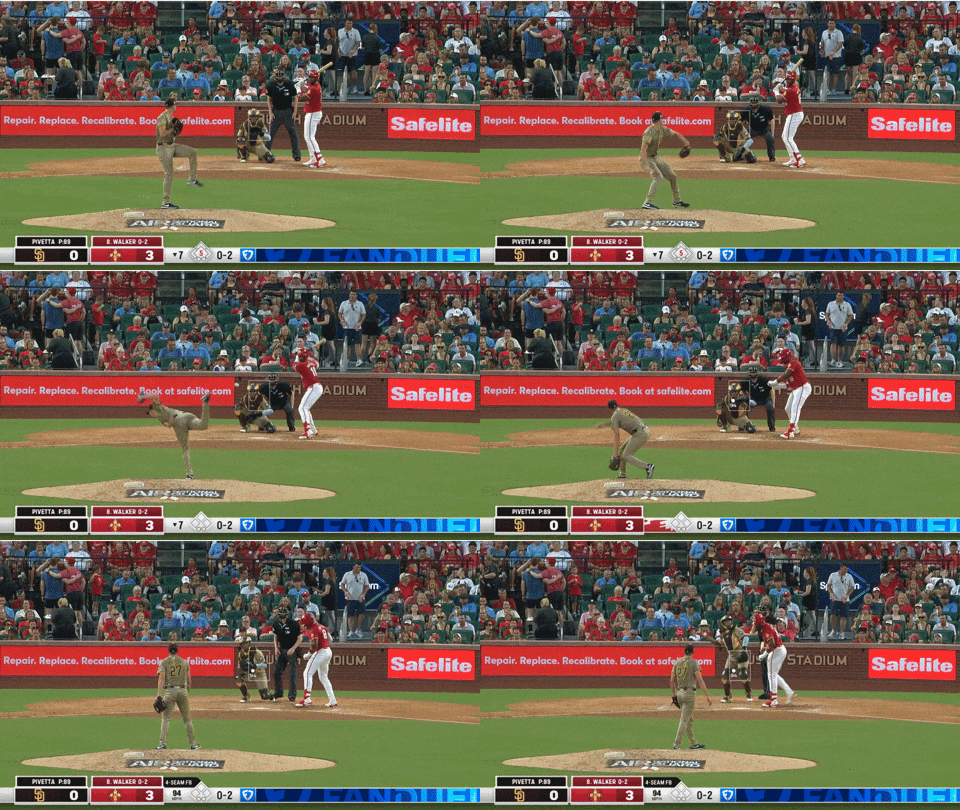
It’s downright crazy how good Skenes is. He’s so fun to watch, at least as long as he isn’t making your team look silly. He throws everything, and all of it is nasty. He drew swinging strikes on five different pitch types, and some of them left batters baffled:
Juan Soto doesn’t look like that very often. But that’s because pitchers like Skenes also don’t come around very often. Seriously, this pitch was 94 miles an hour?! This is unfair:
The Mets hassled Skenes repeatedly throughout his six innings. He surrendered six hits, tying a career high, and walked three. But when there were runners on base, Skenes found another gear. Five of his six strikeouts came with men on. He threw harder, pitched for whiffs, and generally flummoxed his opponents. He’s not always going to allow only one run, but despite the Mets finding occasional cracks in his armor, one earned run felt like a fair result. When Skenes is on the mound, the other team starts at a disadvantage. Read the rest of this entry »
The Kansas City Royals have an excellent starting rotation. Starting pitching (along with Bobby Witt Jr. turning into Honus Wagner with a mullet, I guess) carried the Royals to the ALDS last year. It’s also why the Royals will be well-positioned in the AL Central race if the Tigers ever realize that they’re not actually the 1975 Reds.
But even in such a deep, well-rounded unit, one man must lead the charge. Is it ace Cole Ragans? No. Is it one of Seth Lugo, Michael Lorenzen, or Michael Wacha, Kansas City’s army of rejuvenated Millennials? Again, no.
On Wednesday, the Rocket City Trash Pandas shut out Pensacola, 9-0, in the Southern League. In the Midwest League, the Quad Cities River Bandits eked out a 7-6 win over the Dayton Dragons. And in the big leagues, television cameras captured an enormous raccoon traipsing through the Citi Field seats during the seventh inning of the Mets-Pirates game. It was a good day for raccoons at the ballpark.
The major league raccoon went down one row of seats in center field, then back across the next row up, looking for all the world like it was just searching for its seat. “I’m scared of raccoons,” said SNY broadcaster Ron Darling, stammering slightly. The brief clip makes it look like the Citi Field raccoon was simply out for a late-night stroll, not bothering anybody. It turns out there’s more to the story. Read the rest of this entry »
Ben Lindbergh and Meg Rowley banter about Julio Rodríguez gifting a homer and then taking one away, two Red Sox outfielders teaming up to make a catch, home-run-robbery terminology, Conor Jackson and remembering some guys who were good for your fantasy team, pouring one out for the Austin Barnes Dodgers era, lopsided scores, and the A’s, then (55:30) discuss Pete Rose’s reinstatement from the permanently ineligible list: why it happened, what it means, and what’s next.
Though Roki Sasaki’s deal with the Dodgers wasn’t anywhere close to the winter’s biggest, few free agents were so coveted or came with as much hype attached. Known as “The LeBron James of Japanese baseball” for his exploits in high school, he was dominant — even transcendent — during his 2021–24 NPB run with the Chiba Lotte Marines. As he went through the posting process, his combination of youth and a tantalizing repertoire featuring an elite, 80-grade splitter as well as a fastball with triple-digit velocity generated widespread interest by teams, though a dip in that velo last year did rate as a cause for concern. Now, eight starts into his career with the Dodgers, the 23-year-old righty has been underwhelming, and now he’s hurt, too. On Tuesday, the team placed him on the 15-day injured list due to a shoulder impingement, continuing the dizzying level of turnover within the rotation of the NL West leaders.
This is the latest turn in what’s been a rocky rookie season for Roki. Through 34.1 innings — about 4 1/3 per start — he’s carrying a 4.72 ERA, a 6.16 FIP, and a 6.13 xERA. He’s struck out just 15.6% of batters, while walking 14.3% (the highest mark of any pitcher with at least 30 innings), and has served up 1.57 homers per nine. His 21.9% chase rate is the third-lowest at that 30-inning cutoff.
Batters have struggled to do anything with Sasaki’s splitter, which he’s thrown in the zone just 29.6% of the time; they’ve chased it 30.4% of the time, and overall have hit .137 and slugged .237 against it. Even so, his 35% whiff rate on the pitch is well off the 56.5% whiff rate it generated last year in NPB according to Sports Info Solutions. Batters have fared better against his slider (.250 AVG/.417 SLG, 33.3% whiff) and his four-seamer (.253 VG/.494 SLG, 10.1% whiff), rarely chasing either (14% of the time for the former, 15% for the latter). All six of his home runs allowed have been off of four-seamers, as have two would-be homers robbed by Andy Pages; his xSLG on that pitch is a worrisome .663. His 17.8% whiff rate on four-seamers in the upper third of the strike zone or higher is better, but batters have still slugged .692 on pitches there, with a .903 xSLG. Read the rest of this entry »
Dan Szymborski: Cowser, I think. You’re not rewarded for the best stuff Parker Meadows does!
12:02
.330/50: I looked it up on stat muse, and, weirdly, there are seven seasons where a player hit 50+ hr with a .349+ BA. And there are seven where a player hit 50+ with a .329+ BA. Barry in 01 was at .328 and one of Foxx’s two biggest years was .349. So… I know Zips doesn’t think AJ can keep THIS up, but given he’s been hitting like .370 for more than a year now, where would you rank the season all time if he “slumps” to finish the year at like a .335/.440/.712 with 50+ (again, measurably worse than he has been over the past year)? To me it would basically just be Barry and his special sauce since expansion ahead of it.
12:03
Dan Szymborski: I can’t give an exact ranking off-hand, but it’s an absolutely monster season, and I think it would cement his status as a Sandy Koufax-esque Hall of Famer if something bad happened.
12:03
Dan Szymborski: I would personally argue he’s already at that level, but I strongly suspect I’m much more willing to vote for a dizzying-peak/shortish career guy than most writers are
It’s been one week since the Pirates fired manager Derek Shelton and replaced him with former major league utilityman and Pittsburgh native Don Kelly, who served as Shelton’s bench coach for the entirety of his managerial stint. Firing the manager is one of the first moves made by an underperforming or flat-out awful ballclub, so there’s nothing surprising about Shelton getting the axe after a 12-26 start. But a manager’s record is only as good as the players on his roster and the money spent to build that roster, and Pittsburgh was deficient in both for Shelton’s entire tenure, which spanned five-plus seasons. During that time, the team posted a 308-441 record.
Now with Kelly at the helm, the Pirates are still on a ship that’s at best treading water; they are 3-3 in their six games since he took over, with five of them being decided by just one run. Perhaps Pittsburgh will be better with Kelly managing than it was under Shelton. After all, this is a team that at least has Paul Skenes and Oneil Cruz. However, there is only so much that Kelly can do here. The core problems in Pittsburgh can only be solved with a drastic shift in organizational philosophy, and that starts with owner Bob Nutting and the person tasked with executing that strategy, general manager Ben Cherington. Read the rest of this entry »
Jesús Made Photo Credit: Curt Hogg/USA TODAY NETWORK via Imagn Images
Below is an analysis of the prospects in the farm system of the Milwaukee Brewers. Scouting reports were compiled with information provided by industry sources as well as our own observations. This is the fifth year we’re delineating between two anticipated relief roles, the abbreviations for which you’ll see in the “position” column below: MIRP for multi-inning relief pitchers, and SIRP for single-inning relief pitchers. The ETAs listed generally correspond to the year a player has to be added to the 40-man roster to avoid being made eligible for the Rule 5 draft. Manual adjustments are made where they seem appropriate, but we use that as a rule of thumb.
A quick overview of what FV (Future Value) means can be found here. A much deeper overview can be found here.
All of the ranked prospects below also appear on The Board, a resource the site offers featuring sortable scouting information for every organization. It has more details (and updated TrackMan data from various sources) than this article and integrates every team’s list so readers can compare prospects across farm systems. It can be found here. Read the rest of this entry »
Marcus Semien was a promising prospect heading into the 2013 season, but he was far from a high-profile player. When that year’s Baseball America Prospect Handbook was published, the 2011 sixth-round pick out of the University of California-Berkeley was ranked just 14th in a light Chicago White Sox system. (At the time, in-depth scouting reports were still in their nascent stages here at FanGraphs.)
In the 12 years since then, the 34-year-old Semien has gone on to exceed those modest expectations. He reached the big leagues with the White Sox in September 2013, then established himself as an everyday player after they traded him to the Athletics before the 2015 season. Now in his fourth year with the Rangers after six seasons in Oakland and one in Toronto, the Bay Area native has three All-Star selections, two Silver Sluggers, and a Gold Glove on his résumé. Scuffling in the current campaign — Semien has a 47 wRC+ over 176 plate appearances — he nonetheless has 1,533 hits, including 241 home runs, to go with a 108 wRC+ and 36.1 WAR over his major league career.
What did Semien’s Baseball America scouting report look like in the spring of 2013? Moreover, what does he think about it all these years later? Wanting to find out, I shared some of what then-BA contributing writer Phil Rogers wrote, and asked Semien to respond to it.
———
“The son of former California wide receiver [Damien] Semien, Marcus was a three-sport standout in high school who followed his father’s footsteps to Berkeley, where he focused on baseball.”
“I actually just played basketball and baseball in high school,” Semien replied. “I was part of a state championship runner-up in my senior year, so I missed probably the first three weeks of my [baseball] season. Once I graduated high school, I knew that baseball was all that I was going to play in college.” Read the rest of this entry »