Effectively Wild Episode 627: Saving the Strike Zone, the NL Ascendant, and Other Emails
Ben and Sam answer listener emails about an all-catcher lineup, league strength, robot umps, and more.
Podcast: Play in new window | Download
Subscribe: RSS
Ben and Sam answer listener emails about an all-catcher lineup, league strength, robot umps, and more.
Podcast: Play in new window | Download
Subscribe: RSS
As of just a short while ago: 2015 playoff odds! The odds we ran through last season are back, with division chances, wild-card chances, World Series chances, and so on and so forth. With meaningful player movement basically complete, with few important roster competitions, and with both Steamer and ZiPS folded in, these are your preseason odds, missing only injuries that happen over the next four weeks. Granted, an injury to, say, Mike Trout could change things quite a bit, but these odds shouldn’t change very much before the real baseball starts. This is a big day for those of us who are obsessed with checking the page 20 times a week. Even though there won’t be a reason to do that for a while, it’s just nice to see the page populated with numbers.
The same page was populated with numbers last March. Numbers based on Steamer, ZiPS, and author-maintained team-by-team depth charts. Which is to say, numbers calculated by the same processes. It seems those numbers are no longer available on the internet, but I’ve had them saved in a folder, so I thought now would be a fun time to look at how the numbers have changed for each team since just before last season. In a way it’s a snapshot of the last 12 months. In another way it’s not that at all, but let’s not dwell on semantics. Relative to last year, who’s going into this season with bigger expectations? On the flip side, who’s most trying to focus on the bigger picture?

The purpose of this post is to announce — for the benefit, in particular, of those readers who possess responsibilities which might preclude them from monitoring very closely such developments — the purpose is to announce not only that spring-training baseball has begun in earnest, but also that audio and visual of same is now officially available by way of MLB.TV and probably by other means, as well.
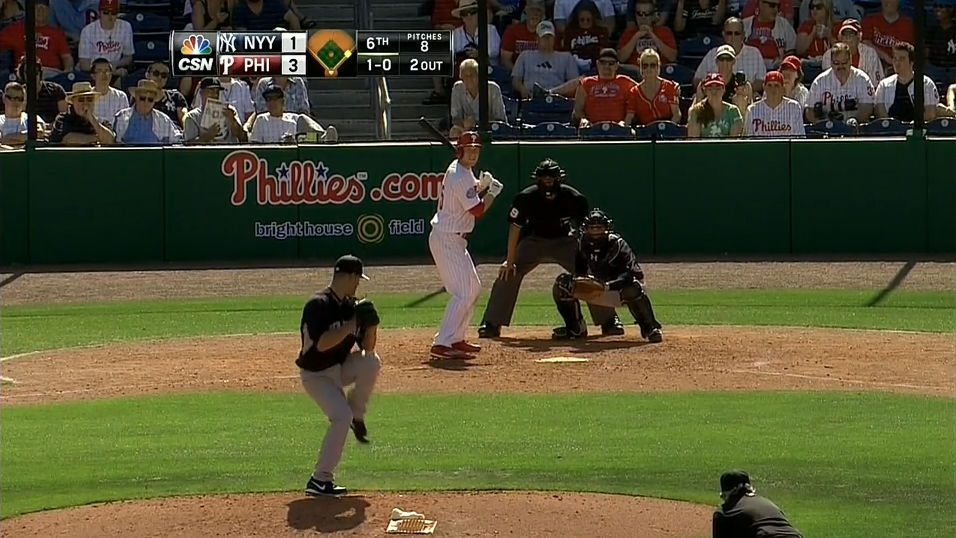
The image embedded above depicts a moment from the Yankees-Phillies contest currently underway in probably Clearwater, Florida. In it, New York right-hander Nick Goody delivers a pitch to Philadelphia third baseman Cody Asche. What sort of pitch? It’s not immediately apparent. The result of the at bat? The reader is surely capable of finding that sort of information. As in most cases, the precise details are immaterial. One is satisfied to learn, merely, that this excellent and useless pastime continues.
As pitchers go, Craig Kimbrel’s been doing all right. Over the last three years, he leads baseball in adjusted ERA. “Well,” you say, “ERA can be misleading.” Absolutely so! Conveniently, over the last three years, he also leads baseball in adjusted FIP. “But,” you add, “FIP can be misleading in its own way.” Definitely. Observe, then, that, over the last three years, he also leads baseball in adjusted xFIP. For Craig Kimbrel, it’s been a clean sweep.
And he’s done it with two pitches: a really good fastball, and a really good curveball. Just using our pitch-type run values, the last three years, Kimbrel ranks second in fastball value per 100 pitches. He also ranks second in curveball value per 100 pitches. Usually you don’t want to read into this stat too much, because pitching sure is a complicated activity, but the right idea here is conveyed. Kimbrel has a good fastball, and he has a good breaking ball, and so he hasn’t needed anything else. He’s about as close to unhittable as a pitcher can humanly get.
With that in mind, this is delicious:
Meanwhile, Braves newcomer Jonny Gomes swung at some Kimbrel offerings and missed a few, including one that appeared to be a … changeup?
[…]
“Chris Johnson (another in the group that faced Kimbrel) told me he threw a couple of change-ups,” said Braves manager Fredi Gonzalez, who was watching pitchers on another field when Kimbrel threw.
Last spring, Mike Trout, Jason Kipnis, Starling Marte, Jedd Gyorko, Matt Carpenter, Yan Gomes, and Andrelton Simmons all received contract extensions buying out free agent years before they had even hit arbitration. The spring before last Anthony Rizzo, Paul Goldschmidt, and Allen Craig signed similar deals. The deals ranged from Gomes’ $23 million guarantee to Mike Trout’s $144.5 million deal. As players file into camp and prove their health, more extensions are likely on the way.
The recent pitcher contract extensions tend to pay more for potential, but on the position player side, present production is more prominent. Of the players signed to extensions in the last two springs, every player had already shown himself to be at least above average, if not an All-Star quality level player. Here are the players who have signed the past two springs as well as statistics for the season prior to signing the extension.
Have you seen Odrisamer Despaigne’s strange crossed-finger grip? I noticed a while ago and wrote about it, and then went on television talking about it, and then was quoted by a colleague, all the while saying that this grip was his changeup grip. It had to be the changeup because I thought I heard that it was and what other pitch could be so weird, and since his change was so strange by movement, it all made sense.
Well, I was wrong. And there’s video proof that I was wrong, all embeddable, searchable, and posterized for posterity too.
We’ve all seen it in various TV shows or movies; the main character is sitting on the floor of some room, surrounded by various pieces of hardware after being challenged to assemble some piece of furniture from vague and unhelpful instructions. And then, usually after a cutaway or some kind of time-lapse, we see the proud main character standing next to the completed product, showing off the fruit of his labor to some secondary character, who then rains on his parade by pointing out that while the product looks nice, there are a few leftover pieces that he somehow managed to exclude from the build.
That’s kind of what this Dodgers team feels like at the moment. On paper, this team could be very good, especially if Joc Pederson takes over as the regular center fielder and hits as well as the projections think he might. At that point, you have Carl Crawford and Yasiel Puig in the corners, with an infield of Yasmani Grandal, Adrian Gonzalez, Howie Kendrick, Jimmy Rollins, and Juan Uribe. That group gives them above average projections at every position, the kind of strong supporting cast that can help one of baseball’s best rotations go after the NL West title. So that group looks pretty good.
| 12:07 |
: Insert snappy intro here
|
| 12:07 |
Gee for Profar, who says no? |
| 12:07 |
: AMERICA
|
| 12:07 |
What are your thoughts on Funkhouser? |
| 12:08 |
: Seen him 5 or 6 times. Without fail, every time he’s been 91-95 t97, 55-60 SL, 50 CH, command flashes 50, solid chance to be #3 starter, but still some feel issues here and there. I’d guess 8-15 in the first round if he keeps this up.
|
| 12:09 |
How would you describe your role on the Jason Garcia hype train? Do you drive the train? Did you build the train? Or do you merely ride said train? |
Lead prospect analyst Kiley McDaniel turned some heads when he ranked Ozhaino Albies — a 5-foot-9, 17-year-old shortstop — as the top prospect in the Atlanta Braves minor league system. Albies was on the prospect radar prior to Kiley’s ranking, but slotted much lower on most organizational prospect lists this winter. Keith Law, John Sickels, Baseball America, and Baseball Prospectus ranked him 3rd, 4th, 5th, and 6th respectively. Here’s what Kiley had to say about Albies and his ranking.
Some scouts are already throwing 60’s on Albies hit tool after a huge pro debut, where he hit .364/.446/.444 in 239 plate appearances over two Rookie ball levels with 22 stolen bases and more walks than strikeouts. He continued his assault by impressing the more heavily-scouted instructional league and every scout that has seen him told me they can’t argue with this ranking.
Power isn’t a big part of game and likely will never be, but he does everything else so well at such a young age, that no one seems to care. He has excellent feel for the stike zone and the bat head, plenty of bat speed, knowledge of when to use his gap power and when to keep the ball on the ground, along with easy plus speed and plus everything on the defensive side, enough to comfortably project to stay at the position. There has to be universal praise for me to go this high on a guy this young and this small that I’ve never seen before, but I think I’ll have him first on this list next year, so I feel fine getting ahead of the crowd now.
Kiley’s definitely the high guy on Albies right now, but KATOH — my prospect projection system — might be even higher. Setting the minimum to 200 plate appearances, the KATOH leaderboard for hitters based on the 2014 season reads thusly. Read the rest of this entry »
As we anticipate the start of the 2015 Major League Baseball season, we begin to speculate about player performance in the upcoming season. While most players are somewhat consistent year-to-year, there are some who have either breakout years or terrible seasons. These extreme years are a confluence of events throughout the season such as player health, skills peaking, and luck — which can be partially captured by BABIP.
To find the seasons with the greatest offensive output changes, I calculated year-to-year changes for players from 2000-2014 in a handful of offensive statistics: WAR, OPS, BABIP, and HR. Since playing time can fluctuate because of injury or being a rookie, I eliminated comparisons of seasons that a player had a high discrepancy in plate appearances.
To visually compare the seasons, I used slope graphs to show the year-to-year changes in the various statistics. Each graph is limited to players in the sample who had the largest changes in both the positive and negative directions. The left end of the line represents the player’s statistic in one year with the right end of the line representing the following year. A steeper the slope indicates the largest change between two years.
Read the rest of this entry »