Sunday Notes: Buck Farmer is Flying Under the Radar in Cincinnati

Buck Farmer is flying under the radar while making an impact in Cincinnati. Baseball’s hottest team went into yesterday having won 12 straight games, and the 32-year-old reliever had pitched in seven of them. Moreover, the Reds had been victorious in 14 of the last 15 contests he’d appeared in. Over those outings, Farmer was credited with two wins and a save while allowing just a pair of runs in 15 innings.

He’s been solid from the start. On the season — his second in Cincinnati after eight in Detroit — the Conyers, Georgia native has held opposing hitters to a .188 average while logging a 2.41 ERA over a team-high 35 appearances. Consistently pounding the zone with a three-pitch mix, he’s issued just 10 free passes while fanning 33 batters in 37-and-a-third innings. By most statistical markers, he’s never been better.

Farmer credits Cincinnati’s pitching program for much of his success.

“I think it’s the development here,” Farmer replied when asked what differentiates his current and former clubs. “[The Tigers] were starting to change over to a more analytical approach before I left, but I don’t think they’d quite made that adjustment yet. When I came here, they were already tuned in. DJ {Derek Johnson] and the other coaches are fully invested in us. They want us to grab a little bit more here and there, and that includes taking what we’re good at and trying to make it great.”

For Farmer, that meant reworking a pitch that has become a lethal weapon. Augmented by a four-seam fastball and a changeup, his slider has flummoxed hitters to the tune of an .091 average and a .212 slug. His whiff-rate with the offering is a heady 45.3%. Read the rest of this entry »


Effectively Wild Episode 2024: The Old College Try

EWFI
Ben Lindbergh and Meg Rowley are joined by FanGraphs’ Eric Longenhagen and Michael Baumann to banter about the Phillies’ outlier legal name, Dave Martinez and the dying art of the theatrical managerial ejection, the benching of Wander Franco, whether the Diamondbacks’, Reds’, and Orioles’ surprising seasons are attributable to MLB’s new rules, and whether bad bullpens are good for baseball, then (59:48) discuss a classic College World Series pitcher’s duel, the College World Series final, whether the Shohei Ohtani comps for Florida’s Jac Caglianone are warranted, college pitch-count controversies, Eric and Michael’s takeaways from the MLB Draft Combine, whether there are indications of a baseball bounceback among young Black athletes, whether the scouts suing MLB over age discrimination are likely to succeed (1:40:57), and more, plus (1:54:05) a Future Blast from 2024.

Audio intro: Guy Russo, “Effectively Wild Theme
Audio outro: Jonathan Crymes, “Effectively Wild Theme

Link to Cuda tweet
Link to latest Martinez ejection
Link to Martinez photo printout
Link to Martinez World Series ejection
Link to Wellman ejection
Link to NYT on ejections
Link to article on Nevin ejections
Link to article on Boone ejection
Link to article on Franco benching
Link to Freeman/Acuña comments
Link to story on Franco’s safe
Link to Stark on surprise teams
Link to FG BsR data
Link to BP BRR data
Link to BP BRR allowed data
Link to Patrick on bad bullpens
Link to Sam on the Royals’ pen
Link to BP on the Mariners’ pen
Link to Paine on payroll and standings
Link to Paine’s MANFRED scores
Link to pre-Skenes/Lowder story
Link to post-Skenes/Lowder story
Link to Betteridge’s law
Link to more on Skenes/Lowder
Link to Passan on Caglianone
Link to WSJ pitch-counts article
Link to Eric’s latest draft rankings
Link to ESPN on Black amateur players
Link to Eric’s Draft Combine footage
Link to scout lawsuit article
Link to other scout lawsuit article
Link to Regan lawsuit article
Link to squatting article
Link to stretching article
Link to other stretching article
Link to Rick Wilber’s website
Link to article on Elly’s cycle
Link to MLBTR on Waldron
Link to article on qualified catchers

 Sponsor Us on Patreon
 Facebook Group
 Twitter Account
 EW Subreddit
 Effectively Wild Wiki
 iTunes Feed (Please rate and review us!)
 Get Our Merch!
 Email Us: podcast@fangraphs.com


Qualified Catchers Are the Hottest New Trend of the Season

Gregory Fisher-USA TODAY Sports

Earlier this week, my colleague Ben Clemens wrote about Marcus Semien and his impressive durability. As Ben pointed out, Semien leads the majors in plate appearances over the last five seasons, which has helped him to be one of the most valuable players in the game despite his relative shortage of standout skills.

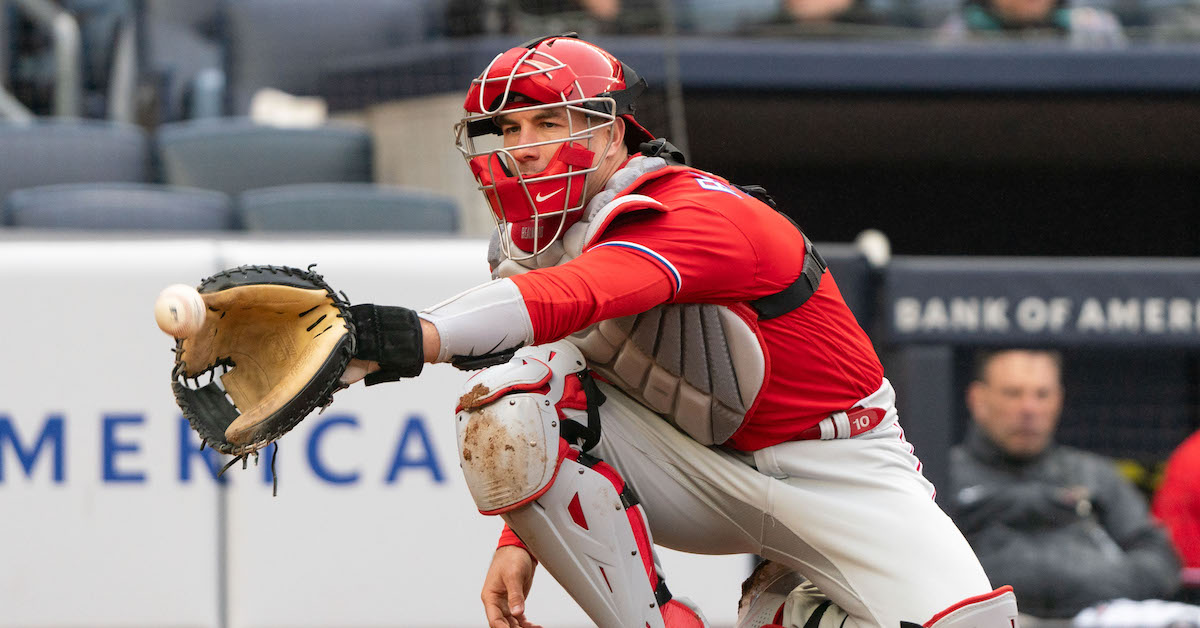
The most productive catcher during that same time period has been J.T. Realmuto, who leads his fellow backstops by more than 5 WAR. He’s also way ahead of the pack with 2,147 plate appearances; Willson Contreras ranks second with 1,879. On the defensive side, the Phillies catcher is similarly outpacing his peers. He has played 4,084 innings behind the dish, 397.2 more than Martín Maldonado in second place. That’s the equivalent of 44 full games, or Austin Hedges‘ 2023 season to date. Much like Semien, Realmuto encapsulates the popular aphorism “availability is the best ability.” He isn’t the best defender or the best offensive catcher, but he’s good at everything he does, and he does it more often than anyone else. Read the rest of this entry »


Esteury Ruiz and Finding Slugging in Speed

Stan Szeto-USA TODAY Sports

On Sunday in Oakland, with the A’s trailing the Phillies 3-1 and lefty José Alvarado on the mound, A’s manager Mark Kotsay sent the right-handed Esteury Ruiz to the plate to pinch hit for lefty Seth Brown, hoping to use a platoon advantage to mobilize some sort of comeback. After falling behind 1-2, Ruiz turned on an Alvarado cutter and sent a 94.1-mph grounder past the third baseman and into left field, giving his team some hope:

Ruiz would come around on a Carlos Pérez single, but the rally would ultimately fall short as the A’s extended a losing streak that has since run to eight games. But Ruiz had done all he was given the chance to do. Read the rest of this entry »


No Batter, No Batter: The Charging of the Guards

Steven Kwan
David Richard-USA TODAY Sports

So here’s what happened. I was watching the MLB game highlights of Tuesday’s Marlins-Blue Jays matchup. I like MLB’s game highlights; in order to keep all the quick cuts from feeling disjointed, they kind of just plop some music on top everything unceremoniously, and sometimes the music can really color your perception of the game. This Mets-Padres game from April is a great example. It was a nailbiter, but it lost some of its nerve-wracking heft thanks to a soundtrack that’s a cross between John Coltrane, Kool & The Gang, and Super Mario 3.

Two on, two out, bottom of the ninth, and it sounds like the monologue is about to start on Saturday Night Live. Anyway, I was watching Tuesday’s Marlins-Jays highlights (the soundtrack for which sounds like The Living End on their union-mandated lunch break), and I noticed this single from Luis Arraez.

Normally, a single from Arraez is about the least remarkable thing in baseball. He is the game’s preeminent singles hitter (and depending on your worldview, perhaps the game’s preeminent hitter, period). What caught my eye was how quickly Daulton Varsho managed to cut this ball off, considering that Arraez slashed it just a foot inside the left field line. Varsho gets fantastic jumps, but I figured he also had to be playing extremely shallow. It occurred to me that maybe every outfielder is playing right on top of Arraez this year, seeing as dumping liners right in front of the outfielders for singles is his superpower. Read the rest of this entry »


Five Things I Liked (Or Didn’t Like) This Week, June 23

Joey Votto

Welcome to another installment of Five Things, a look at odd circumstances and delightful happenings that caught my eye this past week. With the NBA solidly in its offseason, Zach Lowe’s column is taking a break, which means I might be the only Things show in town right now. This week was an awesome one for watching baseball, and I had a hard time narrowing the list down. I hope you like legends making big plays, unheralded rookies swinging games, and two Bay Area teams headed in opposite directions. Who am I kidding? Of course you like those things. Let’s get to it.

1. Joey’s Back!
The Reds are so much fun that I thought about making an entire five things column out of things I’m loving in Cincinnati these days, but I think we just call that an article, so I’m going to settle for writing about one of the best parts of their recent winning streak. As fun as it’s been to see the baby Reds gain confidence and romp to the top of the NL Central, there was something missing. All these kids are fun, but they were missing the team’s best player in a generation while he rehabbed in preparation for what will almost certainly be his last ride.

I started to get excited when Joey Votto’s goofy bus driver persona resurfaced. But I won’t lie to you: I was worried that he might not fit in as well as hoped. The infield was already packed with contributors, and Votto might lead the team to some tough playing time decisions they didn’t really want to make. He wasn’t even that good last year! It was definitely not preordained that everything would work out. Read the rest of this entry »


Arizona Diamondbacks Top 44 Prospects

Joe Camporeale-USA TODAY Sports

Below is an analysis of the prospects in the farm system of the Arizona Diamondbacks. Scouting reports were compiled with information provided by industry sources as well as my own observations. This is the third year we’re delineating between two anticipated relief roles, the abbreviations for which you’ll see in the “position” column below: MIRP for multi-inning relief pitchers, and SIRP for single-inning relief pitchers. The ETAs listed generally correspond to the year a player has to be added to the 40-man roster to avoid being made eligible for the Rule 5 draft. Manual adjustments are made where they seem appropriate, but I use that as a rule of thumb.

A quick overview of what FV (Future Value) means can be found here. A much deeper overview can be found here.

All of the ranked prospects below also appear on The Board, a resource the site offers featuring sortable scouting information for every organization. It has more details (and updated TrackMan data from various sources) than this article and integrates every team’s list so readers can compare prospects across farm systems. It can be found here. Read the rest of this entry »


Luis Arraez Really Could Hit .400

Sam Navarro-USA TODAY Sports

As one would expect, records and milestones often reflect the eras in which they’re achieved. Pitching records tend to be set in low-offense eras, while offensive milestones rack up more quickly at times when runs are plentiful. As the game ebbs and flows, certain benchmarks that are achievable in one era become far more difficult, or even impossible, in another. One of these achievements, which has long fascinated fans, is hitting .400. Even as batting average became a less relevant number in the post-Deadball era (and even less so as front offices gravitated toward other metrics 75 years later), baseball observers have still rooted for someone to hit .400. I’m one of them; not everything that’s fun has to be an amazing analytical tool, and vice-versa. Hits are, for lack of a better word, cool, and the ability to rack up value primarily via batting average has become far rarer than it used to be. And if hits are cool, Luis Arraez is in super-rad territory, as the Marlins second baseman is currently sitting at .398 as we approach the season’s halfway mark.

Whether you think the most recent .400 hitter was Ted Williams, who put up a .406 average in 1941, or Josh Gibson, who put up an impressive .466 for the Homestead Grays in 69 games a couple of years later, there are very few baseball fans remaining who have a living memory of a .400 hitter. After the Splendid Splinter hit .388 in 1957, it was another 20 years until anyone came that close (Rod Carew in 1977). There were always scattered attempts, such as George Brett‘s effort to sneak up to .400 when he hit a stunning .421 in the second half of the 1980 season (he ran out of calendar, finishing at .390). The offensive outburst of the 1990s wasn’t just in home runs, but in batting average as well, and there was another mini-run of .400 attempts. From 1993 through 2000, there were a surprising number of first-half hitters above .380: Tony Gwynn (twice), Larry Walker, Nomar Garciaparra, John Olerud, Darin Erstad, Todd Helton, Frank Thomas, and Paul O’Neill. Nobody’s been at .380 in the first half more recently, and since 2010, only Justin Turner’s gone into the All-Star break with a batting average north of .370. Read the rest of this entry »


Charlie Blackmon Revisits Launch Angle

Charlie Blackmon
Isaiah J. Downing-USA TODAY Sports

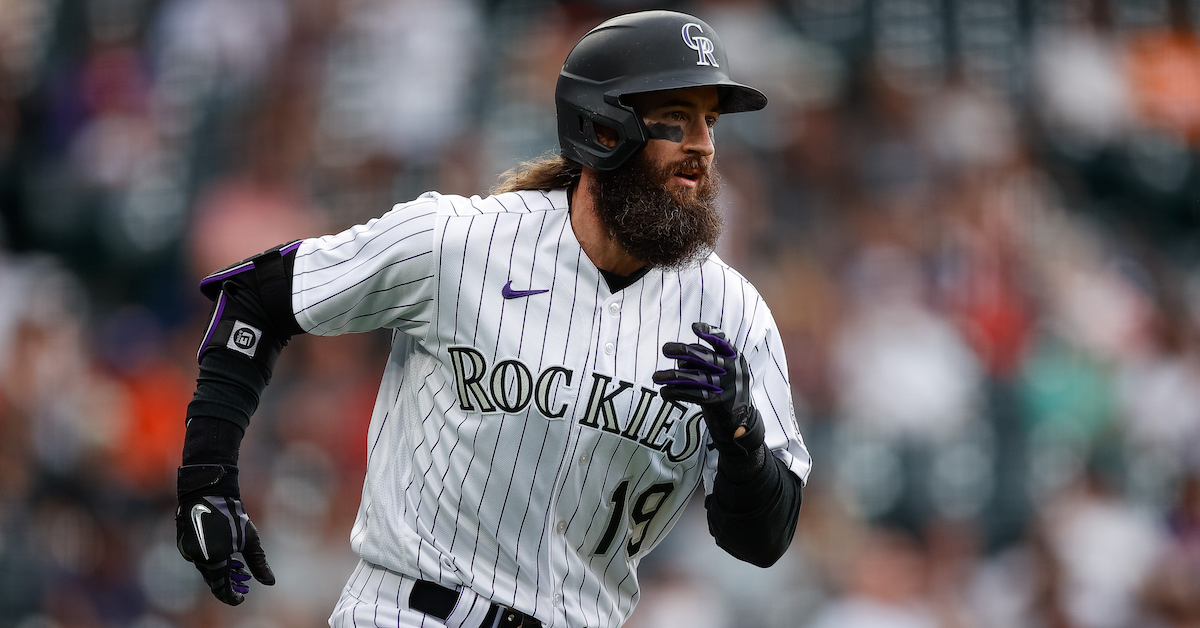
Charlie Blackmon is heading down the home stretch of what has been a productive career with the Colorado Rockies. A little more than a week away from his 37th birthday and in his 13th season with the club that drafted him out of Georgia Tech in 2008, the left-handed-hitting outfielder has stroked 1,646 hits, 572 of which have gone for extra bases. Boasting a .296 career batting average — Coors Field has certainly benefitted him — he topped the Senior Circuit in that department in 2017, when he hit .331. Only Todd Helton has played more games in a Rockies uniform.

Blackmon, who is currently on the injured list with a fractured hand, sat down to talk hitting when Colorado visited Boston earlier this month.

———

David Laurila: Prior to the 2017 season, I talked to you and one of your then-teammates for a piece titled “Charlie Blackmon and Chris Denorfia on Launch Angles.” What are your thoughts on that subject six years later?

Charlie Blackmon: ”Yeah, so launch angle is something people were really excited about a little while ago. I think that’s a way to reverse engineer a really good hit or a home run, right? It’s taking a dataset and saying, ‘Guys have a higher slugging percentage when they hit the ball in the air,’ and then basically find out that 31 degrees is their optimal angle. I mean, it’s like taking something you already knew was good and saying, ‘Well, now I’m going to try to hit it 31 degrees.’

“Adding lift to your swing is going to put the ball in the air, but I didn’t really like how people were going about it. Now I’m seeing that change. I think where the game is from a pitching perspective, even compared to five years ago, is very different. If you look across the league, I would bet that the amount of strikes thrown in the upper third of the zone has more than doubled. I would say that 70% of the pitchers in the league consistently throw high fastballs, whereas it wasn’t long ago that everybody was trying to throw down and away. There has been a big shift in pitching philosophy and fastball-location philosophy in the past few years.” Read the rest of this entry »


Everybody (In Canada) Loves Jordan

Jordan Romano
Dan Hamilton-USA TODAY Sports

Jordan Romano is one of the best closers in baseball, but you wouldn’t know it from perusing your average sports page. He’s a quiet star, in the mildly pejorative sense often implied by “quiet” — not well-enough known, not well-enough talked about, somehow lacking in whatever je ne sais quoi that makes you a star.

Here’s the thing, though: that’s silly. At FanGraphs, we try to avoid that very way of thinking, and yet we’ve written almost nothing about Romano in the past few years. An interview here, a hockey anecdote there, the occasional fantasy piece — it’s not what you’d expect from a guy at the top of the bullpen hierarchy for a playoff team. I’m not kidding myself; this article is Canadian fan service. Let’s talk about what makes Romano so dang good, and ignore why audiences in America seem to ignore him.

If you’re looking at it from a pitch perspective, this one is pretty easy. Romano is good because he throws a hellacious fastball and backs it with an above-average slider. His fastball is a work of art. All the things you’ve heard about what makes a four-seamer good? He has them. He avoids the dreaded line of normality that plagues some heaters that underperform their radar gun numbers; his is mostly up-and-down. Per Baseball Savant, his fastball drops 1.7 inches less than the average four-seamer thrown with similar velocity and also gets 2.4 inches less arm-side fade. In other words, when he throws it to a righty, it ends up less inside than they expect, and also meaningfully higher. Read the rest of this entry »