Additional Detroit Tigers job openings (Product Manager, UI/UX Engineer) are available here.
Principal Quantitative Analyst
Location: Detroit, MI Department: Baseball Operations
Job Summary:
The Detroit Tigers are currently seeking a full-time Principal Quantitative Analyst in the Baseball Operations Department. This role will be responsible for performing analyses and conducting research within Baseball Operations. This position will report to the Director, Baseball Research & Development.
Key Responsibilities:
Develop and productionize Bayesian models to support Baseball Operations decision-making.
Assist with the integration of baseball analysis into our proprietary tools and applications.
Provide technical guidance to Analysts and Analytics Associates.
Complete ad hoc data queries and effectively present analysis through the use of written reports and data visualizations.
Monitor, identify and recommend new or emerging techniques, technologies, models and algorithms.
Other projects as directed by Baseball Operations leadership team.
Minimum Knowledge, Skills and Abilities:
Ph.D. in statistics, mathematics, computer science, or a related quantitative field or equivalent professional experience (3-5 years).
Demonstrated expert-level knowledge of baseball-specific data and sabermetric analysis.
Relevant work experience with statistical software (R, STATA, SPSS, SAS, or similar) and scripting languages such as Python.
Expertise with SQL and relational databases is required.
Experience with cloud computing preferred.
Self-starter.
Team player.
Ability to work evenings, weekends and holidays as dictated by the baseball calendar.
Working Conditions:
Office environment
Evening, weekend, and holiday hours required
We are an equal opportunity employer and all qualified applicants will receive consideration for employment without regard to race, color, religion, national origin, sex, sexual orientation, age, disability, gender identity, marital or veteran status, or any other protected class.
Location: Detroit, MI Department: Baseball Operations
Job Summary:
The Detroit Tigers are currently seeking a full-time Analyst in the Baseball Operations Department. This role will be responsible for performing analyses and conducting research within Baseball Operations. This position will report to the Director, Baseball Research & Development.
Key Responsibilities:
Perform advanced quantitative analysis to support Baseball Operations decision-making, including predictive modeling and player projection systems.
Complete ad hoc data queries and effectively present analysis using written reports and data visualizations.
Assist with the integration of baseball analysis into our proprietary tools and applications.
Contribute to baseball decision-making by generating ideas for player acquisition, roster construction and in-game strategies.
Support the current data warehousing process within Baseball Operations.
Monitor, identify and recommend new or emerging techniques, technologies, models, and algorithms.
Other projects as directed by Baseball Operations leadership team.
Minimum Knowledge, Skills and Abilities:
Demonstrated expert-level knowledge of baseball-specific data, modern statistical techniques, and sabermetric analysis.
Expertise with SQL and relational databases is required.
Relevant work experience with statistical software (R, STATA, SPSS, SAS, or similar) and scripting languages such as Python.
Demonstrated ability to communicate difficult and complex concepts to colleagues possessing a wide range of backgrounds and perspectives.
Degree or equivalent experience in statistics, mathematics, computer science, or a related quantitative field.
Self-starter.
Team player.
Ability to work evenings, weekends and holidays as dictated by the baseball calendar.
Working Conditions:
Office environment
Evening, weekend, and holiday hours required
We are an equal opportunity employer and all qualified applicants will receive consideration for employment without regard to race, color, religion, national origin, sex, sexual orientation, age, disability, gender identity, marital or veteran status, or any other protected class.
Location: Detroit, MI Department: Performance Science, Baseball Operations
Job Summary:
This role will assist with the delivery of performance science solutions within Baseball Operations. The biomechanist will be responsible for translating biomechanical data into applied, actionable outcomes to be used by staffs to optimize performance. This role will work closely with Baseball Analytics, Player Development, Strength and Conditioning, Sports Medicine and Coaching staffs.
Key Responsibilities:
Collect, analyze, and report on data from various performance science sources, including in-game biomechanical data.
Maintain data quality and integrity for all biomechanical data.
Collaborate with coaching staffs and external consultants to design and develop metrics and reports aimed at maximizing player performance.
Work closely with the Director, Performance Science to develop and disseminate information from performance science initiatives.
Assist with data management, organization, and integration into the organization’s databases and athlete management system.
Assist with implementation and maintenance of existing performance science initiatives across the organization, including data collection, analysis, and reporting.
Assist with the design, development, testing and support of new performance science initiatives.
Effectively collaborate and communicate with player development, coaching, sports medicine, strength and conditioning and front office staff.
Review research and technology updates relevant to baseball performance.
Perform exploratory performance science research projects and analysis as directed.
Assist with the maintenance, calibration, and upkeep of performance science related equipment.
Other duties as directed by Director, Performance Science
Minimum Knowledge, Skills and Abilities:
A graduate level degree or 3+ years of experience in biomechanics or performance science is required.
Demonstrated experience with the following technologies preferred: Force plates, IMUs, and motion capture.
Demonstrated experience with modeling and analyzing 3D motion capture data required.
Research or applied experience in professional sport strongly preferred.
Experience using an athlete management system.
The ideal candidate must have excellent computer skills. Proficiency in R highly desirable.
The ideal candidate must have excellent communication skills. Candidate must be able to convey complex performance science findings to relevant staffs.
The ideal candidate must have excellent attention to detail.
The ideal candidate must have excellent organizational skills.
Previous experience working with professional athletes and coaches a plus.
The ideal candidate must be willing to work longs hours, including days, nights, weekends and holidays.
The candidate must be available full-time.
Willing and able to relocate to the Lakeland, FL area or Detroit metro area.
Working Conditions:
Office environment
Evening, weekend, and holiday hours required
We are an equal opportunity employer and all qualified applicants will receive consideration for employment without regard to race, color, religion, national origin, sex, sexual orientation, age, disability, gender identity, marital or veteran status, or any other protected class.
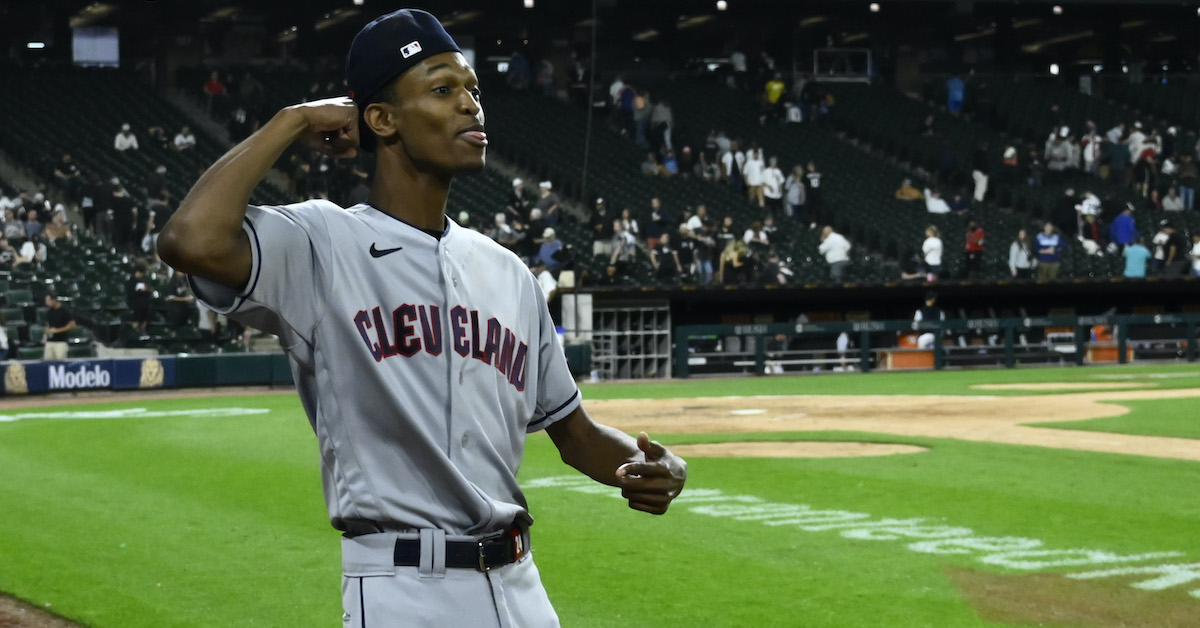
Triston McKenzie was 19 years old and pitching for High-A Lynchburg when he was first featured here at FanGraphs in May 2017. Five years later, he’s one of the top starters on a talented Cleveland Guardians staff. In 31 appearances this season, the lanky right-hander logged a 2.96 ERA and a 3.59 FIP with 190 strikeouts in 181.1 innings. Last week, he tossed six scoreless frames and allowed just two hits in Cleveland’s Wild Card Series-clinching win over the Tampa Bay Rays.
McKenzie, the scheduled starter for ALDS Game 3 versus the New York Yankees on Saturday, discussed his evolution as a pitcher and the mindset he takes with him to the mound during the Guardians’ final home stand of the regular season.
———
David Laurila: We first talked five years ago. What have you learned about pitching since that time?
Triston McKenzie: “The biggest difference is that I’m in the big leagues. Mindset-wise, how I attack hitters hasn’t changed much outside of adapting to this level and understanding that guys are more disciplined in what they do in their approach. I’ve figured out that you can’t always be the the young gun, the kid who is going to throw his best stuff over the heart of the plate. These guys can hit that. So I’d say it’s a mix of finding my identity as a pitcher, figuring out what my strengths are and where I can beat guys, but not getting so headstrong that it’s to my detriment.”
Laurila: How much better do you understand how, and why, your stuff works? You’re obviously working with smart coaches and seeing a lot of data. Read the rest of this entry »
There were two big stories coming into Game 2 between the Astros and Mariners. The first was Yordan Alvarez, hero of Game 1, destroyer of both baseballs and worlds. Before the game, TBS reported that Scott Servais had borrowed a line from Ted Lasso, encouraging his players to be goldfish and forget Tuesday’s heartbreaking defeat. Goldfish or no, the Mariners definitely remembered to be terrified of Alvarez. They also continued their strategy of throwing him sinkers, failing to understand that there is no such thing as the right pitch to throw Yordan Alvarez.
The second story was the pitching matchup. Luis Castillo was coming off a masterful start against Toronto in the Wild Card Series. Framber Valdez had a breakout 2022, including 25 consecutive quality starts. Weak pulled contact is his strength; per the broadcast, the Mariners spent batting practice working on shooting the ball the other way in preparation.
The matchup lived up to the hype. Together, Castillo and Valdez set down the first 10 batters of the game, though the former had a couple of bad misses in the first inning, yanking two pitches in a row against Jeremy Peña and sailing a four-seamer up and away against Alvarez. None of the rest of his pitches to the latter that at-bat touched the strike zone, but that was by design. Here’s what he saw in all three of his plate appearances:
Kyle Tucker kicked off the scoring in the second inning, pulling a slider that caught too much of the plate for a 370-foot home run to right. The solo shot had a launch angle of 43 degrees, which would’ve tied for the 18th-steepest regular-season homer of 2022. Read the rest of this entry »
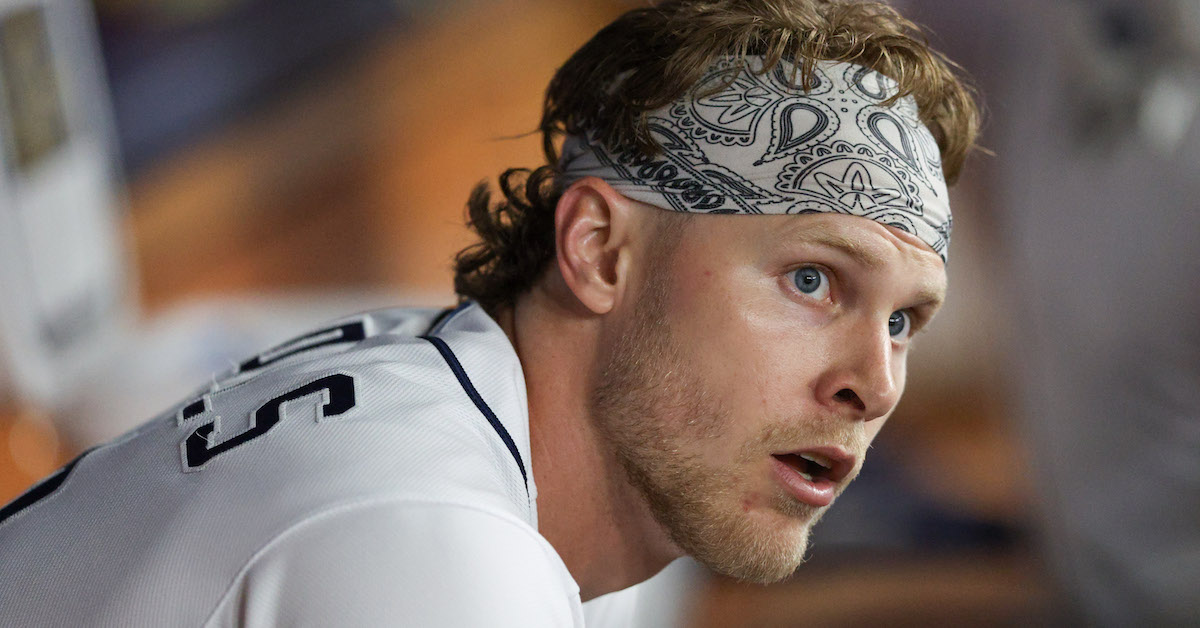
Taylor Walls, pinch-hitter. Pinch-hitter Taylor Walls. I keep turning the words around in my head, like a mantra. Taylor Walls, pinch-hitter. Walls, Taylor: hitter, pinch. Sometimes it makes more sense to me, sometimes less; over enough time, anything you repeat enough seems to lose all meaning. It’s called semantic satiation: your brain starts to perceive anything as gibberish if it’s repeated frequently enough.
In this case, I’m not even sure the phrase made sense in the first place. Taylor Walls, pinch-hitter? This guy? The one who hit .172/.268/.285 this year? In the game to hit? It sounds strange right from the jump. Maybe I started from a faulty premise somewhere. Maybe pinch-hitter Taylor Walls only exists in my head. Maybe this is all a strange fever dream.
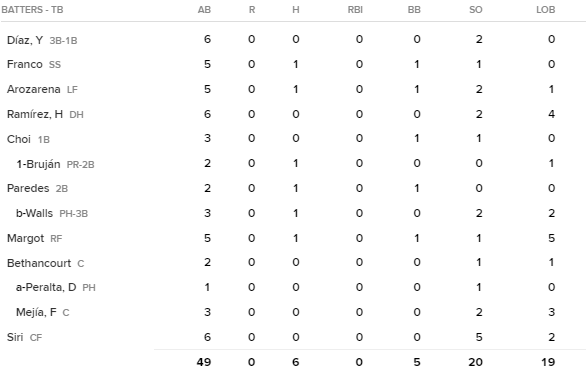
Only, it’s not. There’s box score evidence of it, right on MLB.com:
There he is, pinch-hitting in a playoff game. He’s hitting for Isaac Paredes, a right-hander, which gives us our first piece of evidence. Walls is a switch-hitter. Surely, then he came into the game to bat left-handed. Indeed he did: he faced off against Nick Sandlin, a right-handed reliever, in that initial plate appearance. Read the rest of this entry »
We bring you a trio of AL East-flavored interviews this week as we find ourselves in the middle of the divisional playoff round.
At the top of the show, David Laurila welcomes Eve Rosenbaum, assistant general manager for the Baltimore Orioles. The former director of baseball development, Rosenbaum shares how her responsibilities have changed in her new role as she puts much more focus on the major league club. We also hear about the Orioles’ player development machine, the details of how waiver wires and DFAs work, how the team is making pitchers better after acquiring them, what they saw in Jorge Mateo, and insight as to why they made so many transactions during this encouraging season. [5:30]
Finally, David Laurila returns in the third act with Julian McWilliams, reporter for The Boston Globe. We get the story behind McWilliams’ Baseball-Reference page and short indy ball career, including how long it took him to realize he was joining a team in Las Vegas, New Mexico. The duo also talk about Xander Bogaerts‘ importance to Boston, the comparison between Rafael Devers and Matt Olson, making a comparison between Olson and Triston Casas, being in awe of Yordan Alvarez, and the difference in consistency versus championship success between the Yankees and Red Sox in recent years. [56:51]
To purchase a FanGraphs membership for yourself or as a gift, click here.
To donate to FanGraphs and help us keep things running, click here.
Don’t hesitate to direct pod-related correspondence to @dhhiggins on Twitter.
Job Category: Basketball Operations Location: Salt Lake City, UT 84115, USA Status: Full-Time
Job Summary:
The Utah Jazz are seeking a Software Engineer to support our basketball operations staff. In this role, you will contribute to the design, implementation, and maintenance of data products that facilitate operations and support decision-making across all Jazz basketball functions. These systems and tools will influence key decisions regarding roster construction (draft, free agency, trades), game strategy, skill development, and player wellness.
This role provides exposure to critical components of our data products, from data engineering to UX/UI design & application development. There is opportunity to be involved across the spectrum or within a specific focus, depending on your skills and preference.
*All full-time and part-employees of the Utah Jazz are required to be fully vaccinated. Mandatory vaccinations support our commitment to making our workplace and public facilities as safe and welcoming as possible. Reasonable accommodations will be made for individuals who are not able to get the vaccine due to qualifying medical or religious reasons or would conflict with a sincerely held personal belief. *
Duties & Responsibilities:
Data Engineering Responsibilities
Build and optimize ETL data pipelines for internal and external data sources
Maintain and support production infrastructure for data system
Ensure data integrity through resilient processes and audits
Design and build data APIs for research and reporting
Collaborate with basketball staff to deliver data-enhanced workflows and solutions
UX/UI Design & Application Development Responsibilities
Implement and maintain web applications to enhance research and decision-making
Maintain and support production infrastructure for web applications
Collaborate with basketball staff to deliver data-enhanced workflows and solutions
Qualifications:
To perform this job successfully, an individual must be able to perform each essential duty satisfactorily. The requirements listed below are representative of the knowledge, skill, and/or ability required.
Bachelor’s degree in computer science or demonstrated experience
Experience with version control, collaborative development, and CI/CD principles
Experience with SQL databases and general purpose programming languages (Python, Java) OR front-end JavaScript web frameworks (React, Svelte)
Experience in data pipeline design and maintenance OR full stack web development
Strong project management skills to work independently and coordinate multiple tasks
Demonstrated ability to embrace dynamic and diverse workloads
Capable of working extended hours such as overtime, nights, and weekends as necessitated by the basketball schedule
Preferred Skills
The skills listed below will help an individual perform the job, however they are not required.
Familiarity with cloud infrastructure (AWS, Google Cloud)
Familiarity with workflow management systems (Airflow, Prefect)
Familiarity with container technologies (Docker, Kubernetes)
Familiarity with video and unstructured data
Familiarity with data visualizations (D3.js)
Familiarity with advanced quantitative concepts and data resources in sports
Competencies:
Tech savvy – Anticipates and adopts innovations in business-building digital and technology applications.
Strategic mindset – Sees ahead to future possibilities and translates them into breakthrough strategies.
Organizational savvy– Maneuvers comfortably through complex policy, process, and people-related organizational dynamics.
Communicates effectively – Develops and delivers multi-mode communications that convey a clear understanding of the unique needs of different audiences.
Demonstrates self-awareness – Uses a combination of feedback and reflection to gain productive insight into personal strengths and weaknesses.
Physical Demands:
This person must be able to communicate and express themselves both written and verbally.
This person must be able to observe, inspect, estimate and assess.
This person must be able to sit, stand, bend, walk, and climb stairs for long periods of time.
This person must be able to lift 20 lbs.
The Smith Entertainment Group provides equal employment opportunities to all employees and applicants for employment and prohibits discrimination and harassment of any type without regard to race, color, religion, age, sex, national origin, disability status, genetics, protected veteran status, sexual orientation, gender identity or expression, or any other characteristic protected by federal, state or local laws. This policy applies to all terms and conditions of employment, including recruiting, hiring, placement, promotion, termination, layoff, recall, transfer, leaves of absence, compensation, and training.
We will ensure that individuals with disabilities are provided reasonable accommodation to participate in the job application or interview process, to perform essential job functions, and to receive other benefits and privileges of employment. Please contact us to request accommodation.
Note: The need may arise to revise, supplement, or rescind portions of this job description, and SEG reserves the right to do so at any time. Employees shall be required to meet the qualifications and perform the duties of any revised job description.
A game that figured to be a pitcher’s duel and felt like a 11–10 outburst was neither. Instead, 20 hits, five home runs, and somehow just eight total runs later, it was a classic, tense, tooth-and-nail affair in which neither team enjoyed the comfort of a win probability over 75% until the conclusion of the seventh inning, and even then, it hardly felt that way. At the end, the Padres punched back and evened the score against their big brother/daddy, beating the 111-win Dodgers, 5–3.
After Los Angeles took Game 1 on Tuesday, Clayton Kershaw met Yu Darvish in Game 2 on Wednesday night in a matchup of two of the league’s finest of the moment and the last decade. But both had their hands full with deeply talented lineups. Darvish was missing velocity on most of his arsenal, issued two walks, and surrendered three home runs, but spread the damage out enough to leave with a lead, albeit after just 15 outs. Kershaw kept the Dodgers in the game but also lasted just five innings, though he did manage to pass Justin Verlander and reclaim, for now, the all-time career postseason strikeout record with 213. Read the rest of this entry »
If Phillies fans had known three days ago that their squad would leave Atlanta with a split, they’d all have told you that was swell. It felt as though they were playing with house money after surviving a late onslaught by a Braves lineup that squandered two woulda-coulda-shoulda, difference-making bases loaded situations in Game 1 and escaping with the victory, and they had both Zack Wheeler and Aaron Nola looming for the next two games. But at the mercy of Kyle Wright and Atlanta’s bullpen King Ghidorah of A.J. Minter, Raisel Iglesias, and Kenley Jansen, the Phillies were shut out in Game 2, sent packing in a 3–0 loss which didn’t even last as long (two hours and 49 minutes) as the rain delay that preceded it.
While leaving the den of the defending World Series champions even at a game a piece is, in a vacuum, a huge positive for the Phillies, the context of this split is somewhat alarming. The Braves have outscored them 8–1 over the last 14 innings, as Philadelphia mustered just three hits in this shutout loss. A masterful performance by Wright and opportunistic hitting in the sixth inning were pretty much all of what Atlanta needed to tie the series.
Wheeler largely performed as expected for most of the game. Second among big league starters in WAR across the last two seasons, he needed just 27 pitches to knife through three perfect innings at the start, his adrenaline-boosted fastball velocity a full tick above his 2022 regular-season mark. It’s especially encouraging to see that arm strength given that he is just a few starts removed from coming off the IL with forearm tendinitis.
It wasn’t until the sixth, thanks to some self-inflicted damage on Wheeler’s part, that the Braves broke through in a two-out rally. After he dispatched Marcell Ozuna and Eddie Rosario to start the inning, the righty hit Ronald Acuña Jr. with a fastball, resulting in a lengthy delay so the trainer could check on Acuña. (You know what it’s like to hit your funny bone on the door frame? Imagine the door frame is moving at 97 mph.) Read the rest of this entry »
Hindsight is always 20/20, a truism that is acutely felt after a particularly heartbreaking loss. It’s one ringing true in the heads of Mariners fans who witnessed a Game 1 victory in the AL Division Series slip through their fingers yesterday. Ben Clemens had the game recap, but I wanted to hone in on the final, decisive at-bat in the bottom of the ninth. More specifically, I want to try to answer the question in the headline: what were the Mariners thinking when they brought in Robbie Ray to face Yordan Alvarez?
On the surface, the move looks defensible. Paul Sewald had gotten the first two outs of the inning but had allowed two baserunners to reach to bring Alvarez to the plate. Why not bring in the lefty to gain the platoon advantage? Seattle even thought this very situation through in the lead up to this series. After the game, Mariners manager Scott Servais explained how that plan came to be:
“It was something going into the series where we were at, looking at our rotation, where we were going to head, and talking with Robbie about using him out of the bullpen as a bullet, so to speak, for that type of scenario. Bringing in a lefty against Alvarez, although Alvarez is one of the better hitters in the league … I looked at it in the seventh inning and said, ‘Hey, this could happen.’ So that was the plan going in.”
The Mariners aren’t strangers to game planning around Alvarez, having faced him dozens of times in the regular season during his career. Not that it’s done them much good: he has a career .305/.385/.597 (166 wRC+) slash line against Seattle in 179 plate appearances. You really can’t game plan around Alvarez, either; he’s one of the best hitters in the league and was one of the two best hitters in baseball this year. And it’s not like gaining the platoon advantage is much of an advantage anyway, given his impossibly small career platoon split: a .404 wOBA versus right-handers and a .406 wOBA against left-handers. His career strikeout rate against southpaws is even a few points lower. Read the rest of this entry »
I’m not sure about you, but I’ve been eagerly awaiting the release of Statcast arm strength data for a while now. At the end of September, the day finally came, inspiring me to dive into the metrics of some of my favorite throwers in the league. Fielding mechanics are an under-appreciated part of the game. So much goes into having the appropriate footwork to direct yourself towards a base in order to make an accurate, strong throw, and some do it better than others. With the help of the Statcast Arm Strength leaderboard, I’m going to show you exactly what sets those players apart from the rest of the pack.
There are a few different ways to sort through the leaderboard. You can change the minimum number of throws if you’re mainly interested in finding who has the highest peak arm strength, regardless of how many total throws they’ve made. I settled on 100 throws, the default on the leaderboard. From there, I set out to find concrete examples of players near the top of leaderboard making accurate throws to nail runners between second base and home. Why? Because throwing isn’t just about arm strength – accuracy also plays a big role when it comes to outfield throws. The time it takes for a fielder to step to a ball or move their glove across their body can be the difference between a runner being called safe or out, while a strong and accurate throw gives their teammates the best chance to make a play. At home plate, throws on a fly or one long hop are crucial for catchers. It’s extremely difficult to make a play on a short hop while trying to get a tag down. After my search, I settled on five players from a sample of 20 to 25 who showcased great footwork and instincts to pair with their strong, accurate throws. Below is a representative play for each. To MLB’s Film Room!
Nate Eaton, Kansas City Royals (no. 1 overall)
Nate Eaton has an absolute cannon for an arm. Of all the players in the league with at least 100 throws in 2022, he ranks first on the arm strength leaderboard with an average throw of 98.1 mph. Statcast calculates this number by averaging the top portion of a player’s throws. Eaton is the only player with a number above 98 mph; he also has the highest maximum throw at 103.3 mph. There are only a few players who make your jaw drop when they make throws and Eaton is one of them.
After Gary Sánchez lined this pitch down the left field line, Eaton had a beat on the ball and immediately knew how to attack it. Knowing Sánchez’s speed, he got to the ball and took a few extra steps to plant on his back foot and push a speeding mack truck’s amount of force into the ground. I sometimes get frustrated watching position players throw because they forget their glove side exists. That isn’t a problem for Eaton. After planting, he creates a perfect angle to use his left arm as a coil to throw off of, leading to a seed right over the bag and a nice outfield assist.
Aristides Aquino, Cincinnati Reds (no. 3 overall)
It isn’t hyperbole to say that this is one of the most impressive throws you’ll ever see. Some of the best opportunities for a guy to make a play with his arm come after a misread, when he has overestimated his chances of making a play with his glove. After Aristides Aquino jumped up on the wall to save a few runs, the ball ricocheted off and forced him to scurry after it. After gathering himself and seeing how far Rhys Hoskins was from home, he knew he had a shot.
The two most important parts of this throw are the lead leg block (foot plant) and the crazy sub-scapula adduction (pinching of both scapula). Foot planting like this after running is nothing to bat an eye at. That, on top of his hyper mobile scapula, equated to a beautiful throw. Aquino’s max throw this year was 101.6 mph. I imagine this was pretty close to that.
Michael Harris II, Atlanta Braves (no. 18 overall)
Michael Harris II isn’t quite as large as Eaton or Aquino, making this throw and his maximum throwing velocity of 100.0 mph incredibly impressive. And unlike Aquino and Eaton, this play came on a standard outfield groundball. Harris played the hop perfectly, used a pro step to direct himself, and threw a missile through the would-be cutoff man for a perfect one-hopper to nail Luis Guillorme at the plate.
The pro step is a simple fundamental move where you take your throwing-side leg and swing it right behind your plant foot to properly align yourself toward the ball’s destination. It’s a quick move and the perfect one for attacking a grounder you need to make a throw on. It’s not in this view, but Harris also finishes with a nice little spin after releasing, also known as a janitor throw. It’s a reciprocal movement for the quick rotation that a throw like this requires.
Aaron Judge, New York Yankees (no. 25 overall)
Aaron Judge ranks 25th (92.3 mph) on the arm strength leaderboard. You might expect to see him ranked higher given his size, but if you watch him regularly, you know that he tones it down to make accurate throws like this one. I’m not sure there is a better baiter in the league than Judge. His awareness and feel around the short porch in Yankee Stadium allows him to fool runners into thinking they have a shot at second base.
Tommy Pham is pretty fast! His 64th percentile sprint speed is decently above average, yet, Judge makes him look slow as molasses as he waltzed to this ball in the corner. The fundamentals here are all impeccable. Once Judge knows he can’t get it on the fly, he reorients himself and prepares his hands for a smooth transfer. That part reminded me of a catcher. As a backstop, you’re taught to transfer the ball as deep into your body and as close to your ear as possible when preparing to throw a runner out. It leaves little room for error. Judge did exactly that when reacting to this hop off the wall and made throwing out Pham look easy with a perfect no-hopper. If I had to guess what his hardest throw of the year was, it would be this one.
Julio Rodríguez, Seattle Mariners, (no. 14 overall)
Speaking of baiting, this play by Julio Rodríguez was prime example of the skill. As the ball was lined into center, Rodríguez remained calm and threw up his hands as if he was preparing to catch it on a line. Little did Lourdes Gurriel Jr. know, this ball wasn’t even close to being caught on a fly. This is a combination of lack of awareness and trickery leading to a perfect chance for Rodríguez to nab Gurriel on a force out.
He wouldn’t have been able to do this without his 96th percentile arm strength. Ranked 14th, Rodríguez is a threat to throw out any runner. Typically, a player should have no chance of getting a force out at third base from the outfield, but a slight hesitation due to the hand deke was enough for him to unload a pill. Unlike Harris, Rodríguez opted for a mini crow hop and not a pro step. It’s a slower movement, but my goodness, if you can throw a ball this hard off a crow hop, then I’d say you’ve made the right decision!
I’m going to have a ton of fun with this new leaderboard. To me, a high throwing velocity is just as impressive as a high exit velocity. Seeing arm strength numbers on broadcasts will add interesting insight and context to games. How fast does a throw need to be to turn a double play or nail a runner at home? These are great questions that I’d love to see answered. For now, I’ll leave you with this. Arm strength is the first step in being a great thrower from the outfield, but that doesn’t mean you can discount the importance of accuracy. Each of the throws I highlighted today has something in common in addition to their impressive speeds: they all ended up right over the bag or plate.