FanGraphs Audio: Ben Clemens and Dan Szymborski Devise a New Stat

Episode 982

On this week’s episode of FanGraphs Audio, Ben Clemens and Dan Szymborski banter about recent baseball happenings before coming up with a new way to quantify how compelling players are to watch.

Dan recently ran his ZiPS midseason update for each league, inspiring him and Ben to talk about the Astros and red-hot Yankees having a chance to break the single-season win record, and contemplate how the rebuilding Tigers have been a disappointment even by their standards. The pair also discusses how ZiPS feels about a few intriguing players, including Isaac Paredes, Luis Arraez, Julio Rodríguez, and the ever-incredible Yordan Alvarez. On the subject of Alvarez, the duo spontaneously create the Science vs. Romance stat, which helps to identify batters who are especially fun to watch at the plate. Finally, we hear about Ben’s trip to an amusingly named wine country, which he is happy to recommend.

To purchase a FanGraphs membership for yourself or as a gift, click here.

To donate to FanGraphs and help us keep things running, click here.

Don’t hesitate to direct pod-related correspondence to @dhhiggins on Twitter.

You can subscribe to the podcast via iTunes or other feeder things.

Audio after the jump. (Approximate 52 minute play time.)


Effectively Wild Episode 1872: A Moderate Amount of Hijinks

EWFI
Ben Lindbergh and Meg Rowley rant and banter (ranter?) about MLB’s approach to promoting the Futures Game, then (17:33) discuss superheroes throwing baseballs, the latest exploits of the semi-superpowered Shohei Ohtani and Sandy Alcantara, and Ohtani’s chances against Aaron Judge (and others) in the AL MVP race, Stat Blast (39:03) about losing teams with two hyper-productive players and pitchers with the most even pitch-type distributions, entertain the idea (59:59) of adjusting WAR for quality of competition because of position-player pitchers, speculate about Judge’s free-agent contract, highlight Luis Arraez’s pursuit of Ted Williams, an Andrew Vaughn hidden-ball-trick attempt, Charlie Blackmon’s walk-up song, a fateful Rockies shift, observe (1:23:10) which teams’ playoff probabilities have risen or sunk the most in the last month and react to MLB’s asterisk-esque All-Star Game caps, and close (1:32:32) with a Past Blast from 1872.

Audio intro: Status Quo, “The Future’s So Bright (I Gotta Wear Shades)
Audio outro: Heart, “Hijinx

Link to Futures Game rosters
Link to Jarrett Seidler on MiLB talent
Link to 2023 WBC announcement
Link to The Boys Season 1 clip
Link to Invincible clip
Link to Superman Returns clip
Link to Alvarez throw
Link to video about baseball movies
Link to story on Judge’s 30th homer
Link to story about Ohtani’s game
Link to FG combined WAR leaderboard
Link to Angels PR tweet
Link to other Angels PR tweet
Link to third Angels PR tweet
Link to Jeremy Frank tweet
Link to video of HRs off of VanMeter
Link to Katie Sharp tweet
Link to Stathead
Link to Stat Blast list of losing teams
Link to Dan on sub-replacement Angels
Link to Alcantara’s pitch usage
Link to least-used-top-pitch data
Link to lowest-standard-deviation data
Link to Rob Mains on adjusted offense
Link to Craig on Judge’s contract
Link to PPP velo by year
Link to Patrick on the Rockies’ loss
Link to tweet about the Rockies’ positioning
Link to clip of Rockies-Dodgers play
Link to TikTok of Blackmon’s song
Link to playoff odds changes
Link to France ASG video
Link to asterisky Astros cap
Link to Richard Hershberger’s Strike Four
Link to 1872 story source
Link to history of infield fly rule

 Sponsor Us on Patreon
Subscribe to Stathead (Code: WILD20)
 Facebook Group
 Twitter Account
 EW Subreddit
 Effectively Wild Wiki
 iTunes Feed (Please rate and review us!)
 Get Our Merch!
 Email Us: podcast@fangraphs.com


The ZiPS Midseason Update for the National League

Corbin Burnes
Charles LeClaire-USA TODAY Sports

As we reach the mathematical halfway point of the season and approach the trade deadline, this is an opportune moment to run an update of the ZiPS projected standings. The standings are based on projections from the most robust version of ZiPS rather than the simpler one, which is more practical to run daily during the regular season, implementing things like the Statcast-aided zStats and up-to-date minor league translations.

The process that ZiPS uses is the typical one, but I’ll run it down quickly for those who may be new to how these projections work. ZiPS starts with a modified version of our depth chart and applies a generalized probabilistic model of available playing time for the players listed. So instead of a team’s roster strength being a simple sum of everyone’s projected WAR pro-rated to a fixed expected number of plate appearances, we end up with a whole distribution of possible roster strength. As an example: While Jacob deGrom still has a median of 55 innings in the roster sims I run for each team, sometimes he’ll be at 65 or 70 innings, sometimes he’ll be at 30 or 45 innings, and occasionally, it’ll be much worse than that. ZiPS will then “fill in” playing time based on the next players available on the depth chart and their probabilistic measure of availability. Just to stay with the Mets: When the outfield is healthy, the depth chart is mostly Mark Canha, Brandon Nimmo, and Starling Marte. But on the particularly bad rolls, the team’s estimated roster strength will have a lot more Ender Inciarte, Nick Plummer, Mark Vientos, and even players like Daniel Palka and Terrance Gore.

After ZiPS gets a distribution of each team’s roster strength, it “draws” one each year and sims out the rest of the season, team versus team, a million times and sees what happens. Is this a perfect methodology? Absolutely not! But I think we get closer to our goal of trying to evaluate team uncertainty and team depth, something which is harder to do using a less time-consuming scheme.

We checked the American League yesterday, so now it’s the Senior Circuit’s term. Read the rest of this entry »


Giant Steps Backwards for Last Year’s 107-Game Winners

© Stan Szeto-USA TODAY Sports

The Giants won a franchise-record 107 games last year, then reloaded after being knocked out of the Division Series by the Dodgers. But since posting a 14-7 record through the end of April, things haven’t gone their way. Though they snapped a six-game losing streak with a late-inning comeback against the Diamondbacks on Wednesday night, they’ve dropped 12 of their last 16 games, largely against sub-.500 teams. As the season’s midway point approaches, they’re barely above .500 at 41-39, and what’s more, they just lost their hottest hitter, Evan Longoria, to an oblique strain.

It’s not clear at this writing how Longoria was injured, but losing him is a blow nonetheless. The 36-year-old third baseman is hitting .242/.331/.462 with eight home runs; his 123 wRC+ is fourth among Giants regulars. In the two weeks prior to his injury, as the team has struggled, he hit for a team-high 166 wRC+ (.316/.413/.553) with three of those eight homers.

Longoria already missed the first 30 games of the season due to surgery to repair a torn ligament in his right index finger, making this the fifth straight season in which he has landed on the injured list. Last year, he was limited to 81 games due to a dislocated sternoclavicular joint in his left shoulder as well as a right hand contusion. In 2020, he missed the first seven games of the season due to an oblique strain; reportedly, he tweaked the muscle on his right side while swinging on July 14 of that year and was back in the lineup on July 30. In terming his current strain mild, manager Gabe Kapler offered similar optimism that this won’t be a long-term absence, though Longoria is out through at least the All-Star break. Read the rest of this entry »


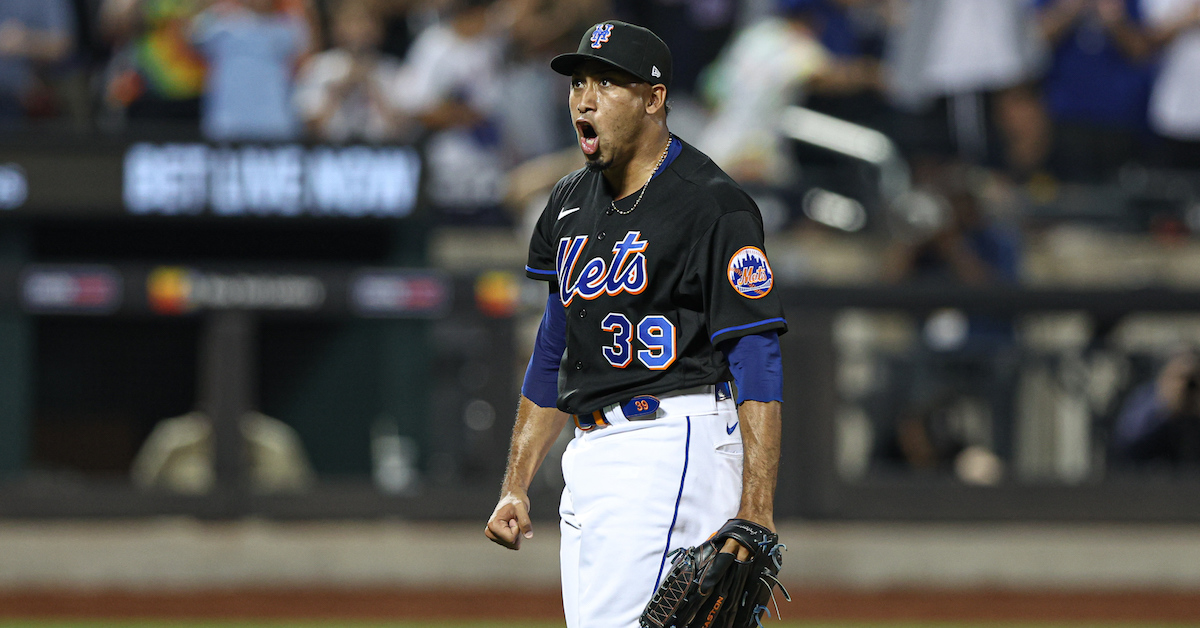
Edwin Díaz Is Going Supernova

© Vincent Carchietta-USA TODAY Sports

The New York Mets acquired Edwin Díaz in a trade with the Seattle Mariners before the 2019 season. At the time, the deal was controversial, to put it charitably. Díaz was coming off a breakout 2018 season, one that established him as the best young reliever in baseball. He struck out 44.3% of his opponents en route to a 1.96 ERA (1.61 FIP, 1.78 xFIP) and had four years of team control remaining.

That combination of skill and value doesn’t come around often, and the Mets paid dearly for it. They took Robinson Canó and his contract along with Díaz, and sent multiple prospects back in the bargain, headlined by Jarred Kelenic, their previous year’s first round draft pick and a consensus future star. Things went quite poorly for New York out of the gate; Kelenic flew through the minors, Díaz posted a 5.59 ERA in his first season with the Mets, and Canó had his worst season since 2008.

You probably already knew all of that. It wasn’t exactly a small story at the time, and when Kelenic debuted at the start of the 2021 season while Canó was serving a suspension for violating the league’s performance-enhancing drug policy, the “Mets snatch defeat from the jaws of victory” headlines reached a fever pitch. But with the benefit of 15 more months of games, and also as someone who isn’t particularly good at hot takes, allow me to add this to the discourse: Edwin Díaz is really good. Read the rest of this entry »


With a Rough Stretch Approaching, Red Sox Look to Reinforce Their Rotation

© Ashley Green/Worcester Telegram & Gazette / USA TODAY NETWORK


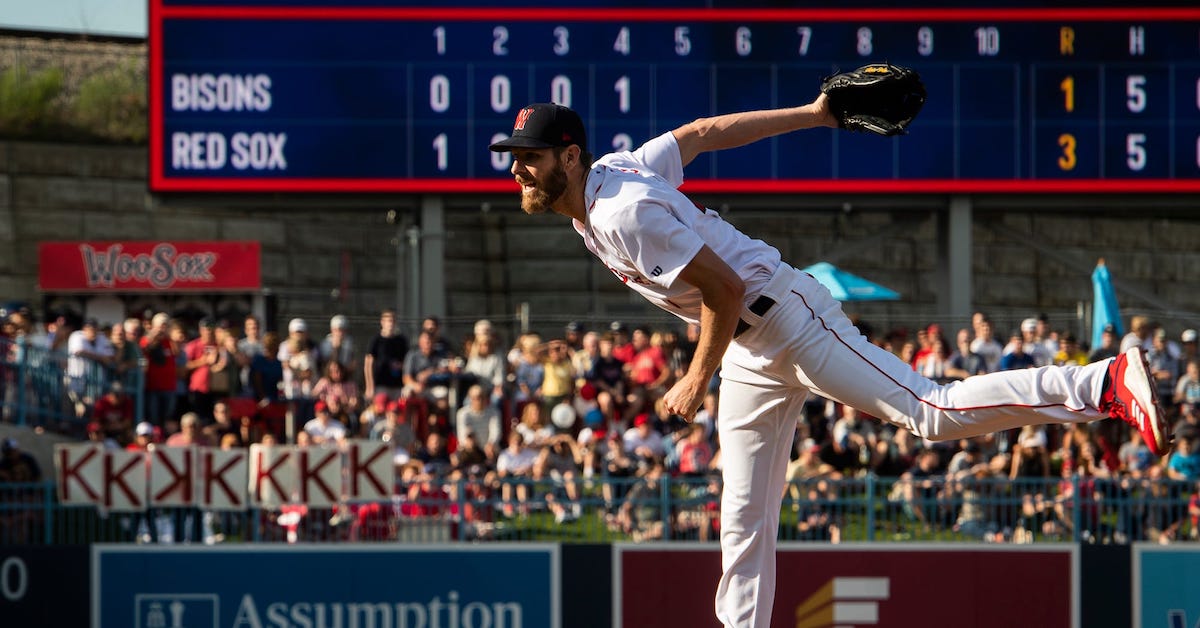
The Mets aren’t the only team awaiting an ace’s return from injury. Chris Sale is scheduled to start for the Red Sox’s Triple-A Worcester affiliate on Wednesday, and if all goes well, the 33-year-old lefty could join the big club after that, in time to help a team whose rotation is looking rather threadbare as it heads into a crucial stretch of the season. While Sale pitches for Worcester, fast-rising prospect Brayan Bello — whose rotation slot Sale is filling — will debut in Boston against the Rays.

After winning 92 games and falling just two wins short of a trip to the World Series in 2021, the Red Sox stumbled to a 14-22 start, and were just 23-27 at the end of May. Though they went 20-6 in June, they actually lost ground to the Yankees, who went 22-6. After splitting their first four games of July, they’re 45-36, 13 games out of first place, and while they now occupy the top AL Wild Card spot, they’re about to face a major test. The three-game series they began on Monday kicked off a brutal 27-game stretch against teams .500 or better, with seven apiece against the Rays (44-37) and Yankees (58-23, a 116-win pace) followed by three against the Blue Jays (44-38), four against the Guardians (40-39), three against the Brewers (47-36) and three against the Astros (53-27).

That’s a weighted opponents’ winning percentage of .595 for that span, a 96-win pace over the course of 162 games, with all but Cleveland currently occupying a playoff spot. The good news for the Red Sox is that 17 of the 27 games are at home, but the bad news is that their rotation currently has three starters (Nathan Eovaldi, Rich Hill, and Garrett Whitlock) on the injured list and a fourth (Michael Wacha) whose status is in question after being scratched on Sunday, forcing manager Alex Cora and chief baseball officer Chaim Bloom to piece things together on a day-by-day basis. Hence the higher stakes when it comes to the progress of Sale and the debut of Bello. Read the rest of this entry »


The ZiPS Midseason Update for the American League

Aaron Judge
Wendell Cruz-USA TODAY Sports

As we reach the mathematical halfway point of the season and approach the trade deadline, this is an opportune moment to run an update of the ZiPS projected standings. The standings are based on projections from the most robust version of ZiPS rather than the simpler one, which is more practical to run daily during the regular season, implementing things like the Statcast-aided zStats and up-to-date minor league translations.

The process that ZiPS uses is the typical one, but I’ll run it down quickly for those who may be new to how these projections work. ZiPS starts with a modified version of our depth chart and applies a generalized probabilistic model of available playing time for the players listed. So instead of a team’s roster strength being a simple sum of everyone’s projected WAR pro-rated to a fixed expected number of plate appearances, we end up with a whole distribution of possible roster strength. As an example: While Jacob deGrom still has a median of 55 innings in the roster sims I run for each team, sometimes he’ll be at 65 or 70 innings, sometimes he’ll be at 30 or 45 innings, and occasionally, it’ll be much worse than that. ZiPS will then “fill in” playing time based on the next players available on the depth chart and their probabilistic measure of availability. Just to stay with the Mets: When the outfield is healthy, the depth chart is mostly Mark Canha, Brandon Nimmo, and Starling Marte. But on the particularly bad rolls, the team’s estimated roster strength will have a lot more Ender Inciarte, Nick Plummer, Mark Vientos, and even players like Daniel Palka and Terrance Gore.

After ZiPS gets a distribution of each team’s roster strength, it “draws” one each year and sims out the rest of the season, team versus team, a million times and sees what happens. Is this a perfect methodology? Absolutely not! But I think we get closer to our goal of trying to evaluate team uncertainty and team depth, something which is harder to do using a less time-consuming scheme.

For today, let’s check in on the American League. Read the rest of this entry »


Detroit’s Jason Foley Is Sinking His Way to the Top

© Junfu Han / USA TODAY NETWORK

Jason Foley has emerged as one of the most reliable members of the Detroit Tigers bullpen, and learning that his four-seam fastball profiled poorly is a big reason why. The 26-year-old right-hander switched to a sinker, and the results speak for themselves. Since debuting with Detroit last June, Foley has a 2.79 ERA and a 3.54 FIP over 36 relief appearances comprising 38-and-two-thirds innings. Throwing his worm-killer 53.9% of the time, he’s logged a 55.3% groundball rate.

Foley, whom the Tigers signed out of Sacred Heart University in 2016, discussed his career-changing repertoire tweak at Fenway Park in late June.

———

David Laurila: You’ve gone from a non-drafted free agent out of a low-profile college program to a pitcher performing at a high level in the big leagues. How did that happen?

Jason Foley: “I get asked that quite a bit, like — ‘You weren’t good enough to get drafted, so how are you now here?’ — and I think a lot of people are looking for one magic answer, or maybe one magic change that I’ve made. But neither of those are true. It really just stems from hard work and consistency, and from all of the little things that help you get 1% better every day.” Read the rest of this entry »


Measuring This Season’s Most (and Least) Consistent Hitters

© David Richard-USA TODAY Sports

There’s a question that gets asked all the time on baseball social media. The variations are endless, but essentially, it boils down to this: Would you rather have an ultra-consistent hitter in Player X, who you can count on for a daily hit, or an uneven hitter in Player Y, who oscillates between prime Barry Bonds and a benchwarmer?

Given specific numbers, you could work out whether Player X or Y is more valuable. But what if we assume they’re players of equal caliber? That’s where it gets tricky. Maybe I’m only seeing certain answers, but in such cases, it seems like people prefer the clockwork Player X. It makes sense: The prospect of guaranteed production is reassuring, as befits our risk-averse tendencies. I have a hunch that we generally overvalue consistency in baseball, but I’m not here to prove that. Instead, I wanted to find out which hitters have been steady at the plate this season, and which hitters have been mercurial.

Over on our Splits Leaderboards, you can break down hitters’ seasons into weekly chunks. They range from Isaac Paredes’ destruction of the league in mid-June (488 wRC+) to Travis Demeritte’s hit-less and walk-less stretch a month prior (-100 wRC+). From there, measuring the variance between those weeks is a fairly simple endeavor. I grouped the weeks by each player, then calculated the standard deviation in wRC+, which represents how spread apart a player’s weeks are from his overall production. The higher the standard deviation, the more variable he is; the lower the standard deviation, the more consistent. Read the rest of this entry »


Effectively Wild Episode 1871: Empire State of Grind

EWFI
Ben Lindbergh and Meg Rowley banter about the possible end of the Taylor Ward/Tyler Wade broadcaster confusion, Ward getting caught unawares at first base, and the Twins turning the first-ever 8-5 triple play, then Stat Blast (11:06) about Cam Vieaux and the most pitches thrown in various types of innings, share a Past Blast (23:33) from 1871, and discuss the Empire State Greys, a traveling Frontier League team that started the season 0-35 and now, at 2-42, is in danger of posting the lowest winning percentage in pro baseball history. Then (43:23) Ben brings on brothers Eddie Gonzalez and Jerry Gonzalez, the co-owners and co-hitting coaches of the Greys, to talk about their work with the Empire Professional Baseball League, the challenges of operating in indy ball, the Greys’ origins and roster composition, being a perpetual road team, the mood on the team during its historically long losing streak, how the streak was snapped, the close calls they had before their first win, facing Kumar Rocker, their hopes for the rest of the season, the Greys’ growing fan base, and more, followed (1:23:54) by a few postscripts.

Audio intro: Bobby Bare, Jr., “One of Us Has Got to Go
Audio interstitial: Fleetwood Mac, “Empire State
Audio outro: Harry Belafonte, “Zombie Jamboree (Back to Back)

Link to video of Ward play
Link to video of Twins triple play
Link to La Russa ejection clip
Link to Vieaux game B-Ref page
Link to Vieaux’s postgame comments
Link to Stat Blast pitch data
Link to most pitches between outs
Link to 2003 Pavano game
Link to 1954 Dodgers-Redlegs game
Link to Allan Roth SABR bio
Link to 2010 Linebrink game
Link to 1996 Orioles-Rangers game
Link to Stathead
Link to Ryan Nelson’s Twitter account
Link to Richard Hershberger’s Strike Four
Link to 1871 story source
Link to list of worst team records
Link to tweet about Muskogee Mets
Link to article about Muskogee Mets
Link to B-Ref page on Muskogee Mets
Link to EW wiki on the Salina Stockade
Link to Ben’s article on the Stockade
Link to the Stockade’s B-Ref page
Link to research on indy league quality
Link to the Greys’ B-Ref page
Link to Frontier League standings
Link to Frontier League stats
Link to story about the NCBL
Link to story about Empire League’s origin
Link to Empire League wiki
Link to Empire League website
Link to the Greys’ January announcement
Link to story about the Greys
Link to other story about the Greys
Link to the Greys on Twitter
Link to the Greys’ team shop
Link to the Greys’ schedule
Link to game story about the first win
Link to photo from after the first win
Link to story about Rocker’s season
Link to Cardinals dingers video
Link to Ben Clemens on single-game homers

 Sponsor Us on Patreon
Subscribe to Stathead (Code: WILD20)
 Facebook Group
 Twitter Account
 EW Subreddit
 Effectively Wild Wiki
 iTunes Feed (Please rate and review us!)
 Get Our Merch!
 Email Us: podcast@fangraphs.com