Dan Szymborski: OK, just regular chat, but adding Thunder to things always makes them more exciting
12:04
Old Hoss Radbourn: I know xStats are flawed (even more so this year because of the change in offensive environment), but they’re showing Abraham Toro getting insanely unlucky. Is there some bad luck masking a real breakout here?
12:04
Dan Szymborski: I think ther’es some bad luck
12:04
Dan Szymborski: xStat stuff is having *calibration* problems, but it should be an issue of *bias* more than accuracy really
12:05
Dan Szymborski: ZiPS stats are more predictive (with slightly differing methodology) and is similarly overexpecting results
Last week, I wrote an article about the influence of batted ball spin. The takeaways were simple: For one, even though confounding variables like temperature and wind speed are hard to eliminate, it’s entirely plausible that batted ball spin alone can subtract crucial amounts of expected distance. Also, while hitters may display a penchant for certain types of spin, they seemed to have little control over it on a daily basis. Potential inaccuracies aside, these findings made sense; hitting a baseball is hard, and batted ball spin is just another piece of the puzzle.
After the article ran, I didn’t expect to revisit this topic anytime soon. But two things inspired me to start exploring again. First, a Twitter mutual was kind enough to provide me with Trackman data of college baseball games that include — you guessed it — batted ball spin axis, which opened up multiple avenues of research. Second, Dr. Alan Nathan, a physics professor at UIUC, summarized his own findings on batted ball spin in the comments. Armed with new data and knowledge, it was time to dive back in. Read the rest of this entry »
As you’re probably aware, Apple TV+ has stepped onto the baseball broadcasting scene this year, airing two games every Friday. They’re stylistically different from your average baseball broadcast, even at a glance. The colors look different, more muted to my eyes than the average broadcast. The score bugs are sleek, the fonts understated. The announcers are mostly new faces. And most interestingly, to me at least, the broadcast displays probabilities on nearly every pitch.
As a big old math nerd, I love probabilities. They appeal to something that feels almost elemental. Every time I watch a baseball game, I wonder how likely the next hitter up is to get a hit – or to reach base, or strike out, or drive in a run. It’s not so much that I want to know the future – probabilities can’t tell you that – but I would like to know whether the outcome I’m hoping for is an uphill battle or a near-certainty, and how the ongoing struggle of pitcher against hitter changes that.
The Apple TV+ broadcasts gets those probability numbers from nVenue, a tech startup that got its start in an NBC tech accelerator. According to an interview with CEO Kelly Pracht in SportTechie, the machine learning algorithm at the heart of nVenue’s product considers 120 inputs from the field of play in making each prediction.
Machine learning, if you weren’t aware, is a fancy way of saying “regressions.” It’s more than that, of course, but at its core, machine learning takes sample data and “learns” how to make predictions from that data. Those predictions can then be applied to new, out-of-sample events. Variations in initial conditions produce different predictions, which is why you can think of it as an advanced form of regression analysis; at its most basic, changes in some set of independent variables are used to predict a response variable (or variables). Read the rest of this entry »
Ben Lindbergh and Meg Rowley talk to Kelly Pracht, the CEO and co-founder of predictive analytics startup nVenue, which has provided the real-time probabilities displayed on this season’s MLB Network-produced Friday Night Baseball broadcasts on Apple TV+. They discuss nVenue’s origin story, its sports-betting ambitions, its 100-plus-input machine-learning model, which factors are and aren’t predictive of performance, Ben and Meg’s misgivings about some of the displayed probabilities, and much more. Then (1:04:37) Ben and Meg bring on FanGraphs writer Ben Clemens to discuss the results of his study about how nVenue’s odds compare to a simplistic, one-factor model, and why they think the accuracy of the system matters.
Position: Data Quality Engineer – Detroit Tigers (Detroit · MI)
Job Summary:
The Detroit Tigers are currently seeking a Data Quality Engineer, Baseball Data Infrastructure. This role will be responsible for designing, managing, and automating data quality processes across our disparate data sources to support Baseball Operations initiatives. This position will report to the Director, Baseball Data Infrastructure.
Key Responsibilities:
Design, implement, and use data quality assurance frameworks to support the process of identifying inconsistent data patterns.
Work with Tigers data engineers and data scientists to implement good data hygiene practices and procedures in our data pipelines.
Work with external data vendors to triage and remedy data quality issues.
Automate and execute test cases in data pipelines and manage data issue tracking.
Minimum Knowledge, Skills & Abilities:
2+ years of relevant work experience in data analysis and engineering using SQL and Python
Knowledgeable with data strategies and practices, such as continuous integration, regression testing, and versioning.
Experience querying SQL data warehouses built for data science and analytics.
Familiarity with cloud computing, cloud storage, and cloud services.
Understanding of data quality frameworks and best practices for implementation.
Passion for baseball and familiarity with current baseball research.
Preferred Knowledge, Skills & Abilities:
Strong SQL skills (T-SQL preferred).
Effective communication skills with an ability to explain technical concepts to developers and business partners.
Experience using Apache Spark (Databricks on Azure preferred).
Experience in generating reports and visuals on large data sources.
Experience with DevOps practices for CI\CD pipelines.
Familiarity with open-source data quality frameworks (Great Expectations preferred).
Familiarity with Airflow.
Working Conditions:
Office environment.
The location may be based in Detroit or fully remote.
Occasional evening, weekend, and holiday hours may be required.
The above is intended to describe the essential job functions, the general supplemental functions, and the essential requirements for the performance of this job. It is not to be construed as an exhaustive statement of all additional duties, responsibilities, or nonessential requirements. Detroit Tigers, Inc. has the right to change, modify, suspend, interrupt, or cancel in whole or in part any job functions outlined in a job description at any time and without advance notice to the employee.
Last week, I discussed some of the young, pre-free agency players who teams should be trying to sign to long-term contract extensions. I hadn’t been planning for there to be a part two, but you guys had so many additional players you wanted to talk about, and I can’t remember the last time I got more DMs about a piece than that one — well, about a piece for which everyone isn’t mad at me, at least!
So, let’s oil up and turn the crank on the ol’ ZiPS-o-Matic and get this projection mill hopping for seven more players.
Walker Buehler, Los Angeles Dodgers: Eight years, $204 million
Buehler is currently in the second and final year of an extension with the Dodgers that pays him $4 million a year. His next deal will be a tad more pricey. Clayton Kershaw is still around in Dodger blue, but his injury history and mild decline resulted in 2021 being the year that Buehler became The Man in the rotation, reducing Kershaw to the role of deuteragonist. And while Los Angeles still has a rocking rotation, the depth isn’t quite what it was in recent years, so there should be more than slight concern that the franchise’s most valuable pitcher is unsigned. With Buehler two years from free agency, the Dodgers aren’t likely to get any massive discounts, but this is the best time to sign him if you don’t want to pay him Gerrit Cole money later. The Dodgers don’t necessarily have to stop at this figure, either; what’s the fun of being wealthy if you don’t use that cash to pay for cool things?
There may be some concern in some places about the dropoff in Buehler’s strikeout rate, but while strikeout rate changes do tend to stick very quickly, they stick far more when the underlying stats support the drop-off than when they don’t. In this case, the contact rates and swinging-strike rates haven’t worsened at all, nor has his velocity fallen off a cliff, suggesting that it’s a blip rather than a plunge. You can make a similar argument for the Dodgers signing Julio Urías to an extension, likely for a significantly lesser haul, but given the workload Buehler has shown he can handle, he’d be my priority. Read the rest of this entry »
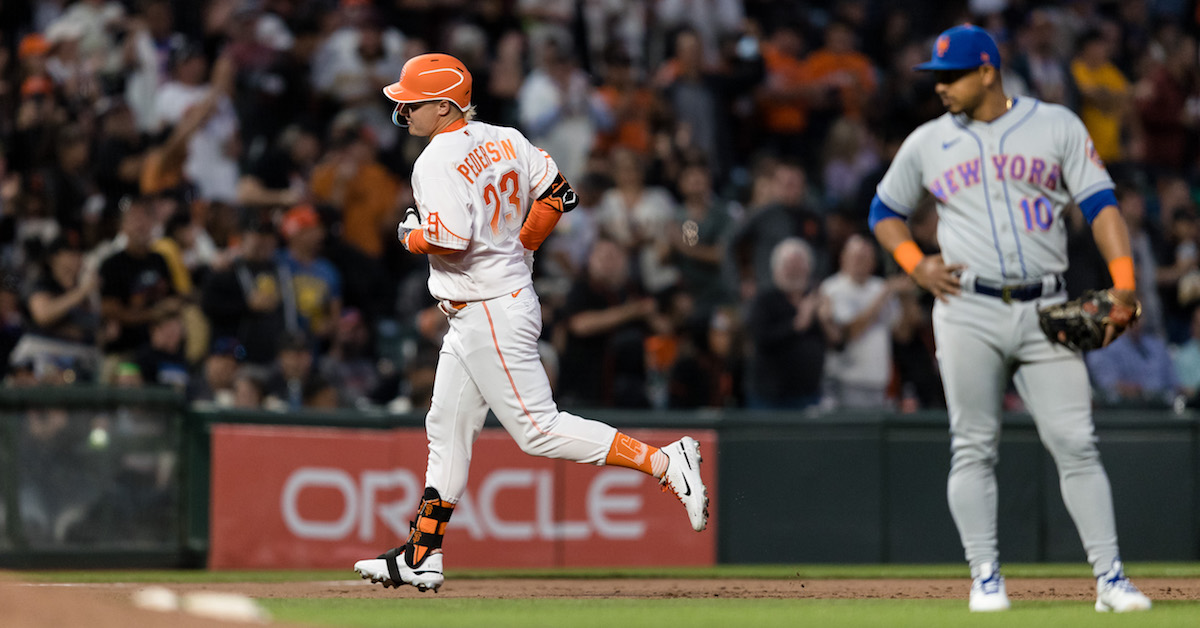
Whether or not you’ve seen it, you likely know the premise of Freaky Friday. A mother and her daughter switch bodies in a great cosmic mixup, and hijinks ensue. Hello! Welcome to FanGraphs. I’m Ben Clemens, and today we’ll be covering classic teen cinema of the early 2000s (and mid-1970s), as personified by last night’s Giants-Mets game.
Tuesday night could have been just another day at the (beautiful, well-appointed) office for the Mets and Giants. After a comfortable win by New York in Monday’s series opener, the Giants returned the favor early in last night’s game. Chris Bassitt, the steadiest starter in a rotation buffeted by injuries, had his worst start of the year, surrendering eight earned runs in only 4.1 innings thanks to three homers, two by Joc Pederson. Logan Webb, meanwhile, cruised through five innings (six strikeouts, one walk, two runs), turning what was billed as a pitching duel into an 8-2 rout.
Teams don’t come back from six-run deficits. When Pederson launched his second homer, a two-run shot that pushed the score to 8-2, the Giants’ win expectancy climbed to 98.2%. Tune into 50 games, and you might see the trailing team pull one out. The Mets behaved accordingly; they brought in Stephen Nogosek, the last reliever in their bullpen, to eat some innings.
That’s the way the game could have ended – but let’s get back to Freaky Friday. In 2021, the Giants won these games, whichever side of the 8-2 score they were on. They were both excellent and a team of destiny, and you have to win plenty of tough ones to end the regular season with 107 wins. Read the rest of this entry »
The Brewers are atop the NL Central thanks in large part to a rotation that has ranked among the game’s best, but the team’s postseason hopes took a hit this week with the news that righty Freddy Peralta will miss “a significant amount of time” due to a posterior shoulder strain. Milwaukee, which is additionally dealing with multiple injuries in its lineup, believes that Peralta will avoid surgery and return this season, but his loss is a disappointment given the 25-year-old’s recent return to form.
Peralta left Sunday’s start against the Nationals after three-plus innings due to tightness in his left shoulder. He failed to retire any of the three batters he faced in the fourth inning, and all three came around to score, the last two on reliever Brent Suter’s watch along with three others. The five runs that Peralta was charged with were as many as he had allowed over his previous five starts.
Indeed, Peralta had been on a roll. After starting the season by allowing nine runs in seven innings in his first two turns, he went on the aforementioned five-start run. In 28.2 innings, he struck out 38 (a 34.2% rate) and walked six (5.4%) without allowing a single homer, a run capped by his seven-inning, two-hit, 10-strikeout game against the Braves on May 16. Granted, the competition he faced during that strech wasn’t fierce, as the Phillies, Pirates, Reds (twice), and Braves are all below .500, and only Philadelphia has a team wRC+ higher than 94, but such is the schedule of an NL Central contender.
Peralta underwent an MRI on Monday, which revealed the strain. The Brewers expect the injury will heal with rest, but it will take some time. “He will be back this season but it’s going to be a lengthy absence,” manager Craig Counsell told reporters on Monday. “We’re confident that there’s gonna be no aftereffects to this thing but it’s going to take a while to heal and then build it back up.”
Through the ups and downs of his season so far, Peralta’s ERA is a gaudy 4.42, but among the 66 NL pitchers with at least 30 innings through Monday (the cutoff point for all stats here unless otherwise noted), his 2.10 FIP was the league’s lowest, his 0.23 homers per nine ranked third (teammate Adrian Houser was first at 0.21), his 1.3 WAR and 30.3% strikeout rate were sixth, his 22.4% strikeout-walk differential was seventh, and his 2.88 xERA was 14th.
Those peripherals are in line with the All-Star campaign he put up last season. After three years of careful workload management — a span during which he struck out 258 in 192.2 innings but never threw over 85 innings in a season — Peralta broke out with career highs of 27 starts and 144.1 innings in 2021. Among NL pitchers with at least 140 innings, his 2.81 ERA placed sixth and his 3.12 FIP was seventh. His 33.6% strikeout rate was third behind only teammate Corbin Burnes and Max Scherzer, and his 24.0% strikeout-walk differential was good for fourth behind that pair and Aaron Nola. Only a late-season bout of shoulder inflammation, for which Peralta spent 15 days on the injured list and had a few shortened starts on either side, put a damper on his strong campaign and prevented him from down-ballot consideration in the Cy Young voting. Read the rest of this entry »
“When you’re pitched away, take the ball to the opposite field.” It’s a training mantra that seemingly exists everywhere. I heard it in Little League. I hear it on major league broadcasts to this day. The data show that hitters do it, and it’s just a natural swing. I can think of few hitting sayings I believe more than this one.
Of course, just because you can hit the ball the other way doesn’t mean you have to. Over the last two years, the list of righty hitters who have pulled the ball most when they swing at away pitches (from right-handed pitchers, just to standardize the sample) probably matches your intuition:
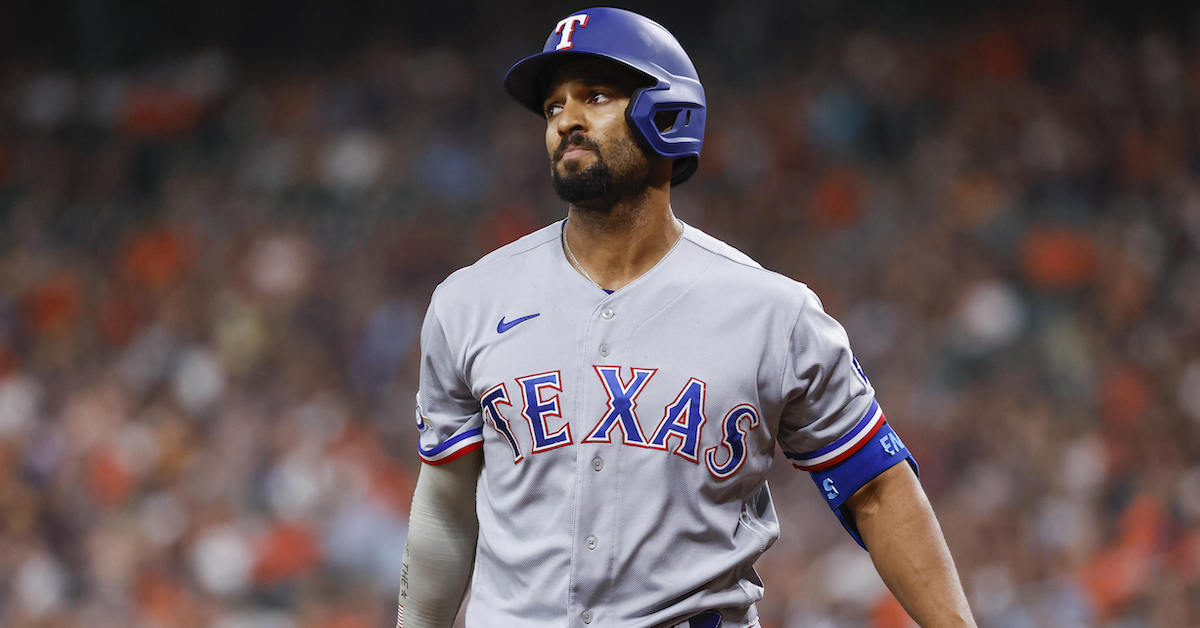
You basically understand the kinds of hitters on here. The guys ranked sixth and seventh are similar types: Salvador Perez and Mike Zunino. It’s big boppers who try to lift and pull the ball no matter where they’re pitched, as well as guys like Marcus Semien who sell out to pull in an attempt to juice their power. If you do the most damage on the pull side and accrue most of your offensive value through power, it’s a natural approach. You think anyone’s coming to the ballpark to see Patrick Wisdom slap a well-placed cutter the other way? They want dingers!
The list of the hitters who pull the ball least often when pitched away is mostly who you’d expect, and also not who you’d expect at all. Feast your eyes on the top five:
The top four are contact-oriented hitters with elevated groundball rates… and the fifth might be the most powerful baseball player in history. Read the rest of this entry »
We are looking for a remote, part-time contract front end developer to help maintain and develop FanGraphs’ website and data tools. We will consider any developer background, but most work will be done in JavaScript and React.
If you have any coding experience, please do not hesitate to apply!
We’re looking for someone with creativity and a user-centric mindset, as well as an appetite for learning and growth.
The position will entail about 10-20 hours of work a week, with some flexibility in terms of schedule. Read the rest of this entry »


 Dan Szymborski: Welcome to THUNDER CHAT

 Sponsor Us on Patreon
 Subscribe to Stathead
 Facebook Group
 Twitter Account
 EW Subreddit
 Effectively Wild Wiki
 iTunes Feed
 Get Our Merch!