

Ben Clemens FanGraphs Chat – 2/28/22
by Ben Clemens

February 28, 2022
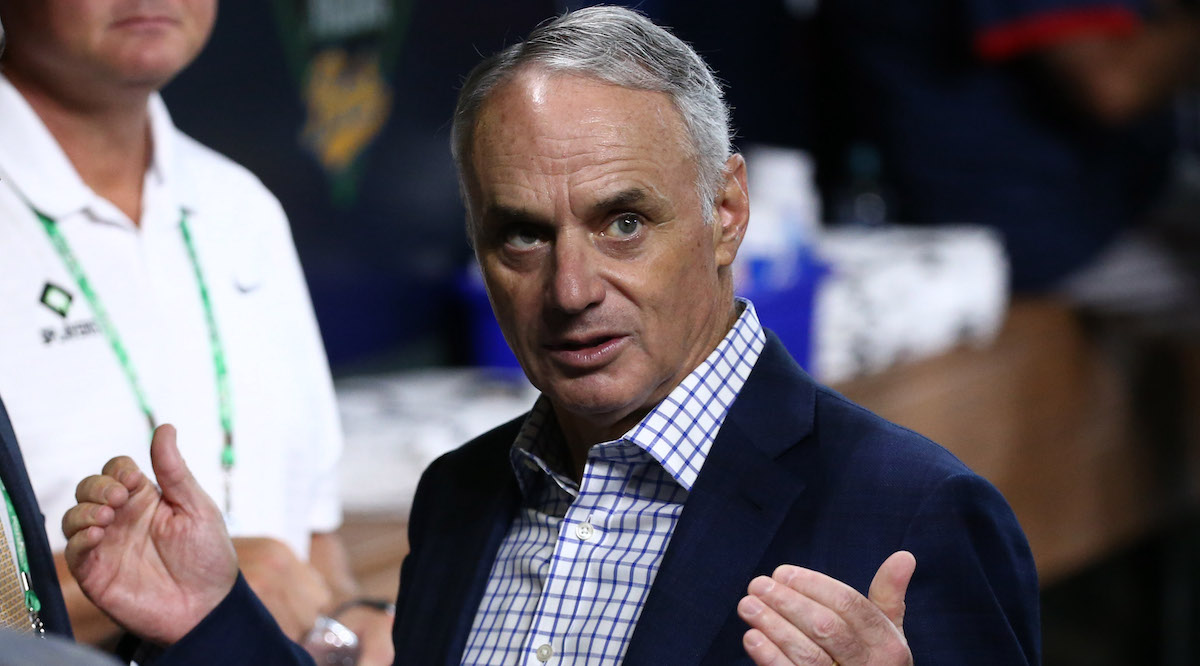
It’s February 28, the deadline set by commissioner Rob Manfred to have a new collective bargaining agreement in place that would end the owners’ self-imposed lockout and allow the season to open as scheduled on March 31 following an abbreviated spring training. To the surprise of no one, there’s no deal yet, even after seven straight days of negotiations between representatives for the owners and the players union in Jupiter, Florida, talks that have stretched into Monday. Negotiations have yielded incremental progress regarding some core economic issues and other matters, but the two sides remain far apart nonetheless. While a league official characterized Sunday’s talks as “productive” after both sides voiced considerable acrimony on Saturday, it would take something on the order of a miracle to have a deal in place by the end of the day.
What’s more, if the league intends to treat the February 28 deadline as a hard one, living up to its threat to cancel games without making them up, and not paying players for a full 162-game season, a deal may become even harder to reach. That would create another issue to settle via negotiations, because the length of a season is subject to collective bargaining; the league can’t unilaterally reduce it. One need only to dial back to 2020 to recall what a fiasco that can become once service time and contract incentives come into play. What’s more, the cancellation of games would raise the possibility of the players answering with some hardball of their own by not agreeing to expanded playoffs for the 2022 season. The union indicated that was possible earlier this month, when the specter of cancellations arose. The value of those expanded playoffs is estimated at $100 million. Read the rest of this entry »

Mick Abel has a classic starter profile and a high ceiling. No. 20 on our recently-released 2022 Top 100 Prospects list, and No. 1 on our Philadelphia Phillies Top Prospects list, the 20-year-old right-hander features a four-seam fastball and a diving slider, plus offerings that he augments with a changeup and a curveball. Drafted 15th overall in 2019 out of a Beaverton, Oregon high school, the 6-foot-5, 205-pound hurler is, in the words of our prospect team, “a prototypical power pitching prospect with huge arm strength, a plus breaking ball, and the frame [to potentially grow into] a No. 1 or 2 starter.”
Abel discussed his repertoire, and his early-career development, over the phone last week.
———
David Laurila: How much have you learned about your pitches since signing with the Phillies?
Mick Abel: “I think I had a really good sense coming in, with how I was brought up with Kevin Gunderson back home. He was sharing the analytical side a lot better than a lot of kids would get from their pitching coaches. But I’ve definitely learned a lot. I’ve learned about things like seam-shifted wake, which is something I’ve asked about a lot.
“As far as my data goes, I haven’t tried to do too many crazy things with it. I know that I’ve got the stuff. It’s more so, ‘How am I going to maintain that, and not deviate too far off of what my normal numbers are?’”
Laurila: That said, have you looked to change any of your pitch characteristics? Read the rest of this entry »

As the lockout wears on, team financials have repeatedly been called into question. Are teams making money? What about if you ignore franchise value? Commissioner Rob Manfred recently claimed that owning a baseball team has been a worse investment than investing in the stock market, a claim that was quickly challenged by outside observers. Last week, Liberty Media, the principle owner of the Atlanta Braves, announced their 2021 financial results, shedding some light on the financial state of the league.
The Braves enjoyed a banner year in 2021. Per their filing, they turned a profit of $104 million. That’s full-year OIBDA, or operating income before depreciation and amortization. That brings their four-year operating income, including the pandemic-marred 2020 season, to $193 million.
OIBDA sounds like a great big pile of financial jargon, and it is, so let’s talk about what all of that means. Operating income refers to the money that the team has left over after it takes in all its revenue and pays all of its costs. More specifically, it’s revenue minus the cost of goods sold minus other operating expenses. If a team sells 100 hot dogs for a net $800, that’s $800 in revenue. If they paid $20 to buy those hot dogs in bulk, that’s $20 in cost of goods sold. If they pay the vendor who sells those hot dogs $15, that’s $15 in other operating expenses. Voila – $765 in operating income. Read the rest of this entry »
Don Mattingly had 2,153 hits, 222 home runs, a .361 wOBA, a 124 wRC+, and 40.7 WAR. Statistically, the New York Yankees legend is similar to a Minnesota Twins legend who a few months ago was voted into the Hall of Fame by the Golden Days Committee. Tony Oliva had 1,917 hits, 220 home runs, a .365 wOBA, a 129 wRC+, and 40.7 WAR.
And then there is Brian Giles, who received nary a vote in his lone year on the BBWAA ballot, and quite possibly will never appear on an era-committee ballot. Perennially flying under the radar while playing in Cleveland, Pittsburgh, and San Diego, the underrated slugger had 1,897 hits, 287 home runs, a .388 wOBA, a 136 wRC+, and 54.8 WAR.
What about peak, you might be wondering? Giles was better there, too.
Mattingly had a six-year peak before back injuries began eroding his skills. Over that stretch, he logged a .388 wOBA, a 143 wRC+, and 31.7 WAR. Meanwhile, Oliva and Giles had seven-year peaks that produced these numbers: Read the rest of this entry »

Ben Lindbergh and Meg Rowley banter about a week of many meetings but no breakthroughs between MLB and the MLBPA, Liberty Media’s financial disclosures about the Braves’ profitability, the prospects of a labor deal before the owners’ deadline for starting the season on time, and more, then (25:22) talk to historian and author Kerry Yo Nakagawa, the founder and director of the non-profit Nisei Baseball Research Project, about the history of baseball in Japan, the development of baseball in the Japanese American community, the impact and legacy of Kenichi Zenimura and the Vancouver Asahi, the 80th anniversary of FDR’s order to incarcerate Japanese Americans during World War II, the role of baseball in the internment camps, Masanori Murakami’s trailblazing career, Nakagawa’s athletic ancestors and his efforts to preserve Japanese American baseball history, and much more.
Audio intro: Buzzard Buzzard Buzzard, “Faking a Living”
Audio interstitial: Kat Eggleston, “Executive Order 9066”
Audio outro: Sloan, “Can’t You Figure it Out?”
Link to Rosenthal’s column
Link to Passan’s tweet
Link to Liberty Media news
Link to The Athletic on Liberty Media
Link to Manfred video tweet
Link to dog photo tweet
Link to Nisei Baseball Research Project
Link to mlb.tv autorenew article
Link to NJAHS summary
Link to history museum explainer
Link to Diamonds in the Rough
Link to barnstorming photo
Link to high school curriculum
Link to Executive Order 9066
Link to E.O. 9066 wiki
Link to story on 80th anniversary
Link to Sleeping Dogs documentary
Link to Vancouver Asahi story
Link to THT on the Asahi
Link to Zenimura info
Link to Zenimura SI story
Link to Gila River story
Link to MLB.com Murakami story
Link to 42 for 21 list
Link to 42 for 21 EW episode
Link to Doc Adams EW episode
Link to Doc Adams story
Link to Doc Adams SABR bio
 iTunes Feed (Please rate and review us!)
 Sponsor Us on Patreon
 Facebook Group
 Effectively Wild Wiki
 Twitter Account
 Get Our Merch!
 Email Us: podcast@fangraphs.com
Podcast (effectively-wild): Play in new window | Download
Subscribe: RSS
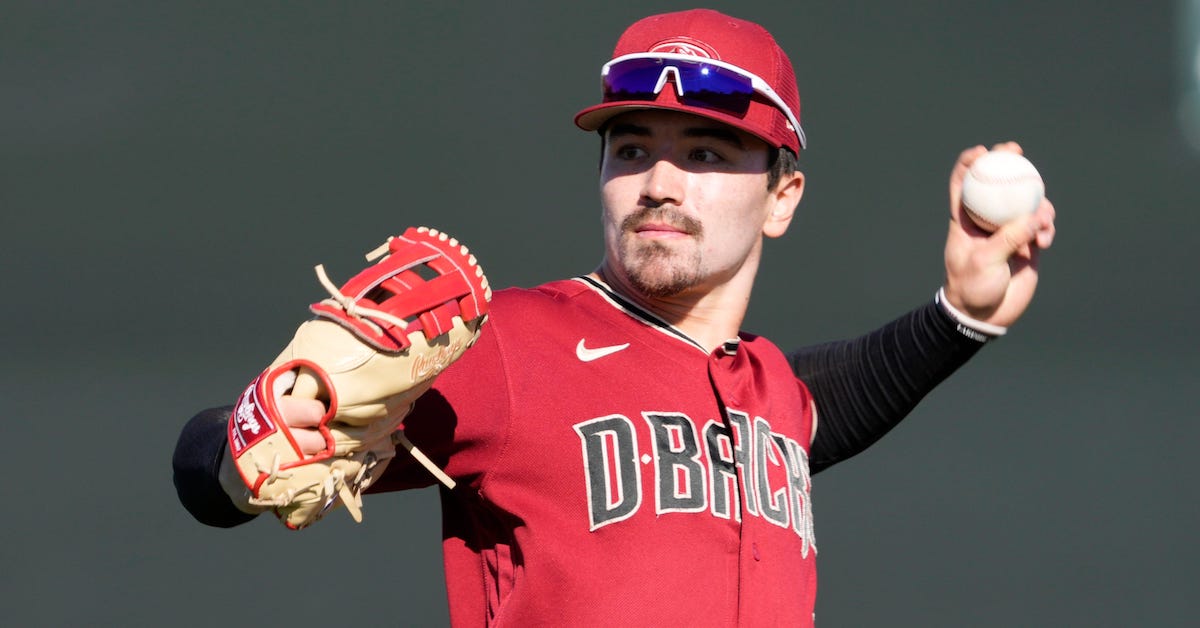
Corbin Carroll is obsessed with baseball. He’s also immensely talented at the game he grew up playing in the Seattle area. Drafted 16th overall by the Arizona Diamondbacks in 2019, the 21-year-old left-handed-hitting center fielder is ranked 14th on our recently-released Top 100 Prospects list.
In the words of our prospect team, Carroll possesses “a blend of physical gifts and heady baseball acumen,” and is expected to “produce at an All-Star level for much of his career assuming a return to full strength.” Most notable in his tool grades are his running ability, which is 70/70 present and future, and his hitting ability, which is 70 future.
Carroll, who missed all but seven games of the 2021 season due to a shoulder injury, discussed his approach and hitting mechanics over the phone Wednesday afternoon.
———
David Laurila: Let’s start with a self-scouting report. Who are you as a player?
Corbin Carroll: “In my eyes… that’s good question. I’d say I like to view myself as a spark plug, someone who is getting the team going and will go the extra step to do whatever it takes to score more runs than the other team. I think that translates in terms of some tangible skills on the field, and maybe to some intangible ones, as well.”
Laurila: With intangibles in mind, do you see yourself as a team leader? Read the rest of this entry »
Nothing complicated this week, as Eric Longenhagen and I open up the FanGraphs Top 100 Prospects list and talk about prospects for a couple of hours. Sometimes it’s best to just keep it simple.
Have a question you’d like answered on the show? Ask us anything at chinmusic@fangraphs.com.
You can subscribe to the podcast via iTunes/Apple Podcasts or Spotify.
Warning One: While ostensibly a podcast about baseball, these conversations often veer into other subjects.
Warning Two: There is explicit language.
Run Time: 1:56:30.
Have a question you’d like answered on the show? Ask us anything at chinmusic@fangraphs.com.
You can subscribe to the podcast via iTunes/Apple Podcasts or Spotify.
Podcast (chin-music): Play in new window | Download
Subscribe: RSS

For the seventh year, I’ve run down the Top 100 prospects as seen by the ZiPS projection system. If you’re unaware of what the ZiPS projections are or what they’re trying to do, please consult this article for further information or the MLB.com executive summary. To make a long story short, ZiPS is a computer system that attempts to turn an avalanche of data into a player projection. (The Z stands for Szymborski, because I didn’t realize in 2003 that this project would be useful enough that I’d need to think of a good name.)
I like to think that I’ve developed a pretty useful tool over the years, but don’t get me wrong: a projection system is not even remotely a substitute for proper scouting. While ZiPS and other systems like it can see patterns in the data that can be hard for humans to extract, humans have their own unique tricks. Projecting prospects is challenging. You’re mostly dealing with very young players, some of whom aren’t even done physically developing. They also play baseball against inconsistent competition and have much shorter resumés than established major leaguers.
Having a real baseball season in 2021 makes me feel a lot stronger about this set of projections than last year’s. Last year, ZiPS faced the challenge of projecting prospects based on data when the vast majority of them hadn’t played in an actual baseball game for an entire year. It’s still not as much data as I’d like — more seasons is always preferable — but if we continue to have minor league seasons, we’ll hopefully get back to our pre-2020 level of confidence in the next couple of years. Read the rest of this entry »