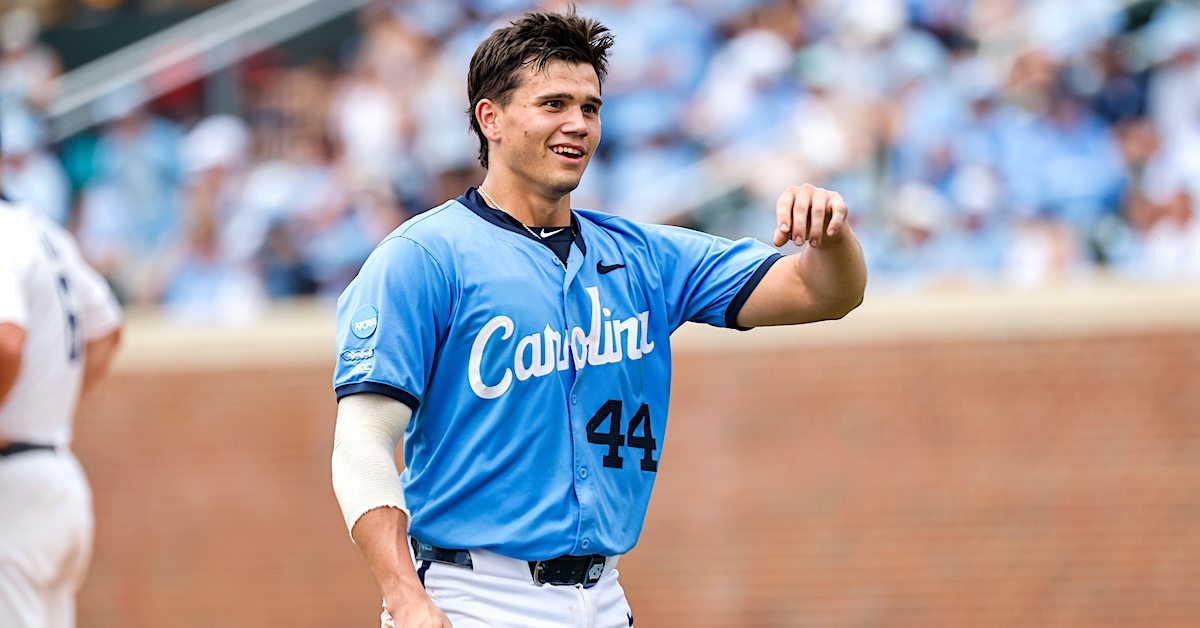
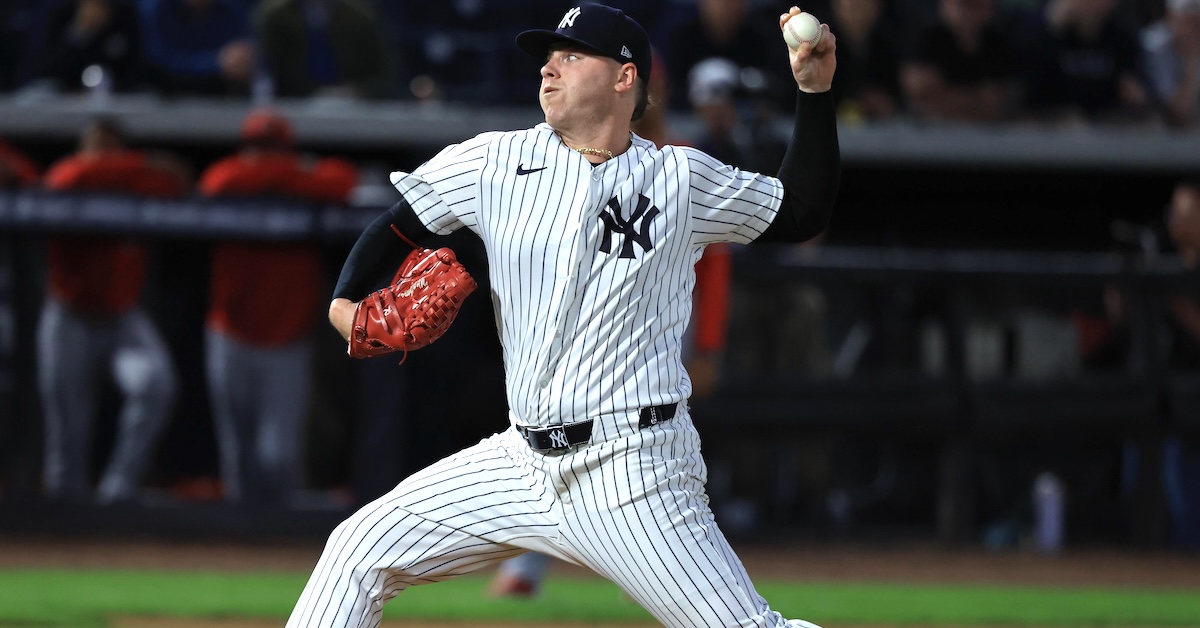
Charlie Condon was drafted just last year, so unlike the previous installments in this series, the 22-year-old corner infielder isn’t exactly revisiting “an old scouting report” here. The observations and opinions he is responding to were written by Eric Longenhagen this past January, less than sixth months after Condon was drafted third overall by Colorado out of the University of Georgia. At the time, the young power hitter had only 109 minor league plate appearances under his belt in the High-A Northwest League.
Eric wasn’t as bullish on him as many other evaluators were when our 2025 Rockies Top Prospects list was published. Our lead prospect analyst ranked Condon second in what he described as a “talented but imbalanced system,” but Eric also gave him just a 45+ FV, citing last year’s poor performance during his first professional season as one of the reasons to be concerned; Condon slashed .180/.248/.270 with a 40 wRC+.
The 6-foot-6, 215-pound right-handed hitter is doing his best to dispel doubts that he can develop into an offensive force at the big league level. After recovering from a non-displaced fracture of his left wrist suffered in spring training, Condon put up a 131 wRC+ over 167 plate appearances with High-A Spokane this season and earned a promotion to Double-A. Since joining the Hartford Yard Goats at the beginning of this month, he’s gone 6-for-27 with a pair of two-baggers.
In a twist to our Old Scouting Reports series, here are Condon’s responses to excerpts from Eric’s January write-up.
———
“Condon went third overall, signed for $9.25 million, and then had a no good very bad pro debut at Spokane during which he hit .180 and struck out 31.2% of the time.”
“That’s just baseball, man, “ Condon said of his disappointing debut. “It’s part of the learning experience, and you have to be able to accept failure and take the positives out of it. I think I’ve learned since then. It’s a tough game.
“Some of it was timing,” the slugger said when asked to elaborate. “I was also getting a little big sometimes. I had to clean up some things with my bat path to help get ready for this year.”
“During instructs, Condon played defense but didn’t get at-bats, as if he was being given time away from the plate to reset.”Read the rest of this entry »
Michael Busch had a pretty nice 2024. In his first taste of everyday playing time in the majors, he hit .248/.335/.440 and socked 21 homers on the way to a 118 wRC+. After years spent in the minors in the Dodgers system, he looked to finally be delivering on his high-strikeout, high-BABIP, high-doubles promise. The Cubs penciled him in as their everyday first baseman. That’s not an imposing batting line, but it’s better than average, so the team spent its winter trading for Kyle Tucker, not trying to upgrade from an already-acceptable situation at first base.
You’ll notice that I said high doubles instead of high power. That’s because Busch had desultory bat speed numbers; he was in the 24th percentile with a 70.3-mph average swing speed. It wasn’t an issue of him having a hard swing and a soft swing that he deployed at different times, either. His fast-swing rate, or the percentage of his swings measured at 75 mph or higher, was a mere 11.3%; league average is around 23%. Busch was adept at getting his barrel to the ball and posting good exit velocity numbers, but that’s generally a recipe for doubles instead of homers. He hit 28 doubles, two triples, and 21 home runs last season, about what was expected from his profile. He got the ball in the air a lot and still hit for a high BABIP – sounds pretty good to me.
What do you think Busch could do to improve his performance in 2025? My immediate answer: Swing faster and hit more homers. Hey, check it out! Busch has already hit 18 homers this year in just over half a season. He’s on pace to shatter his performance last season in pretty much every statistic. He’s hitting .297/.382/.562 with a 165 wRC+. There’s just one problem with my swing-hard-and-prosper theory: He’s not swinging harder. Read the rest of this entry »
The most electrifying moment of the NCAA Tournament came in a game that was all but out of reach already.
Tennessee left-hander Liam Doyle, on his third team in as many seasons, was not present for the Vols’ College World Series title in 2024. But over a short time in Knoxville, he’d nudged his way into a very select group: Along with Florida State’s Jamie Arnold and LSU’s Kade Anderson, Doyle is a candidate to be the first college pitcher taken in the draft.
Ben Lindbergh and Meg Rowley banter about the Rich Hill–Dallas Keuchel competition for the Royals rotation and give José Ramírez his due, then (17:45) answer listener emails about when to fire a GM, an all-star spot for elite defenders, teams composed of clones of Aaron Judge, Daulton Varsho, or Zack Wheeler, moving the mound back unnoticeably, a rule-changing MLB concussion protocol, whether WAR is a counting stat, and unsuccessful surgeries, plus Stat Blasts (1:24:05) about four-team trades, lefty position-player pitchers, homer flubs, bases-loaded walks, and the cost of throwing a ball on purpose, plus (1:47:30) a cat PSA.
Below is an analysis of the prospects in the farm system of the Miami Marlins. Scouting reports were compiled with information provided by industry sources as well as my own observations. This is the fifth year we’re delineating between two anticipated relief roles, the abbreviations for which you’ll see in the “position” column below: MIRP for multi-inning relief pitchers, and SIRP for single-inning relief pitchers. The ETAs listed generally correspond to the year a player has to be added to the 40-man roster to avoid being made eligible for the Rule 5 draft. Manual adjustments are made where they seem appropriate, but we use that as a rule of thumb.
A quick overview of what FV (Future Value) means can be found here. A much deeper overview can be found here.
All of the ranked prospects below also appear on The Board, a resource the site offers featuring sortable scouting information for every organization. It has more details (and updated TrackMan data from various sources) than this article and integrates every team’s list so readers can compare prospects across farm systems. It can be found here. Read the rest of this entry »
To say the last two-plus years haven’t gone the way Sandy Alcantara had hoped would be a massive understatement. Coming off winning the NL Cy Young award in 2022, his numbers dipped the following season, and he was shut down that September with a flexor strain that required Tommy John surgery in October. He returned this spring with his velocity and movement intact, but his performance to start to the season was rough; he ended April with an 8.31 ERA. The buzz about the Marlins trading Alcantara, a seemingly inevitable outcome for a franchise that is run like a glorified farm affiliate to the rest of baseball, died down temporarily. Sure, things have gone better for the ace recently, but his ERA is still inflated at 7.01, albeit with a relatively sunny 4.55 FIP. Has he done enough to fetch a high price if the Marlins trade him in the coming weeks?
My colleague Michael Baumann wrote about Alcantara back at the start of May, focusing on the righty’s poor April. One of the most concerning aspects of that dreadful start was his 14% walk rate, or 5.9 free passes per nine innings. It wasn’t so much an issue of control — Alcantara’s zone percentage was similar to past seasons — but one of command. You can see the contrast between Alcantara’s best seasons and April in botCmd (PitchingBot) and Location+ (Stuff+).
Jake Bird is having a career-best season, and conquering Coors Field has been a big part of the reason why. Over 21 relief appearances comprising 26 1/3 innings, the 29-year-old right-hander has held opposing hitters to a .196/.276/.217 slash line at home. His ERA at the notoriously hitter-friendly venue is 1.71, and his strikeout rate is a healthy 34.3%. Folding in his 18 road outings — including last night’s ERA-inflating, five-run debacle in Boston — Bird has a 3.70 ERA, a 2.92 FIP, and a 27.8% strikeout rate over 48 2/3 frames.
Prior to this year, he’d been a run-of-the-mill reliever on moribund Rockies teams. From 2022-24, Colorado’s fifth-round pick in the 2018 draft had a record of 7-9 with one save and a 4.53 ERA over 177 innings. An unranked prospect coming up through the system, Bird was in possession of an economics degree from UCLA, but boasted little in terms of big league upside. He came into the current campaign projected to essentially replicate the nondescript performances of his previous three seasons.
What is behind Bird’s unexpected emergence as a high-quality bullpen arm? Moreover, what is allowing him to have so much success in his home ballpark? I asked him those questions before Monday’s Rockies-Red Sox game at Fenway Park.
———
David Laurila: How are you having so much success at Coors this year? Can you explain it?
Jake Bird: “I think a lot of it is just the comfortability factor. After being here a few years, I’m realizing that Coors isn’t the big monster that everybody makes it out to be. It’s not that big of a deal. Sometimes [the ball] gets in the air, and the [pitches] move less, but as long as you have a plan of where you want to go with the ball, and sequence pitches, it doesn’t make too much of a difference. Read the rest of this entry »
A month ago, I checked in on Spencer Strider’s worrisome return from internal brace surgery. After four starts, Strider was 0-4 with a 5.68 ERA and a 6.40 FIP. His fastball had lost two ticks. His arm angle had fallen by seven degrees. He wasn’t getting chases. He wasn’t missing bats. In short, he didn’t look like Spencer Strider. “There’s no way for us to know how long it might take Strider to get back up to speed,” I wrote, “but the longer he looks like this, the more reason there is to worry.” One month later, I return to you with good news. Strider has made six more starts, and over the last five, he is starting to look different. He’s run a 2.70 ERA and a 2.35 FIP. His strikeout rate is up and his walk rate is down. You might even say that Strider is halfway back.
Once again, the velocity is the big ticket item, so let’s not waste any time:
At the Miami Marlins, we make waves — on and off the field.
We’re built for sustainable success thanks to our commitment to be great teammates, bold innovators, and thinking long-term. These three pillars guide us in championing a winning culture across the organization. The work we do doesn’t just impact our team — it reaches fans and communities across South Florida.
Position Summary
As a Senior Software Engineer – Front-End, you will be a key contributor to the development and maintenance of software applications that support the Baseball Operations department. Your deep expertise with user interfaces and front-end development will enable you to work on a variety of projects. Your focus will be building data-driven applications, integrating complex systems, and optimizing baseball-related workflows and user experiences. This role requires strong technical expertise, problem-solving skills, and the ability to collaborate effectively with analysts, coaches, scouts, and other stakeholders. Ideally, you’ll be full-stack capable, but with an interest and expertise toward building front-end clients for responsive web and mobile applications.
Essential Functions
Design, develop, and maintain web-based and mobile applications to support baseball operations, scouting, player development, and analytics.
Write efficient, scalable, and maintainable code while adhering to best practices in software engineering.
Collaborate with cross-functional teams to gather requirements and develop technical solutions.
Implement and maintain data-intensive front-end clients built on top of APIs that surface data that will be visualized.
Participate in code reviews, testing, and deployment processes to ensure software quality.
Stay updated on emerging technologies and modern practices in software development and baseball analytics.
Provide mentorship and technical guidance to junior engineers.
Our Values
We Are Great Teammates
Supports and encourages colleagues.
Provides and receives feedback without judgement or ego.
Holds one another to a high standard.
Provides help and encouragement proactively.
Assumes positive intentions from others.
Looks for ways to help make their teammates better.
We Are Innovators
Embraces a growth mindset.
Challenges conventional wisdom.
Unafraid to fail.
Pushes boundaries and doesn’t accept impossible.
Asks why and asks why not.
We Think Long-Term
Asks: what can I do today that will pay off a year from now.
Eschews instant gratification for bigger benefits in the future.
Always trying to think three steps ahead.
Skill Requirements
Strong proficiency in programming languages such as JavaScript, TypeScript, Python and Java.
Strong experience with front-end frameworks (React, Angular, or Vue).
Working knowledge of back-end frameworks (Node.js, Spring, Django, or Flask).
Experience building for mobile, preferably iOS, either with native (Swift) or cross-platform (React Native, Flutter) tooling is ideal.
Knowledge of cloud platforms (AWS, Google Cloud, Azure) and DevOps practices.
Experience developing and integrating APIs and working with relational and NoSQL databases.
Familiarity with CI/CD pipelines, automated testing, and containerization (Docker, Kubernetes).
Strong problem-solving skills and ability to troubleshoot complex technical issues.
Ability to work both independently and as part of a team in a fast-paced environment.
Passion for baseball and familiarity with advanced baseball analytics is a plus.
Education & Experience Guidelines
Bachelor’s degree in Computer Science, Software Engineering, or a related field required; Master’s degree preferred.
Minimum of 5+ years of experience in software engineering, application development, or related fields.
Proven experience in building and maintaining large scale highly available applications.
Prior experience working in sports analytics or baseball-related software development is a plus.
Work Environment
Ability to work evenings, weekends, and holidays as needed.
Availability to travel occasionally for industry conferences or organizational needs.
Ability to sit/stand for extended periods and work in an office environment.
Job Questions:
List a few resources that you value the most for baseball content (i.e. research publications, websites, books, podcasts, etc). No explanation is needed for your selections.