Archive for Playoffs

Can Jose Quintana Save the Cubs?

The Cubs staved off elimination last night through the might of Javier Baez, retaining the hope of becoming the first back-to-back World Series winner since the 1998-2000 New York Yankees. As a reward for their survival, they get to face the best pitcher of this generation in Clayton Kershaw, who has a chance to exorcise some postseason demons of his own with a decisive putaway performance.

But this isn’t about Kershaw. It’s about the man the Cubs send to the mound opposing him. Jose Quintana, whom the Cubs received for a very reasonable return, was acquired for this very reason, and the changes he made since coming to the North Side may set him up for success against the Dodgers tonight.

Read the rest of this entry »


Corey Kluber Is Great, Still Human

The Cleveland Indians’ season concluded on Wednesday night. The team that had thrilled fans with their September winning streak and entered the postseason as the oddsmakers’ favorite to win the World Series was eliminated by a very good New York Yankees team. You can argue how fair it it that the Indians, by virtue of being the best team in the American League this year, had to face the Wild Card-winning Yankees, perhaps the second-best team in the the American League. In any event, that’s the way the playoffs are set up: the Yankees won and the blame game can begin.

People will look to the young star hitters Jose Ramirez and Francisco Lindor, who combined to reach base at a .227 clip, strike out 13 times, and record just a single extra-base hit over the five games. Others will (foolishly) question the Indians’ mental fortitude after dropping six consecutive potential series-clinching games in the past two years. And yes, many will place blame at the feet of Indians ace Corey Kluber, who was as rough in this year’s playoffs as he was brilliant in last year’s.

Read the rest of this entry »


Michael Brantley’s Return Leaves Questions for the Indians

The recent history of players returning from injury to the postseason isn’t great. (Photo: Keith Allison)

On Tuesday, a couple of days ahead of the deadline, Cleveland Indians manager Terry Francona announced the Division Series roster that would take on either (at the time) the New York Yankees or Minnesota Twins. While the most surprising development was probably Francona’s choice to start Trevor Bauer in Game 1, there were plenty of other questions to ask. Should the team be worried about its bullpen after leaving three key relievers off the roster? Are six outfielders too many and 11 pitchers too few? And is carrying outfielder Michael Brantley so soon after his return from injury a good idea?

Michael Brantley has always offered a maddening combination of considerable talent and questionable durability. Selected in the seventh round of the 2005 draft by the Brewers, Brantley was sent to Cleveland as the player to be named later in the 2007 deal for CC Sabathia. After 2009, Baseball America ranked him fifth among the prospects in the Cleveland system, lauding his hit tool and control of the strike zone. After five poor-to-middling seasons to begin his career, Brantley broke out in 2014 with a six-win campaign, his first All-Star appearance, and a third-place finish in the MVP voting.

Despite his offensive outbursts, Brantley has spent a significant amount of time on the disabled list. In 2011, he missed the final month of the season with a wrist injury. The 2016 campaign saw him miss time due to his shoulder. This year, he lost nearly two months to a sprained ankle. With 274 days spent on the disabled list since the start of the 2016 season, Brantley’s availability seems to consistently be an open question.

Given his talents, the Indians clearly would like Brantley around. Moreover, teammates have described him as one of the team’s leaders. However, despite the progress Brantley has made in recovery and his miraculous at-bat this past Saturday, the playoff performances of players returning from injury should curb expectations for the club’s Opening Day left-fielder.

The most recent case of a player returning from injury for the playoffs came against these same Indians last year. Kyle Schwarber, who tore his ACL and LCL in the second game of the 2016 season, returned in the World Series to absolutely mash, slashing .412/.500/.471 in 20 plate appearances — including a key three singles in five at-bats in Game 7. While Schwarber was obviously integral to Chicago’s championship run, other players who’ve returned from injury to appear in the postseason have done so less successfully.

Since 2009, there have been 15 hitters who’ve resumed play in the last half of September from the disabled list and appeared in at least one playoff series. Some of their injuries were more serious than Brantley’s sprained ankle, others much less so; however, the performance of these players can best described, at best, as “middling.”

Players Returning from Injury for Postseason: 2009-2016
Year Player Team Regular Season PA Regular Season Postseason PA Postseason
2009 Greg Dobbs Philadelphia 169 .247/.296/.383 4 .000/.000/.000
2010 Laynce Nix Cincinnati 182 .291/.350/.455 3 .000/.000/.000
2012 Jim Thome Baltimore 163 .252/.344/.442 15 .133/.188/.133
2012 Brett Gardner New York (A) 37 .323/.417.387 8 .000/.000/.000
2013 Jason Heyward Atlanta 440 .254/.349/.420 18 .167/.167/.333
2014 Ryan Zimmerman Washington 240 .280/.342/.449 4 .250/.250/.250
2015 Jorge Soler Chicago (N) 404 .262/.324/.399 25 .474/.600/1.105
2015 Jason Castro Houston 375 .211/.283/.365 18 .063/.166/.063
2015 Kiké Hernandez Los Angeles (N) 218 .307/.346/.490 15 .308/.400/.308
2015 Howie Kendrick Los Angeles (N) 495 .295/.336/.409 22 .273/.273/.455
2015 Yasiel Puig Los Angeles (N) 368 .263/.323/.416 6 .000/.000/.000
2016 Kyle Schwarber Chicago (N) 5 .000/.000/.000 20 .412/.500/.471
2016 Yan Gomes Cleveland 264 .167/.201/.327 4 .000/.000/.000
2016 Gregor Blanco San Francisco 274 .224/.309/.311 10 .125/.222/.250
2016 Shin-Soo Choo Texas 210 .242/.357/.399 3 .000/.000/.000

Now, of course, the posteseason is a place of impossibly small sample sizes, making any resulting lines incredibly variable. That aside, a third of the players here performed poorly in their very few trips to the plate, many in the pinch-hitting role that Brantley is expected to assume. A little under a third performed well, some very much so. This is, of course, the best case for Brantley, and he clearly has the talent to do so. The remaining players fell well short of their season performance and have also tended to strike out at a higher rate than normal. Maybe their timing has been off from their missed time? That’s merely a guess, though. Even accounting for small sample sizes and the increased quality of playoff pitching and competition, something is still lacking in their performance.

Brantley’s inclusion creates further complications for the Indians beyond performance questions. Even with Brantley’s progress in playing the field, he will be unlikely to play anything other than pinch- or designated hitter, forcing the Indians to carry five additional outfielders. As a result, the pitching staff is limited to 11 pitchers, which may be a little short if they weren’t maybe the best pitching staff ever. However, the lack of flexibility created by including Brantley may make the Indians miss hitters such as Yandy Diaz or pitchers such Dan Otero and Nick Goody.

It’s important to remember that the Indians are clearly a better team with a healthy Brantley. However, Brantley’s presence isn’t essential, either: the Indians did go on possibly the most impressive streak in baseball history, becoming the hot team going into the postseason and passing the Dodgers as the Vegas favorite to win the World Series. It’s understandable that the Indians want their one of their leaders back, but the performance of players returning from an injury to the postseason with the added roster flexibility questions makes Brantley’s inclusion a risky one. They might indeed be good enough to overcome a lesser Brantley performance, but Terry Francona and the rest of Cleveland’s decision-makers are certainly hoping that this decision doesn’t come back to haunt them.


Players to Root for in the Playoffs

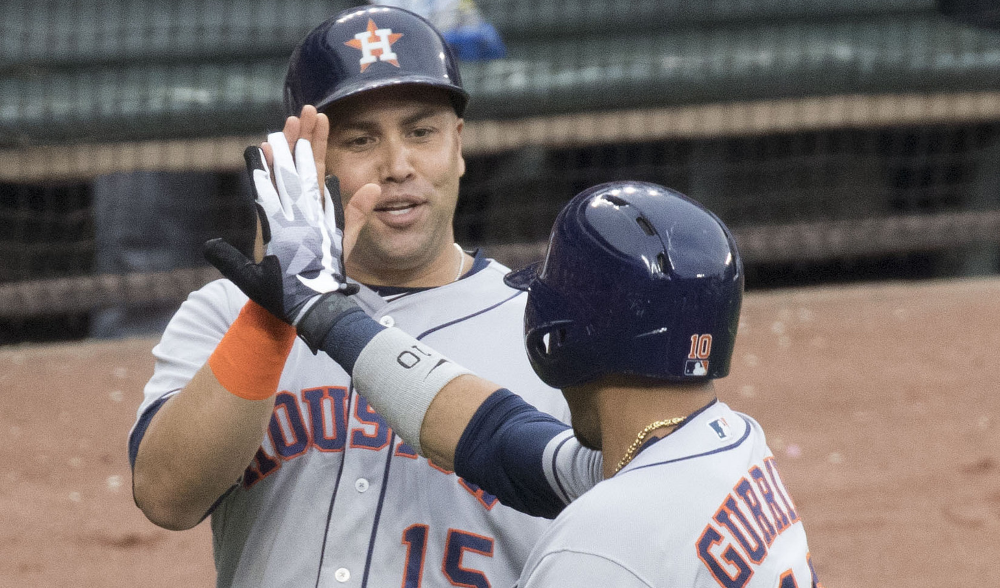
No player in the postseason has more career wins without a title than Carlos Beltran.
(Photo: Keith Allison)

For fans of 10 (and soon to be eight) teams, finding a club for which to root in the playoffs presents little difficulty: just keep doing what you’ve been doing for the last six months. For the rest of us, though, manufacturing some interest in a team or two can be a useful device for cultivating drama in the postseason.

There are a few ways to go about this, of course. For some, the solution is just as simple as rooting against a rival. For others, supporting a team with lengthy curse or championship drought — like the Red Sox or Cubs in recent years or Cleveland, still, this season — might make sense. Backing an underdog is always popular, obviously, as is pulling for all the small-market teams to beat the larger-market ones. There’s no wrong way to do this. What I’d like to discuss here is another alternative, though — namely, rooting for a specific player.

Perhaps you’ve been already been doing this in some capacity. There’s a player who maybe used to play for your favorite team or one whom you always wished would wear your team’s uniform. For me, the easy answer in year’s past has been Adrian Beltre. He’s a future Hall of Famer and a joy to watch. Add in that he was oh-so-close to a title in 2011, and it’s easy to actively support a scenario in which Beltre finally gets a ring. The Rangers failed to qualify for the playoffs this year, though, so rooting for Beltre isn’t an option.

While the Rangers third baseman will be absent from the postseason, there are a handful of other future Hall of Famers who have yet to win a World Series title and will be playing games that count this October.

Read the rest of this entry »


Jose Bautista Thinks the ALCS Is Rigged

Losing is generally not a fun, enjoyable experience. Winning is better, and when you don’t win, sometimes you look for reasons why that coveted win didn’t occur. In baseball, the margin between winning and losing is often very small, and that has certainly been the case in the American League Championship Series: both of the series’ first two games were close, low-scoring affairs won by a Cleveland team that scored a total of runs. While players generally control outcomes, for a high-scoring team like the Toronto Blue Jays to score just one run in two games, the results have been unusual, a little too unusual, per Mike Vorkunov’s twitter account.

I don’t know if I’m lumped in there with “you guys,” but I’m more than happy to discuss the “circumstances” of which Bautista speaks. Bautista’s addressing the strike zone, and he believes that Cleveland pitchers have been getting borderline calls that Toronto’s pitchers haven’t. Let’s work backwards and begin with Saturday’s game. Here’s the strike-zone plot against left-handers hitters for Cleveland and Toronto pitchers care of Brooks Baseball. (View from the catcher’s perspective.)

cle-tor1015lhh

Green is a called ball and red is a called strike, with Cleveland represented by squares and the Blue Jays represented by triangles. For our purposes here, let’s break things into categories. We can look at missed calls in and out of the strike zone and borderline calls. Based on the typical strike zone, we find two missed calls going against Blue Jays pitchers. For borderline calls, let’s say anything touching the line of the typical strike zone is borderline. By that definition, Cleveland threw three borderline pitches and got two strikes. Toronto threw two borderline pitches and got one strike.

Read the rest of this entry »


MLB Network Playoff Gamble Pays Off, Aids Viewers

Criticisms regarding the length of games and pace of play are likely to continue being a focus for commissioner Rob Manfred as he continues to court a younger audience. Baseball games themselves remain MLB’s main product. Increasingly, however, access to that product has become an issue — an issue that could dwarf any pace-of-play problems in the coming years. As more consumers ditch cable, the lifeblood of Major League Baseball television revenues, fewer fans will have access to MLB games. Access is particularly important in the playoffs, where games receive the most national attention, and MLB’s decision in recent years to broadcast multiple games from it own MLB Network have limited viewership. However, MLB’s decision this season to offer a free preview of the network during the first week of the playoffs appears to have paid off.

There was once an outcry when playoff games moved from network television to cable, but that battle — to the degree that it ever existed — has been long lost. The World Series still airs on FOX, but both League Championship Series now appear exclusively on cable, as does the Division Series. Baseball isn’t alone in this regard, either. While the NFL, with its relatively light postseason schedule (only 11 games total), has managed to avoid moving games to cable, the NBA broadcasts both of its conference finals on cable networks. The NCAA’s championship games for both basketball and football, meanwhile, are found on channels that require a cable subscription. MLB’s decision to use its own network represents a bit of a difference case, however, than either of these.

MLB Network has been carrying playoff games for multiple years now, but with just 30-some posteason games available, the decision to remove two of them from wider circulation on standard cable packages — in essence to promote the league’s network — is a bit of a gamble, representing the equivalent of a healthy advertising investment. Broadcast networks are available in roughly 95% of television households, so putting a game on FOX renders it almost universally accessible to all baseball fans. Moving from FOX to say ESPN, TBS, or FS1 lowers that number to around 75-80% of television households. While that number might not be ideal, the number of subscribers approaches 100 million and reaches a vast majority of fans — both those who already fans of the game, as well as those who might be in the future. MLB Network lacks those numbers.

Read the rest of this entry »


Javier Baez, the Chicago Cubs, and the Value of Versatility

Javier Baez is the Chicago Cubs’ current starting second baseman. It’s a new role for him. In four postseason games, he’s made four starts at the position. By contrast, he’d already played 38 regular-season games before he made his fourth start at second, on June 2. It’s not a role he took over at the All-Star break or even later in the season, like teammate Addison Russell did at shortstop last year. Baez made just 38 starts at the position all year long, and as the team prepped for playoffs in September, Baez received just six starts at second base in the final month. Baez’s versatile regular season — as well as the versatility of other Cubs teammates like Kris Bryant and Ben Zobrist — prepared for any role in the postseason, and that versatility enabled by Joe Maddon has played an important role in the team’s success.

Baez is the most shining example of that versatility on the Cubs. He’s played more than 25 games at each of second base, third base, and shortstop — one of only 68 players in history to accomplish that feat, per the Baseball Reference Play Index. While it isn’t so unique that Jedd Gyorko and Darwin Barney weren’t able to also do it this season, Baez’s age is a differentiating factor. Turning 24 years old in December, only Joe Dugan and Rogers Hornsby nearly a century ago accomplished the feat at a younger age (both by just a few months). Baez is also one of only 66 players in history to record at least 50 games at both second and third base. Given that he’s the only name on both lists, it appears safe to say he’s the only player in baseball history with at least 25 games at shortstop, 50 games at second base and 50 games at third base.

Read the rest of this entry »


Did Joe Maddon Get Too Cute in Game 3?

It should be said that it’s players who win and lose baseball games. Jake Arrieta, Ty Blach, Kris Bryant, Madison Bumgarner, Aroldis Chapman, and Conor Gillaspie: all had a greater impact than Chicago Cubs manager Joe Maddon on the outcome of last night’s thrilling 13-inning, 6-5 San Francisco victory. Because players are often forced to make decisions quickly, however, it’s difficult to question the wisdom of those decisions. Telling Hunter Pence not to swing at a 102-mph fastball several inches out of the zone, for example, ignores the reality the situation. There’s no time for deliberation. The same isn’t necessarily true for managers.

Managers, too, make difficult decisions — decisions which, given the wealth of information they possess relative to the general public, are also frequently difficult to critique responsibly. But their thought process is easier to decipher and their decisions are less physical — excepting those that come from the gut. In Game 3 of the Division Series against the Giants, a crazy game that might have been over many times, Maddon made a number of decisions. Most, especially the successful and inconsequential, went unnoticed. What follows is a review of the less successful, less inconsequential decisions.

Using Aroldis Chapman in the Eighth

While this choice is likely to get the most attention, given that Chapman came in and blew the save, using Chapman in the eighth is pretty close to a no-brainer. When Chapman entered the game in the eighth inning and no outs, the Cubs were leading by one run. With runners on first and second and nobody out, however, the Giants actually possessed the higher win expectancy (51%). The leverage index was a massive 5.13. For comparison’s sake, when David Ross came to the plate in the top of the 13th with runners on first and second and one out, the leverage index was a very high, but less light, 4.62. At no point in last year’s 12-inning, World Series-concluding game did the leverage index ever reach 5.0. And actually, after Chapman struck out Hunter Pence, the leverage index even increased to 5.44 for Conor Gillaspie’s plate appearance. Using your lights-out pitcher in this situation is certainly the right move.

Read the rest of this entry »


Trusting Blue Jays Closer Roberto Osuna

In this year’s postseason, relievers have received attention based on when (or if) they have entered the game. For the Toronto Blue Jays and closer Roberto Osuna, there were questions a week ago whether Osuna would be able to pitch at all in the postseason after being removed from the Wild Card victory over the Baltimore Orioles with a shoulder issue. Osuna pitched to four batters in that game, retiring them all and striking out two, but his availability for the recently completed Division Series against the Texas Rangers was in some doubt. Osuna has laid those doubts, as well as those that accompanied a less-than-stellar end-of-season run, to rest.

If you were to hazard a guess at which Blue Jays player was most important in this year’s playoffs — at least in terms of increasing the probability of winning games — you probably would not guess Roberto Osuna. You would also be right not to guess Osuna, as Josh Donaldson’s nine hits and a walk in 19 postseason plate appearances led to a team-leading .635 WPA over the Jays’ four postseason games. Osuna, however, is second on the team WPA leaderboard, despite pitching in only three of the four games and recording just five total innings.

Toronto WPA Leaders, 2016 Playoffs
Player WPA
Josh Donaldson .635
Roberto Osuna .462
Edwin Encarnacion .442
Ezequiel Carrera .242
Marco Estrada .216
Jason Grilli .178
Troy Tulowitzki .152
J.A. Happ .122

Osuna, despite his shoulder issue, has now appeared in three of the four Blue Jays playoffs games (having not been needed in the Game 1 rout of the Rangers). In this year of the non-traditional closer use in the postseason, Osuna has yet to come in at the start of the ninth in a save situation. Every single appearance has been incredibly important — and has often coincided with the most important moments of each game, by leverage index.

Roberto Osuna Playoff Appearances
Game Situation Runners/Outs IP First Batter LI Highest LI in Game
WC Game T9 (tied) 0/0 1.1 2.32 2.32
Game 2 ALDS B8 (up 5-3) 2/1 1.2 2.73 3.30*
Game 3 ALDS T9 (tied) 0/0 2.0 2.32 2.74
*The 3.30 LI occurred with Osuna on the mound in the ninth.

In the playoffs this year, Blue Jays pitchers have faced 15 batters at a point in the game when the leverage index had reached 2.0 or greater. Osuna has recorded eight of those high-leverage plate appearances — more than J.A. Happ (who had four in his start), Francisco Liriano (one), or Joe Biagini (two, one of which was a run-scoring double by Mitch Moreland in Game 2).

Read the rest of this entry »


Age, Salary, and Service Time on the Playoff Rosters

The eight teams playing in the Division Series all built their teams in different fashions. The Astros and Cubs appear to be at the end of rebuilding projects and ready for an extended run at contention. The Rangers have a mix of holdovers from their runs a few years ago, some young players and an infusion in the form of Cole Hamels. The Royals’ combination of process and prospects allowed them to begin a surprising run one season ago. The Blue Jays built a dynamic offense which they supplemented with major moves at the deadline. The Cardinals are in the midst of continuing contention, the Dodgers have spent their way to the top, and the Mets were mired in mediocrity before young pitching and Yoenis Cespedes aided their surge into the playoffs. The teams come with different experience and payrolls.

It’s no secret that the Dodgers have the biggest payroll in the game by close to $100 million over the second-place Yankees. Also fairly well known is that a considerable amount of that money is going to players who are no longer on the team — and many of whom, in fact, were never even on the Dodgers at all this year. Dan Haren, Matt Kemp, Brandon League, and Brian Wilson were responsible for $45 million all on their own. Despite all of the dead money on the Dodgers’ payroll, however, they still have considerably more money on the field compared to the rest of the teams still competing for a World Series.

Read the rest of this entry »