SAN DIEGO — The early hours of Wednesday morning at the Winter Meetings brought a giant-sized deal for baseball’s latest home run giant… but not from the Giants. After a day in which it appeared as though Aaron Judge had decided he was not in fact prepared to be “a Yankee for life,” as he had previously professed, and would instead leave the Bronx to sign with the the team for which he grew up rooting in Linden, California, about two hours from the Bay Area, the 2022 AL MVP has returned to the Bronx via a record-setting nine-year, $360 million deal.
The move happened only after Judge arrived in San Diego on Tuesday night and heard overtures from a third team, the Padres, who had reportedly offered Trea Turner a $342 million deal before the shortstop signed with the Phillies on Monday. Via USA Today‘s Bob Nightengale, San Diego offered Judge $40 million per year over 10 years; whether either deal included deferred money isn’t known. According to the New York Post’s Jon Heyman, the Yankees had offered Judge eight years and $320 million — about $90 million more than the offer that he spurned just before Opening Day. “Once Judge told Hal Steinbrenner he wanted to be a Yankee (but had more $ on table elsewhere — SF and SD) Hal sealed the deal by bumping it another $40M and one year,” Heyman wrote. Read the rest of this entry »
The following article is part of Jay Jaffe’s ongoing look at the candidates on the BBWAA 2023 Hall of Fame ballot. It was initially written for The Cooperstown Casebook, published in 2017 by Thomas Dunne Books, and subsequently adapted for SI.com and then FanGraphs. For a detailed introduction to this year’s ballot, and other candidates in the series, use the tool above; an introduction to JAWS can be found here. For a tentative schedule and a chance to fill out a Hall of Fame ballot for our crowdsourcing project, see here. All WAR figures refer to the Baseball-Reference version unless otherwise indicated.
It happened so quickly. Freshly anointed the game’s top prospect by Baseball America in the spring of 1996, the soon-to-be-19-year-old Andruw Jones was sent to play for the Durham Bulls, the Braves’ High-A affiliate. By mid-August, he blazed through the Carolina League, the Double-A Southern League, and the Triple-A International League, then debuted for the defending world champions. By October 20, with just 31 regular-season games under his belt, he was a household name, having become the youngest player ever to homer in a World Series game, breaking Mickey Mantle’s record — and doing so twice at Yankee Stadium to boot.
Jones was no flash in the pan. The Braves didn’t win the 1996 World Series, and he didn’t win the ’97 NL Rookie of the Year award, but along with Chipper Jones (no relation) and the big three of Greg Maddux, Tom Glavine, and John Smoltz, he became a pillar of a franchise that won a remarkable 14 NL East titles from 1991 to 2005 (all but the 1994 strike season). From 1998 to 2007, Jones won 10 straight Gold Gloves, more than any center fielder except Willie Mays.
By the end of 2006, Jones had tallied 342 homers and 1,556 hits. He looked bound for a berth in Cooperstown, but after a subpar final season in Atlanta and a departure for Los Angeles in free agency, he fell apart so completely that the Dodgers bought out his contract, a rarity in baseball. He spent the next four years with three different teams before heading to Japan at age 35, and while he hoped for a return to the majors, he couldn’t find a deal to his liking after either the 2014 or ’15 seasons. He retired before his 39th birthday, and thanks to his rapid descent, he barely survived his first two years on the Hall of Fame ballot, with shares of 7.3% and 7.5%. Over the past three cycles, he’s more than quintupled that support, jumping to 19.4%, 33.9%, and 41.4%, a point where eventual election, either by the writers or a small committee, becomes a legitimate possibility. With five years of eligibility remaining, he still has a chance to get to 75% from the writers. Read the rest of this entry »
The following article is part of Jay Jaffe’s ongoing look at the candidates on the BBWAA 2023 Hall of Fame ballot. For a detailed introduction to this year’s ballot, and other candidates in the series, use the tool above; an introduction to JAWS can be found here. For a tentative schedule, and a chance to fill out a Hall of Fame ballot for our crowdsourcing project, see here. All WAR figures refer to the Baseball-Reference version unless otherwise indicated.
Carlos Beltrán was the quintessential five-tool player, a switch-hitting center fielder who harnessed his physical talents and became a superstar. Aided by a high baseball IQ that was essentially his sixth tool, he spent 20 seasons in the majors, making nine All-Star teams, winning three Gold Gloves, helping five different franchises reach the playoffs, and putting together some of the most dominant stretches in postseason history once he got there. At the end of his career, he helped the Astros win a championship.
Drafted out of Puerto Rico by the Royals, Beltrán didn’t truly thrive until he was traded away. He spent the heart of his career in New York, first with the Mets — on what was at the time the largest free-agent contract in team history — and later the Yankees. He endured his ups and downs in the Big Apple and elsewhere, including his share of injuries. Had he not missed substantial portions of three seasons, he might well have reached 3,000 hits, but even as it is, he put up impressive, Cooperstown-caliber career numbers. Not only is he one of just eight players with 300 homers and 300 stolen bases, but he also owns the highest stolen base success rate (86.4%) of any player with at least 200 attempts.
Alas, two years after Beltrán’s career ended, he was identified as the player at the center of the biggest baseball scandal in a generation: the Astros’ illegal use of video replay to steal opponents’ signs in 2017 and ’18. He was “the godfather of the whole program” in the words of Tom Koch-Weser, the team’s director of advance information, and the only player identified in commissioner Rob Manfred’s January 2020 report. But between that report and additional reporting by the Wall Street Journal, it seems apparent that the whole team, including manager A.J. Hinch and general manager Jeff Luhnow, was well aware of the system and didn’t stop him or his co-conspirators. In that light, it’s worth wondering about the easy narrative that has left Beltrán holding the bag; Hinch hardly had to break stride in getting another managerial job once his suspension ended. While Beltrán was not disciplined by the league, the fallout cost him his job as manager of the Mets before he could even oversee a game, and he has yet to get another opportunity.
Will Beltrán’s involvement in sign stealing cost him a berth in Cooperstown, the way allegations concerning performance-enhancing drugs have for a handful of players with otherwise Hallworthy numbers? At the very least it appears likely to keep him from getting elected this year. What remains to be seen is whether voters treat him like Rafael Palmeiro and banish him for a big mistake (a positive PED test) in the final season of an otherwise impressive career, or like Roberto Alomar and withhold the honor of first-ballot induction for an out-of-character incident (spitting at an umpire) before giving him his due. Read the rest of this entry »
After overcoming a slow start and firing manager Joe Girardi, the Phillies made it all the way to the World Series for the first time since 2009. On Monday, they took a significant step toward improving their chances of returning, and of upgrading their oft-shaky defense, signing shortstop Trea Turner to an 11-year, $300 million deal, one that includes a full no-trade clause.
Turner, who turned 29 on June 30, spent the past season and a half with the Dodgers after coming over from the Nationals in the 2021 trade deadline blockbuster that also brought Max Scherzer to Los Angeles. In 2022, he earned All-Star honors for the second time, batting .298/.343/.466 (128 wRC+) with 21 homers, 27 steals (in 30 attempts), and 6.3 WAR. He played 160 games and led the NL in plate appearances (708) and at-bats (652) and ranked fourth in steals.
While Turner’s offensive performance represented a dip from his 2021, when he won the NL batting title (.328/.375/.536, 142 wRC+), led the league in steals (32), and ranked third in WAR (6.8), he was still an impressive ninth in the last of those categories in ’22. Bolstered by average defense at shortstop — no small accomplishment or attraction for a team that has employed Didi Gregorius in the recent past — he was third in WAR among shortstops behind Francisco Lindor (6.8) and fellow free agent Dansby Swanson (6.4), but his longer track record for strong production than Swanson, and the added dimension of his speed, had to make him the more attractive of the two for a long-term deal. Toward that end, it’s worth noting that Turner placed second on our Top 50 Free Agents list below only Aaron Judge, one spot ahead of Carlos Correa, four ahead of Xander Bogaerts, and six ahead of Swanson.
The size of Turner’s contract outdid both our median crowdsource estimate (seven years, $210 million) and that of listmaker Ben Clemens (nine years, $288 million), a common theme from among the early deals so far. That should’t surprise us within an industry that appears to have set a record in revenues (just shy of $11 billion) and that just got a $900 million windfall ($30 million per team) from MLB selling its remaining 15% stake in the BAMTech streaming platform to Disney. Read the rest of this entry »
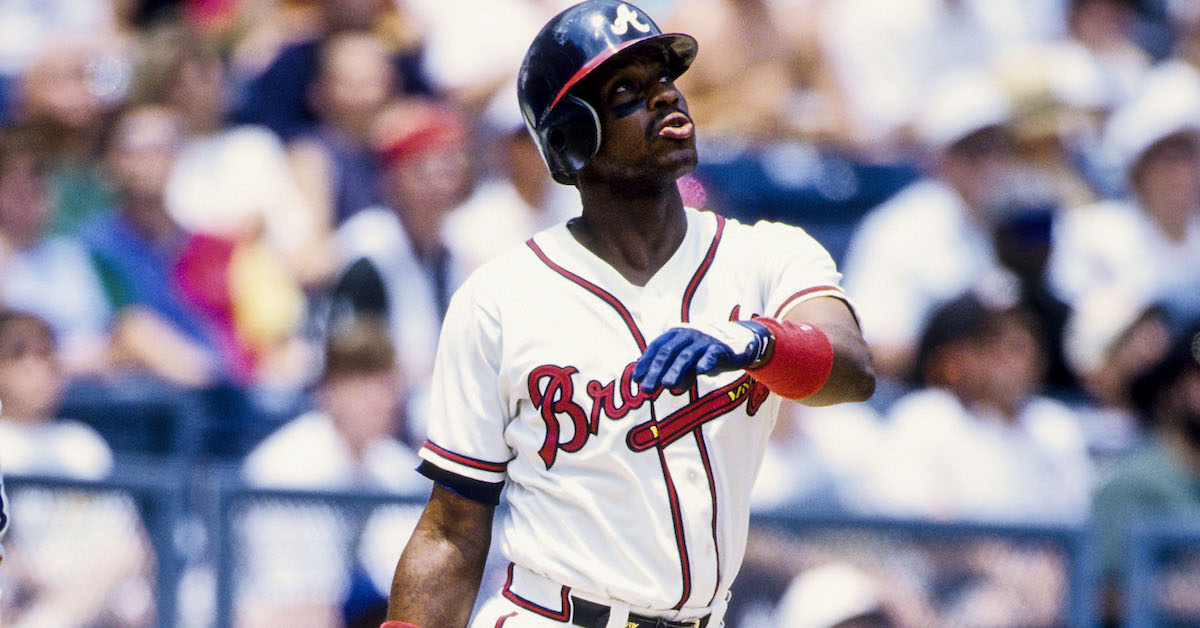
SAN DIEGO — The Crime Dog is going to Cooperstown. On Sunday, the Contemporary Baseball Era Committee unanimously electedFred McGriff to the Hall of Fame, bypassing far more statistically impressive candidates — namely Barry Bonds, Roger Clemens, and Rafael Palmeiro — due to their connections to performance-enhancing drugs. On a panel that included two former teammates (Greg Maddux and Kenny Williams, with Chipper Jones appointed but replaced at the last moment due to illness) as well as former Blue Jays executive Paul Beeston, McGriff was the only candidate from among the eight to reach the necessary 75% of the vote.
Curt Schilling — who like Bonds and Clemens fell off of the BBWAA ballot after 10 years this past January having bled voter support after a seemingly endless string of noxious public comments that culminated with supporting the January 6, 2021 insurrection and comparing Dr. Anthony Fauci to a Nazi — also fell short, though he fared better than the Gruesome Twosome. Indeed it’s not hard to see the results as a rebuke of PED-linked candidates, whether or not they actually tested positive and were penalized by Major League Baseball, by a committee seemingly engineered to keep them out. Read the rest of this entry »
The following article is part of Jay Jaffe’s ongoing look at the candidates on the BBWAA 2023 Hall of Fame ballot. For a detailed introduction to this year’s ballot, and other candidates in the series, use the tool above; an introduction to JAWS can be found here. For a tentative schedule and a chance to fill out a Hall of Fame ballot for our crowdsourcing project, see here. All WAR figures refer to the Baseball-Reference version unless otherwise indicated.
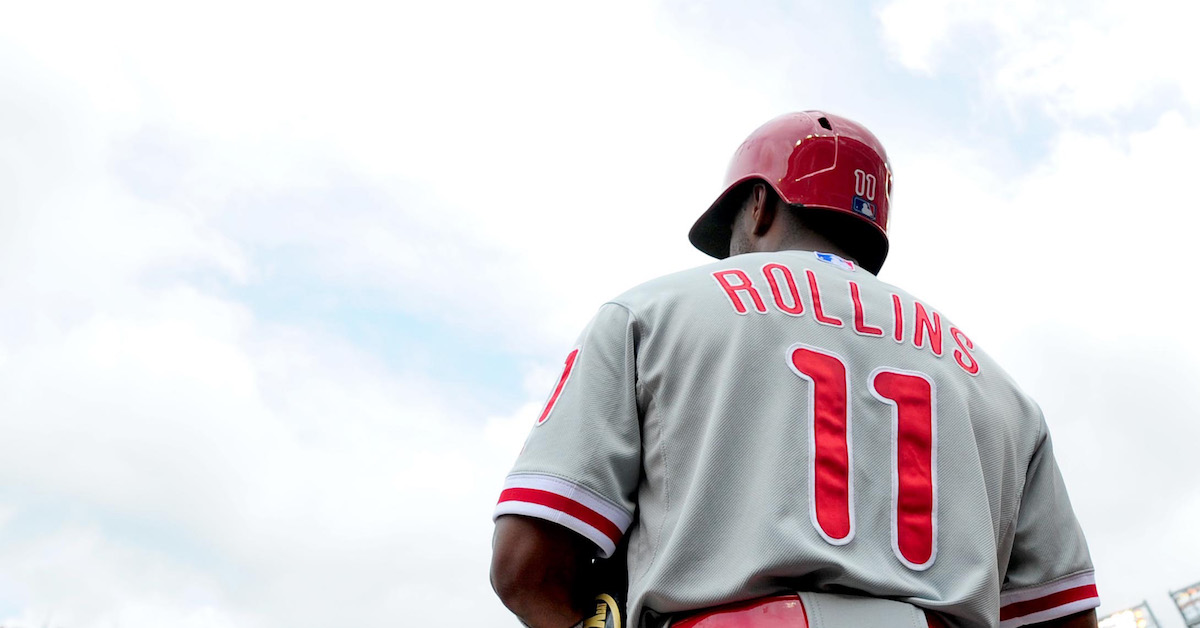
Few players have ever been more central to the Phillies than Jimmy Rollins. In fact, with the exception of Mike Schmidt, no player spent more time in a Phillies’ uniform than Rollins, and even counting the Hall of Fame third baseman, none collected more hits or stole more bases. The pint-sized shortstop — 5-foot-7, 175 pounds according to Baseball Reference — spent 15 of his 17 major league seasons with Philadelphia, where he was at the center of the team’s return to contention following a slide into irrelevance at the outset of the Wild Card era.
Rollins was the starting shortstop on the Phillies’ five straight NL East champions from 2007-11, including their ’08 World Series winning squad — just the second in franchise history — and ’09 pennant winner. A slick fielder who offered speed and pop from both sides of the plate atop the lineup, he garnered the nickname “J-Roll” from legendary Phillies broadcaster Harry Kalas. J-Roll projected a confidence that bordered on cockiness, and carried himself with a swagger. “We’re the team to beat,” he said at the outset of the 2007 season, all but thumbing his nose at the reigning NL East champion Mets, who had outdistanced the Phillies by 12 games. Read the rest of this entry »
Here’s my @fangraphs intro post regarding the process, and the disappointment regarding some candidates absent from among the 8 on the Contemporary Baseball Era Committee ballot blogs.fangraphs.com/new-format-fam… 1/x
The following article is part of Jay Jaffe’s ongoing look at the candidates on the BBWAA 2023 Hall of Fame ballot. Originally written for the 2016 election at SI.com, it has been updated to reflect recent voting results as well as additional research. For a detailed introduction to this year’s ballot, and other candidates in the series, use the tool above; an introduction to JAWS can be found here. For a tentative schedule, and a chance to fill out a Hall of Fame ballot for our crowdsourcing project, see here. All WAR figures refer to the Baseball-Reference version unless otherwise indicated.
Billy Wagner was the ultimate underdog. Undersized and from both a broken home and an impoverished rural background, he channeled his frustrations into throwing incredibly hard — with his left hand, despite being a natural righty, for he broke his right arm twice as a child. Scouts overlooked him because he wasn’t anywhere close to six feet tall, but they couldn’t disregard his dominance over collegiate hitters using a mid-90s fastball. The Astros made him a first-round pick, and once he was converted to a relief role, his velocity went even higher.
Thanks to outstanding lower-body strength, coordination, and extraordinary range of motion, the 5-foot-10 Wagner was able to reach 100 mph with consistency — 159 times in 2003, according to The Bill James Handbook. Using a hard slider learned from teammate Brad Lidge, he kept blowing the ball by hitters into his late 30s to such an extent that he owns the record for the highest strikeout rate of any pitcher with at least 800 innings. He was still dominant when he walked away from the game following the 2010 season, fresh off posting a career-best ERA. Read the rest of this entry »
It’s not hard to muster some cynicism when it comes to the Era Committee voting. Like the various iterations of the Veterans Committees that proceeded it, the small panels of Hall of Famers, executives, and media members tasked with evaluating Era Committee ballots inevitably include voters with strong connections to the candidates, and with that, some potential for cronyism. This isn’t an abstraction confined to the dusky past, not when it was just three years ago that Harold Baines was elected by a Today’s Game panel that included White Sox owner Jerry Reinsdorf, manager Tony La Russa, and general manager Pat Gillick, all of whom had overseen significant stretches of Baines’ career, creating conflicts of interest that almost certainly aided his election. Thus one couldn’t help raise an eyebrow on Monday after the Hall announced the 16 voters who will serve on the Contemporary Baseball Era Committee. The group will vote on eight candidates on Sunday, December 4, at the Winter Meetings in San Diego.
As ever, it’s not hard to start connecting the dots between the panelists and the eight candidates and think about what that might portend, particularly when the ballot’s most notorious player, Barry Bonds, appears to be the orphan of the bunch. The all-time home run leader and seven-time MVP has the credentials for Cooperstown, obviously, but the allegations concerning his connection to performance-enhancing drugs kept him from reaching 75% of the vote at any time during his 10-year run on the BBWAA ballot. Now he’s within a process that allows the Hall to stack the deck against him.
Each Era Committee is appointed by the Hall of Fame board of directors and chaired by Hall chairman of the board Jane Forbes Clark (as a non-voting member). Usually the configuration is something like eight Hall of Famers, four executives and four media members/historians, but that’s not etched in stone. This one has seven Hall of Famers, six execs, and three media members:
The following article is part of Jay Jaffe’s ongoing look at the candidates on the BBWAA 2023 Hall of Fame ballot. Originally written for the 2014 election at SI.com, it has been updated to reflect recent voting results as well as additional research. For a detailed introduction to this year’s ballot, and other candidates in the series, use the tool above; an introduction to JAWS can be found here. For a tentative schedule, and a chance to fill out a Hall of Fame ballot for our crowdsourcing project, see here. All WAR figures refer to the Baseball-Reference version unless otherwise indicated.
Jeff Kent took a long time to find a home. Drafted by the Blue Jays in 1989, he passed through the hands of three teams that didn’t quite realize the value of what they had. Not until a trade to the Giants in November 1996 — prior to his age-29 season — did he really settle in. Once he did, he established himself as a standout complement to Barry Bonds, helping the Giants become perennial contenders and spending more than a decade as a middle-of-the-lineup force.
Despite his late-arriving stardom and a prickly personality that sometimes rubbed teammates and media the wrong way, Kent earned All-Star honors five times, won an MVP award, and helped four different franchises reach the playoffs a total of seven times. His resumé gives him a claim as the best-hitting second baseman of the post-1960 expansion era — not an iron-clad one, but not one that’s easily dismissed. For starters, he holds the all-time record for most home runs by a second baseman with 351. That’s 74 more than Ryne Sandberg, 85 more than Joe Morgan, and 86 more than Rogers Hornsby — all Hall of Famers, and in Hornsby’s case, one from before the expansion era (note that I’m not counting homers hit while playing other positions). Among players with at least 7,000 plate appearances in their career who spent at least half their time at second base, only Hornsby (.577) has a higher slugging percentage than Kent’s .500. From that latter set, only Hornsby (1.010) and another pre-expansion Hall of Famer, Charlie Gehringer (.884), have a higher OPS than Kent (.855). Read the rest of this entry »


 Jay Jaffe


