This is the latest installment of a series in which the FanGraphs staff rounds up the latest developments regarding the COVID-19 virus’ effect on baseball.
Big Leaguers Step Up on Minor League Pay
Late last week, the Nationals announced that they would be lowering their minor league stipend from $400 to $300 per week. The move drew immediate criticism from minor leaguers, and from those on the big league club as well. Within hours, Nats major leaguers had pledged to make up the difference to those affected, as Sean Doolittleannounced.
The optics, and indeed the factual basis, of these two countervailing reactions were terrible for the club. A $100 cut is necessarily a far bigger deal for a minor leaguer than the major league team as a whole, and the players’ instant support of their minor league teammates led to a public relations backlash against the team. Read the rest of this entry »
There’s been considerable movement from both the players and the owners since our last round of polling. For the first time, May will no longer be an option for the season start date. Thanks again for taking the time to answer these questions, and help us understand your perspective on a potential 2020 season. Read the rest of this entry »
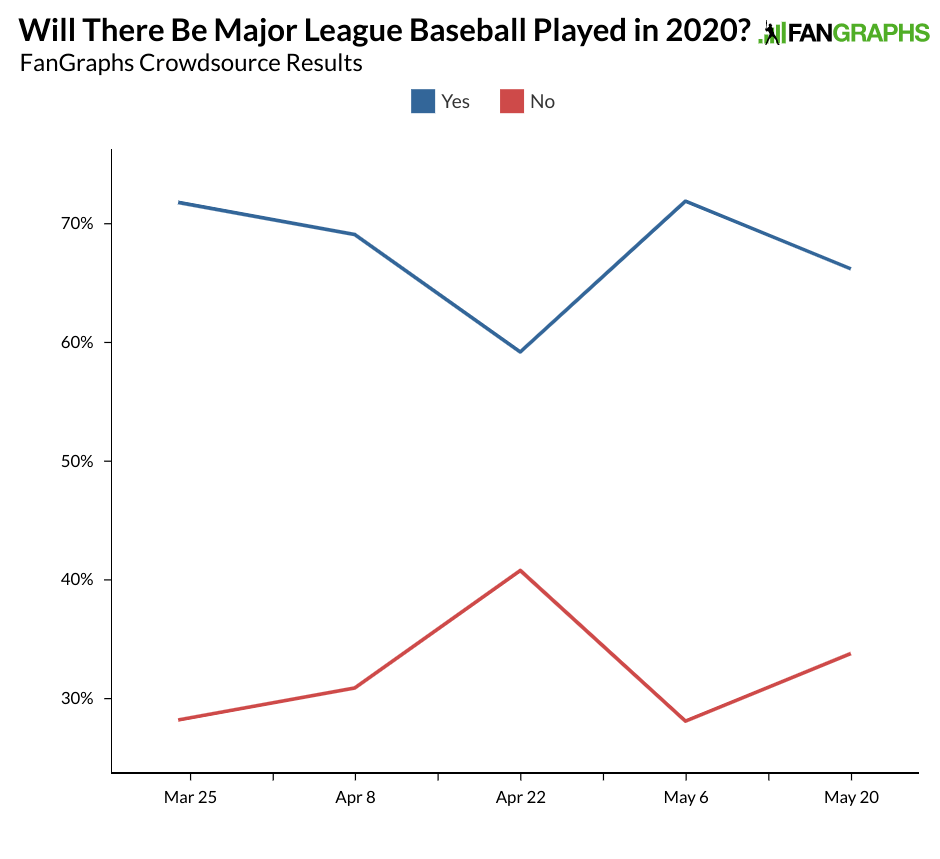
Usually, these results would have been posted last week, but the holiday combined with having some other business to attend to meant a delay until today. The polls closed early last week, before the most recent news cycle of proposals began. We again received more than 1,000 responses, similar to the first four rounds. In the fourth round of voting, the results showed more optimism that some sort of baseball season would be played than in any of the three prior rounds of polling. The results weren’t quite as rosy this time, but two-thirds of the responses believed there would be a 2020 season.
Here’s how the results have tracked since late March:
We saw a couple wild swings the last few rounds, and it will be interesting to see what the next round brings, but this week has settled in between.
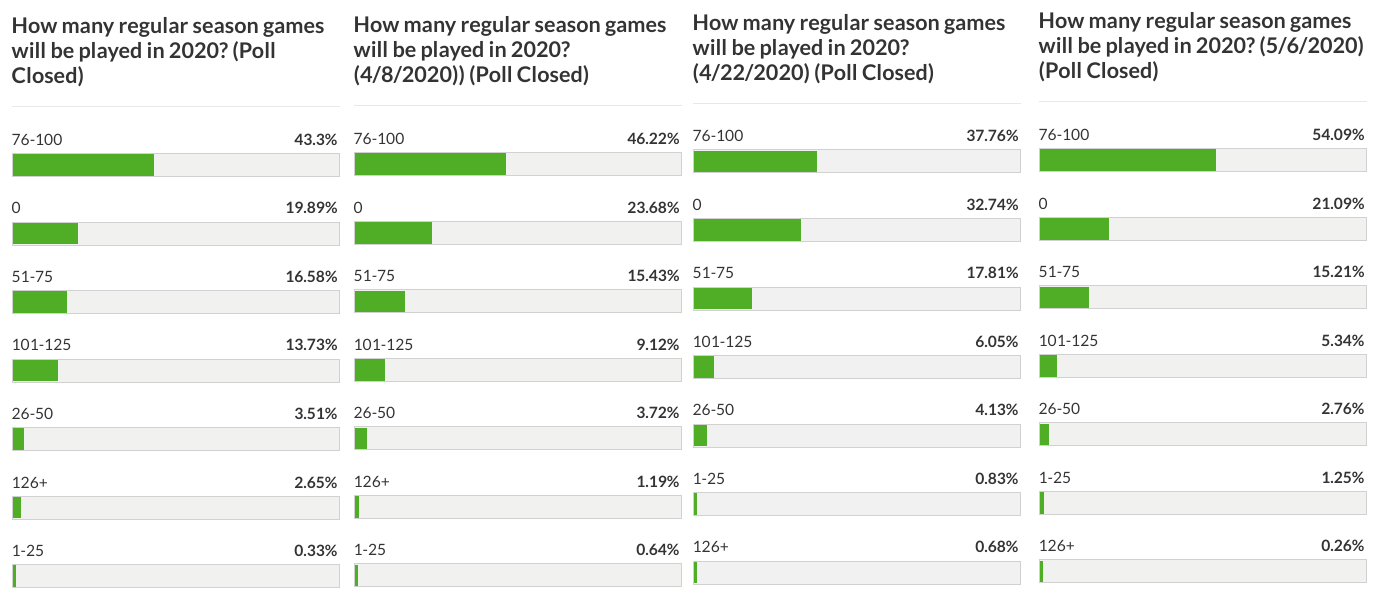
In terms of the number of games, here’s how the responses looked the first four rounds:
And this round:
We see 76-100 maintaining the top spot, falling a bit as zero picks up some votes. The big change came in the outlier groups: those thinking there will be more than 100 games are basically non-existent, while the 51-75 group has picked up a bunch of votes.
As for when the season will start, this will be the last poll with May as an option, though it’s not as if it was a popular choice:
These results are basically in line with the last poll, with July or Never leading the way, though certainly some of the July responses might move to August before switching to Never.
As the league’s public plans have shifted from spring training facilities to home ballparks for game sites, the crowd has shifted its answers in response:
A month ago, 60%-65% of responses thought spring training sites would host regular season games. Two weeks ago, those responses dropped around 10 percentage points and they dropped again this round, with the majority believing no regular season games would take place at spring training sites.
As for games without fans, the results mostly line up with the number of regular season games, though there’s a small percentage of the 76-100 votes above that do shift downward, meaning a small percentage of respondents do expect some games with fans this season:
As for when the season will end…
Late November was about 10 percentage points higher in the last round of voting and it appears those lost votes split between No Season and early November. It appears MLB’s stated preference of a relatively normal postseason schedule if not format has caused some answers to move a little earlier in the year.
As for that format, we’ve seen a massive shift, as the clear majority of fans believe there will be expanded playoffs this season:
Expanded playoffs has nearly doubled in terms of responses since just a couple weeks ago.
Later this week, we’ll take another crack at polling our readers. Given the spate of news across the last week, it will be interesting to see how the mood has shifted.
This is the latest installment of a series in which the FanGraphs staff rounds up the latest developments regarding the COVID-19 virus’ effect on baseball.
Some Minor Leaguers Have Pay Extended, While Others Still Await Word
With the end of the month rapidly approaching, major league baseball teams are running into a deadline of sorts for whether or not they will continue to pay minor league players in the midst of what is all but certain to be a cancelled MiLB season. One of the first teams to announce their decision on this matter was the Oakland A’s, and as my colleague Dan Szymborski discussed in his Wednesday roundup, the news wasn’t positive — A’s minor leaguers will not receive their $400-per-week stipends after May 31. That set a rather ominous tone, but fortunately, many teams in the past 48 hours have come forward with renewed guarantees to their prospects. Here’s a table of what we know about which teams have promised future stipends to minor leaguers, and for how long.
This is the latest installment of a series in which the FanGraphs staff rounds up the latest developments regarding the COVID-19 virus’ effect on baseball.
Oakland A’s Make Drastic Cuts to Minor League Compensation
With the odds of any kind of minor league season being played away from team complexes getting increasingly long, the Oakland A’s announced that they are ending the $400 weekly subsidies paid to their minor leaguers effective June 1; all 30 teams had previously agreed to pay such subsidies until the end of May.
“Unfortunately, considering all of the circumstances affecting the organization at this time, we have decided not to continue your $400 weekly stipend beyond May 31,” Athletics General Manager David Forst wrote in an email to the organization’s minor league players. “This was a difficult decision and it’s one that comes at a time when a number of our full-time employees are also finding themselves either furloughed or facing a reduction in salary for the remainder of the season. For all of this, I am sorry.”
Given the minimum salaries in the minors, which range from $290 a week in rookie ball to $502 in Triple-A, the team could have paid all of their minor leaguers the minimum for just over $1 million. (Note that this comes at the same time MLB is trying to effectively memory hole $1 billion in revenues in their public battle with the MLBPA.)
The clock is ticking on Major League Baseball’s return to play, at least under a proposed timeline that would allow for a three-week spring training in June, an Opening Day in early July, and an 82-game schedule that follows the rough outline of the typical baseball calendar, with the bulk (if not the entirety) of the postseason in October. Over the past couple of weeks, the league and the players have attempted to find common ground with respect to both health and safety issues related to the COVID-19 pandemic as well as the financial ones, the latter with considerably more acrimony — so much so that the threat of no baseball in 2020 still looms, even after the owners made a formal proposal to the union on Tuesday calling for the game’s highest-paid players to bear a disproportionate burden of the financial hit.
The plan, three people with knowledge of the proposal told USA TODAY Sports, does not include the same 50-50 revenue-sharing split the owners agreed on two weeks ago that was never submitted to the union…
The proposal instead includes a sliding scale of compensation, guaranteeing players a percentage of their salary during different intervals of the season, while also including a larger share of postseason money. The players earning the highest salaries would be taking the biggest cuts, while those earning the least amount of money would receive most of their guaranteed salaries, with the union determining the exact percentage splits.
One person who had been briefed on the proposal said the expectation is that players due to make $1 million or less in 2020 would be made close to whole on a prorated basis for games played. Thus, if someone were making the MLB 2020 minimum of $563,500 and 82 regular season games (almost exactly half a season) were played, they would receive roughly half their pay, about $282,000.
But players at the top of the pay chain such as Gerrit Cole and Mike Trout would get less. If that were in the 50 percent range — as an example — then Cole, who was due $36 million, this year would receive half of about the $18 million he would be due for half a season or roughly $9 million.
This is the latest installment of a series in which the FanGraphs staff rounds up the latest developments regarding the COVID-19 virus’ effect on baseball.
MLB’s Extensive List of Health and Safety Protocols Is Being Dissected
Last Saturday, a 67-page document laying out all of the health and safety measures considered necessary for a 2020 major league season was reported by The Athletic. In the week since, voices from inside baseball as well as the public health and epidemiology fields have weighed in on what the proposal means, where it goes too far, and where it falls short.
Beginning with medical experts — since they really are the most important voice here — the perspective seems to be that MLB’s proposal is extensive and thoughtful, but the actual execution of it will be challenging. That was the sentiment communicated by Andy McCullough and Marc Carig in a story for The Athletic that ran Thursday. Part of the challenge could be ensuring that measures are taken as seriously as they should be for as long as possible. If MLB’s protocols are effective, it will mean the virus isn’t spreading throughout clubhouses. That will make the threat seem less dangerous, which could lead to people letting their guard down and no longer following the rules as closely.
Troublingly, the steps toward that false sense of security has already begun. In a report by ESPN’s Jesse Rogers, players openly wondered why so many restrictions would be necessary in an environment where everyone has tested negative for the virus. As doctors have warned, however, false negatives exist, and allowing everyone to proceed with life as normal would be very risky regardless of test results. Read the rest of this entry »
This spring, one of the stickiest issues in the negotiations between the owners and the MLBPA was that of service time credit, a subject that has long caused labor friction. If the 2020 season occurs, the issue of service time credit will largely take care of itself. But what if there is no 2020 season? The lost salaries are hard enough, but the lost service time would have made those losses even greater. Using ZiPS to consider just 15 prominent free agents-to-be after the 2020 and 2021 seasons, I estimated that those players alone would lose roughly $316 million on their next contracts.
In return for $170 million in guaranteed money — an advance if play happened to recommence this year — and agreeing not to sue for their lost salaries, the players struck a deal. If 2020 is not played, the free agents-to-be in 2021 will still hit the market this winter, as players will be credited for the same amount of service they accrued in 2019.
MLB’s system of arbitration and free agency is based on bright lines; five years and 171 days and you have to go through salary arbitration, while one more day lets you hit free agency. The agreement between players and owners benefits them collectively, but inevitably, some individuals will find themselves on the wrong side of one of those new bright lines. And in this case, a few dozen young players, many of whom are among the brightest young talents in baseball, would still be under an additional year of team control if 2020 is lost. Read the rest of this entry »
Two weeks have passed since the last round of questions, so I am once again asking you to weigh in on the shape and size of the potential 2020 baseball season. Thanks in advance for your help in providing these responses. Read the rest of this entry »
This is the latest installment of a series in which the FanGraphs staff rounds up the latest developments regarding the COVID-19 virus’ effect on baseball.
The Rent-is-Too-Damn-High Team
The Oakland A’s and the county stadium authority are in a dispute over ballpark rent. This isn’t the first time there’s been such a dispute at the stadium sometimes known as the Oakland Coliseum. In 2014, the lease-extension negotiations between the A’s and the county stadium authority broke down over a dispute over withheld payments. The Oakland Raiders also withheld rent payments in 2015, part of an ongoing dispute that ended with the Raiders leaving for Las Vegas thanks to a sweetheart deal in their new city.
What’s new this time, of course, is the effect of pandemic economics. Citing the force majeure clause in the contract between the Athletics and the stadium authority, A’s general counsel D’Lorna Ellis referenced the unavailability of the stadium for play to justify the team deferring payment “until [they] have a better understanding of when the Coliseum will be available for use.”
The Coliseum Authority Executive Director made the issue a bit more confusing with contradictory statements, first saying that “because they haven’t used it, they were not able to generate revenue and they have no ability to pay,” before assuring the San Francisco Chronicle that the A’s never suggested revenue was an issue.