Last Saturday, Jalen Beeks had a thoroughly unimportant day at the ballpark. With the Rays trailing Toronto 5-1, he came in to pitch the top of the ninth inning. The stakes? Helping the team hit the showers 10 or 15 minutes earlier, I’d say – he wasn’t going to catapult Tampa to a win with a good performance, what with a four-run deficit and only three outs remaining, but everyone on the team would surely appreciate an efficient outing.
He did it! He got three straight groundball outs. After that, while he presumably changed into his street clothes in the clubhouse, the Rays failed to score in the bottom half of the inning, and the game ended. Thank you for coming to this episode of “FanGraphs Narrates Low-leverage Relief Outings.”
But wait! After this humdrum appearance, an anonymous tipster lit the FanGraphs signal (it’s like the Bat Signal, only with the FanGraphs logo instead). There was more to this half inning than first met the eye. I was on the case. Read the rest of this entry »
When Mookie Betts scuffled through the first couple weeks of the 2022 season, the Dodgers and their fans had cause for concern. The 29-year-old right fielder was coming off the worst season of his eight-year major league career, one in which he was beset by injuries. With well over $300 million still coming his way over the next two decades (a good chunk of which is deferred), this seemed like an inopportune time for him to demonstrate that he was already well into his decline.
One four-week (and counting) hot streak later, it appears that reports of Betts’ demise have been greatly exaggerated. His overall numbers don’t jump off the page due to his slow start, but in this year’s difficult offensive environment, his .263/.354/.482 line is good for a 141 wRC+, which ranks 14th in the NL, and his 1.6 WAR is tied for sixth. He’s been particularly hot lately, hitting .360/.429/.840 with three doubles and three homers over his past six games.
Betts may have created some unrealistic expectations after being acquired by the Dodgers in a protracted five-player blockbuster in February 2020. He proceeded to ink a 12-year, $365 million deal in July, then help his new team win its first championship in 32 years — and his second in three. In the pandemic-shortened campaign, he hit .292/.366/.562 for a 147 wRC+, his highest mark aside from his 2018 AL MVP-winning campaign (185). His 2.9 WAR placed third in the league, he finished second in the NL MVP voting, and he put on a tour de force during the postseason, showing off his skills at the plate, on the bases, and in the field on a nightly basis, right up through the World Series-clinching Game 6 in which he set up the tying run with a scorching double that was just the Dodgers’ second hit of the night, sped home with the go-ahead run on an infield grounder, and added an insurance run via a late homer. Read the rest of this entry »
Who is the most underrated player in the game? The question isn’t an easy one, and that’s especially true for the combatants themselves. Asked for their opinions, a handful of players I approached in recent weeks figuratively threw up their hands. Of the 12 who did come up with names, a majority had to chew on the question before providing an answer. Almost to a man, the initial response was some form of, “Man, that’s tough.”
I posed the question with one ground rule. Players were allowed to name a current teammate, but only if they also named someone from another team. I also offered leeway on “most.” If choosing just one was too challenging, they could simply give an example of a player they consider to be underrated.
The answers, all procured at Fenway Park, are as follows.
“I’ll say Kyle Tucker. I think he’s one of the top-five best players in the league. He doesn’t get enough credit. For me, he’s an MVP type of player. I think he’s going to win multiple MVPs in his career.
“A guy on another team… give me a minute. I’ll say Javier Báez. People obviously give him some credit, but I think he is way better than what a lot of people think. What he brings to the team, to the league, to the fans… he’s fun to watch. He’s got power. He hits. He plays defense. He does everything. I would pay for a ticket to watch him.” Read the rest of this entry »
The main reason why the Astros have been able to survive and thrive despite the departure of a large percentage of the core of their 2017 World Series-winning team is their success in developing their young talent. One of the most prominent of these players, Kyle Tucker, had his breakout season in the shortened 2020 and cemented those gains with a .294/.359/.557, 4.9 WAR 2021 campaign that saw him get his first MVP votes. With Tucker heading to arbitration this winter for the first time, the Astros discussed a long-term contract with their incumbent right fielder in recent weeks, but the deal has apparently fallen through.
The Astros recently spoke with Kyle Tucker’s camp about a contract extension, but the sides were unable to come to a deal and are no longer engaged, sources tell me and @brianmctaggart. Tucker will become arbitration-eligible for the first time at the end of this season.
While it hasn’t worked out, it’s the right idea. Teams want to lock up their best young players, and many players, especially before they get that first big arbitration bump, are interested in mitigating their personal risk. Wander Franco was more likely than not to beat the $182 million he’ll receive from the Rays and the team they trade him to around 2029, but it also provided him some real security, given he’s still a couple years from arbitration. These types of deals can be win-win.
So who should be the next players to get inked for the long haul? Here are my favorite picks. For each, I’ve included their ZiPS projections for both performance and a fair contract; after all, I don’t own a team, so I don’t have the motivation to pitch any absurdly team-friendly agreements like the one Ozzie Albies signed with the Braves. I’ve also omitted Juan Soto since we’ve already talked about him and a long-term deal quite a bit, most recently in Jay Jaffe’s piece before the season that already has the ZiPS projections. If you want a figure, let’s just say 10 years and all circulating US currency. Read the rest of this entry »
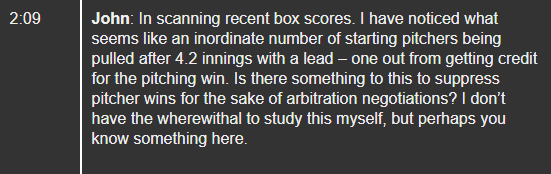
Yesterday, a reader in my chat asked me a question I had no idea how to answer: Are teams increasingly pulling pitchers from games after 4 2/3 innings, even with the lead, in an attempt to cut down on wins and arbitration payouts? Here’s the question in its entirety:
My snap judgment was “probably not.” After thinking about it for a while longer, my answer is still no – but now I have some neat graphs and charts that will hopefully make the point clear. Without further ado, let’s dive into the shape of league-wide starting pitching trends since 1974, the first year in our database of game logs.
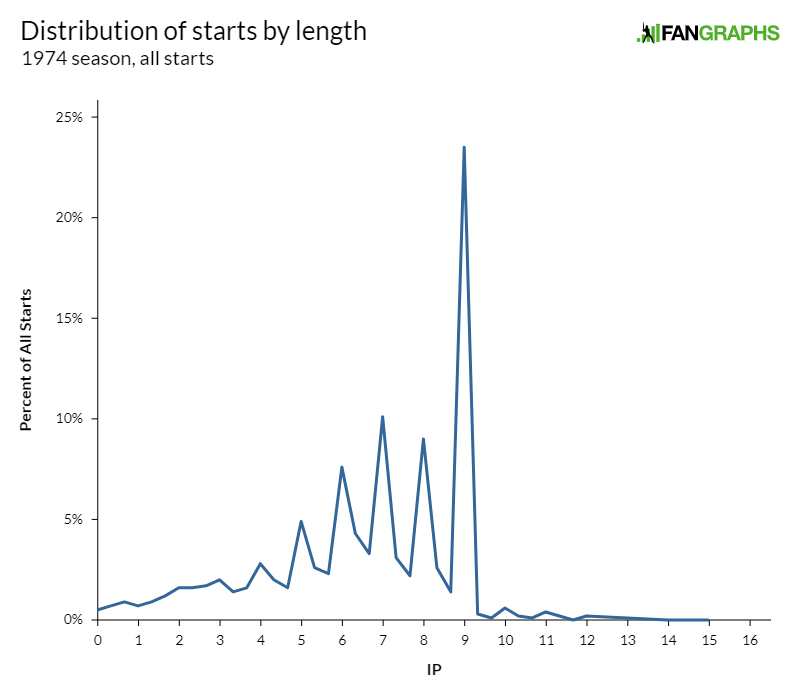
In 1974, the concept of a five-inning start existed, but it was almost an insult. More than a quarter of starts went nine or more innings. That’s hard to do, particularly when that’s an impossible feat for a visiting team that trails after the top of the ninth inning. If that’s roughly a quarter of games (it’s not every game the visiting team loses, but road teams lose more than half of the games they play), that means that roughly a third of eligible starts went at least a full nine. That’s downright wild. Here’s a graph of that wildness:
There were a few short starts, even back in the 1970s – 21% of starts went fewer than five innings. More importantly, a pattern we’ll see repeated again and again is immediately evident. Managers like leaving their pitchers in for a whole number of innings. It’s a natural endpoint to the day, mid-inning pitching changes can be tricky, it’s a way of boosting your starter’s confidence – there are plenty of reasons for this to be the case, and I’m not sure which is most true, but that’s just a fact of baseball. Managers like to pull their starters between innings rather than partway through. Read the rest of this entry »
Last year’s National League West race was a doozy, with the 107-win Giants outpacing the 106-win Dodgers, but this year’s race is shaping up to be an interesting one for a different reason. Through Sunday, all five teams owned winning percentages of .500 or better, though Monday’s loss by the Rockies (17-18), part of a 1-7 skid, upset that arrangement. Even so, it’s an impressively strong division headed by the Dodgers (22-12), with the Padres (22-13) and Giants (21-14) close behind, and the Diamondbacks (18-18) and Rockies playing quite respectably, and much improved over last season.
The biggest surprise of the bunch is the Diamondbacks, who just last year tied the Orioles for the majors’ worst record at 52-110 and finished a honkin’ 55 games out of first place. The team did not have a high-impact offseason; the only free agents the Diamondbacks signed to major league deals were starter Zach Davies and relievers Mark Melancon and Ian Kennedy, with Melancon’s two-year deal the only one stretching beyond 2022. They weren’t exactly big players in the trade market, either, with Sergio Alcántara and Jordan Luplow representing their highest-profile acquisitions. That pair has combined for 103 plate appearances and 0.1 WAR, and Alcántara was DFA’d and lost to the Padres via waivers earlier this month. Read the rest of this entry »
Josh VanMeter was in the news earlier this month for being put in an unfortunate position. A 27-year-old infielder with the Pittsburgh Pirates, VanMeter moved behind the plate in the eighth inning of a tie game when the team was forced to employ an emergency catcher. It didn’t go particularly well. Wearing the Tools of Ignorance for the first time since he was 14 years old, the Ossian, Indiana native took a foul tip off the mask, and Pittsburgh pitchers surrendered seven runs in his lone inning of unscheduled action.
There is more to VanMeter than his ill-fated notoriety. A 2013 fifth-round pick by the San Diego Padres who broke into the big leagues with the Cincinnati Reds in 2019, and who has since played for the Arizona Diamondbacks and now the Pirates, VanMeter is a bona fide hitting nerd.
In the latest installment of our Talks Hitting series, VanMeter sat down during a recent series at PNC Park to discuss the art and science of the craft.
———
David Laurila: You’re a hitting nerd…
Josh VanMeter: “I am. It all started back in 2016 when I was with the Padres. I was in the Cal League and having a pretty good year, then got promoted to Double-A San Antonio about halfway through. I had a hitting coach there named Johnny Washington — he’s the assistant with the Cubs now — and I’ll never forget. I was a guy who hit a lot of groundballs and would occasionally clip some homers, but I was super steep. Within a week, Johnny — who I still love to this day — was like, ‘Man, that ain’t gonna work.’ I was like, ‘What do you mean it ain’t gonna work?’ I was 21 and had been having some success. But he was right. That half season I was in Double-A, I really struggled. Read the rest of this entry »
If I may, I think the uncertainty regarding this season’s offensive environment has made us a bit paranoid. Are hitters lagging behind pitchers due to an irregular spring training? Is the ball not traveling like it once did because it’s been replaced yet again, or is the mass introduction of humidors to blame? Or worse, has MLB introduced multiple balls into the game, some of which are being used in certain games to boost action or influence outcomes?
That last theory has been floating around my Twitter feed for a while now. I’m not going to discuss whether it’s true, but I brought it up because supporters of the multiple ball theory will often compare two batted balls with near-identical exit velocities and launch angles. One ends up traveling more than the other, despite all the indications that it should not. Aha! Something must be up.
In response, a lot of people have suggested batted ball spin as an explanation. Maybe one ball came off the bat with backspin and the other came off with topspin, which would drag the ball down as it traveled through the air. Unfortunately, since data on batted ball spin isn’t available on Baseball Savant, this might seem like a dead end. Don’t worry, though: I had some leftover Trackman data on 2021 NCAA Division I baseball games from a piece that Eric Longenhagen and I collaborated on during last year’s Draft Week, and they contain mostly complete readings on the spin of a batted ball. Could we use collegiate baseball to learn about the odds and ends of batted ball spin, and what it tells us about hitting? Read the rest of this entry »
A quick word of warning: this one is pretty abstract. If you like baseball math, it’s definitely got that. If you like analysis of the 2022 major league season, it absolutely does not have that. I think it’s pretty fun, but if that’s not your cup of tea, this one might not be for you. Anyway: on to the nonsense!
I’m the kind of maniac who likes to play baseball video games when I’m not writing about baseball. Right now, that’s Out Of The Park 23, specifically the Perfect Team mode. It’s a baseball simulation where you collect cards representing current and historical players, build teams, and then play simulated games against other players’ teams.
The headline mode of the game lets you collect whoever you want and battle against your opponents’ best shot – peak Mickey Mantle against peak Tex Hughson, say. That’s fun in its own way (for what it’s worth, Mantle strikes out more than you’d like when facing top-tier competition), but I’m more interested in another mode the game offers: tournaments where you match a limited pool of your players against a limited pool of opponents. Read the rest of this entry »
Pitchers getting injured is never good news, even in a year in which pitching talent seems relatively easy to come by. Sadly, we got a bunch of high-profile names hitting the IL over the weekend, so here’s a quick Monday rundown in case you were doing something more fun on Sunday than stressing about injuries, like watching the baseball games (non-Giants fans, at least).
Given the monumental task of replacing Jacob deGrom in the Mets’ rotation at the start of the season, Megill took his job surprisingly literally, doing his best imitation of the team’s ace. Through six starts, his ERA stood at 2.43 with a nearly identical FIP at 2.44, improving significantly on his major league debut in 2021. Then came the worst start of his professional career — including the minors — as he surrendered eight runs and didn’t even make it through the second inning against the Nationals last Wednesday. Megill can’t point to bad luck either; it’s hard to complain too strenuously about BABIP when you have an xBA of .563 and an xSLG of 1.263.
On the plus side, Megill’s velocity wasn’t down during that disaster of a start, and he didn’t report any discomfort until after the game. One thing that struck me, however, is how much his horizontal release point has changed in a lateral direction throughout the season. From his first start to his last outing, Megill’s horizontal release point has shifted about five inches; those release points tend to be far more consistent in-season, as players are more likely to tinker with this in the winter and spring. Release point inconsistency is a concern, and at least one study that I’m familiar with has linked shifting lateral release points with an eventual need for Tommy John surgery, albeit with low odds (a roughly 5% higher chance of a UCL tear with every 10 centimeters of movement). That’s getting ahead of ourselves, but it’s something to file in the back of your mind.
The decision to put Megill on the IL was made after he experienced soreness during his bullpen on Saturday, with biceps tendinitis as the announced culprit. Colin Holderman got the immediate call-up to take Megill’s spot on the roster, though that may be short-lived, as David Peterson started on Friday. Trevor Williams will get Megill’s start on Monday night against the Cardinals.
In other Mets injury news — of course there’s more, it’s the Mets — catcher James McCann will be out six weeks due to a broken hamate bone. Patrick Mazeika was called up and likely endeared himself to Mets fans more than McCann has by hitting the go-ahead home run in the seventh on Saturday against the Mariners. McCann’s offense has disappeared so quickly over the last year-plus that there’s not likely to be any real consequence for the Mets other than a thinning of the depth chart.
Amid a promising comeback campaign, Luzardo took a step back last week, walking four and allowing four runs in 2.2 innings against the Diamondbacks, bloating his ERA to 4.03. Like Megill, there were no suspicious velocity dropoffs — something to watch for given Luzardo’s injury history — but he reported forearm soreness after the game. In “crossing our fingers” news, he did not believe the pain was similar to what he experienced before his first Tommy John surgery, back when he was a high schooler in 2016:
I just started feeling a little something in the San Diego game, towards the back end of it, but nothing when I was pitching or anything like that. It was more just a little soreness. I kind of backed off a little between my starts. There wasn’t really pain or anything, more like stiffness.
The Marlins held off until this weekend to place Luzardo on the IL, retroactive to his May 10 start, when it became evident that he would be unavailable. It seems that Cody Poteet, already stretched out a bit in relief of Luzardo against Arizona and not used since, will get the spot start on Tuesday, with Sandy Alcantara going on Monday.
As for replacing Luzardo long-term, it doesn’t appear as if the Marlins plan to recall top prospect Max Meyer to fill the spot. My reading of the tea leaves is that they’re not going to push Edward Cabrera up soon as a replacement either; while he’ll get another chance in the not-too-distant future, I think Saturday’s start against Triple-A Nashville would have been a few tune-up innings rather than a 90-pitch outing if a callup was imminent.
Short of any additional bad news, it’s entirely possible that, with two off days in the next week, Luzardo may only miss just the one start.
Kershaw was a late scratch on Friday against the Phillies, pushing Walker Buehler’s start up a day on normal rest. Kershaw has a history of lower back pain and at least one instance (2012) of hip impingement, so the Dodgers are being careful with him. The culprit this time is inflammation of the SI joint, which, I believe, is the sacroiliac joint and not the Sports Illustrated joint; on the pelvis, it’s between the hip and the spine. As I did not attend Hollywood Upstairs Medical College, and my medical knowledge is primarily evaluating how sick I’ll feel if I eat some deliciously spicy food, let’s consult actual doctors here:
Biomechanically, the sacroiliac joint performs several functions. Primarily, its purpose is to attenuate the distribution of force loads from the lower extremities. It functions both as a shock absorber for the spine above and converts torque from the lower extremities into the rest of the body.
As pitching largely involves transfers of force between body parts, it’s understandable why the Dodgers see the need to be cautious. Last year was the first time Kershaw was placed on the IL with elbow issues, and given that it scared them enough to shut him down quickly for the postseason, this is not unexpected caution.
To replace Kershaw on the roster, the Dodgers called up Michael Grove, who got the start on Sunday and may get another down the road, though with a very quick hook. Andre Jackson looked like a rotation fallback option at the start of the season, but he’s failed to finish the third in each of his last three starts for Triple-A Oklahoma City, allowing 10 walks in just 3.1 innings.