Archive for Featured

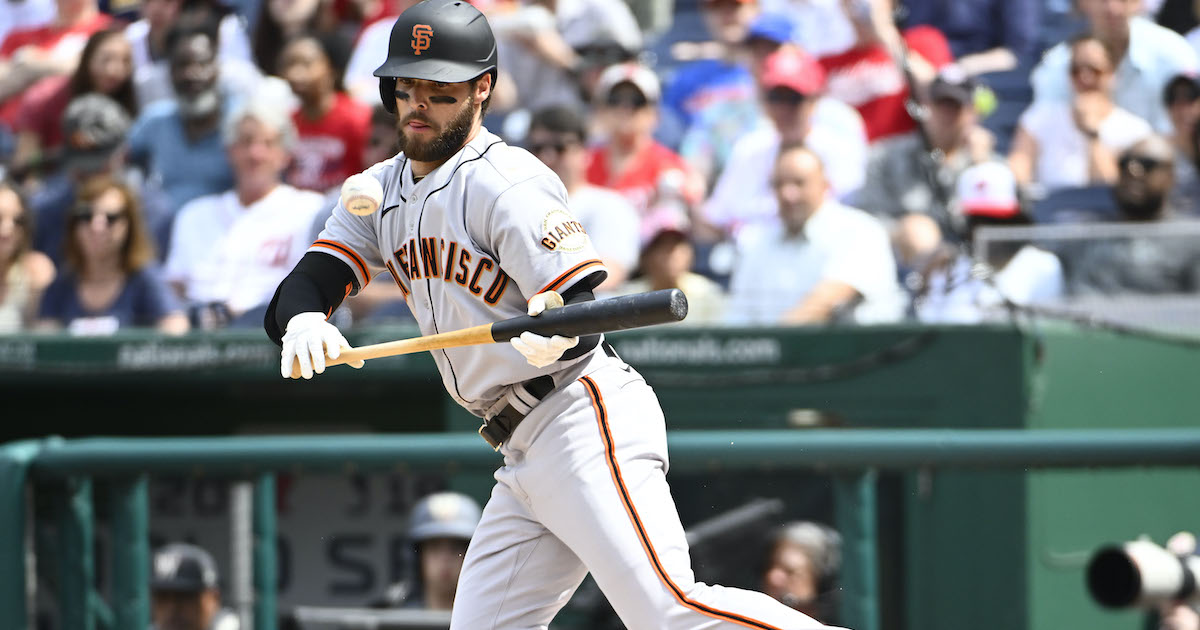
The Giants Love to Bunt. Or Do They?

Luis Gonzalez San Francisco Giants
Brad Mills-USA TODAY Sports

Coming into 2022, Mike Yastrzemski was something of a cipher. Was he a late bloomer who suddenly learned how to hit? From 2019 through the 2021 All Star break, he was excellent, to the tune of a .266/.350/.514 slash line, a 128 wRC+, and 48 homers in 932 plate appearances. Or was he old news, a flash in the pan that pitchers developed a counter for? In the second half last year, he hit .212/.281/.483, struck out nearly 30% of the time, and generally looked like the career minor leaguer he’d been before 2019.

This year, he’s been back on track, and it’s largely been due to a better on-base percentage. Some of that is striking out less; he’s turned in a career-low swinging-strike rate and career low strikeout rate to go along with it. Just as importantly, though, he’s doing better on balls in play, and doing so partially by bunting — something of a San Francisco specialty this year.

In the first 300 games of his career, Yastrzemski bunted ten times. That generally tracks; he’s not particularly fast and hits for power. Why would he do anything other than clock balls over the fence — or, in spacious Oracle Park, into triples alley and off the wall? In fact, you might think that 10 bunts was 10 too many, if it weren’t for the fact that he turned six of them into hits.

This year, he’s put that plan into overdrive, with three bunt hits already after a third of a season. He’s been part of a concerted San Francisco bunting effort so far this year. The team has gone after shifts that don’t respect bunting ability by targeting them early and often, and its captain, Brandon Belt, is something of a bunting enthusiast himself. In fact, the Giants lead baseball in bunt hits, with 11, despite having exactly zero of the 75 fastest runners in baseball this year, per Statcast’s sprint speed leaderboard.
Read the rest of this entry »


Alex Bregman Talks Fixing His Swing, How Pitchers Approach Him, and More

Alex Bregman
Dan Hamilton-USA TODAY Sports

Alex Bregman has a reputation for being a studious hitter. Moreover, he has a well-earned reputation for being a productive hitter. The 28-year-old Houston Astros third baseman boasts a .371 wOBA and a 139 wRC+ in just over 3,000 career plate appearances. At his best, he’s been a beast; in 2019, he slugged 41 home runs and slashed a robust .296/.423/.592.

Recent seasons have seen Bregman perform below his pre-pandemic standards, but even with the downturn he’s been putting up solid numbers. His wRC+ since the start of the 2020 season is equal to this year’s 117. Still in his prime from an age standpoint, he remains a feared hitter in the middle of the Houston lineup.

Bregman talked hitting when the Astros visited Fenway Park in mid-May.

——-

David Laurila: How would you describe your approach to hitting?

Alex Bregman: “The most important thing is knowing what kind of hitter you are [and] knowing what’s going to make you successful. I think that swinging at pitches you can do damage with is extremely important. I think that taking pitches that you can’t do damage with is extremely important. In my best years, I’ve swung the least, while in my worst years I’ve swung the most. I’ve put balls in play that I shouldn’t be putting in play, because they weren’t pitches that I can do damage on.”

Laurila: How can a hitter go about controlling that? A swing decision is something that happens in a blink of an eye.

Bregman: “Good hitters can recognize when pitches are coming into that zone. They can do that early and be able to make a decision, ‘yes or no,’ pretty quickly.”

Laurila: Does a hitter’s hot zone ever change? Read the rest of this entry »


Texas Rangers Top 50 Prospects

© Annie Rice/Caller-Times via Imagn Content Services, LLC

Below is an analysis of the prospects in the farm system of the Texas Rangers. Scouting reports were compiled with information provided by industry sources as well as my own observations. This is the second year we’re delineating between two anticipated relief roles, the abbreviations for which you’ll see in the “position” column below: MIRP for multi-inning relief pitchers, and SIRP for single-inning relief pitchers.

A quick overview of what FV (Future Value) means can be found here. A much deeper overview can be found here.

All of the numbered prospects below also appear on The Board, a resource the site offers featuring sortable scouting information for every organization. It has more details than this article and integrates every team’s list so readers can compare prospects across farm systems. It can be found here. Read the rest of this entry »


Sunday Notes: Orioles Hitting Coach Ryan Fuller Loves Books (and Follows Soccer)

Ryan Fuller taught high school English in Higganum, Connecticut for four years before becoming the hitting coach of the Baltimore Orioles. An infielder at the University of Connecticut before spending a year in the Arizona Diamondbacks system, the 32-year-old Fuller went on to earn a Master’s degree in Education from the University of New Haven. Books, and the lessons they provide, remain a big part of his life.

Asked about his favorites to teach, Fuller began with Harper Lee’s “To Kill a Mockingbird.”

“That was a big one for me in 10th-grade honors,” said Fuller, who has tutored hitters at different levels for over a decade. “From a morality standpoint, there are so many things that I connect with. Kids love reading the book and being able to tie it in with what it means to be a good person. They think about other people — about walking in their shoes, as Atticus put it —and the values and morals are still the same today.”

Fuller cited Shakespeare’s “Romeo and Juliet,” F. Scott Fitzgerald’s “The Great Gatsby,” and Stephen Crane’s “The Red Badge of Courage” as other books he’s seen impact specific age groups in particular ways. The lessons are analogous to his current job.

“It’s kind of the same thing we’re doing with our hitters,” explained Fuller, who is well-schooled in hitting analytics. “We’re taking sometimes complex, abstract things that maybe the hitters aren’t really grasping, and turning them into something tangible. They’ll say, ‘Oh, man, that makes sense.” That’s what I enjoy most about being a teacher.” Read the rest of this entry »


Let’s Look Ahead to the Trade Deadline

© Robert Edwards-USA TODAY Sports

It seems like almost yesterday when, amidst the lockout’s flurry of recriminations and constantly shifting arbitrary deadlines, we weren’t quite sure if there was even going to be a 2022 season at all. But Opening Day arrived after a short delay, and now we’re just about a third of the way through the season. The trade deadline is just two months out and as we saw last year, the elimination of the August waiver-trade period served to increase the stakes. While we don’t know the exact contours of what the pennant races will look like or which destinations make the most sense for potential trade candidates, the basic outlines of the season have been drawn. Short of some major surprises, we can start speculating about a few of the more interesting players likely to be available.

Juan Soto, Washington Nationals

The official position of the Washington Nationals is that they aren’t trading Juan Soto, no way, no how. I’m not sure I actually believe them. Soto will be a free agent after the 2024 season and has already turned down a 13-year, $350 million extension offer from the team. Plus, the longer they hang onto him, the less mega of a mega-package they’re likely to net in return for their superstar. It’s tempting to compare Soto’s situation with Bryce Harper’s, but as he approached free agency, the Nationals were fielding a team they had reason to think was competitive. This year’s squad is looking up at the Reds, and the farm system doesn’t have anywhere near the talent needed to quickly salvage the situation. The possibility of a sale and Soto’s age complicate the calculus – if Washington was able to convince him to stick around, he’s young enough that he’s likely to still be very good the next time they are. Soto isn’t posting his normal numbers, but ZiPS sees little reason to worry; it thinks that Soto’s hit data should have resulted in a BABIP closer to .320 and a slugging percentage well in excess of .500, similar to his xBA and xSLG. It would stink for Nationals fans, and putting together a deal worthy of netting Soto is its own challenge, but a trade could be a possibility come August. Read the rest of this entry »


Adam Cimber Slides to the Left

© Nick Turchiaro-USA TODAY Sports

You’ve probably seen Adam Cimber pitch before. It looks strange, like this:

Or fine, maybe you haven’t seen Cimber himself, but you’ve seen someone like him. Righty, low arm slot, baffles same-handed hitters despite an eight-handle fastball (that’s one with an average velocity in the 80s, for those of you who don’t speak obscure bond market jargon).

As you’d expect, Cimber has been far better against same-handed batters in his career. It’s not particularly close, either; he’s allowed a .315 wOBA to lefties compared to just a .275 to righties. That’s just the name of the game when you’re a soft-tossing sidearmer. Batters who get a good look at your delivery will give you fits.

There’s another reason that sidearmers don’t fare well against opposite-handed batters: Their arsenal just doesn’t match up very well. If you can think of one of these pitchers, they probably throw a predictable mix of fastballs and sliders. It’s simply the natural arsenal from that arm slot. You can run fastballs in and mix in sliders that start out headed for the batter’s hip before ending in the opposite batter’s box. Read the rest of this entry »


New FanGraphs & Effectively Wild Merch Is Now Available at BreakingT!

We’re pleased to announced that we’ve launched a whole bunch of new FanGraphs and Effectively Wild merchandise in partnership with BreakingT.

There are three new Effectively Wild shirts, all designed by Luke Hooper. These include a new take on the Effectively Wild logo, a Stat Blast shirt (complete with song lyrics on the back), and the much requested “How Can You Not Be Pedantic About Baseball?” shirt. Read the rest of this entry »


Who’s the Worst Secondary Pitch Hitter (Among Good Hitters)?

© Neville E. Guard-USA TODAY Sports

At its core, hitting is about hitting fastballs. I’m not sure that’s a good thing – pitchers don’t throw as many fastballs as they used to, because they know that hitters are hunting fastballs. Look at the aggregate data, though, and it’s clear. So far this year, batters are 93 runs above average against fastballs, and naturally enough, 93 runs below average against all other pitches. Last year, they were 344 runs above average against fastballs. It’s a consistent pattern throughout baseball history. Ask a hitter, and they’ll probably tell you the same thing. You make your paycheck on fastballs, and you hope not to spend it all on everything else.

That’s not to say that it applies to all hitters equally. Mike Trout is a good secondary pitch hitter – he’s a great hitter overall. Rafael Devers might be a better secondary pitch hitter than he is a fastball hitter. The archetype exists, because, well, good hitters are good.

The opposite is true as well. Max Muncy has done almost all of his damage against fastballs throughout his career. So has Joey Votto, surprisingly enough – from 2018 to now, he’s been five runs below average against sliders, curveballs, changeups, and splitters combined. There’s no one way to be a great hitter – you can tattoo fastballs and live with the damage from everything else, hunt everything else and survive against fastballs, or find some happy medium.

I thought it would be fun to figure out who most embodies this “baseball is about hitting fastballs” lifestyle. In other words, I’m looking for a hitter who is good overall, but incredibly poor at handling secondary pitches. It won’t do to find someone who’s bad at hitting sliders because they’re just bad at hitting; Billy Hamilton is the worst slider hitter in baseball over the past five years (by run value per pitch seen), but well, he wasn’t in the majors for his hitting. Read the rest of this entry »


Aaron Judge’s Decision To Bet on Himself Is Paying Off

As you may recall, just as the season was getting underway, Aaron Judge, who is set to become a free agent after the 2022 season, rejected a contract extension proffered by the Yankees; the deal would have been worth $230.5 million over eight years (seven years at $30.5 million per year, plus $17 million for this year), keeping Judge in pinstripes for most of the rest of his career. Instead, Judge decided to play out his final season under team control and then hit the free agent market with as much leverage as he is ever likely to have. Judge gambled on himself, and while two-thirds of the season remains, the early returns are pointing in his direction.

In a year that has seen offense largely disappear — just as a number of power hitters have seen their performance evaporate — Judge has bucked the trend. After his home run in Sunday’s loss to the Rays, he’s already up to 18 on the season, nearly half of his total (39) from his impressive 2021 campaign. That number even outstrips the pace of his 2017 season, during which he hit 52 round-trippers in an offensive environment far more conducive to crushing pitchers’ dreams. Judge might not have the big contract he’s looking for yet, but he’s done about as much to improve his standing as anyone could in two months.

Judge’s season line stands at a spicy .303/.371/.657, numbers that would count as superlative even in Coors Field during the era’s highest-offense seasons. In 1968: The Next Generation, that’s enough for a 192 wRC+ and 2.8 WAR; spicy may actually undersell just how dangerous he’s been. Read the rest of this entry »


Underachieving White Sox Drop Keuchel and Lose Anderson as Well

Dallas Keuchel
David Richard-USA TODAY Sports

The White Sox have spent the first two months of the season meandering around .500 due to injuries and underperformance. Over the long holiday weekend, they offered reminders of both issues, first designating struggling starter Dallas Keuchel for assignment and then losing Tim Anderson to a groin strain. With Lance Lynn likely to return from a knee injury within the next couple of weeks, the rotation should remain a source of strength for the defending AL Central winners, but Anderson’s absence looms large in a lineup that’s missing several other key players and struggling to score runs.

The 34-year-old Keuchel had pitched poorly this season, with a 7.88 ERA and 6.20 FIP. He’s averaged just four innings per start, walked hitters at the same rate as which he struck them out (12.2%), and served up a career-high 1.69 homers per nine despite being one of the game’s top groundballers. He appeared to be righting the ship with a pair of solid starts against Red Sox and Yankees earlier this month, allowing two runs in 11 innings against the pair on May 8 and May 14, respectively, but both teams pummeled him upon getting a second look, with damage totaling 12 runs in six innings on May 21 (Yankees) and May 26 (Red Sox).

The White Sox signed Keuchel to a three-year, $55.5 million deal in December 2019, and he pitched well enough the following season (1.99 ERA, 3.08 FIP, 1.8 WAR) to place fifth in the AL Cy Young voting. But last year, even while the team ran away in the division race, he was little more than an innings-eater, pitching to a 5.28 ERA and 5.23 FIP in 162 innings and being left off the Division Series roster. Last year’s Statcast expected numbers (xAVG, xSLG, xwOBA, xERA) were actually worse than this year’s numbers:

Dallas Keuchel by Statcast
Year BBE EV Barrel% Hard-Hit% xAVG xSLG wOBA xwOBA ERA FIP xERA
2018 661 87.3 4.1% 32.8% .246 .362 .305 .293 3.74 3.69 3.60
2019 348 88.8 5.5% 38.5% .261 .423 .327 .329 3.75 4.72 4.82
2020 198 86.8 4.0% 31.3% .278 .394 .249 .317 1.99 3.08 4.27
2021 558 88.3 8.9% 39.7% .302 .493 .356 .372 5.28 5.23 6.15
2022 124 88.3 8.9% 34.7% .280 .445 .411 .349 7.88 6.20 4.48
SOURCE: Baseball Savant

Looking back, Keuchel’s 2020 expected numbers contained some warnings that his season wasn’t nearly as good as his ERA or even his FIP suggested. His results on his cutter, in particular, were way out of line with his expected results:

Dallas Keuchel’s Cutter
Year % AVG xBA SLG xSLG wOBA xwOBA Whiff
2018 15.5% .231 .235 .398 .356 .289 .279 21.7%
2019 19.8% .290 .273 .565 .514 .387 .366 16.3%
2020 30.9% .203 .328 .246 .517 .241 .393 21.4%
2021 24.4% .329 .314 .518 .508 .381 .373 17.4%
2022 17.2% .419 .300 .935 .633 .589 .403 21.5%
SOURCE: Baseball Savant

Note that those odd 2020 expected results, which no doubt owe something to the small sample, bore much closer resemblance to his xBA and xSLG for the following year than to his actual AVG and SLG from ’20. Long story short, Keuchel came out smelling like roses when his overall wOBA allowed was 58 points below his xwOBA, but when his barrel rate more than doubled and his wOBA rose 62 points above his xwOBA in 2022, he was out of a job. Read the rest of this entry »