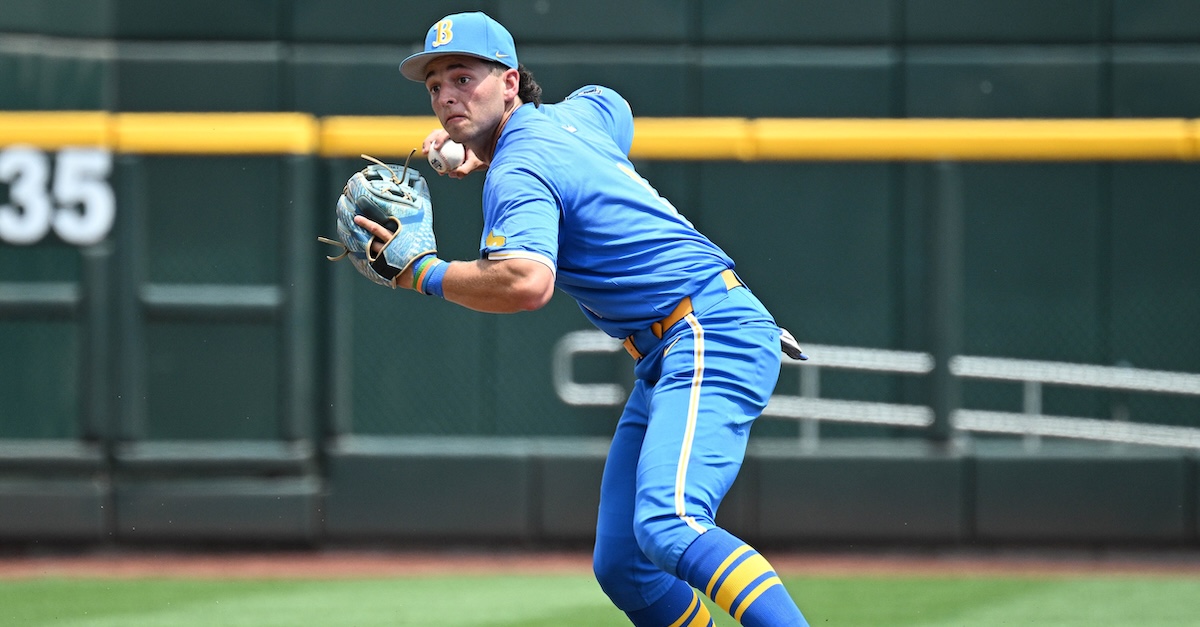
Ben Lindbergh, Meg Rowley, and FanGraphs lead prospect analyst Eric Longenhagen banter about Zack Wheeler declining MLB’s last-minute All-Star invitation, JJ Wetherholt’s long-term contract extension, and how the Futures Game and amateur draft fell flat as spectator events, then discuss the top tier of draft picks, some surprising picks and revamped approaches by teams under new management, why better data hasn’t made teams much better at drafting, why no team has tried blowing by its bonus allotment, and more, plus closing banter about Bryce Harper’s explanation of his video message for a sports-betting addict.
I had the pleasure of attending the 2026 Futures Game yesterday in Philadelphia. Good weather, a big crowd, and great rosters — this game was especially loaded with pitching, which isn’t always the case — made for a fun event.
The nature of the game makes it an imperfect place to evaluate talent. It’s a showcase environment where big tools stand out more than refined skills, and, particularly in a seven-inning game, there’s precious little time for players to show off their range of abilities. Below you’ll find thoughts and reflections on the day, which also included batting practice and pregame defensive work. Inevitably, given the volume of players, some of these write-ups are fairly short, more of a weather report than anything else. In other cases, players moved the needle for me, or at least inspired things for us to monitor over the rest of the season. If you want the full monty on these guys, all of them have full scouting reports on our team-specific lists. We’ve also opted to tuck this recap into our draft coverage navigation widget. If you missed our recap of Day 1, or any of our other coverage, be sure to check it out. Read the rest of this entry »
Below is a team-by-team analysis of last night’s draft activity. Remember that you can find more detailed scouting reports and tool grades for the players drafted yesterday over on The Board. The positions below are what we have them projected as on The Board, not necessarily what the player was announced as. For pitchers, we have a role designated below: starter (SP), or single-inning or multi-inning reliever (SIRP and MIRP).
Arizona was in a tough spot, caught in the middle of the round just after the more skillful hitters (who are usually their type) were picked. They were left with a choice between a few hitters with balanced skill sets but bottom-dwelling defensive fits (like Logan Hughes) or good up-the-middle defenders with hit tool risk. They ended up taking a player from the latter category in Helfrick, who can frame, throw, and has power that he might not tap into consistently due to strikeouts. He could be a Mike Zunino reboot of sorts, which would be a good outcome at the 15th pick. Bryant has a nasty fastball/curveball combo and a projectable frame. We had him ranked 20 spots lower than he was picked, but we don’t really consider him to be a reach; the players in that range are comparable. Kerce has a good shot to be a speedy utility guy, Dowd needs to get stronger, and McDevitt is a test for a player dev group that hasn’t done well with pitchers. His fastball plays, but can they find a secondary pitch? — ELRead the rest of this entry »
I love the draft. Well, from a broader standpoint I find it morally abominable that workers entering an industry have no say in which company they work for or where they’ll be posted. But since we have a draft, and it seems highly unlikely that that’s going to change in the near future, I love covering it.
This is the confluence of amateur baseball (especially college ball, my great love) and the professional game. It’s the dawn of a new age of possibility; for months, we don’t know for sure where Roch Cholowsky or Jackson Flora are going to be playing in the pros. The moment in which we find out is an exciting one. I love seeing the stars of tomorrow before they’ve had their quirks sanded off by the great finishing school that is minor league baseball.
This is a minority position among baseball fans — even diehard fans — and media. In American professional sports, public interest in the draft is proportional to the proximity of draftees to the major leagues. This is as close to a law of natural science as you’ll find in sports, but since the pandemic, Major League Baseball has toyed with finding the limits of that law. Read the rest of this entry »
Here is my final mock draft, which is based on information I’ve continued to gather over the last couple of days. I’ve offered analysis in places where I believed new dope merited it; otherwise, it’s just names. There’s more background for many of these picks in the first mock from a few days ago.
1. Chicago White Sox Pick: Roch Cholowsky, SS, UCLA
Yesterday, teams picking behind Chicago began to believe the White Sox had narrowed their options down to only Cholowsky and Grady Emerson. If the White Sox view Cholowsky and Emerson as equals and the “tie breaker” becomes about bonus money, such that the player being willing to take the lower bonus will help facilitate a bigger, more robust overall draft class for the White Sox, then the pick should be Cholowsky.
If Emerson doesn’t go here, my information indicates he’s going second to Tampa. If Cholowsky doesn’t go here, it’s believed that the Rays prefer Lackey to Roch, with Roch going third to Minnesota. Multiple people have insinuated to me that the Cholowsky camp would rather that not happen. I don’t think the Twins are going to blink, no matter how much money the Giants are willing to offer Cholowsky. They’ll just take him and dare him to go back to UCLA if he truly doesn’t want to sign with them, which is how I would approach the pick. And so maybe there is some symbiosis here, where Roch can land in a spot he prefers and take more than he’d get at pick three (slot there is $9.74 million), but at enough of a discount below the slot at no. 1 ($11.3 million) that it’s worth it to the White Sox. Chicago acquiring an extra pick from the Pirates last night (34th overall) suddenly makes that kind of savings more relevant to the rest of the White Sox draft class than it was 24 hours ago.
Then again, I’m sitting here thinking about Billy Carlson. The idiosyncrasies and vulnerability of Cholowsky’s swing are similar to Carlson’s. How are the White Sox feeling about Carlson so far? Are they emboldened by the changes they made to Jacob Gonzalez’s swing, and confident they can do something similar with Roch if they need to? They just traded Gonzalez. This is conjecture and speculation, whereas the incentives I outlined in the paragraph above are more concrete. Also worth noting here: Emerson and Cholowsky are both represented by Wasserman. That end of the phone line is operating with perfect information; the two players can’t really be played against one another. This scenario where Roch goes first (for $9.74 to $10 million) and Emerson second is the best Wasserman can do for their both clients.
2. Tampa Bay Rays Pick: Grady Emerson, SS, Fort Worth Christian (TX)
If Emerson goes first, I’d expect Lackey to go here.
3. Minnesota Twins Pick: Vahn Lackey, C, Georgia Tech
It sounds like the Twins will take whichever of the three top players remains. Lackey is the top player on my board, but with the same 55 FV grade as Emerson (no. 2) and Cholowsky (no. 3). I did have Drew Burress‘ name mentioned here late last night, at a discount (obviously). Burress’ next realistic homes are rumored to be toward the back of the top 10, so if this is true, Minnesota is looking at a cut of about $2 million and then can flex with their picks in the 70s.
4. San Francisco Giants Pick: Jackson Flora, RHP, UC Santa Barbara
No change from my first mock, where you can read my reasoning. I think pick nos. 4 and 5 will be Flora and Eric Booth in some order. Jacob Lombard is falling.
5. Pittsburgh Pirates Pick: Eric Booth Jr., OF, Oak Grove HS (MS)
I think Pittsburgh dealing the 34th pick last night had a little bit to do with them wanting to improve the big league team and a little bit to do with them waving the white flag at the notion that they were going to be able to leverage their bonus pool into a top-tier player. If Booth goes ahead of them, there’s some late buzz about them possibly diverting away from Flora because the Buccos have “too much pitching,” something that you famously can’t have enough of, and that the Pirates know firsthand to be fragile and volatile. I’d be incredulous if they passed on a guy who I consider to be clearly better than the other options, but the rumored names if they go that route are college outfielders Drew Burress or Derek Curiel.
6. Kansas City Royals Pick: Jared Grindlinger, TWP, Huntington Beach HS (CA)
Kansas City might happily take Booth or Flora here if either of them falls, but I think part of why the Royals have seemingly been kicking the tires on a creative line of play here is because they don’t think that’s likely to happen. Grindlinger’s other homes seem to be in the pick 10-13 range, where the bonus slots are around $6 million. If the Royals can get a deal done with Grindlinger for about that much, their second pick (30th overall) could theoretically be for a nearly $5 million player, though the Giants pick right in front of them and could be a landmine if they try to do that. Grindlinger might be the second- or third-best high school hitter in this class, and to take a player with that kind of upside while simultaneously tee’ing up the rest of your class is a move that takes real moxie given how difficult it is to gauge Grindlinger’s ability compared to the others.
7. Baltimore Orioles Pick: Drew Burress, OF, Georgia Tech
This might be Eric Booth Jr.’s floor if he’s somehow still here. Burress fits with Baltimore’s style of taking high-performing college hitters with their earliest picks and is also a rumored target of their’s.
8. Athletics Pick: Ryder Helfrick, C, Arkansas
The loudest feedback following my first mock was that I had Arkansas catcher Ryder Helfrick entirely too low, with the A’s mentioned as the earliest and likeliest landing spot.
9. Atlanta Braves Pick: Chris Hacopian, 2B, Texas A&M
This is a linchpin pick in this draft that will likely set off a chain reaction for the half dozen or so teams picking immediately behind Atlanta. There’s a scenario where the Braves’ pockets are picked and there’s no one guy left who they love, so they cut an under-slot deal (to buff their options at pick 26) from a short list of players based on which of them would otherwise go latest, as that player has the most incentive to cut. This sequence, where Burress is off the board, spawns that scenario. There’s going to be a run on college hitters immediately following this, and it’s possible Atlanta can get a sense of which of them is falling the deepest throughout the day and make him their target. Hacopian’s injury stuff might be a thing that forces him to the rear of this cluster of college hitters, so I have him speculatively put here. It feels more solid to say that high school lefty Gio Rojas and Virginia outfielder AJ Gracia would otherwise go in the late teens at the earliest, but I think it’d buck Atlanta’s historical trends of caring a lot about pretty deliveries and defensive ability for them to do that. By it’s very nature, the strategy of cutting here to do more at 26 is one of risk mitigation, so taking a guy whose only issue is injury risk feels less scary.
10. Colorado Rockies Pick: Derek Curiel, CF, LSU
I had Curiel off the board ahead of Colorado in my first mock, with Zion Rose here.
11. Washington Nationals Pick: Tyler Bell, SS, Kentucky
I have Washington with college bats, with one source indicating to me they aren’t as strong on Hacopian. Bell would be great value here.
12. Los Angeles Angels Pick: Ace Reese, 3B, Mississippi State
I’m not sure how the late changes atop Los Angeles’ power structure are going to impact this pick, but it feels silly to put the Angels with anything other than college players in the first round until they prove they’re willing to take a high schooler.
13. St. Louis Cardinals Pick: Zion Rose, OF, Louisville
I think this could be a college pitcher if the contact-oriented college hitters are gone at this point, like if Zion goes the pick before this rather than Reese.
14. Miami Marlins Pick: Jacob Lombard, SS, Gulliver Prep (FL)
I think enough teams are scared of Lombard’s contact performance for him to slide. Whether this is actually his backstop I don’t know, but the Marlins have taken high schoolers with hit tool risk pretty consistently, and the optics of this pick would be favorable because they’d get a Floridian who some consider to be a top five pick. Lombard terrifies me, but I still have him ranked ninth because of how big the tools are.
16. Texas Rangers Pick: A.J. Gracia, OF, Virginia 17. Houston Astros Pick: Justin Lebron, SS, Alabama
I think Lebron is gone by one of these two picks. I have very little dope on Texas this year and just consider Gracia as the most stable college hitter left at this point.
18. Cincinnati Reds Pick: Liam Peterson, RHP, Florida
No change, though Trevor Condon’s name has been mentioned here too. With Gio Rojas is still sitting here in this scenario, I wonder if he’d be in the mix for the same reasons (he’s from Florida, and the Reds have been fine using premium resources on high school arms).
19. Cleveland Guardians Pick: Cameron Flukey, RHP, Coastal Carolina
Cleveland takes a Bayesian approach, and Flukey was thought of as a top-10 pick entering the year, then dealt with injury. This is a Gavin Williams sequel if it works out for them.
20. Boston Red Sox Pick: Bo Lowrance, 3B, Christ Church Episcopal (SC)
There have been whispers about Boston cutting here with a contact-oriented college guy, and I wonder if that could be NC State center fielder Ty Head based on their tendencies targeting contact-driven players. This is the middle of where Lowrance’s range is assumed to be.
21. San Diego Padres Pick: Gio Rojas, LHP, Stoneman Dougles HS (FL)
The Padres have been very open to the high school pitching demo and get even better value than they normally would here with Rojas, who becomes the Mick Abel/Andrew Painter of this draft, where it feels silly that arguably the best high school pitcher falls this far.
22. Detroit Tigers Pick: Connor Comeau, 3B, Anderson HS (TX)
Detroit likes projectable, left-handed high school hitters. Bo Lowrance is also a fit, but is off the board in this scenario.
23. Chicago Cubs Pick: Logan Hughes, OF, Texas Tech
24. Seattle Mariners Pick: Tegan Kuhns, RHP, Tennessee
Seattle seems to be on pitching here, of any demo. Liberty’s Ben Blair might be an interesting option with whom to cut a deal. He’s athletic and throws strikes, which is the Mariners’ type. They can do prep pitching later if they cut, maybe Kaiden McCarthy. Here I have them with a player whose fastball is really going to play, and whose secondary stuff they’ll need to develop.
25. Milwaukee Brewers Pick: Cade Townsend, RHP, Ole Miss
The Brewers like guys with great breaking balls or hitters with huge power. Either Townsend or Cole Carlon.
26. Atlanta Braves Pick: Carson Bolemon, LHP, Southside Christian (SC)
No change.
27. New York Mets Pick: Cole Carlon, LHP, Arizona State
The Mets value breaking ball quality and velocity despite relief risk, and Carlon is like a turbo-charged version.
28. Houston Astros Pick: Daniel Jackson, C, Georgia
No change
Eric A Longenhagen: I’ll be joined in the chat by other FanGraphs friends throughout the evening. We’re in for the longest first day of the draft ever, and I’ll be here for as long as is possible, which will at least be through the comp rounds.
12:50
Eric A Longenhagen: People are filing into chat, tell your friends to come hang out.
12:52
Eric A Longenhagen: Reminder that all of our scouting reports are here:
The 2026 MLB Draft begins tomorrow. Dreams will come true, and the course of baseball history will be altered not just by the talent of the players, but by the collective decisions of hundreds of hard-working people with teams and agencies who have been preparing for this since long before last year’s draft even began. Even though the current CBA negotiations and the owners’ proposal to maim the draft’s current format casts something of a shadow on this year’s event, it’s an exciting time for everyone, myself included. I not only get to learn about this class of players and share opinions about their baseball futures with our readers, I also get to highlight the strategies teams might use to maximize the talent they come away with. The bonus pool system, and the ways that teams, players, and their representatives navigate the “game” of the draft, is one of the things that separates baseball’s selection meeting from those of other sports. It rewards strategy, creativity and the cultivation of information that has nothing to do with hard baseball data. In this post, I’ll talk about the makeup and quality of this year’s class, take you through the pockets of players that pose difficult questions for clubs, and discuss a couple potential draft strategies, as well as which teams might best be able to execute them.
You’ll find the scouting reports and tool grades of 146 players over on The Board. Of that group, the 75 with a 40+ FV or above grade have an ordinal ranking, with the balance grouped by demographic. Brendan and I may still pepper that space with additional players between now and the draft, but they’ll be guys who fall lower on the list. The hard-ranked players are the ones who we’re most excited about. Read the rest of this entry »
With the MLB Draft just a day away, there is more information left in my notebook from the Combine than I have time to dispense. So, in the spirit of my post-draft grab bag from last season, here are some players who caught my eye (or at least my microphone) in Phoenix, whose names you ought to know come Draft Day.
Foremost among these is Jackson Flora, a right-handed pitcher out of UC Santa Barbara. I think he’s the top pitching prospect in the class. Eric Longenhagen and Brendan Gawlowski put him fourth overall on The Board; he’s the only pitcher in the top nine. And not that we care too much what other people think, but that’s very much the consensus position.
This draft has a clear top tier of Roch Cholowsky, the UCLA shortstop and presumptive top pick dating back 12 months, plus Georgia Tech catcher Vahn Lackey and Texas prep shortstop Grady Emerson. The prospect team has Future Value grades of 55 on all three of those players, then Flora with a 50, then the rest of the class starting at a 45+.
In his media scrum on Day 1 of the Combine, Flora said he was meeting with seven teams — the ones holding picks two through eight. If he doesn’t go in the first five or six picks, it’ll be a big deal.
Why? Well, I know I just wrote a big thing about how there’s no such thing as an ideal baseball body, but you can forget all that: It looks like Flora. The California right-hander is a lean 6-foot-5, 205 pounds, with mid-to-upper-90s heat that plays up due to extension and hits 100 on the gun from time to time. For hitters who get too comfortable sitting on the heater, Flora can break out a variety of pitches across the cutter-slider continuum. He also debuted a potential plus changeup during this past season.
“That pitch changed my life, made it a lot easier to get outs, so it was awesome,” Flora said. But that’s not the only improvement he made this year. “I think I was just more of a polished pitcher. Instead of throwing the ball as hard as I could all the time and just spinning it, I think I learned a lot about pitching backwards, how to execute pitches, how to pitch to my strengths and a hitter’s weaknesses… I worked a lot on the mental side of the game and my routine during the week off the field. I think that helped me a lot.”
This season, Flora went 12-0 in 16 starters, with an ERA of 1.06. Now, the run-scoring environment in college baseball has changed a lot over the past 15 years, so if you’re just dropping in for the draft, you might not have a good handle on exactly how good a 1.06 ERA is.
It’s incredibly good. The second-best ERA among qualified pitchers belonged to Oregon reliever Tanner Bradley. The only full-time starter to get within a run of Flora, Oregon State’s Dax Whitney, who only made 11 starts. Flora also held opponents to a .153 batting average, which was fourth in Division I and first among starting pitchers. Paul Skenes had a 1.69 ERA and .164 opponent batting average in his draft year, albeit against tougher competition, in way more innings, and with a much higher strikeout rate. Flora might not be quite that good, but he was basically unhittable.
It’s not surprising that Flora improved quite a bit over his time in college, because UCSB is a pitching factory. Flora is likely to be the third Gauchos pitcher selected in the top five picks since 2015, after Dillon Tate went fourth overall in 2015 and Tyler Bremner was picked second last year. Cardinals right-hander Michael McGreevy was also a first-round pick out of UCSB, and then there’s the school’s crown jewel, Cy Young winner Shane Bieber.
“I think it’s just the culture there, just being able to have a lot of trust in the coaches and the team,” Flora said. “There’s so much respect for Coach Checketts and [assistant coach Dylan] Jones, who helped the pitchers so much. So many guys come through here, maybe I should listen to the coaches, maybe they do know what they’re doing.”
Flora was a late bloomer; he said he grew a foot over his four years of high school, and was throwing 89 to 92 mph during his senior year, but got up to 94 by the time he got to campus. Once there, he started putting on weight and gaining strength as he underwent a regimented weight training program for the first time in his life, and the velo kept ticking up.
Having Bremner as an example helped as well. Flora credited his older teammate with making him internalize how good he’d become.
“He’s telling me: ‘Dude, when you’re out there, you need to understand dudes don’t want to face you,’” Flora said. “He was also good at — and we preach this a lot at school — faceless hitters, and just working on controlling the controllables. When the ball leaves your hand, there’s nothing you can really do unless he hits the ball right back to you.”
Armed with that newfound mental strength, plus triple-digit velocity and a new changeup, Flora is set up to make the leap to the pros with ease.
…
Flora is one of the best prospects in this draft, but the best story in the class belongs to Arizona high school catcher Alain Gomez-Gudino.
Jesús Cano profiled Gomez-Gudino for Baseball America back in March, and the tale of how Gomez-Gudino came to be a draft prospect is worth reading in full. In August 2023, Gomez-Gudino, then 15 years old, left Caracas, Venezuela with his mother, sister, and stepfather. After months of planning in secret, they slipped out of town and crossed the border to Colombia, hoping to leave behind Venezuela’s repressive government and economic turmoil. They carried one bag of clothes and food, plus Gomez-Gudino’s catcher’s mitt.
Over the next 17 days, they made their way north through Central America. At one point, Gomez-Gudino had to reach into a river to save his mother, who’d been pulled under by the current, from drowning. Later, they were captured by uniformed strangers of unknown origin in Mexico, and had to plead with them to keep one of their cellphones so they’d be able to stay in contact with family.
Eventually, they arrived in Mexico City, where they waited another three months to get an interview for political asylum in the United States. It’s far from the most perilous part of the tale, but most high school baseball prospects train incessantly. I was curious how Gomez-Gudino had stayed in practice during the four months he and his family were on the road.
“I brought my catcher’s glove all the way here, and I found a ball next to a park in Mexico City,” Gomez-Gudino explained. “I gave my glove to my stepfather, and I’d warm up a bit. I didn’t play that much, just for two weeks before I came here, on a summer team in Mexico.”
Grant of asylum in hand, Gomez-Gudino’s family settled in Scottsdale. He joined the baseball team at Saguaro High School, and his baseball career took off. The webbing of that catcher’s mitt, which had made the trip all the way from Caracas, finally gave out under the force of a fastball from Cam Caminiti, Gomez-Gudino’s high school batterymate. (When they make a movie of Gomez-Gudino’s life story, they’re going to have to break the fourth wall here to reassure viewers that no, this really happened.)
Caminiti went 24th overall to Atlanta in the 2024 draft, and the scouts who’d swarmed over the young left-hander soon took notice of the switch-hitting sophomore backstop. Invites to showcases followed quickly, as did college offers, and two years later, he’s one of the top high school catchers in the class.
All this happened while Gomez-Gudino was still adjusting to life some 3,200 miles and eight countries from home.
“It’s way different [in the U.S.], because you got to go to school,” Gomez-Gudino said. “In Venezuela, it’s just baseball, baseball, baseball.”
Among the many things Gomez-Gudino lacked when he left Venezuela: Any kind of working command of English.
“I had to learn a lot, because when I came here two years ago, I had literally nothing,” he said. “Just, like, ‘Hi, how are you?’ Now, I’m still practicing. It’s not 100%, but I’m trying to get there.”
Going from zero to graduating high school and giving interviews in English in two years is no small task; Gomez-Gudino said there’s no real secret, he just listened as much as he could and asked questions when he didn’t know a word. Music and Adam Sandler movies filled in the rest of the gaps, he said.
Having been through an ordeal I could scarcely contemplate, and despite being on the older side for a high school senior, Gomez-Gudino seems noticeably youthful. He looks like a kid, an impression that was only reinforced by the fact that he smiles all the time. I found myself getting excited, because he’s committed to my alma mater, the University of South Carolina, whose baseball program is in dire need of talent.
Eric had to let me down gently with the truth: He’s probably too good to make it to campus.
Legit switch-hitting catching prospects are rare, and among Gomez-Gudino’s highlights at the Combine was a batting practice round in which he hit an exit velocity of 104 mph from the right side and 106 mph from the left side. Which isn’t in Caden Bogenpohl’s territory, but it’s not bad for an 18-year-old with some physical development left.
And who plays a premium position. As you might have guessed by how far Gomez-Gudino carried his mitt, this kid loves catching.
“I used to pitch a lot when I was a kid, but when I heard pitchers don’t hit, I [switched] to third base,” Gomez-Gudino said. “But when I saw Salvador Perez play, I just liked how he commanded the game, how he called the game, how he talked to his teammates and everything. I just said I want to be like him, to be the captain on the field, call pitches every play, every game, and be in command there.”
Someone is going to take Gomez-Gudino fairly high, and in about five years we’re going to hear this story on Sunday Night Baseball. It’s good enough to bear repeating.
…
Outside the first round, the draft can get unpredictable and mysterious, but one of the guys I’m willing to stick my neck out on is Lucas Nawrocki, a high school two-way player out of Aledo, Texas.
At just 5-foot-11, Nawrocki is a little short for a pitcher — or a power hitter, for that matter, but he put on a terrific batting practice round: 18 pitches, 10 of them put in play at 105 mph or harder, topping out at 109.7.
On the mound, the velocity isn’t especially impressive, but Nawrocki’s secondary stuff is nuts. He’s got a mid-80s kick change that drops in around 1,000 rpm, with a low-80s slider with top-shelf spin numbers: 3,000 rpm at minimum, up to 3,200 pretty easily. This breaking ball he can either throw like a sweeper and get a plate’s worth of horizontal movement, or drop vertically like a curveball. That latter version is just nasty. I don’t know how anyone hits it.
“It works really well. I can manipulate and shape my slider really easily, with that crossfire action,” he said. “I can get more depth on it whenever I want, or I can get more sweeping action whenever I want, so it’s a really neat thing… Last offseason, I was playing with it. I wanted to try to find a curveball, but then I [realized] I can get the same grip and maybe preset my wrist a little bit differently and get a lot more depth, instead of switching up the grip.”
That combination of high-spin/low-spin is incredibly rare. In the majors, only four pitchers have a breaking ball with an average spin rate of 2,900 or higher, and either a changeup or splitter with an average spin rate of 1,300 or lower: Nolan McLean, Matthew Liberatore, Clay Holmes, and Anthony Nunez.
Plus Adrian Morejon, whose average slider spin rate is 2,899 rpm as I write this now, but it was above the cutoff point two weeks ago when I found this bit of trivia and presented it to Nawrocki. I mentioned Morejon because here’s the center field camera angle for Nawrocki at PG National:
And here’s Morejon from the same angle:
A 5-foot-11 left-handed pitcher can get outs if he can kill spin on his changeup while ramping it up on his breaking ball.
Actually, with that foot position and low arm slot, Morejon was not the first name that came to mind: It was Billy Wagner. And because Nawrocki is from Texas, I thought he might’ve been inspired by watching Wagner pitch for the Astros. Obviously I asked him about it, and realized mid-sentence that by the time Nawrocki was born in December 2007, Wagner had already not been an Astro for more than four years.
In my experience, there isn’t such a thing as a standard ballplayer personality. Sure, there are a few givens: competitiveness, capacity for hard work, and self-confidence. If you don’t have those, you’ll be going pro in something other than sports.
But beyond that? There are brash ballplayers, shy ballplayers, smart ones, dumb ones, nervous and twitchy ones, and guys who are so preternaturally relaxed they look like they’re going to fall asleep mid-sentence.
Coleman Borthwick is a people person. Borthwick is a two-way high school player from Florida (in the panhandle, about halfway between Destin and Panama City, which should be a helpful reference for those of you who partied a lot in college), and he’s a people person. Read the rest of this entry »
Here is my first mock draft of the year, compiled with rumors sourced from scouts, executives, agents, and sometimes educated guesses based on team/personnel tendencies from the recent past. If there is enough new information between now and the draft (there usually is), I’ll publish an updated mock on Saturday morning, before things fire off. You can find updated scouting reports and tool grades for over 100 players on The Board, including all of the players mocked below. I’ve hard-ranked all of the 40+ FV and above players, with the others currently grouped by demographic. Later this week, I’ll offer my thoughts on the class as a whole; we’ll also release our final rankings. Brendan and I are working on expanding and augmenting the draft rankings for players likely to go in the middle rounds, so aspects of that part of the website might have an “under construction” look at times during the next few days as we shuffle things around and fold the demographic groups into a final ordinal ranking.
1. Chicago White Sox Pick: Grady Emerson, SS, Fort Worth Christian (TX)
The top tier of this draft is generally seen as three players deep: Texas high school shortstop Grady Emerson, UCLA shortstop Roch Cholowsky, and Georgia Tech catcher Vahn Lackey. Teams picking behind the top three believe the most likely scenario is that those guys will come off the board in some order, with Roch and Emerson having been mentioned up top with Chicago, while Lackey has not been. The White Sox attempted to sign Cholowsky out of high school and no doubt like him, but everyone has the same question about Roch: Will his swing work in pro ball as well as it has so far? There really aren’t questions like that about Emerson. We might learn pretty quickly that Cholowsky is going to strike out more than we want him to, whereas that seems unlikely for Emerson. Conversely, Emerson might surprise us and get stronger than we expect, at which point he’d pretty clearly have the best ceiling of this trio, and you can’t really say that about the college guys, who can either meet our expectations or fall short of them.
2. Tampa Bay Rays Pick: Vahn Lackey, C, Georgia Tech
This seems like a match made in heaven for both player and team. The Rays have been looking for their catcher of the future for a long time, and they value the things Lackey does well (like throw and play defense) as highly as any team. He’d move quickly and aid a perpetually competitive roster, and perhaps exorcise the Buster Posey/Tim Beckham demons. If the Rays want to cut an under-slot deal, Tyler Bell is the player I would both recommend and predict the Rays do it with given that they drafted him coming out of high school. Read the rest of this entry »



 Sponsor Us on Patreon
 Give a Gift Subscription
 Email Us: podcast@fangraphs.com
 Effectively Wild Subreddit
 Effectively Wild Wiki
 Apple Podcasts Feed
  Spotify Feed
 YouTube Playlist
 Facebook Group
 Bluesky Account
 Twitter Account
 Get Our Merch!