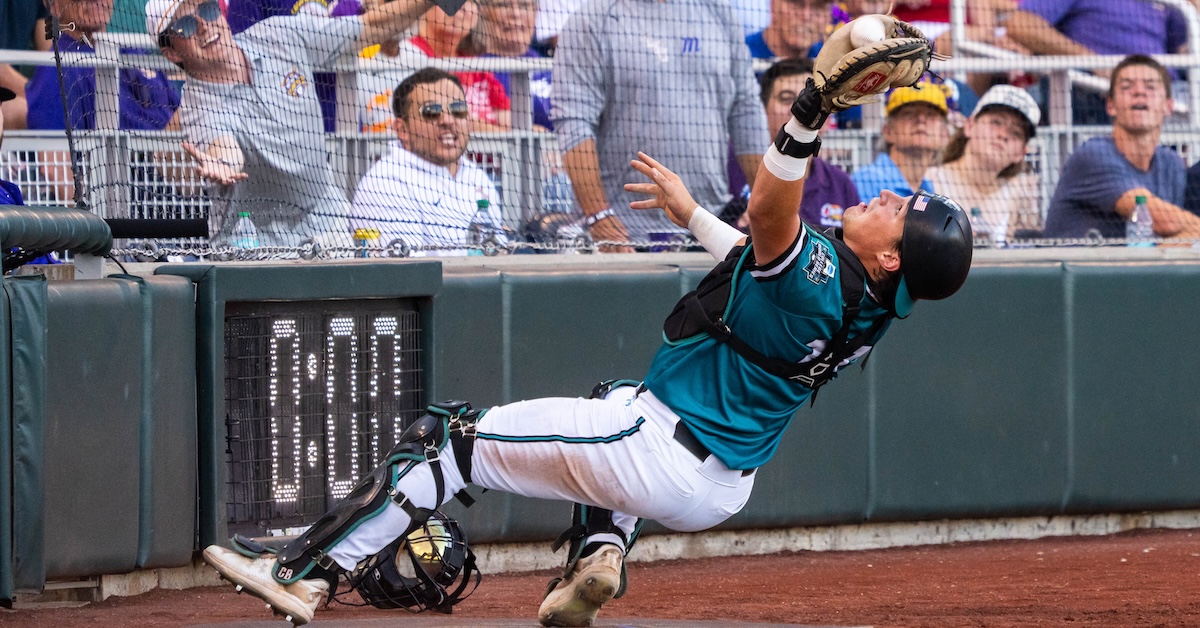
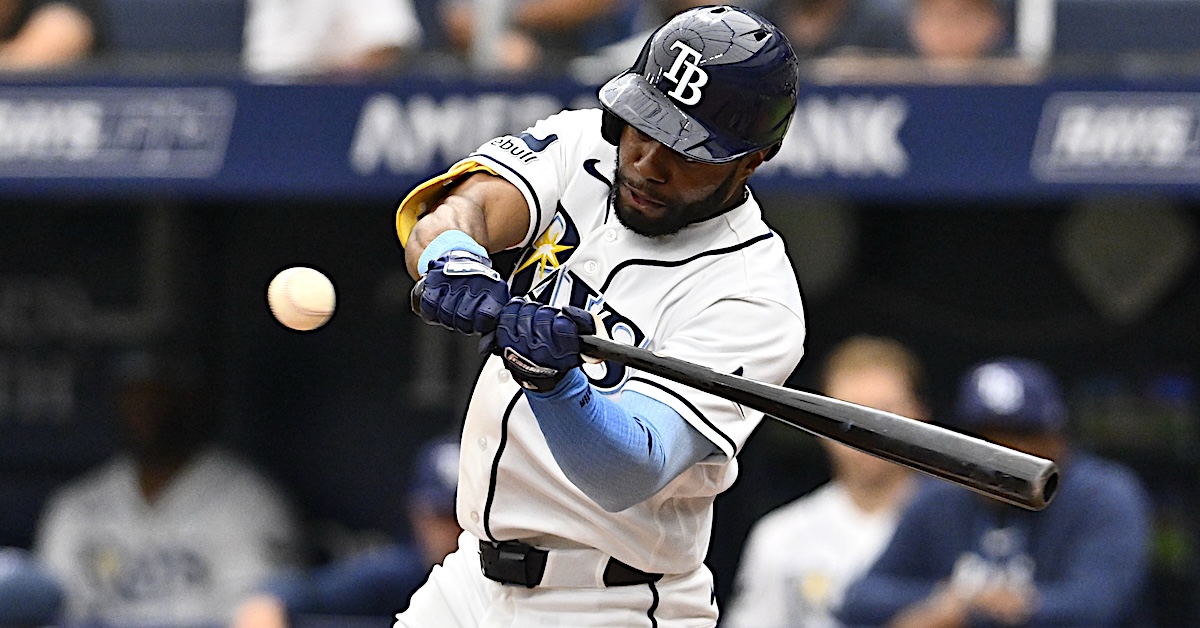
Below is an analysis of the prospects in the farm system of the Tampa Bay Rays. Scouting reports were compiled with information provided by industry sources as well as my own observations. This is the sixth year we’re delineating between two anticipated relief roles, the abbreviations for which you’ll see in the “position” column below: MIRP for multi-inning relief pitchers, and SIRP for single-inning relief pitchers. The ETAs listed generally correspond to the year a player has to be added to the 40-man roster to avoid being made eligible for the Rule 5 draft. Manual adjustments are made where they seem appropriate, but we use that as a rule of thumb.
A quick overview of what FV (Future Value) means can be found here. A much deeper overview can be found here.
All of the ranked prospects below also appear on The Board, a resource the site offers featuring sortable scouting information for every organization. It has more details (and updated TrackMan data from various sources) than this article and integrates every team’s list so readers can compare prospects across farm systems. It can be found here. Read the rest of this entry »
I ended up here by accident. I was writing about Steven Kwan yesterday, and I found myself on a leaderboard that contained all 3,658 qualified seasons for batters since 2002. That’s the first year Sports Info Solutions started tracking its reams and reams of granular data, so I spend a lot of time with the leaderboards set to that particular date range. If somebody is at the top or bottom of a column on that leaderboard, then they have earned a superlative. For example, in 2003, SIS credited Tony Batista with a 63.4% pull rate — the highest pull rate ever recorded! I have to believe it’s the highest of all time, too. How is it even possible to pull the ball 63% of the time? It certainly sounds impossible, but I believe the number to be true both because the second and eighth spots also belong to Batista, and because, well, do you remember Tony Batista’s batting stance?
Yeah, that’s what you’d expect a guy with a 63% pull rate to look like. Batista’s offensive approach made him look like a guy who had time traveled from an age long before right field was even discovered.
Today, we’re talking about a different former Oriole who, at least as of right now, can lay claim to one of the most extreme seasons of all time. Here’s the top of the fly ball rate leaderboard. Once again, we’re looking only at qualified seasons. Read the rest of this entry »
On April 15, Zach Neto was at the plate with one out and nobody on in the top of the fifth inning of the Angels’ game in the Bronx, where his team trailed the Yankees, 3-2. The first two pitches, a low changeup and a high slider, were nowhere near the zone, and Neto laid off easily. The 2-0 pitch from Luis Gil was another slider, this one about belt high and bending away from the right-handed Neto, who kept the bat on his shoulder and watched as the pitch appeared to clip the outside edge of the zone. Home plate umpire Lance Barksdale held up his hand. Strike one. Neto tapped his helmet immediately to challenge the call.
The graphic on the gigantic video board in center field showed that the pitch had missed by 0.4 inches. The call was overturned; the count was now 3-0. Neto walked on the next pitch. Mike Trout stepped in, took a fifth straight ball from Gil, then let a four-seam fastball over the heart of the plate get deep on him. He unloaded, clobbering the cookie 383 feet into the right field seats for a go-ahead two-run blast.
The no-doubt Trout clout would have been the decisive blow in an Angels win if not for a misplayed popup and a Jordan Romano meltdown. The Yankees walked it off on a José Caballero single, relegating Neto’s challenge to a footnote in that night’s game story, if it was mentioned at all. Even so, the gamble was an early example of how the new automated ball-strike challenge system can make the difference between winning and losing a game. Read the rest of this entry »
Chandler Simpson is fast. Being fast is kind of his whole deal. As a minor leaguer in 2024, Simpson stole 104 bases in 110 games. As a rookie in 2025, he stole 44 bases in 109 games. Then he stole 14 in his first 40 games of this season. If you watched Monday night’s nationally televised game between the Rays and the Dodgers, none of this is news to you. Simpson entered as a pinch-runner during a pivotal moment, and his presence instantly altered the gravity of the entire broadcast. ESPN’s cameras never left him, the commentators never stopped talking about him, and the Dodgers were so preoccupied with him that they barely had any focus to spare for the batters who came to the plate while he was on base. But Simpson never stole a base, and that’s likely not news to you either.
Simpson’s last steal came on May 11. That’s 28 games and more than a month ago. Over that time he’s been thrown out four times. On June 4, Marc Topkin of the Tampa Bay Times wrote an excellent article breaking down the circumstances behind the drought. Topkin used his own observations alongside first-hand explanations from Simpson, teammate Cedric Mullins, manager Kevin Cash, and first base/baserunning/outfield coach Corey Dickerson. Topkin noted first that Simpson has had fewer opportunities because he’s slumping at the plate. Since May 20, he’s running a .227 on-base percentage, the fourth-lowest mark among qualified players. Next, Topkin pointed out that Simpson’s downturn has roughly coincided with a downturn in Tampa Bay’s fortunes. The Rays have fallen behind early in games, putting them in situations where it doesn’t make as much sense to risk outs on stolen base attempts. Simpson and the rest of the Rays, though, were less focused on the circumstances and more focused on the intent of the opposition.
“I think the reason he’s in that funk right now is that teams have made a really impressive adjustment against him,” manager Kevin Cash told Topkin. “Every team we see, they were mindful. Now, they’re that much more mindful. We’re seeing pitchers alter their deliveries.”
Asked what opponents are doing to keep him tethered to the base, Simpson answered, “Everything. They’ve been pulling everything out. Slide-step (deliveries), quicker moves, pitchouts, random perfect throws on the money.” Monday night’s game provided an excellent example. Read the rest of this entry »
That statement was true on Opening Day, when the Rays were projected by FanGraphs Depth Charts to win 79.9 games and finish last in the AL East. It’s true again Wednesday morning, after the Rays fell 6-1 to the Orioles for a third straight loss on Tuesday night. But for much of the time in between, the truthiness of that statement wasn’t so clear.
In the last six weeks, the Rays have rattled off a five-game winning streak, two six-game winning streaks, and a seven-game winning streak. Though they no longer hold the best record in the majors, they still boast the top record in the American League, at 34-18. No team has done more to improve its standing during the first third of the season.
They’re just doing it… weird. While the Rays have the second-best record in baseball, they’re 14th in batter WAR and 12th in pitcher WAR. They don’t have a single player in the top 50 on the combined WAR leaderboard and have just three in the top 100.
Instead, the Rays are outperforming both their ability to score and prevent runs, and their ability to turn those runs into wins. The story of their season to this point is no doubt centered on the sticky concepts of luck, fortune, and deservedness. How much should we adjust our expectations for a team, perhaps, playing above its head? Read the rest of this entry »
It’s hard to know what to expect from a pitcher returning from a serious injury. In addition to velocity and spin rate, pitching is also about rhythm and feel, and that can take time to come back after a long layoff. But there was little rust for Gerrit Cole to shake off when he made his season debut Friday night at Yankee Stadium. In his first major league start since undergoing Tommy John surgery on March 11, 2025, Cole silenced the first-place Rays, allowing just two hits and three walks while striking out two across six scoreless innings. His only real trouble came in the first inning, when he gave up a leadoff single to Chandler Simpson and walked Junior Caminero to put two on with nobody out. After a Jonathan Aranda fly out, Cole picked the speedy Simpson off second base and then struck out Yandy Díaz looking at an inside fastball to end the inning. From there, he got in a groove. He averaged 96.1 mph with his four-seamer, and he threw 50 of his 72 pitches for strikes.
Cole left the game with the lead, but the Rays scored four runs in the top of the eighth inning to take the first game of the series, 4-2. They now lead the Yankees in the AL East by 5.5 games. Watching the Rays play Friday night, I couldn’t help but think about how annoying they would be to play against. They pitch well, put the ball in play, and are aggressive on the bases. One Yankee told me before the game that they remind him of last year’s Blue Jays because of their pesky bottom of the lineup and refusal to strike out. I’m still not sure how good the Rays are, but I get the feeling that they are always going to be better than I think.
In this week’s mailbag, we discuss another surprising team over the first two months of the season. We’ll also answer your questions about how many players in baseball have the ability to win MVP, how good Randy Johnson and other all-time-great starting pitchers would’ve been as closers, and why the 9-9-9 challenge beers are so small. But first, I’d like to remind you that this mailbag is exclusive to FanGraphs Members. If you aren’t yet a Member and would like to keep reading, you can sign up for a Membership here. It’s the best way to both experience the site and support our staff, and it comes with a bunch of other great benefits. Also, if you’d like to ask a question for an upcoming mailbag, send me an email at mailbag@fangraphs.com. Read the rest of this entry »
Hunter Feduccia is striving to establish himself behind the dish in Tampa Bay. Acquired by the Rays from the Los Angeles Dodgers as part of a four-player swap at last summer’s deadline, the 28-year-old former LSU Tiger is currently sharing time with Nick Fortes as the left-handed side of a platoon. His pedigree is that of a mid-level prospect. A 12th-round pick in 2018, Feduccia has been described by Eric Longenhagen as “a fairly well-rounded defensive catcher,” but also as a “bat-first backup catcher who struggles to control the run game.”
His offensive numbers in limited major league action are nothing to write home about. Feduccia has just a 63 wRC+ over 184 plate appearances, although his stroke has been showing signs of promise. So far this season, the Lake Forest, Louisiana native is slashing .278/.365/.370 with a 111 wRC+ in 62 trips to the plate. Moreover, he went yard for the first time Thursday afternoon in Tampa Bay’s 5-3 win over the Baltimore Orioles.
But it’s not his bat that I wanted to talk about when I sat down with him prior to a recent game at Fenway Park. What I was interested in were certain nuances of his position, particularly when runners are attempting to pilfer bags. While Feduccia remains a below-average thrower, he’s put a lot of effort into trying to improve that part of his game over the years and has a strong understanding of the components that go into it. I began by asking him how catchers are trained to throw. Read the rest of this entry »
AJ Blubaugh has given a boost to the Astros bullpen since debuting in late April of last season. Over 29 big-league appearances (including three as a starter), the 25-year-old right-hander has logged a 3.22 ERA over 58-and-two-thirds innings while being credited with five wins, against three losses, and three saves. Drafted in the seventh round by Houston out of the University of Wisconsin-Milwaukee in 2022, he ranked third among the system’s prospects with a 45 FV when he reached The Show.
His backstory is atypical, in part because of a pitch he hasn’t thrown since his days as an Ohio prep. Moreover, the Mansfield native now has a delivery that is both conventional and consistent. That wasn’t always the case.
“When I was in high school and started to get into pitching, I threw from three different slots,” Blubaugh explained. “An over-the-top arm slot, a sidearm arm slot, and a submarine arm slot. I would differentiate that every single pitch. One pitch would be a curveball from over the top, then I’d drop to sidearm and throw a slider. Then I’d throw a fastball from submarine. I was just a funky junk-ball thrower. I threw a knuckleball a bunch, probably from the time I was 10 years old to the time I graduated. It was probably my main pitch.”
Remarkably, his butterfly wasn’t simply delivered from down under; it came from each of his arm angles. Read the rest of this entry »
Yandy Díaz was in the news last week when he recorded his 1,000 career hit, making him the 20th Cuban-born MLB player to reach that milestone. The plaudits he received were well deserved, and they were also relatively uncommon. Playing in a lower-profile market, the Tampa Bay Rays stalwart flies under the national radar. Be honest. Outside of when he captured the American League batting title with a .330 average in 2023, when was the last time you paid more than a modicum of attention to the player who is arguably the top hitter in Rays franchise history?
You’re excused if you weren’t aware of just how good Díaz’s numbers are. Now in his eighth season with Tampa Bay after parts of two in Cleveland, he boasts a 133 wRC+ with the Rays, the highest in team annals among hitters with at least 1,000 plate appearances. Over 3,627 plate appearances with his current club, the 34-year-old corner infielder/DH has a .291/.373/.447 slash line and 104 home runs.
Díaz was admirably humble when asked about his milestone the following day.
“I never thought I’d get to 500, let alone 1,000,” he told reporters. “When I signed with Cleveland, I honestly never really thought I was going to get to the major league team. I thought, yeah, I was going to be a professional, but maybe I was going to get cut — specifically because it’s a different style of play over in Cuba. I thank God that I made the team and have been able to do it for so long.”
I asked the Sagua la Grande native how much he’s changed — and how much he really hasn’t changed — since coming stateside to play professionally in 2013. Read the rest of this entry »
Kai-Wei Teng had a limited repertoire when he signed with the Minnesota Twins out of Taiwan in 2017. The right-hander from Taichung possessed just a fastball and a curveball. A lot has changed since that time. Now 27 years old and pitching for the Houston Astros, Teng attacks hitters with a five-pitch mix that includes a sweeper that is not only hard to hit, it is no fun to be on the receiving end of in catch-play.
“It’s insanely good,” Spencer Arrighetti told me last weekend at Fenway Park. “I throw a sweeper. Lance [McCullers] throws a sweeper. We have a couple of other guys who toy around with it. But Teng’s is incredible. Truly. I played catch with him, and it looks like a fastball for 48 feet, then takes a 90-degree left turn. Not all sweepers are created equal. Some of them are a little loopier and bigger, but his is 85 mph. I mean, it’s gross. It really is a great pitch.”
The numbers back that up. Teng has relied on his most-used offering 36.3% of the time this season to the tune of a .118 BAA, a .118 SLG, and a 27.9% whiff rate. His other numbers are impressive, as well. Over 14 appearances, Teng has a 2.35 ERA, a 3.83 FIP, and a 24.7% strikeout rate over 23 innings.