It’s not often that I take a pause from the prospect lists to write about individual call-ups, but we have three big league debuts on the docket for today, and I wanted to update readers on those pitchers, as well one other prospect-related bycatch that’s come up during the course of me working on the Reds, Guardians, and Brewers org lists.
First, let’s talk about the starting pitchers making their big league debuts today: Chase Petty of the Reds, AJ Blubaugh of the Astros, and Noah Cameron of the Royals. All of them have updated player profiles over on The Board.
Chase Petty, RHP, Cincinnati Reds (50 FV)
Petty, who touched 102 in high school, came to the Reds from Minnesota during the spring of 2022 in a trade for Sonny Gray. After missing time with an elbow issue in 2023, he had a healthy and complete 2024 season in which he worked 137 innings spent mostly at Double-A Chattanooga, many more frames than he had thrown in any year prior. Proving he could sustain big stuff across that load of innings was instrumental to his inclusion among the 2025 Top 100 Prospects. His fastball was still sitting 94-97 mph after Petty had been promoted to Louisville at the very end of last season, and he has carried that into 2025. As of his call-up, he has 27 strikeouts, nine walks, and a 1.30 WHIP in 23 innings (five starts). Read the rest of this entry »
Welcome to another edition of Five Things I Liked (Or Didn’t Like) This Week. There must have been something in the water across the league over the past seven days, because while this column always highlights delightful oddities that I caught, they aren’t often so delightful or so odd. This week, rarities abounded. There were runners getting hit by throws, wild acrobatics, no-look passes, and even a pitchout. Hot teams and cold teams clashed, errors got compounded, and situations that felt in hand rapidly got away. So keep an eye on the runner at first base, and let’s get started – after my customary thanks to Zach Lowe of The Ringer, who popularized this column format for basketball.
1. Not-Quite-Free Bases Jarren Duran is off to a slow start to the 2025 season. And while the problems have mostly come at the plate, everything seems a little off. Take this misadventure on the basepaths last Thursday. Duran led off the bottom of the 10th inning with a game-tying single. That made him the winning run, and he immediately started plotting a theft of second base to get into scoring position. Nick Sandlin checked on him:
Then he checked on him again:
That’s two disengagements; Sandlin wasn’t likely to try again. Duran stole 34 bases last year. He’s blazing fast. He was 5-for-5 on the season and had already swiped one in this game. Second base was as good as his. And so the Blue Jays took extreme measures, calling for one of the least-used plays in modern baseball, a pitchout:
Welcome to another edition of Five Things I Liked (Or Didn’t Like) In Baseball This Week. I was at a wedding this past weekend, a generally fun event for a baseball writer. That’s because strangers ask me what I do, and then I get to say, “I’m a baseball writer.” That plays a lot better than, “I work in accounting/finance/tech,” no offense to any of you in those fine fields. But this weekend, someone inquired deeper. “Oh, like sabermetric stuff?” “Yeah! Kind of. Also I make GIFs of dumb and/or weird plays. And bunts, lots of bunts.” Yes, it’s a strange job being a baseball writer, but also a delightful one, and this week delivered whimsy and awe in equal amounts. So unlike guests milling around at a wedding, let’s get straight to the point – after the customary nod to Zach Lowe of The Ringer for the inspiration for this article format.
1. Not Reaching Home
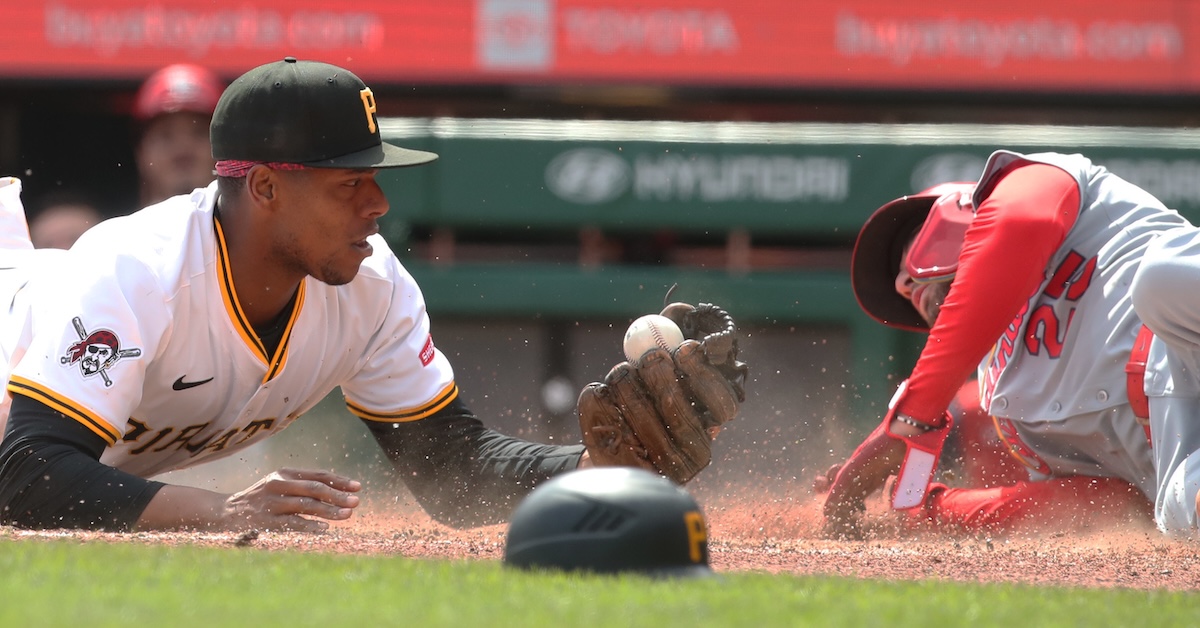
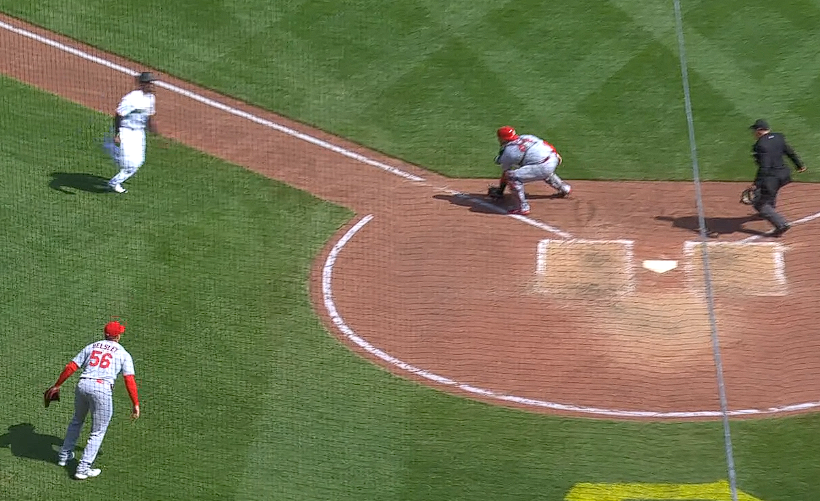
The third time a runner was tagged out at the plate in Wednesday’s Cardinals-Pirates clash came at a pivotal moment. Locked in a scoreless tie in the bottom of the 11th, Pittsburgh finally looked like it would break through when Joey Bart singled to right. But, well:
That was a good throw by Lars Nootbaar and a clean catch by Pedro Pagés, and that combination turned a close play into a gimme. I mean, how often are you going to be safe when the catcher already has the ball in his glove and you’re here:
This seems like an apt moment to reexamine the concept of value. What is a relief pitcher worth? What is anything worth? The context matters quite a bit. In boom times, when you can barely remember a past in which the arrow pointed any direction but up, the upside feels so real that it’s hard to resist. Sure, a premier setup man with a short track record is a luxury, but what’s the harm in splurging? In the darker times, when the eggs sitting in your refrigerator have suddenly gone from basic staples to commodities so precious that you can’t afford to waste them on something as trivial as breakfast, you need to hunt for value wherever you can find it.
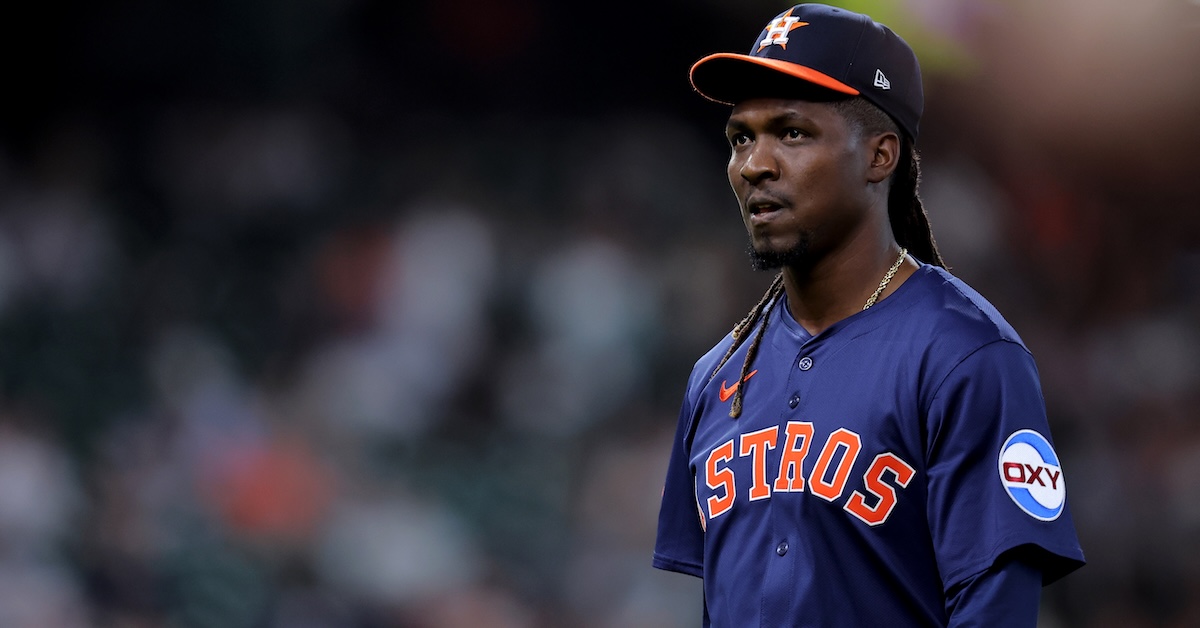
For an Astros team determined to reset its luxury tax penalty, that means trading away reliever Rafael Montero and eating 72% of the money remaining on his contract in order to be free of the other 28%. For the Braves, reeling from a series of early-season setbacks, that means taking a chance on the discounted Montero and his untested splitter in exchange for a player to be named later. Read the rest of this entry »
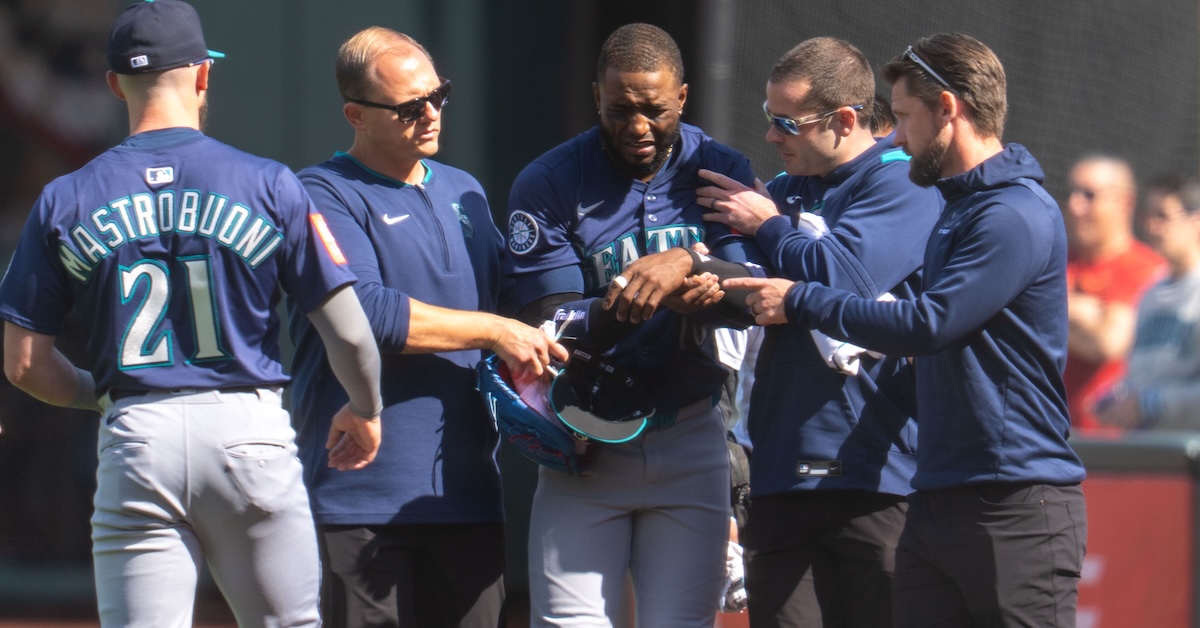
You lose some, and then you lose some. On Sunday at Oracle Park, the Mariners not only fell to the Giants 5-4, but they were forced to remove Victor Robles from the game after he injured his left shoulder making a remarkable catch on the game’s penultimate pitch. His injury is just one of a handful of notable ones suffered in the past several days.
Robles, who broke out last season after being released by the Nationals and signed by the Mariners, had played every inning of every game in right field until the injury. With the score tied 4-4 in the bottom of the ninth, one out, and Luis Matos on first base, Patrick Bailey fouled a drive into the right field corner. Robles sprinted 113 feet, leapt to grab the ball, and then fell over the half-height padded fence and into the netting. After extricating himself, he fell to his knees in obvious pain, rolled the ball to second baseman Ryan Bliss as Matos tagged up and reached third base, and remained on the ground. While he was tended to by Mariners head athletic trainer Kyle Torgerson, Giants manager Bob Melvin challenged the catch ruling, but the call on the field was upheld [as a reader pointed out, Matos was sent back to second under stadium boundary rules]. Finally, Robles was carted off the field, with Torgerson helping him to support his injured left arm.
Miles Mastrobuoni moved from third base to right field to replace Robles, but he didn’t need to for very long, because on the next pitch after play resumed, Wilmer Flores singled in Matos to send the Mariners to defeat, dropping them to 3-7. Medical personnel at Oracle Park popped Robles’ shoulder back into place, and after undergoing X-rays on-site, he was initially diagnosed with a dislocated left shoulder and placed on the 10-day injured list. The results of the follow-up MRI he underwent on Monday afternoon have yet to be announced.Read the rest of this entry »
Daphne Lemke/USA TODAY NETWORK-Wisconsin-USA TODAY NETWORK via Imagn Images
Every year, most teams hold some sort of team bonding, social event during spring training. The specifics of the event vary from team to team, but frequently they include renting out a movie theater and showing some cloying, inspirational movie like The Blind Side, Cool Runnings, Rudy, or better yet, a documentary like Free Solo. Regardless of the team’s outlook on the year, the goal is to get the players amped up for the season and ready to compete on the field, even if the competition in question is for fourth place in the division.
But what if instead of taking the clichéd route, teams actually tried to select a movie that fits their current vibe, one that’s thematically on brand with the current state of their franchise? They won’t do this because spring training is a time for hope merchants to peddle their wares, even if they’re selling snake oil to sub-.500 teams. But spring training is over. It’s time to get real. So here are my movie selections for each American League team, sorted by release date from oldest to newest.
Jackson Jobe supplied a quality quote when asked about last weekend’s three-straight-heaters punchout of Toronto’s Vladimir Guerrero Jr..””I’m done with trying to dot a gnat’s ass,” he told a small group of reporters. “It’s, ‘Here’s my stuff. If you hit it, good. Odds are, probably not.”
Jobe is a student of the art and science of his craft, so I proceeded to ask him where he feels he is in terms development. Has the 22-year-old Detroit Tigers right-hander essentially settled into his mound identity, or is there still work left to be done in the pitch lab?
“I’d like to think I got it pretty much all fine-tuned,” replied Jobe, who is No. 9 on our Top 100. “Now it’s just learning the best way to use it, the best way to sequence it. I put my stuff up against anyone in the league on paper, to be completely honest. It’s just a matter of learning how to harness it.”
Asked about any recent changes to his pitch metrics, the rookie of the year candidate cited his slider. Read the rest of this entry »
If the winter is a time for dreams, the spring is a time for solutions. Your team may have been going after Juan Soto or Aaron Judge or Shohei Ohtani, depending on the offseason, but short of something going weird in free agency (like the unsigned Boras clients last year), if you don’t have them under contract at this point, they’ll be improving someone else’s club. However, that doesn’t mean that spring training is only about ramping up for the daily grind. Teams have real needs to address, and while they’re no doubt workshopping their own solutions – or possibly convincing themselves that the problem doesn’t exist, like when I wonder why my acid reflux is awful after some spicy food – that doesn’t mean that we can’t cook up some ideas in the FanGraphs test kitchen.
This is the final piece in a three-part series in which I’ll propose one way for each team to fill a roster hole or improve for future seasons. Some of my solutions are more likely to happen than others, but I tried to say away from the completely implausible ones. We’ll leave the hypothetical trades for Bobby Witt Jr. and Paul Skenes to WFAN callers. Also, I will not recommend the same fix for different teams; in real life, for example, David Robertson can help only one club’s bullpen. I wrote about the teams in the two East divisions last Wednesday, and then covered the Central divisions on Friday. Today, we’ll tackle the 10 teams in the West divisions, beginning with the five in the AL West before moving on to their counterparts in the NL West. Each division is sorted by the current Depth Charts projected win totals.
Texas Rangers: Reunite with Kyle Gibson
Look at the Rangers in our Depth Charts projection and glance down at the pitchers. Do you see a problem? We project the Rangers to have a decent rotation, right at the back of the top 10, but that also relies on a lot of innings from pitchers who have not been able to throw many in recent years. Jacob deGrom and Tyler Mahle are both projected to throw more innings apiece than the two of them have thrown combined over the last two years. I’d love to see 270 innings from deGrom and Mahle, but to count on that is just begging for a sad story. I probably believe in Kumar Rocker and Jack Leiter more than most, but neither of them should be counted on to solidify an injury-depleted rotation in 2025.
The Rangers need a reliable innings-eater, and old friend Kyle Gibson is still out there. He has made at least 30 starts in five of the last six full seasons, with the one time he didn’t reach that threshold coming in 2019, when he made 29 starts, appeared in 34 games, and put up 2.6 WAR across 160 innings — the fewest innings he’s thrown in that span, excluding 2020. He’s probably never again going to be as good as he was in 2021, when he was an All-Star with Texas before getting traded to the Phillies and finished with a 3.71 ERA, a 3.87 FIP, and 3.1 WAR, but Gibson comes with a fairly high floor. His performance last year with the Cardinals (4.24 ERA, 4.42 FIP, 1.5 WAR, 169 2/3 innings) was his least-productive campaign during that 2018-2024 stretch, but even that would benefit the Rangers right now.
Seattle Mariners: Add some Tork to the lineup
The Mariners have gotten more out of Luke Raley than they’ve had any right to, but he remains a platoon first baseman, with a .575 OPS in the majors against lefties. Even if he can do better than that — ZiPS thinks he’ll put up about a hundred more points of OPS in 2025 — he’s not David Ortiz against righties, so it’s hard to just give him a full-time job at first. The likely candidates to pair with Raley are thoroughly uninteresting, so why not look at Spencer Torkelson, a player who is just begging for a change of scenery? The Tigers have clearly soured on him; otherwise, they likely would not have signed second baseman Gleyber Torres and moved Colt Keith to first base to start there over Torkelson. He’s still young enough to have some upside and get things back on track, but even if he doesn’t ever reach his full potential, he ought to at least beat up on lefties. The Mariners could use more power, and I doubt the price tag will be high.
Houston Astros: Add a very boring arm
The Astros dug themselves a hole early on in 2024, in large part because of a spate of pitching injuries that tested their depth to the breaking point. Houston’s rotation ought to be good, but there still are a number of pitchers with injury concerns, once again leaving the team vulnerable to some bad health luck. The Astros could use some veteran depth to preemptively reinforce the rotation just in case someone goes down, and I think for them, Lance Lynn is the most interesting free agent still available.
The Astros are skilled at refining pitch arsenals, for both prospects and veterans, and Lynn has the weirdest repertoire of the remaining free-agent starters. Rather than the standard fastball-breaking-offspeed mix, Lynn basically throws a bunch of slightly-to-moderately different fastballs, making him the type of pitcher who could benefit from Houston’s wizardry. A sweeper could cause some additional tension for batters compared to his cutter, and he’s never really had a refined offspeed offering to use as a putaway pitch against lefties. The specifics would be for the Astros to figure out. Lynn also has expressed a willingness to pitch out of the bullpen after teams started inquiring about using him as a reliever, so even if Houston’s rotation remains in tact for the whole season, Lynn could still have a role.
Athletics: Get Sandy before heading to the desert
The good: The A’s actually spent some money this winter. The bad: We still project the A’s to have a losing record. The really bad: Our Depth Charts project the A’s to have a worse starting rotation than the White Sox. The Marlins are clearly in the shopping mood, having already sent away Jesús Luzardo, and with teams likely waiting to see how Sandy Alcantara fares after returning from Tommy John surgery, the A’s have an opportunity to jump the 2022 NL Cy Young’s trade market and steal a march on the better wild card contenders. A potential wrinkle here: The Yankees may be in the market for Alcantara now that Gerrit Cole is going to miss the 2025 season while recovering from Tommy John surgery. Still, the A’s shouldn’t let that deter them from targeting an ace at a time when he could be relatively affordable.
Los Angeles Angels: Hire a team of archaeologists to design a very complex treasure hunt that convinces Arte Moreno to sell the team so that he’s free to go on an Indiana Jones adventure
I admit it, I’m at a loss for words with the Angels. In some ways, they’re actually worse off than the White Sox, in that Chicago at least has a reasonable long-term plan while the Angels keep teetering between strategies that are either unclear, unrealistic, or both. Their moves reflect their extreme short-term thinking, leaving the organization without a coherent path to winning now or winning later. Leadership has to come from the top, and Moreno continues to show he is incapable of fixing things. Case in point: The Halos spent this offseason adding veteran depth pieces. These would’ve been smart moves if the Angels were already a good team and looking to patch up their few remaining areas of weakness. That, of course, is not the case. The Angels need to accept that they’re lost before they can move forward and begin to assemble a winning team while Mike Trout is still around. But as long as they keep following an ineffective leader, they’re going to keep walking in circles.
Los Angeles Dodgers: Find a weird reclamation project
This one was a struggle because the Dodgers, while not having the highest median win projection of any team in ZiPS history (that’s still the 2021 Dodgers), they have the highest floor, with no obvious weaknesses anywhere. I guess the one thing the Dodgers are missing is that random broken-down reliever that you forget still plays baseball until they inevitably fix him. I’d love to see if Daniel Bard has another improbable comeback left in him, or maybe Adam Cimber, because a star in the sky disappears whenever a sidearmer loses his job.
Arizona Diamondbacks: See if the Yankees are interested in Jordan Montgomery
As I mentioned in the A’s section, Cole’s Tommy John surgery is a massive blow to the Yankees as they look to defend their American League pennant in 2025. Will Warren has a good shot at being a pretty solid rotation fill-in, but with Luis Gil also out for a while and Nestor Cortes now on the Brewers, the team now has just about zero starting pitching depth left. Jordan Montgomery and the Yankees have a good history, and there’s an obvious need now. Montgomery really struggled in 2024, to the point that Arizona owner Ken Kendrick said publicly that adding the lefty was a “horrible signing.” The Diamondbacks also have plenty of rotation options, so many, in fact, that RosterResource currently projects Montgomery to pitch out of their bullpen. They surely won’t get much in return for him, and they should be prepared to eat a good chunk of his remaining salary, but if they want to move on from him and maybe even get a prospect or two in return, this is the way to do it.
San Diego Padres: Sign David Robertson
The Padres’ bullpen is hardly a dumpster fire, but it is kind of top-heavy, and we project everybody after the fifth option (Yuki Matsui) to be at or below replacement level. There’s not a lot of financial flexibility right now in San Diego for various reasons we won’t go into here, but if the Padres are looking for marginal gains on a budget, David Robertson is by far the best move they could make. They shouldn’t have to spend much to get him, considering he’s 40 years old and remains unsigned in the second week of March, but he is coming off a very good season and is comfortable pitching in a variety of bullpen roles.
San Francisco Giants: Inquire about Jesús Sánchez
The Giants are likely a tier below the Diamondbacks and Padres in the NL Wild Card race, but they’re still close enough that short-term improvements matter. San Francisco’s designated hitter spot is bleak, and the player we have getting the most plate appearances there, Jerar Encarnacion, was in an indie league for much of last season and put up a .277 on-base percentage in the majors. The Giants should see what it would take to get Jesús Sánchez from the Marlins. He’s never developed into a big home run hitter despite solid hard-hit numbers, in large part because he’s never generated much loft. He’s also a spray hitter, and last season, 13 of his 25 doubles were line drives hit the opposite way. It’s the type of game that could be better suited for the spacious Oracle Park. Sánchez would provide a left-handed complement to Encarnacion, and he’s good enough to play all three outfield positions if needed.
Colorado Rockies: Find the next Nolan Jones and Brenton Doyle
Since the departure of former GM Jeff Bridich, the Rockies have made quite a bit of progress in no longer treating prospects as annoyances, and they now give internal, lesser prospects chances to surprise them. The last bit is important, as the Rockies of five or six years ago would never have given someone like Nolan Jones or Brenton Doyle enough playing time to break out in the majors. Doyle hit 23 homers and stole 30 bases in 2024 while winning his second Gold Glove in as many seasons, and although Jones struggled last year, he was hurt on and off and should be expected to at least split the difference between that performance and his 2023 production.
Considering this, the Rockies should go full-carrion bird as the season approaches. Colorado ought to be in on any and all mildly interesting players who are shut out of major league opportunities in 2025. Among the guys the Rockies should target are Mickey Gasper, Edouard Julien, Addison Barger, Shay Whitcomb, Curtis Mead, and Leo Jiménez. They may never develop into stars, but the Rockies need to be willing to throw everything at the wall and hope to find at least a few productive players.
One way to tell the difference between a baseball fan who has a life and a true sicko is whether they have strong opinions on players who sign minor league contracts and attend spring training on a non-roster invite. The person in a Cubs hat who’s stoked about the Kyle Tucker trade and knows all sorts of intimate biographical details about Shota Imanaga? That’s your friend. If they start talking to you about Travis Jankowski, they might be in a little too deep.
We sickos know that while championships can be won and glory earned on the major league free agent market, NRIs are nonetheless a meaningful collection of useful roster players. Sometimes more. I’d argue that these fringe hopefuls are the only players who truly stand to gain by their performance in camp.
Moreover, these players are by definition underdogs. They include former top prospects, guys recovering from injury, and itinerant Quad-A players hoping for one last spin of the wheel. If you weren’t interested in their progress on a competitive level, surely we can interest you in an underdog story. Read the rest of this entry »
Catcher is a thankless job. If you do it successfully, perfectly even, that means that you’re letting highly paid professionals whip projectiles at you as hard as they can hundreds of times a day. Sometimes, other highly paid professionals will divert these projectiles toward you at the last second, or inadvertently hit you with the giant wooden sticks they’re carrying. You have to dive around and flail your limbs, because the only thing worse than getting hit by one of these balls is not getting hit by them; letting them fly by hurts your team. People try to steal from you constantly, so while you’re trying to catch a rock-hard 100-mph pellet, you also have to scan your peripherals. And if all of that isn’t bad enough, here’s the worst part: Sometimes your manager chooses to start Martín Maldonado ahead of you.
I kid, of course, but I’m writing about Yainer Diaz today, and his gradual phase-in to the major leagues is a key part of his major league career so far. Diaz burst onto the big league scene in 2023 with the kind of approach that makes hitting instructors wince, then shrug their shoulders and nod. He swung early and often, took big hacks, and generally acted like he was allergic to taking walks or hitting singles. It worked. He clobbered 23 homers in only 377 plate appearances, spraying loud contact to all fields. He played better-than-expected defense, too, belying his early scouting reports.
Despite that excellent rookie season, Diaz couldn’t displace an aging Maldonado as the team’s primary catcher; he took some reps at DH, but lost those as well when the team got healthy. By the playoffs, he was an afterthought, a pure backup catcher. But when Maldonado (and manager Dusty Baker) departed in the offseason, Diaz ascended to a starting job. Then he struggled – through the All-Star break, he was hitting a so-so .284/.308/.409 with iffy defense. If you’re more of a WAR person, that’s 1.1 WAR, not great. Here’s one story you could tell about Yainer Diaz: a prospect who struggled to break through with regular playing time. Read the rest of this entry »