Archive for Mets

Jake Reed Has Arrived*

One quick note before you read this piece about Jake Reed: He just went on the IL with forearm tightness. He’s also been on four different teams this year, so it’s not like he’s some surefire All-Star who needs to get healthy. I probably wouldn’t have written this article if I hadn’t already been halfway through it when he hit the IL. But I was halfway through, and I think Reed is interesting. You just might, too, after reading this.

As much as I watch baseball, I haven’t seen every random reliever in the game. I was innocently watching a Mets-Giants clash last week when — well, here, just watch it:

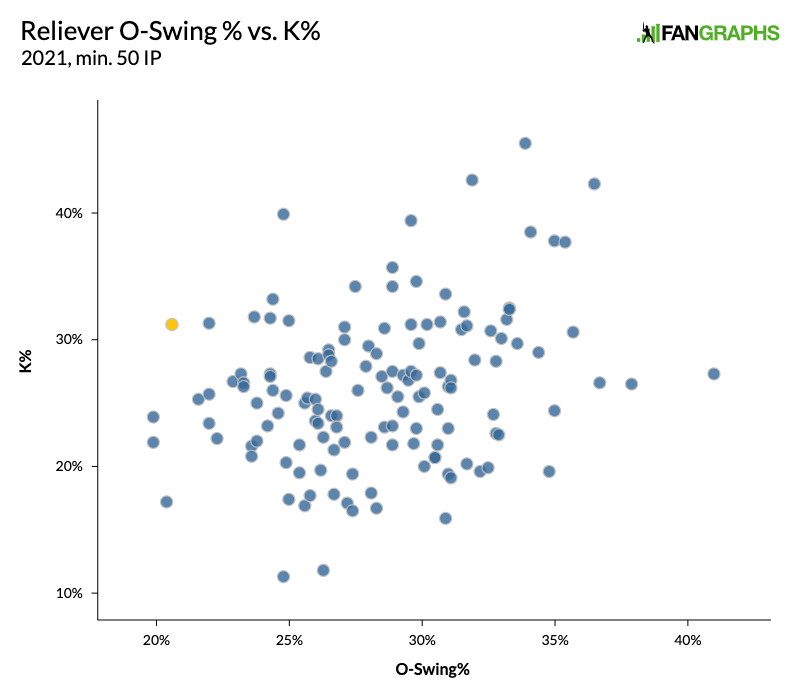
If you’re like me, that delivery made you sit up in your seat as surely as a shot of espresso. It’s just so … sudden. It’s not that he sidearms it; there are plenty of righty sidearmers in baseball these days. It’s not that he short-arms it; there are plenty of those guys in baseball these days. But the combination! It’s like nothing I’ve seen recently, and it focuses you on how quickly batters have to go from waiting to “oh god where is the ball coming from?”
Read the rest of this entry »


Daily Prospect Notes: 8/19/21

These are notes on prospects from Tess Taruskin. Read previous installments of the Daily Prospect Notes here.

MJ Melendez, C, Kansas City Royals
Level & Affiliate: Triple-A Omaha Age: 22 Org Rank: 13 FV: 40+
Line:
2-for-4, HR, K, BB

Notes
Melendez’s four-bagger in Wednesday’s game was his 31st on the season, which ties him with Griffin Conine atop the minor league home run leaderboard.

As an added narrative wrinkle to their ongoing homer chase, Conine’s father (former big-leaguer Jeff Conine), is now an assistant coach at Florida International University under Melendez’s father, Head Coach Mervy Melendez. While the playful, multi-generational rivalry between the father-son duos makes for a compelling storyline, there’s plenty more to be gathered from Melendez’s performance this year, much of which adds significant shine to his prospect apple. Read the rest of this entry »


Testing the Depth: The National League

Yesterday, we explored the roster depth of the American League playoff contenders, identifying the strengths and weaknesses that might prove decisive down the stretch for the teams whose playoff odds sit above 10%. Today, we’ll do the same for the National League squads with October ambitions.

National League East

Atlanta Braves
Strengths: Atlanta’s slow and steady climb into first place has involved a considerable amount of roster management. One side effect of all the maneuvers that have gotten them where they are is significant depth. During Travis d’Arnaud’s absence, the team learned that William Contreras is a capable big league catcher. They filled their considerable outfield holes with Joc Pederson, Jorge Soler, and Adam Duvall, while Cristian Pache, who flamed out early in the season, has finally gotten hot at Triple-A Gwinnett and should be a nice September addition. The Gwinnett infield is packed with players who have big league experience, like Jason Kipnis and Ryan Goins. The return of Huascar Ynoa, with Ian Anderson not far behind, creates a sudden bevy of rotation options. Read the rest of this entry »


Ranking the Prospects Traded During the 2021 Deadline

What a ride this year’s deadline was. All told, we had 75 prospects move in the last month. They are ranked below, with brief scouting reports written by me and Kevin Goldstein. Most of the deals these prospects were a part of were analyzed at length on this site. An index of those pieces can be found here, or by clicking the hyperlink in the “Trade” column below. I’ve moved all of the players listed here to their new orgs over on The Board, so you can click through to see where they rank among their new teammates. Our farm rankings, which now update live, also reflect these changes, so you can see where teams’ systems stack up post-deadline.

A couple of quick notes before I get to the rankings. We’ve included a few post-prospect players here (those marked in blue) so you can get an idea of where we value them now as opposed to where we had them at their prospect peak. Those players, as well as the Compensatory pick the Rockies will receive after they extend Trevor Story a qualifying offer and he signs elsewhere, are highlighted below. We had closer to 40 prospects (and 23 Players to be Named Later) traded last year, with the PTBNL number inflated by 2020’s COVID-related transaction rules. The backfields are not well-represented here, with just four prospects who have yet to play in full-season ball. Two of those are currently in the DSL and have no official domestic pro experience, though Alberto Ciprian has played stateside for instructs/extended spring training. Now on to the rankings. Read the rest of this entry »


Mets Finally Strike, Landing Javier Báez and Trevor Williams

The Mets remained on the sidelines during the frenzy of deals that went down on Thursday and early Friday, but they finally made a big move about an hour before the 4 pm ET trade deadline. In a deal with the Cubs, they acquired infielder Javier Báez, righty Trevor Williams, and cash considerations in exchange for center fielder Pete Crow-Armstrong, the team’s first-round pick in the 2020 amateur draft.

The move addresses a pair of particularly acute needs for the Mets, who placed shortstop Francisco Lindor and ace Jacob deGrom on the Injured List on back-to-back days just after the All-Star break. Lindor left the team’s first game of the second half with a strained oblique, and is now two weeks into a three-to-five-week recovery period, having just returned to baseball activities as of Friday. Báez, a pending free agent, can handle shortstop duties until he gets back, then slide over to second base to form a double play combination that will be must-see TV.

Meanwhile, after deGrom skipped the All-Star Game, he landed on the IL due to a bout of forearm tightness, further exposing the team’s already-depleted rotation. In the 10 games the Mets have played since he went down, they’ve started a pitcher who left his outing and landed on the 60-day IL with a hamstring strain (Robert Stock), a reliever who was the first of six pitchers in an all-bullpen doubleheader game (Aaron Loup), and a starter who was designated for assignment for the second and third times this season the day after getting pummeled (Jerad Eickhoff). A couple hours after the deadline, MLB.com’s Anthony DiComo reported that deGrom is dealing with additional inflammation and is being shut down from throwing for two weeks, with a September return now the best-case scenario. Williams is no deGrom, but he can provide some back-end stability over the next month, and he has a year of club control remaining.

The 28-year-old Báez has rebounded from a dreadful 2020 campaign, during which he hit for just a 57 wRC+ and netted zero WAR; he was vocal about the loss of in-game video to help him make adjustments. His .248/.292/.484 line this year isn’t overly impressive, but he’s shaken off a dreadful June (.157/.231/.373) with a red-hot July (.324/.355/.535), lifting his wRC+ back to 105. Read the rest of this entry »


Trades Aren’t the Only Way to Upgrade: Injured Players Who Could Have an Impact in the NL

Joey Gallo is a Yankee, Eduardo Escobar is a Brewer, and Starling Marte will finish his season in Oakland. It’s already been a fast-paced trade season, and there are still a lot of deals that could be done before Friday’s deadline. But as I noted in a piece on Wednesday that looked at the most impactful players on the IL for American League contenders, there are top-flight pitchers and hitters who are not going to be traded but are waiting in the wings. Today I want to look at the NL side of things.

As a reminder, I calculated team injury impact to date this season by looking at the injury ledger data from Baseball Prospectus to determine each team’s injury impact to date in FanGraphs WAR compared to preseason projections. Additionally, while most of the teams I identified as contending had at least one impactful player on the IL, one did not; I’ll still spend some time on the Padres, but they will need to look to the trade market for reinforcements.

Finally, the cutoff for contending is defined as having playoff odds greater than 30%. I’m sure that will frustrate some Philadelphia and Atlanta fans who believe their teams still have a chance to chase down the Mets. For what it’s worth, the Braves are hoping that Ian Anderson and Drew Smyly can return to throw meaningful innings and that Travis d’Arnaud will return to catch them. The Phillies have zero projected position player WAR on the IL at the moment, although starting pitcher Zach Eflin’s return from the 10-day IL should bolster the rotation. Read the rest of this entry »


40-Man Crunch Situations: National League

Yesterday, I wrote about the American League clubs whose trade deadline behavior might be influenced, at least in part, by impending 40-man roster crunch. That piece, which includes an intro diddy explaining this whole exercise, can be found here. As a reminder, All of these rosters have a talent foundation at the major league level that won’t be moving, and which I’ll ignore below. Instead, I’m focused on the number of players on the 40-man right now, how many free agents will come off that number at the end of the season, which prospects might be added (or not), and who currently on the 40-man is in danger of being passed by the prospects. For the two categories where the rubber meets the road and it’s unclear what will happen (fringe current 40-man members vs. prospects who’ll possibly be added), I italicize the players I view as less likely to stay, or be added to the 40-man. Today, we’ll consider the National League teams with such crunch.

Los Angeles Dodgers

Current 40-man Count: 46 (40 + six 60-day IL players)
Pending Free Agents: 7 (Clayton Kershaw, Corey Knebel, Corey Seager, Chris Taylor, Kenley Jansen, Jimmy Nelson, Albert Pujols), plus Joe Kelly’s club option
Must-Add Prospects: Jacob Amaya, Michael Grove
Current 40-man Fringe: Billy McKinney, Luke Raley, Jimmie Sherfy, Sheldon Neuse, DJ Peters, Darien Núñez
Prospects on the Fringe: Jose Martinez, James Outman, Jeren Kendall, Guillermo Zuniga, Zach Willeman, Gus Varland, Devin Mann, Ryan Noda

The Dodgers have lots of both low-impact overage and viable big leaguers, but aside from Jacob Amaya, none are likely to be more than a 1-WAR type of role player or middle inning relief piece. The number of departing free agents is high, making Amaya and Grove (who has the best stuff of the potential additions but has been wild this year) comfortable adds, but the rest of the group might find roster equilibrium elsewhere. Read the rest of this entry »


Rich Hill, the Newest Met

As of Thursday night, the Mets’ starting rotation featured Marcus Stroman, Taijuan Walker, Tylor Megill, and a sentient ball of string who showed promise in Low-A. Fine, I made up the last one, but if you told the Mets front office about this ball of string, they’d at least ask you for its Trackman data. A seemingly unending string of injuries left the team grasping for pitching — any pitching at all. Enter Rich Hill, in a trade with the Rays:

At a very basic level, the Mets had to make this trade. Jacob deGrom is on the shelf. David Peterson broke his foot walking around. Carlos Carrasco and Noah Syndergaard aren’t ready. Joey Lucchesi tore his UCL. Robert Stock, who was already 10th or so on the depth chart, strained his hamstring. Forget replacement level — Hill represents an upgrade from subterranean level. To some extent, any trade at all would be a win, in that it would leave them able to field a roster.

But Hill isn’t merely roster depth. He’s one of the most interesting pitchers in baseball, a curve-and-fastball machine who has spent years pumping sub-90 mph gas past hitters while bamboozling them with a dazzling array of breaking balls. Heck, earlier this year he was named the AL Pitcher of the Month (it’s not the most prestigious award, but it’s an award) in May, when he posted a 0.78 ERA over 34.2 innings.

Of course, there are other months in the year, and the rest of Hill’s 2021 hasn’t gone nearly so well. In total he sported a 3.87 ERA and 4.55 FIP with the Rays, both of which are the highest marks he’s posted since bursting back onto the scene in 2015. His 9.9% swinging strike rate is better only than his abbreviated 2020 season, and he wasn’t exactly great then either. There’s a strong chance that Hill’s 2021 season will be his last stand. Read the rest of this entry »


The 2021 Replacement-Level Killers: Catcher and Second Base

For the full introduction to the Replacement-Level Killers series, follow the link above. While still focusing upon teams that meet the loose definition of contenders (a .500 record or Playoff Odds of at least 10%), and that have gotten about 0.6 WAR or less thus far — which prorates to 1.0 WAR over a full season — this year I have incorporated our Depth Charts’ rest-of-season WAR projections into the equation for an additional perspective. Sometimes that may suggest that the team will clear the bar by a significant margin, but even so, I’ve included them here because the team’s performance at that spot is worth a look.

As noted previously, some of these situations are more dire than others, particularly when taken in the context of the rest of their roster. I don’t expect every team to go out and track down an upgrade before the July 30 deadline, and in this two-position batch in particular, I don’t get the sense that any of these teams have these positions atop their shopping lists. With catchers in particular, framing and the less-quantifiable aspects of knowing a pitching staff make it easier for teams to talk themselves out of changing things up unless an injury situation has compromised their depth.

Note that all individual stats in this article are through July 18, but the won-loss records and Playoff Odds include games of July 19. Read the rest of this entry »


On a Night of Upsets, Pete Alonso Repeats as Home Run Derby Champ

For all of the anticipation and hype that surrounded the long-awaited participation of two-way phenom Shohei Ohtani as well as distance king Joey Gallo in their first Home Run Derbies — and at mile-high Coors Field, no less — it was easy to overlook the one contestant in the field who’d done this before. Because there was no Derby last year due to the coronavirus pandemic, 2019 winner Pete Alonso entered Monday night as the reigning champion, and he defended his title successfully and emphatically.

Indeed, the Mets’ 6-foot-3, 245-pound slugger seemed built for this competition, and he practically toyed with his opponents. After hitting a contest-high 35 homers in the quarterfinals, Alonso didn’t need his full allotment of time to win either of his final two rounds, capping his run by beating Trey Mancini in the finals, 23-22. In victory, he became the fourth player to win multiple Home Run Derbies, after Ken Griffey Jr. (1994, ’98-99), Prince Fielder (2009, ’12) and Yoenis Céspedes (2013-14). Mancini, who missed the 2020 season while undergoing chemotherapy for stage three colon cancer, put forth a valiant effort with a quick compact stroke that contrasted with Alonso’s long swing, but ultimately, he was outhit and outdistanced.

Alonso and Mancini were both part of the wave of upsets that characterized the night. In the quarterfinal round, all four lower seeds advanced, knocking out the Vegas-favored heavyweights, Ohtani and Gallo. While Ohtani’s loss to eighth-seeded Juan Soto rated as something of a disappointment given his headliner status, their battle was epic, requiring two rounds of tiebreakers. It’s worth noting that Coors Field favors right-handed hitters when it comes to homers, and three of the four lower seeds that advanced — the fifth-seeded Alonso, sixth-seeded Mancini, and seventh-seeded Trevor Story — swing righty. The seedings, by the way, were based upon the participants’ home run totals as of July 7; it wasn’t as though any Derby- or Statcast-related science went into the matchups. Read the rest of this entry »