Matthew Boyd is one the 120 pitchers who have been featured in our ongoing Learning and Developing a Pitch series. In an installment that ran last June, the Detroit Tigers southpaw spoke of how he was introduced to a slider at Oregon State University, and later tweaked his wrist action to give the pitch more consistency and depth. There’s more to the story than was divulged in that telling
— especially when you consider that further fine-tuning has occurred over the past 10 months. Boyd’s slider is better than it’s ever been.
Right now, the lefty is a better pitcher than he’s ever been. Five starts into the season, Boyd boasts a 3.16 ERA, a 2.41 FIP, and has fanned 39 batters in 31.1 innings. The sample size is admittedly small, but there are nonetheless reasons to believe that the 28-year-old Seattle-area product is starting to come into his own. The slider — a pitch he’s throwing 38% of the time — is a big reason. Boyd discussed the offering’s evolution earlier this week.
———
Matthew Boyd: “I’ve worked on it at Driveline a ton in recent years. I worked with Matt Daniels, with Taiki Green, with Kyle [Boddy]. We were just drilling that thing. We got it to a point where it was high-80s, and it was good, but it was inconsistent. It got better, but in 2017 it kind of fell off a little bit, so we worked it again.
“It really started taking off when I was able to match up my delivery. I had been landing in different spots — my land foot would vary by three or four inches, compared to the pitch before. When you have that type of inconsistency with the lower half, it’s going to put your body at changed angles. One degree of wrist angle on the pitcher’s mound is something like 17 inches on the front. That’s huge, right? When I was able to get that consistency… stuff I worked on at Driveline was huge. Things started taking root before [the 2018 season]. Read the rest of this entry »
These are notes on prospects from lead prospect analyst Eric Longenhagen. Read previous installments here.
Vladimir Guerrero, Jr., 3B, Toronto Blue Jays Level: Triple-A Age: 20 Org Rank:1FV: 70 Line: 2-for-5, HR
Notes
The Blue Jays have an off day Thursday, so Guerrero will make his debut Friday at home against Oakland rather than play a road series at Lehigh Valley where I was hoping to see him this weekend, though this serves the greater, baseball-watching good. I don’t have too much to add to what we wrote for the Jays list aside from some ephemeral nuggets.
Guerrero came to camp heavy, and was visibly bigger than he was last fall. He had a strained patellar tendon last year, and an oblique strain this spring. Let’s hope these issues aren’t chronic and don’t cause him to prematurely slide down the defensive spectrum, though he’ll hit enough to render it moot even if it occurs.
After rehabbing in Dunedin to start the year, Guerrero joined Triple-A Buffalo on April 11 and took just one home plate appearance for the Bison before his promotion as they have mostly been on the road while he was with them, and had a home series against Scranton decimated by rain. The 38 games Vlad played for Buffalo were the fewest he spent at any affiliate. Pour one out for Bob Rich, Jr., I suppose — just wait until it thaws.
Notes
Like his college teammate Matt Thaiss, Smith had strong peripheral stats as an amateur but desperately needed a swing change in pro ball to hit for enough power to profile at first base. After slugging under .400 as a college hitter in the Cal League last year and looking overmatched in the Fall League, there’s been some movement in his batted ball profile early this season. After posting ground ball rates of 48.8% each of the last two seasons, Smith is lifting the ball more and his grounder rate is just 33% early on. It’s a tad too early to trust batted ball samples, but that’s a fairly striking difference. It’s still going to be a tough profile and we’re not huge Smith fans here at FanGraphs, but this might be a sign things are getting better.
Oscar De La Cruz, RHP, Chicago Cubs Level: Hi-A Age: 24 Org Rank:15FV: 40 Line: 6 IP, 5 H, 0 BB, 2 R, 8 K
Notes
This was De La Cruz’s second rehab start after returning from a PED suspension that dates back to last July. I saw one of his final spring training tune-ups, during which he was 92-94 with unusually precise command of a plus-flashing slider, and he’s only walked one batter over the two starts. His velocity has been all over the place throughout his injury-riddled career — 93-97 at his best, 88-91 at his worst — but 92-94 with command is fine. He seems like a reasonable candidate to contribute to the Cubs at some point this year, perhaps out of the bullpen if De La Cruz, who has never thrown more than 77 innings in a single season, is on some kind of innings limit.
Notes
Bolton came into some new velo last year, had a strong first half, and then was shut down with a shoulder injury and missed the rest of the year. His early-season results indicate his stuff is back, and he’s only 20 and already at Hi-A. Sinker/slider types like this sometimes don’t hold their strikeout rates as they climb, but even if Bolton becomes a No. 4/5 starter (which is how his stuff grades out on paper) that’s a steal for a sixth rounder.
Notes
Hall has been scorching since late last year. He slashed .378/.441/.500 in August and is at .365/.467/.429 so far this season. He’s continued to steal bases like he did late last summer, too. Of his 22 steals last year, 15 came in August. Hall has seven bags in 16 games so far in 2019. He’s a slash and dash type of hitter and that style of play works best against bad, lower-level defenses, which is part of why he’s got a .523 BABIP right now. That’s got to come down, but this is a strong start.
That Mike Trout isn’t yet leading baseball is a surprise, and an indication that we still need some time before we start touting potential MVP candidates. Cody Bellinger is having a big year, but he put up a 138 wRC+ and four-win season when he was 21 years old. Christian Yelich was sixth in WAR last season and won MVP. Matt Chapman was seventh in WAR a year ago, Anthony Rendon was ninth, and Javier Baez was 14th. Jorge Polanco and Hunter Dozier are certainly shockers, but they are lower on this list than Paul DeJong, so it’s the Cardinals shortstop who is getting a post as he heads toward what could be his breakout season at 25 years old.
When we do an initial look at DeJong’s numbers, his .387 BABIP jumps out as unsustainable. DeJong isn’t going to put up a .343 batting average all season long. He’s not going to put up a 169 wRC+ all season long, either. He doesn’t need to in order to be one of the better players in the league, though. Since the start of last season, DeJong is just shy of 600 plate appearances and put up five wins, one of the top-30 marks in baseball despite being several hundred plate appearances behind much of the league due to a fractured left hand that cost him two months last year. DeJong’s .283 ISO does look a bit higher than we might reasonably expect, but with a .219 career ISO entering the season, it’s not like he has been without power. Even if DeJong were to drop 50 points a piece in BABIP and ISO, we’d still be looking at a player whose bat is about 30% above league average to go along with an above-average glove at shortstop. That would be roughly a six-win player, which seems rather unexpected for Paul DeJong. Read the rest of this entry »
If you know one thing about Kolten Wong, you probably know that he’s a great defender. Honestly, great defender might be underselling it. Since 2014, his first full year in the bigs, he’s third in Defensive Runs Saved at second base. Maybe UZR is more your speed? Wong is third there, too. This isn’t some trick of innings played, either — he’s fourth in UZR/150 among qualifiers. He hasn’t won a Gold Glove yet, but it’s not because he doesn’t deserve it.
If you know Kolten Wong for a second thing, you probably know him for the endless flashes of potential, the bumpy road he’s followed throughout his major league career. In 2013, when he’d barely had a cup of coffee in the regular season, he got picked off of first base to end a World Series game. After two average-ish seasons in the majors, he found himself playing the outfield (?!) so that the team could squeeze more at-bats out of… um… Matt Adams? Brandon Moss? Greg Garcia? Mike Matheny-run teams had some interesting substitution patterns, let me tell you.
In any case, whatever you know about Kolten Wong, elite plate discipline probably isn’t on your list. After all, Wong is on the field for defense. Take a look at his yearly wRC+ numbers, starting with his first full year: 90, 96, 85, 107, 98. Those numbers are totally acceptable for a premium defender (Wong’s career wRC+ bests Andrelton Simmons’), but they also lead to batting at the bottom of the lineup more often than not.
Here’s the thing, though: Wong is certifiably great at controlling walks and strikeouts. It’s not just a 2019 thing, though it’s certainly been the case so far in 2019. Take a look at the list of qualified batters with more walks than strikeouts this year: Read the rest of this entry »
The Milwaukee Brewers signed a famous lefty starting pitcher out of free agency Wednesday, bolstering the back of the rotation. No, not that famous lefty starting pitcher, but a still quite respectable one in Gio Gonzalez, most recently biding his time with the Scranton/Wilkes-Barre Rail Raiders. In MLB terms, Gonzalez’s contract with the team is barely even a wallet-opener at one-year, $2 million with performance incentives.
Milwaukee’s rotation necessitated another arm after the early season struggles of Corbin Burnes. Burnes struggled to hit locations with his hard stuff, resulting in a slugging percentage over 1.000 against his fastball and a total of 11 home runs allowed in 17 2/3 innings. That’s a 58% home run to fly ball ratio! Gonzalez was brought in as an emergency option for the Yankees, and with the team’s injury emergencies largely being hitters, they never called up Gio and he exercised his out clause.
The Brewers and Gonzalez have a recent history, one that went swimmingly after the late August trade with the Washington Nationals. In 2018, Milwaukee was generally content to let Gonzalez go through five solid innings and then go to the bullpen, something that worked out well, at least during the regular season (3-0, 2.13 ERA/3.63 FIP in five starts). ZiPS projects 1.0 WAR for Gonzalez, assuming 100 innings for the rest of the season, which is comparable to the team’s other options. There’s a catch of course, in that the other options aren’t actually available at this moment; Burnes shouldn’t be working out his problems in a pennant race and Jimmy Nelson and Freddy Peralta haven’t yet returned from injury, even though they’ve made progress. Gonzalez doesn’t really add wins to the standings directly so much as serving as inexpensive insurance for other pitchers.
Gonzalez joining the Brewers is only a bit of a surprise in that they weren’t actually the team most in need of Gonzalez’s services. The buzz has been that about a third of baseball was interested in Gio, but why didn’t a team more in need blow away a measly one-year, $2 million option. After all, if you’re in desperate straits and you’re not going after Dallas Keuchel, where else are you going to get viable a starting pitcher outside of the system in late April? It’s not as if the Giants are begging (yet) to trade Madison Bumgarner. Read the rest of this entry »
It would be inaccurate to say that Jeff McNeil came out of nowhere, but unless you were a Mets fan with a deep knowledge of the team’s minor league system, chances are that you hadn’t heard of him before he was called up last July 24. Since then, he’s done nothing less than post the majors’ fourth-highest batting average (.339) as part of a contact-centric profile with echoes of yesteryear. Having additionally shown himself capable of manning multiple positions, the 27-year-old lefty swinger has become a staple of manager Mickey Callaway’s lineups, and a key cog in a much-improved offense.
McNeil arrived as a man of mystery largely because of his age and injury history. A 12th-round 2013 draft pick out of Cal State Long Beach, he hit for high batting averages with minimal power (a total of four home runs) in his first three professional seasons, most notably leading the Florida State League with a .373 on-base percentage in 2015. Just as he reached the high minors, surgeries to repair a pair of sports hernias and a torn labrum in his hip limited him to a mere three games in 2016; he played in just 48 games in 2017 due to a groin injury. Between the lack of playing time and minimal power, he barely grazed even the deepest prospect lists. Just before the injury bug bit, Baseball America included him as a 40-grade prospect, 27th in the Mets’ system, in its 2016 Handbook. He was an honorable mention on FanGraphs’ Mets list that same year.
Finally healthy, and sporting 40 pounds of additional muscle relative to his pre-injury days, the 26-year-old McNeil broke out to hit .327/.402/.626 (182 wRC+) with 14 homers (five more than his previous career total) in just 57 games at Double-A Binghamton last year, then .368/.427/.600 (165 wRC+) with five more homers in 31 games at Triple-A Las Vegas. He begangarneringattention, from prospect hounds, though even Baseball America’s midseason Mets top 10, published four days before his debut, merely consigned him to the “Rising” category. He arrived in Queens in late July, just before the team traded incumbent second baseman Asdrubal Cabrera to the Phillies. As the Mets went nowhere amid an otherwise sour season, he hit .329/.381/.471 (137 wRC+) in 248 PA while playing a credible second base (0.4 UZR in 54 games), good for 2.7 WAR. Notably, he struck out in just 9.7% of his plate appearances, the second-lowest mark of any player with at least 200 PA. Read the rest of this entry »
When I was a kid, my dad taught me about baseball whenever he got a chance. A lot of these lessons were just meaningless baseball truisms: always hit to the right side of second base when there’s a runner on, the best count to steal on is 2-0, catchers are never lefties. Most of these sayings stuck in my brain without ever registering on a conscious level, but one of them fascinated me the moment I heard it. “Throw fastballs when the batter is ahead in the count and breaking balls when he’s behind.” It is known. I’ve pondered the reasoning and factuality of that rule of thumb ever since.
At the most basic level, I totally understand the thinking going on. Fastballs are easier to locate for a strike, and when you’re behind in the count you can ill afford to throw a pitch for a ball. It’s not just that, either. When a batter is down in the count, they need to be much more proactive about swinging at any pitch in the strike zone. If you throw a 1-2 breaking ball that starts out looking like a strike, the batter needs to swing. Throw the same pitch on 2-0, however, and even if it looks like a strike at the start, the batter might not swing — they could be looking for a specific location rather than defending the entire plate.
Go one level higher, however, and things get a lot more confusing. Pitchers throw fastballs when behind in the count, and batters know that pitchers throw fastballs in hitters’ counts. If a hitter knows you’re going to throw a certain type of pitch, that makes their job a lot easier. One of the hardest parts of being a major league batter is that you have to determine how a pitch is going to break after leaving a pitcher’s hand almost instantaneously. Curveballs and fastballs might start at the same place, but they end up in different areas entirely. Take this deception out of the equation, and hitting gets quite a bit easier.
That’s only one level up, though. We can go further. Pitchers know that hitters know that pitchers throw fastballs when behind in the count. If you’re getting a Princess Bride vibe here, you’re not alone. This is a complex issue. What batters expect pitchers to do plays a role in what pitchers should do, and vice versa. There’s an entire field of economics, game theory, devoted to solving this problem. Maybe you saw the movie about it, where Russell Crowe inexplicably writes on every glass surface he can find.
Let’s leave that all aside for now, though. Whatever the theoretical equilibrium is, pitchers do indeed lean away from breaking balls when behind in the count. In 2018, for example, pitchers threw sliders and curveballs 18.8% of the time when behind in the count, versus 27.5% of the time when they were ahead. That’s major league baseball as a whole, though. Collin McHugh has gone to a breaking ball 58% of the time when down in the count. Gerrit Cole is above 40%, and Robbie Ray isn’t far behind him.
Trevor Bauer, on the other hand, seems to have listened to my dad’s advice. Bauer has thrown 139 pitches while behind in the count this year. He’s gone to a breaking ball exactly twice. He’s on pace to set a career low for breaking balls while down in the count, and it’s not even particularly close. In 2016, Bauer fired only 43 breaking balls out of 878 pitches he threw while behind in the count. That was a preposterously low 4.9%, and still triple the rate he’s put up this year so far. Read the rest of this entry »
Marcell Ozuna has had a solid start to his 2019 season. Through 89 plate appearances, Ozuna has hit .256/.348/.615 (150 wRC+) with eight home runs, producing 0.6 WAR. Ozuna’s WAR total puts him in the 67th percentile among qualified hitters to begin the year; that’s not elite, though it’s certainly not bad, either.
One of the (few) fun things about small sample baseball season is the ridiculous numbers that come from it. Jay Jaffe already covered some of these blips from both the pitcher and hitter perspective, but there’s one overlapping case that, at least to me, was worth discussing in its own separate piece, the answer to the above questions, perhaps obvious given this piece’s title: Zack Greinke.
This whole idea came about when I was glancing over the Statcast leaderboards at Baseball Savant a few days ago. At the time, the default setting on the hitter numbers was just 10 batted ball events, allowing for some smaller samples to sneak their way into prominent positions on the board. But there’s no position more prominent than No. 1, and seeing Greinke leading all major league hitters in barrels per plate appearance made me chuckle. It also made me take a second look at his season stats this year.
In 13 plate appearances, Greinke has slashed .500/.545/1.300 (361 wRC+). He has hit two home runs, two doubles, and a single, all while drawing a walk without registering a single strikeout. That’s better than Barry Bonds‘ slash line after 13 plate appearances (.400/.538/.900) in 2004, when he went on to post a ridiculous 1.422 full-season OPS. Let’s marvel at that for a second while we watch Greinke’s two home runs. Read the rest of this entry »
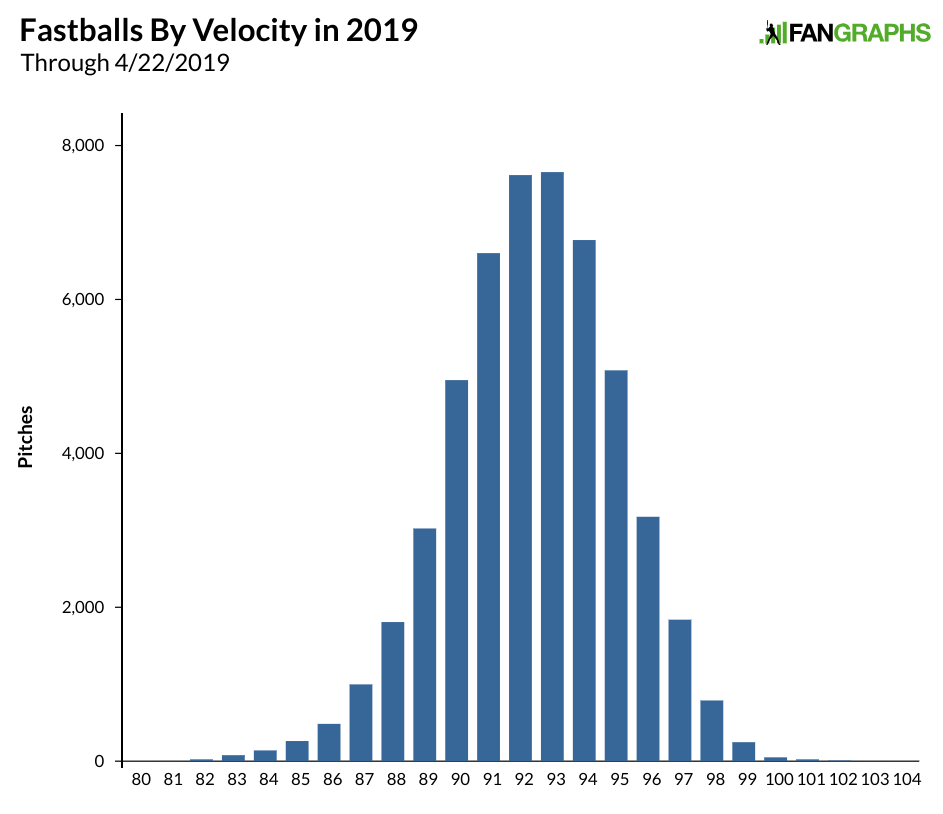
All major league pitchers throw pretty hard, and on average, fastballs are hitting close to 93 miles per hour these days. Pitchers throwing 95 seems common-place, and we regularly see pitches in the upper-90s. Pitchers throwing the ball really hard seems routine, but that should make us appreciate pitchers throwing the hardest even more. As pitch velocities get higher and higher, there are still upper limits, and the players who tend to reach those upper limits seem to find themselves alone. Right now, Jordan Hicks is alone.
The graph below represents all the fastballs thrown, except those by J.R. Murphy, this season.
It might be difficult to see the bars at 102 mph and above, so here’s a chart showing those pitches.
Fastest MLB Pitches in 2019
Player
Date
MPH
Jordan Hicks
4/21
104.2
Jordan Hicks
4/21
103.7
Jordan Hicks
4/21
103
Jordan Hicks
4/21
102.8
Jordan Hicks
4/21
102.4
Jordan Hicks
4/17
102.3
Jordan Hicks
4/17
102.3
Jordan Hicks
4/21
102.1
Jordan Hicks
4/7
102.1
Jordan Hicks
4/17
102.1
Jordan Hicks
4/17
102
SOURCE: Baseball Savant
And to further clarify matters, here’s the average fastball velocity for pitchers with at least 10 fastballs this season.
Michael Chavis lived a dream on Saturday. The No. 3 prospect in the Red Sox system not only made his MLB debut, he banged out a pinch-hit double in his first-ever at bat. He did so against Tampa Bay’s Jose Alvarado, with one on and one out in the top of the ninth inning, and the score knotted at five apiece. Boston went on to score, then held on for a 6-5 win.
There’s a pretty good chance that Chavis was the happiest person in Tropicana Dome that night. He was certainly one of the most excited. At age 23, the native of Marietta, Georgia had done in real life what he once fantasized about doing while batting rocks with a stick in his family’s back yard.
Chavis described the thrill-of-lifetime experience prior to yesterday’s game at Fenway Park.
———
Michael Chavis: “I wasn’t in the lineup — I was on the bench — but I knew the situation. They’d said there was a chance I would get to hit that day. Of course, I didn’t know when, who for, or who would be pitching. Come the eighth inning, looking at the lineup and how the game was playing out, I was thinking there was a chance.
“I’m taking some swings in the cage, and they come in and say, ‘Hey, you’re going to pinch hit in the ninth.’ I’m like, OK. Beautiful. ‘Who’s pitching?’ They say, ‘It’s Alvarado.’ I’m like, ‘Oh, wow.’ He’s a talented guy. Very good fastball.
“I’d faced him in spring training. I’d just come back from being sick, and it was kind of a similar situation in that I didn’t know if I was going to hit. I went up there and K’d on something like four pitches. I hadn’t seen a pitch in seven days, which made a 100-mph fastball that runs like his even more difficult to see. Read the rest of this entry »