Archive for Red Sox

Marcus Walden on the Slider that Resurrected His Career

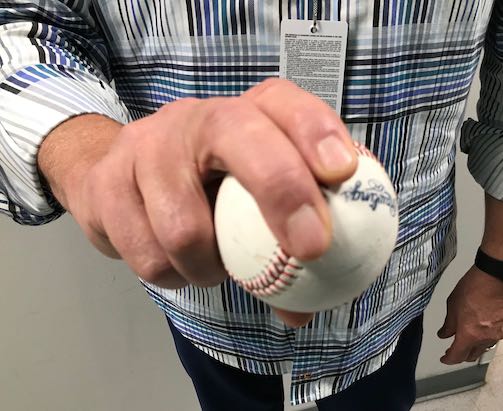
Marcus Walden is a 30-year-old rookie with a 5-0 record, a 1.46 ERA, and a spiked-grip slider that helped rescue him from minor-league purgatory. The story behind the pitch is one of avoidance-turned-desperation, with a healthy dose of studiousness thrown in for good measure. Walden has thrown his slider 41.6% of the time this year in 24.2 innings out of the Boston bullpen.

The righty’s journey to the big leagues was a meandering one. Drafted by the Blue Jays in 2007, Walden subsequently saw time in the A’s, Reds, and Twins organizations. He also spent a summer toiling in the independent Atlantic League. The Red Sox signed him off the scrap heap prior to the 2017 season, but even then his prospect status was tenuous at best. Twenty-six pitchers saw action for the AL East club that year, yet Walden remained in Triple-A.

Walden finally made his MLB debut last April, but his time at the top was short-lived. Sent down in May, he stayed on the Pawtucket roster throughout the remainder of the campaign. This year has been a different story. Walden has been one of Boston’s best relievers — his aforementioned numbers are augmented by a 10.95 K/9 and a 2.46 FIP — and again, his slider is a big reason why. I talked to Walden about his signature offering prior to a recent game.

———

David Laurila: Your go-to pitch is a slider. What is the story behind it?

Marcus Walden: “I didn’t start pitching until my senior year of high school. My freshman year [at Fresno City College] — the one year I went to school — I was throwing a four-seam fastball and a slider. Now I’ve gone back to that same style of a slider, although with a little bit different grip that I learned from Chandler Shepherd, in 2017. And watching Craig Kimbrel was a big help. I watched him closely, especially in spring training of ’17 and ’18 when he was throwing his live BPs. I talked to him a little. It was, ‘All right. What kind of shape are we trying to make with this pitch?’ He throws a knuckle slider, and that’s what I throw now.”

Laurila: Why did you start spiking your slider? Read the rest of this entry »


Chris Sale is Sort of Back

There was a fair bit of consternation regarding Chris Sale at the start of the season. In his first start of the year, he gave up three homers in three innings against the Mariners. Concern mounted when his fastball averaged 89 mph against Oakland in his next start and he struck out just a single batter. The Red Sox told everyone not to worry because dialing back was part of a plan. Sale did nothing to help his cause with a lackluster start against the Blue Jays the next time out, but his fastball averaged over 95 mph against the Yankees in his fourth outing, and over Sale’s last six starts, he’s got 65 strikeouts against seven walks in 38 innings with a 1.92 FIP and a 2.61 ERA. He’s struck out 31 batters in his last two starts, including 17 Rockies in just seven innings on Tuesday. Chris Sale, ravager of batters is back, but his velocity is still down, so he’s adjusted how he attacks hitters.

The game against the Yankees could be looked at as the turning point in Sale’s season thus far — the results certainly back that point up — but that was more of an isolated incident when it comes to the velocity we’ve grown accustomed to the past few years. The graph below shows Sale’s fastball velocity in each start over the past few seasons as well as a band which shows the max velocity for Sale in any given start.

When the Red Sox indicated they had a plan for Sale at the beginning of the year amidst his struggles, pointing to 2018 was the biggest piece of evidence. Sale started the 2018 season with lower velocities and then ramped it up as the season wore on before Sale wore out. This season might require a slower, less inclined ramp to make sure that Sale is still pitching strongly at the end of the season. Where skepticism might remain is whether Sale can be anything close to his prior great self if he spends half the season at 92-93 mph instead of a few ticks higher. If the last few starts are any indication, Sale will be just fine. Read the rest of this entry »


Red Sox Prospect Tanner Houck Has That Sinking Feeling Again

Tanner Houck is off to a book-ended beginning to his second full professional season. Boston’s first-round pick in the 2017 draft allowed seven runs in his first start, and in his fifth, he allowed five. In between, he authored three beauties. Pitching for the Portland Sea Dogs, the 22-year-old righty held Double-A opponents to 10 hits, and a lone marker, over 16 innings.

Houck relies heavily on a worm-killing two-seamer. It’s the pitch that wowed scouts when he was at the University of Missouri, and while it’s once again his go-to, that wasn’t the case over the first half of last season. The Red Sox had Houck put his signature pitch in his back pocket and primarily throw four-seamers against Carolina League competition. The reasoning was sound, but the results weren’t particularly pretty. A fish out of water without his sinker, Houck got hit around.

Come midseason, the Boston brain trust decided that Houck should go back to his old bread and butter. The news came as a relief. His best pitch back at the forefront of his arsenal, Houck proceeded to reestablish himself as one of the organization’s top prospects.

Houck, who takes the hill today in an 11 a.m. matinee, sat down for an in-depth discussion of his two-seamer, and what he gained from last year’s four-seam experiment, at the outset of the current campaign.

———

David Laurila: How would you describe the transition away from, and back to, your two-seamer?

Tanner Houck: “Honestly, [transitioning back] was just like riding a bike. It was getting back to my staple — back to who I am — and to how my career is going to be going forward. It was enjoyable. At the same time, not having thrown a four-seam in college, learning that side of the coin was really big for me. I’m still throwing one now, and it makes the two-seam that much better. Being able to ride a four-seam through the zone — not sink it — in certain counts has definitely helped. I’m able to give the hitter two different looks with relatively the same pitch.”

Laurila: What kind of movement do you get on your four-seamer? Read the rest of this entry »


Guessing the Fate of April’s Underachieving Pitchers

Earlier this week, I made my on-the-record guesses for what would happen with some of April’s underachieving hitters. Now we’ll turn to look at the disappointing pitchers and the potential for more helpings of crow for me to eat come October.

Chris Sale, Boston Red Sox

Last year, through the late-season shoulder problems, I counseled people not to panic so soon on Sale. He’s Chris Freaking Sale after all. When the White Sox put him in the rotation in 2012, there was a lot of doom-and-gloom about how his pitching motion and his frame meant he wouldn’t survive long as a starting pitcher. But from 2012-17, Sale was one of the most durable starters in baseball and now he drinks overflowing pints out of the skulls of those pundits.

But now, I am quite worried, especially in the short-term. He’s shown he can occasionally dial it up as he did in the Yankees matchup, hitting 96-97 through most of the game. But his velocity is generally down, severely so in most games. He went three months without a start below an average of 95 mph last year. This year he’s only had individual pitches passing this mark in a single game (the Yankees one).

If this is the Sale that we have now, I do expect him to adjust in the long-term. But the Sale of 2018 had a highly edited repertoire. He’s essentially a fastball-changeup-slider pitcher who is amazing at changing the look of these pitches. He could throw his fastball anywhere between 88-98 and have it look like five different pitches depending where it was. In 2019, he’s Pavarotti with an octave taken away. His fastball is more one-note and hitters have realized it; of every 10 fastballs that batters swing at, one in 10 of those swings-and-misses from previous years are now being hit.

“But Dan, he’s just being cautious because of his shoulder!” That makes me even more worried if 10 months later, he’s still having to pitch in a way that makes him a less effective pitcher because of a shoulder issue. Elbow problems are bad, but shoulder problems are a whole new level of scary, like going from a haunted house at an elementary school carnival to a Saw movie. I’m hopeful in the long-term, but it’s a problem for Boston getting back into the race. Read the rest of this entry »


Guessing the Fate of April’s Underachieving Hitters

For the first month of every baseball season, I’m a bit notorious for simply answering “April” as the convenient, one-stop-shop for questions relating to why someone’s favorite player is hitting .150. Once we start heading into May, telling people to be patient when 1/6th of the season is already over becomes an increasingly unujustifiable task. While rebuilding teams are in a place at which they can be patient, avoiding judgment is tricky for contenders, especially when every division leader is in first place by fewer than three games.

So let’s get out the guillotine and guess who can be saved and who is a lost cause.

Ryan Braun, Milwaukee Brewers

I remain quite torn about the state of doneness of the Hebrew Hammer. On one hand, he can still hit the ball with authority as seen by the fact that his average exit velocity, dipping under 90 mph, isn’t all that different from the numbers in 2016 and 2017, years in which Braun was still a contributor offensively. If you dig deeper into his pitch-by-pitch stats, Braun appears to be going dead-red for fastballs, and despite a career-low contact rate, he is actually making contact with fastballs at better-than-career-average rates (14.6% whiff/swing rate in 2019 vs. 19.8% career). But other than fastballs, he’s making much worse contact, missing almost half the changeups and sliders he’s offered at (career rate under 30%).

It makes me wonder about Braun’s bat speed. To my naked eye, it looks like he’s trying to compensate for decreased bat speed by making contact with his bread-and-butter pitch (Braun was one of the best fastball hitters in baseball in his prime). He also suggested he was changing his swing in order to hit more home runs. It’s unfortunate that swing speed isn’t one of the things you can get easily, but Alex Chamberlain identified stats that correlate with swing speed when reverse-engineering the scanty data available a few years ago. Isolated power, xwOBA, and contact rate all have a relationship, and in each of the three, Braun is at his career’s nadir.

I think there’s still hope for Braun, but if his bat is slowing down, I wonder if he’s taking the wrong approach in trying to hit for more power. A player with slower bat speed but who is also pulling the ball more (57% compared to 38% career) seems like one trying to cheat on the fastballs. I don’t think Braun’s as doomed as some on this list, but I think that he’d be better off not trying to capture his early-career power because it’s making him a one-dimensional hitter. Read the rest of this entry »


Michael Chavis on Doubling (and Almost Crying) in His MLB Debut

Michael Chavis lived a dream on Saturday. The No. 3 prospect in the Red Sox system not only made his MLB debut, he banged out a pinch-hit double in his first-ever at bat. He did so against Tampa Bay’s Jose Alvarado, with one on and one out in the top of the ninth inning, and the score knotted at five apiece. Boston went on to score, then held on for a 6-5 win.

There’s a pretty good chance that Chavis was the happiest person in Tropicana Dome that night. He was certainly one of the most excited. At age 23, the native of Marietta, Georgia had done in real life what he once fantasized about doing while batting rocks with a stick in his family’s back yard.

Chavis described the thrill-of-lifetime experience prior to yesterday’s game at Fenway Park.

———

Michael Chavis: “I wasn’t in the lineup — I was on the bench — but I knew the situation. They’d said there was a chance I would get to hit that day. Of course, I didn’t know when, who for, or who would be pitching. Come the eighth inning, looking at the lineup and how the game was playing out, I was thinking there was a chance.

“I’m taking some swings in the cage, and they come in and say, ‘Hey, you’re going to pinch hit in the ninth.’ I’m like, OK. Beautiful. ‘Who’s pitching?’ They say, ‘It’s Alvarado.’ I’m like, ‘Oh, wow.’ He’s a talented guy. Very good fastball.

“I’d faced him in spring training. I’d just come back from being sick, and it was kind of a similar situation in that I didn’t know if I was going to hit. I went up there and K’d on something like four pitches. I hadn’t seen a pitch in seven days, which made a 100-mph fastball that runs like his even more difficult to see. Read the rest of this entry »


A Surgical Probe into the State of Chris Sale and the Boston Red Sox

Getting a major, non-emergency surgery is a strange experience. One moment you are yourself, living in the body you have always inhabited, even if that body is now dressed in an unfamiliar and unflattering set of garments foisted upon you by the nurses. You are then wheeled into a cavernous room, where you are laid out on a slab for dissemination, surrounded by a motley crew of strangers with covered faces. Some bustle around with arcane metal implements; others pat you on the shoulder and tell you to have good dreams, thereby placing an unnecessary amount of pressure on you not to have bad dreams, in which case you would have failed at one of your two tasks in this scenario. (The other task is, of course, not dying.) And in what seems like moments (but also seems like a very long time, somehow), you wake up confused, unable to move or speak, with your body permanently altered in ways that you will likely never be able to fully understand. In just a few hours of unawareness, your experience of reality is fundamentally changed. There is nothing you can do but try to adjust. 

The last baseball game I watched before I went under was the Mariners home opener. The Mariners played this game against the defending World Series champion Boston Red Sox and ace Chris Sale, and they won 12-4. Save for their poor defense, they looked all-powerful. The Red Sox looked uniformly awful. The baseball season is full of these little flauntings of expectation: fun, ultimately insignificant. A larger data set irons everything out in the final reckoning. When I got knocked out for surgery in the early morning on March 29th, I had differently-arranged bones, no titanium screws or plates in my body, and a fundamental, unshakeable understanding that the 2019 Seattle Mariners were not, and the 2019 Boston Red Sox were, a reliably excellent baseball team.

I spent the several days post-surgery in a quasi-real state, drifting in and out of consciousness, oozing blood from various orifices, unable to eat much more than hospital-issue jello. When I got home, I tried to watch some baseball. My attention drifted with such hazy determination that it seemed as though a higher power were directing it away, and even without that, I couldn’t stay awake for three hours on end. As my energy and ability to function gradually returned, I was confronted by the massive backlog of undone tasks and unresponded-to emails that appears when you disconnect from the world for a few days.

And so it happened that I didn’t really get a chance to clue back into the baseball universe until this weekend. The world that greeted me was nothing short of astonishing. While I was gone, the Mariners had become the greatest offensive juggernaut that has ever been seen in the history of professional baseball. The Red Sox, meanwhile, had continued to be awful. Just awful! It was astonishing, an astonishing truth to reckon with, especially while on four different kinds of medication.

One reliable element of this new reality, though, was that the Blue Jays were terrible. The team has a collective wRC+ of 63, which in layman’s terms could be described as “ass.” I have seen the Red Sox beat the Blue Jays many, many, many times, and I have seen Chris Sale dominate the Blue Jays many, many times since he made the move to the Red Sox. In 43 innings pitched against the Jays with the Red Sox prior to this season, he allowed but 11 earned runs, and struck out 37.9% of the batters he faced, which has made for some frustrating baseball-watching experiences as a Jays fan. But as an appreciator of all things Sale — the violence of his pitching motion, the sweep of his slider, his cryptid-like frame and terrifying demeanor, his alleged belly-button piercing — watching him pitch against the Jays is a treat.

And there he was on Fenway’s Opening Day, a day of celebration, a reminder of the indomitable World Series championship team of last season, and a reminder that the team taking the field this season is much the same one. The fans were loud, and the weather was gloomy. This was the first game since my surgery that I had a chance to sit down and really focus on; and this, at last, was comfortingly familiar. The Red Sox were an anchor in my sea of uncertainty, the team connecting my pre-op baseball experience to my post-op existence.

For the first three innings, the game wasn’t much more than a great opportunity to catch up further on my rest. Sale retired the first seven batters he faced. His fastball velocity, a matter of justifiable concern for him this season, was up from his last start (though he still failed to generate any swinging strikes with the pitch). Same old 2019 Blue Jays. Same old Chris Sale. The Red Sox managed to score a pair of runs off Matt Shoemaker; everything was as it should be. Sale struck out Richard Urena to lead off the top of the third.

Then Alen Hanson poked a high slider into left field.

It was not a good pitch — Sale’s slider, like virtually all his other pitches, has not had its characteristic venom so far this season. He has not located the pitch well, and this one, too, was poorly placed, high and hanging over over the center of the plate. The ball was not exactly well-hit either, though, and it was just the one baserunner. No big deal. Nothing to see here.

Then Billy McKinney poked another high slider into center field. This slider was a better one — harder, coming at 81 mph instead of 77, and floating less casually over the plate — and McKinney hit it softly, without much conviction. But now, all of a sudden, the Jays had a rally brewing. (The Jays have had three or fewer hits in four of their 12 games this season.) And on Sale’s first pitch to Freddy Galvis, with the hit and run on, the Jays turned that rally into a scoring play. A sac fly tied the game on the next batter before the inning came to a close.

This sequence of events was bizarre to witness — the hit and run actually working, and the Jays managing to get enough runners on base to make the hit and run a viable possibility. As it turned out, the real break in the fabric of reality was yet to come.

The top of the fourth began with yet another single, this time by Randal Grichuk, off a slider that failed to sweep across the plate, instead hanging up and out of the zone on Sale’s armside. (Last year, 48% of swings generated by Sale’s slider were whiffs; this year, that number has dropped to only 28%. Sale threw 26 sliders against the Blue Jays; he generated five swinging strikes against seven balls in play.) This was promptly followed by a Danny Jansen single on a fastball out of the zone, which was promptly followed by an aborted bunt attempt by Lourdes Gurriel Jr. Perhaps confused by the sudden switch from bunting to not-bunting, Christian Vazquez let the ball bounce off his glove.

Grichuk advanced to third. And after a long plate appearance, which included at least one other failed bunt attempt, Gurriel finally shot a single into right field. The Jays had their second three-hit inning of the day, and they had the lead again.

By this point, I felt like I was losing my mind. While all of these singles were certainly the result of some amount of contact-related BA(d)BIP luck, and the passed ball was certainly not his fault, the fact that Sale was allowing this much contact at all — that, almost two weeks after that fateful game the day before my surgery, he looked almost as bad as he had back then — that the Reliably Excellent Red Sox had the same number of wins as my sad little Blue Jays, and that those same Jays now had the lead — none of it made sense. None of it tracked with the concept of baseball reality I had nurtured through my absence. I wondered if the painkillers were eating away at my brain cells.

A sacrifice bunt moved the two baserunners over. Hanson struck out swinging for the second out of the inning. The put-away pitch was Sale’s first swinging strike generated on a four-seamer this season, yet another fact that makes me feel that I have phased into a different dimension of existence. Sale stood for a moment, his jersey rippling gently in the wind, signifying a peace and tranquility that would never come. He threw to the plate, and Vazquez assumed an ideal catching position.

The ball sprang away. One runner came home; the other, Gurriel, scampered to third — from whence he proceeded to do this.

A straight steal of home, on a ball thrown a mile wide of the plate, after an inning where a catcher was possessed by the departed spirit of Rudy Kemmler, and a team with a .193/.268/.320 collective line put together two three-hit rallies. How does one even react appropriately to this? What’s the precedent?

The inning ended with no further runs, and Sale left the game, but its effects lingered, rippling through the chilly air, through the frequency of the boos that rained down onto the field from the Red Sox faithful. Something was off. This was not what was supposed to be happening. The team faded out for the winter, and when they woke up in the spring — the same team with the same players who had won the World Series — their experience of reality had fundamentally changed.  The Red Sox fell to 3-9, in the cellar of the AL East. Their playoff odds, sitting at 88.7% on Opening Day, have nosedived to 63.4%.

Yet that’s still a better chance than not. It’s still better than the Rays, who have flapped their slimy ray wings and glided into first place. Sale says that he’s never felt this lost, but the likelihood of him remaining lost forever seems slim. The experience of reality has changed, but most of the time, things have a way of smoothing over, of returning to the way that they’re supposed to be. Most of the time, the statistics normalize; the issues are problem-solved; the physical and mental injuries are recovered from. The pitcher who’s losing his fastball finds different ways to pitch. The cracks where the bones were separated fuse together again. Something has changed — it will heal, eventually. The titanium screws will always be there, but you’ll largely forget they exist. You just have to survive the adjustment period.


Daily Prospect Notes: 4/8/2019

These are notes on prospects from lead prospect analyst Eric Longenhagen. Read previous installments here.

Luis Robert, CF, Chicago White Sox
Level: Hi-A   Age: 21   Org Rank: 4   FV: 55
Line: 2-for-4, HR, 2 HBP

Notes
Off to hot start, Robert has multi-hit efforts in each of his first four games and has already stolen three bases and homered three times. After watching LouBob a lot last year (first while he rehabbed multiple injuries, then in the Fall League), I grew concerned about how his bat path might limit the quality of his contact (he sometimes struggled to pull pitches he should have) or his rate of contact, which we don’t have a large-enough sample to properly assess because of his injuries. So far, the pull-side stuff hasn’t been founded, as all but two of Robert’s balls in play so far this year have been to the right side of the field, and those were both pop-ups to the second baseman. He’s one of the more physically-gifted players in pro baseball.

Darwinzon Hernandez, LHP, Boston Red Sox
Level: Double-A   Age: 22   Org Rank: 2   FV: 45
Line: 5 IP, 2 H, 4 BB, 0 R, 10 K

Notes
We do not think Hernandez is a long-term starter and instead think he’ll be an elite bullpen arm. His fastball often sits in the upper-90s when he’s starting so it should at least stay there if he’s moved to relief and, though his feel for it comes and goes, his curveball can be untouchable at times. Maybe the strong early-season performances of Matt Barnes, Brandon Workman, and Ryan Brasier has stifled some of the disquiet about the Red Sox bullpen, but in the event that they need an impact arm, I think it’s more likely to be Hernandez than a piece outside the org. Some of this is due to the quality of the farm system, but Hernandez might also just be better than a lot of the options that will eventually be on the trade market. Read the rest of this entry »


Sox, Bogaerts, Agree on $120 Million Extension

Late Sunday, the Boston Red Sox and Xander Bogaerts agreed on a $120 million extension, keeping the team’s star shortstop in Boston until at least 2025. While the deal is being reported as worth $132 million, that figure already includes the $12 million Bogaerts was going to make in 2019, so it’s kind of cheating for the sake of headline inflation. There are two other significant contract stipulations: a vesting option for 2026 worth $20 million, and an opt-out for Bogaerts following the 2022 season. The opt-out ensures that Bogaerts will at least have the option to test free agency once somewhere near his prime during his career, his first year of free agency otherwise being his age-33 season if the option doesn’t vest.

Bogaerts is in a curious position for a star player at a key position on a very popular team: he might actually be underrated. When people discuss the top shortstops in baseball, the list rightly starts with Francisco Lindor, who is the best shortstop in baseball, but then you’ll generally hear Carlos Correa and Corey Seager’s names, then maybe some talk about Andrelton Simmons because of his glove. It’s only then that Bogaerts might be thrown in as a “oh yeah, him too” selection. Bogaerts still only has one All-Star appearance, one fewer than Scott Cooper, and only received back-end MVP votes in a single season. Even in 2018, a season in which Bogaerts was hitting .284/.353/.535 in the first-half, he failed to be named to the midsummer classic’s roster.

Top 20 Shortstops, 2014-2019
Rank Name WAR G AVG OBP SLG
1 Francisco Lindor 22.8 574 .288 .350 .487
2 Andrelton Simmons 18.0 725 .272 .320 .375
3 Xander Bogaerts 17.7 745 .284 .343 .430
4 Brandon Crawford 16.2 750 .257 .323 .415
5 Carlos Correa 15.4 472 .276 .355 .476
6 Corey Seager 14.9 359 .301 .372 .493
7 Didi Gregorius 14.8 658 .268 .315 .437
8 Asdrubal Cabrera 12.5 715 .266 .325 .439
9 Jean Segura 12.0 713 .286 .327 .404
10 Elvis Andrus 11.6 722 .277 .327 .396
11 Trea Turner 11.3 363 .290 .347 .460
12 Troy Tulowitzki 10.8 419 .279 .347 .467
13 Jed Lowrie 10.7 602 .260 .338 .403
14 Marcus Semien 9.9 628 .250 .313 .405
15 Javier Baez 9.9 530 .268 .310 .473
16 Zack Cozart 9.7 505 .249 .314 .414
17 Eduardo Escobar 9.4 649 .260 .311 .431
18 Trevor Story 9.4 403 .267 .332 .528
19 Starlin Castro 9.1 706 .280 .319 .417
20 Addison Russell 8.8 533 .242 .313 .392

But over the last five years, by WAR, only Lindor has clearly contributed more on-the-field than Bogaerts has among shortstops. So why this lack of recognition? Call it the Curse of the Well-Rounded. Bogie does nothing truly poorly, but like a number of other all-around talents, he doesn’t have that one obvious highlight to point to in a culture that likes the ten-second soundbite. He’s topped out short of 25 homers, and only hit .300 the one-time. His glove is middling as shortstops go — there’s significant disagreement between UZR and DRS here — and in sabermetric language, his WAR hovers between three and five a year, so no crazy season like Lindor’s 2018 as of yet. There’s no signature postseason home run to hang his hat on. Bogaerts has played the enchilada in a world obsessed with tacos and burritos.

At just 26, Bogaerts ranks highly enough among shortstops through the same age that he’s on a realistic Hall of Fame trajectory. He’s not on the “hit by a bus and get in” path that Mike Trout finds himself on, and there are players who also ranked highly who have fallen or will fall well short of the Hall (Hanley Ramirez, Garry Templeton, Donie Bush, probably Elvis Andrus), but it’s still an impressive list of Cooperstownerati.

Top 25 Shortstops Through Age 25
Rank Name WAR G AVG OBP SLG
1 Alex Rodriguez 42.8 952 .311 .378 .571
2 Arky Vaughan 39.4 849 .334 .424 .491
3 Cal Ripken 34.7 830 .289 .351 .483
4 Travis Jackson 28.9 899 .295 .344 .447
5 Jim Fregosi 27.0 844 .277 .341 .412
6 Joe Cronin 25.4 711 .305 .388 .458
7 Lou Boudreau 24.2 656 .278 .370 .402
8 Hanley Ramirez 24.0 618 .316 .386 .531
9 Francisco Lindor 22.8 574 .288 .350 .487
10 Robin Yount 21.8 1084 .274 .311 .391
11 Jose Reyes 21.6 755 .287 .336 .436
12 Donie Bush 21.3 766 .251 .362 .310
13 Vern Stephens 20.9 694 .294 .354 .462
14 Nomar Garciaparra 20.0 455 .322 .367 .566
15 Alan Trammell 19.7 850 .280 .350 .383
16 Joe Tinker 19.6 693 .250 .299 .326
17 Bill Dahlen 19.5 644 .292 .372 .438
18 Derek Jeter 19.4 638 .318 .389 .465
19 Cecil Travis 18.7 814 .321 .375 .418
20 Rabbit Maranville 18.7 771 .245 .310 .325
21 Joe Sewell 18.0 635 .322 .411 .434
22 Woody English 18.0 659 .306 .376 .407
23 Elvis Andrus 17.8 914 .272 .335 .345
24 Xander Bogaerts 17.7 759 .284 .343 .429
25 Garry Templeton 17.0 713 .305 .325 .418

At $20 million, the Red Sox get a particularly good deal. Bogaerts likely left some money on the table given the fact that he’s not a two- or three-year player, but one who was only a single season away from free agency. Indeed, as someone who would have hit the market at age 27 and almost certainly is in the top five at his position, one might even characterize $20 million a year as a steal. But don’t take my word for it; what’s the fun of having the magic computer that makes projections if I’m not going to use it?

ZiPS Projections – Xander Bogaerts
Year BA OBP SLG AB H 2B 3B HR BB SO SB OPS+ DR WAR Cumulative
2020 .285 .350 .478 565 161 38 4 21 54 116 10 118 -2 3.9 $31.0
2021 .283 .350 .475 552 156 37 3 21 54 114 10 117 -3 3.7 $61.6
2022 .281 .349 .471 537 151 36 3 20 53 108 9 116 -4 3.5 $91.6
2023 .282 .351 .474 521 147 34 3 20 52 99 9 117 -5 3.4 $122.2
2024 .281 .349 .470 502 141 32 3 19 49 94 8 115 -5 3.0 $150.9
2025 .277 .345 .450 480 133 29 3 16 46 87 7 109 -6 2.4 $174.9
2026 .272 .335 .441 456 124 26 3 15 41 79 6 104 -7 1.8 $193.6

ZiPS has tended to be fairly close with Red Sox signings this era (for example, it came within $2 million of Dustin Pedroia‘s extension), but this one is a very large aberration. The projections from ZiPS estimate — and this includes the risk of projecting 2020-2025 now rather than after he actually has his 2019 season in the books — that Bogaerts left roughly $50 million on the table. If the projections prove to be accurate, as free agency-year contracts go, Bogaerts’s contract will rank in the upper-echelons of big contracts that worked out well for the team, in the territory of Miguel Cabrera’s first contract. Some of that money comes back to Bogaerts in the form of his opt-out, but his downside is much better than, say, Eric Hosmer, a player with a similar opt-out clause, so it’s less of a hit to the team.

Bogaerts will likely speak more on the subject, but two issues seemed to loom large for him in the decision-making process. By all accounts he enjoys playing for the Red Sox and has shared his concerns about the Bryce Harper/Manny Machado market this winter. Add in uncertainty about baseball’s next collective bargaining agreement and it’s understandable why Bogaerts and other free agents to-be have prioritized getting long-term deals done and in the books.

Does Bogaerts end up in Cooperstown? At this point, ZiPS would say no, projecting him to end up with around 45 WAR with 2429 hits and 264 home runs, a career reminiscent of Toby Harrah’s, who was way better than you think. It’s likely some of that will take place at third base as well, which will probably hurt how he is perceived by voters. But it’s not out of the realm of possibility; ZiPS gives him a 20% chance of passing 65 WAR, a number that would make him a likely Hall of Famer, though not a first-balloter. There are 18 shortstops with 60 WAR and the only ones not in the Hall are Alex Rodriguez (who is not yet eligible and will struggle for non-playing reasons), Bill Dahlen, and Jack Glasscock. I swear I didn’t make up the last guy. A one-in-five chance at a summer speech in Cooperstown ain’t bad.


Effectively Wild Episode 1352: Season Preview Series: Red Sox and Orioles

EWFI
Ben Lindbergh and Sam Miller banter about Willians Astudillo making the Twins’ Opening Day roster, whether Astudillo’s uncanny ability to make contact is more mental or physical, and what Oliver Perez and the rest of the remaining LOOGYs can do to preserve their endangered places on major-league rosters when the three-batter minimum goes into effect in 2020, then complete the 30-team preseason series by previewing the 2019 Boston Red Sox (18:40) with Boston Globe reporter Alex Speier, and the 2019 Baltimore Orioles (53:12) with MLB.com Orioles beat writer Joe Trezza.

Audio intro: The Weakerthans, "The Last Last One"
Audio interstitial 1: Guided By Voices, "Alex and the Omegas"
Audio interstitial 2: Chip Taylor, "Nine Soldiers in Baltimore"
Audio outro: Neil Young, "No More"

Link to Rob’s article about endangered LOOGYs
Link to SI article about endangered LOOGYs
Link to Ben on early-season Sale vs. late-season Sale
Link to Ben on champions standing pat and the Boston bullpen
Link to Ben and Baumann on the MLB extension spree
Link to listener’s minor-league free agent tracker
Link to Banished To The Pen’s team preview posts
Link to preorder The MVP Machine

 iTunes Feed (Please rate and review us!)
 Sponsor Us on Patreon
 Facebook Group
 Effectively Wild Wiki
 Twitter Account
 Get Our Merch!
 Email Us: podcast@fangraphs.com