Archive for Twins

The Twins’ Two-Headed Catching Monster

It’s a rough time to be a catcher. Over the last couple of years, we’ve seen catcher offensive production drop to extreme lows. Last year, major league backstops compiled 49.9 WAR, the lowest total since 2004, and their collective wRC+ was just 84, the lowest mark since 2002. In this day and age, it’s not uncommon to see teams select their starting backstops based on their defensive prowess and ability to handle a pitching staff rather than their ability to contribute offensively. That’s the only explanation for why Jeff Mathis continues to receive plate appearances despite a running a wRC+ that’s in the single digits.

For most teams, the backup catcher is an afterthought on the roster, selected for his ability to competently go about his duties without hurting the team too much. Most backup catchers see the field once or twice a week, three times if they’re lucky, so their effect on the overall production of the lineup is rather minimal. But there are a few squads this year who have been blessed with an abundance of catching riches.

Five teams have received more than three wins from their catching corps in 2019:

Team Catching, 2019
Team wRC+ CS% FRM WAR
Brewers 113 29.35% 17.6 4.6
Phillies 97 40.48% 6.5 4.2
Diamondbacks 109 40.38% 9.4 3.8
Twins 116 21.54% 3.7 3.8
Red Sox 84 31.88% 14.4 3.1

Read the rest of this entry »


The Twins Tumble Out of First Place

Remember when the Twins were running away with the AL Central? On June 2, they were a major league-best 40-18, a season-high 11 1/2 games ahead of the Indians (29-30). Ten weeks later, after a wild final two innings of Sunday’s game to cap a series in which the Indians took three out of four, the two teams were tied atop the AL Central at 71-47, and after Cleveland’s walk-off win against the Red Sox on Monday night, the idle Twins find themselves a half-game back.

With Cleveland beating Minnesota in the first two games of their series on Thursday night (7-5) and Friday night (6-2), the two teams actually entered Saturday sharing the division lead as well, that for the first time since April 26, when the Indians were 15-10 and the Twins 14-9. With Jake Odorizzi and friends holding Cleveland to one run on Saturday, Minnesota had edged ahead again, but on Sunday, the Indians touched up José Berríos for two first-inning runs, and carried a 3-1 lead into the bottom of the ninth. An Eddie Rosario double and two singles, all off of Indians closer Brad Hand, trimmed the lead to 3-2. With one out, Marwin Gonzalez bashed a ball off the base of the left-center wall. Luis Arraez scored easily from second base to tie the game, but Tyler Naquin made a perfect barehanded grab of the ball after it caromed, then relayed to Francisco Lindor, whose peg to Kevin Plawecki cut down pinch-runner Ehire Adrianza, the potential winning run, at the plate:

The Twins challenged the call on the grounds that Plawecki blocked the plate without the ball, but the call on the field stood; the play was kosher. Carlos Santana’s grand slam off Taylor Rogers in the top of the 10th inning provided the margin of victory in the 7-3 win. It was a Santana homer in the bottom of the ninth that lifted the Indians over the Red Sox on Monday as well. Read the rest of this entry »


Martín Pérez’s Cutter is No Longer Cutting It

While the Twins going home run-crazy in a world of home run-wackiness may have been the most significant early storyline for Minnesota, one of the team’s other early bright spots was the emergence of Martín Pérez. I was extremely skeptical of the decision to bring him in given his history with the Rangers, and thought the Twins ought to have been more aggressive in signing top free agents after clearing Joe Mauer’s salary.

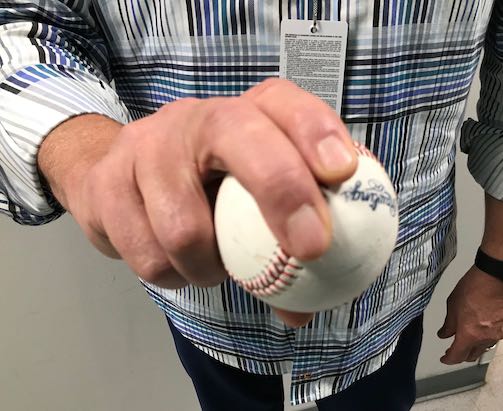
In the early months of the season, my worries about Pérez seemed almost quaint. On May 23, at what I would call his high-water mark, the Twins outslugged the Angels, winning 16-7 and leaving Pérez with a 7-1 record and a 2.95 ERA. He was showing increased velocity. Pérez was never a big fastball pitcher, but his increased velocity from late 2018 — when he had an average velocity of at least 95 mph in four of his September relief appearances — continued in 2019 as a starter. But perhaps the most important factor in his early-season success was the development of his cut-fastball, a pitch he picked up on advice from his agent and with help from teammate Jake Odorizzi.

The proof of the pudding is in the eating and with his fancy new cutter, Pérez feasted on opposing batters in the late spring. Through the literal end of the season (June 20), Pérez threw 435 cutters, making it his most-used pitch, and held batters to a .164 BA and a .250 SLG. Against all other pitches, including his fastball, the league was hitting .301. 42% of his 74 strikeouts were thanks to his cutter. To put how well the cutter was performing in perspective, from 2007 on Mariano Rivera, who knows a bit about this pitch, had batters swing-and-miss on 10% of his cutters. Through mid-June, Pérez was at 15%. Read the rest of this entry »


Nelson Cruz Won’t Stop

The other day I wrote about Shin-Soo Choo and the way he’s hitting the ball really hard despite being a 37-year-old who has never garnered much of a reputation as a power hitter. In that piece, I included a chart that showed Choo was having the second-best season in terms of hard-hit percentage by a player 35 years of age or older since we started gathering such data in 2002. Choo was deserving of the digital ink used on him, but as impressed as I was with his placement on that chart, the most remarkable player listed was the one directly above him. The hard-hit rate that Choo had put together that ranked second on that list was 46.7%. No. 1 on that list was 2019 Nelson Cruz, whose hard contact rate currently rests at a whopping 55%. He’s 39 years old, and he’s hitting the ball hard more often than anyone else in baseball. He also just wrapped up one of the hottest two-week stretches you’ll ever see.

On the morning of July 22nd, Cruz was in the middle of yet another strong season at the plate. His slash line was .270/.364/.543 with 19 homers in 71 games. Even as a designated hitter, that’ll play on just about any team. Then all hell broke loose.

Offensive totals, July 22 — Aug. 6
Player BA OBP SLG HR RBI wOBA wRC+ WAR
Nelson Cruz 0.460 0.526 1.300 13 27 0.699 352 1.9
Next-closest player 0.429 0.500 0.816 7 20 0.516 229 1.2

Look, it is usually best not to fuss too much over a hot streak that is over a sample size this small. The baseball season is long, and because of that, there will be many, many players who throw together a torrid two-week stretch or two. In that table, the next-best players in those categories ranged from Anthony Rendon to Andrew Benintendi to Mike Tauchman. Those players should all feel very happy and proud of the way they’ve been playing baseball, but unless your name is Mike Trout, there is a very good chance that an amazing two-week stretch of baseball will not be followed with another two-week stretch that is just as amazing. This is just the way the game works, and there’s no use in getting too excited over what is only around 50 plate appearances, about 1/12th of your season or less. Read the rest of this entry »


Ranking the Prospects Moved During the 2019 Trade Deadline

The 2019 trade deadline has passed and, with it, dozens of prospects have begun a new journey toward the major leagues with a different organization. We have all of the prospects who have been traded since the Nick Solak/Peter Fairbanks deal ranked below, with brief scouting snippets for each of them. Most of the deals these prospects were a part of were analyzed at length on this site. Those pieces can be found here, or by clicking the hyperlink in the “From” column below. We’ve moved all of the players below to their new orgs over on THE BOARD, so you can see where they rank among their new teammates; our farm rankings, which now update live, also reflect these changes, so you can see where teams’ systems stack up post-deadline. Thanks to the scouts, analysts, and executives who helped us compile notes on players we didn’t know about.
Read the rest of this entry »


Twins Get Best Reliever Traded At Deadline

Minnesota’s playoff position has been fairly secure for some time, but Cleveland has edged closer in the standings for the division. While Cleveland didn’t necessarily make themselves better at the deadline, they did fix a couple monstrous holes in their lineup as they hope to get a lift from ace pitchers returning from injury. The Twins have responded with a move to shore up one of their weaknesses in the bullpen. While Sam Dyson might not have been the biggest name on the market, he ended up the best reliever traded this deadline, as Kirby Yates, Felipe Vázquez, and Ken Giles all stayed put. The deal was first reported by Tommy Birch and then confirmed by Dan Hayes. According to Birch, this is the deal:

Twins Receive:

  • Sam Dyson

Giants Receive:

For the Twins, Sam Dyson presents an immediate upgrade and appealing option in high-leverage situations. The right-hander, who is still arbitration eligible next season, is a groundball specialist with just seven walks on the year. His 2.74 FIP and 2.47 ERA speak to how well he’s performed this season, and his 1.1 WAR ranks 19th among 165 qualified relievers. Dyson relies on a low-to-mid-90s sinker and a low-90s cutter that runs in on lefties and away on righties. Those two represent around 70% of Dyson’s pitches, with a four-seamer, change, and slider mixed in the rest of the time.

Dyson was a very good reliever for the Rangers in 2015 and 2016, but a rough start to 2017 saw the Rangers give up on him. The Giants reaped the benefits of letting Dyson work things out in 2017, and he has provided solid performances the past two seasons. With the Twins, Dyson should slide right behind Taylor Rogers as the second-best reliever on the team. For a bullpen looking for some stability, Dyson should provide exactly that.

As for the players sent to San Francisco, we’ve got three players with some pretty high variability when it comes to reaching their potential. Berroa and Teng are both listed as 40 FV on THE BOARD. Prelander Berroa is only 19 years old, has posted some high strikeout rates in the Appalachian League, and was likened to Fernando Rodney in the prospect report this spring. Kai-Wei Teng is only 20 years old and signed for $500,000 out of Taiwan. He’s made it to Low-A and has posted impressive numbers there. Longenhagen and McDaniel had this to say before the season:

His arm action is a little rough, and Teng’s lower slot makes it hard for him to get on top of his curveball consistently, but he’s very well balanced over his blocking leg and otherwise has a smooth delivery. At this age and size, it’s possible no more than the low-90s velo will come, but that might be enough if that curveball matures, because Teng’s changeup is also very good.

As for Jaylin Davis, he’s hit 25 homers this season between Double-A and Triple-A. He’s now 25 years old and there’s a lot of swing and miss to his game, but if he can access his power in-game, he might be able to contribute in the majors.

This deal looks like targeted quantity over quality, with the Giants looking to bring in players with upside they might not reach in hopes they hit on one of them. For the Twins, they got exactly what they needed — even if they didn’t land a starter — while only having to deal from the depth in their system.


The 40-Man Situations That Could Impact Trades

Tampa Bay’s pre-deadline activity — trading bat-first prospect Nick Solak for electric reliever Peter Fairbanks, then moving recently-DFA’d reliever Ian Gibaut for a Player to be Named, and sending reliever Hunter Wood and injured post-prospect infielder Christian Arroyo to Cleveland for international bonus space and outfielder Ruben Cardenas, a recent late-round pick who was overachieving at Low-A — got us thinking about how teams’ anticipation of the fall 40-man deadline might impact their activity and the way they value individual prospects, especially for contending teams.

In November, teams will need to decide which minor league players to expose to other teams through the Rule 5 Draft, or protect from the Draft by adding them to their 40-man roster. Deciding who to expose means evaluating players, sure, but it also means considering factors like player redundancy (like Tampa seemed to when they moved Solak) and whether a prospect is too raw to be a realistic Rule 5 target, as well as other little variables such as the number of option years a player has left, whether he’s making the league minimum or in arbitration, and if there are other, freely available alternatives to a team’s current talent (which happens a lot to slugging first base types).

Teams with an especially high number of rostered players under contract for 2020 and with many prospects who would need to be added to the 40-man in the offseason have what is often called a “40-man crunch,” “spillover,” or “churn,” meaning that that team has incentive to clear the overflow of players away via trade for something they can keep — pool space, comp picks, or typically younger players whose 40-man clocks are further from midnight — rather than do nothing, and later lose players on waivers or in the Rule 5 draft.

As we sat twiddling our thumbs, waiting for it to rain trades or not, we compiled quick breakdowns of contending teams’ 40-man situations, using the Roster Resource pages to see who has the biggest crunch coming and might behave differently in the trade market because of it. The Rays, in adding Fairbanks and rental second baseman Eric Sogard while trading Solak, Arroyo, etc., filled a short-term need at second with a really good player and upgraded a relief spot while thinning out their 40-man in preparation for injured pitchers Anthony Banda and Tyler Glasnow to come off the 60-day IL and rejoin the roster. These sorts of considerations probably impacted how the Cubs valued Thomas Hatch in today’s acquisition of David Phelps from Toronto, as Hatch will need to be Rule 5 protected this fall.

For this exercise, we used contenders with 40% or higher playoff odds, which gives us the Astros, Yankees, Twins, Indians, Red Sox, and Rays in the AL and the Dodgers, Braves, Nationals, Cubs, and Cardinals in the NL, with the Brewers, Phillies, and A’s as the teams just missing the cut. Read the rest of this entry »


It May Really Be the Lewin Diaz Trade

On Saturday, the Marlins and Twins pulled off a pre-deadline swap.

First, the trade:

Miami gets:

1B Lewin Diaz

Minnesota gets:

RHP Sergio Romo
RHP Chris Vallimont
Player to be Named Later

This deal’s immediate big league relevance centers around 36-year-old Romo, who has had an incredible career for a reliever, especially one who throws as hard as he does. Romo’s fastball has never averaged more than even 90 mph, topping out at 89.9 mph during his rookie year, while average relief fastballs now hum in at 93.6 mph. His 9.8 WAR ranks 15th among relievers since he debuted in 2008, and splitter wizard Koji Uehara is the only other soft-tosser ahead of him.

Most of our readers have probably seen enough of Romo over the last decade to know that he’s been exceptional because of his ability to locate, and change the speed and shape of, his trademark slider. Hitters know that slider is coming — he’s thrown it roughly 53% of the time during his career, second most to Carlos Marmol among all pitchers with 400 or more innings since Romo debuted — and yet Romo’s surgical placement of the pitch just off the plate, equal parts enticing and unhittable, has had big league hitters flailing away at it across more than a decade now. Read the rest of this entry »


Job Posting: Minnesota Twins Baseball Systems Data Quality Engineer

Position: Data Quality Engineer, Baseball Systems

Location: Minneapolis, MN

Description:
The Minnesota Twins are seeking a Data Quality Engineer to join the Baseball Research and Development group. This position offers wide-ranging exposure to current programming methods and frameworks in a fast-paced agile environment. With creativity and passion, this candidate will collaborate with the Baseball Operations staff to ensure good data hygiene across a growing set of disparate data sources. This position requires an intuitive and exacting passion for data detective work. By identifying patterns that affect data quality and by working directly with data scientists, the candidate will help to develop, deliver, and maintain tools to enhance model and decision accuracy. This position requires independent curiosity and a commitment to achieving excellence within a team framework. Strong communication and interpersonal skills will enable the candidate to enjoy engaging relationships with product users.

Essential Duties and Responsibilities:

  • Build data quality assurance tools and procedures to identify and correct data inaccuracies.
  • Design, maintain, and support data warehouses for reporting and analysis.
  • Develop, optimize, and automate data workflows and pipelines ensuring data integrity and quality from external data integrations.
  • Support the individuals of the Baseball Operations team by providing assistance and education on best practices when querying the data warehouse.
  • Work with data scientists to ensure models and analyses follow best practice for accessing the data and are properly integrated into scheduled data processing workflows.
  • Explore emerging technologies and recommend new tools and techniques for collecting and processing data.
  • Develop visualization tools and reports that showcase research findings in creative, effective ways for a variety of different end users and use cases.
  • Use an agile software development approach for quick roll-outs combined with incremental improvement process to existing systems and environments.
  • Provide courteous and timely first-level contact and problem resolution for all Baseball Department users.

Qualifications, Skills, and Abilities:

  • Bachelor’s Degree in Computer Science, Data Engineering, or a related field or equivalent work experience.
  • Software development experience, including requirements definition, design, development, testing, implementation, and iterative improvement.
  • Expertise with SQL, relational databases, database design, and data cleaning techniques.
  • Ability to process and transform data from a variety of sources and formats.
  • Experience with C#, Java, Python, R or other similar language that interacts with data.
  • Knowledge of data visualization packages such as Plotly or ggplot is a plus.
  • Proficiency evaluating and improving the performance of SQL queries.
  • Understand software development best practices and long-term maintainability of code.
  • 2+ years of relevant work experience.
  • Strong work ethic, curiosity, initiative, and problem-solving skills.
  • Open mindedness to learn new technologies and embrace different ways of thinking.
  • Passion for baseball is preferred; passion for problem solving is required.

Physical Requirements:

  • Ability to lift and transport items up to 55 lbs.
  • Must be able to sit for extended periods of time.
  • Must be able to move throughout all areas and levels of the ballpark.
  • Ability to relocate to the Twins Cities area.

To Apply:
External applicants should apply using the application found here.

The content in this posting was created and provided solely by the Minnesota Twins.


The Cy Young Award Is Attainable for Jose Berrios

The last two seasons, Jose Berrios has been on the periphery when it comes to considering the best pitchers in baseball. In 2017 and 2018, he put up three-win campaigns and his 6.1 WAR ranked 22nd among pitchers, just behind Blake Snell, Kyle Freeland, and Mike Clevenger, and just ahead of Jon Gray, Charlie Morton, and Kyle Hendricks. It’s a good group to be associated with, and a few of those players have had great seasons, but with Berrios putting up two similar seasons, he’s not viewed in the same way as Snell and he hasn’t been quite good enough to move himself into the top 10 or 15 pitchers in the game. That’s changed this season, as Berrios has been more aggressive, reduced his walk rate, and become more effective against lefties, all of which has resulted in a season that’s put him firmly among the top 10 pitchers in the game.

After an uneven debut season in 2016 at just 22 years of age, Berrios registered solid efforts in 2017 and 2018. Here’s how those seasons compare to what Berrios has been able to do this year:

Jose Berrios’ Step Forward
IP K% BB% ERA FIP WAR WAR/200
2017-18 338 24.1% 7.7% 3.86 3.88 6.1 3.6
2019 104.2 22.9% 4.7% 2.84 3.54 2.8 4.8

The big positive change is the reduction in his walk rate. Berrios has achieved that number mostly by pitching more in the zone. He’s sacrificed his strikeout rate slightly, though he’s made up for that loss by doubling his infield fly rate. Berrios’ FIP this season might not seem drastically altered from the previous two seasons, but with the change in run environment, the three-tenths difference means more than a win over the course of a full season. Berrios did suffer a blister issue in his last start against Kansas City, but currently remains on schedule to start later this week with hopes that the issue is a minor one. Read the rest of this entry »