US Flag Bunting
US Flag Bunting
US Flag Bunting
US Flag Bunting
US Flag Bunting
US Flag Bunting
US Flag Bunting
US Flag Bunting
US Flag Bunting
US Flag Bunting
US Flag Bunting
US Flag Bunting
US Flag Bunting
US Flag Bunting
US Flag Bunting
US Flag Bunting
US Flag Bunting
US Flag Bunting
US Flag Bunting
US Flag Bunting
US Flag Bunting
US Flag Bunting
US Flag Bunting
US Flag Bunting
US Flag Bunting
US Flag Bunting
US Flag Bunting
US Flag Bunting
US Flag Bunting
US Flag Bunting
US Flag Bunting
US Flag Bunting
US Flag Bunting
US Flag Bunting
US Flag Bunting
US Flag Bunting
US Flag Bunting
US Flag Bunting
US Flag Bunting
US Flag Bunting
US Flag Bunting
US Flag Bunting
US Flag Bunting
US Flag Bunting
US Flag Bunting
US Flag Bunting
US Flag Bunting
US Flag Bunting
US Flag Bunting
US Flag Bunting

Archive for Yankees

More UCL Tears Prompt Pointed Exchange, Few Answers to Baseball’s Thorny Mess

Joe Nicholson-USA TODAY Sports

If last week’s news that Eury Pérez would need Tommy John surgery was bad, Saturday was a whole lot worse. Within a span of five hours, the baseball world learned that the Guardians’ Shane Bieber, the Yankees’ Jonathan Loáisiga, and the Braves’ Spencer Strider have all incurred significant damage to their ulnar collateral ligaments, with Bieber headed for Tommy John surgery, Loáisiga set to undergo season-ending surgery as well, and Strider headed to see Dr. Keith Meister, the orthopedic surgeon who will perform the surgeries of the other two.

The losses of those pitchers is a triple bummer, not just for them and their respective teams — each of which leads its division, incidentally — and fans, but for the sport in general. Underscoring the seriousness of the issue, by the end of Saturday both the players’ union and Major League Baseball traded volleys regarding the impact of the introduction of the pitch clock on pitcher injuries in general.

Bieber, a two-time All-Star, won the AL Cy Young award and the pitchers’ Triple Crown during the pandemic-shortened 2020 season, but missed significant time in two out of the past three years due to injuries. In 2021 he was limited to 16 starts due to a strain of his subscapularis, the largest of the four muscles that make up the rotator cuff, and last year he made just 21 starts, missing 10 weeks due to elbow inflammation. He had pitched very well this season, with a pair of scoreless six-inning outings, each totaling just 83 pitches. He struck out 11 A’s in Oakland on Opening Day and then nine Mariners (without a single walk) in Seattle on April 2.

Bieber experienced more soreness than usual while recovering from the Opening Day start, but the 29-year-old righty and the team decided to proceed without extra rest, according to MLB.com’s Mandy Bell, who wrote, “Bieber wanted to see if he could push through this, considering he hadn’t felt any pain in Spring Training.”

The discomfort persisted during Bieber’s second start, after which the team ordered additional testing, “which revealed the injury to the same ligament he had problems with last year,” wrote Bell. If I’m not mistaken, that last bit of information is new, as previous reports of last year’s injury did not specify as to the inflammation’s cause. “He really put in a ton of work this winter and throughout spring training, and we all felt he was on a good path to stay healthy and contribute for the balance of the season,” said president of baseball operations Chris Antonetti on a Zoom call with reporters. Antonetti additionally lauded the pitcher’s “sheer toughness and grit” in maintaining a high level of performance, while manager Stephen Vogt sounded a similar note in saying, “The amount of work that this guy’s put in over the last few years, the things that he’s pitched through, that’s a testament to who he is.” But those supportive statements raise the question of whether this juncture could have been avoided had Bieber taken a longer time to heal from the damage found last summer, as teammate Triston McKenzie did. Missing from that comparison, however, is information regarding the severity of the two pitchers’ tears, details to which we’re not privy.

As a pending free agent, Bieber is in a tough spot, as he’ll enter the market under a cloud of uncertainty, likely cutting into a payday that’s ceiling has already been reduced by his previous outages. As for the Guardians, their remaining rotation looks so shaky that it ranks 27th in projected WAR via our Depth Charts, and their Playoff Odds have decreased since Opening Day (from 33.5% to 32%) despite the 7-2 start that has put them atop the AL Central.

The 26-year-old McKenzie, who was limited to four starts last season by a teres major strain as well as his UCL sprain, was rocked for five runs (four earned) in 3.1 innings in his first outing on Monday against the Mariners. His four-seam fastball averaged just 90.5 mph, down two miles per hour from 2022, when he was fully healthy. Carlos Carrasco, now 37, is coming off a 6.80 ERA in 20 starts with the Mets. Both Tanner Bibee, a 25-year-old righty, and Logan Allen, a 25-year-old lefty, are coming off strong rookie seasons and have pitched well in the early going, but Gavin Williams, a 24-year-old righty who posted a 3.29 ERA and 4.05 FIP in 16 starts as a rookie last year, began the year on the injured list due to elbow inflammation himself and has not yet been cleared to begin a rehab assignment. Out on rehab assignments are 25-year-old righty Xzavion Curry, and 32-year-old righty Ben Lively, both of whom were sidelined by a respiratory virus during spring training. Both split time between starting and relieving last year but turned in ERAs and FIPs over 5.00, the former with the Guardians, the latter with the Reds. Joey Cantillo, their top upper level pitching prospect, is out for 8-10 weeks with a left hamstring strain.

As for the 29-year-old Loáisiga, he’s been so beset by injuries throughout his career — including Tommy John surgery in 2016 — that he’s thrown 50 innings in a major league season just once (70.2 in 2021) and has totaled 50 innings between the majors and minors just two other times, in 2018 (80.2, mostly as a starter) and ’22 (50 exactly). He was limited to 17.2 innings last year due to in-season surgery to remove a bone spur in his elbow, then less than five weeks after returning was sidelined by inflammation in the joint. Three appearances into this season, he was diagnosed with a flexor strain and a partially torn UCL, though based upon the reporting, it sounds as though he’s a candidate for the internal brace procedure that requires less recovery time. Via MLB.com’s Bryan Hoch:

Meister’s initial reading of an MRI performed on Thursday in New York suggests that Loáisiga could avoid undergoing what would be his second career Tommy John surgery, with the estimated recovery for Meister’s preferred procedure spanning 10-12 months.

It was Dr. Jeffrey Dugas who invented the internal brace procedure, in which collagen-coated FiberTape suture is used to anchor the damaged UCL, speeding up recovery by eliminating the time needed for a tendon to transform into a ligament. Meister has pioneered the combining of traditional Tommy John surgery with the use of the internal brace; when it’s referred to at all as different from traditional Tommy John, it’s as a “hybrid” procedure. It’s what Jacob deGrom had last year (with Meister performing the procedure), and it sounds like what Shohei Ohtani (who was operated on by Dr. Neal ElAttrache) underwent last fall as well. In a March 7 piece in the Dallas Morning News, Meister said he’s done over 300 hybrid surgeries since 2018, which suggests the distinctions are being blurred when we track such surgeries.

Regardless of the type of surgery, Loáisiga’s absence has dealt a significant blow to a bullpen that already looked considerably less formidable than in years past. After ranking third in the majors with 7.2 WAR in 2021 and fifth with 5.9 in ’22, the unit slipped to 16th (4.2 WAR) last year, and ranked 19th in our preseason positional power rankings; Yankees relievers are now down to 22nd. Beyond closer Clay Holmes and setup man Ian Hamilton, it’s a largely unfamiliar if not untested cast, featuring a pair of ex-Dodger southpaws (Victor González and Caleb Ferguson), a trio of righties with career ERAs above 5.00 (Nick Burdi, Dennis Santana, and Luke Weaver). Moreover, the 31-year-old Burdi has never thrown more than 8.2 innings in a major league season, and another righty, Jake Cousins, has just 55.2 career innings, 30 of which came in 2021. Maybe pitching coach Matt Blake and company can find some diamonds in the rough, and maybe the likes of Tommy Kahnle, Lou Trivino, and Scott Effross can recover from their various injuries and surgeries to provide help later this season, but this is a clear weakness for a team off to an 8-2 start.

Strider is coming off a stellar season — his first full one in the rotation — in which he led the NL in strikeouts (281), strikeout rate (36.5%), FIP (2.85), and wins (20) while making his first All-Star team and placing fourth in the Cy Young voting. After throwing five innings of two-run ball while striking out eight on Opening Day against the Phillies, he surrendered five runs in four innings against the Diamondbacks on Friday, then complained about elbow discomfort afterwards. The Braves sent the 25-year-old righty for an MRI, after which the team’s official Twitter account shared the bad news:

Strider already underwent his first Tommy John surgery as a sophomore at Clemson in 2019. While it’s not a guarantee yet that he’ll need a second one, the Braves sound resigned to it, with manager Brian Snitker telling reporters, “The good news is he’s going to get whatever it is fixed and come back and continue to have a really good career.” Strider at least has security even if he’s never the same, having already signed a six-year, $75 million extension in October 2022, the largest pre-arbitration extension ever for a pitcher.

The Braves will certainly feel his loss. Of their remaining starters, 40-year-old righty Charlie Morton has been reliable and durable, taking the ball at least 30 times in each of the past three seasons, but 30-year-old lefty Max Fried was limited to 14 starts last year by hamstring and forearm strains as well as a blister on his index finger. Lefty Chris Sale, 35, missed 10 weeks last year due to a stress fracture in his scapula, which limited him to just 20 starts — nine more than he totaled over the three prior seasons combined while missing time due to Tommy John surgery and a stress fracture in his rib. Thirty-year-old righty Reynaldo López is starting again after spending nearly all of the past two seasons as a reliever. Twenty-four-year-old righty Bryce Elder was an All-Star last season but was optioned to Triple-A Gwinnett to start the year after a second-half fade and a rough spring. Prospects AJ Smith-Shawver, a 21-year-old righty, and Dylan Dodd, a 25-year-old lefty, are also at Gwinnett; the former was no. 63 on our Top 100 Prospects list. Ian Anderson and Huascar Ynoa are both recovering from Tommy John, the former from April 2023 and the latter from September ’22. One way or another, the Braves will cobble things together, but they can’t afford too much else to go wrong.

Saturday’s flood of UCL-related headlines followed a week that featured the bad news about Pérez as well as Tommy John surgery for A’s reliever Trevor Gott. On Saturday evening, Major League Baseball Players Association executive director Tony Clark released a statement that targeted the pitch clock as the culprit for so many arm injuries:

Despite unanimous player opposition and significant concerns regarding health and safety, the Commissioner’s Office reduced the length of the pitch clock last December, just one season removed from imposing the most significant rule change in decades.

Since then, our concerns about the health impacts of reduced recovery time have only intensified.

The league’s unwillingness thus far to acknowledge or study the effects of these profound changes is an unprecedented threat to our game and its most valuable asset – the players.

The league quickly countered:

This statement ignores the empirical evidence and much more significant long-term trend, over multiple decades, of velocity and spin increases that are highly correlated with arm injuries. Nobody wants to see pitchers get hurt in this game, which is why MLB is currently undergoing a significant comprehensive research study into the causes of this long-term increase, interviewing prominent medical experts across baseball which to date has been consistent with an independent analysis by Johns Hopkins University that found no evidence to support that the introduction of the pitch clock has increased injuries. In fact, JHU found no evidence that pitchers who worked quickly in 2023 were more likely to sustain an injury than those who worked less quickly on average. JHU also found no evidence that pitchers who sped up their pace were more likely to sustain an injury than those who did not.

Particularly in the wake of the recent in-house drama that resulted in a challenge to his leadership of the union, Clark’s statement is probably better understood as a political one than a scientific one. The majority of the players he represents are pitchers, and they may be looking for a target for their anger and fears regarding increased injury rates. It’s worth noting that those players — or at least the major leaguers who were part of the union when the most recent Collective Bargaining Agreement was hammered out in March 2022 — agreed to the structure of the Joint Competition Committee, which contains six owners, four players, and one umpire; “unanimous” is more likely referring to those four players rather than the 6,000-plus the MLBPA now represents.

As the league’s statement notes, and as The Ringer’s Ben Lindbergh reported last week, MLB has been conducting a comprehensive study of pitcher injuries since October, and once it’s done (perhaps later this year) “intends to form a task force that will make recommendations for protecting pitchers.” The group will “try to come up with some solutions and implement some solutions,” according to Dr. Glenn Fleisig, who as the biomechanics research director at the American Sports Medicine Institute and as an injury research adviser for MLB is one of the experts being consulted.

To varying degrees, Fleisig, Meister, ElAttrache and the now-retired Dr. James Andrews have all publicly pointed to the extra stress on arms induced by the quest for increased velocity, increased spin, and maximum effort as the primary causes of increased pitcher injury rates, a quest that starts in youth baseball, while players’ bodies are still developing. Leaguewide data from the pitch-tracking era particularly points to the way major league players and teams have chased velocity:

Four-Seam and Breaking Ball Velocity and Spin
Season FF% FF Avg Velo FF Avg Spin FF% ≥ 97 BB% BB avg velo BB Spin
2008 33.8% 91.9 3.8% 22.7% 80.5
2009 35.1% 92.1 4.2% 23.7% 80.7
2010 32.9% 92.2 4.8% 23.6% 80.8
2011 33.2% 92.4 4.6% 24.8% 81.2
2012 33.6% 92.5 5.0% 25.3% 81.1
2013 34.7% 92.7 5.5% 25.2% 81.5
2014 34.2% 92.8 6.1% 24.6% 81.7
2015 35.5% 93.1 2239 8.2% 24.8% 82.2 2193
2016 35.9% 93.2 2266 8.5% 26.3% 82.1 2368
2017 34.5% 93.2 2260 8.2% 27.2% 82.0 2417
2018 35.0% 93.2 2267 7.7% 27.5% 82.2 2436
2019 35.8% 93.4 2289 8.0% 28.5% 82.4 2465
2020 34.7% 93.4 2305 8.5% 29.1% 82.2 2479
2021 35.4% 93.7 2274 9.1% 29.3% 82.6 2452
2022 33.2% 93.9 2274 11.2% 31.1% 82.8 2459
2023 32.2% 94.2 2283 12.3% 31.2% 83.0 2460
2024 31.2% 94.0 2282 11.6% 30.9% 83.0 2458
SOURCE: Baseball Savant

The average four-seam fastball velocity has consistently crept up by 0.1–0.2 mph per year, with a couple jumps of 0.3 mph; while it’s down thus far this year, velocities tend to increase once the weather warms up. The percentage of four-seamers 97 mph or higher more than tripled from 2008–23, and shot up 54% from 2019–23. The average spin rate for four-seamers increased by only about 2% from 2015 — the first year of Statcast — to ’23, and while the average spin rate for all breaking pitches combined increased by about 12% in that span, most of that jump was in the first two seasons. Those spin rates have been pretty consistent since then, but the total volume of breaking balls has increased.

The idea that the pitch clock could be contributing by making pitchers dial up to maximum intensity with less time to recover between pitches has intuitive appeal, but injury rates had already risen before the clock’s introduction last year. As Baseball Prospectus’ Derek Rhoads and Rob Mains noted, the total of 233 pitchers who landed on the injured list last year was about the same as in 2022 (226) and ’21 (243), up from ’19 (192). Likewise for the number of Tommy Johns as measured by year, starting with the day that pitchers and catchers report (as opposed to a calendar year): 28 for last season, compared to 26 for 2022, 31 for ’21, 27 for ’20, and 16 for ’19. In a study published last June, my colleague Dan Szymborski found no meaningful relationship in injury rates with regards to the pitchers whose pace increased the most from 2022 to ’23, at least to that point. The Hopkins study that MLB cited has yet to be published, though it’s hard to believe that the league hasn’t shared its preliminary findings with the union. Notably, Clark did not point to any study that produced a result that reflected his constituency’s concerns.

On the subject of velocity, the link between Strider’s high velo and the propensity for such pitchers to require Tommy John is hard to miss. Of the top 15 starting pitchers in terms of average four-seam fastball velocity from 2021–23, 10 have undergone at least one surgery to repair their UCLs, and Strider is in danger of becoming the fourth to need a second:

Highest Average Four-Seam Fastball Velocity, 2021–23
Pitcher Pitches Avg Velo (mph) TJ/UCL repair
Jacob deGrom 1385 99.0 6/12/23 (2nd)
Hunter Greene 2317 98.6 4/9/19
Sandy Alcantara 2063 98.0 10/6/23
Spencer Strider 3381 97.7 2/1/19
Grayson Rodriguez 1043 97.4
Gerrit Cole 4836 97.3
Tyler Glasnow 1575 97.4 8/4/21
Luis Castillo 3150 97.3
Shane McClanahan 2439 96.7 8/21/23 (2nd)
Shohei Ohtani 2296 96.7 9/19/23 (2nd)
Luis Severino 1515 96.6 2/27/20
Jésus Luzardo 2337 96.5 3/22/16
Zack Wheeler 3727 96.4 3/25/15
Frankie Montas 1554 96.4
Brandon Woodruff 2352 96.3
SOURCE: Baseball Savant and the Tommy John Surgery Database
Minimum 1,000 four-seam fastballs.

Some of those pitchers have had little trouble recovering and maintaining their elite velocities after their first such surgery, but as the sagas of deGrom and Ohtani illustrate, that hardly makes them immune from needing a second procedure. As the big contracts of so many of the pitchers above remind us, velocity gets pitchers paid, and so discouraging them from throwing at maximum effort with such frequency may be a tough sell, particularly when the next guy is willing to do so, damn the consequences.

This is all one big, thorny mess that won’t be solved overnight. The sad fact is that dozens or even hundreds more pitchers will be injured before we see if MLB can introduce meaningful steps to curb injury rates. In the meantime, teams will just turn to the next man up — and if he gets hurt, the next man up after him — to get by.


Five Things I Liked (Or Didn’t Like) This Week, April 5

Orlando Ramirez-USA TODAY Sports

Welcome to the triumphant return of Five Things I Liked (Or Didn’t Like) This Week, the longest-named column in baseball. Rogers Hornsby famously stared out his window all winter waiting for baseball to return. I can’t claim to have done the same, but I’m still overjoyed it’s back, and what better way to celebrate than by talking about some weird and delightful things that caught my eye while I soaked in baseball’s opening week? As always, this column is inspired by Zach Lowe’s basketball column of a similar name, which I read religiously.

1. Non-Elite Defenders Making Elite Defensive Plays
Great defenders make great plays. I’m sure you can picture Nolan Arenado making a do-or-die barehanded throw or Kevin Kiermaier tracking down a line drive at a full sprint. That’s why those guys are such storied defenders; they make the exceptional seem expected. There are plenty of other players in baseball, though, and many of them make the exceptional seem, well, exceptional. When someone you wouldn’t expect turns in a web gem, it feels all the better, and this week had a ton of them.

There’s the Juan Soto throw, of course:

That was brilliant, and it came at the perfect time. Plenty has already been written about it, but that doesn’t make it less impressive. Soto is at best an average outfielder and likely worse than that, and his arm is one of the weaker parts of his game. But he’s capable of brilliance out there from time to time, particularly when accuracy matters, and this one delivered.

But there were so many more! How about Brett Baty doing his best Arenado (or Ke’Bryan Hayes, shout out to the real best third base defender) impression on a tough grounder:

That’s phenomenal work. The combination of a weakly hit ball and fast runner meant that Baty had to make every instant count. Any wasted movement on a gather or pivot would’ve made Matt Vierling safe. This wasn’t your normal plant your feet and make a strong throw kind of out; Baty was either going to fire off balance or eat the ball. Check out his footwork, courtesy of the always-excellent SNY camera crew:

That throw came against his momentum and with his left leg completely airborne. As an added bonus, fellow lightly regarded defender Pete Alonso received the throw perfectly. Baty was a top prospect because of his hitting. If he keeps making plays like this, we might have to tear up that old scouting report.

Speaking of prospects who aren’t known for their fielding, Jordan Walker was one of the worst outfield defenders in baseball last year – understandable for a 21-year-old learning a new position in the major leagues. He’s fast and has a powerful throwing arm, so the building blocks are there, but the numbers don’t lie: He was out of his element in the outfield.

Maybe this year is different, though:

Simply put, that’s a great play. Jackson Merrill’s liner was headed toward the gap, which meant that Walker had to come in almost perpendicular to the ball to make a play. A bad step early in the route likely would’ve left him high and dry. But he got it right and turned a double into an out.

These guys won’t always make the right plays. In fact, they often won’t. That only makes it more fun when they nail it. Even bad major league defenders are capable of brilliance. Stars – they’re absolutely nothing like us!

2. Location, Location, Location
Pop ups are death for hitters. Infield pop ups are particularly so. Every other type of hit has some chance of finding a hole, but the combination of short distance and long hangtime mean that if you hit the ball straight up and it doesn’t go far, you’re going to be out. Batters hit .006/.006/.006 on infield fly balls from 2021 through 2023 – 12,583 pop ups led to 74 hits. You generally need some wild wind, a collision, or perhaps an overzealous pitcher trying to field for himself to have any shot at a hit. Mostly, though, it just turns into an out.

So far, 2024 has had other ideas. In the first five days of games, two infield pop ups turned into singles. One even turned into a double. It’s silly season for bad contact, in other words. It all started with Eddie Rosario:

That’s one of the hardest-hit infield pop ups of the year, one of only two hit at 95 mph or harder. That meant that the Reds had all day to camp under it, but unfortunately for them, it was a windy day in Cincinnati on Saturday. Gameday reported 17 mph winds from right to left, and you can see Santiago Espinal and Christian Encarnacion-Strand struggle to track the ball. If your infield pop up is going to drop, that’s a common way for it to happen.

Another unlikely but possible option is to hit the ball extremely softly, as Matt Carpenter demonstrated on April Fool’s Day:

That was a pop up, but it didn’t go very far up. With the infield playing at medium depth and Graham Pauley guarding third base after an earlier bunt single (yeah, Carpenter had quite a day), there was just no time to get to it. Maybe Matt Waldron could have made a play, but pitchers generally stay out of the way on balls like those for good reason. Even then, it would have required going over the mound and making a running basket catch. Sometimes, your pop ups just land in the exact right spot.

But wait, there’s one more. This one was a real doozy by René Pinto, also on April 1:

This one is the last pop up hit archetype: a Trop ball. There’s no wind in Tampa Bay’s domed stadium, but there is a blindingly white roof. White, conveniently enough, is the color of a baseball. So when you really sky one, as the Rays catcher did here, things can get dicey.

How easy of a play was this? In some ways, it was phenomenally easy. After all, five different fielders had time to converge on the ball, and Corey Seager easily could have made it there if he weren’t covering third. That ball hung in the air for more than six seconds, plenty of time for everyone to judge it. It didn’t carry very far, and there was no pitcher’s mound to stumble on.

Leaguewide, hits like this are the least likely of any pop up to land. Even at the Trop, batters are hitting only .011/.011/.011 on them in the Statcast era. But in other ways, it’s not a probability but a binary. This was Jonah Heim’s ball, but he just plain couldn’t see it:

From there, it was academic. And the Rangers’ diligence in heading for the ball meant that no one was covering second, so Pinto got to jog an extra 90 feet with no one stopping him. That might be the slowest home to first time on an in-play double that I’ve ever seen. That screenshot up above was only a few seconds before the ball landed, and Pinto was still near home plate.

In the long run, these things will even out. Most infield fly balls get caught. But sometimes things get really weird – and weirdness can be sublime. Naturally, Yandy Díaz smoked the next pitch for a 331-foot frozen rope – and made the last out of the game. What a sport.

3. Oneil Cruz Is Chaotic, and Good
I watched Saturday’s Pirates-Marlins tilt closely to write about Jared Jones, but my eyes kept straying. Catch a Pittsburgh game, and I’m pretty sure you’ll feel the same way. Oneil Cruz isn’t always the best player on the field. Sometimes, in fact, he’s a hindrance for Pittsburgh’s chances. But one thing you can never say is that he’s boring.

When Cruz is on the basepaths, his speed means trouble. For who? It’s not always clear, because he’s aggressive to a fault. When he’s on third base and the ball is hit on the ground, you better believe he’s going home:

I think that was a good decision, but it’s close. A perfect throw from Josh Bell probably gets him there; Bell had already thrown out Michael A. Taylor at the plate on a similar play earlier in the game, for example. But the throw wasn’t quite perfect, and Christian Bethancourt couldn’t corral it anyway. Cruz would have been safe even if Bethancourt caught it cleanly, but the ball rolled to the backstop to bring in another run.

In the long run, pressure like that tends to pay off, at least in my opinion. Taylor would have been out at first if Cruz didn’t go for it, and the difference between second and third with two outs (Cruz stays) and first and third with two outs (Cruz tries for home and makes an out) isn’t particularly huge. Sure, it’s a chaotic play, but it’s a positive for the Pirates.

Cruz’s defense is a work in progress, but no one can doubt his tools. Sometimes he’ll make a mess of a play that should be easy:

I’m not in love with his decision to stay back on that ball, but Jesús Sánchez is slow enough that it all should have worked out anyway. But staying back meant Cruz had to crow hop and fire a laser to first. He has a huge arm, but it’s not the most accurate, as you can see here. A different setup would have made that play far easier.

On the other hand, sometimes he’ll make a mess out of a play, only to recover because of that cannon arm. This is definitely not how Tom Emanski would teach it:

Cruz handcuffed himself on the initial attempt; instead of being able to make a clean backhanded pick, he got stuck with the ball coming straight at him and flubbed the scoop. For most players, that would be the end of the play, even with a catcher running. But Cruz has a get out of jail free card: He can pick the ball up barehanded and then unleash havoc. The NL Central has a ton of big shortstop arms: Masyn Winn set the tracked record for an infield assist at the Futures Game last summer, and Elly De La Cruz is no slouch. But Cruz might have them both beat when he can set his feet and get into one. Even flat-footed, that throw got on Connor Joe in a hurry.

This game had a ton of Cruz action; not every Pirates game is like that. I watched Monday’s Pirates-Nats tilt hoping for an encore, but Cruz held onto a ball rather than attempt to turn an outrageous double play and was restrained on the basepaths. At the plate, he’s striking out so much that hard contact is barely keeping him on the right side of a 100 wRC+. His trajectory in the majors is still extremely uncertain. Still, I’m going to keep tuning in and hoping for some excitement. You never know what will happen next when Cruz is on the field.

4. The White Sox Get Feisty
It’s going to be a rough season on the south side. The White Sox are a bad team, they don’t have any obvious reinforcements in sight, and they got swept in the season-opening series against the Tigers. The Braves were due up next – after treating the White Sox like a de facto farm system over the winter – and Atlanta romped to a 9-0 rain-shortened victory Monday.

Tuesday promised more of the same. The temperature at game time was a miserable 44 degrees. Remarkably, 12,300 courageous fans showed up, but not all of them were there for the home team. After all, rooting for a club that seems likely to get battered by the best team in baseball on a frigid Tuesday night doesn’t sound particularly appealing, so a meaningful percentage of the audience was audibly cheering for Atlanta. Things were looking grim, in other words.

Something funny happened, though. The White Sox and their fans made a game out of it. Garrett Crochet spun an absolute gem in his second start of the season: seven innings, eight strikeouts, one walk, and one lone run on a Marcell Ozuna homer. When pinch hitter Paul DeJong smacked a solo shot of his own, it gave Chicago a 2-1 lead with only two frames left to play.

That set the stage for an explosive finish. Almost immediately, Atlanta threatened again. Jarred Kelenic worked a one-out walk in the top of the eighth, bringing Ronald Acuña Jr. to the plate. “MVP! MVP!” The Atlanta fans in attendance made their presence known as Acuña worked a walk to put the tying run in scoring position.

But Chicago’s fans, few though they might be, weren’t going quietly. They drowned out the MVP chant in a series of boos, then started a “Let’s go White Sox” cheer as a counter. After a sleepy start, the game suddenly had some juice.

Michael Kopech came in to relieve John Brebbia after that walk, and he promptly walked Ozzie Albies to load the bases. But Yoán Moncada turned a slick double play to keep the Pale Hose out in front. The dugout loved it:

The Sox tacked on an insurance run in the bottom of the eighth, and it turned out they needed it. Kopech had a tough time closing things out. Ozuna smashed his second solo shot to cut the lead to 3-2 before Kopech walked Michael Harris II after an extended plate appearance in which Harris fouled off a string of high fastballs and spit on a low slider. Orlando Arcia wouldn’t go down quietly, either. Kopech again missed with the one slider he threw, and Arcia eventually slapped a cutter through the infield to put the tying run in scoring position for the second inning in a row.

Was this fated to be a crushing loss? Kopech couldn’t find the zone against Travis d’Arnaud, falling behind 3-1 with four straight elevated fastballs. The slider was totally gone; perhaps the adrenaline that came with the potential for his first big league save was too much. The crowd and players were rowdy now, treating this early April game like one with huge implications. Boos rained down after not particularly close pitches got called balls. Braves fans tried to start their own cheers but got repeatedly drowned out by the Sox faithful.

With Acuña on deck, walking d’Arnaud was unacceptable. Kopech tickled the strike zone on 3-1, which brought it all down to a full count pitch. He hit his spot perfectly, and d’Arnaud could only pop it up:

The crowd roared. The lights dimmed as fireworks went off. Kopech looked relieved more than excited as the team celebrated around him. For a day, at least, Chicago’s best was enough to hold off the best team in baseball.

This isn’t how the year will go for the White Sox. They’re headed straight into a rebuild with an unpopular ownership and front office group. I’m not sure that the fans will be able to muster up the same excitement for a July tilt against the Pirates. For a day, though, the atmosphere felt electric and the underdogs came up big. What a magical sport that lets us find moments of excitement even in seasons of despair.

5. Nolan Jones Tries To Do Too Much
Nolan Jones is one of my favorite young players to watch. He’s what you’d get if you took a garden variety power hitting outfielder and stapled a bazooka to his right arm. His outfield defense is below average if you ignore his throws, but you can’t ignore throws. Statcast has him in the 100th percentile for arm strength and runs saved with his arm; in other words, he’s a highlight reel waiting to happen when he picks the ball up. He had 19 outfield assists last year in less than 800 innings, leading baseball while playing 500 fewer innings than second place Lane Thomas.

This year, things haven’t gone quite so well. Jones already has more errors than he did in all of last season. One sequence against the Cubs summed up what I think is going wrong. Everyone knows Jones has a cannon, and so when Christopher Morel singled to left, Ian Happ wasn’t thinking about trying to score from second base:

That’s just smart baserunning. There’s no point in testing the best arm in the game when he’s running toward the ball from a shallow starting position. Only, did you see what happened out in left? Let’s zoom in:

Jones planned to come up firing. He absolutely didn’t need to; as we saw, Happ had already slammed on the brakes. But if you have the best arm in the game, every play probably feels like a chance to throw someone out, the old “every problem looks like a nail to a hammer” issue. He tried to make an infield-style scoop on the run and paid for it. That’s a particularly big error given the game state and location on the field; there’s no one backing Jones up there, and with only one out, it’s not *that* valuable to keep the runner at third anyway.

The ball rolled all the way to the wall, which was bad enough. Happ and trail runner Seiya Suzuki both scored easily. But Jones compounded the error. Let’s see what happened next from Morel’s perspective:

Like Happ, Morel slammed on the brakes as he got to third. After all, Jones has a huge arm and there’s still only one out, so trying to squeeze in the last 90 feet doesn’t make that much sense. Even with his eyes on the play the whole time, he decelerated to a stop. But Jones overcooked his relay throw:

I’m not quite clear about what happened there. That was a situation for a lollipop; the play was over, and all he had to do was return the ball to the infield. Maybe he got a bad grip on the ball, maybe he slipped as he was throwing it, but he just spiked it into the ground and Ryan McMahon couldn’t handle the wild carom.

This feels to me like a clear case of Jones trying to do too much. He appears to be pressing, trying to throw the world out after last year’s phenomenal performance. But part of having a huge arm is knowing when you don’t need to use it. That experience comes with time, and I’m confident that he’ll figure it out, but his aggression has hurt the Rockies so far. Oh, and those other errors? Sometimes you just miss one:


Juan Soto and the Third Base Fill-Ins Start the Yankees on the Right Foot

Troy Taormina-USA TODAY Sports

The Juan Soto era of Yankees baseball is off to a resounding start. The 25-year-old superstar put on a tour de force as his new team swept a four-game series against the Astros in Houston to open the season, most notably by throwing out the potential tying runner at the plate in the ninth inning on Opening Day and then driving in the decisive runs in each of the next three games. The sweep would not have been possible, however, without a couple of unheralded reserves rising to the occasion, namely Oswaldo Cabrera and Jon Berti, both filling in for the injured DJ LeMahieu at third base.

First, let’s note Soto, who absolutely wore out Astros pitchers by going 9-for-17 with a trio of walks and a quartet of RBI, one in each game. He began with a fifth-inning single off Framber Valdez that brought home the Yankees’ first run of the season and started a comeback from a 4-0 deficit. Then with one out in the ninth and the Yankees up 5-4, he scooped up Kyle Tucker’s single and nabbed Mauricio Dubón at the plate. In the seventh inning on Friday, he worked a bases-loaded walk against Rafael Montero to break a 1-1 tie, and in the bottom half of the frame followed with a sliding catch off an Alex Bregman bloop that could have brought in the tying run. In the seventh inning on Saturday, he broke a 3-3 tie by poking an opposite-field solo homer into the Crawford Boxes at the expense of Bryan Abreu. And in the ninth inning on Sunday he again broke a 3-3 tie, capping a three-hit day by slapping a two-out, full-count RBI single off Josh Hader. Oh, is that all?

The Yankees couldn’t have asked for more from their latest marquee addition, who helped them to their first 4-0 start since 2003 (also on the road) and their first four-game series sweep ever in Houston. Including their three-game sweep at Minute Maid Park last September, they’ve won seven in a row against the team that has tormented them for most of the past decade by eliminating them from the postseason in 2015, ’17, ’19, and ’22. For a Yankees team that missed the postseason last year, that has to be a boost.

They did it all while scrambling to fill the shoes of the 35-year-old LeMahieu, who was slated to be their leadoff hitter and regular third baseman to start the season. On March 16, LeMahieu fouled a ball off the top of his right foot in an exhibition game, and was initially diagnosed with a bone bruise after X-rays, a CT scan, and an MRI all came back negative. His slow recovery made apparent his need to start the season on the sidelines; on Opening Day, the Yankees made it official by placing him on the IL retroactive to March 25. A follow-up MRI on Saturday revealed that he had actually suffered a fracture.

This is the second year out of three that LeMahieu has contended with an injury to his right foot. In 2022, he broke a sesamoid bone in his right big toe that led to ligament damage in his second toe; he needed a cortisone shot at the All-Star break and played through the injury for most of the second half, hitting just .228/.308/.327 over that span, spiraling into a 1-for-31 slump before missing three weeks in September, and getting left off the postseason roster. He never underwent offseason surgery to alleviate the issue, which may have contributed to his first-half struggles in 2023 (.220/.285/.357, 77 wRC+), but thanks to former hitting coach Sean Casey, who helped LeMahieu improve his lower body positioning, he hit for a 129 wRC+ in the second half, though he still finished with a thin .243/.327/.390 (101 wRC+) line.

While the Yankees did not announce a full timeline for his return, manager Aaron Boone said the infielder would work out at the team’s spring training facility in Tampa as his pain allows, and that he would be re-imaged in two weeks; a best-case scenario might put his return at the end of April, though the team isn’t going to rush him back. LeMahieu’s slow recovery from his previous foot injury is an “added concern, which is why we’re not pushing it,” Boone said, “It’s not something that he’s going to play through. He’s going to be 100 percent.”

The Yankees hadn’t confirmed the fracture until after the season started, but they knew LeMahieu would be out and also that Oswald Peraza would begin the year on the IL with a right shoulder strain. Both injuries prompted New York to pulled off a three-team trade just 24 hours before Opening Day, acquiring Berti from the Marlins, trading 18-year-old outfielder John Cruz — a “prospect of note” on the Yankees’ Top Prospects list — to the Marlins and 26-year-old out-of-options backup catcher Ben Rortvedt to the Rays, with 23-year-old outfield prospect Shane Sasaki going from Miami to Tampa Bay, as well. In 2023, the 34-year-old Berti, who spent the past five seasons with the Marlins, batted .294/.344/.405 (103 wC+) with seven homers in a career-high 424 plate appearances en route to 2.1 WAR; his batting average was a career high, and he just missed setting full-season highs in the other slash categories. One oddity about his numbers is that he went from stealing a major league-high 41 bases in 46 attempts in 2022 to just 16 in 22 attempts in ’23 despite the new rules that had so many players running wild; even so, his sprint speed still placed in the 95th percentile, according to Statcast.

The righty-swinging Berti can play second base, shortstop, and third base, and also has experience at all three outfield positions, though 29 of his 30 starts in the outfield over the past three seasons were in left field. He didn’t see his first action for the Yankees until Sunday, when he went 1-for-4 with a fourth-inning single off Astros starter J.P. France; the hit brought home Anthony Rizzo to put the Yankees ahead 2-1, but they couldn’t hold that lead. It was in the ninth inning where Berti came up bigger. With the Yankees having taken the lead thanks to Soto’s RBI single, the Astros began the inning with back-to-back singles by Jeremy Peña and Victor Caratini against closer Clay Holmes. Jose Altuve then ripped a hot grounder down the third base line, but Berti prevented what could have been an RBI double with a diving, backhanded stop, then recovered to beat Peña to third for the force out.

Berti didn’t get to play until Sunday because the 25-year-old Cabrera had done such a strong job holding down the hot corner. A 45-FV switch-hitting prospect who was more or less crowded out of the middle infield by the rises of Peraza and Anthony Volpe, both younger and with higher ceilings, Cabrera reached the majors first, on August 17, 2022. He hit .247/.312/.429 (111 wRC+) with 1.5 WAR in 171 PA in a utility role over the final third of the season, learning the outfield corners on the fly but starting key games at shortstop as well, including two against Houston in the ALCS. He made the team out of spring training last year and spent most of the season in the majors but struggled mightily, hitting just .211/.275/.299. His 60 wRC+ tied for the sixth-lowest mark among players with at least 300 PA, and he finished with -0.6 WAR. He struggled from both sides of the plate, with a 61 wRC+ against lefties and a 60 against righties.

While he started spring training in a 1-for-23 slump, Cabrera overhauled his swing and approach. He ditched a high leg kick in favor of a toe-tap that he had previously used mainly in two-strike situations in order to reduce his movement and simplify his path to the ball. He also focused more on contact and on hitting line drives after observing Soto in batting practice. Cabrera told The Athletic’s Chris Kirshner:

“The one big thing that I see from that guy is he doesn’t try to hit fly balls… He’s not trying to hit the ball in the air every time. His hands just get quick to the ball. That’s what got my attention. He’s always trying to hit line drives. When I saw Soto hitting in the cage for the first time, it was low line drives all of the time, so what am I doing trying to hit homers all of the time? I talked with the hitting coaches about it — obviously, Soto and I are not the same. But I’ve been trying to take some of the things he does into my game.”

On Opening Day, Cabrera batted ninth and collected a fifth-inning infield single off Valdez and then a game-tying solo homer off Montero in the sixth. On Friday, he went 4-for-5, with a single and a double off Cristian Javier, then an RBI single off Tayler Scott, and a two-run single off Parker Mushinski. While he batted right-handed against Valdez, he went lefty-on-lefty against Mushinski, something the team is having him do against certain southpaws. He had less success with that approach against Josh Hader, striking out against him on both Saturday and Sunday, but in the first of those games he had already hit a game-tying two-run homer in the seventh off Abreu, a righty. He started at shortstop on Sunday, filling in for Volpe, who sat due to a stomach bug.

Cabrera’s .438/.471/.875 across 17 PA is a clear signal that we’re in small-sample territory, but it’s worth at least a passing note regarding how much harder he’s hit the ball. Last season, he averaged just 87.8 mph in exit velocity, with a 3.5% barrel rate and a 32.5% hard-hit rate. Through his first 10 batted balls, he’s averaged 91.6 mph with one barrel and five hard-hit balls.

Obviously, the samples will have to get much larger before we have any real idea whether Cabrera truly has improved. Nonetheless, his rising to the occasion in timely fashion offers hope that the Yankees are a deeper team than last year, one that will be able to weather the absence of LeMahieu.


Effectively Wild Episode 2142: Season Preview Series: Yankees and Nationals

EWFI
Ben Lindbergh and Meg Rowley banter about the J.D. Martinez and Michael Lorenzen signings, Eury Pérez‘s elbow, Jackson Holliday not making the O’s Opening Day roster, and MLB’s crowded, mediocre middle, then preview the 2024 New York Yankees (16:49) with The Athletic’s Chris Kirschner, and the 2024 Washington Nationals (1:14:13) with The Washington Post’s Andrew Golden.

Audio intro: Philip Bergman, “Effectively Wild Theme
Audio interstitial 1: Philip Bergman, “Effectively Wild Theme
Audio interstitial 2: Xavier LeBlanc, “Effectively Wild Theme
Audio outro: Jimmy Kramer, “Effectively Wild Theme

Link to FG post on JDM
Link to JDM deferral info
Link to FG post on Lorenzen
Link to MLBTR on Pérez
Link to MLBTR on O’s roster
Link to prospect promotion incentive
Link to FG playoff odds
Link to Yankees offseason tracker
Link to Yankees depth chart
Link to Chris on Volpe
Link to Chris on Verdugo
Link to Yankees wifi story
Link to Stro/Cash story
Link to SP projections
Link to RP projections
Link to Cashman on Stanton
Link to Leanhardt article
Link to 2019 Judge comment
Link to Judge toe story
Link to Cole option story
Link to Bellinger on Seinfeld
Link to Chris’s sitcoms tweet
Link to Chris’s Athletic archive
Link to Nationals offseason tracker
Link to Nationals depth chart
Link to Rizzo offseason quote
Link to Andrew’s viral photo
Link to Mintz on the photo
Link to FG post on the photo
Link to Stuff+ rankings
Link to scouting changes
Link to Orr on Abrams
Link to Andrew on Abrams
Link to SB leaders after 7/6
Link to Andrew on García Jr.
Link to Andrew on Robles
Link to Strasburg story
Link to Lerner sale story
Link to BP catcher defense
Link to Andrew’s WaPo archive
Link to ballpark meetup forms
Link to meetup organizer form

 Sponsor Us on Patreon
 Facebook Group
 Twitter Account
 EW Subreddit
 Effectively Wild Wiki
 iTunes Feed (Please rate and review us!)
 Get Our Merch!
 Email Us: podcast@fangraphs.com


Szymborski’s 2024 Booms and Busts: Hitters

Gregory Fisher-USA TODAY Sports

With the start of the season just two weeks away, it’s time for one of my most beloved/hated/dreaded annual traditions: making my picks for breakouts and busts. For those of you who haven’t read one of these pieces in the past, these are my picks for the players who are the most likely to change the general consensus about them over the course of the 2024 season. And since we’re talking about generally low-probability outcomes — this isn’t a list of players with better or worse projections than last year — there’s no exercise with more potential to make me look super smart… or dumb. For every J.P. Crawford or Steven Kwan triumph, there’s an instance of Andrew Vaughn-induced shame.

As usual, let’s start with a quick table of the triumphs and humiliations of last year’s picks:

Szymborski Breakout Hitters – 2023
Player BA OBP SLG wRC+ WAR
Bryson Stott .280 .329 .419 101 3.9
Gleyber Torres .273 .347 .453 123 3.2
Seiya Suzuki .285 .357 .485 126 3.2
Oneil Cruz .250 .375 .375 109 0.3
Jesús Sánchez .253 .327 .450 109 1.3
Jordan Walker .276 .342 .445 116 0.2
Riley Greene .288 .349 .447 119 2.3
Andrew Vaughn .258 .314 .429 103 0.3

Szymborski Bust Hitters – 2023
Player BA OBP SLG wRC+ WAR
Paul Goldschmidt .268 .363 .447 122 3.7
Joey Gallo .177 .301 .440 104 0.7
Nick Castellanos .272 .311 .476 109 1.0
Yasmani Grandal .234 .309 .339 80 -0.1
C.J. Cron .248 .295 .434 82 -0.5
Josh Donaldson .152 .249 .418 78 0.0
Salvador Perez .255 .292 .422 86 -0.3
Christian Walker .258 .333 .497 120 3.8

It was about an average year. Vaughn and Christian Walker were the biggest misses, and Jordan Walker’s lousy defense kept him from being a win. Now on to this year’s picks.

The Breakouts

Spencer Torkelson, Detroit Tigers
Spencer Torkelson’s .233/.313/.446 line certainly didn’t knock any socks off, but he was a (relative) beast over the last two months of the season, hitting .244/.329/.526 with 16 homers. Now, I always warn folks to not read too much into monthly splits because there’s a tendency to think that splits coinciding with a good explanation are enough to overcome the small sample size issues, and because the endpoints are selective. The two-month split, however, isn’t why Torkelson’s here. Rather, there was a lot of evidence to suggest that he was underperforming his peripherals for most of the season up until that point. From the beginning of the season through August 8, Torkelson was the biggest zStats underachiever with significant playing time. Using only Statcast data with no information as to actual results, ZiPS thought that in that span Tork should have been an .868 OPS hitter; his actual OPS was .688. His OPS after that day? .921! Remember, Torkelson was a top-five prospect in baseball entering his rookie season in 2022, so even though his first year was a disaster, he’s not some 31-year-old beer leaguer coming out of nowhere.

Patrick Bailey’s Bat, San Francisco Giants
I can’t really call it a full breakout since Patrick Bailey already had an overall breakout season, thanks to defense that crushed even the loftiest of expectations. What puts him here is that people may be sleeping on his bat. No, I don’t think there’s any chance he starts hitting like Buster Posey, but Bailey’s otherworldly defense and lackluster bat (wRC+ of 78) appears to have pigeonholed him as a typical no-hit, all-glove backstop. I think that would be a mistake. Catchers have really weird developmental curves and I can’t stress enough how difficult it is for a catcher to nearly skip the high minors; he only played 28 games above A-ball before debuting in San Francisco. He hit .251/.351/.424 in the minors – again, not star quality but far from a total zero – and even without full developmental time offensively, he wasn’t completely destroyed by MLB pitching. In fact, he showed surprisingly solid plate discipline and power for a prospect with so little experience with the bat. Both ZiPS and our Depth Charts project Bailey to have an 82 wRC+, but I would not be shocked if he finished the season with a mark between 95 and 100, which, if his defense holds up, would make him an elite catcher overall.

Wyatt Langford, Texas Rangers
I don’t have a formal rule about it, but when ZiPS projects a player with little or no MLB experience to lead in a significant stat, I should take it very seriously since ZiPS doesn’t often go nuts about minor leaguers. The last player I can think of is Luis Arraez, who had a 21% chance of hitting .300 for his rookie season, according to ZiPS, which also projected him to have the highest batting average in baseball by 2020. ZiPS thinks Wyatt Langford is going to lead the majors in doubles and be one of the best offensive rookies in recent years. He was one of the few college hitters that ZiPS saw as nearly ready for the majors in 2023, and it liked him more than similarly advanced hitters Nolan Schanuel and Dylan Crews. Since ZiPS is my sidekick – or maybe it’s the other way around – I gotta have its back!

Anthony Volpe, New York Yankees
Anthony Volpe had a solid rookie season, but given his elite prospect status, it was a mild disappointment that he was only league average. Because of this, I think people are now underselling his offensive upside. He hit for a lot of power for a 22-year-old shortstop (21 home runs, .174 ISO). He also stole 24 bases on 29 tries, including successfully swiping each of his first 15 attempts, and was worth 3.5 base running runs. Two of his biggest problems were that he didn’t get on base enough (.283 OBP, 8.7 BB%) and struck out too much (27.8 K%), but these weren’t issues for him in the minors, and some of his fundamentals here are promising — he actually gets off to fewer 0-1 counts than most players with his strikeout rate. All of this suggests that he should figure things out with more major league experience. ZiPS also thinks he should have had a .312 BABIP given his Statcast data, instead of his actual mark of .259, which indicates that some of his woes were likely do to bad luck.

Keibert Ruiz, Washington Nationals
As with Volpe, I think Keibert Ruiz’s low BABIP, especially his .223 BABIP in the first half, made his season look a lot weaker than it was. ZiPS saw a .270 BABIP as a more reasonable number for him as a hitter in the first half, and that number continued to rise in the second half; he had a .285 zBABIP by the end of the season. Giving Ruiz back some of the batting average makes his actual .226/.279/.360 first-half line look a lot less abysmal and his .300/.342/.467 one in the second half look less like a fluke. In fact, except for a bit more power, most of the difference between his first half and second half was BABIP, so the halves weren’t quite as different as they appeared. Overall, his zStats line of .274/.330/.445 reflects a much more advanced hitter than we saw overall in 2023.

As I reminded people with Bailey, catchers tend to have a weird developmental pattern, and Ruiz has been no exception. Ruiz was a top prospect for a long time before hitting the Double-A wall, and his standing fell quite a bit in the eyes of prospect watchers. But he re-established himself as a top prospect to a degree that he was a huge part of Washington’s return when it traded Max Scherzer and Trea Turner to the Dodgers in 2021. I think people forget how young he still is at 25, and being older is not as big of a deal for a catching prospect than for someone at any other position.

Elly De La Cruz, Cincinnati Reds
Elly De La Cruz is a common breakout pick for obvious reasons, but I’m including him here specifically because his plate discipline wasn’t as bad as it looks from the raw stats. ZiPS actually thought, from his plate discipline data, that his strikeout rate should have been more like 27% instead of nearly 34%, enough to knock off 27 strikeouts. And given that he should be a high BABIP player, because he was the fastest man in baseball last year, putting more balls in play would benefit him more than it would most players. Overall, his zStats line last year was .273/.323/.449, compared to his actual line of .235/.300/.410, meaning the holes in his game aren’t quite as deep as his reputation would suggest.

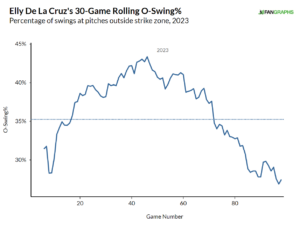
And if you don’t buy that, he did show better plate discipline as the season progressed. I’ll again warn of the dangers of storylines that coincide with splits, but things like offensive swing percentage stabilize very quickly, mitigating some of the sample size issues. I don’t think it’s a stretch to look at the graph below and conclude that De La Cruz got caught up in the hype of his initial success and became too aggressive. As a result, he started struggling before coming to realize that he had gotten away from the approach that made him such a dynamic player in the first place.

Dominic Canzone, Seattle Mariners
One should be suspicious of Pacific Coast League stats, but Dominic Canzone’s .354/.431/.634 line last year was good even by PCL standards, enough for a 151 wRC+ in the league. However, that success didn’t follow him to the majors. He probably doesn’t have a lot of upside, but the rate of his improvement over the last couple of years suggests that there’s a chance he could have a nice little Geronimo Berroa-esque run.

Tucupita Marcano, San Diego Padres
This one is kind of a stretch because I don’t see an obvious path for Tucupita Marcano to get much playing time. He hasn’t hit at all in the majors yet, but he’s also had a weird minor league career; he’s still just coming off his age-23 season and has made some progress at translating his minor league plate discipline to the majors. ZiPS isn’t in on him, but Steamer is, and if he can managed his 94 wRC+ Steamer projection, along with a decent glove (though more at second base than short) and his speed, he’ll at least be interesting. Gotta have one out there pick, no?

The Busts

Cody Bellinger, Chicago Cubs
I don’t think Cody Bellinger will fall anywhere near the depths of his brutal 2021 season, but there are reasons to be suspicious of last year’s resurgence. He changed some of his mechanics and altered his approach, especially in two-strike counts, to make more contact, and those adjustments should be sustainable. It’s the power numbers that are a bit preposterous, to the degree I can’t think of any comparable player who managed to maintain this amount of power with mediocre-at-best exit velocity numbers. Statcast’s expected slugging percentage knocks 88 points off his actual one, and the ZiPS version (zSLG) is 20 points meaner than that.

J.T. Realmuto, Philadelphia Phillies
This one hurts, especially for a player ZiPS was so excited about in 2015-2016 before his breakout. But the decline in J.T. Realmuto’s offensive numbers in 2023 is supported by the drop in his peripheral numbers; he was just a bit worse at everything last year. He’s also a catcher entering his mid 30s. This is a gut thing more than a projection thing, but I suspect any kind of a leg injury would be a bigger deal for a surprisingly quick player like Realmuto, whose offensive stats already reflect his speed, than for your typical catcher.

Isaac Paredes, Tampa Bay Rays
Isaac Paredes is a good hitter, but is he really a 140 wRC+ guy? In both Statcast and ZiPS, Paredes had an even larger disparity between his actual power numbers and his peripherals than Bellinger. That said, there’s some good news, because unlike Bellinger, Paredes has done this before. There were 20 hitters in 2022 that hit at least five more homers than zHR expected, and 18 of them went on to hit fewer home runs in 2023. Paredes was one of the two who hit more (the other was Pete Alonso). Because Paredes has such a low hard-hit percentage, I’m not completely on board yet.

Lane Thomas, Washington Nationals
One thing about Cinderella stories is that people tend to overrate them after the ball. Most of these stories don’t involve permanent stardom; Joey Meneses and Frank Schwindel are two example of people getting too excited about an older breakout guy. Unlike Schwindel, Lane Thomas is probably still a league-average player, on the level of his 2021 and 2022 seasons, but I’d be shocked to see him hit 30 homers again. He’s probably a stopgap center fielder/fourth outfielder type, and I’m seeing him surprisingly high in some fantasy rankings.

Dominic Fletcher, Chicago White Sox
I was pretty shocked to see the White Sox trade Cristian Mena for Dominic Fletcher, even with the assumption that ZiPS is being too exuberant about Mena in ranking him at the back of the top 50 prospects. If you evaluate him the way our prospect team does, a fourth outfielder for a 45 FV prospect is quite a rich gain. And it’s looking like the Sox will give Fletcher a pretty good chance at getting the majority of the playing time in right field. It’s not as bad as the team’s irrational excitement about Oscar Colás last year, but there’s just not a lot of support for Fletcher’s maintaining his .301/.350/.441 line from his brief stint in the majors. That’s ridiculously higher than his zStats slash line of .249/.290/.376, which works out to a difference of 125 OPS points.


The Yankees Are in a Precarious Spot After Losing Gerrit Cole

Brad Penner-USA TODAY Sports

After a pair of runner-up finishes in 2019 and ’21, Gerrit Cole finally won a Cy Young Award last year, but it doesn’t look like he’ll become the first American League pitcher to repeat since Pedro Martinez in 1999–2000. On Wednesday, the New York Post’s Jon Heyman reported that the 33-year-old righty will miss at least one to two months of the regular season due to an elbow issue, and is heading to Los Angeles for an in-person consultation with Dr. Neal ElAttrache, one of the industry’s top orthopedic surgeons — a move that has fueled speculation his injury could be even worse. At the very least, the loss of Cole exposes the Yankees’ lack of rotation depth and jeopardizes their chances of returning to the playoffs after missing out in 2023.

In one of the most nerve-wracking days in recent Yankees history, the team sent both Cole and Aaron Judge — two players making a combined $76 million in 2024 — for an MRI on Monday. The slugger had been experiencing discomfort in his abdominal area, which he believes stems from work he did over the offseason to correct his mechanics in the wake of his right big toe injury. He got a clean bill of health and expects to return to the lineup this weekend. As for the ace, his difficulties in recovering from his starts sent him to the MRI tube. Said manager Aaron Boone, “He described it as his recovery before getting to his next start has been more akin to what he feels during the season when he’s making 100 pitches… When he’s throwing 45 and 55, he usually doesn’t have the recovery issues he’s having.”

The exact nature of Cole’s diagnosis has yet to be reported, only that he’s experienced inflammation and “a twinge in his elbow.” It’s not uncommon for a team to get input from multiple doctors and have a player undergo additional tests, such as a dye contrast MRI to get a better look before determining a course of action; at the very least, Cole reportedly had x-rays and a CT scan on Tuesday. As this has played out, the high stakes and the Yankees’ opacity in handling the extended absences of Judge, Anthony Rizzo, Carlos Rodón, Luis Severino and other players in recent years has fed into a cottage industry that presumes cover-ups and worst-case scenarios. That Boone and general manager Brian Cashman have sometimes downplayed initial concerns ahead of prolonged outages in such cases has further fanned those flames. Read the rest of this entry »


Szymborski’s 2024 Booms and Busts: Pitchers

Troy Taormina-USA TODAY Sports

With the start of the season a little over two weeks away, it’s time for one of my most beloved/hated/dreaded annual traditions: making my picks for breakouts and busts. For those of you who haven’t read one of these pieces in the past, these are my picks for the players who are the most likely to change the general consensus about them over the course of the 2024 season. And since we’re talking about generally low-probability outcomes — this isn’t a list of players with better or worse projections than last year — there’s no exercise with more potential to make me look super smart… or dumb. For every Jordan Montgomery or Dylan Cease who makes the breakouts list, there’s a Yusei Kikuchi or Sam Howard pick that I definitely wish I could forget I made!

As usual, let’s start with a quick table of the triumphs and humiliations of last year’s picks.

Szymborski Breakout Pitchers – 2023
Pitcher K/9 BB/9 HR/9 FIP ERA ERA- WAR
Hunter Greene 12.2 3.9 1.5 4.25 4.82 105 2.0
Brandon Pfaadt 8.8 2.4 2.1 5.18 5.72 130 0.3
Graham Ashcraft 6.9 3.2 1.4 5.06 4.76 103 1.5
Tanner Scott 12.0 2.8 0.3 2.17 2.31 53 2.8
Josiah Gray 8.1 4.5 1.2 4.93 3.91 89 1.6
Roansy Contreras 7.2 4.2 1.4 5.19 6.59 148 0.1
Dustin May 6.4 3.0 0.2 3.23 2.63 62 1.2
Brayan Bello 7.6 2.6 1.4 4.54 4.24 93 1.6

Szymborski Bust Pitchers – 2023
Pitcher K/9 BB/9 HR/9 FIP ERA ERA- WAR
Sandy Alcantara 7.4 2.3 1.1 4.03 4.14 94 2.9
Robbie Ray 8.1 13.5 0.0 5.96 8.10 198 0.0
Corey Kluber 6.9 3.4 2.8 7.11 7.04 155 -0.8
Johnny Cueto 6.7 2.6 2.9 7.02 6.02 137 -0.7
Craig Kimbrel 12.3 3.7 1.3 3.81 3.26 74 1.1
Mike Clevinger 7.5 2.7 1.1 4.28 3.77 87 2.2
Chris Bassitt 8.4 2.7 1.3 4.28 3.60 85 2.6
Kyle Freeland 5.4 2.4 1.7 5.30 5.03 100 1.2

It wasn’t a great year for breakouts, as the only one I’d really call a true win was Tanner Scott, who was one of the elite relievers in baseball. While some of the pitchers that didn’t really break out had silver linings — Hunter Greene pitched better than his actual ERA and Brandon Pfaadt had a kick-ass postseason — I can’t say that our collective opinions of any of the other pitchers changed drastically in 2023. Except maybe Roansy Contreras, in the wrong direction. The busts went quite a bit better — for me, anyway — with arguably six of the eight considered disappointments for their teams in 2023. But it’s certainly less satisfying to have your pessimism be confirmed rather than your optimism.

The Breakouts

Edward Cabrera, Miami Marlins
The fact that Edward Cabrera walks a lot of batters is, of course, a Very Big Deal. But there’s so much talent bubbling underneath the surface that it’s hard to not feel that if something clicks, he could be one of the top 10 pitchers in the league. Despite his frequent command problems, Cabrera misses bats, and not just by blowing away batters with velocity. Sometimes, these inconsistent young pitchers with velocity have trouble getting strike three – Nathan Eovaldi was a classic example of this early in his career – or batters don’t actually chase them out of the strike zone. These aren’t Cabrera’s problems, and he isn’t getting hit hard, either. His biggest problem has been falling behind in the count; his first-strike percentages in the majors have been dismal, and that’s an important number in terms of predicting future walks. But at least both he and his team are quite aware of this. The fact that he’s missed a lot of time due to injuries could also explain his command issues. For all of this organization’s flaws in other areas, it has a strong record of developing pitchers with similar profiles to Cabrera. With more experience, he should be able to figure things out at the big league level.

Alas, Cabrera’s case is complicated by a shoulder impingement that was diagnosed recently following an MRI. It remains to be seen how much time he’ll miss, though it seems certain he’ll start the season the IL. I like him enough that I’m still keeping him on this list; hopefully, his prognosis won’t get worse upon further evaluation.

Griffin Canning, Los Angeles Angels
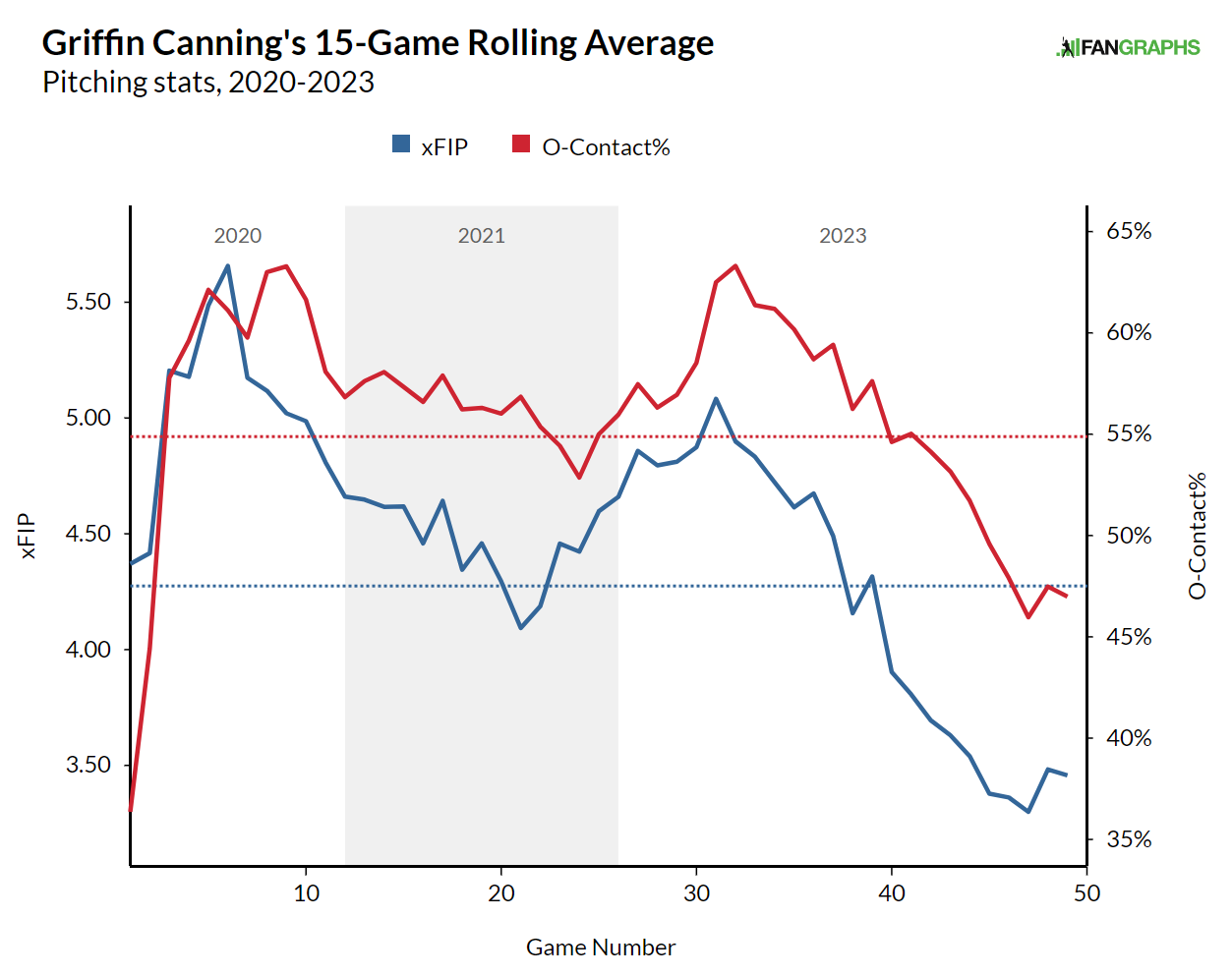
Aside from Shohei Ohtani and Mike Trout, the 2023 Angels were rarely watchable. So you’ll be forgiven if you didn’t realize that Griffin Canning quietly had a successful return last season from a stress fracture in his back that had kept him out of action for nearly two years. Not only was he a competent mid-rotation starter, he actually added a tick to his fastball and had a career best strikeout rate. As the season went on, hitters chased him out of the strike zone more frequently than in previous years, which is necessary for a pitcher like Canning, who will never dazzle anyone with pure velocity.

Canning still has a tendency to leave a pitch hanging in the wrong place – especially with his curve – but in his second full season back, I’m hopeful he can make progress there. I think there’s a real shot he ends the season considered a solid no. 2 starter instead of an afterthought.

Graham Ashcraft and Hunter Greene, Cincinnati Reds
Screw it, I’m taking them again! Since I’m sort of cheating by having the same reasoning two years in a row, I’ll make them split a single breakout pick. Both still have two wipeout pitches, but each still has an issue holding him back. Greene had trouble at times last season when he left his four-seamer over the middle of the plate; despite his heater’s 98.3 mph average velocity, nine of the 19 home runs he allowed came on four-seamers in the heart zone. Meanwhile, Ashcraft struggled to strike batters out. Both pitchers have made significant tweaks to their repertoires. Ashcraft added a changeup, and Greene started throwing a curveball and a splitter in the offseason. They can’t both not break out again, right? If it doesn’t work out, I may take them for a third year simply out of stubbornness.

Nick Pivetta, Boston Red Sox
No name at the top of 2023 stuff leaderboard may be more surprising than Nick Pivetta’s, especially if, like most people, you didn’t pay a lot of attention to the Red Sox in the second half of last season. Pivetta lost his starting job in mid-May, went to the bullpen and added a sweeper. The new pitch turned his season around and he returned to the rotation for good in September, making five starts to close the season. In those final five outings, he recorded 38 strikeouts and just five walks across 30 innings. Most encouragingly, Pivetta pitched seven scoreless innings in each of his final two starts. He had the fourth-biggest jump in Stuff+ from the first half to the second half. And you can see it in the results.

ZiPS is less optimistic about Pivetta than I am. I’m going to call ZiPS wrong on this one, and hope I won’t have to eat those words in six months.

Hunter Brown, Houston Astros
With his six-pitch repertoire and top-prospect status, Hunter Brown was an exciting addition to the Astros rotation last year. At times, he looked worthy of the hype — he struck out more than 10 batters per nine innings — but overall he was a bit of a disappointment, as he posted a 5.09 ERA in 31 outings (29 starts). That said, there are signs that he was a bit unlucky: Opponents had a high BABIP against him, and he allowed home runs at a much higher rate (1.50 HR/9) than he had at any point as a professional. Additionally, considering he threw nearly 30 more innings (155.2) than in any previous season (126.1), he may have just been gassed at the end of the year. Through his first 23 games (22 starts), which spanned 125.1 innings, he had a 4.16 ERA and 3.92 FIP. Over his final eight games (seven starts), he posted an abysmal 8.90 ERA and 6.26 FIP, with more than a third of the home runs he gave up (nine of 26) coming during that final stretch.

MacKenzie Gore, Washington Nationals
Of the three true outcomes, home runs have always had a weird relationship with pitchers. Strikeout and walk rates tend to be stable numbers, so it’s typically meaningful whenever they fluctuate drastically, whereas home run rates are extremely volatile. So volatile, in fact, that xFIP, a stat that has one of the more bizarre central conceits — “Let’s just assume that every pitcher has the same ability to prevent homers.” — actually has predictive value relative to stats that take a pitcher’s home run rate as gospel. As a result, “Let’s look for a pitcher who is pretty good but allows too many damn homers,” has proven to be a sneaky good way to predict breakouts, such as Corbin Burnes and Dodgers-era Andrew Heaney. MacKenzie Gore misses bat and he’s made great strides in improving his command, so I’m betting that he’ll wrangle the round-trippers too.

Shintaro Fujinami, New York Mets
OK, it’s admittedly scary to put Mets in the breakout category, especially a Met who had an ERA above seven his first season in the majors. Shintaro Fujinami’s seven starts last year were an unmitigated disaster, but he pitched a good deal better from the bullpen. Now, his 5.14 ERA as a reliever isn’t exactly cause to hang the Mission Accomplished banner, but the .209/.319/.351 line he allowed in relief comes out to a fairly respectable runs created ERA of 3.70. Given that, his velocity, and his history in Japan, I’m willing to give him a mulligan for 2023. A good reclamation project for the Mets.

Kyle Nelson, Arizona Diamondbacks
Have you seen his slider? The double whammy of a very high home run rate (12 in 56 innings) and a high BABIP (.324) served to keep Kyle Nelson’s ERA relatively high in what could very well have been his breakout season. And even then, all it took was a brutal September to dive bomb his seasonal numbers. If Nelson finishes with an ERA above four in 2024 over at least 30 innings, I’ll eat a full order of Cincinnati chili, and as those that are familiar with my can attest, that’s not something I relish doing. No, I’m not promising something crazy like eating my hat or a 1995 Ford Taurus.

The Busts

Gerrit Cole, New York Yankees
Let’s get two things out of the way first: This has nothing to do with the sudden MRI for his elbow, and this doesn’t mean I think Gerrit Cole will be a lousy pitcher. But there are some warning signs in his 2023 profile, despite his winning the AL Cy Young, and I think all the projection systems have been picking up on it. A sudden drop in strikeout percentage is usually a blaring klaxon, and it was supported by a similar decline in his plate discipline stats; the contact rate against Cole was his highest since he played for the Pirates. And whereas he had a couple weirdly high home run seasons while pitching well, that metric was oddly low in 2023 and it was not matched with changes in exit velocity or fly ball/groundball tendencies. In other words, his low home run rate hid several indicators of a looming decline, and we can’t count on that coverup to continue. I still think Cole is a top 10 pitcher, but it’s hardly a guarantee that he’ll be a five-win pitcher again this season.

Blake Snell, Someone Eventually
Hey, if I’m going to pick one Cy Young winner, why not go for the pair? Blake Snell will keep striking out tons of guys, but he gives up a lot of free bases, and one of the key factors that kept his ERA so low was some fairly extreme splits with runners on vs. bases empty, and that isn’t a long-term characteristic. Also, his .256 BABIP allowed won’t be easily repeated. Sidestepping the WAR vs. RA9-WAR fights after about five months of them, Snell’s not likely to be the best pitcher in the league in 2024. And it doesn’t appear that teams are jumping at the opportunity to pay him as if that were the case, either; I doubt his agent, Scott Boras, would be publicly expressing Snell’s willingness to sign a short-term contract otherwise. Snell’s a very good pitcher, but he’s just not this good.

Bryan Woo, Seattle Mariners
I’m a fan of Bryan Woo, and he certainly had a terrific rookie season for a pitcher with almost no experience in the high minors. He advanced so quickly that I didn’t even have a preseason projection for him last year! But despite the success and little grumbling from any of the projection systems, I’m not quite sure he’s a finished product yet. One worry is how fastball reliant he was. Lefties absolutely torched Woo in the majors last year, and it’s easier to simply dismiss that when it’s not from a pitcher without a killer offering to fight against the platoon disadvantage. At least he’s certainly aware that he needs to develop his changeup more. If Bryce Miller’s splitter works out, maybe Woo should consider cribbing his notes.

Matt Manning, Detroit Tigers
I buy the Tarik Skubal dominance, but with Matt Manning, not so much. Low strikeout pitchers can survive in the majors, but the ones who do are generally the ones who keep the ball down and don’t get hit very hard. Manning doesn’t really do either at this point. The numbers ZiPS uses aren’t the same as Statcast’s xStats, but Manning’s 5.00 zFIP was nearly as bleak as the xERA that Statcast produced (5.48). I’d say “when in doubt, learn a splitter,” but that’s mostly because of my long-term stanning of Kevin Gausman. I’m generally optimistic about the Tigers this year, but I think Manning’s ceiling looks pretty low from here.

Emilio Pagán, Cincinnati Reds
I’ve already talked about Emilio Pagán this offseason, but it wouldn’t show a lot of guts if I didn’t put the pitcher I deemed “my least favorite signing of the offseason” on my busts lists, now would it? If anything Pagán is the exact reverse of the Burnes-Heaney rule I talked about in the breakouts. It’s true that last year, he set career worst marks in contact rate against, average exit velocity, and strikeout rate, but he also had the lowest home run rate of his career, allowing five homers instead of his normal baker’s dozen or so. And he’s going to play his home games in a bandbox (the Great American Ballpark) for the first time ever. Pagán had the fifth-lowest batting average against in the majors on barrels/solid contact hits last year, and compared to the four pitchers ahead of him (Alexis Díaz, Will Vest, Trevor May, and Devin Williams), Pagán allowed those types of contact at nearly twice the rate. As a whole big leaguers batted .614 on barrels and solid contact hits in 2023. Pagán is likable and generally popular with fans, and I’m certainly not rooting against him, but he has a history of being worse than Bill Murray at stopping gophers.


The Weakest Spots Among Better-Positioned Contenders

Wendell Cruz-USA TODAY Sports

Earlier this week, I took a projection-driven two-part look at the trouble spots on National League and American League contenders. The exercise — a sibling of my annual pre-trade deadline Replacement Level Killers series — primarily highlighted clubs in the middle of the table, based on our Playoff Odds, with many of the best teams, such as the Braves and Dodgers, going completely unmentioned.

In that regard, the exercise worked as I had intended, focusing on the teams and spots where a marginal addition from outside the organization or even a modest breakout from within it could have a sizable impact on their chances of making the postseason. To be considered contenders, teams needed Playoff Odds of at least 25%, and roughly speaking, all but one of those mentioned fell in the range of 80-85 wins. Under the 12-team playoff format, that certainly counts as contention once you consider that two of last year’s NL Wild Card teams, the Diamondbacks and Marlins, qualified with just 84 wins, nosing out the 83-win Cubs and the 82-win Padres and Reds. At each position, I highlighted the two lowest-ranked teams from within that subset, so long as they projected to produce less than 2.0 WAR, after an adjustment: I applied a 20% reduction to counter the general tendency to overestimate playing time at this point in the season. In other words instead of having a total of 1,000 WAR projected across the 30 teams, and 57% of that (570 WAR) allocated to position players, our Depth Chart values currently add up to about 682 WAR, an inflation of about 20%.

Because the mid-table teams almost invariably had some glaring weakness, seven teams escaped scrutiny. The Braves (98.5% odds), Dodgers (94.6%), and Cardinals (53.5%) — three of the NL’s top four teams by those odds, each favored to win their respective divisions — were absent from the Senior Circuit roundup, while the Yankees (75.6%), Rays (62.5%), Orioles (50.6%) and Rangers (36.3%) missed out on the fun in the Junior Circuit piece. Only one of the top four NL teams showed up with trouble spots (the Phillies at 58.5%), but the AL distribution was more haphazard, in that the Astros (86.8%), Twins (64.9%), Mariners (58.6%), and Blue Jays (47.4%) each had at least one representative within my roundup.

In response to the feedback I received, I thought it would be worthwhile to do one more roundup in this format, this time limiting it to those otherwise unexamined teams and going only one layer deep at each position. I couldn’t quite call this “The Weakest Spots Among the Powerhouses” or “… Among the Top Contenders,” hence the title. Note that not every position had a team fall below the threshold, though I do mention the lowest-ranked ones in passing for those spots. It’s worth keeping in mind the tendency for even the game’s top prospects to have fairly tepid projections based upon limited minor league data and a higher risk of being farmed out if they start slowly; those players don’t always hit the ground running. For team totals, I’ve cited the adjusted WARs, but where I reference individual player projections I’ve stuck to the published figures.

Catcher

Rays (21st, 1.9 adjusted WAR)

My AL roundup contained only the Red Sox catchers, and while I’m not sure what happened since I composed the list to move the Rays from right at the 2.0 minimum to below it, here we are. Since landing on last summer’s Replacement Level Killers list, they’ve basically turned over their tandem, with René Pinto and Alex Jackson replacing Christian Bethancourt and Francisco Mejía. The 27-year-old Pinto did the bulk of the catching in the second half, hitting .252/.267/.456 (98 wRC+) in 105 PA, with an eye-watering 34-to-2 strikeout-to-walk ratio. It’s true that he hits the ball hard, but the Rays seem to like him more for his defense than his offense — or, more specifically, his framing, which was 1.7 runs above average by our framing metric and two above by that of Statcast. Meanwhile, the latter system rated him at seven runs below average in blocking and one below in caught stealing.

The 28-year-old Jackson didn’t play in the majors last year, and he owns a .141/.243/.227 line and 48.1% strikeout rate in 185 PA in the majors, mostly from 2021. Nonetheless, he tore up Triple-A (.284/.347/.556 with 16 homers in 248 PA) with the Brewers and Rays’ affiliates before being sidelined by a shoulder injury. Defensively, he’s been a bit below average in framing but is otherwise average-ish. The 28-year-old Mejía, back in the organization on a minor league deal after a brief odyssey with the Angels, probably has his work cut out to regain a share of his old job. He hit just .227/.258/.400 (80 wRC+) last year and hasn’t come close to fulfilling the promise he showed at the plate in the minors.

First Base

Yankees (17th, 1.4 WAR)

Anthony Rizzo got off to a hot start in 2023, hitting for a 146 wRC+ through May 28, when he collided with Fernando Tatis Jr. and missed his next three games due to what the Yankees called a neck injury. Upon returning, he hit for just a 43 wRC+ over the next two months before the team shut him down with post-concussion symptoms; he didn’t play again, and finished at .244/.328/.378 (100 wRC+). The 34-year-old Rizzo is said to be healthy now, but he projects for just a .238/.332/.426 line, a 111 wRC+ — right at the major league average for first basemen last year — and 1.3 WAR, which won’t be a huge help to the Yankees lineup. The most likely backup is DJ LeMahieu, who’s slated to be the starting third baseman and who’s coming off his second 101 wRC+ in three years, though he did post a 129 wRC+ after the All-Star break compared to a 77 before, when he was still dealing with the effects of a right big toe injury. Oswaldo Cabrera, a switch-hitting utilityman who was very good in a late-2022 stint and terrible last year, is another alternative for first.

Second Base

Oddly enough — or perhaps fittingly, as we are talking about good clubs — none of these teams has a second base situation that falls below the threshold. Orioles second basemen project to rank 14th in the majors with an adjusted 2.4 WAR, the lowest mark from among this group, but that’s with 20-year-old Jackson Holliday, the no. 1 prospect on our Top 100 list, 25-year-old Jordan Westburg, and 29-year-old Ramón Urías projected to account for most of the playing time, with all projecting to be average or better — which particularly for Holliday would be no small achievement, even with his pedigree. Note that this is Baltimore’s only appearance within this exercise, even though the team has a lower projected value at the first base and DH slots than it does at second base; the O’s just don’t stand out relative to their competition’s weaknesses.

Shortstop

Braves (24th, 1.6 WAR)

The Braves project to be the majors’ top team, but they do have their weaknesses, and this is one. After letting Dansby Swanson depart as a free agent, they turned shortstop duties over to Orlando Arcia, who had spent five and a half seasons with diminishing returns in Milwaukee, plus another season and a half as a utilityman for Atlanta, playing a grand total of 24 innings at shortstop. The team nonetheless signed him to a three-year, $7.3 million extension — practically peanuts — and he handled the position reasonably well, hitting .264/.321/.420 (99 wRC+) with a career-high 2.3 WAR despite a mixed bag of defensive metrics. Given that he netted just 0.2 WAR from 2018–22, the projection systems are understandably skeptical he can sustain such production; if he can’t, who knows what kind of magic pixie dust the Braves can sprinkle on backups Luis Guillorme and David Fletcher to try and turn them into league-average regulars.

Third Base

Here’s another spot where none of these teams falls below the threshold, with the Dodgers (15th at 2.1 WAR) the lowest ranked. Neither Max Muncy’s fielding at third base nor his low batting averages are pretty, but he’s a disciplined hitter who can absolutely crush the ball and justify his spot in the lineup; last year, he matched his career high of 36 homers while netting 2.9 WAR. Chris Taylor and the freshly re-signed Enrique Hernández are around for those times when Muncy’s banged up or the team could use more defensive support.

Left Field

Dodgers (21st, 1.4 WAR)

This is the NL West juggernaut’s weakest spot, even after taking steps to address it. Newcomer Teoscar Hernández, who joined the fold on a one-year, $23.5 million deal, hits the ball very hard… when he makes contact. In 2023 he posted an average exit velocity of 91.3 mph (80th percentile), a 13.8% barrel rate (88th percentile), and a 49.4% hard-hit rate (90th percentile). The problem was that he struck out 31.1% of the time opposite a 5.6% walk rate, so he hit an uninspiring .258/.305/.435 (105 wRC+). To be fair, he did say he had trouble seeing the ball at the Mariners’ T-Mobile Park, where he slugged just .380, so it’s hardly out of the question that a change of scenery could drive a rebound for the 31-year-old slugger. The aforementioned Taylor and Enrique Hernández will see time here as well, but both are a few years removed from their best work. Taylor rebounded from a bad season and a slow first half to hit .237/.326/.420 (104 wRC+) but struck out 32.6% of the time himself, while Hernández perked up after returning to Los Angeles, posting a 59 wRC+ with the Red Sox and a 96 wRC+ with the Dodgers.

Center Field

One more where everybody is above the threshold, with the Rays (19th at 2.1 adjusted WAR) the lowest ranked among those here, based primarily on the projections’ skepticism that Jose Siri can repeat last year’s extreme performance. (See Davy Andrews’ piece on Tromps Per Womp.)

Right Field

Cardinals (14th, 1.8 WAR)

Given his plus-plus raw power, few people doubted Jordan Walker’s offensive ability, hence his no. 12 ranking on last year’s Top 100 Prospects list. At age 21, with no Triple-A experience, he made the Cardinals out of spring training and immediately reeled off a 12-game hitting streak. But when the league quickly adjusted, he struggled briefly and was sent to Memphis to work on his approach, particularly so he could elevate the ball with greater consistency. Even with a 46.9% groundball rate, he finished at a respectable .276/.342/.445 (116 wRC+), but his defense was another matter. Blocked by Nolan Arenado at third base, he moved to the outfield and was absolutely brutal according to the metrics (-16 DRS, -12 RAA, -11.8 UZR), and the visuals weren’t much better, even with the occasional impressive play. Thus he netted just 0.2 WAR. He does project to improve to 1.6 WAR, with Dylan Carlson getting time in right field as well — presumably when the Cardinals mercifully slot Walker at DH — and I’d bet that Walker far outhits the 116 wRC+ for which he’s projected.

Designated Hitter

Rangers (13th, 1.2 WAR)

With all but the Dodgers and Yankees projected to produce less than 2.0 WAR out of the DH spot (that’s after adjustment), this category is shooting fish in a barrel, and with the Cardinals and Rangers virtually tied, I’m focusing on the defending champions. This is hardly a bad situation, not only because Texas ranks among the upper half of the 30 teams, but also because about half the playing time projects to go to 22-year-old Wyatt Langford, who was chosen fourth in last year’s draft and rocketed through four levels to reach Triple-A, hitting .360/.480/.677 (190 wRC+) with 10 homers in 200 PA along the way. He just placed second only to Holliday on our Top 100 list as “perhaps the most complete hitter in the minors.” The problem is that he’s a 30-grade defender, with the speed for center field but a fringe-average arm and a poor feel for outfield play in general, at least at this stage; meanwhile, the outfield of Evan Carter, Leody Taveras, and Adolis García features strong defenders at all three spots. Langford could make the roster out of spring training, but it’s not a guarantee. With the possible exception of Corey Seager, who’s working his way back from January hernia surgery, no other Ranger projects to have much impact at this spot, hence the middling ranking.


Sunday Notes: Synced Up and Simplified, Mick Abel is Watching in a New Way

In terms of rankings and projection, Mick Abel is much the same pitcher he was 24 months ago. When the now-22-year-old right-hander was featured in February 2022 during our annual Prospect Week, he was No. 1 in the Philadelphia Phillies system and No. 20 on our Top 100. Fast forward to the present, and he is No. 2 in the Philadelphia Phillies system and No. 22 on our Top 100. As Eric Longenhagen explained in his recent writeup, “Abel didn’t have an especially good 2023… [but] still has most all of the ingredients needed to be an impact starter, he just isn’t totally baked yet.”

How has the 2019 first-rounder out of Beaverton, Oregon’s Jesuit High School matured the most since our conversation two years ago? I asked him that question at Philadelphia’s spring training facility in Clearwater, Florida on Friday.

“I’d say it’s the separation of over-the-rubber and over-the-plate mentality, knowing how to distinguish between the two,” replied Abel, who had a 27.5% strikeout rate but also a 13.5% walk rate in 108-and-two-third innings with Double-A Reading last year. “Whether it’s in the bullpen or on the game-mound, knowing when and how to make adjustments without getting too deep in my head about it.

“Staying more direct and knowing that if I get too long with my arm action in back I’m going to be a little later to the plate,“ Abel said when asked to elaborate on the actual mechanics. “I want to make sure that everything is on time going down the hill.” Read the rest of this entry »


Giancarlo Stanton Tries to Change Things Up After a Dreadful 2023

Nathan Ray Seebeck-USA TODAY Sports

Following a career-worst season and some stinging public criticism from Yankees general manager Brian Cashman, Giancarlo Stanton is making some changes. Earlier this week, the oft-injured 34-year-old slugger reported to spring training looking significantly leaner than in the past, and on Wednesday provided the public with the first glimpse of his reworked swing. Sure, this all fits into the realm of spring training clichés, and batting practice cuts won’t tell us whether the changes can reverse his decline or improve his chances of staying healthy, but a rebound would certainly be welcome as the Yankees attempt to recover from their worst record in 31 years.

Amid a season in which so many key Yankees wound up sidelined by injuries for significant spells, Stanton played in just 101 games, his lowest full-season total since 2019, when he was limited to 19 games by left biceps and right knee injuries. This time around, he missed 46 days due to a left hamstring strain, the latest in a litany of lower body injuries he’s incurred since the start of 2019:

Giancarlo Stanton’s Injuries as a Yankee
Start End Days on IL Injury
4/1/19 6/18/19 78 Left biceps strain
6/26/19 9/18/19 84 Right knee sprain (PCL)
10/13/19 10/18/19 5* Right quadriceps strain
8/9/20 9/15/20 37 Left hamstring strain
5/14/21 5/28/21 14 Left quad strain
5/25/22 6/4/22 10 Right ankle inflammation
7/24/22 8/25/22 32 Left Achilles tendonitis
4/16/23 6/1/23 46 Left hamstring strain
SOURCE: Baseball Prospectus
* = no injured list; missed time during American League Championship Series.

That’s 301 days on the injured list, not including his missing three games in the 2019 ALCS against the Astros. Meanwhile, Stanton has played 391 regular season games, which prorates to an average of 89 over a 162-game season.

It was with that frustrating series of absences in mind that Cashman vented during a media session at the GM meetings in Arizona last November, “I’m not going to tell you he’s gonna play every game next year because he’s not. He’s gonna wind up getting hurt again, more likely than not, because it seems to be part of his game.” To be fair, Cashman immediately added, “But I know that when he’s right and healthy – other than this past year – the guy’s a great hitter and has been for a long time.”

Stanton refrained from public comment at the time, letting agent Joel Wolfe trade volleys with the GM, who went into damage control mode. “I value Giancarlo Stanton as a player,” he told reporters. “Without a doubt, he’s one of the big drivers when we do win. He’s one of the few players you bring to New York that hasn’t backed down, that has handled himself in a professional manner through thick and thin.” The GM additionally spoke with both player and agent to clear the air, and since then, both Cashman and Stanton have kept the substance of their discussion private. “He knows my reaction to that,” said the latter at the Yankees’ spring training complex on Monday.

Until 2023, Stanton’s absences were mitigated at least somewhat by his productivity. He hit .248/.338/.493 for a 130 wRC+ from 2019–22, including .273/.354/.516 (138 wRC+) in his 139-game ’21 campaign, his healthiest one of that stretch. He made the AL All-Star team in 2022, but his ugly final line (.211/.297/.462, 116 wRC+) concealed a drastic split: He hit .285/.339/.523 (142 wRC+) through May 24, his last day before landing on the IL due to right ankle inflammation, but just .166/.272/.425 thereafter, and to get to an even 100 wRC+ for that stretch required hitting home runs in his final three games. That sorry batting line looks a lot like last year’s one (.191/.275/.420), though with rising scoring levels, the latter was good for just an 89 wRC+ and -0.8 WAR. Since that ankle-related IL stint, he owns a 93 wRC+ and -0.6 WAR in 699 PA. It ain’t great.

As ever, Stanton struck out a lot, but that wasn’t his primary problem. In terms of overall strikeout rate, his 29.9% was down 0.4 points from 2022, and dead even with ’18. His 34.1% whiff rate was right at his Statcast-era average, down 2.4 points from 2022, and down 0.3 points from ’18. His 13.7% swinging strike rate and his 29.4% chase rate were both similarly below 2018, ’22, and his career marks.

Likewise, Stanton continued to put a charge in the ball when he connected, if not quite as hard as in recent years (I’ve omitted 2019 and ’20 due to their small samples):

Giancarlo Stanton Statcast Profile
Season EV Percentile Barrel% Percentile Hard-Hit% Percentile
2018 93.7 99 8.9% 97 50.8% 97
2021 95.1 99 9.7% 91 56.3% 100
2022 95.0 99 11.3% 98 52.3% 98
2023 93.3 96 9.4% 94 48.4% 86

Not all contact is created equal, of course. Stanton pulled the ball 41.1% of the time in 2023, up from 36.5% in ’22 and his highest full-season rate since ’17, when he was still a Marlin. In general, pulled fly balls tend to be the most productive, while opposite field groundballs tend to be more productive than pulled ones even after the banning of infield shifts. What we see with Stanton is that his results on pulled groundballs — which used to be quite good, because he hit them so hard — have deteriorated drastically, as have his results on pulled fly balls:

Giancarlo Stanton Groundballs and Fly Balls to Pull Side
Season Pull GB% EV LA Hard-Hit% AVG Lg AVG SLG Lg SLG wOBA Lg wOBA
2018 20.0% 93.8 -12.4 49.4 .337 .243 .398 .286 .319 .230
2021 20.2% 94.4 -13.1 58.3 .236 .218 .278 .259 .223 .206
2022 18.6% 96.8 -11.8 57.1 .184 .220 .184 .259 .162 .209
2023 21.4% 91.3 -19.8 49.1 .113 .220 .113 .260 .100 .209
Season Pull FB% EV LA Hard-Hit% AVG Lg AVG SLG Lg SLG wOBA Lg wOBA
2018 5.5% 100.4 35.0 39.1 .478 .490 1.826 1.743 .937 .885
2021 4.8% 100.7 36.9 47.1 .438 .485 1.750 1.716 .826 .896
2022 6.1% 99.6 31.8 68.8 .667 .495 2.467 1.775 1.221 .899
2023 7.7% 99.9 37.2 36.8 .316 .493 1.263 1.797 .633 .912
SOURCE: Baseball Savant

Because xBA, xSLG, and xwOBA don’t account for spray angle, I’ve instead used the annual league-wide averages for right-handed hitters where I’d usually put those figures. You can see that Stanton was way below those averages last year despite exit velos about 5 mph above the league-wide averages. His launch angles were particularly extreme, given that righties averaged -12.0 degrees on pulled grounders and 34.7 degrees on pulled fly balls. His 37.2-degree average on the latter was so high as to be unproductive; he was over 500 points short of the league average slugging percentage on fly balls. I couldn’t fit it into the table, but the estimated average distance on his pulled fly balls in 2023 was 344 feet, a full 20 feet shorter than his average from the year before; he averaged 356 feet in 2018 and 348 in ’21.

Some of the missing production probably owes to Stanton’s speed, or lack of it. His sprint speed fell from the 69th percentile in 2018 to the 13th percentile by ’21, and was down to the fourth percentile last year. It’s likely that some of this is intentional — his not running hard at times is a way to prevent injuries or to avoid turning minor aches into major problems — but it’s no doubt costing him hits here and there, contributing to his shortfalls in batting average relative to xBA. In fact, a quick look at his player page shows that his rate of infield hits per groundball (IFH% on his player page) has fallen from 12.8% in 2018 to 4.4% in ’21, 4.1% in ’22 and 2.8% last year.

Meanwhile, Stanton got under a lot more balls than usual, regardless of direction, leading to a higher percentage of harmless popups and flies. His 26.6% Under rate was his highest of the Statcast era, well above his 19.7% in 2022; he hadn’t been above 22% since ’16. He went 6-for-66 on those balls in 2023, which was actually better than his 2-for-52 in ’22 or his 4-for-70 in ’21; the problem was that those balls occupied a larger share of his contact.

Though he still slugged .533 against four-seamers and .516 against sinkers, Stanton was much less productive against fastballs of both types than in the past. He struggled with sliders, as he usually does, and was utterly helpless against curveballs, which was comparatively new. In 2018, he hit .233 and slugged .517 against curves, and even in ’22, he was at .222 AVG/.389 SLG; last year, he plummeted to .115 AVG/.269 SLG. His heat maps show that he has serious holes in his swing. Here’s a comparison between his heat maps for barreled balls against fastballs (the top pair) and breaking balls (the bottom pair); 2018 is on the left and ’23 on the right. Note how much smaller the coverage of the latter is — he didn’t barrel a single ball against pitches outside those areas — and how there is much less red.

Here’s a look at the progression of Stanton’s overall xwOBAs by Gameday zone:

Check out the sequence in the lower right corner of the strike zone. Within this timespan, Stanton’s xwOBAs in that cell have dropped from .287 to .252 to .207 to .129 (see here to zoom in on the numbers). Meanwhile, all of the red has disappeared from the upper and outer thirds of the zone. As Alex Chamberlain wrote last week, that upper third is particularly important when it comes to producing pulled fly balls, so it doesn’t help that Stanton’s whiff rate in that part of the zone has climbed from 23.1% in 2018 to a decimal or two on either side of 30% in the last two seasons — more than double the league-wide rate.

Particularly in light of the data, I’m hardly the first to wonder if Stanton’s series of lower body injuries has compromised his flexibility, contributing to those open holes in his swing. Indeed, in September at Pinstripe Alley, Malachi Hayes built on FanGraphs contributor Esteban Rivera’s visual breakdown of some mechanical issues Stanton was having, pointing out the slugger’s increased difficulty with low breaking balls and the way pitchers were going even lower against him:

Sliders and changeups, making up about a third of the pitches he sees, are crossing the plate a little less than two inches lower and a little bit farther away than they have over the last few years. It sounds like a small change, but the difference shows up in heat maps — especially against right-handed pitchers — and it seems increasingly clear that he just can’t go down and get those pitches like he used to.

Stanton, whose work ethic and conditioning have never been in doubt within the organization, told reporters he spent the offseason focusing on mobility and on changing his swing. Improved mobility should help him find time in an outfield mix that will include Alex Verdugo in left, Aaron Judge in center, and Juan Soto in right. Light-hitting Trent Grisham can help in center, and while that could mean Judge spending time in left field, as manager Aaron Boone suggested last month, it’s probably going to mean a lot of DH duty for No. 99 as well, given his own injury history. The situation will only become more crowded once Jasson Domínguez returns from the Tommy John surgery he had in September. Unless Stanton can play the outfield — more likely right field, with Soto slotting in left — he stands to lose playing time. He played just 33 games in the outfield last year, and 38 the year before, and the results were quite poor (a combined -7 DRS, -4 RAA, and -0.8 UZR in 567 innings for the two seasons). More mobility certainly couldn’t hurt.

As for the promised changes, here’s a glimpse of the 6-foot-4 Stanton (listed at 245 pounds but looking lighter) appearing kind of skinny next to the 6-foot-7, 282-pound Judge, via Newsday’s Erik Boland:

Here’s a side-by-side comparison of Stanton’s stance, from last season to this year, courtesy of The Athletic’s Chris Kirschner:

And here he is taking a BP cut:

Stanton is more upright, with his back leg closer to the plate than before, but at this level of intensity and the limited number of angles, it’s tough to say more than that. Given that it’s February, his changes — and those of everybody else who reported to camp talking about swing tweaks, new pitches, and improved training regimens — should be considered a work in progress. With the addition of Soto, there’s a bit less pressure on Stanton to be one of the lineup’s primary producers, but the Yankees can’t justify playing him if he remans below replacement level. We’ll see soon enough whether he can return to being close to the dangerous hitter he used to be.