Jay Jaffe FanGraphs Chat – 11/25/19

12:02
Avatar Jay Jaffe: Hey folks, welcome to my first solo chat in over two months! Between our postseason group chats, the Hall of Fame ballot releases timed to coincide with this time slot, and some lesser issues, I’ve been out of the loop with this process but for today, I’m back at it, just in time to avoid giving you any useful Thanksgiving tips.

12:03
Bring Back Jeff: In all seriousness, I do understand what you mean about batting average. This is fundamentally a game about entertaining us. We get to choose what we care about. And batting average is fun, even though it may not correlate all that strongly with the “value” of the player.

12:06
Avatar Jay Jaffe: Last week, a good chunk of our staff descended upon New York City and we did a FanGraphs live thing on Thursday. During my panel, which also included The Athletic’s Lindsey Adler and Marc Carig, I went into a tangent on batting average, saying, “Let’s give a shit about batting average again” or words to that effect (I haven’t played this back https://www.fangraphs.com/blogs/effectively-wild-episode-1460-live-fro…), a sentiment that I’ve been mulling for months but haven’t had the chance to write up in full treatise form

12:07
Avatar Jay Jaffe: The statement, which i only briefly fleshed out, has to do with countering the aesthetic shortcomings of the current iteration of baseball before us, and I think Bring Back Jeff’s non-question kind of summarizes some of that. Anyway, I’ll have more to say about the topic at some point this winter, perhaps even in the next couple weeks, but I make no promises as to when because it’s Hall season and I’m up to my neck in both Modern Baseball and BBWAA processes.

12:08
Avatar Jay Jaffe: Anyway… on with the show, which will also be interrupted by a brief radio spot that you can hear via SiriusXM at about 12:35

12:08
Dave: After reading your piece it seems that Rolen didn’t end up having a good relationship with the Cards or Phils. If he’s elected does he go in without a logo?

Read the rest of this entry »


Taking a Look at Spin Mirroring

There are a myriad of things pitchers can do to get a leg up on a hitter. Changing speeds, eye level, sequencing, and even spin rate are a few of the more popular methods. Changing speeds can interfere with a hitter’s timing, while changing eye levels can force a hitter to adjust to a larger focal point. Varying pitch selection based on the situation can help a pitcher become less predictable, and changing the spin rate can have an effect on the expected movement of a pitch.

But there are other subtle tricks pitchers have up their sleeves. One of these tricks, explored in an article for The Athletic by Joe Schwarz and elaborated on in another by Eno Sarris, is known as pitch or spin mirroring, and with the right pitch attributes, it can be a powerful weapon.

Being able to spot a pitch’s spin can tip a hitter off to what is coming, a skill some hitters claim to have. That’s a big advantage to have in a decision that transpires over the course of milliseconds. When pitches are spinning over 2000 times a minute, is the human eye really that good? Perhaps. As Preston Wilson points out in the piece linked to above, a hitter might see “more white or more red,” which gives an indication as to what pitch is coming. More white would indicate a faster or more abundantly spinning pitch, like a curveball or fastball, while more red could be a changeup.

In theory, a pitcher could use spin mirroring effect to parry those abilities, especially with a fastball and curveball combo because of the high spin on both pitches. Furthermore, if the rotation blur of the ball is mostly white, you’ll have a much harder time deciphering the direction in which the spin is oriented. Read the rest of this entry »


Celebrating Jacoby Ellsbury

Last Wednesday, the New York Yankees released Jacoby Ellsbury, cutting ties with the oft-injured outfielder even though he still had a year and more than $26 million left on his long-term deal. The Yankees are trying to worm their way out of that commitment, on the somewhat dubious premise that he received treatment from an unapproved physician, so the drama isn’t quite over yet. Either way though, he’s played his last game in New York. Along with Greg Bird and Nester Cortes Jr., Ellsbury was released in order to clear roster space for younger prospects.

By any measure, Ellsbury’s time in the Bronx was a disappointment. He played 120 games only twice, topped the three-win mark just once, and started four playoff games during his tenure. His first season was promising: He took advantage of Yankee Stadium’s short porch in right and parked 16 homers, the second-highest total of his career, en route to a 3.6 WAR season. But injuries and age soon caught up with him. While he retained most his speed and wits on the bases, starting in 2015, his production at the plate dipped noticeably. After falling out of the lineup in 2017, Ellsbury missed the entire 2018 season recovering from an oblique strain and a torn labrum in his hip, and then all of last year while batting plantar fasciitis. He was not expected to contribute significantly to the 2020 Yankees had he remained part of the roster.

In the wake of his release, there have been a few pieces speculating about where Ellsbury ranks on New York’s list of biggest free agent busts. That’s as unfair as it is uncharitable for a player who was pretty good in pinstripes before injuries kept him away from the field.

More to the point, there’s far more about Ellsbury’s career to celebrate than to lament. At his best, he was a breathtaking center fielder and one of the most exciting baserunners in recent memory. His 343 career steals are the seventh-most of any player this century, an impressive total even without considering that he stole successfully more than 82% of the time. He was a big part of two World Series winners and his out-of-nowhere power spike in 2011 fueled one of the best individual seasons of the decade. He stole home not once but twice, and set a major league record by reaching base 30 times on catcher’s interference. He was good, he was fun, and if this is the end for Ellsbury, we’re lucky to have seen him play. Read the rest of this entry »


JAWS and the 2020 Hall of Fame Ballot: Scott Rolen

The following article is part of Jay Jaffe’s ongoing look at the candidates on the BBWAA 2020 Hall of Fame ballot. Originally written for the 2018 election at SI.com, it has been updated to reflect recent voting results as well as additional research. For a detailed introduction to this year’s ballot, and other candidates in the series, use the tool above; an introduction to JAWS can be found here. For a tentative schedule and a chance to fill out a Hall of Fame ballot for our crowdsourcing project, see here. All WAR figures refer to the Baseball-Reference version unless otherwise indicated.

“A hard-charging third baseman” who “could have played shortstop with more range than Cal Ripken.” “A no-nonsense star.” “The perfect baseball player.” Scott Rolen did not lack for praise, particularly in the pages of Sports Illustrated at the height of his career. A masterful, athletic defender with the physical dimensions of a tight end (listed at 6-foot-4, 245 pounds), Rolen played with an all-out intensity, sacrificing his body in the name of stopping balls from getting through the left side of the infield. Many viewed him as the position’s best for his time, and he more than held his own with the bat as well, routinely accompanying his 25 to 30 homers a year with strong on-base percentages.

There was much to love about Rolen’s game, but particularly in Philadelphia, the city where he began his major league career and the one with a reputation for fraternal fondness, he found no shortage of critics — even in the Phillies organization. Despite winning 1997 NL Rookie of the Year honors and emerging as a foundation-type player, Rolen was blasted publicly by manager Larry Bowa and special assistant to the general manager Dallas Green. While ownership pinched pennies and waited for a new ballpark, fans booed and vilified him. Eventually, Rolen couldn’t wait to skip town, even when offered a deal that could have been worth as much as $140 million. Traded in mid-2002 to the Cardinals, he referred to St. Louis as “baseball heaven,” which only further enraged the Philly faithful.

In St. Louis, Rolen provided the missing piece of the puzzle, helping a team that hadn’t been to the World Series since 1987 make two trips in three years (2004 and ’06), with a championship in the latter year. A private, introverted person who shunned endorsement deals, he didn’t have to shoulder the burden of being a franchise savior, but as the toll of his max-effort play caught up to him in the form of chronic shoulder and back woes, he clashed with manager Tony La Russa and again found himself looking for the exit. After a brief detour to Toronto, he landed in Cincinnati, where again he provided the missing piece, helping the Reds return to the postseason for the first time in 15 years. Read the rest of this entry »


Job Posting: Diamondbacks Short Season Hitting Coordinator

Position: Short Season Hitting Coordinator

Department:Baseball Operations
Status: Regular Full-Time
Location: Scottsdale, Arizona

Position Summary:
The Arizona Diamondbacks are seeking a Short Season Hitting Coordinator who will work closely with the Minor League Hitting Coordinator and oversee coordinating and developing players at their Dominican Academy, Short-Season clubs, Arizona operations (including spring training), extended spring, Arizona League and Instructional League as well as special assignments. The ideal candidate will use analytical data and technology to create plans for players to maximize their development and will collaborate with players, staff and the front office. Spanish speaking is required for this role, as well as the flexibility to be on the road for weeks at a time, including international travel.

Duties & Responsibilities:

  • An understanding of hitting technology and how it can be implemented
  • Communicating hitting technologies including video and wearable technology with Spanish speaking players and staff
  • Working with hitters in one-on-one environments
  • Working with short season hitting coaches to implement philosophy
  • Incorporating analytics as it relates to hitting
  • Effectively communicating technical and analytical concepts to non-technical people
  • Ability to carry out and create a hitting plan for players in conjunction with the Hitting Coordinator
  • Ability to multitask and balance multiple projects at once
  • Working and collaborating with players, staff and the front office
  • Independently evaluate professional and amateur baseball players
  • Flexibility to travel internationally and be on the road for weeks at a time
  • Carry oneself in a respectful manner that positively represents the organization

Skills:

  • Fluency in Spanish is required
  • The ability to effectively communicate with and relate to people who have varying backgrounds and experiences working in and playing baseball, respecting and empathizing with both the human and analytical perspectives of the game
  • Intellectual curiosity and creativity
  • Experience working with Blast, K-Vest, force plates, slow motion video and Rapsodo
  • Technical knowledge pertaining to statistical analysis
  • Proficiency in Microsoft Office
  • Strong organizational and time management skills
  • Strong work ethic and attention to detail

To Apply:
Interested candidates should send a resume and supporting materials to bbopsjob@dbacks.com.

The content in this posting was created and provided solely by the Arizona Diamondbacks.


Job Posting: Dodgers Amateur Scouting Assistant

Title: Assistant, Amateur Scouting

Department: Amateur Scouting
Status: Full-Time, Seasonal
Reports to: Assistant Director, Amateur Scouting
Deadline: December 1, 2019

The Los Angeles Dodgers are seeking an Assistant in the Amateur Scouting Department. This role will focus on providing administrative and technical support throughout the year in preparation for the 2020 and 2021 Rule 4 Drafts, in addition to being exposed to both traditional scouting and analytically-based concepts related to player evaluation. The individual will work closely with the entire amateur scouting staff in order to gather, organize, and process all pertinent information prior to the 2020 Draft and assist with in-person data collection as needed throughout the season.

Job Functions:

  • Provide administrative, logistical, and technical support to the Amateur Scouting and Baseball Operations Departments, mostly in preparation for the Rule 4 Draft.
  • Assist with the collection of biographical, medical, and statistical information on Draft-eligible players.
  • Manage the daily in-flow of information through various internal and external data sources, implement detailed tracking processes to organize all information, and effectively communicate information needs throughout the department.
  • Assist with the planning and execution of various department meetings and events—including Preseason and Pre-Draft workouts, Post-Draft Mini-Camps, and several department-wide meetings throughout the year.
  • Provide in-person player evaluations, in-person video collection, and ad-hoc data collection and analysis, on an as-needed basis.
  • Perform related duties as assigned.

Basic Requirements/Qualifications:

  • Bachelor’s degree
  • Willingness and ability to relocate to Glendale, AZ or Los Angeles, CA
  • Fervent passion for baseball and a career in player evaluation
  • Strong to excellent organizational, interpersonal, and time management skills
  • Strong verbal and written communication skills
  • Proficiency in Microsoft Word, PowerPoint, and Excel with experience or exposure with SQL being an advantage
  • Ability to lift and carry 25 lbs
  • Willingness and ability to work weekends, holidays, and open to travel, as needed

To Apply:
To apply, please complete the application, which can be found here.

The content in this posting was created and provided solely by the Los Angeles Dodgers.


Sunday Notes: Tigers Introduce Pitching Analytics to Player Development

The Detroit Tigers are a rebuilding team with a plethora of promising pitching prospects. As of a few weeks ago, they also have a director of pitching development and strategies, and a coordinator of player development analytics. Each is a new position within the organization, and both are a step in the right direction. Dan Hubbs was hired to fill the first of those roles, Jordan Wergiles the last.

Who are Hubbs and Wergiles, and what will be their primary responsibilities? I asked those questions to Al Avila during the recently completed GM Meetings.

“Dan came from the University of Southern California, where he was the head baseball coach,” answered Avila. “Before that he was the pitching coach there for 12 years. He comes with a good knowledge of the technology that’s being used now. He understands the analytics that can help a pitcher get better. Basically, his challenge is to set up our pitching system.”

Addressing Wergiles — a recent Wake Forest University graduate who’d been interning for the Tigers — Avila spoke of the organization’s attempts to keep up with an ever-changing game.

“There are obviously some things that your average instructor, or pitching coach… those guys aren’t analysts,” said the GM. “Those guys don’t work with numbers. They work with human beings, so it’s more of, ‘Hey, here is what the numbers are telling us about this pitcher.’ [Wergiles] can be deciphering that to the coaches, so that they can make those adjustments with the pitchers.”

Requests to speak to Wergiles and Hubbs about their new roles were declined by the Tigers. Read the rest of this entry »


Effectively Wild Episode 1460: Live from New York, it’s Effectively Wild!

EWFI
Ben Lindbergh and Meg Rowley host a FanGraphs Live! event and EW taping at Subculture in Manhattan, featuring three panels comprising seven guests: “Major League Update” (current events and New York baseball) with FanGraphs’ Jay Jaffe and The Athletic’s Lindsey Adler and Mark Carig; “Baseball By the Numbers” (sabermetrics and Statcast) with FanGraphs’ Craig Edwards and MLB.com’s Mike Petriello (45:54); and “UMP: The Untitled McDongenhagen Panel” (scouting and player evaluation) with FanGraphs’ Kiley McDaniel and Eric Longenhagen (1:27:18), including questions from the audience after each discussion.

Audio intro: The Who, "Join Together"
Audio outro: Slade, "See Us Here"

Link to FanGraphs event listing
Link to preorder Future Value (coupon code FV20)
Link to EW Secret Santa sign-up
Link to order The MVP Machine

 iTunes Feed (Please rate and review us!)
 Sponsor Us on Patreon
 Facebook Group
 Effectively Wild Wiki
 Twitter Account
 Get Our Merch!
 Email Us: podcast@fangraphs.com


The Brew Crew Continued to Thrive While Thwarting Cubs

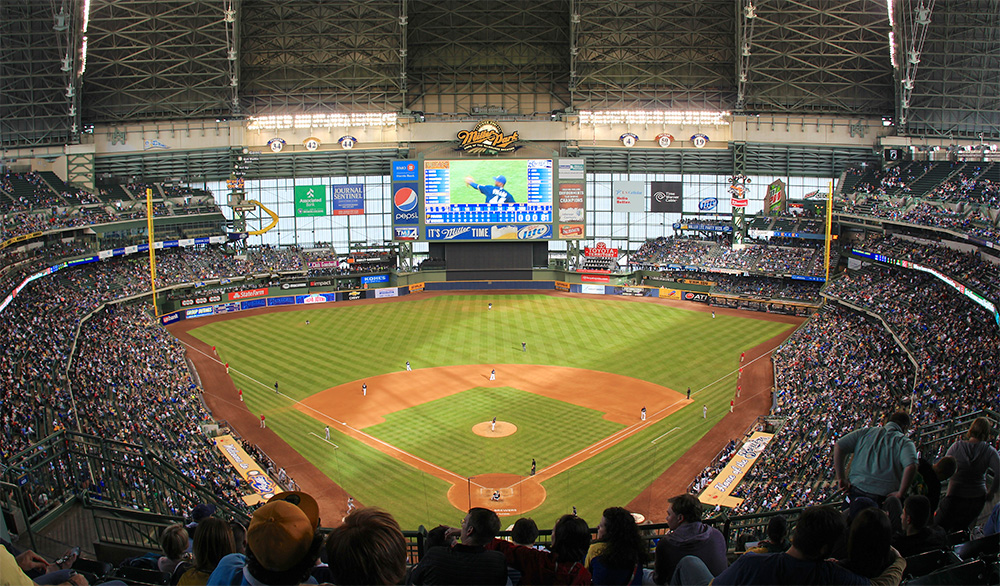
Milwaukee managed a rewarding rebuild without hitting rock bottom. (Photo: daveynin)

“I am sick to death of cleverness. Everybody is clever nowadays.” – Oscar Wilde, The Importance of Being Earnest

From the point of view of the 2010s Cubs, one could argue that their true antagonist has been the Milwaukee Brewers rather than their historical rivals, the St. Louis Cardinals. In two consecutive Septembers, it was Milwaukee that twisted the knife, first by catching up and taking the division on the back of an eight-game winning streak in 2018, and then by winning 11 out of 12 in 2019 to leave Chicago choking in the dust. They even managed that last one without Christian Yelich, a feat not unlike the magician’s grand reveal at the end of a particularly exciting illusion.

The Setup

As far as rebuilds go, the mid-decade one by Milwaukee was not too traumatic. In 2014, the Brewers burst out of the gate unexpectedly, winning 10 of their first 12 games, giving them first place in the NL Central. Despite projected win totals in the mid-70s, Milwaukee’s 20-8 April gave the club enough of a cushion that when the inevitable regression toward the mean occurred, it didn’t fall out of first place until the start of September. Four months of below .500 ball (53-55) eventually did them in, and a rough September dropped their final record to 82-80.

After struggling in 2015, the Brewers had the courage to do what a lot of teams in a similar position do not: rebuild before the roster was devoid of talent. Philosophically, rebuilding from a situation in which you’re not completely out of options ought to give a team more flexibility in the rebuild and a less painful fallow period. While I’m no expert in home repair, I would guess that it makes sense to replace the roof before you’ve got six inches of water in your kitchen. Read the rest of this entry »


Surprise, Surprise: José Abreu and the White Sox Stay Together

Yesterday, the White Sox did something they haven’t done before. They signed Yasmani Grandal to the largest contract in team history, and I’m a huge fan of that move. Today, they did something they have done before — commit to José Abreu. He signed a three-year, $50 million contract extension replacing the qualifying offer he had accepted, which will keep him with the team through 2022.

If you’re determined to see this deal through a cold, analytical lens, you might wonder whether it makes sense. $50 million is a lot for a first baseman, after all, and it’s particularly a lot for a first baseman who finished 14th in WAR at the position in 2019 and who will be 35 by the end of the extension.

If you’re feeling uncharitable, you might impugn Chicago’s process. Abreu was an All Star, received MVP votes, and led the AL in RBI. In a previous era, no one would question this deal (assuming the money were era-adjusted). It’s tempting to say that the Sox are stuck in the past, the front office equivalent of a Hall of Fame ballot blank save for Jeter — that signing Grandal was a rare moment of timeliness from a broken clock.

But to me, that’s a poor reading of this story. José Abreu and the White Sox aren’t a random player and team. Their relationship is complex, and painting this as solely a pay-for-production decision simply doesn’t capture the totality of what this deal means. From a pure numbers standpoint, the deal may not stand up — but that’s not what this contract is all about. Read the rest of this entry »