
Down Goes Frazier When it Comes to Defensive Metrics
Clint Frazier has made significant contributions to a banged-up Yankees team that sits atop the AL East with a hefty 38-20 record, but his performance in Sunday night’s game against the Red Sox in the Bronx was the stuff of which nightmares are made. You know, the kind in which you not only can’t stop doing that thing you’re not supposed to do, but you’re doing it in directly in front of 40,000 people emotionally invested in your success or failure, not to mention the millions more watching on television all around the world. The 24-year-old right fielder misplayed three balls in the late innings that helped to blow open a close game, the latest manifestations of his ongoing defensive woes.
Frazier’s misadventures began in the seventh, with the score 3-2 in favor of the Red Sox following a battle between former Cy Young-winning southpaws David Price and CC Sabathia. With reliever Luis Cessa on the mound, one out, and Michael Chavis on first base following a forceout, Frazier failed to keep Eduardo Nunez’s single in front of him. The ball rolled all the way to the wall, resulting in a two-base error that scored Chavis:
The Most Exciting Team in Baseball
June 3, 2019
As a baseball fan, winning feels great and losing feels awful. When teams win in dull fashion, fans are generally content to take the wins even if they aren’t all that thrilling. The Astros, Twins, and Dodgers are blowing teams out on a regular basis, but those wins aren’t causing too much consternation. But on the other end of the spectrum are teams that lose a lot of games and fail to provide much excitement during those contests. These are the bad teams that fall behind early and don’t give too much reason in terms of wins and losses to keep following the game. By combining a team’s winning or losing ways with how important at-bats tend to be, we can determine the most exciting team in baseball, as well as the most miserable club.
To determine how often teams have tension-inducing moments, we can take a look at Leverage Index (LI). Our glossary says “Leverage Index is essentially a measure of how critical a particular situation is. To calculate it, you are measuring the swing of the possible change in win expectancy.” A game’s LI starts at 1.0, and the more meaningful plate appearances gets, the higher the index rises; if plate appearances become less meaningful, the index goes lower. Leverage Index shows up on our Play Logs and is on the bottom of our Win Expectancy graphs. Here’s one for Game 3 of last year’s World Series:
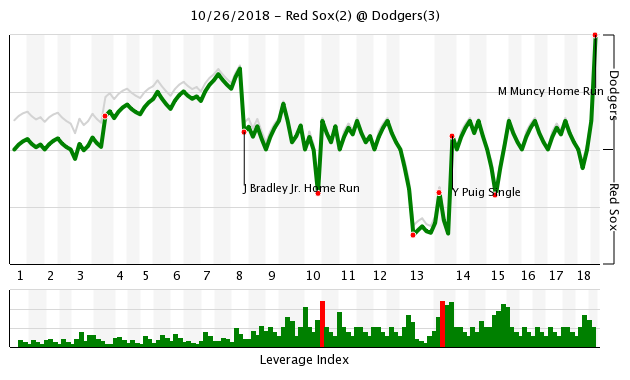
The bars along the bottom identify the biggest moments of the game, even if something big doesn’t show up on the scoreboard. For teams, we are dealing with more than a thousand plays at this point in the season. If we take the average LI of every play, we can see if teams have a tendency to have a decent number of important moments during their games or if things are decided relatively early, with the players playing out games with little chance of changing the outcome. Read the rest of this entry »
Bruce Not-So-Almighty Heads to Philly
June 3, 2019
Jerry Dipoto broke a nearly two-week trade drought over the weekend, sending outfielder Jay Bruce and everyone’s favorite player, cash considerations, to the Philadelphia Phillies. In return, the Mariners received 1B/3B/OF prospect Jake Scheiner.
As with most Mariners, Bruce started the season with impressive power numbers, hitting seven home runs in the team’s first 13 games. There was a period earlier this season when home runs represented seven of Bruce’s nine hits, an unusual balance even for a one-dimensional power hitter in these home run-filled times. As a fan of unusual baseballings, I will cheerfully admit that I was kind of hoping for that to continue. At one point in April, Bruce held a .204/.298/.673 line. To put that into perspective, only four seasons in history among qualified batters have featured a SLG-OBP difference greater than 300 points.
Largest SLG/OBP Differences
| Year | Player | Team | SLG-OBP |
|---|---|---|---|
| 2001 | Barry Bonds | Giants | .348 |
| 1921 | Babe Ruth | Yankees | .334 |
| 1920 | Babe Ruth | Yankees | .316 |
| 2001 | Sammy Sosa | Cubs | .300 |
| 1994 | Jeff Bagwell | Astros | .299 |
| 2019 | Christian Yelich | Brewers | .294 |
| 2019 | Joc Pederson | Dodgers | .293 |
| 1927 | Lou Gehrig | Yankees | .291 |
| 1995 | Albert Belle | Indians | .289 |
| 1994 | Matt Williams | Giants | .288 |
| 1927 | Babe Ruth | Yankees | .286 |
| 2019 | Josh Bell | Pirates | .286 |
| 1930 | Al Simmons | Athletics | .285 |
| 1998 | Mark McGwire | Cardinals | .282 |
| 1932 | Jimmie Foxx | Athletics | .280 |
Bruce’s flirtation with a 400-point difference early was way more fun to me than the usual “Joe So-and-So is on pace for 324 homers!” stuff. A race to topple Mark Reynolds for Mendoza Line-superiority in home runs (32) and slugging percentage (.433) could have been my song of the summer. Unfortunately, Bruce’s homer-pace slackened and he started hitting the occasional single. That has been enough to turn his 2019 into a more typical “middling power hitter” tune.
While I don’t think that anyone believed the Mariners were even close to being the best team in baseball — save for a couple of excited Mariners fans in my Twitter timeline — a 13-2 start gave Seattle some hope for a more interesting summer than expected. After all, this is a team that was forecasted to be on the dull side, but more blandly mediocre than unfathomably terrible. The best recent comparison would be the 2014 Milwaukee Brewers, another team that just wasn’t very good, but after a blazing 20-7 start and a 6 1/2 game lead, had enough of a cushion to be relevant into late summer.
Instead, Seattle unwound their hot start with impressive speed. Since the 13-2 start, the team’s gone 12-35, essentially ending any potential for a shocking run at the AL West title. To find a worse 47-game run for the Mariners, you have to look back to 1980, during the Dark Times of Seattle history. Bruce Bochte led the team in homers that year, crushing…uh…13 dingers, and the starting shortstop was the actual Mario Mendoza.
Once the 2019 version of the team was out of contention, the question became when Seattle would start selling rather than if. Bruce was always one of the best bets to go quickly if another team needed his services, not having been acquired by Seattle because of any burning desire to have him on the roster but as a balancing act to make the money in the Edwin Diaz–Robinson Canó trade satisfy both sides of the transaction. The Mariners may not have planned to give Daniel Vogelbach a serious look, but the Kyle Seager injury had a domino effect on the roster, sending Ryon Healy to third and Bruce and Edwin Encarnacion to first, opening up a spot for Vogelbach. The early demotion of Mallex Smith resulted in Mitch Haniger playing center field with more regularity, and that defensive combination allowed the team to fit Vogelbach, Bruce, Encarnacion, and Healy into the lineup simultaneously.
That gave the Mariners a lot of homers, but it turned out to be a not-so-good development for the team’s fielding. Through Monday morning, the Mariners are last in the majors in DRS (-50 runs) and UZR (-35 runs). Amusingly, Ichiro still leads M’s outfielders in UZR, at 0.2 in 10 innings.
Once everyone started shuffling back to their proper positions, Bruce was demoted to a semi-platoon role. He now follows another veteran acquired as salary makeweight from the Mets trade, Anthony Swarzak, out of town.
Bruce is a better fit with what the Phillies need. While the team’s left-handed hitters have combined for a wRC+ of 98 in 2019, it’s largely because of the existence of Bryce Harper. Odúbel Herrera’s arrest for domestic violence and uncertain return left the team in search for some left-handed hitting outside of Harper, and an extra outfielder. Ideally, Nick Williams would have been the best option to get increased playing time, but he has had an abysmal 2019, hitting .159/.205/.232 with a single homer as a part-timer. One can argue, probably correctly, that Williams likely has higher upside than Bruce, but things have changed in Philadelphia in the last couple of years. A team in contention and a rebuilding team ought to look at risk in different ways.
Bruce will likely continue in the semi-platoon role, as a fourth-outfielder who spells the regulars and plays a corner against a tougher righty when Scott Kingery isn’t in the lineup. Citizens Bank is a place where Bruce’s power, his only real remaining strength at this point, will shine. He is no longer the young semi-star he was in his early days with the Reds, but at this point of Bruce’s career, nobody’s really expecting that anymore. As a role player for the Phillies, Bruce will do his part to help the team hang onto first place.
Dan Szymborski FanGraphs Chat – 6/3/2019
June 3, 2019
| 12:01 |
 Dan Szymborski: It is noon. It is a time for chats. Dan Szymborski: It is noon. It is a time for chats.
|
| 12:01 |
: Now that the White Sox are in second place should they pull the trigger and start calling up guys from their farm system to push them closer to a wild car? i of course am referring mostly to Alcides Escobar.
BCC: Josh Nelson |
| 12:01 |
Dan Szymborski: ALCIDES KNOWS MORE ABOUT RINGS THAN JOSTENS
|
| 12:01 |
: Can Erick Fedde become a viable starter for the Nationals? He hasn’t gone deep into a game yet, but has avoided giving up the big inning so far.
|
| 12:02 |
Dan Szymborski: I think he can be. The Nats really were too optimistic about counting on both Anibal and Heckickson.
|
| 12:02 |
: Dan, what the hell?
|
Mock Draft 4.0: The Morning Of
With the MLB draft set to kickoff this evening, here is our latest mock, compiled using industry chatter from team personnel and player reps, our own in-person scouting, and educated guesses informed by how we believe individual teams have operated recently. For more information on the players mentioned below, head over to The BOARD, which we’ll continue to flood with player info over the next few days, as well as our first three mocks.
We’ll do one more names-only mock tonight just before the draft kicks off, and based on how we characterize the process surrounding a few of the picks, we expect some behind-the-scenes fireworks just before dinner time on the East Coast tonight.
1. Orioles – Adley Rutschman, C, Oregon State
Clubs still think there’s a real chance for a cut-rate option here, with Vaughn and Bleday the two leading candidates and Witt less likely. This crew keeps a tight lid on things, and may not call someone’s adviser to really get down to brass tacks until sometime late this afternoon. Even the advisers of those potential backup options don’t yet know if they’re going 1-1, or how to handicap it. Contact hasn’t been made with Rutschman’s reps for weeks, which is also to be expected to maximize leverage. We think a lot of the buzz here is being mentioned as posturing, and that the odds are high the pick is just Rutschman; it’s something like an 80% chance, but by no means a slam dunk. It’s worth noting that some of the concerns on Rutschman’s medical are more likely to be flagged by Baltimore given their specific medical staff. Read the rest of this entry »
Daniel Vogelbach Is Hitting Right (We’ll See About Left)
On May 8, Kyle Seager hurt his left hand. This was bad news for Seager and for the Mariners, but good news for Daniel Vogelbach. With Seager out, Ryon Healy moved from first to third base, covering for Seager; Edwin Encarnación, in turn, moved into the first base slot vacated by Healy, and Vogelbach — who had not previously had a path to much playing time — became the Mariners’ primary designated hitter. Since then, and despite a mixed May that dropped his wOBA from a terrific .481 through April 30 to a diminished but still distinguished .385 after the weekend’s action, Vogelbach has shown all the power that his brawn has always promised and the plate discipline that has always been his calling card to boot. His .313 ISO is now ninth in the game, and behind only Joey Gallo and George Springer in the American League.
Let’s start with the power, both because there aren’t too many people who can do the damage Vogelbach does when he really connects with a baseball, and because it provides a clue to what’s changed this year. When Vogelbach connects, as he did on May 27 at the expense of José Leclerc, the camera tends to pan so far up that it’s clear the operator, like everyone else in the ballpark, has no idea where the baseball is or where it’s going to land. All that is clear, for the few long seconds the ball is airborne, is that it’s gone an awfully long way. After this bomb (only the third in the history of the park to hit the third deck, and the first since Carlos Delgado did it way back in 2001), the Mariners put up a traffic cone and taped over the seat. That’s just fun to watch. Read the rest of this entry »
The Ballpark Netting Debate Is Back
by Sheryl Ring

June 3, 2019
Last Wednesday, Cubs outfielder Albert Almora Jr. hit a foul ball. That is not an unusual occurrence at a baseball game, except that this particular foul ball hit a four-year-old girl in the stands. Almora, quite understandably, was visibly shaken.
Check this out! It was a SCARY & JARRING moment @MinuteMaidParks last night during #Cubs–#Astros game, when a 4 YO girl was hit by a foul ball! It happened when Cub's player, Albert Almora Jr. hit a foul line drive into the stands. Fortunately, she's OK. #khou11 #htownrush pic.twitter.com/xvrxwmV5c5
— Michelle Choi (@MichelleKHOU) May 30, 2019
Unsurprisingly, the incident ignited another round of debate over a topic we first discussed last year: protective netting at ballparks. Brian Johnson, a former major league catcher and current scout for the San Francisco Giants, told CNN’s Jeff Pearlman that the existence of seats without netting is like building cars without seat belts. But, as we discussed last year, the law doesn’t see it that way:
As explained in the Restatement [of Torts], there exists in the law a doctrine called “assumption of the risk.” In the context of baseball, that basically means that if you sit in an area without protective netting and you know it’s a possibility that a foul ball might come your way, you can’t sue the team for getting injured by that foul ball. As one court put it in a case called Edward C. v. City of Albuquerque, a fan ‘must exercise ordinary care to protect himself or herself from the inherent risk of being hit by a projectile’ — even if that projectile is traveling upwards of 100 mph.
There’s a really excellent write-up on this that you can read here. In short, however, this “baseball rule” represents the majority rule in the United States. If a foul ball comes your way at a ballpark, the law basically says you should have seen it coming. You’ll probably find language on your ticket saying you assume the risk of injury by foul ball, like the Yankees have on theirs.
Sunday Notes: Mets Prospect Stephen Nogosek Is a Mule Deer on the Mound
Stephen Nogosek got one step closer to the big leagues when he was promoted from Double-A Binghamton to Triple-A Syracuse On May 24. The next rung on the ladder is New York, and the 24-year-old right-hander will be bringing more than a four-pitch mix with him when he arrives at Citi Field. He’ll bring a mule-deer mindset, as well.
Nogosek was a Duck before becoming a Met. In between, he was Red Sox property, having been selected by the AL East club in the sixth round of the 2016 draft out of the University of Oregon. Thirteen months later, he was included in the trade-deadline deal that brought Addison Reed to Boston. The address change didn’t shake him up so much as wake him up.
“I was asleep on this bus,” explained Nogosek, who was with high-A Salem at the time. “We were our way to Winston-Salem, and Adam Lau nudged me and said, ‘Hey, you just got traded.’ I was like, ‘Whatever,’ and fell back asleep. When I kind of woke up a little, I was like, “OK, did I really get traded?’
Shenanigans were certainly possible — teammates can’t always be trusted on such matters — but this was no tomfoolery. Once the cobwebs cleared, Nogosek learned that he would indeed be receiving his paychecks (meager as they are in the minors) from another organization. Read the rest of this entry »
Effectively Wild Episode 1383: Net Results
June 1, 2019

Ben Lindbergh and Meg Rowley banter about the Mariners’ recent run of ineptitude, why some teams talk to the media and whether there’s a moral obligation for teams to share information about preventing player injuries, a question from a fantasy player who’s aiming to compete in 2027, a Clayton Kershaw vs. Jacob deGrom matchup as non-must-see TV, and the aging of Kershaw compared to that of Felix Hernandez, then discuss the arguments against and for extending the protective netting in MLB ballparks to the foul lines (and mention a few FanGraphs upgrades).
Audio intro: Graham Parker, "Protection"
Audio outro: Dr. Dog, "How Long Must I Wait?"
Link to Ben on college player development
Link to Ben on protecting team secrets
Link to Elton question
Link to study on injuries from foul balls
Link to Travis on the uptick in fouls
Link to Rosenthal on extending the netting
Link to FanGraphs’ mock draft 3.0
Link to Kiley on college player development
Link to Foley’s book-signing event
Link to preorder The MVP Machine
 iTunes Feed (Please rate and review us!)
 Sponsor Us on Patreon
 Facebook Group
 Effectively Wild Wiki
 Twitter Account
 Get Our Merch!
 Email Us: podcast@fangraphs.com
Podcast (effectively-wild): Play in new window | Download
Subscribe: RSS