Happy Friday, everyone! I have good news, mostly for my editor: This will be shorter than the massively long two-week update from last Friday. The bad news, however, is that Justin Verlander makes for a less compelling featured photo than Corbin Burnes, so I appreciate that you clicked on this article anyway. Let’s fill you in on what’s new with the Matrix. Read the rest of this entry »
Eric A Longenhagen: Good morning from windy Tempe where I’m working on the Giants prospect list and doubling back on my international bonus info to have as accurate a picture as I can for next week’s signing period kickoff…
Eric A Longenhagen: How the Giants list and the Int’l list sequence early next week might depend on whether we learn of Sasaki’s destination over the weekend, and how much chaos that creates.
The following article is part of Jay Jaffe’s ongoing look at the candidates on the BBWAA 2025 Hall of Fame ballot. For a detailed introduction to this year’s ballot, and other candidates in the series, use the tool above; an introduction to JAWS can be found here. For a tentative schedule, see here. All WAR figures refer to the Baseball Reference version unless otherwise indicated.
2025 BBWAA Candidate: Carlos González
Player
Pos
Career WAR
Peak WAR
JAWS
H
HR
SB
AVG/OBP/SLG
OPS+
Carlos González
LF
24.4
23.7
24.1
1,432
234
122
.285/.343/.500
112
SOURCE: Baseball Reference
He won’t end up in Cooperstown like Larry Walker and Todd Helton, and he was never the face of the franchise the way Troy Tulowitzki was, but Carlos González is the only player to appear in three separate postseasons for the Rockies, a bridge between high points of the Helton/Tulowitzki era to those of the Nolan Arenado one. González solidified his spot in the majors with the 2009 Rockies, who overcame a slow start to claim a Wild Card berth, and was still playing regularly (albeit much less effectively) on their ’17 and ’18 Wild Card qualifiers. In between those October appearances, the sweet-swinging CarGo made three All-Star teams, took home three Gold Gloves, and won a very Coors Field-flavored batting title that propelled him to third place in the 2010 NL MVP race. Alas, as with so many other Rockies stars, he also battled numerous injuries, topping 140 games just three times in his 12 seasons.
Carlos Eduardo González was born on October 17, 1985 in Maracaibo, Venezuela, to parents Euro (an auto mechanic), and Lucila (an employee in the insurance industry). Euro had only a passing interest in baseball, but his oldest son, Euro Jr., dominated street games in their Maracaibo neighborhood. Euro Jr. didn’t start playing organized baseball until he was 12, so he never had the opportunity to capitalize on his raw talent, but he took great interest in the affinity that Carlos, his younger brother by seven years, had for the game. When Carlos was five, Euro Jr. helped find him a Little League team, his entry into Venezuela’s vast state-run youth baseball structure. Euro Jr. worked to help his younger brother buy a glove and baseball shoes.
As a child, Carlos often snuck into the kitchens and closets of relatives and hijacked their broom handles. “I would find the broom and unscrew it so I had a bat to hit stuff with,” he told the Denver Post’s Troy Renck in 2013. His toys became projectiles. “I never liked playing with them. I would toss them up in the air and hit them all the time,” as he told Renck. Read the rest of this entry »
For the 21st consecutive season, the ZiPS projection system is unleashing a full set of prognostications. For more information on the ZiPS projections, please consult this year’s introduction and MLB’s glossary entry. The team order is selected by lot, and the next team up is the Toronto Blue Jays.
Batters
The AL East team that entered 2024 with the highest projected floor turned out to have… the lowest actual floor in 2024. Curse you, probability! The rotation disappointed last year, and a wide swathe of the starting lineup either underperformed or got injured, and in some cases, both. Read the rest of this entry »
Ben Lindbergh, Meg Rowley, and Ben Clemens banter about the Giants signing Justin Verlander, a plateau in leaguewide slider usage, and why spending on free agents has exceeded expectations so far. Then (20:55) they continue a cherished podcast tradition by conducting the 12th annual Effectively Wild Minor League Free Agent Draft, in which they select 10 minor league free agents each and compete to see whose roster will accumulate the most combined MLB playing time in 2025.
Primary Purpose
The Cleveland Guardians Baseball Operations department is seeking analysts who are creative, curious, and collaborative teammates who enjoy tackling unique and challenging problems. The analyst role supports multiple departments (Player Development, Pro/Amateur/International Acquisitions, and the Major League team) with analysis and the practical application of evidence and research-based tools, resources, and processes to help facilitate their work.
Core Job Functions
Analysts are expected to work in a fast-paced team environment and communicate effectively with various organizational stakeholders. The bullets below are intended to capture major realms in which work might be focused, although the Analyst’s time spent across each area may differ based on their skillset, interests, and the team’s needs.
Analysis:
Facilitate and conduct evidence-based analysis in support of each department.
Communicate findings to key stakeholders across the organization.
Development:
Work collaboratively with Baseball Research and Development to uncover actionable insights across Hitting, Pitching, and Defense/Base-Running.
Work collaboratively with Baseball Systems to build and manage software products that directly drive our internal processes.
Support the application and education across departments of evidence-based practices & organizational philosophies.
Baseball Operations:
Facilitate and conduct analysis to support strategic planning.
Provide general ad-hoc support across baseball operations.
We know that historically marginalized groups – including people of color, women, people from working class backgrounds, and people who identify as LGBTQ – are less likely to apply unless and until they meet every requirement for a job. We encourage you to reach out if you have questions about the role or your qualifications. We are happy to help you feel ready to apply!
Basic Requirements
Ability to craft and articulate a compelling message to others in both written and verbal form.
Collaborative and able to succeed in a team-oriented environment.
An ability to build and maintain relationships with a broad range of baseball operations employees, including but not limited to scouts, coaches, and front office members.
Relentlessly curious and open-minded with a track record of evidence-based and divergent thinking.
Working knowledge of cutting-edge, publicly available baseball research.
Willing to frequently work nights, weekends, and holidays—particularly during the season.
Expected relocation to Cleveland and travel to Arizona for Spring Training.
Potential travel to Minor League affiliate teams.
Preferred Experience
While we don’t expect any candidate to meet every requirement, we’re looking for either a breadth of experience or deep expertise in a particular area. We’re considering applicants with a wide variety of past experiences.
Demonstrated expertise in biomechanics, hitting analysis, pitching analysis, or sport science.
Demonstrated understanding of statistics and experience carrying out quantitative analysis.
Demonstrated experience with a database language such as SQL and a programming language such as R or Python.
Ability to communicate in Spanish is a plus but not necessary.
Bachelor’s degree or prior professional experience.
Organizational Requirements
Reads, speaks, comprehends, and communicates English effectively in all communications.
Represents the Cleveland Guardians in a positive fashion to all business partners and the general public.
Ability to develop and maintain successful working relationships with members of the Front Office.
Ability to act according to the organizational values and service excellence at all times.
Demonstrated commitment to working with diverse populations and contributing to an inclusive working environment.
Ability to walk, sit or stand for an entire shift.
Ability to work extended days and hours, including holidays and weekends.
Ability to move throughout all areas and levels of the Ballpark.
Ability to work in a diverse and changing environment.
Occasional physical activity such as lifting and carrying boxes up to 25 lbs.
At the Cleveland Guardians, we are all about creating an inclusive environment that brings out the best in everyone. It is a big part of who we are, how we compete, and how we make an impact in our community. We want every employee to feel like they truly belong here.
We also know that people from historically underserved groups—like women and people of color—sometimes hesitate to apply for jobs unless they check every single box on the qualifications list. We’re looking for the best person for the job, and we know that you might bring skills and experiences that aren’t exactly listed but could be a huge asset to our team. So, if this role excites you, we encourage you to apply, even if you don’t meet every single qualification.
On Thursday the Dodgers and Twins agreed to a small trade involving former Top 100 Prospect, Diego Cartaya, a 23-year-old Venezuelan catcher who has struggled to develop as he’s been exposed to upper-level pitching. The Dodgers designated him for assignment earlier this week. In exchange, the Dodgers received hulking 20-year-old DSL righty, Jose Vasquez, a hard-throwing prospect who has spent the last two seasons in the DSL.
Cartaya was a big bonus amateur player ($2.5 million) whose career had a very promising first four seasons. He slashed .254/.389/.503 in 2022, at mostly High-A, when he was still just 20 years old. He was striking out at an elevated rate (26.7%) at the time, but he was also getting to impressive power and playing a premium position. His big frame and plus raw arm strength were the foundation of a likely defensive fit at catcher, and at the time it felt fine that Cartaya (who had missed all of 2020 because of the COVID shutdown, and most of 2021 due to injury) was a little behind as a receiver and ball-blocker.
In the two seasons since then, though, Cartaya has either plateaued or regressed in basically every facet of the game. His hands remain below average, and this shows in the way he tries to frame borderline pitches and in how he tries to pick balls in the dirt. Cartaya is capable of hurling darts right to second base with plus pop times, but he often either takes too long to get rid of the baseball, or airmails throws into center field. He has a good arm, yet he’s allowed stolen bases at an 80% success rate in his minor league career and 84% in 2024.
At a mix of Double- and Triple-A, Cartaya hit .189/.278/.379 in 2023 — his first year on the Dodgers 40-man roster — and .221/.323/.363 in 2024. His measurable power has dipped, with his hard hit rate dropping from 41% in 2022 to 33% last year. It’s prudent to give young catchers a long runway to develop as hitters because their bodies take a beating playing defense, and they might be physically compromised for large chunks of a season, such that it impacts their overall offensive output. But Cartaya has now had two years with the look of a fringe prospect, and so at this point it’s fair to consider him exactly that. He’s still a big-framed young guy with that big arm, and the Twins have had success at developing catchers who were once considered long shots to remain behind the plate, so Cartaya still carries some prospect value as a potential late-bloomer.
While Cartaya’s development stagnated and his options nearly ran dry, Dalton Rushing emerged as a potential everyday catcher in the Dodgers system. Hunter Feduccia (whom I have a backup catcher grade on) is a solid third option on the 40-man right now, behind starter Will Smith and backup Austin Barnes, while Rushing further develops in the minors. There was probably still time for the Dodgers to attempt to develop Cartaya if they really wanted to, but as a contending team they’ll likely have other, more pressing needs for that 40-man roster spot, and they got an actual prospect in return.
Cartaya is now on Minnesota’s 40-man in what will be his final option year. He is very unlikely to make the Opening Day roster, barring injuries to the catchers in front of him, and he’s likely to be the Twins’ fourth catcher on the depth chart when camp breaks, behind Ryan Jeffers, Christian Vázquez, and another former Dodgers minor leaguer, Jair Camargo. Industry inventory at catcher is always low, and depth at that position is coveted on the margins of every roster. If the Twins develop Cartaya enough that he can be their backup next year when Vázquez’s contract ends, then they can feel okay about having given up an actual prospect for him.
That actual prospect is Jose Vasquez, who signed with Minnesota at the tail end of the 2022 signing period (December 13) for $120,000, and he spent both 2023 and 2024 in the DSL. After walking more than a batter per inning in his debut season, Vasquez had a much better second campaign, working 2-to-4 innings at a time, as both a starter and reliever, and amassing 30 2/3 innings, 45 strikeouts, and a much more tenable 15 walks.
Despite his strike-throwing improvement, Vasquez is still most likely going to be a reliever. He’s a physical, 220ish-pound 20-year-old who has had trouble harnessing his 94-97 mph fastball, which sometimes has very heavy late sink. His 84-88 mph slider is curt and cuttery at times, but it flashes bat-missing two-plane shape and above-average length. Vasquez’s realistic ceiling is better than a generic middle reliever, but he’s maybe a half decade away from the bigs. He’ll probably begin his Dodgers career in Extended Spring Training.
Pitchers and catchers might not start reporting to camp for another five weeks, but as we count down the days until the start of spring training, we can at least look forward to the winter’s remaining free agents finding new homes, as well as the announcement of each team’s list of non-roster invitees (NRIs) to big league camp. And if we’re lucky, a few more big trades might go down.
Whatever happens, our Opening Day Tracker will continue to be updated with every player who will report to a major league camp, as well as their projected roster status.
Here’s a quick primer on who will be in major league camp, what happens as rosters are pared down to 26 players, and how our tracker can help you keep up between now and Opening Day. Read the rest of this entry »
Dan Szymborski: Let’s start the madness. I mean chat.
12:00
Egg Man: New team today ? Still 10 to go.
12:01
Dan Szymborski: Blue Jays tomorrow. I was travelling back through snow and then had to dig out my driveway and my mom’s driveway. Measured nine inches on my back lawn.
12:01
David Stearns: Mets sign Alonso, Winker, Scott and Maton are they the nl east favorites?
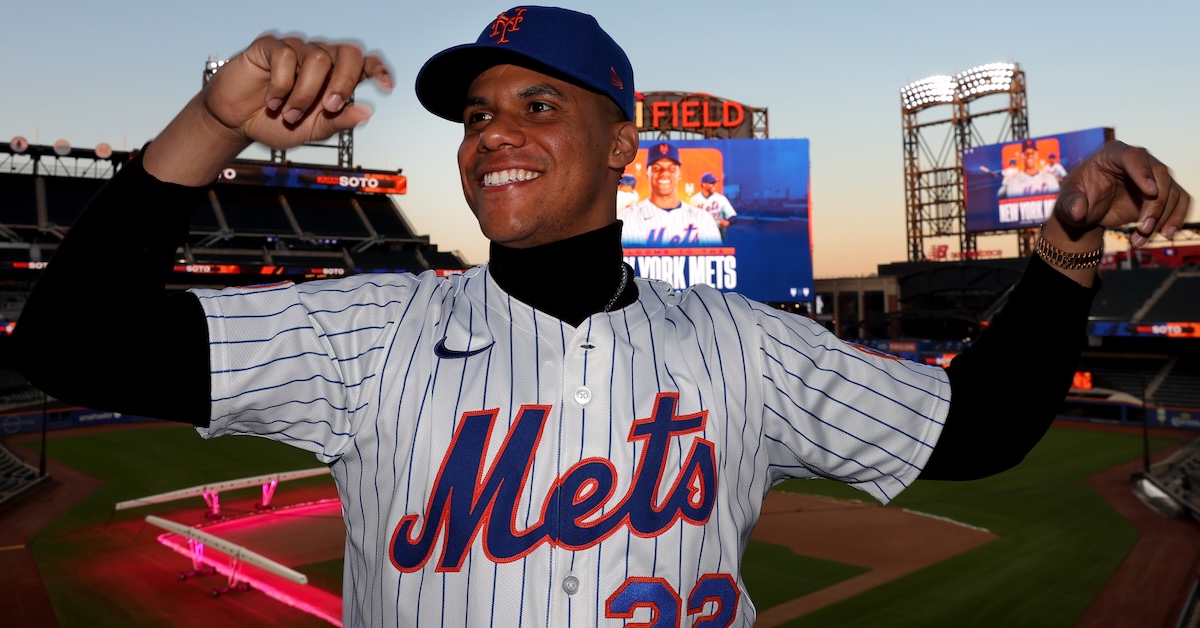
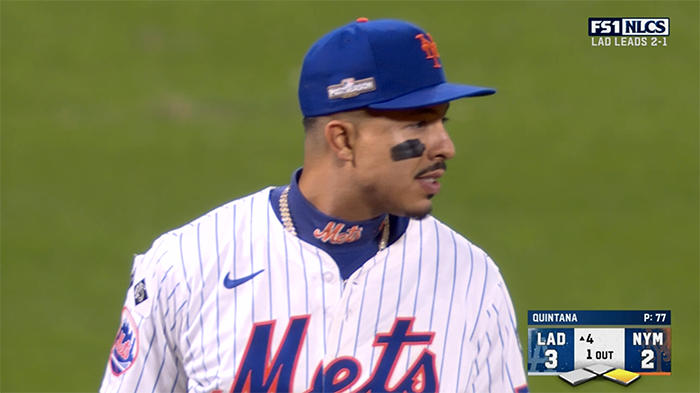
On December 12, the day of Juan Soto’s introductory press conference with the Mets – imagine for a moment being one of the three people in New York City who still requires an introduction to the concept of Juan Soto – the temperature at nearby La Guardia Airport peaked at 43 degrees. Soto wore a turtleneck and chain under his blazer, presumably to ward off the cold, but possibly because he was inspired by the look his new teammate Mark Vientos rocked during the National League Championship Series.
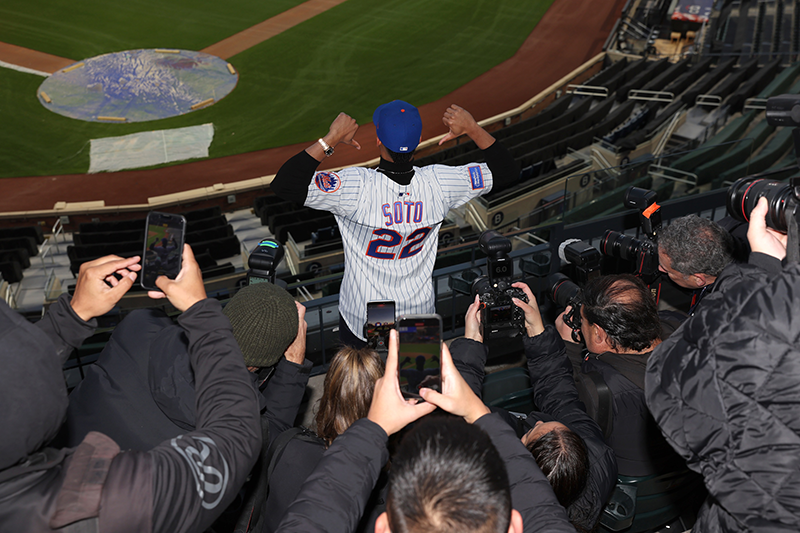
During the press conference, Soto swapped out the blazer for a crisp, new Mets jersey, but he left the turtleneck in place. The temperature was down to 37 by the time he ventured out to the elevated seats behind home plate for a photo op. “We got about fifteen minutes with Soto and his family,” said photographer Brad Penner in an email, “and it was COLD.” The photo op wasn’t just quick. It was weird, and the images it left us with are bizarre and beautiful. “I’ve done many press conferences,” wrote Penner, “but few that were like this one.”
Brad Penner-Imagn Images
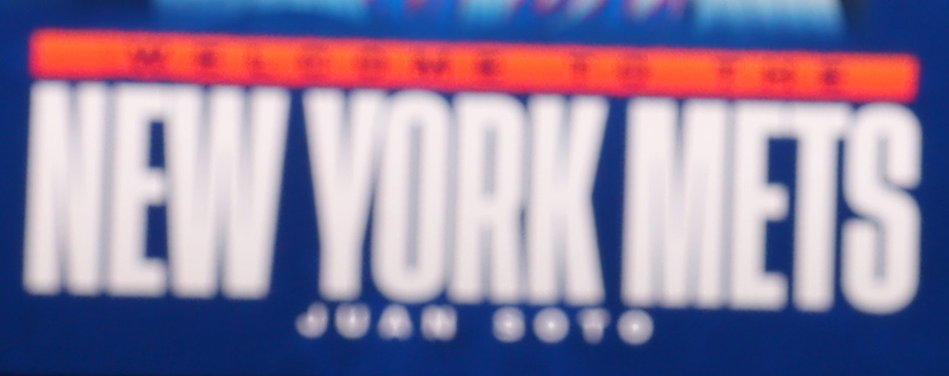
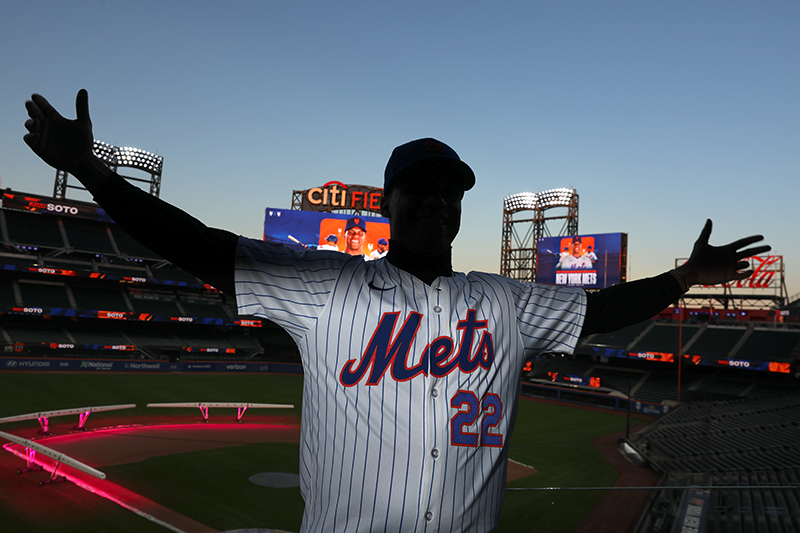
As he so often does, Soto seemed to jump right out of the photos. “I chose a seat as close to where Soto would be,” Penner said, “so I could line him up with the scoreboard, rather than the field and seats.” That was smart, as the Mets displayed a “Welcome to the//New York Mets//Juan Soto” graphic on both scoreboards, each featuring three images of him. That left many of the photos with seven Sotos in them, quite possibly a world record. With the focus of the lens necessarily all the way in the foreground, the scoreboard isn’t crisp. You can just make out the tiny “Welcome to the” portion of the graphic, but only if you zoom in and enhance like a CIA agent tracking Jason Bourne through a train station. (Also, there’s no comma between “Mets” and “Juan Soto,” so it reads like the entire team has been renamed the New York Mets Juan Soto. Take that, Cleveland Napoleons!)
Soto was standing in an area that was much darker than the field and the scoreboard in the background, and in the twilight, the black fabric of the turtleneck discolored his paper-thin jersey in an odd way. The white jersey shone brightly where it hung free, but where it lay flat against the turtleneck, it failed to contain the darkness within. The numbers on Soto’s jersey lit up like reflectors while the underside of his cap swallowed light like a black hole. In one picture, Soto smiles and spreads his arms wide, but his arms and his entire head are fully engulfed in impenetrable shadow.
Brad Penner-Imagn Images
In case you can’t tell, I adore these pictures. They’re not the action-packed hero shots that we’re used to seeing splashed across the sports section or the homepage of our favorite baseball analytics website. We’re accustomed to crisp, perfectly lit pictures of batters flattening fastballs into pancakes and pitchers grimacing mid-delivery with their UCLs stretched past the point of no return. But for the past month, with no new art to take their place, these photos of Soto looking, of all things, human, are everywhere. There he is on the television, in the newspaper, on the internet: in the dark, wearing a baseball jersey over a chain and a turtleneck that probably cost more money than I have ever seen in my life, alternating between posing confidently and standing awkwardly.
That’s part of the deal for professional baseball players. From the moment they arrive at spring training until the moment their season ends, they’re fair game for photographers. The Imagn photo service has 4,455 pictures of Soto, 1,113 of them from the 2024 season alone. But when the season ends, the players disappear. In the winter, they get to live their quasi-private lives away from the cameras, and baseball editors get to scroll through Imagn’s 56 pages of 2024 Juan Soto pictures in an attempt to avoid reusing that one shot they used back in December.
But now we’ve got art of Soto in a Mets uniform. Sure, the art isn’t what we’re used to, but it beats using an old photo of him in a Yankees uniform. Here’s what you see what you search Imagn for Juan Soto (which you can do here).
For any editor whose news organization didn’t send a photographer to Soto’s presser, this is what you have to choose from. It’s one closeup after another: Juan Soto with his arms outstretched like Moses parting the Red Sea, Juan Soto nervously smiling and adjusting the cuff of his turtleneck, Juan Soto with his hands raised like he’s conducting an orchestra, Juan Soto with the same goofy, sideways smile that Steve Carell wore in the poster for The 40-Year-Old Virgin.
I was a teenager when digital cameras began to fully replace film cameras, and I remember that era just well enough to appreciate what the transition cost us. Today, you can take and instantly delete an infinite number of pictures until you get one that shows exactly what you want it to show. Before that option was available, you couldn’t see your photos until you remembered to take the roll to the developer months later. When you finally got them back, you’d discover that you had your finger over the lens for a couple of them, that you had your eyes closed for a couple more, that the lighting was off for a couple more, and that one was, for no discernible reason, completely gray. If you were a total amateur like me, you’d consider yourself lucky to end up with two or three photographs that actually came out well. In other words, photography used to accurately represent real life. Real life is 90% crazy eyes and pre-sneeze faces, and you don’t get to dial up the saturation. I don’t mean to sound like a crank. I love having a decent camera in my pocket at all times; I’m just saying that it has distorted our world a bit.
For that reason, I love the fact that these pictures are everywhere you look. Penner took all of them, and he’s a fantastic photographer. He took the widely circulated picture of Francisco Lindorcelebrating on the field after the Mets dispatched the Phillies in the NLDS, and he even had a comp in mind for the madness of Soto’s press conference: Kemba Walker’s 2021 introductory presser for the Knicks, which took place at the top of the Empire State Building. But still, these are not the perfect pictures we’re used to seeing. They show the rare photo opportunity that ends up looking every bit as contrived as it actually is.
Brad Penner-Imagn Images
For the next month, do your best to enjoy these pictures. The moment Soto arrives in Port St. Lucie, you’ll stop seeing them. They’ll be replaced by low-angle shots of a godlike Soto in a crisp uniform, an immaculate Florida sky behind him. He’ll be launching batting practice home runs and laughing with his teammates. It will be perfect. There will be no turtleneck.




 Sponsor Us on Patreon
 EW Subreddit
 Effectively Wild Wiki
 iTunes Feed
 Spotify Feed
 Facebook Group
 Bluesky Account
 Twitter Account
 Get Our Merch!
 Dan Szymborski