Bryce Harper’s Broken Thumb Could Derail Phillies’ Comeback
Bryce Harper
Orlando Ramirez-USA TODAY Sports

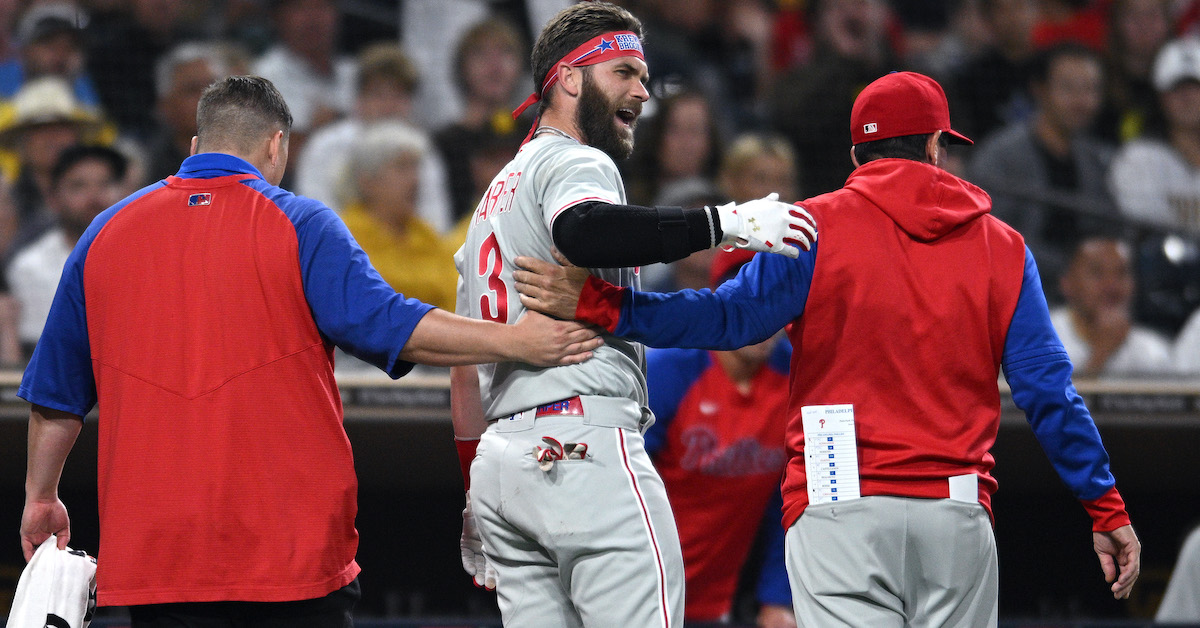
Since firing manager Joe Girardi on June 3, the Phillies have made significant strides toward climbing back into the playoff hunt, but on Saturday night, their chances took a significant hit. In the fourth inning of their game with the Padres in San Diego, Bryce Harper was hit by a 97-mph Blake Snell fastball, fracturing his left thumb and knocking him out of the lineup indefinitely.

When Harper was hit, his hands were so near his head that initially it appeared he got hit in the face. Even after it was clear that it had not, it was apparent that his injury was a significant one:

“I kind of wish it would have hit me in the face,” Harper told reporters afterward, conveniently forgetting many a career-altering beaning. “I don’t break bones in my face. I can take 98 to the face, but I can’t take 97 to the thumb.”

The 29-year-old Harper, the National League’s reigning Most Valuable Player, was already playing through a torn ulnar collateral ligament in his right elbow, an injury that was diagnosed in mid-May, after which he received an injection of platelet-rich plasma. The tear is apparently traceable to an April 11 throw from right field that had limited Harper to designated hitter duty since April 17. Last week, he missed three games due to an infected blister at the base of his left index finger.

Despite the elbow injury, Harper has thrived. He’s hitting .318/.385/.599 with 15 homers, with both his slugging percentage and 166 wRC+ ranking second in the NL — the latter mark just four points below last year’s major league-leading figure — and his 2.7 WAR ninth. This month, as the team has gone 18–6 (17–6 since firing Girardi, including wins on Saturday and Sunday over the Padres), Harper hit .359/.455/.641 (201 wRC+), practically carrying the offense. But at this writing, he’s the third of the NL’s top 10 players in WAR to be sidelined by an injury, joining Manny Machado (sprained left ankle) and Mookie Betts (cracked rib) in the virtual infirmary. Read the rest of this entry »


Cardinals Rookie Brendan Donovan Believes in Line Drives

© Jeff Curry-USA TODAY Sports

Brendan Donovan knows who he is as a hitter. The St. Louis Cardinals rookie is at his best when he’s hunting line drives, and that approach has been working like a charm. Two months into his big-league career, the 25-year-old is slashing .315/.426/.448 — with 14 doubles and one home run — in 197 plate appearances. Moreover, his 146 wRC+ is tops among qualified first-year players.

A left-handed hitter whom the Cardinals selected in the seventh round of the 2018 draft out of the University of South Alabama, Donovan is coming off a 2021 season that saw him climb from High-A to Triple-A, then excel in the Arizona Fall League. That meteoric rise continued this spring. Donovan earned a promotion to St. Louis in late April, and all he’s done since arriving is spray line drives. It’s what he does.

Donovan discussed his swing and approach when the Cardinals visited Fenway Park earlier this month.

———

David Laurila: How have you developed as a hitter since coming into pro ball?

Brendan Donovan: “We made a change in our hitting department — Jeff Albert, Russ Steinhorn, and those guys came in — and I was someone that made contact, but it wasn’t always quality contact. What we did is put me into a better body posture, better positioning, more tilt over the plate. I learned how to load the back hip a little better and flatten out my path. From there, it’s basically, ‘Let’s just try to get on plane, and see how long we can stay on plane.’ That’s helped me with fastballs up, and given me more adjustability on breaking balls and changeups, because I’m in the zone longer. Read the rest of this entry »


Sunday Notes: Jordan Lyles Knows What it’s Like to Lose

Jordan Lyles plays for a Baltimore Orioles team that stands 34-39 and is currently projected to finish 72-90. For the 31-year-old right-hander, that qualifies as more of the same. Lyles is in his 12th big-league season, and not once has he played a full year with a team that finished above .500. Moreover, he’s been on four clubs that lost 100-plus games. The worst of the worst was the 2013 Houston Astros, who went 51-111, a staggering 45 games out of first place.

The three seasons in which he’s played for multiple teams haven’t been much better. In each of those years, one of the two clubs he took the mound for ended up losing over 90 games. To date, Lyles has never pitched in the postseason.

That he never anticipated such a dearth of winning would be stating the obvious. Selected 38th-overall in 2008 out of a South Carolina high school, Lyles entered pro ball with the same lofty hopes and dreams as his draft-class peers. When you’re young and talented, visions of championship glory come with the territory.

He did reach the big leagues in relatively short order. Seventeen when he signed, Lyles was a precocious 20 years old when he debuted with the Astros in 2011. His first outing was a harbinger of things to come. The fresh-faced youngster allowed just a pair of runs over seven innings, only to see the bullpen blow the lead, depriving him of a win. At season’s end, Lyles was 2-7, the team 56-106. Read the rest of this entry »


Effectively Wild Episode 1867: Defining Fun

EWFI
Ben Lindbergh and Meg Rowley answer listener emails about why players in the dugout seem so confident in pitch locations, whether it would ever help to wear two gloves, MLB Big Inning and other baseball equivalents of NFL RedZone, the extreme dimensions of the Polo Grounds, what makes it so impressive that some players perform at the same level for a long time, whether the Cardinals are a fun team, and what it means when we say that a player is “fun to watch,” then (55:45) take pedantic questions about “pedantic” vs. “semantic,” whether every batted ball that hits the ground is a ground ball, “former” first-round draft picks, “number one” draft picks, how best to describe a batter’s small-sample line, the (un)importance of head-to-head team records, clearing the bases and homers that drive in multiple runs, how to refer to ballparks that have since changed their names, and the on-deck circle vs. the “next batter’s box,” followed (1:32:07) by a Past Blast from 1867.

Audio intro: Nick Lowe, “Hope for Us All
Audio outro: The Mynabirds, “Semantics

Link to Martinez ejection story
Link to MLB Big Inning
Link to B-Ref Stream Finder
Link to Ben on baseball RedZone
Link to the Mitchell catch
Link to Sam on the Mitchell catch
Link to Polo Grounds dimensions wiki
Link to B-Ref on the Polo Grounds
Link to THT on extreme ballparks
Link to THT on ballpark homogenization
Link to 85.4 mph home run
Link to Ben on quality of competition
Link to Dan Szymborski on Cardinals projections
Link to Viva El Birdos on Cardinals projections
Link to THT on political baseball jargon
Link to The Atlantic on baseball stereotypes
Link to research on baseball stereotypes
Link to Craig Wright on the running game
Link to Pages From Baseball’s Past
Link to Defector on The Athletic
Link to Richard Hershberger’s Strike Four
Link to 1867 story source
Link to 1873 dead ball ad
Link to “next batter’s box” diagram

 Sponsor Us on Patreon
Subscribe to Stathead (Code: WILD20)
 Facebook Group
 Twitter Account
 EW Subreddit
 Effectively Wild Wiki
 iTunes Feed (Please rate and review us!)
 Get Our Merch!
 Email Us: podcast@fangraphs.com


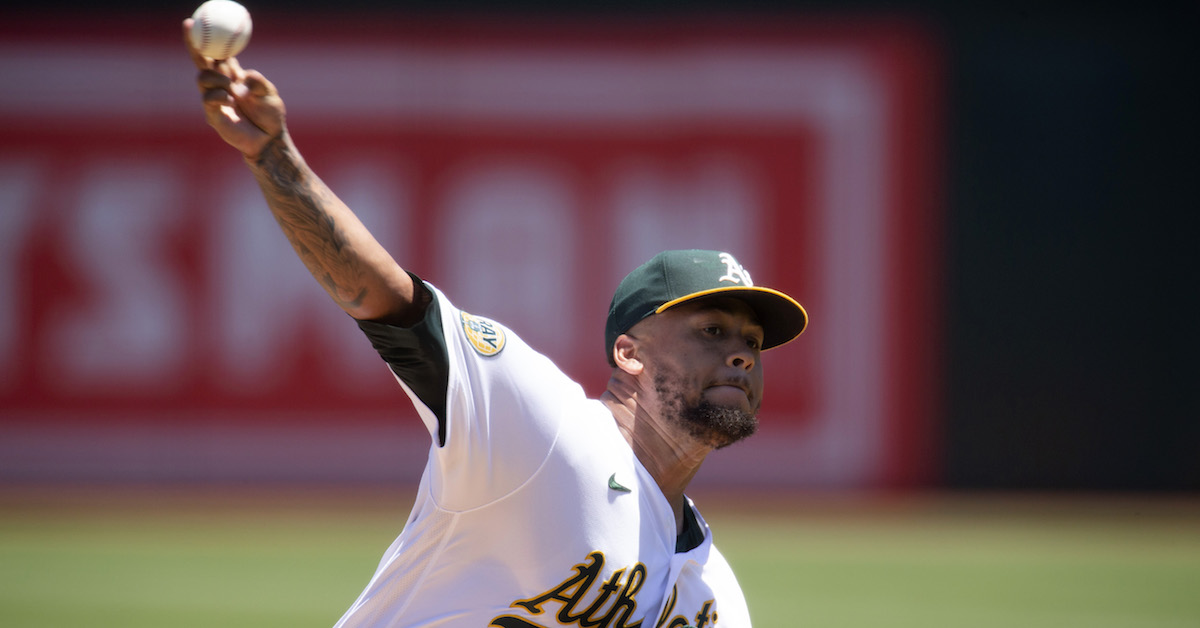
Frankie Montas Stands Alone

© D. Ross Cameron-USA TODAY Sports

Frankie Montas took the mound to start the eighth inning yesterday afternoon with a chance at history. He hadn’t allowed a hit all game, and looked to be picking up steam; his last pitch of the seventh inning hit 99 mph on the stadium gun, one of his hardest pitches of the day. He cut down the first two batters of the eighth in short order – four pitches, two grounders – leaving him only four outs from the first no-hitter of his career.

Montas is one of the best pitchers in baseball. A year ago, he put together his first full season, 32 starts of 3.37 ERA excellence. This year, he’s cleaning things up around the edges: fewer walks, more grounders, and more innings per start. His 3.21 ERA, 3.15 FIP, and 2 WAR are all in the top 20 among starting pitchers.

One small downside: Montas plies his trade in Oakland. That 2 WAR is more than every other player on the A’s has amassed combined (that rest-of-roster total comes in at 1.8 WAR, if you’re keeping score at home). Baseball is a team sport, even if many of the interactions feel individual; Montas sports a 3-7 record despite his sterling numbers. Read the rest of this entry »


There’s No Clear Favorite in the NL Rookie of the Year Race

MacKenzie Gore
Orlando Ramirez-USA TODAY Sports

Last week, I took a look at the fascinating race for the American League Rookie of the Year award, where four of our top five preseason prospects who have made their major league debuts — three of them on Opening Day — are making for a packed and compelling competition. In the National League, the race is just as crowded, though there isn’t a clear-cut favorite. And while the race in the AL is filled with top prospects, there are far more surprises and underdogs in the NL.

Before we get into the details, here’s some important context from that previous article:

When Major League Baseball and the Major League Baseball Players Association signed a new Collective Bargaining Agreement this offseason, it included some interesting provisions designed to combat service time manipulation. Top prospects who finish first or second in Rookie of the Year voting will automatically gain a full year of service time regardless of when they’re called up, and teams that promote top prospects early enough for them to gain a full year of service will be eligible to earn extra draft picks if those players go on to finish in the top three in Rookie of the Year voting or the top five in MVP or Cy Young voting. The goal was to incentivize teams to call up their best young players when they’re ready, rather than keeping them in the minor leagues to gain an extra year of team control. So far, the rule changes seem to have had their intended effect: three of our top five preseason prospects, and 11 of our top 50, earned an Opening Day roster spot out of spring training.

Of those 11 top 50 prospects who started off the season in the major leagues, just five of them were in the National League. The highest-ranked player in that group was CJ Abrams (15), with the four others falling below 30th on our preseason list. That’s not to say that there’s a lack of highly regarded prospects making their debuts in the senior circuit; there have been a few more big call-ups since Opening Day, including our No. 8 prospect, Oneil Cruz, just a few days ago. Still, the differences between the two leagues are stark when you pull up the rookie leaderboards.

With that in mind, here are the best rookie performers in the NL through June 22:

NL Rookie of the Year Leaders
Player Team PA wRC+ OAA WAR Overall Prospect Rank
Brendan Donovan STL 180 148 -2 1.4 Unranked
Michael Harris II ATL 91 151 4 1.3 Unranked
Alek Thomas ARI 157 119 1 1.1 23
Luis Gonzalez SFG 180 129 -3 1.0 Unranked
Jack Suwinski PIT 173 116 1 0.9 Unranked
Nolan Gorman STL 107 136 -1 0.7 53
Christopher Morel CHC 151 117 -5 0.7 Unranked
Seiya Suzuki CHC 163 114 -1 0.6 Unranked
Geraldo Perdomo ARI 215 78 -1 0.5 83
Oneil Cruz PIT 14 37 0 0.0 8
CJ Abrams SDP 76 59 0 -0.1 15
Bryson Stott PHI 147 36 -1 -0.5 34
Player Team IP ERA FIP WAR Overall Prospect Rank
Spencer Strider ATL 47.2 3.40 2.38 1.2 Unranked
MacKenzie Gore SDP 54.1 3.64 3.28 1.2 Unranked
Aaron Ashby MIL 55 4.25 3.64 0.7 46
Graham Ashcraft CIN 33.1 3.51 3.88 0.5 Unranked
Roansy Contreras PIT 37.1 2.89 4.12 0.4 41
Hunter Greene CIN 65 5.26 5.30 0.1 31
Nick Lodolo CIN 14.2 5.52 4.63 0.1 51

Where the AL had a trio of top prospects leading the way, the NL has seven players firmly in front with plenty of others close behind. In that group, just Alek Thomas was ranked on our preseason top 100; the others were a mix of the unheralded, the very young, or those who had already lost their prospect sheen. Read the rest of this entry »


Miami Marlins Prospect Cody Morissette Is New Hampshire Proud

© Jasen Vinlove-USA TODAY Sports

MLB history includes 54 players born in the state of New Hampshire. Cody Morissette is hoping to become the 55th. A 22-year-old infielder who was drafted 52nd overall last year out of Boston College, Morissette is No. 11 on our newly-released Miami Marlins Top Prospects list.

A Manchester native who attended high school in Exeter, Morissette excelled at the collegiate level — he posted a .337/.400/.507 slash line in his three seasons as an Eagle — while being overshadowed by a high-profile teammate. Sal Frelick, himself a native New Englander, was taken 15th overall last year by the Milwaukee Brewers.

Morissette, who is slashing .232/.314/.444 with 12 home runs for the High-A Beloit Sky Carp, touched on his New Hampshire roots, and his big league aspirations, earlier this week.

———

Morissette on his three-homer game on June 17:

“That was a special night for me. Along with being able to help the team win, it was really cool to hit three home runs, because it’s the first time I’ve done it on a big diamond. Baseball is a weird game. The night before, I was 0-for-5 with five strikeouts. I wanted to come back the next day and respond in a good way, and three home runs was definitely a good way to respond.”

On reports that he projects as hit-over-power: Read the rest of this entry »


Miami Marlins Top 35 Prospects

© Rhona Wise-USA TODAY Sports

Below is an analysis of the prospects in the farm system of the Miami Marlins. Scouting reports were compiled with information provided by industry sources as well as my own observations. This is the second year we’re delineating between two anticipated relief roles, the abbreviations for which you’ll see in the “position” column below: MIRP for multi-inning relief pitchers, and SIRP for single-inning relief pitchers.

A quick overview of what FV (Future Value) means can be found here. A much deeper overview can be found here.

All of the numbered prospects below also appear on The Board, a resource the site offers featuring sortable scouting information for every organization. It has more details than this article and integrates every team’s list so readers can compare prospects across farm systems. It can be found here. Read the rest of this entry »


FanGraphs Audio: Chaim Bloom Chats Secret Sauce, Jim Callis Talks Combine

Episode 980

This episode, we sit down with the head honcho of the Red Sox before an old friend comes by to talk about the state of the amateur draft landscape.

  • At the top of the show, David Laurila welcomes Chaim Bloom, chief baseball officer for the Boston Red Sox. Bloom shares his journey from a Latin Classics degree at Yale to contributing at Baseball Prospectus to an internship with the Rays in 2005 to eventually being in charge of a major league front office. The duo also talk about the past and future of knuckleballers in the game, the significance of starting pitchers going the distance, the Andrew Benintendi trade, Jackie Bradley Jr. moving off of center field, and how the club has improved at developing pitchers. [3:45]
  • In the second half, Eric Longenhagen is joined by Jim Callis of MLB Pipeline. The pair were both just at the MLB Draft Combine in San Diego and discuss the event they have dubbed the Winter Meetings of the draft. They also talk about the College World Series, the ironically named Kumar Rocker rule, how new technology and data is continuing to influence amateur scouting, and how their mock drafts are going so far. Finally, Jim shares an anecdote about the Kyler Murray pick. [32:30]

To purchase a FanGraphs membership for yourself or as a gift, click here.

To donate to FanGraphs and help us keep things running, click here.

Don’t hesitate to direct pod-related correspondence to @dhhiggins on Twitter.

You can subscribe to the podcast via iTunes or other feeder things.

Audio after the jump. (Approximate 85 minute play time.)


Effectively Wild Episode 1866: That Sinking Feeling

EWFI
Ben Lindbergh and Meg Rowley banter about two spectacular games by Shohei Ohtani and Ohtani’s extraordinary playing-time pace and relay a sinker-iffic response from Michael Lorenzen to a previous discussion about baseball grip, then (24:22) answer listener emails about using different-colored balls to denote different levels of liveliness, how much time to train players have in-season, whether fielders are to blame when their gloves develop holes, outlawing webbed gloves to raise BABIP, single-game team home-run records, whether players who come up now are already conditioned by pitch clocks, PitchCom and pace, which single stat they would most want to know about hitters and pitchers, and how many appeals a ball-strike challenge system should allow, plus (1:23:17) a Past Blast from 1866.

Audio intro: Jon Brion, “Hook, Line and Sinker
Audio outro: Japanese Breakfast, “Boyish

Link to Ohtani game stories
Link to FG combined WAR leaderboard
Link to Langs tweet
Link to pre-2022 combined BF+PA data
Link to Lorenzen comments
Link to MLB mud memo
Link to sinker HBP rate
Link to Annie Hall clip
Link to Justin Choi on sinkers
Link to Ben on pitching machines
Link to Diaz glove video
Link to Vlad glove video
Link to Rob Arthur on low BABIP
Link to 2015 story on age and pace
Link to Rob on pace and velo
Link to Russell on pace and velo
Link to Rob on batter age and pace
Link to 27-and-under SP pace
Link to 28-and-over SP pace
Link to team homer records in game
Link to team homer records in season
Link to MiLB experimental rules
Link to Richard Hershberger’s Strike Four
Link to 1866 story source
Link to Creighton SABR bio
Link to tweet about Pabor’s nickname
Link to Thorn on Pabor’s nickname
Link to Gavarni illustration

 Sponsor Us on Patreon
Subscribe to Stathead (Code: WILD20)
 Facebook Group
 Twitter Account
 EW Subreddit
 Effectively Wild Wiki
 iTunes Feed (Please rate and review us!)
 Get Our Merch!
 Email Us: podcast@fangraphs.com