Tossed Salads and Scrambled Eggs: Adam Frazier Comes to Seattle

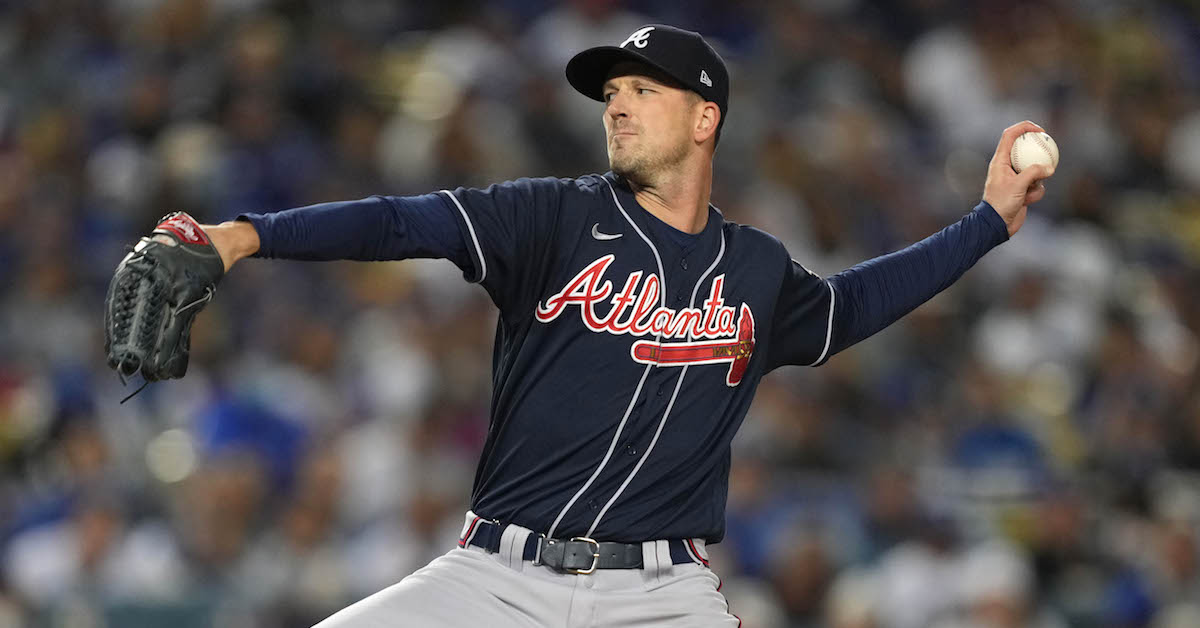
In an accord between familiar and frenetic trading partners, the San Diego Padres sent Adam Frazier to the Seattle Mariners on Saturday in exchange for prospects Ray Kerr and Corey Rosier. It’s a bit of an odd move. The Padres, nominally in win-now mode, just shipped off a 3.5-win player for prospects. Meanwhile, the Mariners beefed up their thin infield, but at the risk of incurring a considerable opportunity cost in a free agent market that seemed tailor made for their needs.

Let’s touch on San Diego’s side first, since it’s the more perplexing one at a glance. Frazier is the big name in the deal. The National League’s starting second baseman in last summer’s All-Star Game, the 29-year-old hit .305/.368/.411 last season while accruing the aforementioned 3.5 WAR, though his production dipped following the trade. Always a good contact hitter, Frazier joined the game’s elite in 2021 with a 10.8% strikeout rate — only Michael Brantley, David Fletcher, and Kevin Newman whiffed less often. While 2021 may well have been his peak, Frazier’s been a pretty good player for a long time: Since debuting in 2016, he’s notched a 103 wRC+ and has averaged 2.4 WAR per 162 games. Contending teams looking to gain ground don’t usually trade away this kind of production, particularly from a player they just acquired last July.

Despite that, you can understand why the Padres considered him surplus to requirements. With no path to a starting job in the infield, and Ha-Seong Kim around to fill a multi-positional utility role, Frazier was a bit of a square peg on a roster of round holes. Yes, the Friars could have used him in the outfield — as they sometimes did last summer — but it’s not the best use of his skills. In theory, exchanging him for players who could offer the Pads more stick in the outfield or depth in the bullpen makes sense. Read the rest of this entry »


Red Sox Fill Out Rotation With Intriguing Michael Wacha Addition

The Red Sox have made their first free-agent signing of the offseason, bringing in Michael Wacha on a one-year, $7 million deal, as the Boston Globe’s Alex Speier reported. The 2022 season will see Wacha donning his fourth uniform in the last four years after he spent ’21 with the Rays, ’20 with the Mets, and everything up to that point with the Cardinals. That recent bouncing around comes as his performance has fallen on hard times, with three straight seasons with an ERA over 4.50. But while the 30-year-old righty may not be a splashy signing, teams have found ace-level performance in this price range in previous years, like the Giants signing Kevin Gausman to a $9 million deal in 2019, or the Blue Jays signing Robbie Ray for $8 million last offseason. And in Wacha’s case, there were some interesting things happening with him late in the year that make this deal worth diving into.

Wacha’s Career Performance
2013-2018 2019-2021
ERA 3.77 5.11
ERA- 96 123
FIP 3.68 5.07
FIP- 93 120
HR/FB 10.3% 19.9%
K-BB% 13.1% 13.6%

When Wacha is off, as has often been the case since 2019, he has a hard time keeping the ball in the yard. His HR/FB rate has nearly doubled from his prime years with the Cardinals and is the fourth worst in the majors since 2019. And that’s despite his velocity — 93.8 mph on his four-seamer on average last year — being nearly the same as it was when he was in St. Louis. Read the rest of this entry »


Steven Matz to Cardinals Puts Steve Cohen on Tilt

There are two narratives to consider with Steven Matz, who signed with the Cardinals last Wednesday. There’s the straight-up baseball story of a solid pitcher joining the rotation of a good team. Then there’s the seemingly never-ending soap opera that is the Mets, whom he spurned in the final moments of his free agency for St. Louis.

Let’s start with the baseball side of things. Matz immediately fills a rotation spot for a Cardinals team that will likely be in the thick of things in the NL Central in 2022. At four years and $11 million per, with the chance to earn an additional $4 million over the life of the contract via performance bonuses, he topped the length and total value, though not AAV, predicted by Ben Clemens in our top 50 free agents list, on which he ranked no. 31, and beat the crowd-sourced numbers in each category.

The lefty will slot somewhere in the middle of the St. Louis starter group, certainly following Adam Wainwright and Jack Flaherty, and if there’s anyone on the market who fits the definition of middle-rotation starter, it’s Matz. As 2020 gets further away in our collective rear-view mirrors, we’ve learned how much data from that season is an outlier, and an extreme one at times, as was the case with him; he was northing short of miserable in his nine appearances that season. And while he had his share of health issues in his earlier years, if you take his three most recent full seasons, he’s been the roughly the same player in terms of both consistent performance and availability.

He doesn’t have the kind of high-spin, bat-missing stuff that teams tend to look for in the modern game, but Matz keeps the ball on the ground at roughly a 50% rate and should benefit greatly from a Cardinals defense that represents a significant upgrade from what was behind him in Toronto. He leans primarily on his 93–96-mph sinker and throws a pair of breaking balls roughly a quarter of the time, preferring his curve over his slider, and for good reason, considering the quality of the pitch. Changeups are rare but shouldn’t be, as he’s added a few inches of drop on the pitch over the past few years, leading to an offering that performs quite well.

During those previously mentioned three full seasons, Matz averaged 30 starts and 155 innings per, so he’s been taking the bump every five days, but going deep into games is not something he brings to the table, as he got more than 18 outs just three times in 2021. He can throw a strike when he has to but needs to play around the edges in order to succeed with his arsenal, leading to deeper counts, more than 100 pitches per six innings, and the need for multiple relievers to finish the job.
Read the rest of this entry »


Job Posting: Seattle Mariners High Performance Positions

Please note, this posting contains eight positions.

Position: Diversity Fellowship

Department: Baseball Operations
Reports To: Minor League Athletic Training Coordinator
Status: Exempt

Primary Objective: Responsible for assisting Mariners High Performance Medical Staff with delivery of comprehensive athletic training services to the Seattle Mariners players. Read the rest of this entry »


Job Posting: Seattle Mariners Player Development Positions

Please note, this posting contains eight positions.

Position: Affiliate Manager

Department: Player Development
Reports to: Director, Player Development
Status: Exempt

Primary Objective: Responsible for coordination, support and assistance to the Director, Player Development in all facets of player education, preparation, and planning at assigned affiliate. Manage the on-field affiliate in all areas of player development including in-game management, and practice design. Read the rest of this entry »


Texas Signs Marcus Semien for Seven

Marcus Semien finally landed his long-term contract over the weekend, coming to an agreement on a seven-year, $175 million deal with the Rangers. The tritagonist of the AL MVP race in both 2021 and ’19 hit .265/.334/.538 with 6.6 WAR for the Blue Jays in 2021, playing in all 162 games for just the second time in his career.

The exact distribution of the money is not yet public, so we don’t know about opt-outs, options, buyouts, incentives, and the like. But whatever the fine print says, this is a big contract, and one that it looked like Semien would never be able to land. A late bloomer, he was not widely considered a top prospect around baseball, though he ranked 31st in the inaugural ZiPS Top 100 Prospects before the 2014 season after terrific all-around performances in ’13 for Triple-A Charlotte and Double-A Birmingham. But it was the outlier here, and the White Sox of the time were not a particularly imaginative organization. They didn’t see him, then error-prone, as a shortstop, and in any case, Alexei Ramirez had an ironclad hold on the position. This was the era in which the Sox seemed determined to play Gordon Beckham at second indefinitely, despite any performance-based reason for that strategy, and little attempt was made to find a role for Semien on the roster. He, along with Chris Bassitt and a couple others, was shipped off to Oakland after the 2014 season for Jeff Samardzija.

Oakland has never shied away from being the Island of Misfit Toys and found a better use for Semien, and like Marco Scutaro, a stathead darling from a decade prior, he turned out to be a low-cost, league-average infielder. With the help of Ron Washington, he improved immensely with the glove and nearly put up his first 4-WAR season in 2018. When his power broke out, as it did the following season, he was a legitimate contender for the AL MVP award.

The next time you hear bemoaning about how players always have career years right before they hit free agency, remember to keep the example of Semien in your mind. He finally made it the market after 2020, his age-29 season, but was coming off a relatively unimpressive follow-up to his MVP-caliber ’19, hitting .223/.305/.374. It was hardly a lousy year by any stretch — his 1.2 WAR represented a 3.1 WAR pace over a full campaign — but it was one to get the word “fluke” out there.

With the hope of a bounceback season in a year not drastically shortened by a raging pandemic, he signed a one-year deal with Toronto worth $18 million, positioning him to get one more chance to land a big deal. That bet paid off, and while the shape of his contribution changed between ’19 and ’21 — less batting average, an easier defensive position, more power — a second big season answered a lot of questions about just how good a player he was.
Read the rest of this entry »


Sunday Notes: Brewers Prospect J.T. Hintzen Isn’t a Knuckleball Pitcher

J.T. Hintzen is a reliever with a five-pitch arsenal. Atypical as that is — most bullpen arms don’t feature such a wide array of offerings — it’s one particular pitch that sets the 25-year-old right-hander apart from his peers. Hintzen’s varied mix includes the increasingly-rare knuckleball.

More on that in a moment.

Hintzen is as unheralded as he is unique. A 10th-round pick in 2018 out of Florida Southern College, the Greenwich, Connecticut native remains under the radar despite a 3.38 ERA and 204 strikeouts in 162-and-a-third professional innings. Back in action this summer following last year’s COVID-cancelled minor-league season, he logged a 3.88 ERA and a 12.3 K/9 over 58 innings with the Double-A Biloxi Shuckers.

Hintzens arsenal comprises two sliders — “one that sweeps across the zone, and one that’s more downward” — a changeup, a four-seam fastball with good ride, and the knuckleball. Effectively tunneling his heater and the sharper of his breakers is a big key to his success.

“[The slider] comes out of the same arm slot as my fastball, and pairing the two usually gets hitters out, because they can’t read it well,” explained Hintzen, who augmented his 36 regular-season appearances with 11 more for the Arizona Fall League’s Salt River Rafters. “It comes out hard. If I throw my fastball 90 mph, my slider is probably coming out around 85. The sweeping one is more like 80 mph. I’ve gotten up to 20-plus inches of horizontal break with that one — straight across the zone like a frisbee — whereas the [harder one] is more like five to 10, but more downward. I’m throwing them on two different planes.”

Hintzen delivers his pitches from a lower arm slot — his release point will creep below five feet — and the spin he gets on his fastball ranges between 2,400 and 2,500 RPMs. And then there’s the pitch that rotates hardly at all. Read the rest of this entry »


Effectively Wild Episode 1777: Happy Francsgiving

EWFI
Ben Lindbergh and Meg Rowley banter about the Rays signing 20-year-old Wander Franco to a long-term extension, rapid movement in the starting-pitcher market (capped off by the Cardinals signing Steven Matz and Mets owner Steve Cohen tweeting out his reaction), and the White Sox inking Kendall Graveman. Then (36:41) they continue their series of discussions of Korean baseball drama Stove League by breaking down Episodes 5–8. (Note: No spoilers beyond Episode 8.)

Audio intro: Willie Nelson, "I Let My Mind Wander"
Audio outro: Lana Del Ray, "Not All Who Wander Are Lost"

Link to Dan Syzmborski on the Franco extension
Link to Ginny Searle on the Franco extension
Link to Devan Fink on the Giants’ deals
Link to story about Cohen and Matz
Link to Luke Hooper on the Graveman signing
Link to Korean report on corporal punishment
Link to “Fighting!” expression
Link to “You’ve worked hard!” expression
Link to first EW Stove League discussion
Link to Stove League teaser video
Link to Stove League review
Link to stream Stove League via Kocowa
Link to stream Stove League via Viki

 iTunes Feed (Please rate and review us!)
 Sponsor Us on Patreon
 Facebook Group
 Effectively Wild Wiki
 Twitter Account
 Get Our Merch!
 Email Us: podcast@fangraphs.com


FanGraphs Audio: Ballots on the Brain

Episode 950

We bring you an early episode before the holiday with discussions on how the Cy Young ballots were filled out and how the Hall of Fame ballots were constructed.

  • To begin the show, David Laurila is joined by Alex Speier of The Boston Globe and C. Trent Rosecrans of The Athletic to discuss their Cy Young ballots. It was a tight race in both leagues this year, and Alex recently wrote on how the voting process helped him reimagine how he evaluates pitching analytics. The trio have an in-depth conversation on things like ERA, FIP, quality versus quantity of innings, and how our views on these things have evolved over time. [2:31]
  • After that, Jay Jaffe welcomes Adam Darowski, head of user experience at Sports Reference, to talk about the arrival of the Hall of Fame ballots. Jay joined Adam on his own podcast back in August to discuss the formation of the Early Baseball and Golden Days ballots, and now that those have been revealed as well, they take a closer look at the many players through history who deserve more recognition. The pair go over a number of worthwhile figures on the ballots as well as some of the complex contexts involved in their candidacies, including the fact that some are still with us today. [38:15]

To purchase a FanGraphs membership for yourself or as a gift, click here.

To donate to FanGraphs and help us keep things running, click here.

Don’t hesitate to direct pod-related correspondence to @dhhiggins on Twitter.

You can subscribe to the podcast via iTunes or other feeder things.

Audio after the jump. (Approximate 1 hour 14 minutes play time.)


Graveman Takes Rejuvenated Career to Chicago’s South Side

It’s a good time to be a pitcher: The market for hurlers has been ablaze with rumors and signings, and we haven’t even reached Thanksgiving. The latest move comes from the White Sox, who have signed reliever Kendall Graveman to a three-year, $24 million deal, per MLB Network’s Jon Heyman. He is already the fifth pitcher to sign a multi-year deal so far this offseason, and the sixth pitcher to come off our Top 50 free agent list, where he was ranked at No. 45.

Graveman spent his mid-20s as a starter for the A’s, posting elite ground-ball rates and minimal strikeouts — a recipe that never quite worked out, as by the time he had Tommy John surgery in 2018, he had a career ERA of 4.38, a FIP of 4.54, and a strikeout rate of only 15%. He returned to the big leagues in 2020 with the Mariners, which is where we first got a glimpse of his new form, with a 3.60 ERA and 3.09 FIP in a month of bullpen work to close out the season.

His successful transition to the ‘pen after struggling as a starter is hardly a new story, yet Graveman and his aversion to whiffs isn’t exactly the prototype you look for when trying to create a great reliever. One of the keys for him, as is often the case, came from tapping into unseen velocity when pitching shorter relief outings; what once was a 93-mph sinker now sat 96 and touched 99.

The velocity carried over into 2021, and with it, newfound run suppression, as he became a dominant closer for the surprising Mariners. By the time the trade deadline rolled around, Graveman had a 0.82 ERA, and while his peripherals (a 2.90 FIP and 3.13 xFIP) may have suggested he was closer to a good reliever than an elite one, it was still clear that the move to the bullpen had turned his career around. The Astros acquired him at the deadline to bolster their bullpen for the playoffs, and while still good, he regressed closer to what his peripherals had said all along, putting up a 3.13 ERA the rest of the way. Read the rest of this entry »