Ben Clemens FanGraphs Chat – 4/13/26
by Ben Clemens

April 13, 2026
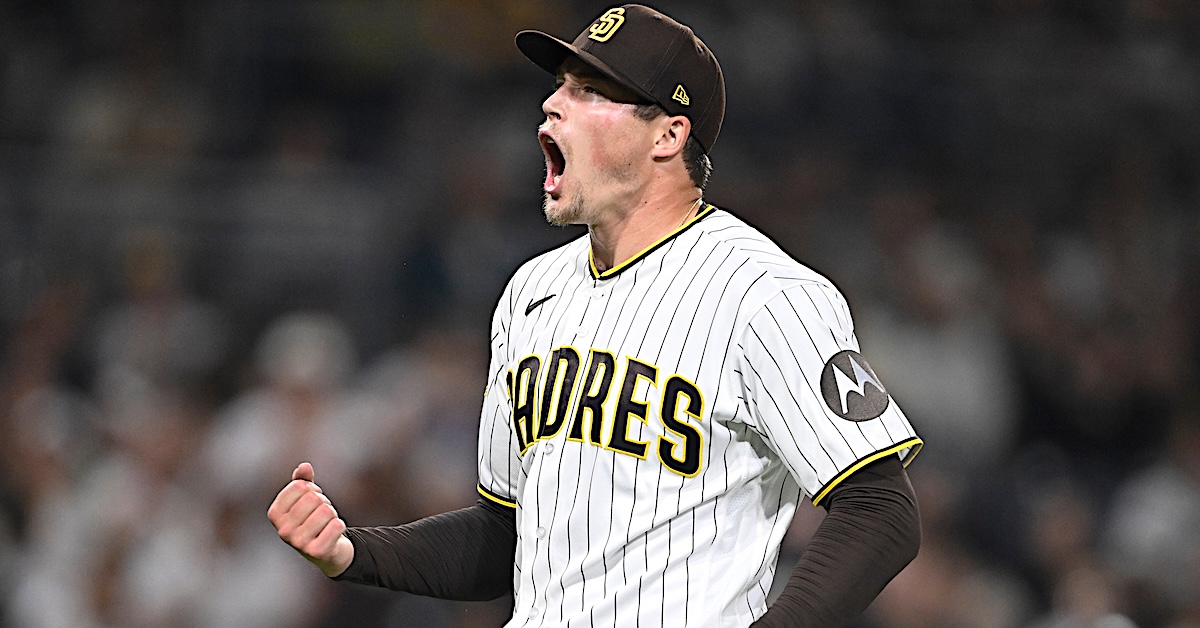
My puny mortal brain is having trouble making sense of the numbers coming out of San Diego right now. It’s an uncanny valley thing. Mason Miller’s statistics just don’t quite seem like they’re numbers that you can put up in the majors. Oh, they’re all in the right columns. They’re not impossible or anything. It’s just that no one else has numbers that look quite like this, and even more so than that, if you think about what they all mean together, it doesn’t seem like the performance they describe can possibly be real.
Let’s start with the most striking statistic: 19 strikeouts in 24 batters faced. That 79.2% strikeout rate is obviously technically feasible, but I keep saying it in my head and it keeps not making sense. I look at strikeout rates a lot, particularly early in the season. But even for very good pitchers, they tend to top out around 40%, maybe 50% if they’re performing especially well. I can fit those numbers into my head. That means that about half the batters they face are going to strike out – easy enough. Face four batters in an inning? Two punchouts.
But 79% doesn’t work so easily. In a four-batter inning, that’s three strikeouts! But you don’t get a lot of four-batter innings if you’re striking out three batters an inning. Another way of thinking about that: Batters reach base safely about 40% of the time when they don’t strike out. But if they’re striking out 80% of the time, they’re already making outs in 80% of their plate appearances right off the top, and then add another 12% from in-play outs (60% times 20%). That’s an out rate of 92%! I can’t wrap my head around 92% outs. That’s the ratio of outs in your average two-hit complete game. But your average two-hit complete game includes a ton of batted-ball luck. Miller’s dominance doesn’t involve a lot of batted-ball luck – or a lot of batted balls.
That leads me to my next point of cognitive dissonance: all the swinging strikes. Right now, Miller is running a 39.6% swinging-strike rate on his slider. That means that batters swing at – and miss – 39.6% of the sliders he throws them. But they only swing half the time! That means they’re coming up empty 79.2% of the time when they offer at that pitch. Likewise, his four-seam fastball carries a 24.4% swinging-strike rate, off of a 43.5% whiff rate. These numbers are all ludicrous if you stop to think about them. Read the rest of this entry »
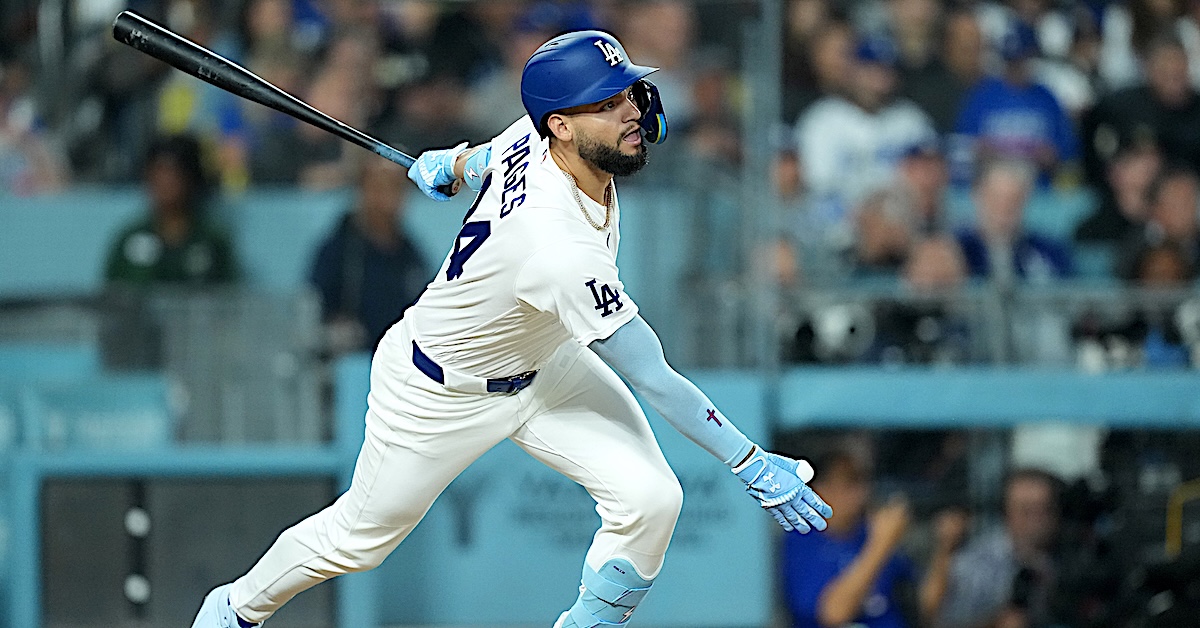
Andy Pages was the starting center fielder — and the youngest starter, period — on championship-winning Dodgers teams in each of his first two campaigns, showing considerable year-to-year improvement in the regular season but practically disappearing in October due to epic slumps. Now, the 25-year-old has put those postseason indignities behind him and emerged as one of the game’s hottest hitters to start 2026, while also helping the team jump out to the best record in the majors.
Through 15 games, the Dodgers are 11-4, a game and a half better than the second-best team thus far, the Padres (10-6). Pages, who has played all but four innings, has multiple hits in eight of his 15 games; only the Rangers’ Brandon Nimmo (nine) and the Rays’ Chandler Simpson (eight) have as many or more such games. In his latest multi-hit effort, on Friday against Texas, Pages went 3-for-3 with a walk and two key extra-base hits. He smoked a two-run double down the right field line off Robert Garcia in the seventh inning, turning a 4-3 deficit into a 5-4 lead, and followed up with a two-run homer to left-center field off Luis Curvelo in the eighth to extend the lead to 7-4. The Dodgers needed all of those runs as they hung on to win 8-7 on Max Muncy’s walk-off home run, his third dinger of the game.
To date, Pages is hitting an absurd .429/.467/.714 (233 wRC+). He finished the weekend leading the NL in all of those categories except slugging percentage; he’s also first in WAR (1.2, tied with Jordan Walker) and RBI (17). Two and a half weeks into the season isn’t enough to confirm whether he’s unlocked a new level of performance — he’s obviously not going to maintain those slash stats — but he’s shown some promising signs, and his prominence atop the leaderboards at least merits a closer look. Read the rest of this entry »
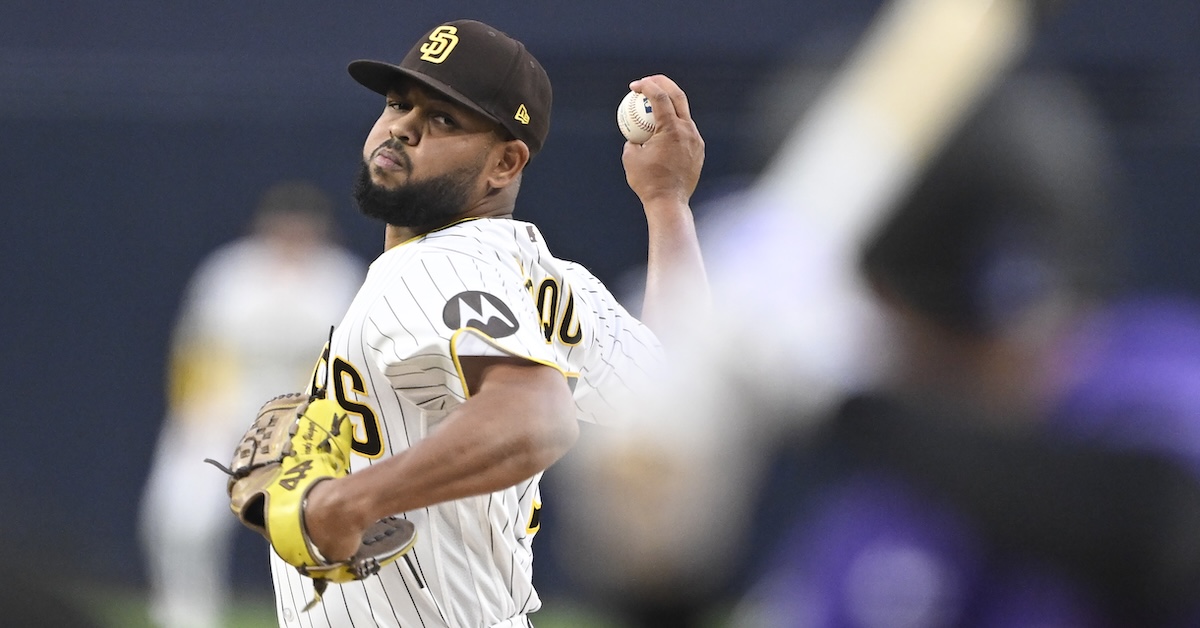
Randy Vásquez has struck out 19 batters in his first three starts of 2026. He didn’t record his 19th strikeout in 2025 until May 14, in the third inning of his ninth start.
Vásquez has simply dominated in the earliest days of the new season. He opened the year with six shutout innings against the Tigers, striking out eight. He picked up a mere three strikeouts in his second start against the Red Sox, but his stuff was just as good, generating whiffs on 32.6% of swings. And then he picked up eight more strikeouts on Thursday against the Rockies. He now has a 1.02 ERA, a 2.57 FIP, a 27.5% strikeout rate and a 5.8% walk rate, pitching like a top 20 starter in the majors to begin 2026.
Weird, right?
It’s not that Vásquez was terrible before this year. He posted a 3.70 ERA and 4.96 FIP across 26 starts in 2025, and his performance was similar in the two seasons prior. That’s a pitcher who can stick in the backend of most rotations and serve as useful depth. But it wasn’t clear what Vásquez did well, or how he might take the next step to becoming a true mainstay in the majors. He walked more batters than average. He didn’t really limit hard contact. And his 14.8% strikeout rate was the lowest among any starting pitcher with at least 200 innings from 2023 through 2025. He was just kind of there. Read the rest of this entry »
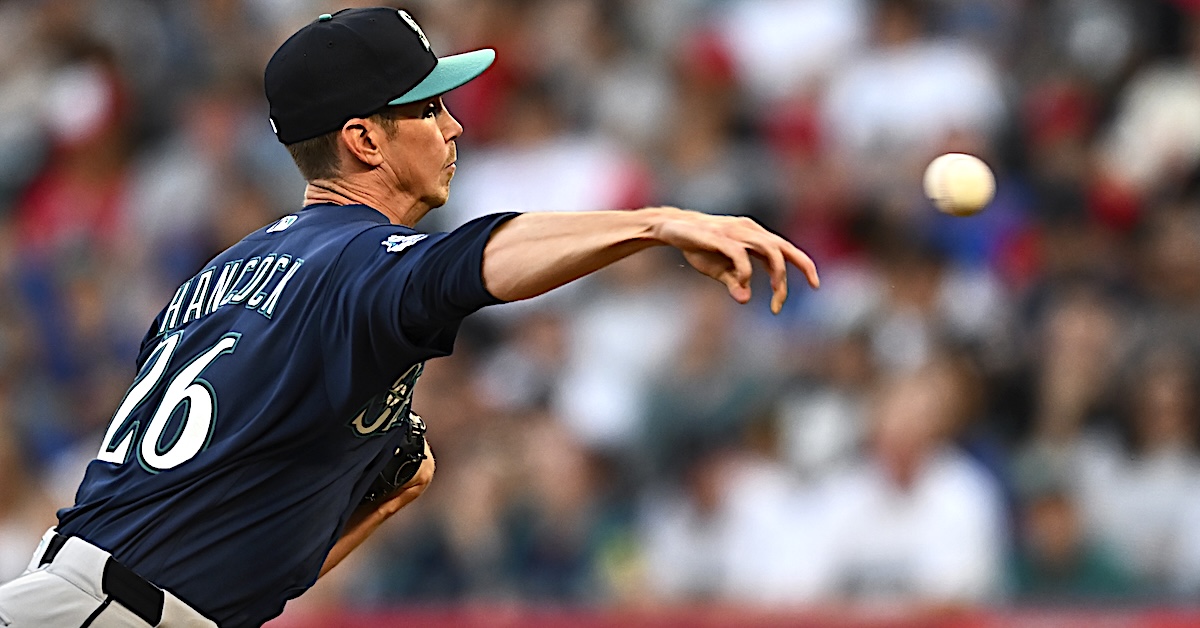
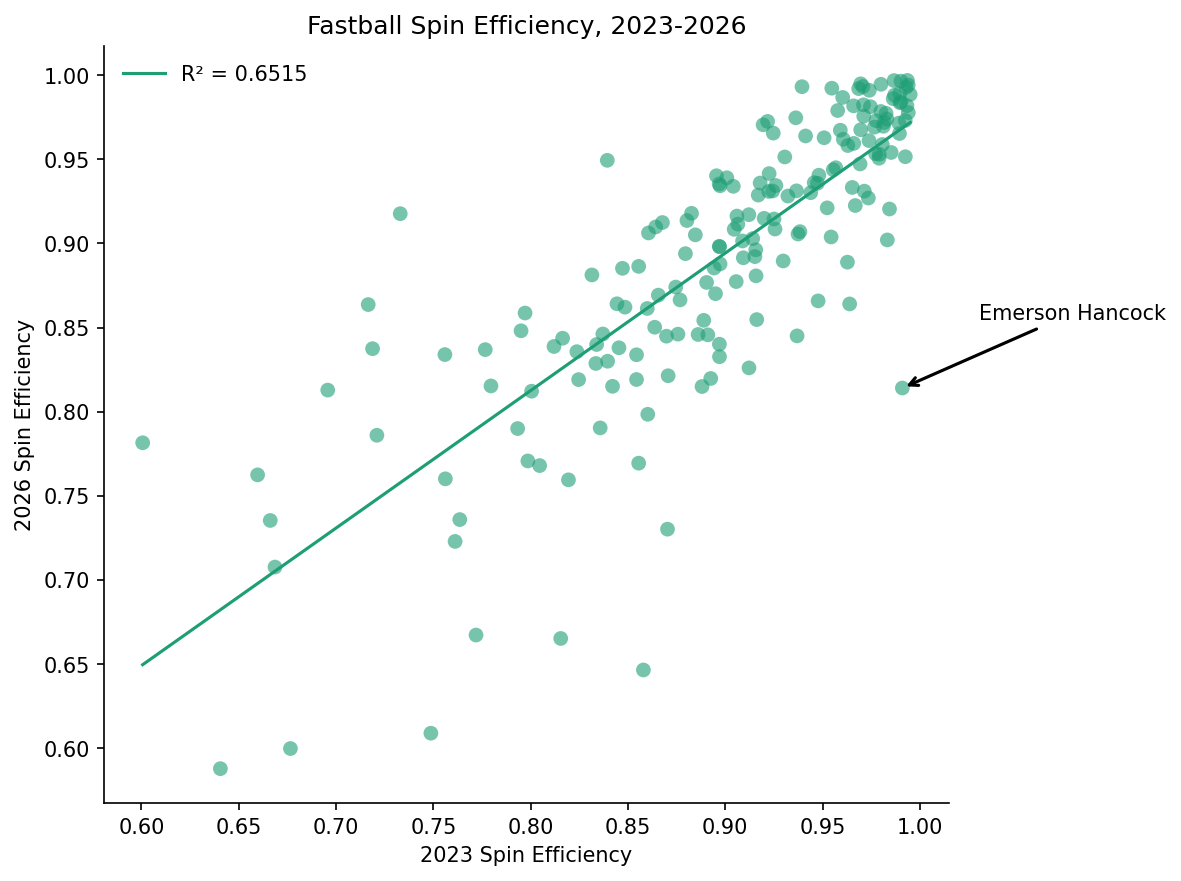
Pitchers can do all sorts of things to change their lot in life — launch plyo balls, rig up a Trackman, add a kick change — but motor preferences tend to be a fixed fact. Most pitchers fall into one of two buckets: pronator or supinator. Pitchers with high spin efficiency (say, 95% and up) on their four-seam fastball belong to the pronator class, while those below 90% can be considered supinators. (As a reminder, spin efficiency is the measure of how much spin is “useful;” a fastball thrown with perfect backspin would have 100% spin efficiency.) These mechanical biases tend to remain constant throughout a career. I took 185 pitchers who threw at least 25 fastballs in both 2023 and 2026; over that three-year span, the r-squared between their spin efficiency was 0.65.
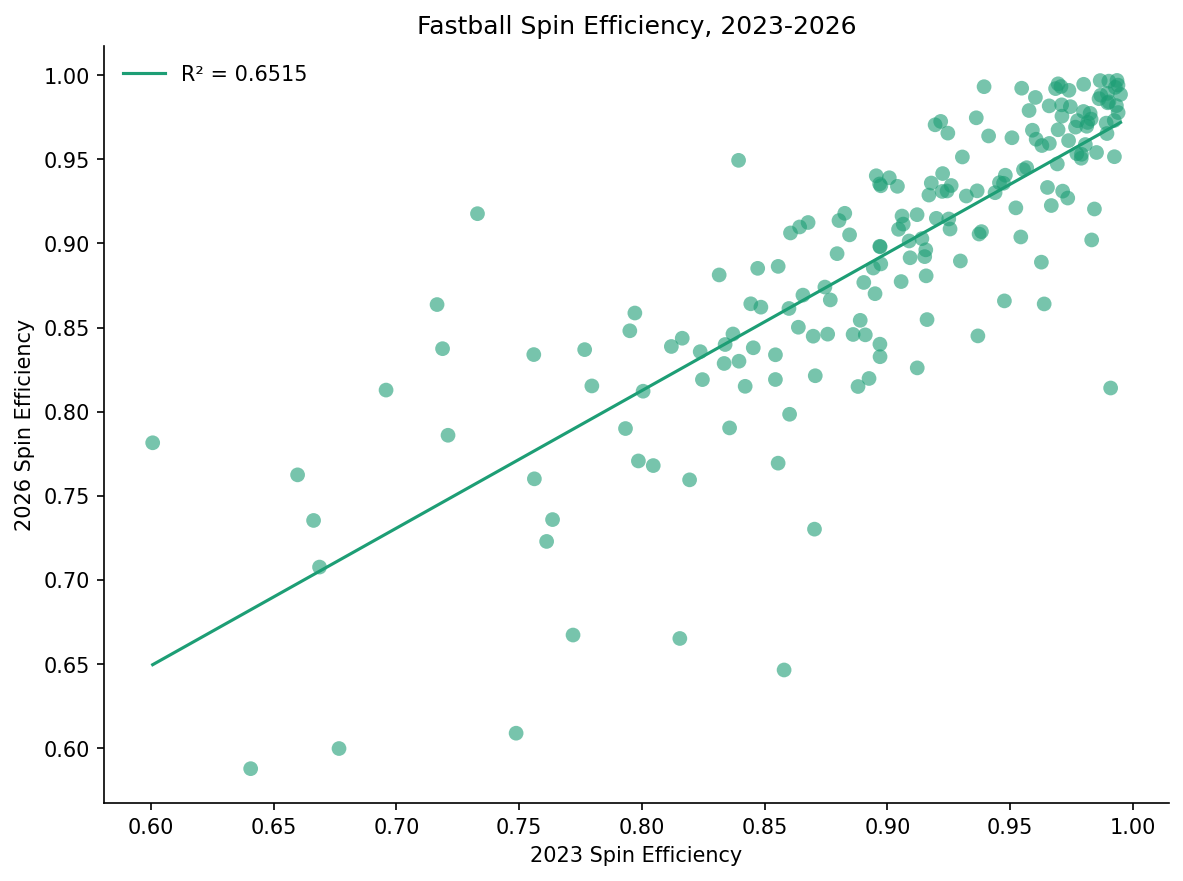
On that plot above, you’ll see, as there always are, a few outliers. One is Joe Boyle. The tale of Boyle is relatively well known at this point, at least in certain social media pitching circles. Over the last three years, Boyle went from throwing from an over-the-top arm angle (53 degrees) to a distinct side-arm slot (26 degrees.) The arsenal, in turn, transformed alongside it. This dramatic slot change coincided with his fastball spin efficiency declining from 86% in 2023 to 67% in 2026, one of the largest drops in that span.
Boyle belongs to that collection of dots on the left of the plot that went from low spin efficiency to even lower spin efficiency. And then there’s one little dot all alone on the right side of the plot. That’s Emerson Hancock.
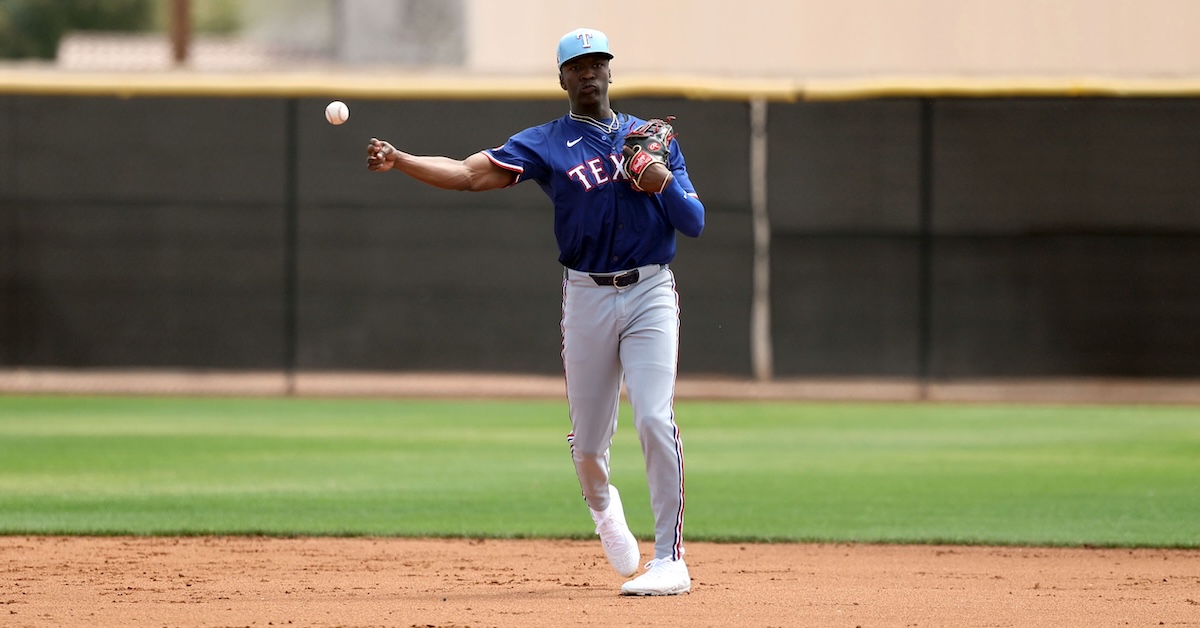
Below is an analysis of the prospects in the farm system of the Texas Rangers. Scouting reports were compiled with information provided by industry sources as well as my own observations. This is the sixth year we’re delineating between two anticipated relief roles, the abbreviations for which you’ll see in the “position” column below: MIRP for multi-inning relief pitchers, and SIRP for single-inning relief pitchers. The ETAs listed generally correspond to the year a player has to be added to the 40-man roster to avoid being made eligible for the Rule 5 draft. Manual adjustments are made where they seem appropriate, but we use that as a rule of thumb.
A quick overview of what FV (Future Value) means can be found here. A much deeper overview can be found here.
All of the ranked prospects below also appear on The Board, a resource the site offers featuring sortable scouting information for every organization. It has more details (and updated TrackMan data from various sources) than this article and integrates every team’s list so readers can compare prospects across farm systems. It can be found here. Read the rest of this entry »
Jacob Misiorowski has a fastball that consistently reaches triple digits, and he augments it with an effective curveball-slider combination. Usage-wise, the 24-year-old Milwaukee Brewers right-hander is throwing his high-octane heater at a 62.3% clip, while his breaking-ball percentages are 16.6 and 17.3 respectively. Given the lethality of those pitches — his xBA is a paltry .168, and his K-rate an MLB-best 41.8% — he has little need for a changeup…
… but there is one in his arsenal. From time to time, he will even show it to a batter. Of the 289 pitches Misiorowski has delivered so far this season, 11 (3.8%) have been changeups. The story behind his only-sporadically-used weapon?
“I’ve had a changeup my whole career,” Misiorowski told me prior to throwing three of them in a 101-pitch start at Fenway Park on Tuesday. “That was one of the first pitches I truly learned. But then as I started throwing harder, I began going away from it, and it obviously got worse and worse the less I threw it. By the time I got drafted [63rd overall in 2022], I basically didn’t have a changeup any more. I had to relearn it, re-figure it out. So, yeah, it’s always been there, but it hasn’t always been there.”
Misiorowski went on to tell me the grip was originally a more conventional four-seam circle, but that he now has his pointer and middle fingers together, and his thumb underneath. He also said that he likes the amount of horizontal he gets on it, which is generally around 18 inches and has been up to 20. When I told him that the movement profile sounds a little like a two-seam sinker, he agreed that it does.
A few more things Misiorowski told me about the pitch are unfortunately lost, due to glitches I’ve recently encountered on my iPhone’s recording app (I mentioned this teeth-gnashing, hopefully-resolved-soon, issue in Monday’s piece on Padres’ broadcaster Mark Grant.) Fortunately, I was able to grab a few minutes with Brewers pitching coach Chris Hook, who made up for the missing words with his own perspective.
How would he describe Misiorowski’s changeup? Read the rest of this entry »
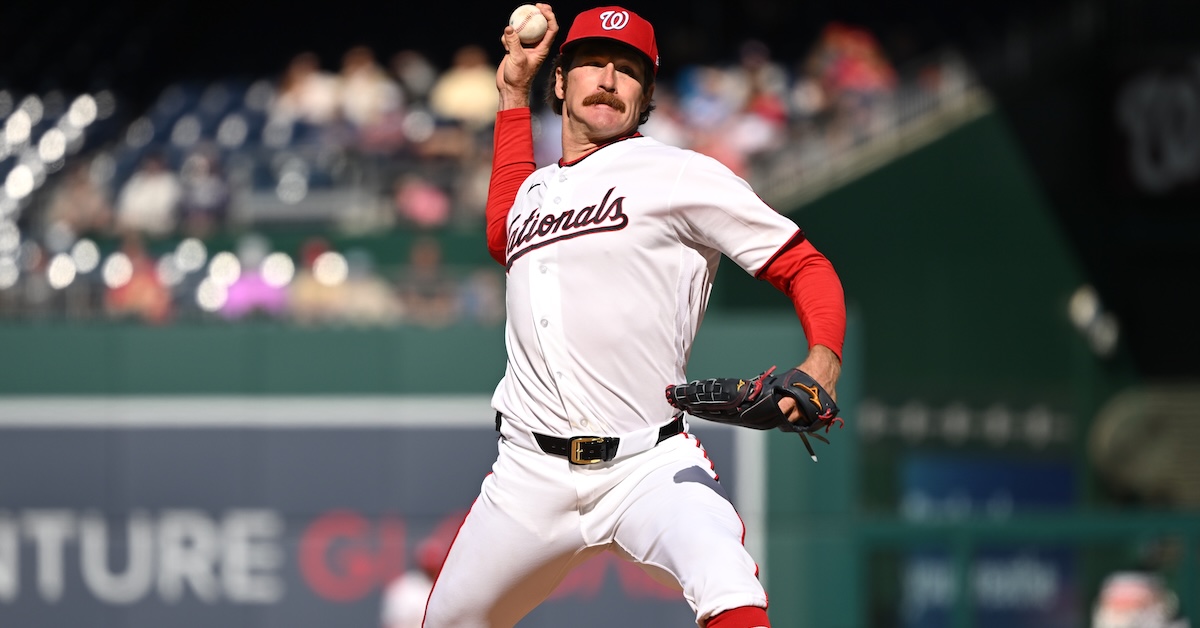
I went to the Nationals-Cardinals game on Wednesday afternoon at Nats Park to check in on the two rebuilding clubs early in the season. Washington has been in a perpetual rebuild for pretty much the entirety of the 2020s, while St. Louis just tore its roster down to the studs this past offseason. And yet, with Chaim Bloom installed as the new president of baseball operations, a deep farm system, and several young position players starting to come into their own, the Cardinals seem to be closer to their next winning season than the Nationals.
That’s certainly how things played out on Wednesday, when the Cards beat the Nats, 6-1, to take two out of three in the series. St. Louis first baseman Alec Burleson, the team’s second-longest tenured position player, went 3-for-4 and knocked in three runs, and second baseman JJ Wetherholt made several slick plays in the field. Wetherholt, who entered this year as the 12th-ranked prospect in baseball, has reached base in all 11 of his starts this year, and he has at least one hit in 10 of them. (He went 0-for-4 with a walk and a run on Wednesday.) The big story, though, was Jordan Walker, who hammered his fifth home run of the season in the fifth inning. It was the 17th time in franchise history that a player has homered five times within his first 12 games to start the season. After two below-replacement-level seasons, it seemed less likely that Walker would ever make good on his former top prospect pedigree, but now he looks like a completely different player. He seems way more confident and is making much better swing decisions; he’s lifting the ball, while walking more and striking out less. Yes, it’s only been 12 games, but the early returns are promising. He enters Friday night’s game against the Red Sox slashing .295/.367/.682 with a 192 wRC+.
I’ll talk more about the Nationals in my answer to the first question below. We’ll also answer your questions about the World Series teams whose players accumulated the most and least WAR by the end of their careers, the potential injuries that would stop the Dodgers from being World Series favorites, and the most successful three-true-outcomes pitchers of all time. But first, I’d like to remind you that this mailbag is exclusive to FanGraphs Members. If you aren’t yet a Member and would like to keep reading, you can sign up for a Membership here. It’s the best way to both experience the site and support our staff, and it comes with a bunch of other great benefits. Also, if you’d like to ask a question for an upcoming mailbag, send me an email at mailbag@fangraphs.com. Read the rest of this entry »

This is a free preview of a paid episode. To hear more, please visit our Patreon.
Ben Lindbergh and Meg Rowley banter about the bad omen of a broken bat on an Ichiro Suzuki statue, whether Mason Miller is, at this moment, the best pitcher ever on a batter-per-batter basis, and how to label atypical pitches, then Stat Blast (30:00) about team promotional giveaways, age and debut gaps among MLB brothers, and switch-hitters who hit higher in the lineup from one side. Then (47:58) Ben talks to 88-year-old All-American Girls Professional Baseball League pitcher Dolly “Lippy” Vanderlip about growing up as the lone girl in games against boys, joining the AAGPBL at age 15, playing for manager Jimmie Foxx, life on and off the field, the end of the league, how A League of Their Own revitalized interest in the AAGPBL, the impending launch of the Women’s Pro Baseball League, and more.
Audio intro: Tom Rhoads, “Effectively Wild Theme”
Audio interstitial: Moon Hound, “Effectively Wild Theme”
Audio outro: Alex Glossman and Ali Breneman, “Effectively Wild Theme”
Link to broken statue video
Link to broken statue image
Link to Mariners joke tweet
Link to statue being fixed
Link to statue story summary
Link to Mariners wRC+ ranking
Link to three arms episode
Link to Wicker Man post
Link to highest K% for RP
Link to lowest FIP for RP
Link to Miller pitch-type splits
Link to Miller’s stats as a Padre
Link to Sheehan on Miller
Link to Padres-Rockies game story
Link to MLB SP stats
Link to MLB RP stats
Link to team RP stats
Link to Crizer on Imai
Link to MLB.com on Imai
Link to MLBN on Imai
Link to Imai’s Savant arsenal
Link to shuuto wiki
Link to 2025 promotions data
Link to team giveaway rates
Link to Sox giveaway expansion
Link to MLB brothers data
Link to Ben on Guerrero birthdates
Link to Art Fowler SABR bio
Link to switch-hitters info
Link to switch-hitters data
Link to “Hello, Dolly!” wiki
Link to Dolly’s wiki
Link to Dolly’s AAGPBL player page
Link to AAGPBL wiki
Link to WPBL wiki
Link to AAGPBL queer history
Link to Blair article 1
Link to Blair article 2
Link to Ball on extensions
Link to Paine on extensions 1
Link to Paine on extensions 2
Link to First Pitch site
Link to Grounds Crew Baseball site
Link to Mariners Stathead
 Sponsor Us on Patreon
 Give a Gift Subscription
 Email Us: podcast@fangraphs.com
 Effectively Wild Subreddit
 Effectively Wild Wiki
 Apple Podcasts Feed
 Spotify Feed
 YouTube Playlist
 Facebook Group
 Bluesky Account
 Twitter Account
 Get Our Merch!
Podcast (effectively-wild): Play in new window | Download
Subscribe: RSS
| 12:31 |
: What’s up party people? Happy Friday from my old man’s place in Catty, and thanks for being patient while I helped my grandmother with some stuff this morning. I’m gonna keep things to about 45 minutes today so I can catch my flight to Florida.
|
| 12:32 |
: Eric, thanks as always for your thorough work and unparalleled depth in the A’s prospect list. This is like Christmas morning for me!
|
| 12:32 |
: Hey thanks, it was fun to sit on them for a bunch of the spring and feel good about wrapping my arms around the whole lot of these fellas. Kade Morris!
|
| 12:33 |
: A 45 FV is a big jump in your eval of Junior Perez, considering he didn’t get a mention on their list last year. What changed for you? Just more confidence in the whole profile thanks to contact and defense gains?
|
| 12:34 |
: I was too light on his CF defense last cycle and that piece is the biggest reason why Perez > Bolte.
|
| 12:34 |
: Is MIL Luke Adams’ overly-passive hitting profile sustainable? His contact quality and approach are excellent, but he’s still not swinging the bat enough. And I’m worried about his defense.
|