
Are Plate Discipline Breakouts for Real?
Earlier this month, I noted that hitters are chasing fewer pitches and seeking out fastballs in the zone. It’s one thing batters can do to fight back against the rising pitching talent and increased strikeouts. It seemed to me that every time I looked into a hitter potentially breaking out this season, I saw the same pattern: fewer swings on pitches outside the zone and a rising wRC+.
- It was true for George Springer, who took over the AL WAR lead.
- Hunter Dozier seemed to benefit greatly from better discipline.
- Jason Heyward’s mini-resurgence seemed due to better plate recognition.
- Paul DeJong took a step forward by mashing balls in the strike zone and avoiding those outside of it.
There comes a point when writing about the same thing over and over again becomes presumptuous if we can’t quite be sure that the benefits will last. To that end, I first went through plate discipline numbers from this season to determine if chasing fewer pitches seemed to help batters like I think it should. First, I looked at all hitters with at least 300 plate appearances in 2018 who were also qualified for the batting title as of May 13 of this year. While we can presume that taking pitches outside the strike zone is a skill, and one that stabilizes pretty quickly based on previous research, here’s how the numbers from last season and this one match up as of Tuesday’s data.
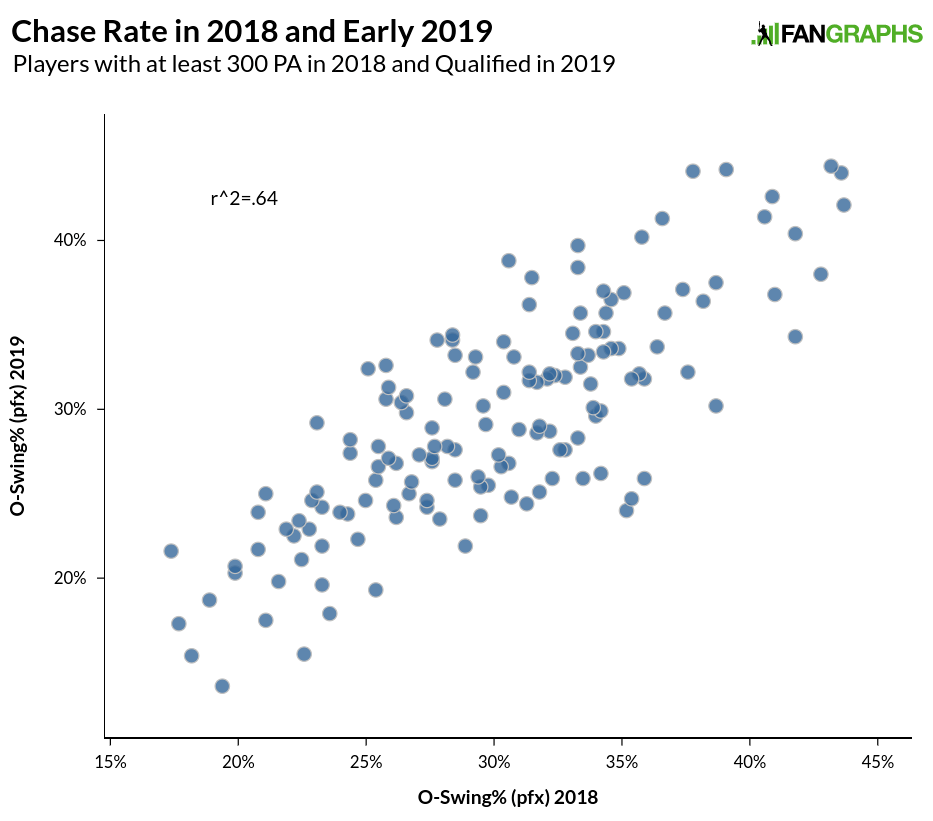
Even at the very early stages of this season, we see that O-Swing% is pretty consistent compared to last year. As to individual players, here are the biggest changers in a positive way over last season.
| Name | O-Swing% (pfx) 2018 | O-Swing% (pfx) 2019 | O-Swing Change |
|---|---|---|---|
| Hunter Dozier | 35.2 | 24 | -11.2 |
| Dansby Swanson | 35.4 | 24.7 | -10.7 |
| Ryon Healy | 35.9 | 25.9 | -10 |
| Orlando Arcia | 38.7 | 30.2 | -8.5 |
| Freddie Freeman | 34.2 | 26.2 | -8 |
| Niko Goodrum | 33.5 | 25.9 | -7.6 |
| Dee Gordon | 41.8 | 34.3 | -7.5 |
| Tommy Pham | 22.6 | 15.5 | -7.1 |
| Kris Bryant | 28.9 | 21.9 | -7 |
| Yonder Alonso | 31.3 | 24.4 | -6.9 |
| Asdrubal Cabrera | 31.8 | 25.1 | -6.7 |
| Joey Gallo | 32.3 | 25.9 | -6.4 |
| Justin Smoak | 25.4 | 19.3 | -6.1 |
| Cody Bellinger | 30.7 | 24.8 | -5.9 |
| Kole Calhoun | 29.5 | 23.7 | -5.8 |
| Mike Trout | 19.4 | 13.6 | -5.8 |
| George Springer | 23.6 | 17.9 | -5.7 |
| C.J. Cron | 37.6 | 32.2 | -5.4 |
| Jason Heyward | 32.8 | 27.6 | -5.2 |
| Albert Pujols | 32.6 | 27.6 | -5 |
| Joc Pederson | 33.3 | 28.3 | -5 |
| Avisail Garcia | 42.8 | 38 | -4.8 |
| Michael Conforto | 27.9 | 23.5 | -4.4 |
| Miguel Rojas | 34 | 29.6 | -4.4 |
| Jose Altuve | 34.2 | 29.9 | -4.3 |
| Paul DeJong | 29.8 | 25.5 | -4.3 |
| Amed Rosario | 41 | 36.8 | -4.2 |
As for how these players have been helped, here are those same players along with their change in wRC+ over last season.
| Name | O-Swing% (pfx) 2018 | O-Swing% (pfx) 2019 | O-Swing Change | wRC+ 2018 | wRC+ 2019 | wRC+ Change |
|---|---|---|---|---|---|---|
| Hunter Dozier | 35.2 | 24 | -11.2 | 80 | 172 | 92 |
| Dansby Swanson | 35.4 | 24.7 | -10.7 | 80 | 111 | 31 |
| Ryon Healy | 35.9 | 25.9 | -10 | 90 | 104 | 14 |
| Orlando Arcia | 38.7 | 30.2 | -8.5 | 54 | 85 | 31 |
| Freddie Freeman | 34.2 | 26.2 | -8 | 137 | 147 | 10 |
| Niko Goodrum | 33.5 | 25.9 | -7.6 | 103 | 85 | -18 |
| Dee Gordon | 41.8 | 34.3 | -7.5 | 77 | 104 | 27 |
| Tommy Pham | 22.6 | 15.5 | -7.1 | 129 | 131 | 2 |
| Kris Bryant | 28.9 | 21.9 | -7 | 125 | 148 | 23 |
| Yonder Alonso | 31.3 | 24.4 | -6.9 | 97 | 68 | -29 |
| Asdrubal Cabrera | 31.8 | 25.1 | -6.7 | 111 | 101 | -10 |
| Joey Gallo | 32.3 | 25.9 | -6.4 | 110 | 156 | 46 |
| Justin Smoak | 25.4 | 19.3 | -6.1 | 121 | 109 | -12 |
| Cody Bellinger | 30.7 | 24.8 | -5.9 | 120 | 227 | 107 |
| Kole Calhoun | 29.5 | 23.7 | -5.8 | 79 | 117 | 38 |
| Mike Trout | 19.4 | 13.6 | -5.8 | 191 | 176 | -15 |
| George Springer | 23.6 | 17.9 | -5.7 | 119 | 181 | 62 |
| C.J. Cron | 37.6 | 32.2 | -5.4 | 122 | 109 | -13 |
| Jason Heyward | 32.8 | 27.6 | -5.2 | 99 | 115 | 16 |
| Albert Pujols | 32.6 | 27.6 | -5 | 90 | 102 | 12 |
| Joc Pederson | 33.3 | 28.3 | -5 | 126 | 141 | 15 |
| Avisail Garcia | 42.8 | 38 | -4.8 | 92 | 124 | 32 |
| Michael Conforto | 27.9 | 23.5 | -4.4 | 120 | 153 | 33 |
| Miguel Rojas | 34 | 29.6 | -4.4 | 79 | 68 | -11 |
| Jose Altuve | 34.2 | 29.9 | -4.3 | 135 | 119 | -16 |
| Paul DeJong | 29.8 | 25.5 | -4.3 | 102 | 161 | 59 |
| Amed Rosario | 41 | 36.8 | -4.2 | 85 | 100 | 15 |
| AVERAGE | 32.5 | 26 | -6.5 | 106 | 126 | 20 |
For most of the players above, chasing fewer pitches is associated with better offensive outcomes. All other hitters lost about five points on average of wRC+ this season, although the players who had the biggest increase in chasing pitches outside the zone didn’t see a significantly different drop than the rest of the population who stayed pretty close to last year’s numbers. These numbers aren’t going to tell us much about whether the changes will remain going forward, nor will they tell us if the offensive gains are here to stay.
Looking back at last year might provide some help in determining whether this year’s players are likely to keep their hitting gains. I checked out all players with at least 300 plate appearances in 2017 and 100 plate appearances in April. Players looked very much last season like the hitters who most changed their O-Swing percentage from the previous season, improving their wRC+ in April by an average of 29 points over the previous year. Then I looked at how that group performed the rest of the year. The results are a mixed bag.
| 2017 | April 2018 | ROS 2018 | |
|---|---|---|---|
| O-Swing% | 33.0% | 25.3% | 30.5% |
| wRC+ | 111 | 140 | 114 |
We see that the players who showed increased plate discipline in April of last season kept some of those improvements the rest of the year. There was a slightly higher correlation between the April O-Swing% and the ROS O-Swing% than 2017 O-Swing% and ROS O-Swing%. The gains made on swinging at pitches outside the zone were real. Unfortunately, the gains made on the wRC+ side didn’t really stick. As a group, the players simply reverted mostly back to 2017 performance the rest of the way.
Not ready to give up, I isolated the group into players who significantly improved O-Swing% in April and improved wRC+ in April. While most of the players who showed improved plate discipline got better results, that wasn’t true for all players. We are down to a group of 16 hitters, but this is how they turned out.
| 2017 | April 2018 | ROS 2018 | |
|---|---|---|---|
| O-Swing% | 33.0% | 24.8% | 30.7% |
| wRC+ | 104 | 149 | 115 |
That looks better. Nine of the 16 players showed significant improvement over their 2017 numbers while only four got significantly worse. To provide a comparison, I took a similar group of players who improved their wRC+ in April 2018 over the previous season but who did not do better at O-Swing%. These were the results.
| 2017 | April 2018 | ROS 2018 | |
|---|---|---|---|
| O-Swing% | 31.8% | 32.6% | 32.8% |
| wRC+ | 97 | 141 | 99 |
Well that’s kind of interesting. Nine of the 17 players got significantly worse while only four made big gains in wRC+. The median change from 2017 was an eight-point loss of wRC+ while the group of players who improved their wRC+ and their O-Swing% last April had a median gain of 12 points. I only studied one year of data, so some necessary waffling is included here, but the data does show some promise that the players who have improved their wRC+ and O-Swing% in the early part of the season have a decent chance of hitting better the rest of this summer than they did last year.
Craig Edwards can be found on twitter @craigjedwards.
Not a single player for the Rockies on the list. This is not surprising.
I’m a little confused. Heyward has a 100 wRC+ this year after a 99 last year, so why is he listed as +16?
His 2019 wRC+ is wrong in the table. Lots of guys have slightly off 2019 wRC+ (likely just because the data was pulled before today) but his is particularly far off the mark.
Stats were pulled Tuesday. Apparently going 0-15 dropped Heyward by a quite a bit.
Interesting stuff. Kinda need bigger samples, though.
Btw, the 3rd sentence in the last paragraph is a bit long and hard to follow, but maybe that’s just me. Might be clearer as bullet points, or at least with a comma before “while.”
Typos in the last sentence: “chase” should be “chance” (Freudian?), and it should say they DECREASED (or improved) their O-swing%.
[Those errors have been corrected.]
Also … While this sample suggests a significant “stickiness” for wRC+ gains based on discipline, the size of those ROS gains seems a bit disappointing. Or to put it another way, about 75% of the early gains vanished in ROS.
First thing I thought of when I saw that was Didi Gregorius’s start last year. His plate discipline last April was downright Votto-esque, but then he went back to being the same “old” (2016-17 NYY version) Didi Gregorius.
I did the same for Ks.
https://community.fangraphs.com/are-players-learning-to-cut-their-strikeout-rate/
For Ks I found basically a perfect one third split. One third loses all of the gains, one third keeps most of the gains and another third keeps 30-50% of the gains. It is a positive sign but no guarantee.as a group about 40% of the gains sticked, seems it is a little worse for patience.
The best part of this for me was Trout- his chase rate last year is lower than everyone’s improved chase rate except Pham Smoak and Springer and he’s now dropped it. His WRC+ is “down” to 176. He’s just unbelievably good and somehow still improving
Of course Mike Trout is on the list and of course his o-Swing was already crazy and of course he improved on it.
Hate to be a spoilsport, but … Shouldn’t we expect young veterans to improve in O-swing % ?
Bryce Harper set a career low last year, as did Jose Ramirez and Mookie Betts. Kris Bryant is doing it this year. These are just off the top of my head.
We tend to gloss over the fact that certain skills MUST improve to offset the slow decline of hand-eye coordination, which tends to peak around age 24.
Trout’s improved by 22%, which is a bigger jump than even after his rookie season.
It’s also a bigger improvement than he made between his 2nd and 8th seasons.
This article needed more Cody Bellinger. Cutting K rate in half while hitting like Trout for almost 2 months is something else.
On the other hand … Last year, Bellinger cut his K% almost 3 points and upped his contact% the same, but fared much worse than his rookie year. It’s not quite as simple as “more contact is always good.”
Would be interesting to see how much of this is pitcher-assisted – meaning, if pitchers throw less in the zone to these guys historically because they are prone to chase, the hitter adjusts by being more patient in April, then pitchers adjust back ROS. This happened with Odubell Herrera in 2016. Would be interesting to see the zone% for these guys with the same splits to see if there is anything else to identify.
I wonder if you would get even sharper results with a more granular look at it, using Tango’s shadow and chase zones. Batters reasonably should swing at many pitches in the shadow zone with 2 strikes and less than 3 balls. A swing at any other pitch in the shadow and all pitches in the chase is a Bad Swing Decision. Significant BSD rate changes would, I’d hypothesize, be a good indicator, and maybe better than simple OSwing.