Jay Jaffe: Good afternoon, folks, and welcome to my first solo chat of the 2023 regular season — last week’s chat was scrubbed due to my participation in the Opening Day chat.
Once upon a time, a Clayton Kershaw–Madison Bumgarner matchup would have been a sight to behold. But when the two lefties squared off on Saturday evening in Los Angeles, it was a decidedly one-sided affair. Kershaw dominated the Diamondbacks, allowing one run and striking out nine over six innings; Bumgarner, meanwhile, was pummeled for five first-inning runs and lasted just four frames. It was the latest in a long line of disappointing performances since the former Giants ace joined the Diamondbacks.
Bumgarner was on the ropes from the beginning. He served up a double to Mookie Betts on his fifth pitch of the game, hit Max Muncy to load the bases with one out, walked the bases loaded after Chris Taylor’s sacrifice fly scored Betts, and gave up a grand slam to Trayce Thompson, who would later add homers off relievers Kevin Ginkel and Carlos Vargas.
By the time the dust had settled, Bumgarner had thrown 31 pitches and was down 5–0. The 33-year-old lefty did pull himself together enough to follow with three scoreless innings, allowing one baserunner in each, but he finished with four walks and four hits allowed, striking out just two and getting just five swings and misses. Including his 10 called strikes, his 17.6% CSW was his fifth-lowest mark from among his 66 starts as a Diamondback; his low was 15.2% (eight called strikes, two swinging strikes in 66 pitches) in a September 27, 2020 start against the Rockies, in which he at least posted five shutout innings, netting his only win of the pandemic-shortened campaign.
Saturday’s bad news went beyond that meager CSW rate. For one thing, old friend Eno Sarris suggested that Bumgarner and Ginkel were tipping pitches:
Looks like the D-backs were tipping pitches last night against the Dodgers. Some pictures: Kevin Ginkel slider (wrist curl, grass between arms), Kevin Ginkel fastball (no wrist curls, no grass) and Madison Bumgarner letting runner on second see right into his glove. pic.twitter.com/rd2H8C1TAL
Even if that hadn’t been the case, the average velocity of Bumgarner’s pitches was down by nearly two miles per hour relative to last year:
Madison Bumgarner Velocity Comparison, 2022–23
Year
4-Seamer
Cutter
Curveball
Changeup
Slider
2022
91.2
87.4
78.6
85.5
83.3
2023
89.1
85.8
76.7
83.7
84.4
Change
-2.1
-1.6
-1.9
-1.8
+1.1
SOURCE: Baseball Savant
You can safely ignore that positive bump on Bumgarner’s slider, as he threw just one on Saturday. Additionally, the spin on his four-seamer averaged just 2,041 RPM, down 162 from last year and 184 from his final start of the spring, on March 27 against the Guardians. The pitch also got 2.7 inches less horizontal break than last year’s model. The Dodgers didn’t actually do any damage off of Bumgarner’s four-seamer, though hitters last year destroyed it to the point that it was the majors’ second-least valuable pitch according to Statcast:
If all of this sounds like a pitcher who’s Physically Not Right, the thought crossed the minds of the Diamondbacks. On Sunday, the team sent the 33-year-old lefty back to Phoenix to be evaluated by team doctors, with manager Torey Lovullo telling reporters, “Bum was talking about fatigue postgame last night.” More via MLB.com:
“Information was kind of coming in slowly and we just thought it’d be the best thing for him to get back to Phoenix where our doctors can get a look at him. On the urgency scale, I don’t think it’s very high, but it’s all precautionary at this point.”
“There was nothing major from his standpoint,” Lovullo said Saturday night. “It was more just us asking questions and trying to find out if everything is OK. There was looseness to the breaking ball, and things just weren’t consistent. He’s always around the zone, but there were some big misses today. Red flags go up when we see that, our eyes tell us a story, but Bum was OK.”
Bumgarner underwent an MRI that showed no structural damage, and as Lovullo said before Monday night’s game, he’s on track to make his next start, likely Friday against the Dodgers at Chase Field. But even if he’s got the green light physically, that’s a long way from finding reasons to be particularly optimistic about his 2023 chances. The former World Series hero is coming off a season in which he pitched to a 4.88 ERA and 4.85 FIP in 158.2 innings and set full-season lows with his 16% strikeout rate and 9% strikeout-walk differential (he was 0.2 points lower in both categories in 2020). Meanwhile, his 9.8% barrel rate and 42.8% hard-hit rate were both full-season highs for the Statcast era. Though he made 30 starts for just the second time since 2016, his 0.5 WAR was the second-lowest among pitchers with 30 or more starts, ahead of only the Mariners’ Marco Gonzalez (0.1).
Since joining Arizona via a five-year, $85 million deal in December 2019, Bumgarner has put up a 5.06 ERA and 5.08 FIP in 350.2 innings, netting just 1.2 WAR. Highlighted by a seven-inning hitless outing that didn’t count as an official no-hitter, his best work came in 2021, when he pitched to a 4.63 ERA and 4.67 FIP in 146.1 innings en route to 1.5 WAR; he missed over six weeks that year due to shoulder inflammation, and while he pitched better after the injury than before, his career has continued its downward trajectory.
Indeed, as measured by Stuff+, the quality of Bumgarner’s pitches has been deteriorating:
Madison Bumgarner Stuff+, 2020–23
Season
Stf+ FA
Stf+ SI
Stf+ FC
Stf+ CU
Stf+ CH
Stuff+
2020
92
98
95
75
107
90
2021
86
80
105
102
57
94
2022
80
95
100
87
57
86
2023
66
—
102
76
72
82
Woof. Obviously you can take this year’s one-game sample with a grain of salt, but as Sarris, the model’s co-creator, wrote, the fastball Stuff+ does capture some signal at this level. Aside from his cutter, which he throws about 28% of the time, Bumgarner doesn’t have a pitch that’s consistently average or better, and at this point, one has to wonder what exactly he and the Diamondbacks, for whom former Astros pitching coach Brent Strom now works, are doing to reverse this rather dismal trend. In an age when pitchers reinventing themselves with new offerings or refinements of old ones seems like a constant, why is none of this is happening for Bumgarner?
On a team that aspires to break .500 for the first time since 2019 but that projects for just 78.4 wins via our preseason Playoff Odds, Bumgarner now stands out as one of the weak links. The Diamondbacks’ rotation placed just 23rd in our Positional Power Rankings, with six Arizona starters — staff ace Zac Gallen, veteran righties Zach Davies and Merrill Kelly, rookie Ryne Nelson, and prospects Brandon Pfaadt and Drey Jameson — all forecast to exceed Bumgarner’s projected 0.3 WAR, the last three of those each with 40–100 fewer innings. In other words, the case that he is one of the Diamondbacks’ best five starters relies upon some combination of reverence for his track record, a desire to justify a contract that looks like a sunk cost, and a need for prospects to get more seasoning. Bumgarner’s World Series exploits are the stuff of legend, but since spraining his AC joint in a 2017 dirtbike accident that cost him three months, he’s managed just a 100 ERA- and 108 FIP- and reached 30 starts only twice. Going by batted ball stats, he’s had an xERA of 5.53 or higher in every season with the Diamondbacks save for 2021.
Bumgarner is the Diamondbacks’ highest-paid player, owed $23 million for this year and $14 million for next year, but at best he looks more like a guy who can eat 140–150 innings at the back the rotation. It’s understandable why he’s begun the year in the starting five as Arizona breaks in Nelson, uses Jameson out of the bullpen, and farms out Pfaadt, who made just 10 starts at Triple-A Reno last year. But if the Diamondbacks are going to turn the corner, they’ll have to reckon with what the 2023 version of Bumgarner can give them. Right now, that doesn’t look like a whole lot.
When the Angels signed Anthony Rendon to a seven-year, $245 million deal in December 2019, the expectation was that he’d be a difference-maker, augmenting a lineup that already included Mike Trout and Shohei Ohtani and helping the Halos return to the postseason after a five-year absence. Though he played up to his capabilities in the pandemic-shortened 2020 season, Rendon’s last two years have been greatly limited due to injuries, and so far his ’23 season is off to a less-than-auspicious start.
On Opening Day, following a 2–1 loss to the A’s at Oakland’s Ring Central Coliseum, Rendon was involved in an altercation with a fan wearing an A’s hat as he exited the field. Apparently displeased by something the fan yelled, Rendon confronted him, reaching up and grabbing him by the shirt, then taking an open-handed swipe at him. In the video that circulated after the game, you can hear Rendon’s side of the story, not all of which is safe for work:
Whatever the fan said to Rendon isn’t part of either video, but even if it were, it’s unlikely to justify the third baseman’s actions; a player simply can’t mix it up in a physical altercation with a fan, period. Rendon is lucky he didn’t actually hit the man, because he’d almost certainly face a more severe fine and suspension than he might receive. As it is, both Major League Baseball and the Oakland Police Department are investigating the incident, with the latter saying it was investigating a battery:
When asked if Oakland Police Department was investigating the incident with Anthony Rendon, this is what the department said: pic.twitter.com/2If9BU23D6
The Angels and A’s were off on Friday. On Saturday, the team made Rendon available to the media prior to the game, but he repeatedly said that he couldn’t comment on an ongoing investigation. Manager Phil Nevin and general manager Perry Minasian made similar no-comments, with the former saying that “at some point” he would address the matter.
Beyond the altercation (and, if we’re being cheeky, including it), Rendon is so far hitless with a walk, a sacrifice fly and two strikeouts in eight plate appearances during this young season. He started in Saturday’s 13–1 win but was pulled in the sixth inning, having banged his left knee on the tarp in pursuit of a foul ball. He sat out Sunday’s contest after getting treatment; the 32-year-old third baseman said that he was well enough to play but that it was already a planned day off for him.
Rendon is coming off not one but two disappointing, injury-shortened seasons in a row, which makes it easy to forget just how he earned that big contract, which still has the fourth-highest average annual value ($35 million) of any position player besides Aaron Judge ($40 million), Trout ($35.54 million), and Carlos Correa ($35.1 million). From 2017 to ’19, Rendon hit for a 145 wRC+ (eighth in the majors) with 18.7 WAR (tied for fifth) and capped that by helping the Nationals win the World Series in 2019, driving in a series-high eight runs, including six (with two homers) in Games 6 and 7. After signing with the Angels, he hit a robust .286/.418/.497 in 52 games in 2020, placing seventh in the league with a 152 wRC+ and tying Trout for third with 2.5 WAR; unfortunately, terrible run prevention cost the Angels a playoff spot.
In 2021, Rendon was sent to the injured list by groin and hamstring strains as well as a knee contusion; he played in just 58 games, none after July 4, and while rehabbing from the hamstring injury suffered a bout of right hip impingement that necessitated season-ending surgery in August. He hit just .240/.329/.382 with six homers, setting career lows with a 94 RC+ and 0.1 WAR. Last year, he landed on the IL due to right wrist inflammation in late May and played just four games in mid-June upon returning before undergoing surgery to repair a subluxation of a tendon. The surgery was supposed to be season-ending, but Rendon healed more quickly than expected and was able to return near the end of the year. That allowed him to serve a five-game suspension for his role in a June 26 benches-clearing brawl with the Mariners and then play in two games, during which he went 0-for-4 with three strikeouts.
If Rendon’s season-ending coda wasn’t exactly impressive for its performance, it at least sent him home “just having the peace of mind of going into the winter and having a normal offseason,” as he said at the time. “It was good to show myself going into the offseason that I could play… It wasn’t the greatest playing those last few games, but just to have that in the back of your mind knowing that I had another three months knowing I could continue to get stronger.”
Following a normal offseason, Rendon hit a sizzling .500/.561/.806 in 41 PA of Cactus League play. Obviously, one can’t put a ton of stock in such numbers, but they at least back up his assertion that he was fully healthy. For what it’s worth, he averaged an exit velocity of 94.4 mph on the 11 balls he hit in parks equipped with Statcast. As Davy Andrews noted last week, there’s at least some signal within the noise when it comes to spring exit velos, albeit at the 15-batted ball level.
Rendon is rejoining what projects to be the strongest Angels squad in recent years, at least going by their preseason Playoff Odds projection of 83.5 wins, which translates to an 18.5% chance of winning the AL West and a 44.7% of reaching the postseason for the first time since 2014. With the offseason additions of free agents Brandon Drury and Gio Urshela, the Angels have upgraded their infield, notably adding some depth that seems designed to insure against another Rendon outage. With first baseman Jared Walshsidelined by headaches and insomnia, Drury is starting at first base instead of second, though hopefully that’s a short-term issue.
There aren’t a ton of small-sample positives to be taken from Rendon’s performances in the past two seasons, but a few things do stand out. Even while swinging and missing more than ever last year (7.1% swinging-strike rate), he remained an exceptionally disciplined hitter, chasing just 23.4% of pitches, walking 11.9% of the time and striking out 18.1% of the time (his highest mark since 2016). His 8.3% barrel rate was his highest since 2019 and would have placed in the 54th percentile; as it was, it exceeded his previous Statcast career mark by 0.9 points.
Considering that he missed well over 200 games over the past two seasons and will turn 33 on June 6, Rendon still projects to be a force if he’s healthy. His Depth Charts projection forecasts a .264/.359/.442 line in 131 games; his 128 wRC+ matches that of Manny Machado for the seventh-highest among third basemen, and his 3.8 WAR is tied for eighth. The systems don’t know any details about Rendon’s physical condition, but even while accounting for the significant outages of his past two seasons, they project him for something near a star-level contribution, which shouldn’t be too surprising given that he reached or exceeded 5.9 WAR four times from 2014 to ’19 and on a prorated basis would have cleared that as well in ’20.
With Ohtani and Trout coming off exceptional showings on the big stage of the World Baseball Classic, the Angels do have a certain aura of optimism surrounding them for a change. A healthy Rendon should be part of that, but we’ll have to wait and see whether his lapse of good judgment in Oakland costs him some playing time.
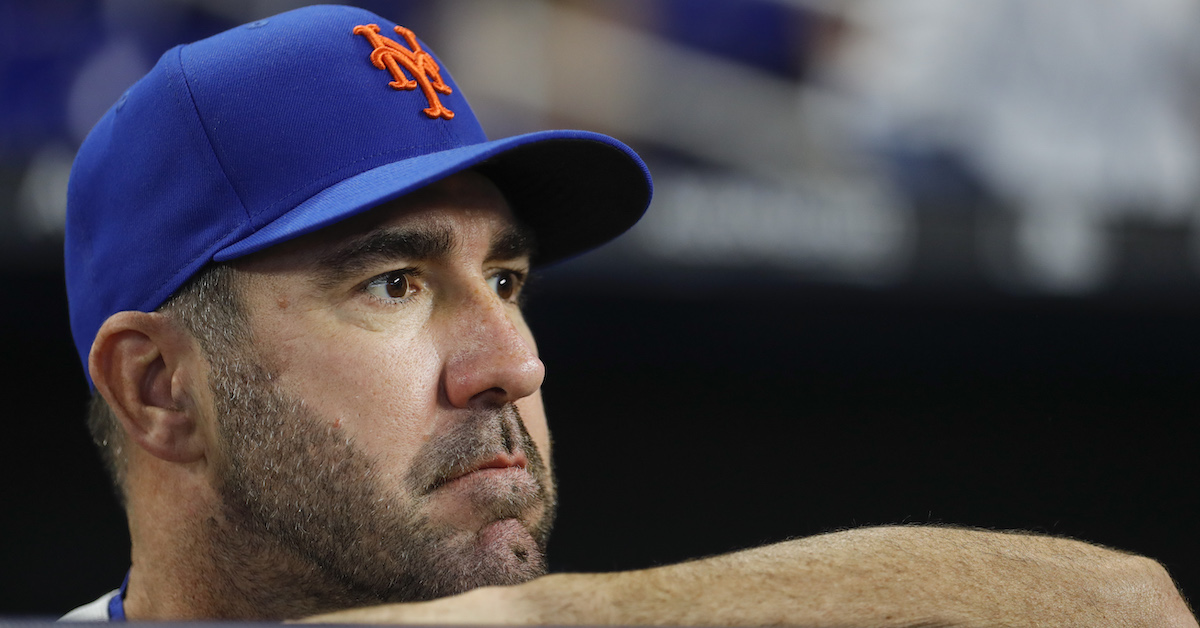
Justin Verlander wasn’t scheduled to start on Thursday, but he couldn’t even make it to the first pitch of his first Opening Day as a Met unscathed. The 40-year-old righty officially opened the season on the injured list due to a low-grade strain of his teres major, and while his absence isn’t expected to be a lengthy one, it comes at the tail end of a spring in which the Mets already lost starter José Quintana for about half the season and closer Edwin Diaz for most if not all of it.
Unfortunately, Verlander isn’t the only frontline starter to be sidelined by a teres major strain this week, as the Guardians’ Triston McKenzie recently suffered a more serious strain of the same muscle. Likewise, Verlander isn’t the only big-name hurler for a New York team who was sidelined this week (the Yankees’ Luis Severino is out again), nor is he the only NL East starter to turn up lame on Thursday (the Braves’ Max Fried took an early exit), or the only over-40 star whose plans took a turn (the Cardinals’ Adam Wainwright missed his Opening Day assignment). If it’s not a party until something gets broken, it’s not a new baseball season until a star pitcher goes down. Perhaps the only consolation to be had in this round-up is that all of these injuries are muscle strains of some sort rather than ligaments or tendons. Read the rest of this entry »
Last year, Andrés Giménez enjoyed quite a breakout season, helping to lessen the sting of the Francisco Lindor trade by emerging as one of the top second basemen in the game. He made his first All-Star team, won his first Gold Glove, and helped the Guardians win the AL Central for the first time since 2018. Now, the team has guaranteed that he’ll stick around for a good long while. On Tuesday, ESPN’s Jeff Passan reported that Giménez has agreed to terms on a seven-year, $106.5 million extension that also includes an option for an eighth season.
The full details of the contract have not yet been reported, but the deal appears to cover the 2023-29 seasons, with a $4 million signing bonus and a $23 million club option for 2030 that comes with a $2.5 million buyout. Via as-yet-unspecified escalators, that option can increase to $24 million (note that Passan has reported the option year as 2031, meaning that the guaranteed portion of the deal wouldn’t begin until next season). At its maximum, the extension could pay Giménez $128 million over eight years, his ages 24-31 seasons.
The guaranteed portion of the contract is the second-largest in team history after José Ramírez’s five-year, $124 million extension signed last year. The extension is the latest manifestation of what has practically become a Cleveland tradition, one that traces back to the rebirth of the franchise. In the mid-1990s, general manager John Hart pioneered the practice of signing young stars such as Sandy Alomar Jr., Carlos Baerga, Manny Ramirez, Jim Thome, and Omar Vizquel to extensions that ran through at least some of their arbitration years and kept them in the fold when they would have hit free agency. It’s a strategy that enabled the team to save millions of dollars while maintaining a competitive nucleus, and one that has become popular with several other teams, most notably the Braves (for whom Hart served as president of baseball operations from late 2014 to late ’17). Long after Hart left Cleveland, successors Mark Shapiro and Chris Antonetti continued to sign players such as Ramírez, Michael Brantley, Travis Hafner, Jason Kipnis, Corey Kluber, Carlos Santana, and Grady Sizemore to deals along those lines.
That’s an incomplete list of players who went this route, but it never included Lindor, who went year-to-year during his arbitration years until the team decided it couldn’t afford him at a full market price. On January 7, 2021, Lindor and Carlos Carrasco were traded to the Mets in exchange for the then-22-year-old Giménez, shortstop Amed Rosario, outfielder Isaiah Greene and righty Josh Wolf.
Giménez had hit an impressive .263/.333/.398 (105 wRC+) in 49 games with the Mets during the pandemic-shortened 2020 season, but he struggled in his first year with Cleveland, batting .218/.282/.351 (74 RC+) in 68 games sandwiched around a detour to Triple-A Columbus that lasted nearly three months. He did hit much better after returning (.245/.320/.382, 94 wRC+) than before (.179/.226/.308, 43 wRC+) even if he didn’t actually make better contact. As I noted last fall, he held his own after returning despite lacking a consistent approach at the plate. “Last year [2021] he’d deviate after like a bad game,” manager Terry Franconatold the Akron Beakon Journal’s Ryan Lewis in May. “You’d have different stance, you have a leg kick you didn’t have, you get a toe-tap.”
Guardians hitting coaches Chris Valaika and Victor Rodriguez helped Giménez ditch the leg kick, which they felt was hindering his pitch recognition and his timing. He fared better against every major pitch type in 2022 than ’21, and overall batted .297/.371/.466 with 17 homers and 20 steals. His 140 wRC+ finished in a virtual tie with Rafael Devers and Carlos Correa for eighth in the AL (one point ahead of Ramírez) and among second basemen of either league trailed only Jose Altuve and Jeff McNeil. On the other side of the ball, Giménez’s 16 DRS, 9 OAA and 6.5 UZR each ranked second among all second basemen, and overall, his 6.1 WAR tied Xander Bogaerts for fifth in the AL, and among second basemen trailed only Altuve. That’s some fine company.
Giménez’s performance included a few areas of concern, notably a 40.8% chase rate, 6.1% walk rate, and Statcast contact numbers (87.8 mph average exit velocity, 6.2% barrel rate, 37.6% hard-hit rate) that placed only in the 29th–36th percentiles. Thanks in part to his 94th-percentile speed, he was nonetheless one of the majors’ most productive hitters on groundballs, ranking among the top half-dozen in both batting average and wRC+:
As noted last fall, hitters combined for a .235 AVG and 35 wRC+ on grounders; based on that, Giménez netted an extra 17 hits, without which he’d have finished with a .263 AVG and .433 SLG, much closer to his expected numbers.
While I do wonder about the sustainability of that aspect of his game, in all, that’s a pretty impressive showing for a 23-year-old. In fact, it’s one of the best age-23 seasons of the past decade:
Again, fine company even given the presence of a few players who have flamed out; Bellinger and Bryant have both dealt with a series of injuries, while Puig’s decline has been an ugly mixture of on- and off-field issues. The book isn’t closed on any of the above players, but several are Cooperstown bound. It’s worth noting that the two other Cleveland players on the list have turned out quite well, and that Giménez’s 140 wRC+ is actually higher than all of the other non-first base infielders — even those who out-homered him by a significant margin.
Because Giménez spent so long in the minors in 2021, he’s accrued only two years and 106 days of major league service time, 66 short of reaching three full seasons (which would have made him eligible for free agency after the 2025 season) and 22 short of becoming an arbitration-eligible Super Two. Thus, his contract for 2023 was among the 28 the team recently renewed; most of those salaries haven’t even been published yet, but Giménez was only set to make $739,400. The $4 million signing bonus bumps him up to something closer to what a star-caliber player in his first year of arbitration eligibility might make. For example, Bichette, who’s heading into his age-25 season with 3.063 years of service time, is making $2.85 million in salary plus a $3.25 million signing bonus as part of his three-year, $33.6 million extension, while the Padres’ Jake Cronenworth, who has exactly three years of service time, is making $4.225 million coming off back-to-back 4.1-WAR seasons. Had he reached three years, Giménez might be somewhere in that ballpark.
Via Dan Szymborski, here’s Giménez’s projection through 2030, the year with the club option:
ZiPS Projection – Andrés Giménez
Year
Age
BA
OBP
SLG
AB
H
HR
SO
SB
OPS+
WAR
$
$Arb
2023
24
.266
.336
.416
515
137
15
119
20
108
4.4
$36.9
$0.7
2024
25
.265
.336
.420
517
137
16
115
19
109
4.5
$39.6
$7.9
2025
26
.264
.338
.419
515
136
16
112
18
110
4.5
$42.1
$14.7
2026
27
.260
.334
.416
515
134
16
109
16
108
4.0
$38.5
$17.4
2027
28
.257
.333
.409
514
132
16
106
15
105
3.6
$35.5
—
2028
29
.255
.333
.407
513
131
16
105
13
105
3.2
$32.9
—
2029
30
.255
.333
.407
513
131
16
106
12
105
2.9
$30.4
—
2030
31
.257
.334
.409
513
132
16
106
11
106
2.8
$31.3
—
Even with some regression to 4.5 WAR per year at his peak, the ZiPS contract projection for Giménez if he were a free agent comes to a whopping $287.2 million, which is more than Bogaerts received from the Padres as a 30-year-old free agent (and spread out over 11 years, at that). Even with the expected discounts for his arbitration years, Giménez projects to be worth $139.5 million through 2029, and $170.8 million through ’30; through that lens, this looks like a rather club-friendly deal. It’s not an out-and-out steal the way Ramírez’s five-year, $26 million deal for 2017-21 — over which the third baseman produced 28 WAR, made three All-Star teams and finished in the top three in AL MVP voting three times — turned out to be, but it’s clear that Giménez traded some risk for financial security. If he’s still even close to being a three-win player in 2030, he’ll stand to make tens of millions more, though he’s unlikely to approach the windfall he might have reaped if he’d spent all of 2021 in the majors and hit free agency after 2025, his age-26 season.
All of which is to say that this is A Very Guardians Deal, and while we can again bemoan the salary structure that prevents players short of six years of service time from getting anything approaching their full market value, it takes two sides to tango. And we shouldn’t be surprised if at least a couple more extensions follow in short order. ViaThe Athletic’s Zack Meisel, the team is in “advanced negotiations” with multiple players including Rosario, Triston McKenzie, Steven Kwan, and Trevor Stephan, hoping to complete extensions by Opening Day (Stephan’s is reportedly nearing completion). Meanwhile, Emmanuel Clase (five years, $20 million) and Myles Straw (five years, $25 million) signed such deals last spring, albeit at a scale much smaller than that of Giménez. If some of those extensions come though, they’ll probably increase the team’s payroll — estimated at around $90.7 million even with several of those aforementioned extension candidates’ salaries unknown — by a few million dollars. They’re still likely to rank among the bottom third of the 30 teams, even while contending for another AL Central title or at least a playoff spot. This approach has worked for the Guardians before, and at least in terms of establishing generational wealth for Giménez, it will work for him as well.
Yesterday, Dan Szymborski and Michael Baumann previewed left and center field. Now we round out the outfield positions with a look at right field.
Blame Bryce Harper, Juan Soto, Ronald Acuña Jr., and even Aaron Judge. Right field may be home to some of the game’s best hitters and brightest stars, but last year the position fell into a collective offensive funk, in part because some of the aforementioned players either underperformed or spent more time at other positions — or both.
Perhaps that was just the flip side of a 2021 season in which right fielders collectively produced a 109 wRC+, higher than any other position besides first base and the highest of any batch of right fielders since ’17. In 2022, right fielders combined for just a 102 wRC+, the lowest mark within our positional splits, which go back to 2002. They were outhit not only by first basemen (111 wRC+) but by left fielders (106) and third basemen (105) as well; left fielders had last outproduced them in 2006, third basemen in ’16, and not once had both done so in the same season. Seventeen of the 30 teams failed to reach a 100 wRC+ at the position, while nine were below 90. Only 18 players accumulated at least 200 plate appearances at the position while maintaining a 100 wRC+, down from 21 in 2021 and 24 in ’19. Read the rest of this entry »
Yesterday, Meg Rowley introduced this year’s rankings, while Dan Szymborski examined the state of the league’s catchers. Today, we turn our attention to first and second basemen.
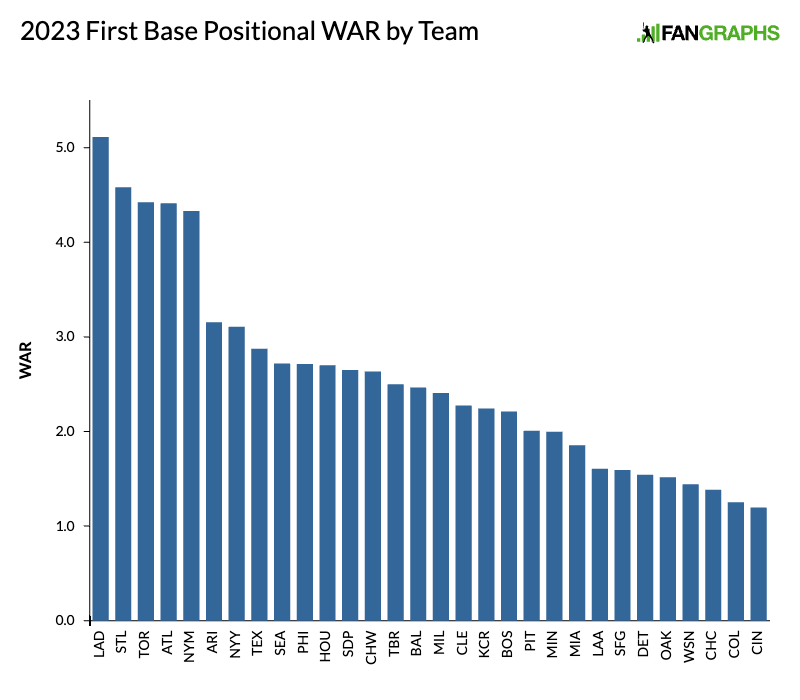
First base was “The Goldy and Freddie Show” in 2022. Paul Goldschmidt and Freddie Freeman both topped 7.0 WAR, becoming the only first basemen to reach that plateau since 2015, when Goldschmidt and Joey Votto both did so; since 2009, Chris Davis (2013) is the position’s only other player to reach such heights. Goldschimdt hit for a 177 wRC+, the highest mark by a first baseman since Votto in 2012, and became the first first baseman since Votto in ’10 to win an MVP award in a full-length season (Freeman and Abreu took home the honors in the pandemic-shortened 2020 campaign).
What goes up must come down, though, and so just as 2021 found the majors’ first basemen combining for their highest wRC+ (114) and WAR (70.2) since ’17, last year they collectively fell off. They still posted the highest wRC+ of any position (111), but their combined WAR dropped to 51.1, a decline of about 0.6 WAR per team. Christian Walker was the only first baseman within three wins of Goldy and Freddie’s 7.1 WAR, and just eight players who spent a plurality of their time at the position topped 3.0 WAR, down from 10 in ’21. Read the rest of this entry »
However you feel about the World Baseball Classic, there’s no getting around the fact that the Mets were dealt a stunning blow when Edwin Díaz sustained a freak right knee injury on Wednesday night while celebrating Puerto Rico’s victory over the Dominican Republic. On Thursday afternoon, general manager Billy Eppler announced that Díaz had suffered a full thickness tear of his patellar tendon and would undergo surgery later in the day. The timeline for returning from such injuries is around eight months according to Eppler, making it likely (though not completely certain) that Díaz would miss the whole season.
That’s a gut punch, particularly as the Mets and anyone who roots for them no doubt harbored dreams of the soon-to-be-29-year-old closer nailing down the final outs of the World Series. The injury comes just three days after the team confirmed that lefty starter José Quintana will be out until at least July as he recovers from bone graft surgery to repair a stress fracture and remove a benign lesion from the fifth rib on his left side. Three other relievers on the depth chart sustained significant injuries this week as well, with Brooks Raley straining his left hamstring while working out with Team USA in the WBC, Bryce Montes de Oca diagnosed with a stress reaction in his right elbow, and Sam Coonrod suffering a high-grade lat strain. The Mets have had better weeks, to say the least.
Eppler noted that some athletes have returned from patellar tendon surgeries in six months, but that they’re exceptions. I was only able to find a few recent examples of major league pitchers undergoing patellar tendon repairs, and they fit a six-to-nine-month range:
Angels righty Garrett Richards suffered a complete tear of his left patellar tendon while covering first base on August 20, 2014, and underwent surgery two days later. He made his 2015 season debut on April 19, about two weeks after Opening Day and about eight months after surgery, and went on to set career highs with 32 starts and 207.1 innings that year.
Royals lefty Matt Strahm tore his left patellar tendon on July 1, 2017 and underwent surgery on July 14. He returned to the mound in the minors on April 7, 2018, about nine months later, and was back in the majors a month after that, making 41 appearances totaling 61.1 innings. In late October 2020 while a member of the Padres, Strahm underwent patellar tendon surgery on his right knee, then returned to the mound in the minors on July 24, 2021 (nine months later), and to the majors on August 3, though he made just six appearances before being sidelined by inflammation. He recovered to make 50 appearances totaling 44.2 innings for the Red Sox in 2022.
Phillies righty Zach Eflin underwent surgeries to repair both patellar tendons in 2016, with the right one first on August 19. He returned to the mound in the minors on April 6, 2017, and was in the majors 12 days later — again about eight months — though he struggled with his performance and was sent to the minors, where he was hampered by elbow and shoulder strains. Four years later and much more established at the major league level, he underwent another surgery to repair his right patellar tendon on September 10, 2021 and was back on a major league mound for the Phillies’ third game of the season last April 8, about seven months later.
That’s an average of about eight months to return to competitive pitching, but all of those timelines are at least somewhat confounded by the offseason, with surgeries taking place in the July-to-September range and leaving no possibility of a six-month return even if the player were to heal quickly. Richards was the only one whose injury was reported as a full tear, like that of Díaz, and in comparing the two, the distinction of whether the injury is on the same side as the throwing arm probably matters; a pitcher’s back leg (same side) drives velocity, but the stress on the front leg (opposite side) for a pitcher’s stride is hardly trivial both for purposes of controlling pitches and in not overtaxing the arm.
Even allowing for the fact that relievers require less buildup than starters, it does seem very difficult to make an in-season return from such a surgery. If one simply ponders the math of a theoretical best-case scenario, six months would put Díaz in mid-September, leaving time for a late-season tuneup before the playoffs; seven months would land him mid-playoffs if the Mets do get that far.
Any way you slice this, it sucks, particularly for Díaz, who’s coming off an incredible season in which he made his second All-Star team, won the NL’s Trevor Hoffman Award as the league’s top reliever — thus completing the set he began when he won the AL’s Mariano Rivera Award in 2018 — and had his entrance music (Blasterjaxx & Timmy Trumpet’s “Narco”) become a viral sensation. Statistically, he led all relievers who threw at least 50 innings with a 0.90 FIP, 1.69 xERA, 50.2% strikeout rate, 42.6% K-BB%, and 3.0 WAR; his 1.31 ERA ranked fourth among those qualifiers, and his 32 saves (in 35 attempts) ranked fourth in the NL. The day after the World Series ended, he agreed to a record-setting five-year, $102 million deal to remain a Met. It was a very good year.
You don’t easily replace a player like that even given a full offseason and a spend-happy owner, but teams with playoff aspirations deal with closer changes on the fly. Think of Rafael Soriano saving 42 games for the Yankees after Rivera tore his ACL in early 2012, Koji Uehara converting 23 straight save chances with a 0.36 ERA for the Red Sox after Joel Hanrahan and Andrew Bailey needed surgeries in ’13, or Wade Davis replacing the injured Greg Holland for the Royals in mid-’15 and closing out the Division Series, Championship Series, and World Series in October. Stuff happens, and teams deal with it; nobody wins without having several good relievers anyway, and GMs do build their rosters with contingencies in mind.
As to how the Mets will cover the ninth inning, via SNY’s Andy Martino, the team views 37-year-old righty David Robertson and Raley, a 34-year-old lefty, as its top options to match up in save situations. Robertson has saved 157 games in his 13-year major league career, including 20 last year for the Cubs and Phillies. In doing so, he posted a 2.40 ERA and 3.58 FIP with a 30.3% strikeout rate in 63.2 innings, a respectable showing given that he had been limited to 19 games from 2019 to ’21 due to a flexor strain, Tommy John surgery, and a commitment to Team USA for the Olympics (he saved two games and won a silver medal). Raley has just nine career saves, but six of them came last season with the Rays, for whom he put up a 2.68 ERA and 2.74 FIP with a 27.9% strikeout rate in 53.2 innings. Since returning from a five-year stint (2015–19) with the KBO’s Lotte Giants, he’s held lefties to a .213 wOBA, but righties have hit him for a .308 wOBA; last year, the splits were .214 and .247, respectively. Raley’s hamstring strain is reportedly low-grade, and he’s expected to return to action in a few days.
Setup man Adam Ottavino, a 37-year-old righty, has 33 career saves as well, with a high of 11 in 2021 with the Red Sox. Last year while setting up Díaz, he pitched to a 2.05 ERA and 2.85 FIP with a 30.6% strikeout rate in 65.2 innings, saving three games. The Mets may prefer to keep him in that setup role, however.
The free-agent market does have experienced closers still on the shelves such as Archie Bradley, Zack Britton, Ken Giles, and Corey Knebel, but each is there for a reason. Bradley suffered a forearm strain in late September last year, ending what was already an injury-marred season in which he threw just 18.2 innings in the majors for the Angels. Knebel saved 12 games for the Phillies with a 3.43 ERA and 4.46 FIP in 44.2 innings but suffered a shoulder capsule tear. Giles totaled just 4.1 innings last year and a mere eight over the last three years due to Tommy John surgery, other elbow problems, a middle finger sprain, and shoulder tightness. He threw a couple of February showcases that have failed to lead to a signing but has another scheduled for Friday. At best, any of them would be a project, not an immediate replacement.
The most workable option of that group is probably Britton, a 35-year-old lefty who pitched under Mets manager Buck Showalter with the Orioles from 2011 to ’18, making two All-Star teams and winning the 2016 Mariano Rivera Award. After undergoing September 2021 Tommy John surgery and bone chip removal — that in a season that also included a previous arthroscopic surgery on his elbow and a hamstring strain — he made just three appearances with the Yankees last year. Hopes for him to be part of the team’s postseason bullpen were dashed when he struggled with his control and was sidelined by a bout of shoulder fatigue. By coincidence, on Thursday he was scheduled to throw at least his third showcase session since January, and the Mets were expected to attend. Via MLB Trade Rumors, the Mets had previously focused on relievers with minor league options remaining, but with Díaz moving to the 60-day injured list and freeing up a spot on the 40-man roster, that’s less of an issue now.
Trading for a closer is another option, but at this point, the cost would be prohibitively high for a reliable one such as the Pirates’ David Bednar, a 2022 All-Star who won’t even be eligible for arbitration until after this season, or the Royals’ Scott Barlow, who has two years of club control remaining. On that note, Martino reported that last summer the Mets explored a possible trade for Alexis Díaz, Edwin’s 26-year-old brother and teammate on Puerto Rico’s WBC team (the sight of him sobbing over his brother’s injury on Wednesday night was heartbreaking). Last year as a rookie with the Reds, Díaz saved 10 games and notched a 1.84 ERA and 3.32 FIP in 63.2 innings, wit a 32.5% strikeout rate but 12.9% walk rate. Batters hit just .127, slugged .190, and whiffed on 31.1% of swings against his four-seamer, which averaged 95.7 mph with high spin; against his slider, they hit .133 and slugged .253, with a 45% whiff rate.
Díaz, though, has a full five years of control left, and the Reds have no reason not to ask for the sun, moon, and stars given the leverage they would have in revisiting a trade. Reds GM Nick Krall would probably lick his chops and ask for some combination of prospects Francisco Álvarez, Brett Baty, and Ronny Mauricio.
It’s far more likely that the Mets will sort through their internal options during the first half of the season and then start working on prying a late-inning reliever from a noncontender in July. With at least some part of Díaz’s $17.25 million salary covered by insurance (as is the case for all WBC participants), the Mets could, for example, absorb what remains of Daniel Bard’s $9.5 million salary (plus the same for 2024) when the Rockies inevitably look to cut costs.
There’s no getting around the fact that this is an impactful injury. Going by our Depth Charts, with Díaz the Mets bullpen ranked fourth in the majors with 3.7 projected WAR, and the closer accounted for 1.8 of that, nearly half:
Mets Bullpen Projection Pre- and Post-Díaz Injury
Split
Innings
ERA
FIP
WAR
WAR Rk
Pre-Injury
539
3.26
3.40
3.7
4th
Post-Injury
539
3.41
3.58
2.1
19th
Ouch. Overall, the team’s projected total WAR dropped them from 52.3 (fourth in the majors behind the Braves, Padres, and Yankees) to 50.7 (fifth, with the Blue Jays sneaking into fourth). New York’s Playoff Odds took a hit, too:
Mets Playoff Odds Pre- and Post-Díaz Injury
Split
W
L
Win%
Div
Bye
WC
Playoffs
WS
Pre-Injury
91.2
70.8
.563
30.9%
27.0%
51.4%
82.3%
8.4%
Post-Injury
90.3
71.7
.557
26.1%
22.4%
51.6%
77.7%
7.0%
Change
-0.9
0.9
-.006
-4.8%
-4.6%
0.2%
-4.6%
-1.4%
Double ouch. Even a six-point drop in winning percentage lowers the Mets’ odds of winning the NL East by nearly five percentage points, and likewise for making the playoffs, with their World Series odds knocked down a peg.
Every team, even championship ones, has to surmount injuries and other curveballs thrown its way. Losing Díaz stinks, and losing him in the manner that the Mets did even moreso (but I’m not listening to your death-to-the-WBC gripes). Even so, he’s not Francisco Lindor or Max Scherzer, and this $355 million roster can’t afford to fall apart over losing 60-some elite innings. The Mets must figure out how to win without Díaz while holding out hope that maybe — just maybe — they can stick around long enough for him to join them and fulfill that World Series dream.
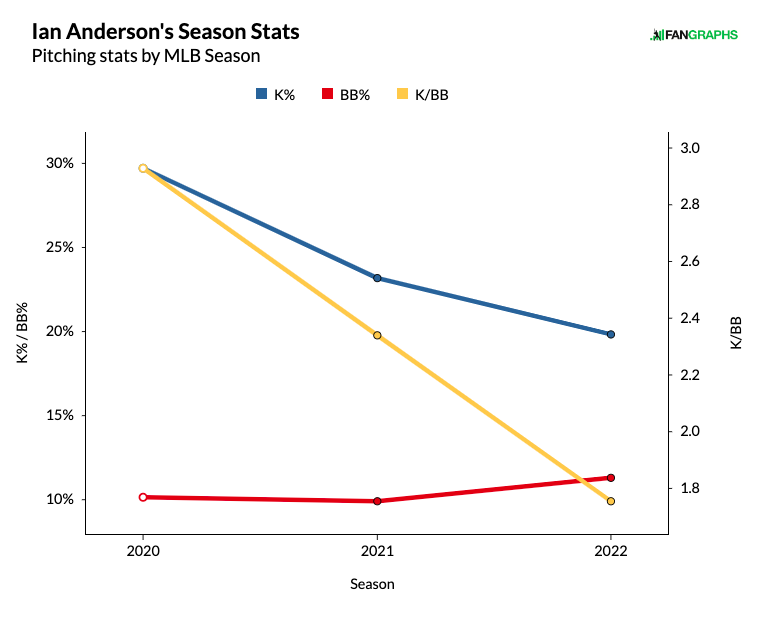
Ian Anderson played a major part in the Braves’ success when they came within one win of a trip to the World Series in the pandemic-shortened 2020 season and then won it all the following year. But after struggling for the first four months of the 2022 season, he was optioned to Triple-A Gwinnett and made just one appearance for Atlanta as it won the NL East but was upset by the Phillies in the Division Series. While Anderson had a shot to reclaim a rotation spot this spring, on Tuesday he was optioned once again, both due to his control problems and to other pitchers making stronger cases for the fifth starter role.
I wrote about Anderson’s demotion last August, but a recap is in order. The third pick of the 2016 draft burst upon the major league scene in late 2020, pitching to a 3.28 ERA and 3.80 FIP in 30 starts totaling 160.2 innings during the ’20 and ’21 regular seasons. He added some stellar postseason work in that span, going 4–0 with a 1.26 ERA in eight starts totaling 35.2 innings; he was kept on a short leash, most notably departing Game 3 of the 2021 World Series after throwing five no-hit innings.
Last year was a different story, as Anderson was lit up for a 5.00 ERA and 4.25 FIP in 111.2 innings across 22 starts. His FIP barely budged relative to 2021 (4.12), but his 1.42 runs per nine rise in ERA from that his previous mark of 3.58 ranked fifth in the majors among pitchers with at least 100 innings in both seasons. Meanwhile, his strikeout and walk rates continued a two-year trend of creeping in the wrong directions, with the former down to 19.7% and the latter up to 11.0%.
Exacerbating Anderson’s problems was a 54-point rise in BABIP, from .259 to .313, the majors’ fifth largest among the aforementioned qualifiers. He decreased his barrel rate from 9.5% to 6.2%, but that was offset by slight increases in his average exit velocity and hard-hit rate, not to mention his pull rate; his xERA went from from 4.27 to 4.37. Read the rest of this entry »
Jay Jaffe: Good afternoon and Happy Pi Day, folks! I’m in the middle of a snowstorm with a sick kiddo underfoot and a contractor overstaying his welcome, but we’re gonna try to get this one in.
2:03
Jay Jaffe: ‘Tis the season when I plug away at the Positional Power Rankings, so I haven’t published anything since Friday’s look at how the injuries of some high-profile starting pitchers will be handled within their various rotations https://blogs.fangraphs.com/painter-rodon-gonsolin-and-quintana-are-th…
Chip: Most knowledgeable people make the point that you shouldn’t read too much into spring training results, mostly referring to misplaced optimism or pessimism. What if a guy is continuing an already bad trend? I’m thinking specifically of Spencer Torkelson who was bad last year, changed his bat, and now is bad in spring training. Is he, just, maybe not a major league player?
2:08
Jay Jaffe: Count me as one who thinks you shouldn’t read too much into spring results, or dismiss a 23-year-old with 70-grade raw power after just 404 major league plate appearances. Should he be in the majors yet? Maybe not, given his modest results at Triple-A. Should you build your fantasy roster around him? Hell no. But 29 spring ABs in the first half of March against variable competition tells you nothing about where his career is going

 Jay Jaffe: Good afternoon, folks, and welcome to my first solo chat of the 2023 regular season — last week’s chat was scrubbed due to my participation in the Opening Day chat.