Archive for 2018 Trade Value

Cole Hamels to Cubs Looks Imminent

Last week, Craig Edwards observed that the current Cubs rotation was on pace to become the club’s worst ever. While the team as a whole had prevented runs at something slightly better than an average rate, that was due largely (noted Edwards) to the contributions of the defense. The starters, meanwhile, had performed poorly in those areas (strikeouts, walk, home-run prevention) over which they exerted the most control.

From Edwards’ post:

The Cubs appear to have gone some way towards addressing this particular shortcoming on Thursday night. While nothing’s official, a trade for Rangers left-hander Cole Hamels appears imminent. Per Jeff Passan:

For all his name recognition, the present-day incarnation of Cole Hamels is inferior to the best version of that same pitcher, the one whose on-field exploits for a decade were rivaled only by those produced by a group of starters who will receive real consideration for the Hall of Fame. After recording a successful first full season with the Rangers in 2016, Hamels has authored more ordinary work in the meantime, recording 1.7 WAR in 262.1 innings since the beginning of 2017. That said, both his swinging-strike and overall strikeout rates (9.7% and 17.1%, respectively, in 2017) have returned to his pre-2017 levels (12.3% and 22.7%, respectively, in 2018). He has exhibited, meanwhile, no real signs of velocity decline.

Read the rest of this entry »


The Toronto Blue Jays Are Now Happless

A day after Boston added starting-pitch depth from the Rays in the form Nate Eovaldi, the Yankees have followed suit this afternoon with another AL East team, acquiring left-hander J.A. Happ from Toronto in exchange for infielder Brandon Drury and outfielder Billy McKinney.

While this trade doesn’t preclude the Yankees from making a splashier acquisition for a starting pitcher, it wouldn’t surprise me if Happ is the only significant addition to the New York rotation. The team’s been linked to Cole Hamels in recent weeks, but that seems a curiously unsatisfying acquisition from New York’s perspective. At this point, Hamels’ reputation is still mostly derived from what he did in Philadelphia and, after a so-so 2017, he’s been hit hard and often in 2018. It’s tempting to disregard the inflated HR/FB rate as a fluke, but his 44.9% hard-hit rate this year is the second-highest among qualifiers — this after he set a career high in 2017. Now, that’s not enough to doom a pitcher by itself — Zack Greinke and Patrick Corbin are up there too and having fine seasons — but it does lend support to the notion that his homers allowed aren’t flukes.

Getting hit hard is a risk in Yankee Stadium, and the point of these types of deadline trades isn’t to maximize upside but rather to find some certainty. No, Happ wasn’t really the sixth-best starter in his 20-4, 3.18 ERA Cy Young-contending year in 2015, but he’s also a fairly safe pitcher at this point, one who has already been playing in the AL East and experienced plenty of success. The Yankees aren’t trying to make a David Price or a Johnny Cueto trade here; rather, they’re looking for someone more dependable than Sonny Gray to slot after Luis Severino, Masahiro Tanaka, and CC Sabathia down the stretch. Fourth starters do tend to make an appearance in the playoffs and, should the Yankees reach the ALDS — which our odds says isn’t about 70% likely to occure — it’s difficult to imagine they’d be comfortable turning to Gray, who has failed to complete the fifth inning in seven of his 19 starters in 2018. And with it looking more and more likely the Yankees are the first Wild Card rather than the AL East winner, that extra Wild Card game means they’re even more likely to require the services of that fourth starter.

In the ZiPS playoff odds, the addition of Happ to the rotation boosts the team by about a win over the course the rest of the season, moving their divisional odds from 23% to 28% in the projections. ZiPS believe the Yankees are a slightly better team than the Red Sox, but the 5.5 games baked into the cake, so to speak, are telling here. This is more a depth move for the Yankees than something intended to upend any playoff scenarios.

Read the rest of this entry »


Which Teams Could Even Trade for Lindor and Ramirez?

“Probably none,” is mostly the answer to the question posed in the title.
(Photo: Erik Drost)

Last week, I took up the mantle from Dave Cameron and published this site’s 11th annual Trade Value series. If you’re new to the concept, the Trade Value series represents an attempt to rank the most valuable assets in baseball, accounting for each player’s current skill level, age, and health while factoring in controllable years or contract status (with lots of advice from scouts and execs). Few, if any, of the players are likely to be traded in reality; however, the rankings represent an opportunity to see how the industry is and isn’t valuing players.

An unusual thing happened in this year’s series — namely, the top two spots in the rankings went to a pair teammates, Francisco Lindor and Jose Ramirez. By my reckoning, the combined eight years for which their contracts are controlled by Cleveland are worth around $385 million*. They’re incredibly valuable.

*To arrive at this figure, I used ZiPS projected WAR, projected dollar-per-WAR inflation, discounted values for years further into the future, and a linear concept of dollar-per-WAR. This is more of a ballpark number since clubs on either extreme of the payroll spectrum may value each win much more or less than the average team that’s assumed in this sort of calculation.

In the wake of this year’s edition, I began thinking: would any clubs have sufficient ammunition for Cleveland even to consider a possible trade of Lindor and Ramirez? As with the Trade Value series itself, this is mostly a hypothetical question. The Indians, as a contending club, have little incentive to deal two of the majors’ best players. Still, I was curious if any club could put together enough assets even to make it possible.

Read the rest of this entry »


2018 Trade Value: #1 to #10

Jose Ramirez has considerable value even without his bat.
(Photo: Keith Allison)

As is the annual tradition at FanGraphs, we’re using the week of the All-Star Game — while (some of) the industry pauses for a metaphorical breather — to take stock of the top-50 trade assets in the sport. For more context on exactly what we’re trying to do here, see the honorable-mentions post linked at the top of the page.

For this post and the others in this series, I’ve presented a graphic (by way of the wizard Sean Dolinar) breaking down each player’s objective skill level (represented, in this case, by a five-year WAR projection from ZiPS), contract/team-control details, rank in last year’s series, and then year-by-year details of age/WAR/contract through 2023, although a couple players have control beyond those five years. For those readers who are partial to spreadsheets rather than blocks of text, I’ve also included all the players we’ve ranked so far are in grid format at the bottom of the post.

The ZiPS WAR forecasts did influence the rankings a bit: for players who were bunched together, it acted as an impartial tiebreaker of sorts, but the industry opinions I solicited drove the rankings.

With that said, let’s get to the top 10 spots on the Trade Value list this year.

Five-Year WAR +26.3
Guaranteed Dollars
Team Control Through 2022
Previous Rank #35
Year Age Projected WAR Contract Status
2019 25 +5.3 Arb1
2020 26 +5.5 Arb2
2021 27 +5.5 Arb3
2022 28 +5.0 Arb4
Arb

Severino bests Kluber for the top spot amongst pitchers on this year’s list. He is eight years younger than Kluber with an additional year of control and has been at least as good as the Cleveland right-hander this season, depending on how you measure it. Predictably, though, execs are concerned — as they are with basically any pitcher — that Severino’s next pitch could lead to a year-long DL stint and uncertainty after that. As a 24-year-old who averages 97.7 mph on his fastball, Severino is still a bit of a risky bet compared to comparable hitters. There’s a tier here from Nos. 7 to 13 that you could shuffle in a few different orders depending on your personal preferences or evals of these players.

Read the rest of this entry »


2018 Trade Value: #11 to #20

Corey Kluber lurks menacingly… in the hearts of major-league batters!
(Photo: Erik Drost)

As is the annual tradition at FanGraphs, we’re using the week of the All-Star Game — while (some of) the industry pauses to take a metaphorical breather — to take stock of the top-50 trade assets in the sport. For more context on exactly what we’re trying to do here, see the honorable-mentions post linked at the top of the page.

For this post and the others in this series, I’ve presented a graphic (by way of the wizard Sean Dolinar) breaking down each player’s objective skill level (represented, in this case, by a five-year WAR projection from ZiPS), contract/team-control details, rank in last year’s series, and then year-by-year details of age/WAR/contract through 2023, although a couple players have control beyond those five years. For those readers who are partial to spreadsheets rather than blocks of text, I’ve also included all the players we’ve ranked so far are in grid format at the bottom of the post.

The ZiPS WAR forecasts did influence the rankings a bit: for players who were bunched together, it acted as an impartial tiebreaker of sorts, but the industry opinions I solicited drove the rankings.

With that said, let’s get to the next 10 spots on the Trade Value list this year.

Five-Year WAR +17.2
Guaranteed Dollars
Team Control Through 2024
Previous Rank
Year Age Projected WAR Contract Status
2019 22 +2.3 Pre-Arb
2020 23 +3.0 Pre-Arb
2021 24 +3.8 Arb1
2022 25 +4.0 Arb2
2023 26 +4.1 Arb3
Pre-Arb
Arb

Torres was our 12th-ranked prospect entering the year and, while that top tier has mostly stayed where they are (except for party-crashed Juan Soto), there’s been a shuffle of the name up top. Torres is one of the players to whom I refer in the introduction who wouldn’t have appeared on this list before the season began (although he would’ve been in the mix for an honorable mention) but whom it would be insane to exclude now. The difference? Just 63 big-league games. If Torres had no pedigree and was pulling some Shane Spencer or Bo Hart business, this wouldn’t be the case, as his age, pedigree, and track record have all suggested this sort of thing was on the table.

Read the rest of this entry »


2018 Trade Value: #21 to #30

Noah Syndergaard’s velocity is a mixed blessing in terms of long-term value.
(Photo: Keith Allison)

As is the annual tradition at FanGraphs, we’re using the week of the All-Star Game — while the industry pauses to take a metaphorical breather — to take stock of the top-50 trade assets in the sport. For more context on exactly what we’re trying to do here, see the honorable-mentions post linked at the top of the page.

For this post and the others in this series, I’ve presented a graphic (by way of the wizard Sean Dolinar) breaking down each player’s objective skill level (represented, in this case, by a five-year WAR projection from ZiPS), contract/team-control details, rank in last year’s series, and then year-by-year details of age/WAR/contract through 2023, although a couple players have control beyond those five years. For those readers who are partial to spreadsheets rather than blocks of text, I’ve also included all the players we’ve ranked so far are in grid format at the bottom of the post.

The ZiPS WAR forecasts did influence the rankings a bit: for players who were bunched together, it acted as an impartial tiebreaker of sorts, but the industry opinions I solicited drove the rankings.

With that said, let’s get to the next 10 spots on the Trade Value list this year.

Five-Year WAR +20.8
Guaranteed Dollars
Team Control Through 2023
Previous Rank
Year Age Projected WAR Contract Status
2019 25 +3.1 Pre-Arb
2020 26 +4.0 Pre-Arb
2021 27 +4.3 Arb1
2022 28 +4.6 Arb2
2023 29 +4.8 Arb3
Pre-Arb
Arb

Ohtani was ticketed before the season to appear much higher than this, but some concern about an imperfect UCL has now turned to what most feel is an inevitable Tommy John surgery at some point during the course of his six controlled years. If you remove much of this year on the mound from his cost-controlled seasons, take away another 12-18 months for surgery, and add to that some uncertainty about whether the stuff/feel/stamina comes all the way back, and we’re now talking about three or four years of a premium but somewhat risky talent. If you look around, that’s roughly where he’s landed as far as comps. While the expectation of health has shifted south a bit since Opening Day, the evaluation of his talent has moved north a bit, both as a pitcher and hitter, following his uneven looks in spring training.

Read the rest of this entry »


2018 Trade Value: #31 to #40

Jose Altuve will not be constrained by your “aging curves.”
(Photo: Keith Allison)

As is the annual tradition at FanGraphs, we’re using the week of the All-Star Game — while the industry pauses to take a metaphorical breather — to take stock of the top-50 trade assets in the sport. For more context on exactly what we’re trying to do here, see the honorable-mentions post linked at the top of the page.

For this post and the others in this series, I’ve presented a graphic (by way of the wizard Sean Dolinar) breaking down each player’s objective skill level (represented, in this case, by a five-year WAR projection from ZiPS), contract/team-control details, rank in last year’s series, and then year-by-year details of age/WAR/contract through 2023, although a couple players have control beyond those five years. For those readers who are partial to spreadsheets rather than blocks of text, I’ve also included all the players we’ve ranked so far are in grid format at the bottom of the post.

The ZiPS WAR forecasts did influence the rankings a bit: for players who were bunched together, it acted as an impartial tiebreaker of sorts, but the industry opinions I solicited drove the rankings.

With that said, let’s get to the next 10 spots on the Trade Value list this year.

Five-Year WAR +14.5
Guaranteed Dollars
Team Control Through 2024
Previous Rank
Year Age Projected WAR Contract Status
2019 23 +2.8 Pre-Arb
2020 24 +3.0 Pre-Arb
2021 25 +3.0 Arb1
2022 26 +2.8 Arb2
2023 27 +2.9 Arb3
Pre-Arb
Arb

I feel like I’m supposed to kick this off with a Ferris Bueller reference, but I couldn’t come up with anything fitting. Walker is one of the rare prospects who gets the coveted “has a chance to become be an ace” label that’s only true of a handful of pitchers on Earth at a given time. For all the (rightful) handwringing about how scouts don’t truly understand upside when guys like Joses Altuve or Ramirez can emerge as the best hitters in the game after never appearing on a top-100 list, the group of aces who weren’t at some point described as a potential ace is basically just Cliff Lee, and he was touted in the minors.

Read the rest of this entry »


2018 Trade Value: #41 to #50

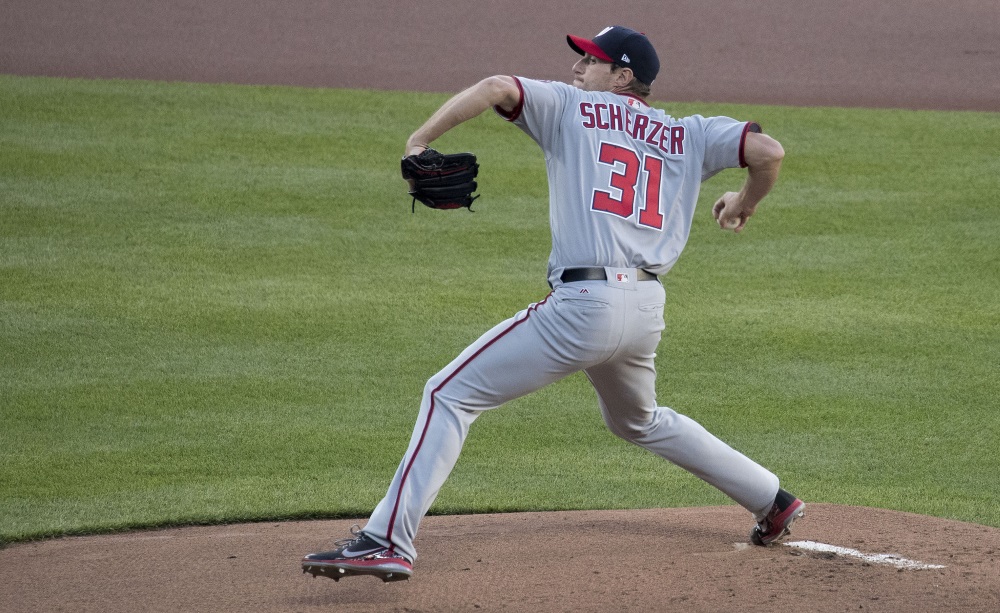
Max Scherzer’s contract renders him an option only for big-market clubs.
(Photo: Keith Allison)

As is the annual tradition at FanGraphs, we’re using the week of the All-Star Game — while the industry pauses to take a metaphorical breather — to take stock of the top-50 trade assets in the sport. For more context on exactly what we’re trying to do here, see the honorable-mentions post linked at the top of the page.

For this post and the four to follow, I’ll present a graphic (by way of the wizard Sean Dolinar) breaking down each player’s objective skill level (represented, in this case, by a five-year WAR projection from ZiPS), contract/team-control details, rank in last year’s series, and then year-by-year details of age/WAR/contract through 2023, although a couple players have control beyond those five years. For those readers who are partial to spreadsheets rather than blocks of text, I’ll also include all the players we’ve ranked so far are in grid format at the bottom of the post.

The ZiPS WAR forecasts did influence the rankings a bit: for players who were bunched together, it acted as an impartial tiebreaker of sorts, but the industry opinions I solicited drove the rankings.

With that said, let’s get to the final 10 spots on the Trade Value list this year.

Five-Year WAR +16.3
Guaranteed Dollars
Team Control Through 2024
Previous Rank
Year Age Projected WAR Contract Status
2019 22 +2.2 Pre-Arb
2020 23 +3.0 Pre-Arb
2021 24 +3.7 Pre-Arb
2022 25 +3.7 Arb1
2023 26 +3.7 Arb2
Pre-Arb
Arb

This last spot, as I’m sure was true on all of the versions of the list Dave did, was a tough to decide upon. As you can see from the honorable mentions, basically every type of player has a solid candidate for this spot. One could argue on behalf of Matt Olson, for example, that he’s a similar player to Tucker, has just one fewer year of control, and has already posted 3.6 WAR in his first 167 games. That said, Tucker seems to get a bit of a boost from the industry because of his recent call-up and that isn’t all nonsense: calling a top prospect up to a contending team before there’s any incentives by way of service time suggests the things non-Astros people know about Tucker (mental makeup, etc.) are positive.

Read the rest of this entry »


2018 Trade Value: Honorable Mentions

The industry places Javy Baez and Manny Machado just outside the top-50 players by trade value.
(Photo: Keith Allison)

All-Star week has arrived, which means a lot of things, like that the races for the 2018 postseason have begun to take shape (at least in the NL, where postseason races exist) and also that many of those who work in baseball are currently taking rushed, abbreviated vacations. Around here, though, it marks the time for a different tradition — namely, the start our annual Trade Value series.

The inimitable Dave Cameron did this list for 13 years, 10 of them for this website. He’s now moved on the Padres, though, and FanGraphs has somehow ended up with me in his place. This list wouldn’t be possible without the model established by Cameron, nor the help of Sean Dolinar, Dan Szymborski, and Carson Cistulli in putting together this year’s series. A special thanks is also due to industry friends who put up with much rougher early versions of this list, were generous with their time, and helped whip it into shape.

For those new to the series, it marks an attempt to answer the question “Who would bring back the most in trade if he were put on the market before the deadline?” What’s notable about this list — as opposed to the prospect types I assemble with Eric Longenhagen — is that it’s the only one for which my opinion doesn’t matter. The goal here isn’t for me to project anybody’s future value but rather to capture the opinions of the industry and how they value players in reality, right now.

Read the rest of this entry »