Bryce Elder was thriving when he was featured here at FanGraphs in July 2023. Then in his first full season with the Atlanta Braves, the now 27-year-old right-hander was 8-2 with a 3.18 ERA, and he’d recently been named an NL All-Star. Killing worms was his M.O. Relying heavily on a sinker, Elder boasted a 53.6% groundball rate, which ranked fifth best among qualified pitchers.
Then things slowly started going south. From August 2023 through last season, Elder was on the winning end of just 14 decisions while putting up a 5.53 ERA over 48 starts comprising 259 innings. The University of Texas product had gone from a burgeoning frontline starter to profiling as more of a back-of-the-rotation arm.
Adversity has a way of begetting change, and much for that reason, Elder is no longer the same pitcher who struggled to record outs. The transformation has taken a bit of time — Rome wasn’t built in a day — but his current-season results are certainly pleasing to the eye. Over 14 starts, Elder has a record of 5-3 to go with a 2.66 ERA and a 3.46 FIP over 84 2/3 innings. Notably, his 45.0% groundball rate is the lowest of his career.
Elder discussed his evolution — one that has essentially brought him full circle in terms of success — when the Braves visited Fenway Park late last month.
———
David Laurila: It’s been three years since we first spoke. What has changed?
Bryce Elder: “A lot has changed. When we talked in 2023, I’d been on a roll; I’d had a good first half. But then the second half was pretty rough. It wasn’t all rough, but the numbers weren’t all that great. I was kind of like, ‘I’m tired of sucking, tired of not being very good, so I’m going to try to make some changes. I’d never worked on mechanics too much, and I’d never been a big, like, stuff chaser, but I got tired of dying on the hill of complete execution.
“I never thought I’d be saying that, even a year ago. But what I figured out is that if I could make my stuff a little better, that would only help. And then, if I was moving a little better on the mound, my execution was going to be just as good as it’s ever been, if not better. So, I think I’ve had a little tick up in stuff, as well as in my execution.”
Shane Baz features a five-pitch mix: a four-seam fastball and a knuckle curve being the most prominent in terms of usage. The Baltimore Orioles right-hander also throws a cutter, a curveball, and a changeup. And then there is the offering that reluctantly remains in his back pocket. Baz would love to one day unleash his knuckleball on major-league hitters.
“I threw one when I was a kid, up until I was probably 13 or 14,” explained Baz, who was a big Tim Wakefield fan while growing up in Tomball, Texas. “It was my only off-speed pitch up until then — I was just fastball/knuckleball — so I’ve got a lot of experience with it. I actually try to throw it in every bullpen [session]. I’ll definitely get it into a game, eventually. I just have to convince [pitching coach Drew] French to let me throw it. Maybe next spring training I’ll be able to mix some in and show him what it looks like in a game. I mean, it’s pretty good.”
Baz went on to say that that he threw his pet pitch with a three-finger grip — “fingers on the horseshoe, right by the label” — in his younger days, but once his hands got bigger he went to “the traditional two-finger knuckleball.” And while he basically stopped throwing it in games once he matured and developed more pitches, he’s never lost his affinity for baseball’s butterfly.
At 96.1 mph, Baz’s four-seamer is above average for velocity, but while extra oomph is advantageous for heaters, that isn’t the case for low-spin floaters.
“I can get it up to about 80, but those aren’t as good,” Baz said. “I think it’s best when it’s like 70 to 75. That’s when I have the best control of it and can keep the spin really low. When I’m trying to throw it hard, it starts spinning more and not having as much knuckle effect.”
His overall understanding of the pitch is impressive, and that includes spin properties. Read the rest of this entry »
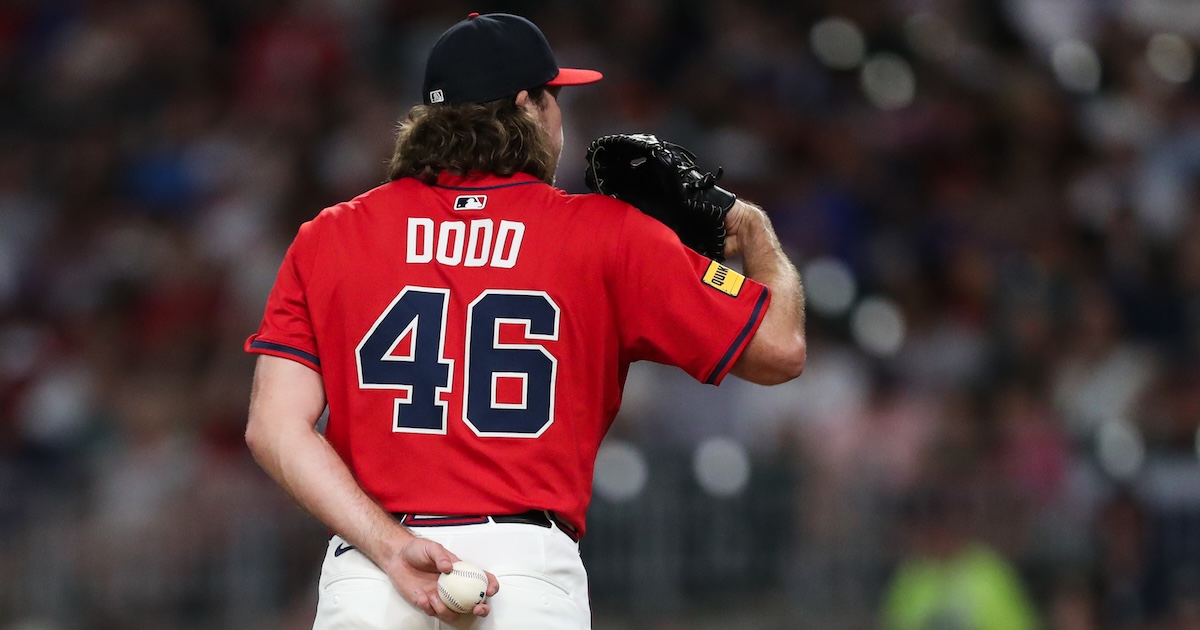
Dylan Dodd throws a sinker that doesn’t sink. Nor does it have much horizontal movement. For all intents and purposes, it isn’t a sinker at all. Despite it being classified as such, the pitch is functionally a four-seamer delivered with a two-seam grip.
Labels aside, it works just fine. The 27-year-old southpaw has thrown his signature offering 87 times (59.6% usage) this season to the tune of a .158 batting average allowed and a 26.3% strikeout rate while making seven appearances out of the Atlanta Braves bullpen. Limited to 10 2/3 big league innings due to an earlier stint on the IL for thoracic spine inflammation, Dodd has fanned a dozen batters, allowed seven hits, and issued just one free pass.
I learned about his atypical “sinker” when the Braves visited Fenway Park late last month. All I knew prior to our conversation was that Dodd’s player page showed him having transitioned away from a four-seamer, and that doing so was yielding good results. Interested in the reason behind the switch — ditto the process behind it — I began by asking him if what I’d seen was accurate. Read the rest of this entry »
Mike Stanley was C.J. Nitkowsk’s biggest nemesis. In seven career plate appearances versus the now-Atlanta Braves broadcaster, Stanley homered twice, hammered a double, and walked four times. That added up to a 4.333 OPS. Of the 592 batters Nitkowski faced over 10 big-league seasons, no one was more injurious to his stat sheet.
Somewhat surprisingly, the pair of gophers — one at Tiger Stadium in 1996, the other at Fenway Park in 2000 — aren’t what the southpaw most remembers about his matchups with the slugging catcher/first baseman. What stands out is the two-bagger.
“I have a story about Mike Stanley,” explained Nitkowski, who made 336 MLB appearances, 213 of them with Detroit, while pitching for eight teams from 1995-2005. “As a kid who grew up in New York and was a Yankees fan, I always knew who he was. He was a Yankee when I was in high school. When I got drafted and went down to Orlando for my first spring training [with the Cincinnati Reds in 1995] — I went early to get out of the cold — I was working out with Chad Mottola, who is now the hitting coach for the Rays. He was my first roommate in professional baseball.
“Chad lived down there,” continued Nitkowski. “Mike Stanley happened to live in the same neighborhood, and they worked out together once in awhile, so I met him. I was 21 or 22 years old, so it was a big deal. You meet a big-leaguer and are trying to play it cool — you’re a professional now — but it was Mike Stanley. That’s cool. I thought it was kind of a big deal. I got to know him a little bit.”
Fast forward to August 12, 2000. Stanley was playing for the Oakland Athletics, while Nitkowski was pitching in relief for the Tigers. A request was made in the dugout during the sixth inning. Read the rest of this entry »
Spencer Strider had a fascinating first inning at Fenway Park on Tuesday. The Atlanta Braves right-hander threw 10 pitches in the frame, and it took him just five to retire the final three batters he faced. The first two batters were another story entirely. Jarren Duran walloped the second of Strider’s offerings over the right field fence, and Ceddanne Rafaela followed by depositing his fifth bullet over the Green Monster. The Red Sox led 2-0 before he had recorded an out.
What was that inning like for Strider? Wanting to find out, I approached him the next day to see if he’d be amenable to a pitch-by-pitch revisiting of what had happened. We’d had such a conversation back in his rookie season, albeit under far different circumstances: He’d fanned the side on 11 pitches in his lone inning of work.
Strider was happy to oblige, so I began by asking him if his game plan differed from 11 days prior, when he’d started against the Red Sox in Atlanta.
“There was some variation,” the righty replied. “I walked Duran to lead off the game in the previous outing, and I felt like some of that was a game-plan thing where we wanted to go with the heater; the walk was a lot of arm-side heaters. For my stuff, and kind of my mechanics, we wanted to target the glove side and get ahead [on Tuesday]. And I did, although I kind of pulled it down a little bit more than we were trying to do. Then we went back to it, as was the plan, and I kind of threw it in the same spot. The down-and-in heater to lefties isn’t a spot where you want to go, especially when they’re sitting heater. Maybe he pops it up or grounds out. Maybe he takes it again. Instead, he hit a homer. Big league hitters do that.”
Welcome to another edition of Five Things I Liked (Or Didn’t Like) This Week in Baseball. In keeping with the increasingly lenient definition of “this week” that I’ve been using of late, we’ve got stuff from all throughout May in this column. May is a great time to watch baseball. (It’s always a great time to watch baseball, but May is particularly good.) The weather is heating up. Ballparks are swelling with the start of summer crowds. Tarps are coming off. So please join me on a trip through the league, from fun teams to watch to nifty little plays. And as always, thanks to Zach Lowe of The Ringer for the inspiration.
1. The Go-Go Nats
Nationals fans have endured seven years in the wilderness since the team’s 2019 title. Washington’s season-high win total in that span was 71 (2023 and 2024). This year’s team is finally playing around .500 ball, though our projections think the Nats will end up right around that 71-win high-water mark again. (We have them down for 74 at the moment.) But while the winning hasn’t quite come back yet, the fun has.
This year, the Nationals are dominating on offense. They’re leading the majors in scoring by a mile, averaging an enormous 5.49 runs per game. They’ve hit the most doubles in baseball – in fact, they have the most extra-base hits in baseball. They’re top 10 in on-base percentage, top five in slugging, and top five in stolen bases. They’re first in overall baserunning value. They’re third in BaseRuns-projected scoring. This isn’t smoke and mirrors. Read the rest of this entry »
One of my favorite article genres to produce is “you’ve never heard of this reliever, but he’s great now.” Generally speaking, it’s either some dude who has been in the majors for a while but recently learned something new, or someone who burst onto the scene with some quirky pitch, delivery, or approach. Today, though, I’m trying a slightly different variation. You probably have heard of Dylan Lee. He’s appeared in the majors for six straight years and racked up more than 200 innings pitched in that time. He’s not doing anything particularly new in 2026. But he’s great, and somehow we’ve basically never written about him, so I think it’s time to rectify that shortcoming.
In 19 2/3 innings of work this year entering Wednesday, Lee has posted a 0.92 ERA and 1.08 FIP. He’s striking out a third of the batters he faces and barely walking anyone. And while no one is that good in the long run, Lee’s career stats are very solid, as well. He has a career 2.65 ERA and a 3.24 FIP (2.92 xERA, 3.19 xFIP, 2.79 SIERA). Sure, it’s over only 224 innings, but those numbers are superb. He has the 10th-best ERA of any reliever since his debut, and every other run prevention estimator is similarly situated toward the top of the table.
The simplest way to describe Lee’s game is that he throws a gyro slider as often as possible, plus a fastball and changeup when he needs to switch things up. He’s throwing that slider 56% of the time this year, which is narrowly a career high, but he’s thrown 52.5% sliders in his career, so this is hardly a complete sea change. He leans especially hard on the slider against lefties, using it more than three quarters of the time. But even against righties, he throws 46% sliders and spots his other two pitches off of his breaking ball.
While sweeping sliders are all the rage these days, Lee doesn’t throw one. His slider is most remarkable for how little it breaks. He’s not quite Tatsuya Imaiout there, but in 2025, his average slider moved about an inch to his arm side, the “wrong way.” This year so far, it’s moving about an inch to his glove side. Unlike many slow, straight sliders, Lee’s has a tiny bit of induced vertical break; the pitch falls about four inches less on its flight to the plate than your average mid-80s gyro slider.
That sounds terrible, right? “Hey, I throw my slider kind of slow, and also it doesn’t slide, and also it doesn’t have any downward break.” Anyway, on an unrelated note, here’s a leaderboard from 2026:
“If Bobby [Cox] wasn’t here, he’d be one of the leading candidates for the job. A new broom sweeps clean. That’s all,” said Braves owner Ted Turner at the October 8, 1981 press conference to announce the dismissal of the manager who had piloted the team for the previous four seasons, with just one finish above .500. Known then as one of baseball’s most controversial, impulsive, hands-on owners — so hands-on that he had even managed the team for one night, only to be prohibited from doing so again — Turner admitted that he was making a change for change’s sake.
The Braves would win the NL West in 1982 under new manager Joe Torre, but not until Turner rehired Cox as general manager after the ’85 season — just after he’d managed the Blue Jays to their first division title — and focused on building from within instead of chasing expensive free agents did the team sustain its success. Once Cox returned to the dugout in mid-1990, he led the Braves to 14 division titles, five pennants, and a championship in 15 seasons (1991–2005), interrupted only by a second-place finish in strike-shortened 1994. He added a wild card berth in his final season (2010) for a record-setting 16 playoff appearances in 29 seasons of managing. He won four Manager of the Year awards, and on the 2014 Expansion Era Committee ballot, alongside Torre and Tony La Russa, he was elected unanimously to the Hall of Fame.
Cox won more regular season games (2,504) than all but Connie Mack, La Russa, and John McGraw. He ranks third all-time in games above .500 (503), fifth in games managed (4,508), sixth in losses (2,001), and 19th in winning percentage (.556) at a 1,000-game cutoff. Aided by expanded playoffs, he’s first all-time in postseason losses (69), second in games managed (136) behind only Torre, and fourth in wins (67). He’s also the all-time leader in managerial ejections with 162, 41 more than McGraw. The count undergirded his reputation as a players’ manager. “If I were on the field, I’d want the manager sticking up for me,” Cox once said. “Sometimes players are dead wrong, ranting and raving, but you stick up for them. They appreciate that.”
“He treats you like a man. He’s very simple in what he wants,” saidTom Glavine in 1999. “He doesn’t have a whole lot of rules. You show up on time, and you show up ready to play, and you play the game the right way.”
Brash and often profane, or at least offensive, Turner earned nicknames such as “Captain Outrageous” and “The Mouth of the South” for confrontational statements, ostentatious womanizing, and self-aggrandizement. Anecdotes from his early years owning the Braves could fill a book. He eschewed the executive suite for a seat behind the home dugout, often appeared in the clubhouse wearing jeans and boat shoes, and took up chewing tobacco to fit in with players. In 1978, the New York Times’ Roger Vaughan called him “an interesting blend of Southern gentleman and funky downhome goofhead cousin in whose vernacular the words ‘sir’ and ‘ain’t’ nestle compatibly. It is an ideal combination for selling baseball in Atlanta.”
By the mid-1980s, with Cox in the fold, Turner learned to leave baseball to his baseball people and focused more on his cable television empire, where he proved to be a visionary, taking the Braves nationwide via Superstation TBS, founding the Cable News Network, purchasing the libraries of MGM films to broadcast on Turner Classic Movies and Hanna-Barbera cartoons to air on the Cartoon Network. In 1996, he merged his conglomerate — which included the Braves — with Time Warner, creating what was hailed as the world’s largest communications company, and became vice chairman while surrendering control of the Braves. After the Braves moved from Atlanta-Fulton County Stadium to their new ballpark, Turner Field, in 1997, he retained a presence at their games for several more years. He remained with Time Warner after AOL purchased it in 2001, though his prominence in the corporate hierarchy was reduced.
“For the 10 years I ran [the team], it was a disaster,” said Turner in October 1996, after completing the sale. “But buying the Braves was a good move. As I relinquished control of the Braves and gave somebody else the responsibility, they did well.”
After selling his company, Turner put his money toward humanitarian and conservation efforts. In 1997, he donated $1 billion to create the United Nations Foundation, supporting the UN and its causes; at the time it was the largest philanthropic gift in history. He became the fourth-largest landowner in the U.S., using his two million acres spread across 13 ranches for sustainable agriculture and managing the world’s largest private bison herd.
Turner died on May 6 at age 87. He had suffered from Lewy body dementia, a progressive brain disorder, since being diagnosed in 2018. Cox died on May 9 at age 84, after battling numerous health issues following a massive stroke in 2019. Their deaths followed the May 4 passing of John Sterling, a play-by-play broadcaster for the Braves from 1982–87 who gained greater fame in that role with the Yankees.
That’s a rough stretch for Braves fans, even with the team currently making a strong rebound from a rare losing season (76-86) that ended a run of seven straight postseason appearances and a 2021 World Series championship. While Turner and Cox didn’t do it alone — scouting director Paul Snyder, Hall of Fame GM John Schuerholz, and pitching coach Leo Mazzone figured prominently, and pitchers Glavine, Greg Maddux, and John Smoltz, center fielder Andruw Jones, and third baseman Chipper Jones built Hall of Fame careers with the Braves — the late great tandem raised the bar for Atlanta baseball.
“Whatever truth is to be found in it, the following is incontrovertible,” wrote the Atlanta Journal-Constitution’s Ken Sugiura. “It would seem a near impossibility for another two-person team to have a greater impact on sports in Atlanta than Turner and Cox. Turner was the dynamic owner who stopped at nothing to support the team. Cox was the steady skipper who delivered Atlanta — a fan base whose sporting history is draped in heartache and failure — its most consistent winner, and arguably its grandest moment, the 1995 World Series championship.”
…
Robert Joe Cox was born on May 21, 1941 in Tulsa, Oklahoma to J.T. Cox, an electrician, and Willie Mae (Hendrix) Cox, a store clerk. When the young Cox was three years old, his family moved to Selma, California, a farming community in the San Joaquin Valley. He grew up a Cardinals fan because the team based a Class-C affiliate in nearby Fresno, and idolized Stan Musial. At Selma High School, he played baseball, football, and basketball. In 1959, legendary Dodgers scout (and later pitching coach) Red Adams recruited him out of Reedley Junior College to sign for a hefty $40,000 bonus.
Cox spent five years in the Dodgers’ system (1960–64), splitting time between second base and third and climbing as high as Double-A Albuquerque in 1964. In November of that year, the Cubs chose him in the minor league portion of the Rule 5 draft; he spent 1965 at their Triple-A Salt Lake City affiliate, then on April 28, 1966 was traded to the Braves. After a strong 1967 season at Triple-A Richmond, he was dealt to the Yankees for catcher Bob Tillman and pitcher Dale Roberts on December 7, 1967.
In the spring of 1968, the going-on-27-year-old Cox initially won a reserve spot on the Yankees; when 23-year-old third baseman Mike Ferraro slumped and was sent down to Triple-A Syracuse, Cox took over for him. He played regularly in 1968, and even earned Topps All-Star Rookie honors, but was reduced to a bench role in ’69, when 23-year-old Bobby Murcer won the third base job, and then a platoon role after Murcer moved to right field. Across two seasons, Cox hit a combined .225/.310/.309 (87 wRC+) with nine homers and 1.6 WAR, and endeared himself to manager Ralph Houk, who called him “an old-fashioned ball player… comes to work early, keeps busy, hones his bat, talks baseball all the time and thinks baseball all the time. He has his limitations, of course, but you can’t help rooting for him.”
“My knees were shot by the time I got to the major leagues. I struggled a little bit when I was up there,” Cox told Kevin Newell in a 2009 interview. “But I loved it. It was a great experience. I had the opportunity to play alongside Mickey Mantle in 1968.”
After spending 1970 at Syracuse, Cox retired as a player. The Yankees believed he was worth keeping around, hiring him to manage the team’s A-level Fort Lauderdale affiliate, which went 71-70 in 1971. In 1972, Cox managed Double-A West Haven of the Eastern League to an 84-56 record and a division championship. He spent 1973–76 managing Syracuse, finishing above .500 each year and winning the International League championship in ’76 after going 82-57. During that time, he oversaw dozens of future major leaguers, most notably Rick Dempsey, Scott McGregor, and Ron Guidry.
In 1977, Cox joined the Yankees as first base coach under Billy Martin, alongside Yogi Berra, Elston Howard, and Dick Howser. “I got to know those guys really well. Pick their brains here and there,” he told Newell. After that team won the World Series, Turner hired the 36-year-old Cox to manage the Braves, replacing the fired Dave Bristol. “We’re hoping Bobby can be the manager to lead us to the promised land as soon as possible,” said Turner. “His credentials, background, and experience were just what the doctor ordered.”
Cox understood the tall task ahead, saying, “We lost 101 games last year, so obviously there is the need for a lot of work… Our top pitcher (Phil Niekro) won 16 games and lost 20 and our next-best pitcher (Dick Ruthven) won seven games. We definitely need pitching, that’s all there is to it. You can’t win without pitching.”
…
Robert Edward Turner III was born on November 19, 1938 in Cincinnati to father Robert Edward Turner Jr. (known as Ed) and Florence Rooney Turner. Ed was a Mississippi native whose family grew cotton; he moved to Ohio during the Great Depression. When Ted was nine, the family moved to Savannah, Georgia, where Ed started a billboard advertising company. While growing up, Ted suffered physical and psychological abuse at the hands of his alcoholic father, whom he nonetheless strove to please. He romanticized his harsh treatment, tellingThe New Yorker’s Ken Auletta in 2001, “He thought that people who were insecure worked harder, and I think that’s probably true. I don’t think I ever met a superachiever who wasn’t insecure to some degree.”
Ted attended the Georgia Military Academy, the military program at Chattanooga’s McCallie School, and then Brown University, where he was vice president of the debating union and captain of the sailing team. His choice of studies angered his father, whose disdainful letter Ted published in the campus paper: “I am appalled, even horrified, that you have adopted Classics as a major. As a matter of fact, I almost puked on the way home today… I think you are rapidly becoming a jackass, and the sooner you get out of that filthy atmosphere, the better it will suit me.”
While Ted later switched to economics, he was suspended twice and ultimately expelled for multiple infractions of having women in his dorm room. After leaving Brown and spending six months in the Coast Guard to fulfill his military service obligation, he returned to Georgia to join his father’s company. But even while expanding the business, Ed spiraled downwards while battling depression as well as alcohol and drug abuse. On March 5, 1963, Ed committed suicide at age 53. Deeply in debt, he had agreed to sell the company’s largest division, but the 24-year-old Ted decided to keep it, returning the down payment and paying a penalty for annulling the deal.
Turner pushed the company to greater success than his father had, and kept up with competitive sailing, trying out unsuccessfully for the 1964 Olympics. By 1970, bored of billboards, he bought a money-losing UHF television station, Channel 17, which ran fifth out of five stations in the Atlanta market. He renamed the station WTCG, which stood both for Turner Communications Group and its slogan: “Watch This Channel Grow.” The station ran old movies, classic cartoons, and syndicated sitcoms like Andy Griffith and The Beverly Hillbillies. In 1973, Turner acquired broadcasting rights for both the Braves and the NBA’s Hawks, providing WTCG with bulk programming. He bid $600,000 for the Braves’ rights, triple what the previous rights-holder, WSB, had been paying, and agreed to televise three times as many games, going from 20 to 60 per year. Turner expanded his station’s range beyond Atlanta by relaying WTCG’s signal using microwave dishes throughout the Southeast. Cable systems picked up the station.
However, the Braves were flailing. They went 67-94 in 1975 while ranking 11th in a 12-team league in attendance. An ownership group from Boston sought to purchase the team and move it to Toronto. Fearful of losing his programming, in January 1976, Turner purchased the team for $500,000 in cash and $8 million at 6% annual interest over 10 years — giving him a complete inventory of 162 games to broadcast; in 1977, he bought the Hawks, as well. Meanwhile, changes in FCC rules allowed over-the-air broadcasters to use RCA’s communications satellite to transmit their signal to cable providers, facilitating the ability for WTCG to go national. The station had two million subscribers by the end of 1976 and reached all 50 states by the end of ’78; its value had increased by $40 million. In 1979, it would be rechristened Superstation WTBS. Around this time, Turner branded the Braves as “America’s Team.”
Thanks to the landmark Messersmith-McNally decision that opened the floodgates for free agency, baseball’s landscape was changing, too. Turner’s opening salvo was to sign Andy Messersmith, the three-time All-Star who successfully challenged the reserve clause, to a three-year, $1 million deal in April 1976, and assign him jersey no. 17, with CHANNEL in place of MESSERSMITH above it — free advertising for his station, at least until NL president Chub Feeney cracked down in late May. At that time, Feeney also ordered Turner to stop playing poker with his players, and disallowed contractual incentives based on the team’s performance and attendance.
As if Turner needed even more ways to set himself apart from other owners, for the Braves’ 1976 home opener, he led the Atlanta-Fulton County Stadium crowd in singing a pregame “Take Me Out to the Ballgame,” rode a chariot while racing ostriches against the team’s broadcasters, and climbed onto the field to congratulate right fielder Ken Henderson after he homered.
OTD in 1976, Ted Turner competed with Skip Caray, Pete Van Wieren, and Ernie Johnson in a pre-game Ostrich race. The idea was a one lap around the warning track heat, but the Ostriches apparently weren't clear on the course. Ted and the announcers even wore custom racing silks. pic.twitter.com/frKd3Jn0hf
Another pregame promotion called for players to race while pushing baseballs with their noses from third base to home plate. After Braves players balked at participating, director of public relations Bob Hope (not the legendary entertainer) interrupted the owner’s dinner with the Reverend Jesse Jackson and asked him to race Phillies reliever Tug McGraw. Turner won, bloodying his face in the process.
On September 17, 1976, Turner quietly made baseball history by promoting Bill Lucas, a former minor league infielder then working as the team’s farm director, to the title of vice president of player personnel and charged him with performing the duties of a GM — though Turner himself kept the GM title. Lucas became the first Black man to run a major league franchise, but alas died of a brain hemorrhage in May 1979 at age 43. Turner also brought back franchise iconHenry Aaron after his 1976 retirement. Aaron spent 13 years as vice president and director of player development before becoming a senior VP in 1989.
Turner wanted more free agents. During the 1976 season, commissioner Bowie Kuhn fined him $10,000 for tampering by having GM John Alevizos convey his interest to the agent of Giants outfielder Gary Matthews, an upcoming free agent. At a cocktail party during the World Series, Turner publicly challenged Giants owner Bob Lurie to outbid him for Matthews, and in November, signed the outfielder to a five-year, $1.875 million deal. After Lurie complained, Kuhn suspended Turner for one year while allowing the contract to stand. Kuhn also stripped the Braves of the third overall pick in the June amateur draft.
“I’m thankful he didn’t order me shot,” said Turner, who sought an injunction to block the suspension. While that process played out, on May 11, 1977, with the Braves having lost 16 straight games, he sent Bristol on a 10-day sabbatical “scouting trip,” donned a uniform, and appointed himself as “acting manager,” justifying the move as a chance to get an up-close look at his investment; coach Vern Benson made the lineup and dictated strategy. After the Braves lost to the Pirates, executives around the game voiced their disapproval. “By making himself manager, he’s making a bigger laughingstock out of the team than the losing streak is,” said Lurie. “It’s got to be one of the most ridiculous things I’ve seen in baseball,” said Padres GM Buzzie Bavasi. “Well, maybe they’ll Turner it around,” quipped White Sox GM Roland Hemond.
The next day, Feeney disallowed the move, ordering Bristol reinstated. On May 19, a federal judge upheld Kuhn’s right to suspend Turner but reinstated the draft pick. In September, while under suspension, Turner skippered the Courageous to victory in the 1977 America’s Cup, beating the challenger Australia in a four-race sweep.
Bristol was fired on October 25, 1977. The Braves’ board of directors focused on six candidates, including Berra and Howser, but did not talk to all of them; Niekro, the team’s 38-year-old ace, also threw his hat in the ring, but in the end, Turner chose Cox.
…
The Braves lost 187 games in Cox’s first two seasons, but with 1974 first-round pick Dale Murphy, originally a catcher, breaking out with a move to center field, the team went 81-80 in 1980, its best showing in six years, and drew over one million fans for the first time. In the strike-torn 1981 season, the Braves went a combined 50-56; additions of expensive free agents, such as reliever Al Hrabosky (signed in November 1979) and Claudell Washington (signed in November 1980), did nothing to change their fate. Shuffling the deck chairs, Turner dismissed Cox, whom the Blue Jays hired a week later. Toronto GM Pat Gillick, who as the Yankees’ coordinator of player development in the mid-1970s had worked with Cox, believed his new manager could mold a young team into a contender.
The Blue Jays had finished last in the seven-team AL East in each of their first four seasons and the first half of 1981 before rising to sixth in the second half of that year, but a booming farm system had already produced a two-time All-Star in righty Dave Stieb, a fifth-round 1978 pick. With Stieb having his first Cy Young-caliber season, righty Jim Clancy making his lone All-Star team, and youngsters Jesse Barfield, Lloyd Moseby, and Willie Upshaw acclimating to the majors, the team went 78-84 in 1982, finishing sixth, then jumped to 89 wins in ’83 and ’84, with finishes of fourth and second. Hitting coach Cito Gaston, a former minor league teammate of Cox who played for him in 1978, helped mold one of the game’s top offenses, led by Barfield, Moseby, and former Rule 5 pick George Bell. Stieb emerged as the AL’s top pitcher but never won a Cy Young.
Further fueled by the emergence of shortstop Tony Fernández — the crown jewel of the team’s pipeline of Dominican talent — and the shifts of Jimmy Key to the rotation and Tom Henke to closer, the Blue Jays went 99-62 in 1985, winning the AL East by two games over the Yankees. They took a three-games-to-one lead over the Royals in the first best-of-seven ALCS, but Cox’s gambit of starting Key, Doyle Alexander, and Stieb on three days of rest in Games 5 through 7 failed, and Kansas City’s young pitching held Toronto to five runs over those three games. The Royals completed the series comeback and went on to beat the Cardinals in the World Series.
“Bobby instilled winning,” former Blue Jays communication head Howard Starkman told Sportsnet’s Shi Davidi. “We were only eight years into the business and all of a sudden we were one win from having the World Series at Exhibition Stadium… Bobby knew how to get the most out of players.”
Upon election to the Hall in 2013, Cox called his Toronto stint “one of the greatest experiences I ever had in baseball… I had more fun there than probably anywhere in the world.” But with his contract expired and his family still in Atlanta, he accepted Turner’s overture to return as GM.
After winning the NL West in 1982 — the first of Murphy’s back-to-back MVP seasons as he emerged as a wholesome icon ideal for marketing “America’s Team” — the Braves slipped to second in each of the next two years, with totals of 88 and 80 wins. Torre was fired, after which the team crashed to 66-96 under Eddie Haas and interim replacement Bobby Wine. Turner hired manager Chuck Tanner, who had won the 1979 World Series with the Pirates, before hiring Cox as GM.
The team barely improved, and Turner earned a reputation as such an easy mark for free agents that some approached him without being represented by agents, who were still comparatively new to the sport. Other owners disliked him, not only for his boorish, outspoken nature, but also for driving up salaries even while unsuccessfully pursuing the likes of Goose Gossage, Pete Rose, and Dave Winfield. Turner’s 1984 signing of Bruce Sutter to a six-year, $9.1 million contract included an outrageous 13% interest rate on deferred payments. That deal that looked worse when shoulder trouble hastened Sutter’s decline and ended his career prematurely.
Finally in 1986, team president Stan Kasten — who also served as the Hawks’ GM and president — advised Turner to lay off the big signings. “We had a last-place team with the highest payroll in baseball,” Kasten toldThe Athletic’s Tyler Kepner. He told Turner, “I know the ad boys who are selling our game on TV — which is the engine driving our train — need something to sell in the offseason, so you’re signing free agents every year… You’re also blocking the development of younger players and you’re giving up draft-pick compensation.”
“Stan, I don’t need a lecture. Just do it,” Turner told Kasten. He and Cox fell into line during the mid-1980s collusion scandal, where owners avoided poaching other teams’ free agents. Notably, in an incident described in John Helyar’s vastly entertaining Lords of the Realm, Cox withdrew an offer to free agent righty Bryn Smith, in part because the structure of Turner’s ownership fell under league scrutiny as he brought in minority partners to bail him out of debt after buying MGM and trying to buy CBS. Even while telling his fellow owners, “Gentlemen, we have the only legal monopoly in the country and we’re f—ing it up,” Turner could only afford to buck the system so hard.
From 1985–89 under Tanner (who was fired in early 1988) and Russ Nixon, the Braves annually lost between 89 and 106 games, never finishing higher than fifth, but below the surface, Cox was laying the groundwork for what would follow, aided by Snyder. They drafted pitchers Kent Mercker (1986), Steve Avery and Mark Wohlers (both 1988), outfielder Ryan Klesko (1989), and third baseman Chipper Jones (1990, with the first pick); all would soon contribute, as would 1983–85 draftees Glavine, Ron Gant, and David Justice, whom Cox inherited. Cox’s August 1987 trade of the veteran Alexander to the Tigers for Smoltz, a 20-year-old prospect, was a stroke of genius that also helped Detroit win its division; by 1989, Smoltz was an All-Star.
On June 22, 1990, with the team en route to a 65-97 record and its third straight season of attendance below one million, Cox fired Nixon and returned to the dugout. For as bad as things looked, the rotation — led by Glavine, Smoltz, and Charlie Leibrandt — emerged as a strength, Justice won NL Rookie of the Year, and Gant broke out. In the fall, Cox relinquished GM duties to Schuerholz, who had helped build the Royals into an AL powerhouse and at one point tried to hire Cox.
In 1991, Glavine won 20 games and his first Cy Young, Avery came into his own, and Schuerholz signee Terry Pendleton won the NL batting title and MVP award. The team won 94 games, including eight in a row from September 28 to October 4 to turn a two-game deficit into a division title. Thanks to back-to-back shutouts by Avery (the series MVP) and reliever Alejandro Peña in Game 6 and Smoltz in Game 7, the Braves outlasted the Barry Bonds/Bobby Bonilla Pirates in a thrilling NLCS to capture their first pennant since 1958.
The World Series against the Twins — who also vaulted from worst to first — proved to be an instant classic, with five games decided by one run and four via walk-off, three of which came in extra innings. The Twins won the first two in Minnesota, but the Braves took the next three in Atlanta. They lost Game 6 at the Metrodome on Kirby Puckett’s 11th-inning walk-off homer, and then Jack Morris shut out the Braves for 10 innings in Game 7; Smoltz, Mike Stanton, and Peña matched zeroes with Morris until Gene Larkin’s 10th-inning walk-off single against Peña decided the championship.
The agonizing near-miss was hardly the last. In 1992, after a 98-64 record and another NL West title, the Braves again outlasted the Pirates in a seven game NLCS, rallying for three runs in the bottom of the ninth against flagging starter Doug Drabek and reliever Stan Belinda. With two outs, pinch-hitter Francisco Cabrera drove in the tying and winning runs for a 3-2 victory that sent the Braves back to the World Series to face the Blue Jays, now managed by Gaston.
Atlanta won Game 1 behind Glavine and catcher Damon Berryhill’s three-run homer off Morris (now a Blue Jay), but lost three one-run games in a row. After Smoltz beat Morris in Game 5, the Braves scratched out the tying run against Henke in the bottom of the ninth in Game 6 to send it to extras. Leibrandt, relegated to relief duty that postseason, yielded two runs in the top of the 11th. The Braves rallied to bring the tying run to third base before Otis Nixon — who had driven in the ninth-inning run — grounded out to end the series.
In December 1992, the Braves signed Maddux, the reigning NL Cy Young winner, to a five-year, $28 million deal, winning out over a reported $34 million bid by the rebuilding Yankees. With Maddux winning his second of an unprecedented four straight Cy Youngs, Glavine placing third, and Justice, midseason acquisition Fred McGriff, and Gant finishing 3-4-5 in the NL MVP voting, the 1993 team won a franchise-record 104 games. They needed every win to edge the Giants, who themselves had added Bonds in free agency, in the NL West standings, but fell to the Phillies in a six-game NLCS. The 1994 team was 68-46, second in the newly reorganized NL East behind the Expos, when the players’ strike began in August.
On May 7, 1995, two weeks into the strike-delayed season, Cox was arrested at his home and charged with simple battery for allegedly punching his wife Pamela and pulling her hair during a domestic dispute. The police report said Cox was intoxicated and that his wife had visible swelling and redness on the left side of her face. She said he had spilled a drink on the carpet while the couple had guests over and that she had made a comment about it; the alleged assault occurred after their guests departed. In the report, Pamela Cox “stated that this has occurred many times before, but (she) never called the police because of possible media attention” and the effect on their children, the youngest of whom witnessed the attack. Cox admitted to pulling his wife’s hair and calling her a name but denied hitting her, according to the report. He added “that she also has been violent in the past, and that he hit her in reflex to her assault on him.”
In a joint press conference two days later, Pamela “said she didn’t make statements to police about physical abuse in the past or on Sunday night and didn’t know why they were in the police report,” according to a newspaper report in the Columbus Ledger-Enquirer. More:
“Said Pam Cox of the dispute: ‘It was just a personal problem… that had been escalating. We needed to talk about this a month ago, but due to the (Braves’) extended spring training it just kept escalating.’
“Bobby Cox, who said, “I’m just not a good listener,” said the couple will attempt to resolve their problems with the assistance of counseling. But he strongly denied the charge that he hit his wife.”
While today Major League Baseball would have placed Cox on leave and likely would have disciplined him in accordance with its domestic violence policy, at the time neither the league nor the Braves imposed any penalty on Cox — or even investigated the matter. The couple attended court-ordered counseling, after which the charges were dropped.
On the field, the Braves put it all together in 1995, going 90-54 to begin their string of NL East titles. Maddux and Glavine finished first and third in the Cy Young voting, and McGriff, Justice, Klesko, and rookie Chipper Jones all hit at least 20 home runs. After steamrolling the Rockies in a four-game Division Series, the Braves held the Reds to five runs in a four-game NLCS sweep. In a tight six-game World Series, the Braves limited a powerhouse Cleveland lineup that included Albert Belle, Kenny Lofton, Manny Ramirez, and future Hall of Famers Eddie Murray and Jim Thome to just 19 runs; five games were decided by one run. The Braves secured their championship — the franchise’s first since 1957, when it played in Milwaukee, and the first ever for an Atlanta team in a major professional sport — when Glavine (the Series MVP) and Wohlers combined for a one-hit shutout, backing Justice’s solo homer in a 1-0 victory. “The team of the Nineties has its world championship!” exclaimed NBC announcer Bob Costas.
“At last, at last,” said an elated Turner, whose five-year plan to bring Atlanta fans a championship instead took two decades. In September 1995, just before all of that went down, he agreed to sell Turner Broadcasting — which by that point owned CNN, TBS, TNT, the Cartoon Network — as well as the Braves to Time Warner for $7.5 billion dollars worth of stock. The deal, which took just over a year to complete, made Turner the vice chairman of Time Warner and its largest single shareholder (10%), but he relinquished control of the Braves, from whom he’d already stepped back.
“I’ve been a C.E.O. for 33 years, and that’s a long time for anyone,” Turner said when the deal was first announced. “I’m married to Jane Fonda, so I know what it’s like to be No. 2,” he added, referring to his third wife, who would help shape his political evolution and his latter-day philanthropic efforts.
The regular-season dominance continued, as the Braves annually led the NL in wins from 1996–99, with the majors’ best record in ’97 (101-61) and ’99 (103-59), and a new franchise record of 106 wins in ’98. Smoltz’s 1996 Cy Young ended Maddux’s four-year reign, and after the Braves swept the Dodgers in the Division Series and beat the Cardinals in a seven-game NLCS, 19-year-old Andruw Jones, a late-season call-up, clubbed two homers in the World Series opener against Torre’s Yankees. But while the Braves won the first two games in New York, the Yankees took four straight in Atlanta to capture their first championship since 1978.
After winning four pennants in five years, Cox’s Braves ran into buzzsaws in the postseason in 1997 and ’98, falling to the Marlins and Padres in a pair of six-game NLCS. The team did return to the World Series in 1999, the year Chipper Jones won NL MVP honors, but was swept by the Yankees in the World Series.
Cox’s Braves continued to win division titles, but from 2000–05, they were ousted in the Division Series all but once, with three straight Game 5 losses from ’02–04. The great rotation, the foundation of the team’s success, scattered. Smoltz lost his 2000 season to Tommy John surgery and returned as a reliever. Glavine defected to the Mets after 2002, and Maddux rejoined the Cubs after ’03. The farm system produced NL Rookie of the Year Rafael Furcal in 2000 and a solid second baseman in Marcus Giles in ’01, but it would take until the ’05 arrivals of Jeff Francoeur and Brian McCann before factoring in again. In 2006, after Mazzone departed to join the Orioles, the Braves slipped to 79-83, their first losing season since 1990, and their first of four straight outside the postseason; they sandwiched winning records around a 72-90 crash in 2008.
On September 23, 2009, Cox announced he would return for one final season. With a lineup anchored by McCann and rookie Jason Heyward and a staff led by Tim Hudson and Billy Wagner, the 2010 Braves rose to the occasion by going 91-71 and claiming the NL Wild Card, but the eventual champion Giants ousted them in the Division Series. All four games were decided by one run, but the Braves scored just 11 total.
Such offensive droughts, or at least a lack of timely hitting, often doomed Cox’s postseason teams despite the starters’ great efforts. While Smoltz went 15-4 with a 2.65 ERA for the Braves in October, Glavine went 12-15 with a 3.44 ERA, and Maddux 11-13 with a 2.81 ERA. In 129 postseason games from 1991–2010 under Cox, the Braves outscored opponents 539-472 but went 64-65, including 19-25 in one-run games and 5-7 in walk-offs. Their batting clutch score in that span was -3.20, their pitching clutch score -0.44 — in other words, they underperformed, particularly on the offensive side.
Upon retiring, Cox continued as a team consultant, but he suffered a massive stroke after participating in the Braves’ home opener in 2019. Though his condition eventually improved somewhat, he never regained full capacity for speech or the use of his right arm, and made it to Truist Park — where a statue of him was unveiled in 2017 — just three times, the last on August 22, 2025 to celebrate the 30th anniversary of his championship team.
Turner’s volatility and Cox’s steadiness made them quite an odd couple. Both men had their flaws, but they paired well. Together and separately, they left an indelible mark on baseball.
On April 29, 2021, Matt Olson hit himself in the face with a baseball in the batting cage at Tropicana Field. A freak bounce off the L-screen left him with the kind of shiner an athlete can usually only acquire by going 12 rounds with Marvin Hagler, but fortunately no lasting damage. By May 2, Olson was well enough to return to the lineup, and he hasn’t missed a game since.
Olson’s consecutive games streak now stands at 820; not only is this the longest active run in baseball, he recently passed Nellie Fox for the 11th-longest streak in MLB history. Assuming he avoids any further batting practice mishaps, Olson will end the season with the eighth-longest streak ever. Only seven players in MLB history — and 10 in all of North American top-level sports — have ever played in 1,000 straight games. Olson is due to become the 11th before the All-Star break next year. Read the rest of this entry »
Viorel Florescu/NorthJersey.com-USA TODAY NETWORK via Imagn Images
NEW YORK — “He brought that New York theater to the ballpark,” said Aaron Judge about John Sterling before Monday’s game, offering a perfect summation of the approach of the longtime Yankees broadcaster, who died earlier that day at the age of 87 in Englewood, New Jersey. Dressed in a suit and tie even though listeners couldn’t see him, prone to dropping a reference to a midcentury Broadway musical while celebrating a Yankees home run, and delivering his lines with a booming baritone capable of reaching the cheap seats, Sterling brought a unique and dramatic flair to the job.
His grandiloquent style could be polarizing, his puns agonizing. His personalized calls for each Yankee player’s home runs — from “Bernie goes boom! Bern, baby, Bern!” for Bernie Williams to “Robbie Cano, don’t ya know?” for Robinson Canó to “He sends a Tex message!” for Mark Teixeira — could sound a bit corny at times, his stentorian elongation of the word “the,” as in his oft-imitated “Thuuuuuuuuh Yankees win!” a hammy flourish.
When you root for a team, though, calls like Sterling’s punctuate the high points of fandom and the thrill of victory. Sterling never failed to convey the excitement of the ballpark with his triumphant blasts, but he easily downshifted into a calmer cadence with his partners, most notably Michael Kay and Suzyn Waldman, during more mundane moments. Such conversations are the comforting stuff of summers past, and such enduring presences in the booth offer us yardsticks by which we can measure our lives. Read the rest of this entry »