Archive for Daily Graphings

And Now, a Mess of Minor MLB Moves

This week may be Prospects Week here at FanGraphs, but for MLB, this has been Minor Signings Week. The long offseason dance is just about over, and everyone’s now at risk of going to homecoming alone. So rather than a long spiel that sees me reference a historical battle or obscure 18th-century literature, let’s get straight to the moves.

Read the rest of this entry »


Yankees Take a Left Turn with Justin Wilson

In their latest move to revamp a bullpen that was atypically subpar in 2020, the Yankees have signed free agent Justin Wilson to a one-year contract that’s reportedly worth around $4 million — one that apparently has player and club options to lower its average annual value for Competitive Balance Tax purposes. Regardless of the deal’s complexity, this will be the 33-year-old lefty’s second go-round with the Yankees, for whom he pitched in 2015; he spent the past two seasons with the Mets.

Wilson’s final 2020 numbers with the other New York team (3.66 ERA, 3.04 FIP, 0.5 WAR in 19.2 innings) were solid but unremarkable. Of the 10 runs he allowed, six were clustered into two outings of three runs apiece: a loss against the Red Sox on July 29, and a hold against the Marlins on August 26. Beyond those two clunkers, he allowed runs in only three of his other 21 outings. For the fourth straight season, he walked more than 10% of batters he faced, though his 10.5% rate was still his lowest since 2016.

Below the surface, Wilson’s performance was more interesting. Relying primarily upon a four-seam fastball that averaged 94.9 mph and a cutter that averaged 90.8 mph, he did an excellent job of limiting hard contact in 2020. Via Statcast, his 84.5 mph average exit velocity placed in the 96th percentile, his 28.3% hard-hit rate was in the 92nd percentile, and his .274 xwOBA in the 75th percentile. Those numbers are based on a small sample of just 53 batted ball events, but they’re only a bit better than what he did in a 2019 sample of 101 batted ball events: 85.3 mph exit velo, 27.7% hard-hit rate, .285 xwOBA. In fact, over the past two seasons, Wilson’s four-seamer — which at 2,280 rpm hardly has a noteworthy spin rate — has generated the lowest exit velocity of any four-seamer in the majors:

Lowest Exit Velocity Via Four-Seam Fastball, 2019-20
Rk Pitcher Team BBE EV
1 Justin Wilson Mets 68 83.8
2 Darwinzon Hernandez Red Sox 56 84.7
3 Junior Guerra Brewers/D’backs 74 84.9
4 Brent Suter Brewers 99 85.0
5 Kyle Gibson Twins/Rangers 128 85.3
6 Tyler Rogers Giants 83 85.3
7 Aroldis Chapman Yankees 74 85.4
8 Noah Syndergaard Mets 144 85.7
9 Taylor Cole Angels 59 85.9
10 Julio Urías Dodgers 208 86.1
Minimum 50 batted ball events

Likewise, Wilson’s overall 85.0 mph average exit velocity over the past two seasons was the majors’ fifth-lowest at a 50-inning cutoff. The innings total is low because he missed over seven weeks due to left elbow soreness, but even with that absence, he ranks second in the majors in appearances (472) and innings (424.2) by left-handed relievers since the start of the 2013 season, trailing only Tony Watson — who just agreed to a minor league deal with the Phillies — in both categories. From 2013 to ’18, Wilson averaged 67 appearances and 61 innings per year, accompanied by a 3.34 ERA and 3.32 FIP.

Read the rest of this entry »


Twins Opt for Variance with Matt Shoemaker

In 2016, Matt Shoemaker had a career year. He made 27 starts, threw 160 innings, and compiled 3.5 WAR on the back of a 3.88 ERA, 3.52 FIP, and truly pinpoint control (4.5% walk rate). In the four years since, he’s thrown 166 innings — total. That’s been worth 1.3 WAR, with his 4.12 ERA, 4.73 FIP, and 8.2% walk rate all representing steps back from his peak form.

Of course, as a pitcher, his services are still in demand: There are never enough arms to cover the innings that teams need, and you can always dream on someone returning to their peak form. This year, that need and dream belong to the Twins, who signed Shoemaker on Sunday to a one-year deal worth $2 million as he attempts to reprise his former success.

From late 2016 to ’20, everything that could go wrong for Shoemaker did. On September 4, 2016, he was hit in the head with a line drive that fractured his skull. He rehabbed from that injury in time for the 2017 season, only to have his year cut short by forearm tightness; he eventually had a compressed nerve surgically corrected. When he returned to the field, his arm still hurt, and he missed most of 2018 after surgery on an elbow tendon.

That was enough for the Angels, who non-tendered Shoemaker, but his woes were only beginning. After signing with the Blue Jays, he tore his ACL during a rundown (as a fielder, but still!) after only five starts. After yet another rehab, he returned for an abbreviated 2020. Even then, he couldn’t stay on the field, missing the better part of a month with shoulder inflammation.

That’s a truly grim five-year stretch, the kind of injury past that some pitchers can’t recover from. But while some pitchers’ arms are never the same after that kind of luck, Shoemaker has been effective when he’s taken the field. It hasn’t been great — as I mentioned above, his ERA, FIP, and walk rate have all been worse — but he’s still been playable, and it’s easy to convince yourself that a healthy Shoemaker might add back some velocity and pick up where he left off.
Read the rest of this entry »


Twins Prospect Aaron Sabato on Mashing (and Hopefully Not DHing)

Aaron Sabato went in the first round last summer because of his bat. As Eric Longenhagen wrote when putting together our Minnesota Twins Top Prospects list, “teams were about as sure of Sabato’s hitting ability as they were of any player’s in the 2020 draft.” An accomplished slugger at the University of North Carolina, the 21-year-old first baseman is a masher with an admirable offensive ceiling.

Defense is the question mark. At 6-foot-2 and 230 pounds, Sabato is built for power and not speed, with some pundits already projecting him as a DH. The Rye, New York native’s take on that opinion might be best-expressed as, “Not so fast.” Sabato sees himself as a more-than-capable fielder who can help his team on both sides of the ball. As for what he can do with a bat in his hands, let’s just say that he agrees with the scouting community. Sabato isn’t cocky, but he certainly doesn’t lack confidence.

———

David Laurila: You were a middle infielder in high school, and now there are people projecting you as a designated hitter. What are your thoughts on that?

Aaron Sabato: “Guys read the height and weight, then they’re, ‘Oh, he played shortstop a couple years ago and now he’s on a corner at first base; he must be trending toward DH.’ I don’t see it that way at all. My feet move really well, my hands are really good. If you watch me — my actions and the way my body moves — you’ll know that I’m not a DH. Obviously, I’m not going back to the middle of the infield, but whether it’s third or first — I know it’ll most likely be first — I can play a corner. I think I proved to the coaches, and the staff, down in instructs that they didn’t draft a DH. They drafted a guy who could field, maybe an at elite level.”

Laurila: How big were you in high school?

Sabato: “My weight wasn’t as high — I was probably 215 — but I was chubbier. I grew an inch or two in college, and I also thinned out.”

Laurila: How were you playing shortstop as a “chubbier” kid? Were you at a small school? Read the rest of this entry »


The Rays Finally Have a Full Rotation, At Least For Now

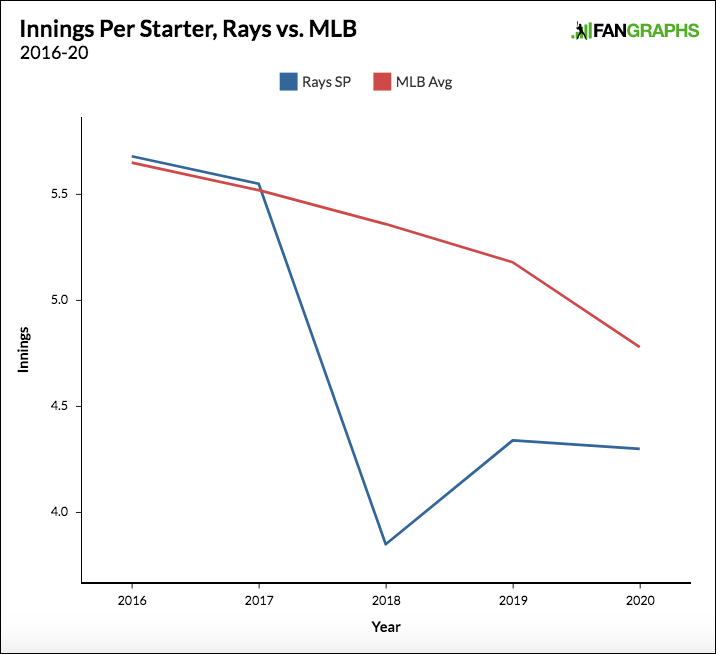
The average innings per start across MLB has been in decline for a few years now. The last time starting pitchers threw more innings than they did the previous season was in 2014, at 5.97 per start. Just five years later, that number had dropped all the way to 5.18, a loss of nearly 400 starter innings league-wide. At the forefront of this were the Rays, who began using openers in 2018 and finished the year with their starters throwing nearly 200 fewer innings than those of any other team.

Two seasons later, a pandemic-shortened season introduced a number of factors — injuries, larger rosters, seven-inning doubleheaders, and more — that helped the rest of the majors take a step toward Tampa Bay’s minimization of the starter’s responsibilities.

With the 2021 season two months away, it seems apparent that those two lines are about to diverge. With roster sizes being trimmed back to 26 and a somewhat more typical offseason hopefully leading to fewer injuries, I would guess that the average starter workload will go up for the first time in seven years. The Rays, however, appear to be heading for a season of pitching management even more extreme than what they had in 2018, after signing two pitchers over the holiday weekend: 40-year-old lefty Rich Hill and 33-year-old right-hander Collin McHugh, each at one year apiece, with the former set to make $2.5 million and the latter $1.8 million. Read the rest of this entry »


Jake Arrieta Is a Cub Again

For the second time in his career, Jake Arrieta will join a rebuilding Cubs team. The soon-to-be 35-year-old righty spent four seasons and change with the Cubs from mid-2013 to ’17, joining a team en route to 96 losses and helping Chicago to four straight playoff berths, including a long-awaited championship in 2016. During that stretch he emerged as an ace, throwing a pair of no-hitters and winning a Cy Young. This time around, he’s trying to re-establish himself as a reliable starter via a one-year, $6 million deal, that for a team that’s in the process of blowing up the roster that won the NL Central in the abbreviated 2020 season.

The contract is a big step down from the complex three-year, $75 million deal Arrieta just completed with the Phillies, but then he struggled mightily while trying to live up to that contract. Over the course of those three seasons, he delivered a 4.36 ERA, 4.55 FIP and 3.7 WAR in 352.2 innings, making a full complement of starts only in 2018. The recurrence of a bone spur in his right elbow, which had bothered him the previous year as well, limited him to 24 starts in 2019 before he underwent season-ending surgery in mid-August. While Arrieta could have opted out and sought a larger payday at that juncture, it clearly wasn’t in the cards for him amid the diminishing returns.

Those returns continued to diminish in 2020, as Arrieta made just nine starts before being shut down in mid-September due to a right hamstring strain. His 5.08 ERA was his highest mark since 2012, when he was still trying to find himself with the Orioles; the season was his fifth straight with an ERA that increased from the previous year. He broke a similar streak in the FIP department with a 4.66 mark, down from 4.89 in 2019 and in the vicinity of league average (101 FIP-). Read the rest of this entry »


Grayson Rodriguez on His Changeup, Which Isn’t a Screwball (Or Is It?)

Grayson Rodriguez is a top-100 prospect thanks to a four-pitch mix that includes an explosive high-spin heater. As electric as that mid-90s offering is, it’s not the most eye-catching item in his arsenal. The Orioles’ top pitching prospect throws a changeup with screwball characteristics. While not technically a screwball — Juan Marichal and Mike Norris come to mind — the movement profile is anything but run-of-the-mill for a right-handed change. At age 21 with a bright future ahead of him, Rodriguez is armed with a unique pitch.

———

David Laurila: You’ve developed a good changeup. What makes it effective?

Grayson Rodriguez: “The way I like to attack with my fastball sets up my changeup well, how it moves and what it looks like out of my hand. As I’ve learned how to throw it with TrackMan and Edgertronic cameras, I’ve figured out a way to get the ball to spin exactly how I want it to. Those things have really helped me, because my changeup is different from a lot of other guys’. It’s almost like a screwball. Hitters don’t see it as much as they do a normal changeup.”

Laurila: How do you get the screwball action?

Rodriguez: “At my release point, my wrist is pronating a lot more than normal. If you break down my hand movement and wrist position — break everything down in slow motion — it’s really turning over. It’s kind of an aggressive, violent turn-over. You don’t see that very often. My ball, on an axis, is spinning at about 3 o’clock to 3:30. If you were to picture that on a clock, it’s almost like a left-handed slider, or a left-handed curveball.” Read the rest of this entry »


The Way Out

Editor’s note: This story includes a discussion about attempted suicide and mental health. If you or someone you know is having thoughts of suicide or is in emotional distress, contact the National Suicide Prevention Lifeline at 1-800-273-TALK(8255) or at suicidepreventionlifeline.org.

I woke up and everything was dark. My eyes were open; it felt like they were open. But I couldn’t see anything. Where was I? What had happened? There was a horrible taste in my mouth, and it was bitterly cold. There were strange sounds, whirring, sharp, mechanical noises, and I could hear large things moving around me. People, maybe, but I couldn’t see them. I couldn’t see anything.

“Can you tell me what the date is today?” a voice said.

So I’m in the hospital, I thought. Okay. I had been in the hospital enough, woken up for enough early-morning blood tests, to know this drill. They have to confirm that you know who you are, that you know where you are, even though they already know who you are and where you are. Okay. Okay. It had been, the night before, January 30th. “It’s January 31st,” I said, with strange difficulty, my voice garbled and unfamiliar.

“It’s February 2nd,” the voice said.

I remembered, suddenly, what I had done. Oh, fuck, I thought, and the darkness in front of my eyes seemed to grow. I couldn’t move, but the void around me was moving, shifting, ready to consume me. There was nothing that could ever exist; there was nothing else to be imagined. There was no way out.

Oh, fuck, I thought, I’m still alive.

***

Six years later — six years to the day — I stare at my computer screen, scrolling through tweets. I am comfortable and warm. I live in a lane house with my partner. We have two cats. My eyes hurt, but only because of the blue light. When I look outside, I see the sun shining; later, I think, when I am done writing, I will go for a walk, and see if there are any new birds at the pond. I’ve gotten very into birds lately, ever since the pandemic started. They are everywhere, these intricate, wonderful little creatures. You just have to take the time to notice them. Most of the time, nowadays, I do. Most of the time, I am happy. Read the rest of this entry »


Oakland Adds Bullpen Depth With Petit and Romo

The A’s continued to stockpile relievers over the weekend, signing free agents Yusmeiro Petit and Sergio Romo to one-year contracts, both for a little over $2 million for the 2021 season.

Petit is a familiar face in Oakland and will likely play a similar role as he has since 2018: pitching mostly mid-leverage innings, mainly in the sixth through eighth innings. He was rarely used for longer than an inning in 2020; the odd shape of the season and the more expansive roster made this less desirable and less necessary. Still, in the past, he’s been one of the closest players to the old long reliever archetype that has largely faded out of baseball.

Most Two-Inning Relief Appearances, Active Pitchers

Among active pitchers, only Stammen has made more two-inning relief appearances. Compared to history, though, 106 appearances only gets Petit into a tie for 323rd all-time, behind the relief stars primarily from the 1960s, 70s and 80s who dominated this usage.

Most Two-Inning Relief Appearances
SOURCE: Baseball-Reference

Read the rest of this entry »


No Joy in Cooperstown Again, as Hall of Fame Induction Festivities Cancelled

The good news is that the Hall of Fame will host an induction ceremony in 2021. The bad news is that it won’t be open to the public, and that just about everything else in connection with the Hall’s annual festivities has been canceled due to the coronavirus pandemic for the second year in a row. The institution announced as much in a press release on Friday:

“Though we are having to cancel our 2021 Hall of Fame Classic Weekend, the Hall of Fame is maintaining its commitment to hold an Induction Ceremony on July 25,” said Jane Forbes Clark, Chairman of the National Baseball Hall of Fame and Museum. “We had hoped to be in a position to welcome loyal baseball fans back to Cooperstown for Induction Weekend, but with the continuing uncertainties created by COVID-19, the Board of Directors has decided not to hold Induction Weekend ceremonies at the traditional Clark Sports Center location. We have prepared alternative plans to conduct our annual Awards Presentation and Induction Ceremony as television events taking place indoors and adhering to all of the required New York State guidelines.”

Induction Weekend was scheduled to take place July 23–26, with the big ceremony at the Clark Sports Center on Sunday, the 25th. Instead, it will be broadcast live on MLB Network that day beginning at 1:30 pm ET.

Though nobody was elected from the 2021 cycle — the BBWAA voters pitched their first shutout since 2013, while the Early Baseball and Golden Days Era Committees had their meetings postponed — last year’s honorees did not get their moment in the Cooperstown sun. Thus, the Hall is making arrangements for Derek Jeter, Larry Walker, Ted Simmons, and whoever will represent the late Marvin Miller (it’s complicated) to receive their plaques and give their speeches via an indoor event that will adhere to all of the required New York State COVID-19 guidelines. Jeter and Walker were elected via the 2020 BBWAA ballot; Simmons and Miller were chosen via the Modern Baseball Era Committee.

Read the rest of this entry »