Archive for Daily Graphings

How They Got There: The 1980-1989 NL Cy Young Winners

If you want to get an idea of how high the bar is to become a Hall of Fame pitcher, consider that only two of the 17 Cy Young winners from the 1980s have been inducted. One, Steve Carlton, is a four-time winner whose career spanned three decades. The other, Rollie Fingers, was one of the better relievers in the game throughout his 16-year career.

Those not in the Hall of Fame had a shorter span of greatness, even if only one year. Temporarily unlocking that Cy Young ability can come down to a change of scenery, a strong supporting cast, or working with a new pitching instructor. In other words, being in the right place at the right time. Here’s a look back at how the NL Cy Young winners of the 1980s were acquired.

1980 NL Cy Young
Rank Name Team Age How Acquired W L IP ERA FIP WAR
CY Steve Carlton PHI 35 Trade (STL) Feb’72 24 9 304.0 2.34 2.42 8.8
2nd Jerry Reuss LAD 31 Trade (PIT) Apr’79 18 6 229.1 2.51 2.99 4.6
3rd Jim Bibby PIT 35 Free Agent (CLE) Mar’78 19 6 238.1 3.32 3.82 2.6

At the time, St. Louis Cardinals lefty Steve Carlton and Philadelphia Phillies right-hander Rick Wise were in very similar situations. Both were All-Stars in their mid-20s who wanted to be paid a higher salary than their respective teams were offering for the 1972 season. Players didn’t yet enjoy a right to free agency. If a player held out for his preferred salary, he might find himself sitting out part of the season, or on the trading block; very rarely did teams submit to a player’s salary demands. Read the rest of this entry »


Rafael Devers, Inefficient Thief

Rafael Devers was an absolute stud last year. He amassed more than 700 plate appearances, the first full season of his career, and put up career highs in pretty much everything. Each of the three slash stats, ISO, wRC+, WAR, defensive value, baserunning runs — seriously, pretty much everything. But I’m not here to talk about that today; we get it, Rafael Devers is great. Instead, let’s talk about another career high: eight times caught stealing.

That sounds bad, right off the jump. Eight times? The rule of thumb with stolen bases is a 75% success rate; succeed any less often, and you’re costing your team value. Take a look at the caught stealing leaderboard, and you can see that most baserunners implicitly get this tradeoff:

Caught Stealing Leaders, 2019
Player Stolen Bases Caught Stealing Success Rate
Whit Merrifield 20 10 66.7%
Amed Rosario 19 10 65.5%
Ronald Acuña Jr. 37 9 80.4%
Jonathan Villar 40 9 81.6%
Victor Robles 28 9 75.7%
Mallex Smith 46 9 83.6%
Rougned Odor 11 9 55.0%
Rafael Devers 8 8 50.0%

Going 50% on your attempts clearly isn’t that. Take a look at this one, from a May 8 game against the Orioles:

Read the rest of this entry »


The Remaking of a Pitcher in the KBO: A Conversation with Josh Lindblom, Part 1

With so much attention focused upon the Korea Baseball Organization right now, it’s helpful to find points of reference, not only players from major league organizations who have gone over to South Korea to escape the Quad A life of bouncing up and down between the minors and majors but also those who have rejoined MLB. One who has done so while upgrading the quality of his baseball life is Josh Lindblom 린드블럼. A 2008 second-round pick by the Dodgers out of Purdue University, the 6-foot-4, 240-pound righty spent parts of four seasons in the majors (2011-14) with four different teams, albeit with diminishing returns. Twice he was traded for former All-Stars, namely Shane Victorino (in a Dodgers-Phillies deal) and Michael Young (in a Phillies-Rangers swap).

After the 2014 season, Lindblom signed with the KBO’s Lotte Giants, and quickly found a level of success that had eluded him stateside. He went 13-10 with a 3.56 ERA (142 ERA+) and 6.5 WAR in 2015 (advanced stats via Statiz), and while he wasn’t as strong in ’16 (10-13, 5.29 ERA, 99 ERA+, 2.7 WAR), he returned to the States on a minor-league deal with the Pirates. Unfortunately, he scuffled during a brief major league stint, and was released in mid-July. He returned to the Lotte Giants on a midseason deal, and helped the team to its first playoff appearance since 2012 by going 5-3, with a 3.72 ERA (136 ERA+) and 2.3 WAR in 72 innings.

From there, Lindblom landed a one-year, $1.45 million deal with the Doosan Bears and emerged as one of the top pitchers in the entire KBO, going 15-4 with league bests in ERA (2.88), ERA+ (175), and WAR (6.8). After re-signing for $1.77 million for 2019, he followed that up with a similarly outstanding campaign, going 20-3, with a 2.59 ERA (164 ERA+) and 6.9 WAR. The Bears, who finished second in 2018 and lost the Korean Series to the SK Wyverns, won it all in ’19, and Lindblom was voted the league’s MVP; in both years, he won the circuit’s Choi Dong-won Award, as the KBO’s top pitcher. Now 32 years old, he parlayed his success abroad into a three-year, $9.125 million-plus-incentives deal to start for the Brewers — the kind of security he’s never had before. Read the rest of this entry »


After Years of Profits, MLB Owners Ask Players to Subsidize Potential Losses

Six months ago, few people likely loved the status quo more than MLB Commissioner Rob Manfred and the group of owners who employ him. Having just completed the third year of a five-year Collective Bargaining Agreement with the players, baseball revenues continued to soar, with estimated profits during those years totaling $3.57 billion even before accounting for the $2 billion windfall from the BAMTech sale to Disney. Players saw their share of revenues shrink over those three years due to stagnant payrolls, and hoped for an opportunity to negotiate a better deal after the 2021 season. After years of huge profits under the current CBA, MLB owners are faced with the threat of potential losses, and according to reports from Evan Drellich, Ken Rosenthal, and Joel Sherman, the owners appear set to ask the players to subsidize those losses.

According to Rosenthal’s report, MLB wants to introduce revenue sharing for 2020 only:

Because games, at least initially, will be played without fans, the players would be asked to accept a further reduction in pay, most likely by agreeing to a set percentage of revenues for this season only.

The idea behind such a plan, from the league’s perspective, would be to protect the players and owners against the economic uncertainty created by the virus.

The players agreed in March to prorate their salaries in a shortened season. Those salaries cover the regular season only, while postseason shares are based upon gate receipts. If the players agreed to a set percentage of revenue, they also would share any additional national TV money generated during the postseason.

Read the rest of this entry »


A Face, a Name, and the Void Between

The frequency of North American baseball players randomly disappearing from their teams reached a peak in the early 20th century. Baseball was a big enough deal that a player going missing was newsworthy, which allowed me to read about their disappearances a century later. At the same time, baseball was not yet a big enough deal that choosing to skip out on your team meant missing a multi-million dollar payday, or the prospect of multi-million dollar legal action brought against you. The phenomenon seemed so common in the early 1900s that the stories of players going missing were often preceded with “another” or followed by “again,” and the tales were plentiful enough to allow for quite a bit of variety in their conclusions.

While the tale of the bridegroom who never came arrived from the late 19th century, the stories that will follow over the next few entries hail from a time when both the American and National Leagues existed alongside a veritable wilderness of competitive minor league teams, constantly moving, changing names, collapsing, scheming, and springing up again. It was the perfect time for baseball players to get lost in intrigue and confusion — and a time in which it was easy for players to be obscured by history. We begin with a story of the latter.

***

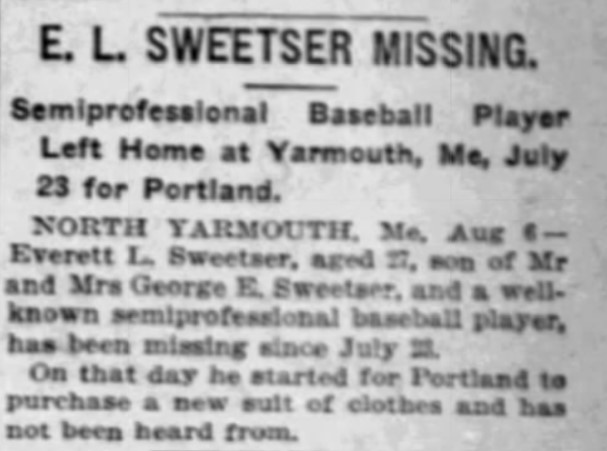
This is the very brief tale of Everett L. Sweetser, a 27-year-old semiprofessional baseball player and resident of North Yarmouth, Maine. By all accounts, Sweetser wasn’t a particularly notable player. In fact, I can find no public connection between his name and the word “baseball” until August 6, 1912: the day that his missing notice was published in the Boston Globe.

Read the rest of this entry »


Pre-Orders for FanGraphs Merchandise End Tonight!

FanGraphs merchandise is still available for pre-order, but time is running out for this round! Pre-orders for all sizes of select merch conclude tonight at midnight PDT, with merchandise expected to ship in early June.

Items available for pre-order include:

Read the rest of this entry »


OOTP Brewers: Brock Solid

So far this season, my OOTP Brewers updates have followed a familiar cadence. Every Monday or Tuesday, I write about some new disaster for the team. Josh Lindblom is out for the year, maybe, or Lorenzo Cain isn’t hitting. Maybe the Mets put up six trillion runs on us, or Luis Urías broke his foot rehabbing his broken hand. You get the idea — these articles has been a struggle to keep a team on the field, serialized.

This week is going to be about whatever the opposite of that is. The Brewers have played six games since my last update. They’ve won all six, taking them to 23-18 on the year. The contributions have come from everywhere — the team allowed only 15 runs in those six games while scoring 32. Josh Hader faced 20 batters and struck out 12. This is the Brewers team the Milwaukee brass hoped for in the offseason; pitching lines that look like this:

Oh yeah — Corey Knebel is back. The above game was his first one back in the majors, but he looked fine during his rehab assignment as well. In the meantime, we’ve added Tony Cingrani on a minor league contract, and after a few tune-up appearances, he’ll be ready to bolster the big league bullpen whenever needed. Mystery man Sam Pierron is still going back and forth with me about money, but between Knebel and Cingrani, the reinforcements have arrived. Read the rest of this entry »


Sunday Notes: Seattle’s Evan White Angles Up (Sort Of)

Evan White was playing in his first full professional season when I interviewed him 24 months ago. I went on to write that White “not only bats right and throws left, he’s a first baseman whose athleticism and offensive skill set are more akin to that of a center fielder.” My esteemed colleague Eric Longenhagen had recently called the University of Kentucky product “perhaps the 2017 draft’s most unique player.”

Two years later, White is No. 4 on our Mariners Top Prospects list, and No. 64 on our 2020 Top 100 Prospects list. Moreover, he’s projected to begin the season — assuming there is a season — in Seattle’s starting lineup. If so, he’ll have leapfrogged Triple-A. White spent last year at Double-A Arkansas where he slashed .293/.350/.488, with 18 home runs in 400 plate appearances.

The introduction to the 2018 interview also included the line, “Last June’s 17th overall pick doesn’t project to hit for much power.” As evidenced by the aforementioned output, that’s now looking to be untrue. White’s swing is proving to be more lethal than expected — this despite his not having retooled it toward that end.

“I’m just continuing to learn, continuing to grow,” White told me prior to spring training’s being shut down. “My approach is the same — it’s to stay middle of the field — but my timing is more consistent. If I’m late, I’ve got to rush, and when I’m rushing I’m not making as good decisions because I’m not seeing the ball as well.”

Seeing the ball has never been much of an issue. Along with possessing solid bat-to-ball skills, the Columbus, Ohio native strives to be a selective hitter. That’s not by chance. As noted in the earlier piece, White has a strong appreciation for what Joey Votto brings to the table in Cincinnati. Read the rest of this entry »


Cooperstown’s Sacrifice Amid the Coronavirus

“I would tell you very quickly it was scaled down to, ‘It’s either July 26 or it’s 2021,” said Tim Mead, president of the National Baseball Hall of Fame in discussing the institution’s decision to postpone this year’s Induction Weekend due to the impact of the COVID-19 pandemic. “There’s a standard and the quality associated with that ceremony and the Induction Weekend, and we weren’t going to trim any of it for any reason just to make sure it happens.”

I spoke to Mead on Sunday, May 3, four days after the Hall officially announced that there would be no induction ceremony this year and 370 days after he was announced as the seventh president in the institution’s history. In the days before and since, I also spoke to Cooperstown’s past and present mayors as well as a couple of local small business owners for whom the cancellation is just the latest of several blows suffered amid a shutdown that threatens to wipe out the entire tourist season.

The Hall itself has been closed since March 15, and the streets of the town of around 1,800 are deserted, that despite relatively few residents in the town and its surrounding areas falling ill from the virus. The underlying rural/urban tensions caused by the shutdown are playing out all over the country right now, but there may be no place where the contrast is as stark as this idyllic and storied village, which annually draws half a million visitors from all across the U.S., and even internationally, for its baseball-related attractions.

What Mead conveyed in our conversation is the Hall’s sense of responsibility in announcing its decision just shy of three months ahead of the actual weekend. The handwriting on the wall is clear enough, particularly given the complex logistics that underly the celebration. At a time when public health officials are mandating social distancing measures and strongly advising against gatherings of even a handful of people, the thought of tens of thousands of people traveling long distances, convening, and then returning to their communities — potentially furthering the spread of the coronavirus or fueling the second wave of an outbreak — is a nonstarter. Read the rest of this entry »


MLB’s Possible Three Division Monte

With so much uncertainty surrounding the “when” and “if” of a 2020 MLB season, it’s not surprising to see a constant progression of new plans. What it comes down to is that there’s no obvious one-size-fits-all solution that maximizes player and staff safety, baseball quality, the number of baseball games, and league revenue simultaneously. It’s only in such an odd year that things like playing in spring training parks, Arizona/Florida leagues, neutral playoffs, fanless games, and Thanksgiving baseball actually seem plausible rather than falling in the category of whimsical skylarkings.

While states re-opening for business seems like a dubious decision, often running counter to the advice of public health experts, it appears inevitable that many jurisdictions will resume much of their pre-COVID-19 economic activity, though with additional precautions and wariness of others. We’re far from being able to expect normal game conditions, with fans and hot dog vendors, but increasingly, there’s a push to play a large percentage, if not all of the season, in teams’ home parks.

With travel likely to be both more difficult and more perilous, CBS Sports’ RJ Anderson reported a proposal for a three-division alignment for the 2020 season. This would likely involve teams at least starting in just a few stadiums before an eventual move to their home cities depending on the course of the virus. Read the rest of this entry »