Archive for Daily Graphings

Let’s Take a Look at Mike Tauchman’s Breakout

Earlier this month, Jake Mailhot looked at one of the Yankees’ big breakout stories, Gio Urshela. Today, we’ll examine another. If you told many Yankees fans before the season that the majority of Miguel Andújar and Giancarlo Stanton’s playing time would be occupied by Urshela and Mike Tauchman, a lot of them would have thrown in the towel. Of course, that’s when you’d have looked deeper into our crystal ball, and informed them that by August 23, the Yankees would have an 83-43 record with near-certain playoff odds while Urshela and Tauchman have combined for a 5.7 WAR.

It’s no secret that we at FanGraphs like Tauchman; our own Alex Chamberlain has had eyes on the former Rockies outfielder for awhile. Tauchman displayed unique power-contact skills in the high minors similar to those of hitters like Rhys Hoskins and Daniel Vogelbach. But Tauchman is 28 years old, too advanced in age to be considered a bona fide prospect. Prior to 2019, he struggled in his brief major league cameos. Between 2017 and 2018, he hit for a paltry .153/.265/.203 with no home runs in 69 plate appearances. With Colorado grooming younger outfielders like David Dahl and Raimel Tapia for the future, and with Charlie Blackmon solidly entrenched in a starting spot (not to mention Ian Desmond), Tauchman didn’t seem to have a future with the Rockies. Read the rest of this entry »


Bellinger, Devers, and MLB’s Most Improved Position Players

FanGraphs contains multitudes. Multiple flavors of Wins Above Replacement — one in which the pitching component is driven by FIP, the other by actual runs allowed (RA9-WAR) — for one thing. Multiple projection systems (Steamer and ZiPS) and ERA estimators (FIP, xFIP, SIERA). Multiple measures for defense, pitch selection, and plate discipline, borne of different data feeds. Multiple ways of measuring playoff odds and projected won-loss records. Multiple depth charts, now that we’ve brought Roster Resource on board. There’s a lot of cool stuff… if you know where to look.

One of the cool but relatively new and lesser-known features is our Season Stat Grid, introduced just over a year ago, and in the planning stages for longer (I know that I’m one of the people who lobbied for the tool). The grid allows the user to view 11 year worth of data in a single category, and to track and rank year-to-year totals and changes based on thresholds of plate appearances and innings. It’s hours of fun, and occasionally fuel for an article. So after highlighting the exceptional, breakout season of Rafael Devers and noting that — at the time it was written, at least — he had the majors’ largest year-over-year improvements in batting average, on-base percentage, and WAR, while ranking second in his gains in wRC+ and fourth in slugging percentage, I figured the topic was worth a league-wide look.

Towards that end, I chose 10 statistical categories where we might look for significant changes, namely the aforementioned five plus walk and strikeout rates, out-of-zone swing rate, fielding (UZR plus positional adjustment, if any) and, for a nod towards win expectancy, Clutch. To qualify, players had to reach 400 plate appearances last year and 300 thus far this year. I then took the top 30 players whose changes went in the right direction (higher in all cases except for strikeout and chase rates), awarding 30 points for first place, 29 for second, and so on. When two or more players were tied — even if it was just a virtual tie, where we can’t see what’s to the right of the displayed decimals — I split the points evenly among the tied; for example, James McCann and Yoán Moncada, who have increased their batting average by 66 points apiece, occupy the third and fourth spots and thus each get 27.5 points. I doubled the impact of WAR and wRC+ (60 points maximum), even though components of those are included elsewhere within the survey, on the belief that those two stats drive the lion’s share of our understanding as to who has improved.

Read the rest of this entry »


Finding a Beltway Baseball Comp for Renato Núñez

Every year, the Orioles and Nationals play games against one another, though the number actually varies depending on baseball’s rotational interleague schedule. These meetings are referred to as the “Beltway Series,” paying homage to the defining characteristic of the region: traffic on I-495 (the Capital Beltway) and I-695 (the Baltimore Beltway). While I am (mostly) kidding, I still sometimes wonder why there isn’t a better name for this geographical rivalry.

Set to factor in that series is Renato Núñez. The Orioles’ slugging designated hitter is having quite the year. Through games on Wednesday, he has more home runs than Bryce Harper, having hit 28 through his first 488 plate appearances. There’s not much beyond the power, though. He’s slashing .240/.309/.478 with a 103 wRC+, and due to his defensive limitations, he’s been held to just 0.7 WAR.

As we know, the Orioles are not in a position of contention this season, which is exactly why a guy like Renato Núñez can get play in the range of 150 games. All teams look for players with untapped potential. Not all teams, however, can give these players the plate appearances necessary to grow into the productivity that potential suggests. But the Orioles can, and Núñez is the beneficiary.

Núñez’s seemingly odd season had me hunting for a comp. What might a player with this skillset — good power, not a lot of contact, below-average discipline — look like in the future? What can the Orioles expect from Núñez in three, four, or five years?

To answer this question, I downloaded every individual player season with at least 300 plate appearances over the last five years, including 2019. I filtered my search using three conditions: a walk rate between 7-8%, an isolated power above .200, and a batting average between .230 and .250. In my mind, these three results-based constraints accomplish two goals: they limit my search to just a handful individual player seasons and allow me to find players who have similar intrinsic characteristics to Núñez’s. Read the rest of this entry »


Patrick Corbin Slows the Tempo

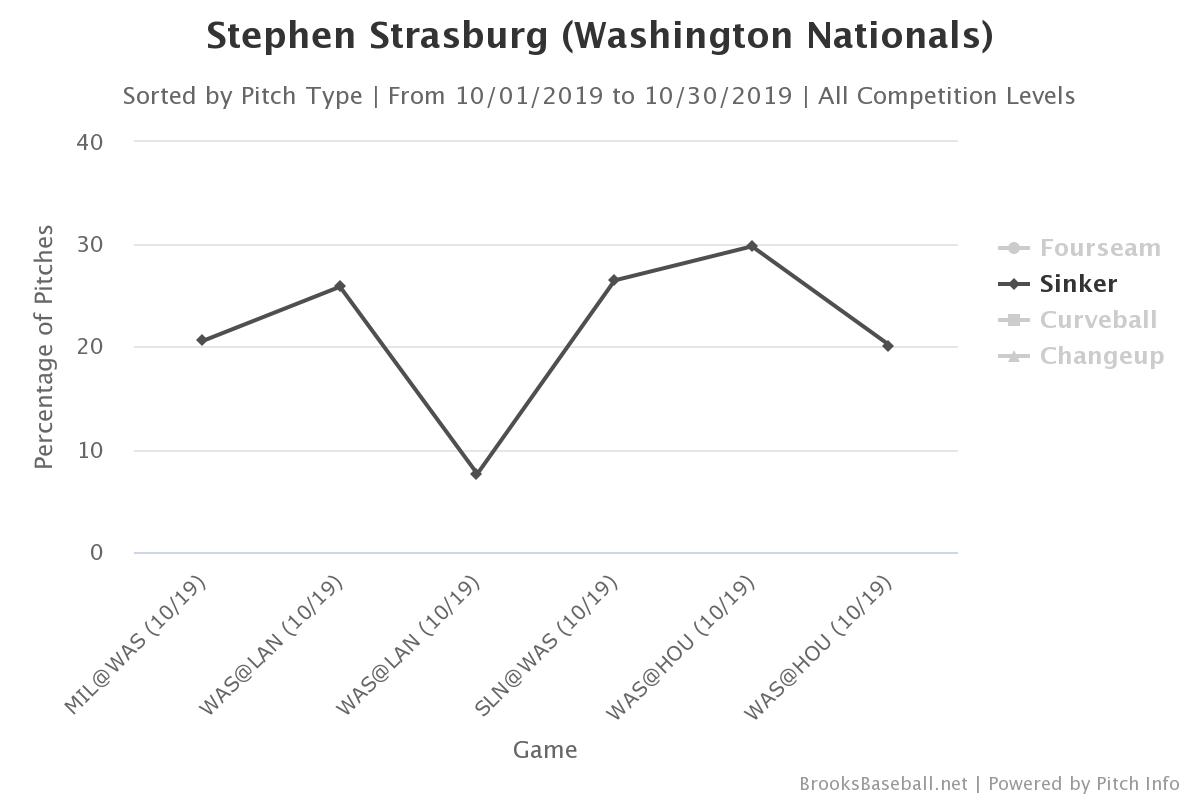
In my mind, Patrick Corbin is an archetype. He’s the idealized sinker/slider guy, pairing the two pitches so masterfully that batters can’t figure out which one is coming until it’s too late. His breakout in 2018 was foreshadowed by a solid 2017, when he upped the percentage of sliders he threw from 26.5% to 38%, and he hasn’t looked back since. After signing with the Nationals as a free agent, he’s delivered another solid season, sinking and sliding his opponents into oblivion, with a few four-seamers thrown in to keep batters honest.

That’s not all he does, though. That’s the business side of Patrick Corbin’s pitching, but sometimes he likes to goof around. Take a look at this ludicrous curveball he threw Manny Machado in June:

That is absolutely nothing like every other pitch Corbin throws. Machado’s not even mad; he’s impressed:

Yes, Patrick Corbin has a slow curve, and it’s a joy to watch. Read the rest of this entry »


Pitch Framing Park Factors

Back in March, we introduced catcher framing numbers on FanGraphs. Not long after, Tom Tango noted in a blog post that pitch framing numbers should be park-adjusted since pitchers and catchers in some parks are getting more strike calls (relative to Trackman’s recorded locations) than others.

We can see this in the graph above, which is based on called pitches within a 3.5 x 3.5 inch area in and around the strike zone. There are, on average, 64 pitches per game that meet this criteria so this graph essentially shows how many extra “framing” strikes pitches and catchers were assigned in each park per game. Put another way, this tells us how many more strike calls they received than we’d expect based on the recorded locations of the pitches. We’d certainly expect some spread in the results for home team pitchers and catchers, since some teams have better framers than others, but we shouldn’t see such a large spread for road pitchers and catchers, whom we’d expect to have essentially average framing talent. We also see that there’s a strong positive correlation between extra strikes for the home team and extra strikes for road team, suggesting that the park itself plays a role. There are two big outliers here — Sun Trust Park and Coors Field, both in 2017. Something must be amiss at those parks and we should control for it when calculating our framing numbers.

Adjusting Pitch Framing Numbers for Park Effects

Just as when constructing other park factors, we need to be careful to account for the quality of the players playing in each park. We’ll need to account not only for the pitchers and catchers who played in each park but also for the batters, some of whom have fewer strikes called against them. What we need is essentially a WOWY (with or without you) calculation where we find each park’s tendency to yield strikes, controlling for the pitcher, catcher, and batting team. In practice, it’s easiest to do this with the help of a mixed effects model. We can take the mixed-effects model we used to estimate pitcher and catcher framing and simply add random effects for the ballpark and batting team.

After adjusting for the park and batter effects that we find, we can take another look at the graph that led us here and compare home and road framing at each park, but this time with park-adjusted numbers.

This looks much better! With park effects removed, we still have a significant spread in home-team framing but a relatively small spread in road-team framing.

New Pitch Framing Numbers

For most catchers, our park adjustments make little difference. The graph below plots the new framing runs for catcher-seasons against the old framing runs with 2017 performances shown in red.

The tables below show the team-seasons, catcher-seasons, and catcher careers most affected by the park adjustments.

Top 5 Team-Seasons in Framing Runs Gained
Team Season Old FRM New FRM Park Bias
Rockies 2017 -26.2 -9.6 -16.6
Rangers 2017 -25.8 -12.2 -13.6
Blue Jays 2010 -0.5 10.9 -11.4
Mariners 2017 -8.2 3.0 -11.2
Tigers 2017 -24.1 -13.1 -11.0

Bottom 5 Team-Seasons in Framing Runs Gained
Team Season Old FRM New FRM Park Bias
Braves 2017 29.3 9.4 19.9
Orioles 2017 13.2 -0.4 13.6
Braves 2009 47.0 38.2 8.8
Brewers 2010 44.4 35.9 8.5
Pirates 2008 -51.7 -59.9 8.2

Top 5 Player-Seasons in Framing Runs Gained
Player Season Old FRM New FRM Park Bias
Jonathan Lucroy 2017 -22.1 -10.1 -12
James McCann 2017 -16.2 -8.1 -8.1
A.J. Pierzynski 2010 -5.8 2.2 -8.0
Mike Zunino 2017 2.4 10.2 -7.8
John Buck 2010 -19.1 -11.7 -7.4

Bottom 5 Player-Seasons in Framing Runs Gained
Player Season Old FRM New FRM Park Bias
Tyler Flowers 2017 31.9 20.5 11.4
Austin Hedges 2017 21.8 12.8 9.0
Kurt Suzuki 2017 -2.9 -10.9 8.0
Welington Castillo 2017 1.6 -6.3 7.9
Yadier Molina 2017 8.7 1.8 6.9

Top 5 Player-Careers in Framing Runs Gained
Player Old FRM New FRM Park Bias
A.J. Pierzynski -41.9 -21 -20.9
A.J. Ellis -77.0 -59.9 -17.1
Joe Mauer 13.7 27.5 -13.8
Jonathan Lucroy 126.9 139.6 -12.7
Wilin Rosario -39.5 -29.3 -10.2

Bottom 5 Player-Careers in Framing Runs Gained
Player Old FRM New FRM Park Bias
Brian McCann 181.9 162.0 19.9
Welington Castillo -52.0 -66.0 14.0
Miguel Montero 127.0 113.6 13.4
Wilson Ramos 21.2 8.3 12.9
Ryan Doumit -156.7 -165.7 9.0

Did the Cardinals Get Robbed of a Chance at a Win?

On Wednesday night, the Cardinals trailed the Brewers 5-3 entering the eighth inning. As the home team, St. Louis went back out on defense to start the frame. Lefty Tyler Webb retired the Brewers on eight pitches. Before the Cardinals could take their turn at the plate in the bottom of the eighth, however, it started raining. Confusion and more rain ensued.

Now, the Brewers had come up to bat in the top of the eighth, so the Cardinals were supposed to get a chance to at least finish the inning, right? That’s what the press box in St. Louis was originally told, but that statement was clarified.

As for the rule, MLB’s website states:

If a regulation game is terminated early due to weather, the results are considered final if the home team is leading. If the home team is trailing, the results are considered final if the game is not in the midst of an inning when the visiting team has taken the lead.

The rule is fairly clear that since the Brewers began the eighth inning with the lead, once the game is terminated, the Brewers get the win. A suspension to pick up the game at a later date wasn’t an option for this game. As Derrick Goold indicated above, general practice is to let the home team get as many cracks at scoring as the visiting team. If the game were to continue, the teams would have had to wait until at least 11:30 or 12, when the rain got lighter and died down. The Cardinals remained at home for their next game while the Brewers made the trip back to Milwaukee with an offday before their game on Friday. While I can’t say whether or not the result was fair, or look up all the instances in which games were delayed and then continued and to which this rule might have been applied, we can go back and look at all the instances when a game was terminated. Read the rest of this entry »


The Twins’ Latest Hitting Machine

Once upon a time, it was not uncommon to see a batter’s walk rate sitting higher than his strikeout rate. In the early 90s, more than a quarter of qualified batters had a walk rate higher than their strikeout rate. That number has slowly dwindled as strikeout rates have skyrocketed. This season, just two qualified batters have taken a stroll to first more often than a stroll back to the dugout: Alex Bregman and Carlos Santana. If we lower the plate appearance threshold, another batter joins this interesting group of players: Luis Arraez.

Arráez doesn’t hit for power like Bregman and Santana, he simply makes a ton of contact. His 91.9% contact rate leads the majors, just ahead of contact maestro David Fletcher. There’s nothing inherently more valuable about running a walk rate higher than your strikeout rate — there are plenty of players who thrive with a walk-to-strikeout ratio much lower than one — but Arráez’s batting style is a rare sight in today’s era of three true outcomes. His ability to draw a walk does make him stand out against some of the other batters with an aggressive, high-contact approach like Fletcher or Willians Astudillo. The combination of elite bat control with a discerning eye has helped him post the fifth-highest OBP among all batters with at least 200 plate appearances.

Arráez was signed out of Venezuela as a 16-year-old international free agent back in 2013. His ability to consistently put wood on the ball helped him rise quickly through the Twins organization. He peaked as the No. 12 prospect in their system this past offseason, but his lack of power limited his potential ceiling. Still, that didn’t hold him back from posting a minor league slash line of .331/.385/.414. His hit tool is equal parts natural ability and dedication to his craft. Back in June, he spoke with Mariana Guzman of Twins Daily about his pre-game routine: Read the rest of this entry »


Bo Bichette Is Walloping the Baseball

While it did keep the record-setting streak of days with a position player pitching alive — it’s now up to seven, running the already record-level total number of such appearances this season to 80 — Richard Ureña‘s mop-and-bucket outing at the tail end of the Blue Jays’ 16-3 loss to the Dodgers was not the most notable thing about Tuesday night’s game. No, that would be Bo Bichette’s utter annihilation of two Clayton Kershaw pitches, one on the ace southpaw’s second pitch of the game, and the other in the sixth inning, before things really got out of hand:

For a brief and perhaps unprecedented moment, my Twitter timeline was unanimous:

Per Statcast, both of Bichette’s blasts came off his bat at 105.8 mph, the first one with a 25 degree launch angle and an estimated distance of 423 feet, the second with a 30 degree angle and a distance of 411 feet. None of those numbers were out of character for the 21-year-old rookie shortstop, who at this writing has clubbed seven homers in 103 plate appearances since being recalled on July 29, in a move that appeared timed to take some of the sting out of Marcus Stroman being traded to the Mets. Among Bichette’s blasts are a 107.5 mph, 441-footer off the Yankees’ Domingo Germán and a 107.7 mph, 436-footer off the Royals’ Jakob Junis, the latter his first in the majors on August 1. This was his first multi-homer game, and his first homers off a pitcher who had made an All-Star team or won a Cy Young award, though, so it counts as a momentous occasion.

Read the rest of this entry »


The Retooled Mike Clevinger Is Something to Behold

Before Cleveland Indians right-hander Mike Clevinger exited his second start of the season with an injury, he was throwing some of the most dominant stuff in baseball. He left his April 9 start against the Toronto Blue Jays with five innings of one-hit baseball under his belt, and over his first two starts combined, he had allowed no runs, surrendered just four walks, and struck out 22 batters in 12 innings. A strained muscle in his upper back, however, meant that the Indians would have to wait more than two months for him to return to the mound. In his first two starts back in June, he got roughed up to the tune of 12 runs allowed on eight hits, six walks, and nine strikeouts in 6.1 combined innings. Then the calendar turned to July, and Clevinger turned back into the version of himself he teased in April.

Since July 1, Clevinger has made nine starts. He has thrown 54 innings, struck out 74 batters, walked just 14, and allowed four home runs. His ERA of 2.17 in that timespan ranks 10th in the majors, but his 2.33 FIP is second, and his 2.55 xFIP is first. That kind of performance is no mere return to being healthy for the 28-year-old veteran; It’s the best he’s ever looked.

Clevinger finished his first three seasons in the big leagues with FIPs of 4.86, 3.85 and 3.52, respectively. In 72 innings this season, he’s lowered that all that way down to 2.47. That figure is weighted down by the lowest walk and home run rates of Clevinger’s career, but mostly, it’s down because his strikeout rate has skyrocketed. After entering 2019 with a career K/9 rate of around 9.5, he’s elevated that figure to over 13 to this point in the season.

That explosion in strikeouts coincides with a major step forward for Clevinger’s stuff in just the past year or so. Over the past three years, he has seen his average fastball velocity increase each season — not an easy task, considering that he didn’t break into the majors until he was 25 years old. Most pitchers lose a tick or two in velocity between their mid and late 20s, but Clevinger has gone the other direction. According to Statcast’s pitch data, from the beginning of the 2017 season until June 9, 2018, Clevinger registered an average fastball velocity of at least 94 mph in just two games, both of which were relief appearances. In starts, he tended to average 92-93 mph. Then, on June 14, his average fastball velocity spiked to 94.9 mph in a seven-inning, one-run, 10-strikeout performance against the White Sox. His average velocity was above 94 mph in three of his next five starts, and reached at least 93.9 mph in each of his final nine starts of the season. In those nine starts, his ERA was 2.03, and he struck out 63 batters in 53.1 innings. Read the rest of this entry »


How to Dance with a Little League Umpire

Editor’s note: Justin has previously written at The Hardball Times, among other outposts of the baseball internet, including The Good Phight and Baseball Prospectus. He’ll now add contributing to FanGraphs to that list. We’re excited to welcome him.

This dance only has a couple moves, and they go like this:

One partner, the coach, mutters or shouts an invitation for the other partner, the umpire, to dance with him. The umpire should not — and likely won’t — accept.

Not at first.

He must listen, certainly, and he must hear. He must register every mean or vile thing that comes out of the coach’s mouth. But he must also not hear them. Because it is not time to make his move.

Not yet.

It’s still the coach’s turn to dance. He flails his arms. He stomps his feet. And then, finally, the umpire makes two moves — the only two he’s got.

The first one can be a few things: A whisper. A head cock. Maybe a request for the coach to dance a little longer. Just one more step. Just one more word. Just so the ump can see if he’ll do it.

And if the coach obliges, the ump makes his other move.

He points up and out at the horizon, and tells the coach the dance is over. He can go off somewhere in the direction the ump just pointed. It doesn’t matter where. But he’s got to go now. Because the dance is done, even though the music’s still playing.

With all the chest-pounding, finger-pointing, eye-bulging, and hands-on-hipping we see from major league umpires, it can appear a less graceful, a less coordinated dance than it actually is. But down in the little leagues, all of the mental alertness and situational awareness umpiring requires can be, by necessity, more clearly on display. Read the rest of this entry »