Archive for Daily Graphings

COVID-19 Roundup: Flickers of Hope and Even Baseball

This is the latest installment of a daily series in which the FanGraphs staff rounds up the latest developments regarding the COVID-19 virus’ effect on baseball.

The COVID-19 pandemic continues to escalate, with the number of confirmed cases in the U.S. alone above 46,000, and the worldwide total approaching 400,000. For the first time, the single-day death toll in the U.S. topped 100 on Monday, pushing the country’s tally past 500, and already as of Tuesday morning, it’s closing in on 600. Even so, President Trump and his administration spent its time on Monday downplaying the pandemic’s deadliness, expressing impatience with the advice of health experts, including those of Dr. Anthony Fauci, the director of the National Institute of Allergy and Infectious Diseases, and musing about lifting the guidelines for Americans to stay at home and reopening the country in order to stimulate the economy — advice that could further overwhelm hospitals, expand the outbreak, and have deadly consequences for millions.

The news around the country is grim at just about every turn. For glints of optimism, one must look to Italy, where the count of new cases and the daily death toll have both decreased for three straight days — thanks to lockdowns that are much more strict than the patchwork of orders in place across the U.S. That said, the grim tallies in Italy, a country of over 60 million that has reported nearly 64,000 confirmed cases (but perhaps 10 times as many cases overall, with the balance going uncounted due to asymptomatic cases and a shortage of tests) and over 6,000 deaths, are still sobering.

On the baseball front, the quiet from the weekend that Tony Wolfe covered in Monday’s installment has continued, at least as far as MLB is concerned. But roughly 7,000 miles away from New York City, it was another story on Monday night…

Live Baseball in Korea

As was the case with the U.S. and MLB, the novel coronavirus pandemic in South Korea forced the Korea Baseball Organization to postpone its Opening Day, which was scheduled for March 28, that after canceling all of its preseason games. Thanks to the country’s success in flattening the curve through quick intervention, widespread testing, contact tracing, isolation, and surveillance — the last at a level that certainly would not be deemed acceptable in the U.S., to say nothing of the feasibility of the other measures — just 64 new cases were reported on Sunday. Read the rest of this entry »

David Bednar, Brandon Brennan, and Tony Gonsolin on Their Changes and Splits

Pitchers learn and develop different pitches, and they do so at varying stages of their lives and careers. It might be a curveball in high school, a cutter in college, or a changeup in A-ball. Sometimes the addition or refinement is a natural progression — graduating from Pitching 101 to advanced course work — and often it’s a matter of necessity. In order to get hitters out as the quality of competition improves, a pitcher needs to optimize his repertoire.

In this installment of the series, we’ll hear from three pitchers —David Bednar, Brandon Brennan, and Tony Gonsolin — on how they learned and developed their changeups/splitters.

———

David Bednar, San Diego Padres

“I never really had a great feel for a changeup. In 2017, after I first got drafted and was in instructs, I was kind of toying around with it when one of our pitching coordinators pushed me towards Hideo Nomo, who was one of our special assistants and helping out. The coordinator got me throwing in front of Hideo. He gave me a few pointers, and kind of switched up my grip in a way that worked better for me.

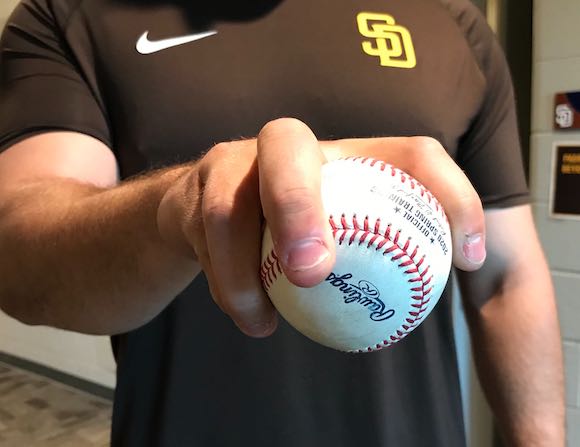
David Bednar’s splitter grip.

“The grip is a slight variation [from Nomo’s splitter]. My two fingers are kind of offset on the seams, so that I have something to pull down on. There’s a little bit of slider action to it at times, but for the most part it’s either straight down, or has a little bit of cut. Read the rest of this entry »


MLB’s Sticky Service Time Situation

While the long-term financial implications of a pandemic for baseball players and owners might not be top of mind for many of us right now, discussions between players and owners on the myriad issues resulting from the season’s delay are taking place right now, and those discussions will have considerable effects on the sport’s future. Last week, among reports of the league potentially skipping June’s amateur draft, service time emerged as the most significant potential baseball issue resulting from COVID-19, particularly if the 2020 season is lost.

The problem is not a simple one, as players generally receive service time for being on a major league roster, with the resulting time accrued inching players closer to larger salaries in the form of arbitration and, eventually, free agency. If a partial season is played, some sort of service time pro-ration based on the actual number of days in a season seems likely. If the season goes 100 days instead of 186, starting every player who sees major league time with 86 days is another potential compromise. Likewise, salaries don’t seem to be a big issue, per Jon Heyman, with pro-ration also likely in that case. But what might happen should no season take place is more difficult to say.

Joel Sherman reported the MLBPA has proposed a full year of service time if players had a certain amount of service time accrued in 2019, with Ken Rosenthal reporting the time period was 60 days, essentially pushing forward service time for players who were on rosters for a significant portion of last season. MLB, for obvious reasons, does not want to provide such credit. Unfortunately, the framing of this issue has been somewhat problematic. In his tweets, Sherman said the following:

Pretty much certain MLB would not give full service without games played/revenue taken in. Remember service time is an MLB lifeblood impacting arbitration, free agency, pension.

While Rosenthal framed the issue in this manner:

The owners, after losing an entire year of revenue, would want relief in a variety of areas, including service time. They would not simply grant a year of service to every player who appeared in a single major-league game in 2019. The union, likewise, knows a certain threshold of service in ’19 would be required, and its proposals reflect that understanding.

Read the rest of this entry »


JAWS and the 2020 bWAR Update, Part 2

Josh Donaldson is one of the game’s elite two-way players, but like the late Ernie Lombardi, he received rude treatment when it came to Baseball-Reference’s latest update to its version of WAR. Last week I began a breakdown of B-Ref’s influx of new data, which resulted in alterations to five different areas of its version of WAR, some aspects of which affect players as far back as 1904 and others as recent as last season. The introduction of detailed play-by-play baserunning and caught stealing data from the 1930s and ’40s, for example, cost Lombardi — a heavy-hitting Hall of Fame catcher who played from 1934-47 — a whopping 7.3 WAR. Donaldson took the largest hit among contemporary players, losing 3.8 WAR via changes in the way Defensive Run Saved is calculated. For the 34-year-old third baseman, the loss adds a bit of insult to the injury of this delayed season, which won’t make it any easier for him to build what is admittedly a long-shot case for the Hall of Fame.

B-Ref’s version of WAR is different from that of FanGraphs, but as bWAR is the currency for JAWS, it’s of particular interest to me. While the Hall of Fame itself is as closed right now as any museum due to the COVID-19 pandemic, Hall arguments are never out of season, nor is taking stock of greatness, particularly when it provides a diversion from considering stockpiles of toilet paper and shortages of N95 masks. B-Ref’s adjustments are hardly unprecedented for the site, which adds new data annually. The earliest boundaries for game logs and play-by-play data have moved backwards by decades over the years, for example, and last year’s big-ticket addition was a major update to catchers’ defensive statistics for the 1890-1952 period.

Reordered for their chronological effect, this year’s update has incorporated the following:

  • New Retrosheet Game Logs (1904-07)
  • Caught Stealing Totals from Game Logs (1926-40)
  • Baserunning and Double Plays from play-by-play data (1931-47)
  • Defensive Runs Saved changes (2013-19)
  • Park factor changes (2018)

As I noted last week, the career WAR totals of 11 Hall of Fame position players swung by at least 2.5 WAR, some positive and others negative. Where Lombardi was the biggest loser in that update, shortstop Arky Vaughan was the biggest gainer from among the enshrined; his 5.1-WAR gain was the second-largest swing overall, 0.1 less than that of three-time All-Star Lonny Frey (a teammate of Lombardi’s with the Reds from 1938-41). Because nobody needed 3,000 words from me in the first installment of a series as we await the green light on the 2020 season, I didn’t publish the table of the position-by-position changes or delve into the effects on other groups of players, such as Donaldson and his contemporaries. This time around, we’ll do just that. Read the rest of this entry »


Let’s Manage the Brewers!

There’s no baseball right now. Heck, there’s no anything right now; Joe Buck is offering to do play-by-play of domestic chores:

But if you’re in the mood for some baseball, you’re in luck. Brad Johnson of RotoGraphs has organized a 30-person Out Of The Park league with human managers for every team. Partially, some of the fun will be providing updates and talking about team strategy. Candidly, we’re all looking for something to write about, and describing the machinations of our very own team is too good to pass up.

But we can do more. I’m managing the Milwaukee Brewers. Rather than simply tell readers what my team is doing, I’m opening it up to the crowd. We, as a FanGraphs community, will be running the Brewers. Maybe it will work well. Maybe it’ll be a disaster. Either way, though, I think it’ll be a lot of fun.

I’m going to lay out a few ground rules. You’re not getting to vote on whether we should trade Christian Yelich for a bag of nickels. We shouldn’t. There’s no point in taking a vote on that. And we’re not going to legislate the overall direction of the team — we, the Brewers front office, are going to operate under budget constraints while attempting to make the playoffs in a competitive NL Central. Read the rest of this entry »


COVID-19 Roundup: The Service Time Elephant in the Room

This is the latest installment of a daily series in which the FanGraphs staff rounds up the latest developments regarding the COVID-19 virus’ effect on baseball.

This is the beginning of our second week of daily updates on the COVID-19 pandemic, and around the world things have only continued to escalate. Just on Sunday, it was reported that Rand Paul became the first United States senator to test positive for the virus, news he apparently received just after going to the gym while awaiting test results; four other Republican senators, including Mitt Romney, were forced to self-isolate because of recent contact with Senator Paul. Later in the day, a $1.8 trillion stimulus bill stalled in the Senate, pushing back any action until early this week. Meanwhile, according to The Washington Post, cases in the United States jumped by 38% on Sunday, with the new total exceeding more than 34,000 positive tests and 470 deaths nationwide.

Inside the baseball world, however, it was a strangely quiet weekend. After last week saw a steady flow of news regarding how teams will compensate the most vulnerable people in their employ during the outbreak — that is, stadium workers and minor league players — the weekend was one largely spent watching the dust settle. But that doesn’t mean we didn’t take the time to speculate a bit more about the consequences of what’s to come in the baseball world, as well as some developments on sports overseas.

Without Update on Scheduled Start to Season, Service Time Concerns Increase

Crises such as this one render most other things insignificant. Someone you know or a famous face you recognize gets sick, and suddenly a mortality rate that once seemed low to you is now made real. Big words like “recession” start getting tossed around as even the healthy among us begin losing their jobs en masse. We refresh our news source of choice even more frantically than we already had been, looking for any sign of hope, but every update carries with it more uncertainty, a reminder that the place we’ve wound up in is one we have never been before. Read the rest of this entry »


The Joy of a Kind of, Sort of Old Baseball Game

First of all, thank you for continuing to make FanGraphs a part of your day in this difficult time. In an ideal world, or really just a normal one, you’d be diving into a Positional Power Rankings post, or reading a few notes from the field, or perusing something else to get you jazzed for would have been Opening Day on Thursday. Eleven days ago, I had plenty of ideas for that type of content. Suffice it to say, an article about an old ballgame I found on YouTube wasn’t one of them. Still, you’re here, and you’re probably seeking some small semblance of normalcy; I want nothing more than to do the sorts of routine, mundane things I normally wouldn’t have given a second thought. Something like a mid-June baseball game between the Colorado Rockies and the Miami Marlins. That’s some normal, forgettable stuff right there.

So let’s make the best of it. Let’s climb on the way-back machine and travel to a simpler time: June 11, 2015. You remember all the way back then? The ball hadn’t yet been juiced. The Royals were the best team in the American League. Donald Trump was still a few days away from riding down his golden escalator. Matt Harvey was one of the best pitchers in baseball. An age, and just five years, ago.

On that night, the Rockies visited the Marlins. There is nothing remarkable about this game. These were two bad teams already buried in the standings. David Phelps and Chris Rusin were the starting pitchers. There were something like 500 people in the crowd, each going through the motions of a typical early summer evening at the park.

A big part of the fun when you watch an old game is the disorienting collision between what we know now and what we knew then. This game was played the year after Giancarlo Stanton had his face fractured by an up and in fastball. I remember the incident well, as you might. I also knew, but had totally forgotten, that for a time, he wore a personalized helmet with a wire flap in the shape of a “G” meant to protect his jaw. A very slim fraction of the baseball-playing population could pull that off without looking like a dork, but Stanton happens to be just such a player. Read the rest of this entry »


Even in Baseball, Sometimes Distance Is the Best Thing for Everybody

At first you might think baseball is the safest place to be right now. The game is defined by distance: The 90 feet of chalk to first base, the fluctuating placement of an Atlantic League pitchers mound, the 500 feet between Vladimir Guerrero Jr. and a poorly located fastball.

On the field, everybody’s standing far more than six feet apart. But inevitably, distance closes as players congregate at home after a dinger or outfielders perform a choreographed jumping move following a win. Or, most obviously problematic, fans cluster together in the heat of summer, soaking in fluids, inhaling each other’s breath, and scraping against each other’s knees as they make their way to their seats, stepping in puddles of spilled beer and peeled-off band-aids. Really, it’s kind of surprising baseball wasn’t the epicenter of a global pandemic rather than a victim of its cultural impact.

Humans are drawn to each other. Not always, and not everybody, but before, during, and at the end of the game, we come together to celebrate or commiserate or get on the subway. In times like these, in which the future of baseball is left ambiguous given the alarming and very real nature of a planet-wide crisis, it becomes clear that on occasion, distance can be the best thing for us.

As common a tactic as the mound visit is, not having one can be just as valuable. Baseball is full of pitchers who understood the value of distance, and their instinct to maintain it has allowed them to find great success. Read the rest of this entry »


Projection Hindsight Is 20/20 and It’s Totally Awesome

One of the things you have to get used to when you work with projections is being wrong. Like, All. Of. The. Time. While I’d like to believe that the projections are accurate and it’s just real life that mucked things up, that isn’t quite how they work. There are always events you didn’t see coming, assumptions you made erroneously, and just plain old irreducible error, all of which are going to thwart you.

On a basic level, you’re supposed to be wrong. Imagine a world in which you knew, for an exact fact, that every team was a coin flip to win every game. With this perfect knowledge, you’d still expect nearly a quarter of the league to win either 73 games or fewer, or 89 games or more, through nothing but luck. For the math-inclined, this is a hypergeometric distribution, not a binomial one; the coin flips are not independent because the win totals will still add up to 2,430 and one team’s win invariably is another team’s loss. Here’s a quick table for some of the win totals, showing the probability of a team winning exactly X games and how many of the teams you’d expect to have won up to X games:

Win Probabilities, Major League Coin-Flipping
Wins Probability 1-in-X Chance of Occurring Cumulative
70 1.4% 73 5%
71 1.8% 56 6%
72 2.3% 44 9%
73 2.8% 35 12%
74 3.4% 29 15%
75 4.0% 25 19%
76 4.6% 22 24%
77 5.2% 19 29%
78 5.7% 18 35%
79 6.1% 17 41%
80 6.3% 16 47%
81 6.4% 16 53%
82 6.3% 16 60%
83 6.1% 17 66%
84 5.7% 18 71%
85 5.2% 19 76%
86 4.6% 22 81%
87 4.0% 25 85%
88 3.4% 29 89%
89 2.8% 35 91%
90 2.3% 44 94%
91 1.8% 56 95%

As an example, you’d expect 3.4% of those coin flip teams to win exactly 74 games, with 15% of all teams winning up to 74 games.

But we don’t have anywhere near perfect knowledge about how good a team will be. We’re not even in the same zip code as “near perfect”; we just hope to be on the right continent. As a result, our error bars are going to be significantly larger than even the rather erroneous results you still get with omniscient projections. Read the rest of this entry »


Sunday Notes: Mariners Prospect Jarred Kelenic Embraces The Art of Hitting

Jarred Kelenic is No. 11 on our 2020 Top 100 Prospects list, and his bat is the main reason why. As Eric Longenhagen wrote in the 20-year-old outfielder’s scouting profile, “[H]e’s been one of the — if not the — best hitters his age from the time scouts began to see him.” The New York Mets selected Kelenic sixth overall in the 2018 draft out of a Waukesha, Wisconsin high school, then shipped him to the Seattle Mariners in the seven-player mega-deal headlined by Robinson Cano.

Kelenic possesses marquee potential. In 500 plate appearances last year, split between three levels, he slashed a healthy .291/.364/.540, with 23 home runs. Moreover, Kelenic spent the final three weeks in Double-A, a heady accomplishment for a prep-draftee playing in his first full professional season.

I caught up to the fast-tracking youngster two weekends ago as he was taking part in big-league camp. Our conversation began with one of my favorite ice-breaker questions: Do you view hitting as more of an art, or more of a science?

“I think it’s an art,” answered Kellenic. “It’s something that’s developed over time. Kind of like a painting. It takes time to get all of the detail. Hitting is the same way.”

Kelenic credits much of his development to his father, Tom, and to a former minor-league catcher who throws him batting practice back home in Wisconsin. The latter owns STIKS Academy and Sports Training, and according to Kelenic, Sean Smith knows his swing just as well as he does.

Longenhagen called Kelenic’s left-handed stroke “short to the ball,” and the player himself had much the same description when asked to describe his M.O. at the dish. Read the rest of this entry »