Archive for Daily Graphings

Exactly Three Things About Avisail Garcia

A number of years ago, when I had reason to watch the Tigers, I got to see a bit of a young Avisail Garcia. From a young age, Garcia was referred to as “Mini Miggy,” that being a reference to regular Miggy, Miguel Cabrera. Garcia is from the same country as Cabrera, and he played for the same team as Cabrera, and he had a build and swing somewhat reminiscent of Cabrera. You probably know how it’s worked out to this point. Garcia was Mini Miggy in the same way so many small Dominican righties have been Mini Pedros. Cabrera will eventually end up in the Hall of Fame. Garcia was non-tendered by a bad baseball team at the age of 27.

But today is January 15, and these are trying days to be a baseball writer. The start of the season still feels ages away, and there’s only so much one can write about Bryce Harper and Manny Machado. And so, here we are. Garcia is finalizing a contract with the Rays, a one-year contract worth at least $3.5 million and at most $6 million. Garcia doesn’t seem ticketed for a starting role — he’ll probably bounce around, getting opportunities to hit against lefties. The better he does, the more he’ll play, but he’s joining a team with too many talented players for there to be a long leash. Just because Garcia will start the season in Tampa Bay doesn’t mean that’s where he’ll end it.

The Rays have wanted a right-handed hitter. I assume they wanted a better right-handed hitter. But this is the right-handed hitter I’ve been given a reason to write about right now. So if you’ll join me, I have three things I’d like to share with you. Three fun facts, if you will, three ways in which Garcia is unusual.

Read the rest of this entry »


Steve Stone Has a Lot of Opinions on Pitching

Steve Stone knows a lot about pitching. A savvy right-hander for four teams from 1971-1981, he hurled 43 complete games, and augmented a 101-93 record with a rock solid 3.97 ERA. Stone was especially stellar in the 1980 season, garnering 25 wins for the Baltimore Orioles and taking home the American League Cy Young Award.

He doesn’t lack for opinions. Given his current job, he’s not supposed to. The 71-year-old has been in the broadcast booth for 30-plus years, the last 10 of them with the White Sox. As fans of Chicago’s South Side team can attest, Stone knows his stuff, and he’s not shy about sharing it. Agree with him or not, he’s rarely boring.

Stone sat down for a wide-ranging interview — one that offered some blunt commentary on players and trends alike — during a visit to Fenway Park midway through the 2018 season.

———

Steve Stone on learning as a young pitcher: “I pitched with Juan Marichal and Gaylord Perry. I pitched with Jim Palmer and Mike Flanagan. I pitched with Wilbur Wood. One thing I learned … I was very young when I was with Marichal and Perry. I didn’t have Hall of Fame talent, so it was hard to assimilate what they had to show me. Plus, Gaylord wasn’t forthcoming about anything that made him the pitcher he was. Marichal probably would have been, had I been able to understand how he did certain things.

“Perry threw a spitter. He wasn’t going to share that. Not unless I brought $3,000 to the park. That’s how much he said he’d charge to teach me the spitter. I was taking home $8,500. I didn’t want to give him 40% of my yearly take-home pay to try to learn a pitch that very few people can master. Read the rest of this entry »


The Specter of Jason Heyward’s Contract Looms Over Manny Machado

Three winters ago, Jason Heyward was a young free agent, a relative rarity as most players make their debuts at 23 years old or older, while many other young stars sign contract extensions prolonging the wait to hit the open market. Heyward debuted at just 20 years old on Opening Day back in 2010 and moved through the arbitration process to become a free agent heading into his age-26 season. There hadn’t been a free agent like Heyward — that young and that accomplished — in more than a decade. Three seasons later, Heyward has put up just four wins rather than the four wins per year that was expected. And now a very similar player in Manny Machado is hitting free agency, and might not be receiving the offers he expected.

While Manny Machado isn’t Jason Heyward, he’s not Bryce Harper either. Machado just put up his best offensive season with a 141 wRC+, while Harper’s season was almost viewed as a disappointment despite him hitting a very similar 135 wRC+. Harper derives nearly all of his value from his bat, while Machado is a more balanced player, getting value from his bat and his glove. In that way, he’s a remarkably similar player to Jason Heyward when the latter hit free agency.

Manny Machado and Jason Heyward Through Age-25
Name PA HR BB% K% ISO AVG OBP SLG wRC+ WAR
Manny Machado 4074 175 7.3 % 16.4 % .204 .282 .335 0.487 120 30.2
Jason Heyward 3429 97 10.8 % 18.5 % .163 .268 .353 0.431 118 25.2

Machado got a one-third season jump on Heyward to begin his career and has almost never been hurt, leading to roughly an extra season’s worth of playing time and a five-WAR lead. Heyward walked more, while Machado hit for more power. Heyward’s baserunning exceeded Machado’s, but his good defense at a more difficult position evened out that baserunning deficiency. When Heyward hit free agency, there were some (including me) who argued that Heyward’s contract floor in free agency should have been something like $160 million, with a reasonable value potentially above $300 million based on his comps at the time. Heyward is the most recent player to point to when it comes to long-term deals not working out, even when signed at a young age. Setting aside that Heyward was hurt almost immediately, that the Cubs changed a swing that worked in 2015, and that Heyward will now be on his third hitting coach in four years, what Heyward really should be is another data point among potential Manny Machado comps.

Earlier this month, I took a look at some comps for Bryce Harper mostly ignoring his MVP season. Near the end of the piece, I noted just how great Harper’s overall comps were.

There are so few players like Bryce Harper in baseball history that it is tough to find a lot of good comparisons. In the past 100 years, there have only been 16 players within five WAR of Harper and also within 20% of his plate appearances. Of those 15 other players, 11 are in the Hall of Fame. Manny Machado is another player on that list, with the others being Jim FregosiCesar Cedeno, and Vada Pinson. The 14 players averaged 37 WAR from age-26 through age-35, with eight of the 11 players who played since 1947 hitting that average.

The same exercise with Machado yields slightly different results due to a difference in plate appearance and Harper’s half a win higher WAR total. We end up with 16 total players, including Machado and Harper. We lose Johnny Bench and Tim Raines, but gain Adrian Beltre, so the number of Hall of Famers is pretty close. Also added to the list is Jason Heyward, but even if we include Heyward’s 4.1 WAR and assume he will not generate any wins over the next seven seasons, the average WAR produced from 26 years old through age 35 is 34.8 WAR. That’s easily $300 million contract territory, and with seven of the 11 players since integration going above that mark, there’s a reasonable chance of hitting that mark with Machado.

On the other hand, if we were to admit that the valuations on Heyward missed the mark from some reason or another — like too much of his value being tied into defense or perhaps that debuting young isn’t as important as we thought — we can take a different angle to get a better perspective on Machado. The last set of comps look at only total value, go very far back in history, and take into account up to seven nearly full seasons for some players. Let’s start by narrowing things down a bit. We’ll look at Machado’s last four years, when he put up a 128 wRC+ and 21.7 WAR from age 22 through his age-25 season. To find good comparable players, we’ll look at non-catching position players from 1973-2008 with at least two wins at 25 years old, a WAR between 18 and 26, a wRC+ between 118 and 138, a positive defensive value, and enough plate appearances to qualify for the batting title. Here are Machado’s comps.

Manny Machado Age-22 Through Age-25 Comps From 26-35
Name PA HR AVG OBP SLG wRC+ Off Def WAR
George Brett 5554 204 .316 .393 .535 148 317.4 14.9 53.7
Scott Rolen 5367 195 .284 .367 .492 124 172.9 131.4 47.6
Derek Jeter 6923 161 .317 .387 .456 125 247.2 -14.1 46.1
Chet Lemon 5059 151 .266 .352 .441 121 112.1 43.6 33.2
Cesar Cedeno 4007 78 .277 .342 .418 113 76.6 -41.2 17.5
Troy Glaus 3485 172 .255 .357 .485 120 81.6 -38.9 15.6
AVERAGE 5066 160 .286 .366 .471 125 168 16 35.6

Through 2008, six players have taken Manny Machado’s path at the same age. Two are Hall of Famers, and Scott Rolen should be a third. Even if we include more recent players who have yet to play through age-35, only Jose Ramirez and Ryan Zimmerman qualify and the latter drops the average by just a couple of wins. Machado is still pretty easily a $300 million value by this analysis assuming we start with a $9M/WAR evaluation. Now, let’s only use the last three seasons, where Machado put up 15.1 WAR and a 125 wRC+. Using similar PA, defense, and age-25 restrictions, with WAR between 12 and 18, and a wRC+ between 115 and 135 yields the following comps at age 26 through 35 years old.

Manny Machado Age-23 Through Age-25 Comps From 26-35
Name PA HR AVG OBP SLG wRC+ Off Def WAR
Chipper Jones 6165 312 .312 .413 .565 150 401 -33 55.3
Scott Rolen 5367 195 .284 .367 .492 124 173 131 47.6
Derek Jeter 6923 161 .317 .387 .456 125 247 -14 46.1
Andre Dawson 5839 260 .285 .332 .502 125 180 7 39.6
Ryne Sandberg 5416 185 .290 .353 .465 122 148 42 38.5
Robin Ventura 5405 223 .267 .363 .465 113 85 114 37.4
Willie Randolph 5500 32 .273 .368 .343 106 43 87 31.8
Eric Chavez 3217 123 .260 .339 .451 108 30 29 16.6
Troy Glaus 3485 172 .255 .357 .485 120 82 -39 15.6
Edgardo Alfonzo 3390 84 .280 .357 .422 106 31 7 14.4
Lloyd Moseby 3237 88 .251 .333 .405 103 25 -42 9.3
AVERAGE 4904 167 .279 .361 .459 118 131 26 32

Another very good group here, but it’s worth noting that Glaus, Chavez, and Moseby all posted WAR totals at age-25 at least two wins lower than Machado last year, so restricting this group further would yield a number even higher than the previous group. It is also worth noting that Jason Heyward, Dustin Pedroia, Nolan Arenado, and Ryan Zimmerman are all recent comps. Pedroia has been worth 33 wins over the past 9 years with Zimmerman worth around 14 over the past eight seasons, and including those two players only drops the average WAR by about one win. Arenado has already put up 11 wins in two seasons, we’ve discussed Heyward, and in the unlikely event that none of the four active players produce anything else, the group average still sits at around 28 wins. We are dealing with a very accomplished group whose average production would be worth well over $300 million over the next 10 years.

When we drop down to just the last two years of Machado, we should see the most pedestrian group given Machado’s lackluster 2017 season. Over the last two seasons, Machado has a 122 wRC+ with 8.8 WAR, so we’ll look at players between 112 and 132 wRC+ with between 7 and 11 wins, leaving the other parameters the same.

Manny Machado Age-24 Through Age-25 Comps From 26-35
Name PA HR AVG OBP SLG wRC+ Off Def WAR
Carlos Beltran 5748 252 .282 .368 .509 129 265.8 21.6 47.2
Alan Trammell 5279 132 .293 .359 .445 121 138 125.5 44.8
Andre Dawson 5839 260 .285 .332 .502 125 180 7.4 39.6
Dave Winfield 6301 256 .290 .359 .496 136 263.7 -112.4 37.6
Matt Williams 5155 261 .278 .327 .503 112 79 76 31.9
Dwayne Murphy 3989 142 .241 .348 .410 116 73 42.7 25.4
Dusty Baker 5407 166 .279 .346 .432 119 114.5 -62.1 24
Coco Crisp 4345 82 .260 .327 .393 96 31.8 20.9 20.3
Eric Chavez 3217 123 .260 .339 .451 108 29.5 29.3 16.6
Raul Mondesi 4571 201 .264 .330 .478 109 61.5 -49 16
Edgardo Alfonzo 3390 84 .280 .357 .422 106 30.5 6.7 14.4
Roberto Kelly 3915 98 .290 .338 .436 105 29.6 -68.5 9.5
Lloyd Moseby 3237 88 .251 .333 .405 103 25.1 -41.7 9.3
AVERAGE 4646 165 .273 .343 .452 114 101.7 -0.3 25.9

As we might expect given Machado’s 2017, this is the most disappointing group we’ve seen. It’s also still a group that might produce an average outcome in the $275 million range. There are three Hall of Famers up there with Beltran having a chance at four. The same caveats as above regarding Moseby and Chavez apply here, as well. Among active players, we still have Pedroia, Heyward, and Arenado, though we add Kyle Seager, who has averaged around four wins per season over the last five years despite a disappointing 2018 campaign. We also add Christian Yelich, who has just one season beyond 25 years old, but won the NL MVP with a 7.6 WAR year. Javier Baez and Xander Bogaerts also qualify, but are the same age as Machado.

If we only had Machado’s 2018 season as a comparison, this is what that group looks like:

Manny Machado Age-25 Comps From 26-35
Name PA HR AVG OBP SLG wRC+ Off Def WAR
Larry Walker 5127 277 .331 .416 .613 147 323 6 48.6
Alan Trammell 5279 132 .293 .359 .445 121 138 126 44.8
Bobby Grich 5209 158 .271 .375 .438 132 185 51 42.7
Andre Dawson 5839 260 .285 .332 .502 125 180 7 39.6
Ryne Sandberg 5416 185 .290 .353 .465 122 148 42 38.5
Tim Raines 5808 107 .294 .385 .429 125 221 -53 36.8
Willie Randolph 5500 32 .273 .368 .343 106 43 87 31.8
Jesse Barfield 3456 153 .250 .336 .456 115 58 71 24.7
David Wright 3824 112 .286 .366 .458 128 127 -16 24.1
Marcus Giles 2190 38 .273 .348 .405 100 12 8 9.2
AVERAGE 4765 145 .285 .364 .455 122 143 33 34.1

These are the wildest results we’ve seen with a bad Marcus Giles, a good but injury shortened run from David Wright, a decent run from Jesse Barfield, and then near-Hall of Fame or better runs from the seven remaining players. Of the more recent players, Evan Longoria, Ryan Zimmerman, Hanley Ramirez, Kris Bryant and Matt Chapman also fit the bill. Even including the first three more recent players doesn’t drop the average below 30. Of note, Jason Heyward is not a comp in the last group, as Machado’s 141 wRC+ was significantly higher than Heyward’s age-25 season and at least 20 points higher than every season Heyward has put up since the right fielder’s 134 wRC+ in his 2010 rookie campaign.

Jason Heyward might show some similarities to Manny Machado, but that contract and the results the last three seasons shouldn’t scare people away from Manny Machado. Heyward is still young enough that he could turn his contract around, but that also shouldn’t matter for Machado. The current free agent has better comps than Heyward and is coming off a much better season. Even with similar comps, Heyward is still just one data point among multiple Hall of Famers. Players who hit like Machado, play solid defense, and perform well in their early to mid-20s tend to keep doing so. The same should be expected of Machado, as well.


Derek Holland Is Derek Holland Again

One season ago, Derek Holland was one of the worst pitchers in baseball. There were 134 pitchers in the majors who threw at least 100 innings. Holland wound up with the fifth-worst ERA-. He wound up with the single worst FIP-, and the single-worst xFIP-. He allowed the second-highest wOBA, and he allowed the very highest expected wOBA, based on Statcast. It was a new low for Holland in what had earlier been a promising career. After peaking with the Rangers when the Rangers were good, Holland fought knee trouble and shoulder trouble. After that miserable 2017 with the White Sox, Holland joined the Giants on a minor-league contract.

Last year’s Giants were bad. One of the things that happens when a team is bad is that the team also doesn’t draw very much attention. Criticism is heaped upon the good players who disappoint, and optimists might hunt for bright spots among youth. But bad teams are by and large forgotten or ignored as a summer wears on. As a consequence of that, you might not have noticed Derek Holland’s 2018. I know I didn’t, for a while. It was a terrible year for the Giants. It was a successful year for Holland.

Read the rest of this entry »


DJ LeMahieu Is Going to Look Familiar

Late last week, free-agent infielder DJ LeMahieu signed for two years and $24 million. LeMahieu is going into his age-30 season, and not that long ago, I wrote about his offensive upside. Given where we are in the information era — and the player-development era — I find LeMahieu intriguing, and so I’m a fan of the terms. I think he can be a lot more valuable than this, although to his agent’s credit, he’s also a member of baseball’s veteran middle class, so it’s good to lock down a multi-year contract at all.

The one thing that’s somewhat surprising is that LeMahieu didn’t sign with, say, the Brewers. He signed with the Yankees. The Yankees already had a player at LeMahieu’s primary position, just as the Mets already had a player (two of them, in fact) at Jed Lowrie‘s primary position. So, just like with Lowrie, LeMahieu is expected to move around the diamond. It makes it all the more difficult to fit Manny Machado with the Yankees. It also makes you wonder at least a little bit about Miguel Andujar’s future as the Yankees’ third baseman. In LeMahieu, the Yankees signed a talented player, but it raises new questions. It also re-raises old ones.

For the next few minutes, though, let’s forget all of that. Let’s forget about how the Yankees’ infield all works together. Let’s forget about Machado, and Andujar, and Troy Tulowitzki. Let’s just talk about DJ LeMahieu’s hitting. Does he remind you of anyone?

Read the rest of this entry »


The Angels and Anaheim Made a Short-Term Deal

In October, we talked about the Angels opting out of their stadium lease with the city of Anaheim. At the time, the move required that the team vacate the venue at the close of the 2019 season. Given the rapidly approaching deadline and acrimony between the parties, I speculated then that the most likely outcome would be a short-term deal.

So where does that leave the Angels and Anaheim? Most observers think these two parties need each other, and I tend to agree. . . . The Angels need a baseball stadium, and Anaheim doesn’t want to lose its tenant, even if the team has been a pain in its butt. At the same time, however, we’re already seeing trial balloons floated about moves to Portland or Las Vegas, and neither side is moving with any urgency at this point (though that could and probably will change down the road). I think the safe bet is a short-term, five- or ten-year lease with another opt-out, enough for the two sides to have a brief cooling-off period.

As it turns out, the two sides did end up reaching a short-term agreement, but it was for a far shorter length of time than most observers, including myself, anticipated.

The Angels and the city of Anaheim are expected to agree to a one-year extension of the team’s lease at Angel Stadium, which would keep the team in Anaheim through the 2020 season.

The Anaheim City Council is expected to consider the extension at its meeting Tuesday. Harry Sidhu, the city’s new mayor, plans to introduce the proposal after meeting last week with Angels owner Arte Moreno.

So why the short-term pact? For one thing, both sides are reportedly planning to use the extension to give some breathing room to further negotiations. Alden Gonzalez wrote for ESPN that the team and city have already begun a dialogue.

New Anaheim Mayor Harry Sidhu, sworn in last month, met with Angels owner Arte Moreno last week, and both sides decided that more time would be beneficial.

“We realized a one-year extension will give us adequate time to work collaboratively on a long-term relationship,” Moreno said in a statement.

“From that meeting, it is clear the team’s priority is to stay in Anaheim, if we can work out a deal that benefits our residents, the city and the team,” Sindhu said in his statement. “We need a plan to make that happen, and we need time to make that happen.”

On the surface, this seems entirely reasonable. A deadline at the end of 2019 would make it difficult for extension talks to be productive given the proverbial sword of Damocles hanging over the parties. Still optimism for a deal seems to revolve around the city’s newfound willingness to discuss either a new stadium, or significant renovations to the existing structure, a proposition the city earlier considered a non-starter.

While neither side has commented in recent months on specifics of what they hope a new lease might include, city spokesman Mike Lyster said, “We’re going to look at everything from rehabbing the stadium all the way to building a new stadium.”

But for the team, there’s a catch. While the city is now willing to discuss the concept of a new ballpark, the city is not at all willing to finance such a venture. Instead, the city is proposing an arrangement like the one the Anaheim Ducks tentatively made for their venue, the Honda Center, late last year.

The broad terms of the deal were approved unanimously by the Anaheim City Council at the Oct. 23 meeting and call for the city to sell three Honda Center parking lots, plus a lot across the street, at fair market value to Anaheim Arena Management (AAM), which could be developed into homes, office and commercial space. The vote gives city staff a framework to negotiate the final terms of the deal for later approval by the city council.

The Ducks, who have been based in Anaheim the past 25 years, would sign onto another 25-year commitment with Anaheim after their current agreement ends in June 2023. Anaheim Arena Management, which currently operates and maintains the Honda Center, would continue operating the facility until 2048.

Such a deal would be an elegant solution to the current impasse, changing what the Angels consider to be a “toxic” atmosphere for local businesses into a private-public partnership. At the same time, it’s far from a sure bet; for one thing, a deal like this, while addressing the team’s location concerns, wouldn’t provide the upgraded facility the team desires. And worse, the Ducks’ deal did cut into what the Angels wanted as part of their own mixed-use complex.

[Anaheim] Councilman Stephen Faessel, who otherwise called the proposal a “great deal,” questioned why the deal includes the sale of a parking lot across from the Honda Center by ARTIC without a formal bidding process where other developers could also bid for the property.

“ARTIC is not that far from Angel Stadium, and now we’re likely going to have to negotiate a deal with the Angels, how do we know the Angels won’t give us a better deal?” Faessel said.

City spokesman Mike Lyster later clarified the city is not considering selling the ARTIC lot, but may lease it to the Honda Center.

So despite how the deal has been framed – as a way for the two sides to buy time to reach a more long-lasting arrangement – this extension is no guarantee that an agreement will, in fact, be reached. And most interestingly, the one-year extension keeps open the possibility that the team could consider a jump outside of California – particularly given the recent development that Portland may be ready for a major league team as soon as 2022.


Sunday Notes: Can the Astros’ Secret Sauce Spice Up Orioles’ Pitching?

Pitchers in the Astros organization were K-happy this past season. Thanks to a bevy of power arms and analytics-based attack plans, each of Houston’s full-season minor league affiliates led its respective league in strikeouts. So did their short-season and, most notably, their big-league club.

Given that he’d spent the last six seasons as a high-ranking member of Houston’s front office, I asked Mike Elias if that’s something that could maybe be replicated in Baltimore.

“We’re very much hoping to replicate even a semblance of that success here,” answered the Orioles Executive Vice President and General Manager. “The fact that we have (Assistant GM, Analytics) Sig Mejdal here, and Chris Holt, who was our assistant pitching coordinator in Houston, makes me feel really good about our chances of doing so. There is a little bit of a secret sauce behind that. I’m not going to explain it fully, but we had a great program there. We took a lot of time developing it, and we want to get it in place here as well.”

Hoping to glean at least a little insight into the secret sauce’s ingredients, I suggested that both draft and player development strategies are involved in the process. Read the rest of this entry »


Russell Martin Fetches Two Fringe Prospects

In a trade that sent Russell Martin back to Los Angeles, the Blue Jays acquired two interesting, but drastically different, prospects in teenage second baseman Ronny Brito and Double-A righty Andrew Sopko.

Sopko is the more likely of the two to wear a major league uniform, as his skills are constantly desired among teams seeking to build starting pitching depth at Double and Triple-A in the event of big league injuries. He’s an efficient strike-thrower with spot starter’s stuff; a fastball that resides in the 88-92 range, an average changeup that flashes above, and a slurvy breaking ball with enough depth that it will be an issue for hitters who struggle to square up break.

Pitchers with this kind of stuff are typically found at the very back of the rotation or waiting to pick up a start due to injury. The frequency with which pitchers get hurt makes teams’ 6th-8th starters very important, as they may have to make meaningful starts at some point during the year. Sopko projects to be a very competent version of this.

Brito is more boom or bust. After dealing with injury and struggling badly throughout his first full pro season, Brito had a monster year in the offense-friendly Pioneer League, slashing .288/.352/.489 with 11 homers in 53 games at age 19.

While the dizzying elevations of the Pioneer League drastically inflate offensive performance, Brito does have legitimate, above-average raw power, and he’s capable of hitting balls out to all fields, even as a teenager, something not typical of middle infield prospects.

What eyeball scouts are skeptical of, though, is Brito’s bat. He’s free-swinging and prone to the strike out. His swing has gone through several iterations — a leg kick was implemented and then uninstalled for a while last fall, for one — and all of this mechanical variability makes it harder to evaluate Brito as a hitter. But a lack of plate discipline makes Brito’s contact profile high risk, even if there’s natural feel for contact here once his swing gets dialed in.

He has a chance to stay at second base, but he hasn’t really improved there since signing, and some scouts think his defense has actively gone backwards as his frame has thickened. His body is also pretty much maxed out, so he’s not likely to grow into much more power as he ages, though he already has enough to profile at any infield spot provided he becomes a competent defender and takes better at-bats. If that stuff comes, Brito will be an everyday player, but scout-to-scout optimism for improvement is highly variable.


The Dodgers Have a New Old Catcher

Because the Dodgers have two of the best young catching prospects in baseball, we knew they didn’t necessarily need a long-term solution behind the plate. But because the Dodgers lost Yasmani Grandal to free agency — and, ultimately, the Brewers — we knew they needed at least short-term help, to pair with Austin Barnes. One name that was frequently connected to Los Angeles was Francisco Cervelli, who the Pirates have considered moving. The Dodgers have gone in another direction, bringing back a familiar face, albeit a face that’s displaying more wrinkles.

Dodgers get:

Blue Jays get:

Martin was available. Martin was obviously available. He’s almost 36 years old, and the Blue Jays like Danny Jansen. They also have Luke Maile, Reese McGuire, and, if he still deserves to be included, Max Pentecost. Martin was out of room to play in Toronto, so the team looked to shed some of his $20-million final-year salary. I don’t think that much of the salary is being shed here at all, but then, any savings count. The Jays are out from underneath at least a little bit of money. And the Dodgers have their veteran stopgap.

Read the rest of this entry »


Yankees Go a Different Route on the Infield

The Yankees signed a free agent infielder. He’s been an All-Star and has won Gold Gloves, and there are considerable differences of opinion over how much he might be worth, but the Yankees found the player for whom it was worth going over the competitive balance tax threshold. That player is not Manny Machado. Signing DJ LeMahieu will cost the Yankees $24 million. Not per season, but total over the next two years, per Jack Curry and Ken Rosenthal.

The Yankees’ infield is an intriguing one. With shortstop Didi Gregorius set to miss some of next season, the team signed Troy Tulowitzki to play shortstop. Tulowitzki has barely played the last two seasons and at 34 years old, it isn’t clear he has much left, but with Gregorius coming back at some point and Gleyber Torres able to play short, the team didn’t necessarily need Tulowitzki to earn a starting role. The club still has Miguel Andujar penciled in at third base with some hope that he will improve his defense, while over at first base, the team has late-season wonder Luke Voit and perpetually hurt Greg Bird.

The logic for adding Manny Machado was pretty sound. Beyond his obvious talent at the plate, the Yankees had a potential hole at shortstop and a long term opening there after next season. This year, Machado could have played third base, with Andujar moving to first base, designated hitter, or another team. That would leave Torres at second base, and first base as is. It would also likely provide the team a five-win upgrade over its present situation. As to how things will fit with LeMahieu, Jack Curry provides some insight.

LeMahieu has started 882 games in the field in his career and 857 of those have come at second base. He’s started 24 games at third base, the last one coming in 2014, and he also started one game at first base for the Cubs during the 2011 campaign. It would seem that this signing is an insurance policy of sorts for the shortstop situation. If Torres needs to move to short, the organization doesn’t have anyone capable of playing at an average level at that spot. If Andujar completely bombs out on defense at third base, the team could move LeMahieu or Torres there and hope to get decent play. Of course, LeMahieu is a very good defensive second baseman, and it would be odd to move him from that spot given how well he fits there.

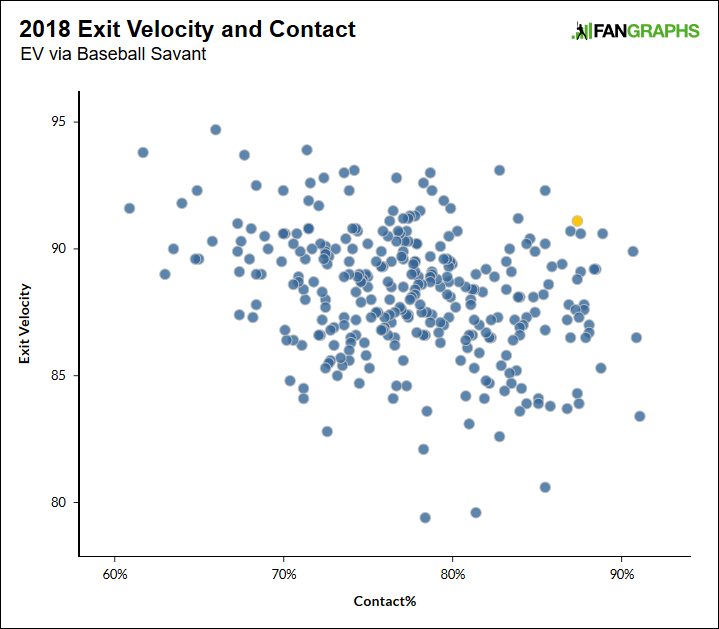
There’s also the question of LeMahieu’s bat. The now-former Rockies’ second baseman has played essentially six full seasons in the majors and been above-average offensively in exactly one of them. In 2016, Leamhieu posted a double-digit walk rate, a strikeout rate of just 13%, an ISO of .147 and a sky-high .388 BABIP on his way to a 130 wRC+. The last two seasons, his walk rate has dropped to 8%, his strikeout rate increased slightly to 14%, his ISO has been .123, his BABIP .326, and his wRC+ has been 10% below league-average. Combined with solid defense, this has made him a roughly average player. Jeff Sullivan noted that LeMahieu does have some hidden upside as a player who hits the ball hard and makes a lot of contact, and used the graph below to illustrate those two skills, with LeMahieu’s spot highlighted.

If LeMahieu could take that hard contact and put it in the air more often, he might hit for more power and have better overall numbers. As Sullivan (along with Travis Sawchik) noted, there might have been some attempts by LeMahieu to achieve a change. In 2018, he posted a GB/FB rate below 2.0 for the first time in his career, while his 30% pull-rate was a career-high. It likely helped cause his career-high .152 ISO. If that power came at the expense of hits — LeMahieu had a career low .298 BABIP, as well as fewer walks, with just a 6% walk rate — it isn’t clear the trade-off has helped yet.

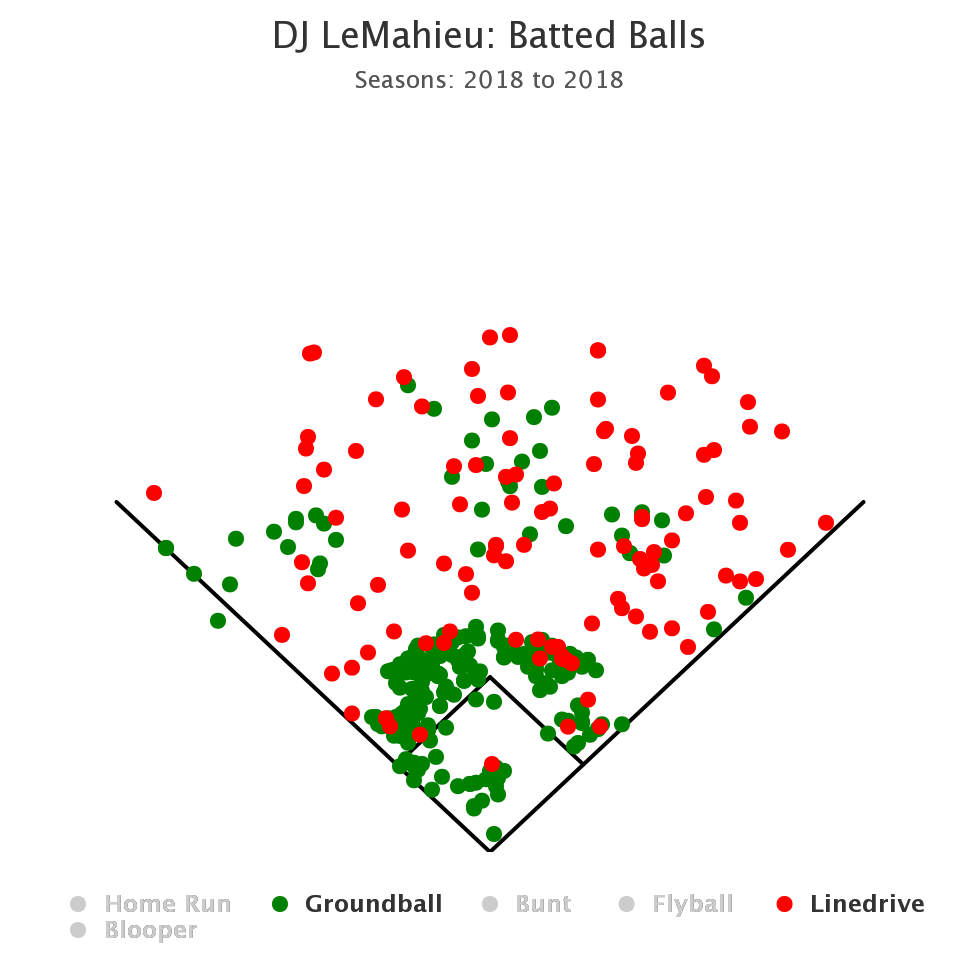
The problem for LeMahieu is that he just hasn’t been able to translate his hard ground balls into hard fly balls. On ground balls last season, LeMahieu put up an average exit velocity of 89.6 MPH, well above the 84.5 mph league average and in the top 10% in all of baseball. On fly balls, LeMahieu put up an average exit velocity of 91.3 mph, which is harder than his grounders, but below the league average of 91.6 mph last year. His exit velocity ranks so highly overall because he hits balls on the ground very hard, which is generally what allows him to post high BABIPs and come close to a league-average player. This is what his spray chart looked like last year.

That’s a lot base hits from a player who can’t be effectively shifted against. LeMahieu might have some untapped power, but he hasn’t yet been able to get to it. At 30 years old, he probably isn’t getting any better than the useful player we see right now. In any event, the Yankees aren’t bringing LeMahieu in for his untapped power. They are bringing him in to raise the team’s floor should their other infield options fail to work out, and to add a solid glove with good contact ability.

In a world where LeMahieu was one of very limited options, the move would make sense, albeit not all that much sense if LeMahieu is a utility player. We don’t live in that world, though. We live in a world where Manny Machado exists, wants to play in New York, and doesn’t seem to have a whole lot of bidders for his services. By signing LeMahieu, the Yankees are essentially committed to going over the competitive balance tax next season. The last time the Yankees passed on a $200-plus million infielder who really wanted to play for the Yankees, the team missed the playoffs in two of the next three seasons and didn’t play in a playoff series during that time. Robinson Cano averaged five wins per season over those three years in Seattle, as the Yankees opted to spend their money on Jacoby Ellsbury, Brian McCann, and Carlos Beltran. The Yankees should be better the next three seasons than they were from 2014 to 2016, and D.J. LeMahieu should help them, but it’s easy to see how the Yankees might end up regretting passing on a 26-year-old star so they can save a little money. Unless they still sign Machado, in which case the last paragraph is moot.