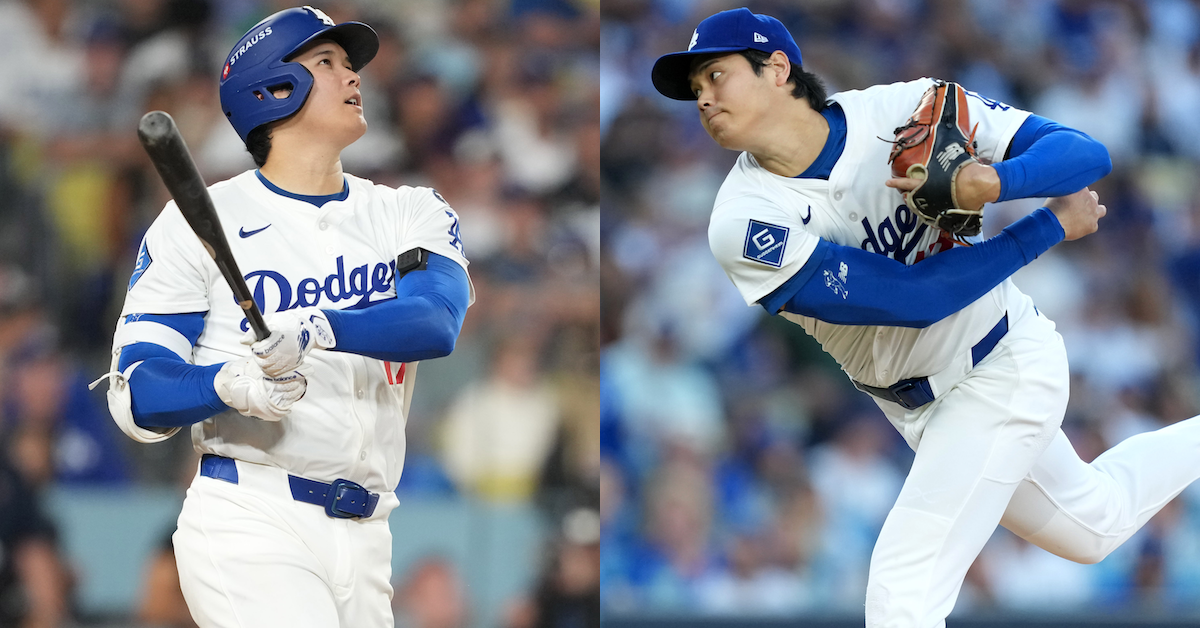
Let’s be more direct: Ohtani just had the greatest individual game in postseason history. On the mound, he threw six scoreless innings, allowing two hits and three walks while striking out 10. He got pulled after giving up two straight baserunners to start the seventh, which kind of mucked up his line, which is ironic, because that’s what the Dodgers offense has been doing to other starting pitchers over the past two weeks. Read the rest of this entry »
Eric A Longenhagen: Hello hello, it’s a gorgeous Fall day in Tempe and I’ve got a packed schedule that will likely compress today’s chat. I’m going to allow a couple minutes for some more questions to flow in before we begin in earnest.
12:05
Alex: What have you made of the Nationals’ hirings and how do you expect them to handle key players differently than the past regime?
12:07
Eric A Longenhagen: I think the way things have trended in Boston from a talent acquisition and development standpoint have been very positive, and I’d be stoked to have the people chiefly responsible for that helming my club. They’re young kids with a lot of juice, too. Let’s see how things continue to trend, but this feels like a strong start.
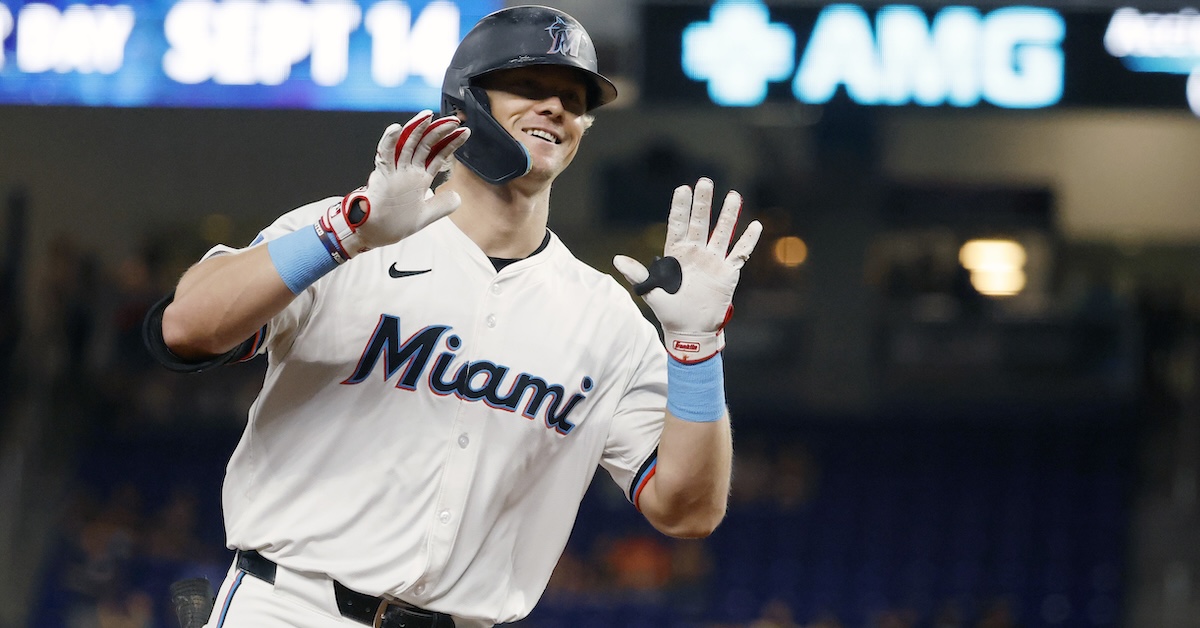
Kyle Stowers came into the year on the heels of frustration. Shuttling between Baltimore and Triple-A Norfolk, the Stanford University product put up an uninspiring 84 wRC+ over 168 plate appearances with the Orioles across the 2022-2024 seasons. Moreover, he then scuffled in his first opportunity with the Marlins. Acquired by Miami along with Connor Norby in exchange for Trevor Rogers at last year’s trade deadline, Stowers proceeded to produce just a 57 wRC+ over 172 PAs. The 2019 second-round pick hadn’t exactly reached failed-prospect territory, but he was falling well short of his potential.
This year was a different story entirely. Finally finding his footing, the 27-year-old outfielder broke out while serving as the Marlins’ everyday left fielder. Prior to having his season end early due to a left oblique strain — he played his last game on August 15 — Stowers slugged 25 home runs while slashing .288/.368/.544 with a 149 wRC+ over 457 plate appearances. For good measure, he represented the Fish in the All-Star game, and was recently named a senior circuit Gold Glove finalist.
I asked the left-handed slugger about his breakout when the Marlins visited Boston in August, a series that coincided with his season-ending injury. Was it simply a matter of his getting an extended opportunity, or was there more to it? Read the rest of this entry »
Jovanny Hernandez / Milwaukee Journal Sentinel-USA TODAY NETWORK via Imagn Images and Bill Streicher-Imagn Images
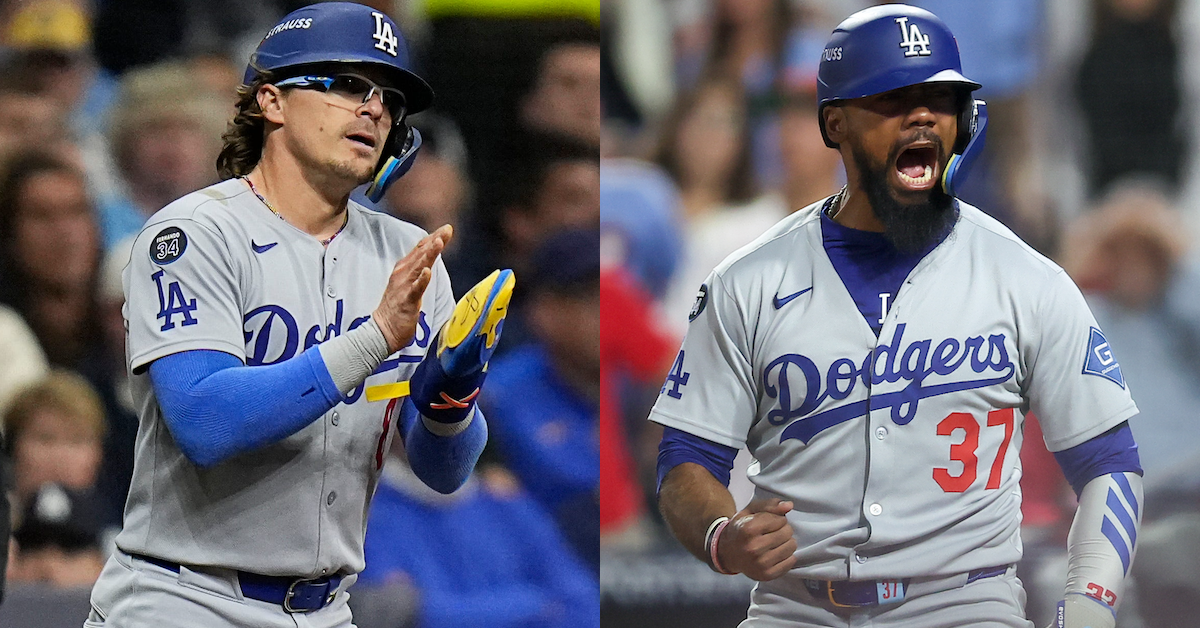
Unhittable starting pitching has carried the Dodgers through the Wild Card and Division Series and staked them to a 2-0 lead over the Brewers in the National League Championship Series. But as Blake Snell and Yoshinobu Yamamoto have made the the biggest headlines, some of their elite hitters such as Shohei Ohtani, Freddie Freeman, and Will Smith have scuffled. Meanwhile Enrique Hernández and Teoscar Hernández (no relation) have picked up the slack, recalling their contributions during last year’s championship run; their efforts even bookended the fateful game-tying five-run rally in the World Series clincher against the Yankees. After subpar regular seasons married by injuries, both have rediscovered their groove in October.
At American Family Field on Tuesday night, the dynamic duo shone once again during the Dodgers’ 5-1 victory in Game 2. With the team trailing 1-0 in the second inning following Jackson Chourio’s leadoff homer off Yamamoto, Teoscar got ahead 3-0 against Freddy Peralta, then pounced on the next pitch thrown in the zone, a 3-2 hanging curveball, and demolished it for a towering solo home run — 105.9 mph off the bat, with a 39-degree launch angle — to left field.
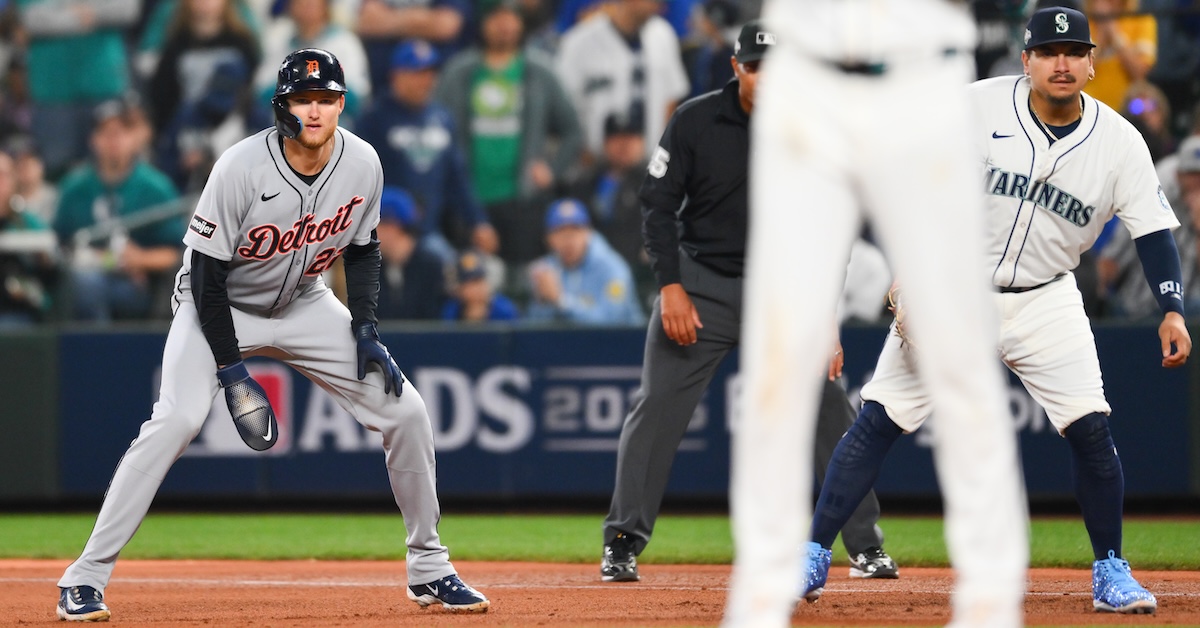
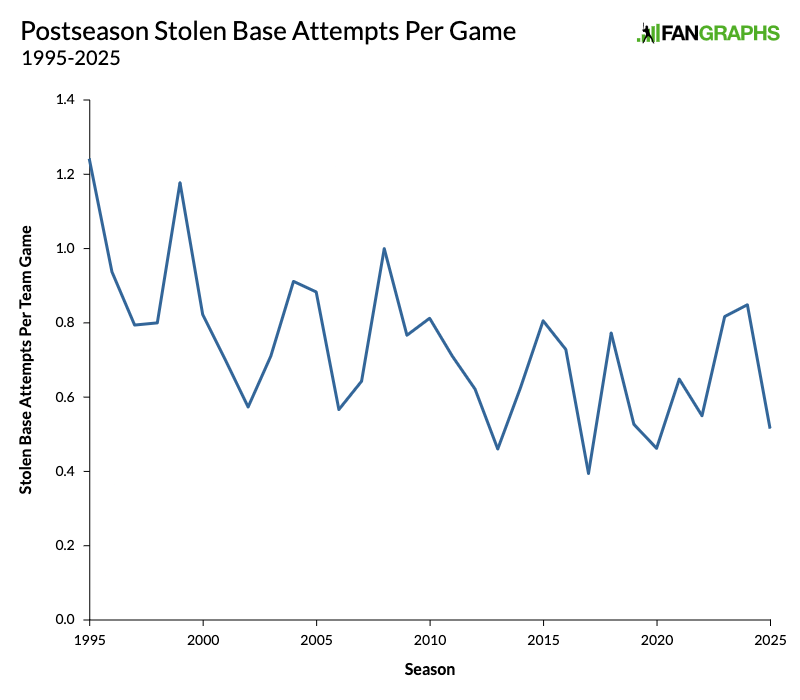
I’ve got some terrible news for you. The crime rate is way down. I know that sounds like it should be good news, but when it comes to baseball, it’s just boring. Nobody’s stealing any bases during the playoffs (except for Randy Arozarena and, of course, Josh Naylor). The 34 total playoff games have seen just 26 steals on 35 total attempts. That’s 0.51 attempts per team per game, a huge drop-off from a regular season that averaged 0.91. The Blue Jays and Dodgers have combined for just two steals on two attempts. Boring.
On its own, that doesn’t seem too surprising. This is the fourth year in a row that teams have attempted fewer steals per game in the playoffs than in the regular season. The reasons behind this are easy enough to understand. First, we have a logistical hurdle. Runs are harder to come by during the playoffs. This year, we’ve seen 4.45 runs per team game during the regular season and just 4.02 during the playoffs. On-base percentage is down 11 points, which means fewer baserunners and fewer stolen base opportunities to start with. Next, we’ve got the risk aversion angle. Those baserunners are a more precious commodity at a time when the stakes are at their highest. Running into an out on the bases is a very loud unforced error, the kind of thing you get roasted for in the papers the next morning. It’s a lot harder to see how much potential value you’re leaving on the table by just staying put. I feel confident that I’ve never read an article roasting a player for not trying to steal.
SEATTLE — There’s an age-old question among pitching philosophers. Should an approach focus more on the pitcher’s strengths or the hitter’s weaknesses? In my experience, pitchers do not ask themselves this question, though. They almost always prefer to pitch to their own strengths. They might tweak their strategy if a hitter has an obvious and exploitable weakness that they feel comfortable attacking, but mostly they’d rather stick to what they do best.
But what happens when what a pitcher does best aligns perfectly with what his opponent does best? When it’s not just that he’s ignoring the hitter’s weakness, but that he’s also pitching to the hitter’s strength? Game 3 of the ALCS between the Mariners and the Blue Jays gave us a data point to consider when answering that question. Toronto walked away with a 13-4 victory in Seattle to cut the Mariners’ series lead to 2-1, and did so by sticking to its strengths in the batter’s box. Read the rest of this entry »
Philadelphia, late in a must-win road game in a tightly contested playoff series, has all but gotten a stop. The team has held serve, against all odds blanking its opponent to force another frame and extend the season. Then, all of a sudden, the ball does something weird. It goes in a direction nobody anticipated, and as the entire Delaware Valley looks on in disbelieving horror, the home team scores to seal a walk-off win and advance to the next round.
I’m sure you’ve deduced from the lack of proper nouns in the previous paragraph that I’m not talking about the recently concluded Phillies-Dodgers NLDS, or the Orion Kerkering throwing error that ended it. No, I’m talking about this.
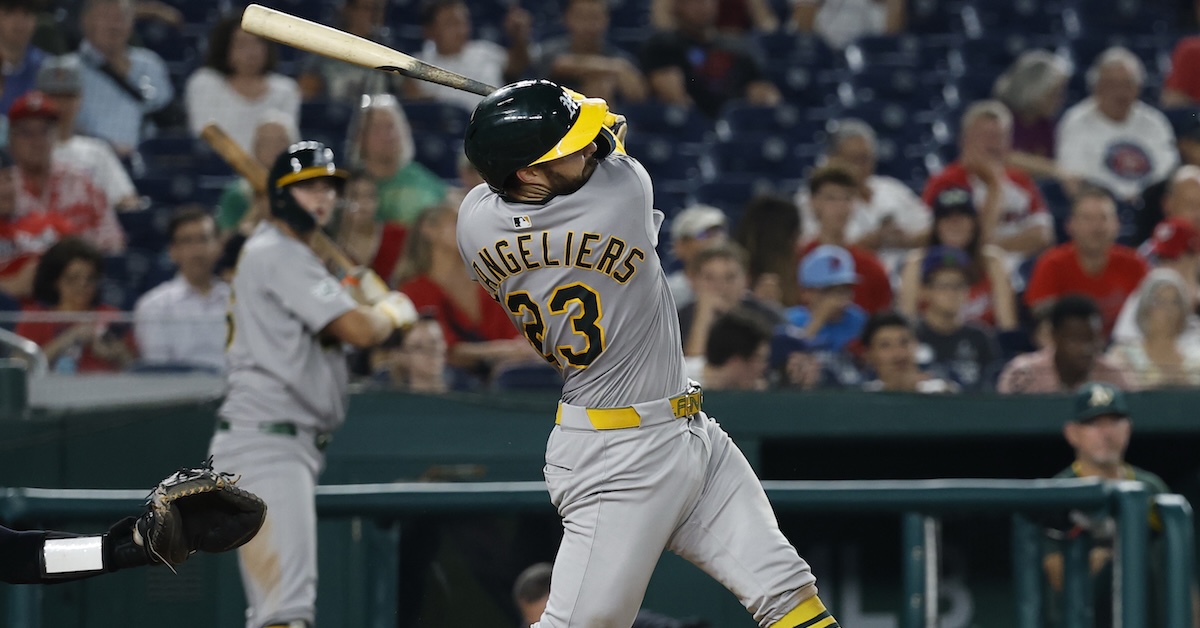
Shea Langeliers has emerged as one of baseball’s best backstops. Building on a 2024 season in which he swatted 29 home runs while logging a 109 wRC+, the 27-year-old slashed .277/.325/.536 with 31 home runs and a 132 wRC+. Moreover, he lowered his strikeout rate from 27.2% to 19.7%, and upped his WAR from 2.0 to 3.9. Those numbers came with the Athletics, who acquired Langeliers in the March 2022 trade that sent Matt Olson to the Braves.
Taken ninth overall by Atlanta in 2019 out of Baylor University, Langeliers was called “the consensus best catcher in [that year’s] draft not named Adley Rutschman” by Eric Longenhagen and Kevin Goldstein. When ranking Langeliers fifth in the Braves system in the spring of 2021, our then-prospect analyst duo also opined that “offensive development will dictate his ultimate value, as his defense is big league-ready right now.” As the numbers show, the right-handed hitter’s offense has developed just fine.
Langeliers sat down to talk hitting when the A’s visited Boston in September.
———
David Laurila: How have you changed as a hitter over the years? For instance, are your swing and setup any different from when you got to pro ball?
Shea Langeliers: “Those haven’t changed a whole lot. What has changed is how I’m mentally ready to hit sooner, throughout the process, if that makes sense. A good way to explain it would be, before release being able to physically pull the trigger on my swing. Being ready to hit earlier in the loading process gives me more time to see the pitch and react to it. It’s also a good mental cue for me.
“Another thing is that when I first got to the big leagues, I was trying to hit everything as hard as I can, all the time. I’ve dialed that down a little bit. There is a little more bat control now, so I’m missing fewer pitches.”
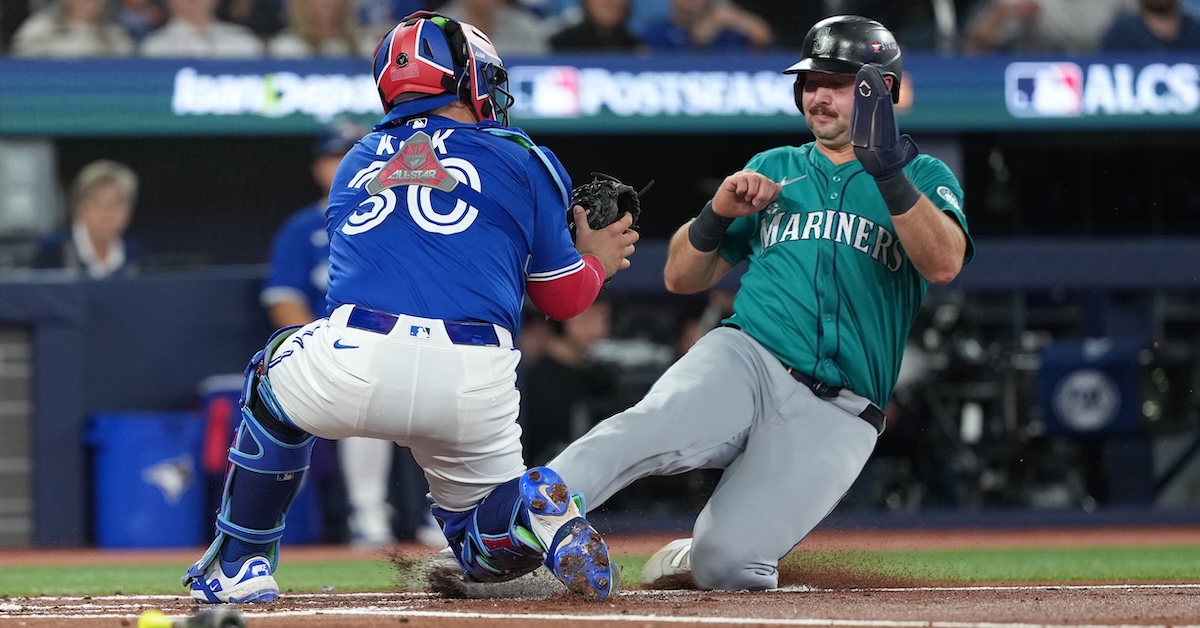
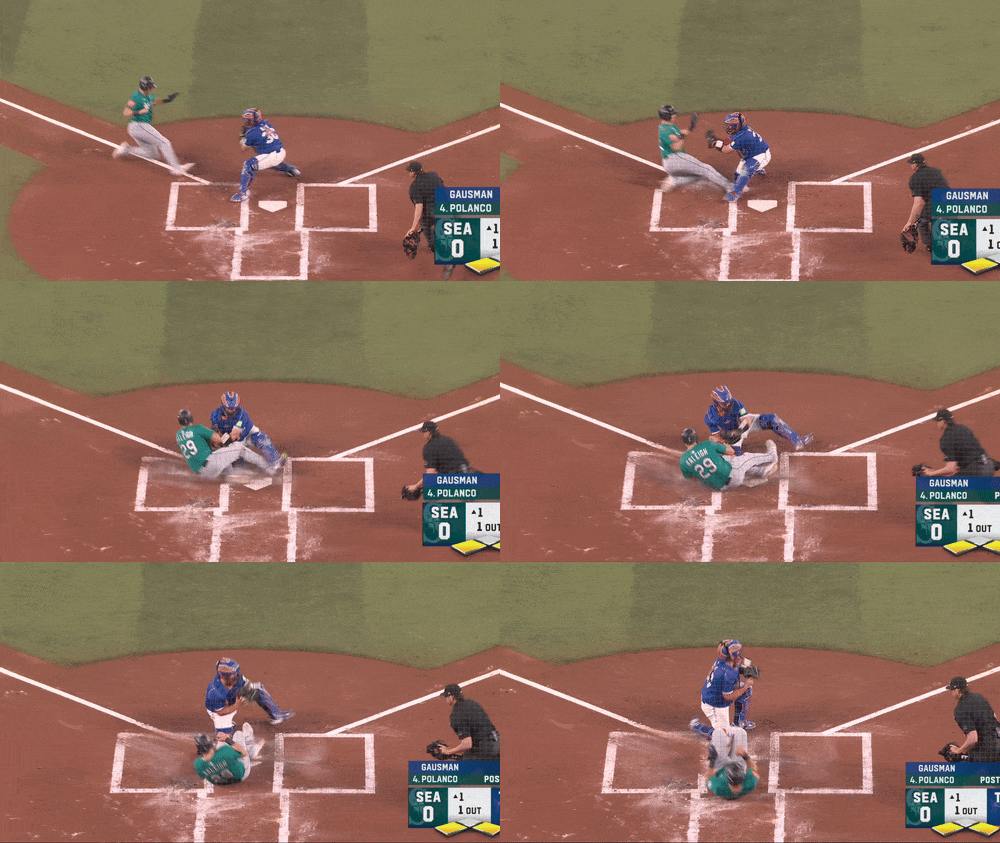
It was really close. On Sunday, in Game 1 of the American League Championship Series, in the top of the first inning, with one out and runners on first and third, once and future hero playoff hero Jorge Polanco hit a bouncer to the third baseman. The runner on third was going on contact, but the runner on third was Cal Raleigh, and while relatively quick for a catcher, the Sultan of Squat is not exactly known for his speed. Had the ball been hit anywhere other than directly at a corner infielder, he might have beaten it easily. Instead, Addison Barger’s throw beat Raleigh to the bag by at least three metres (the game was in Canada, after all). But it was still really close.
The throw arrived in plenty of time, and it was by no means off target. To make sure he ran no risk of hitting the runner, Barger wisely threw the ball toward the right side – the first base side – of catcher Alejandro Kirk’s body. The throw wasn’t high either, but it did arrive at shoulder height. Raleigh was running as hard as he could, and in the time it took Kirk to swing his catcher’s mitt from high on his right side to low on his left side, he’d closed the distance to roughly one metre. Then Kirk made an important decision. With Raleigh bearing down on him, he chose not to keep swinging the glove down and toward the plate. He reached out for a high tag and swept the left side of his body out of the way in the same moment. Self-preservation undoubtedly played a role in the decision. It cost him valuable centimetres (God, this feels wrong), and it very nearly allowed Raleigh to sneak his right cleat between Kirk’s legs and onto home plate before his torso crashed into the mitt. For the briefest of moments, the two catchers looked like colliding galaxies, smashing then spinning together as their gravitational fields intertwined:
In real time, the play went from looking like a sure out to an impossibly close call. Maybe Raleigh got his foot in there and maybe he didn’t. The call on the field was out, and unbelievably, the Mariners declined to challenge it. The video never got dissected by the replay room in New York. The chief marketing officer of Zoom Communications, Inc. surely wept. Read the rest of this entry »
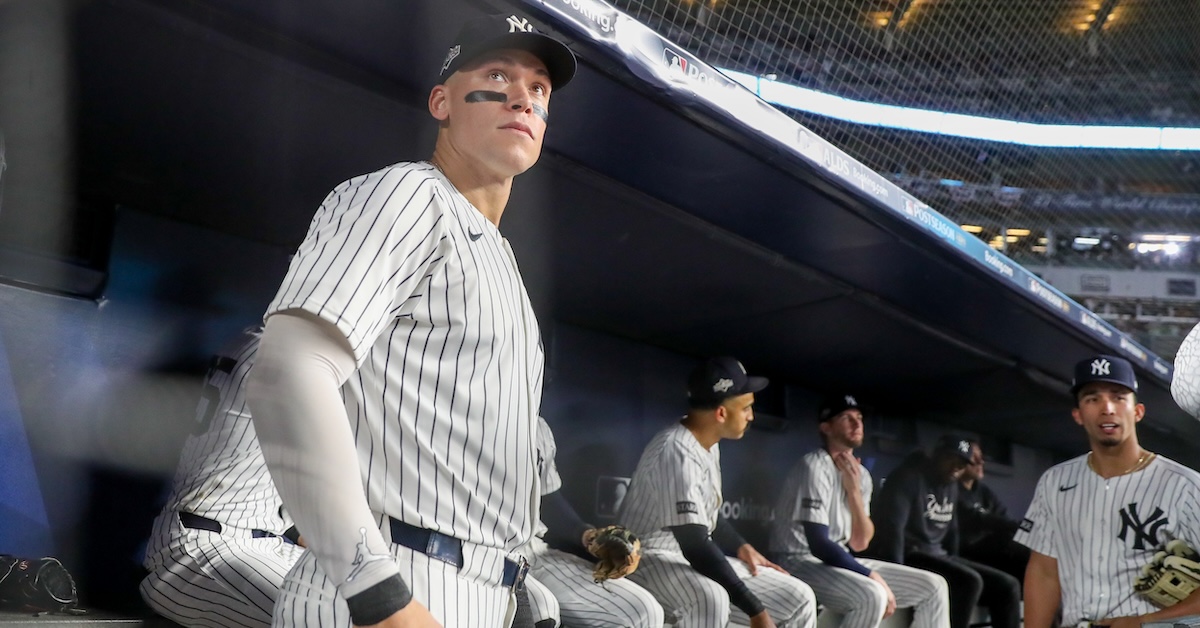
NEW YORK — About 45 minutes after the “best team” that Aaron Boone has ever managed was eliminated from the playoffs, several of its members sat in the clubhouse drinking a few small beers. The mood was wistful, the somber finality of it all floating through the very same air that less than a week earlier had reeked of celebratory champagne.
They had just lost the American League Division Series to the Blue Jays in four games, and for the most part, it wasn’t all that close. Despite an all-time great postseason performance from Aaron Judge following yet another all-time great regular season from him, New York was thoroughly outplayed by Toronto. Boasting the most annoying opposing lineup in baseball, the Jays peppered pitchers with their all-fields approach and their refusal to swing and miss. Theirs was a Boomer’s more-than-platonic ideal of an offense – they had the lowest strikeout rate (17.8%) and the highest batting average (.265) in the majors this season — but it wasn’t a true throwback. The Blue Jays weren’t dependent on the long ball, but they were more than capable of hitting home runs, as we all saw during the ALDS. As a team, Toronto slashed .338/.373/.601 for a 168 wRC+ across the four games. Yankees pitchers struck out 23.7% of the hitters they faced during the regular season but just 14.9% of the Blue Jays who batted in the series.
“They beat us this series,” Boone said. “Simple as that.”
Yet even as the Yankees accepted their fate, that they had played their last baseball game of the season, they were still trying to understand how it all went wrong. Hadn’t they addressed their shortcomings from a year ago, when they lost to the Dodgers in the World Series? They lengthened their lineup, improved their baserunning, and enhanced their rotation during the offseason, and then ahead of the trade deadline, they made more moves designed to shore up their defense and bolster their bullpen. Some of those deals didn’t pan out, but many of them did. Read the rest of this entry »