Archive for Featured

Don Mattingly Talks Hitting

Don Mattingly knows hitting. The Miami Marlins manager slashed .307/.358/.471 over his 14 seasons with the New York Yankees, winning a batting title along the way. Since his playing days, he’s served as a hitting coach for both his former team and for the Los Angeles Dodgers. “Donnie Baseball” also managed the Dodgers, a five-season stint that preceded his arrival in Miami six years ago.

Mattingly shared his thoughts on hitting, both mechanical and philosophical, over the phone prior to a recent game. (This interview was edited for length and clarity.)

———

David Laurila: Let’s start with your playing career. How would you describe who you were as a hitter?

Don Mattingly: “I kind of changed over the years. I came up as a guy who was probably known more for just putting the ball in play. I hit for [a high] average in the minor leagues. I used the whole field and had more of a hit-it-where-it’s-pitched type approach. From there, I kind of grew in strength, which allowed me to drive in runs. I became more of a doubles guy.”

Laurila: Was the change mostly a matter of getting stronger, or were there adjustments, as well?

Mattingly: “I definitely made adjustments. The biggest was probably getting physically stronger — that was the start of it — [because] I didn’t really hit for true home run power. I didn’t have home run power through the minor leagues. Read the rest of this entry »


The Cardinals Give a Lesson in Context

As a shortstop, you never want to be in this position:

You can almost see the expletives flying out of his mouth, and it gets worse: Nolan Arenado is out of frame to the right, which means that ball is ticketed for left field. How did it get to this point? Let’s back up.

When you’re fielding a bunt, decisions come at you immediately. Barehand it? Glove it? Lead runner? Take a beat and take the sure out? You have to make all of those choices in a split second. Here’s the play in the ninth inning of Sunday’s Cardinals/Royals game that left Paul DeJong lunging helplessly:

Obviously, it didn’t turn out well. But it’s not as though Paul Goldschmidt didn’t know there was a chance of failure going in. Going for the lead runner on a bunt is a high-risk, high-reward play; anyone could tell you that. How large was the risk? How valuable was the reward? Let’s find out together, because I think this situation is low-key fascinating. Read the rest of this entry »


The Blue Jays Are the Right Kind of Aggressive

I’ve spent way too much time pondering how to begin this article. So instead of formulating a timely and witty introduction, I’ll be direct: The Blue Jays offense is amazing! You already know that, but it bears repeating. Together, Jays hitters have amassed the league’s second-highest wRC+ while maintaining the league’s second-lowest strikeout rate. This is scary, and this is legit.

Right now, the only team with a higher wRC+ is the Astros. The only team with a lower strikeout rate is… also the Astros. And it’s easy to explain. They don’t have the most power or the best discipline, but they do lead the league in O-Contact%. Even when would-be balls are swung at, they’re either put in play or fouled off. Couple that with a minuscule swinging-strike rate of 8.7%, and it’s a team poised to give opposing pitchers fits. Tenacity wins.

As for the Blue Jays, however, their formula isn’t immediately noticeable. Duh, they have the best hitter on the planet. I know, imaginary voice, but I’m talking about the team as a whole. A few days ago, the Jays routed the visiting Red Sox, outscoring them by eight runs. Let’s consider how the ambush unfolded. Nathan Eovaldi had managed to salvage a rough start until the fifth inning, when Teoscar Hernández unleashed his full strength against a first-pitch fastball:

Read the rest of this entry »


Harrison Bader Catches Them All

I know what you’re thinking: it’s a layup of a title. Harrison Bader is one of the best defensive outfielders in baseball. When he needs it, he can engage a little bit of turbo boost, turning his range from excellent to downright ludicrous:

Too easy, right? What a one-note title. We get it: he catches all the balls. If you thought that was what I had in store for you, gather around, because things are about to get exciting.

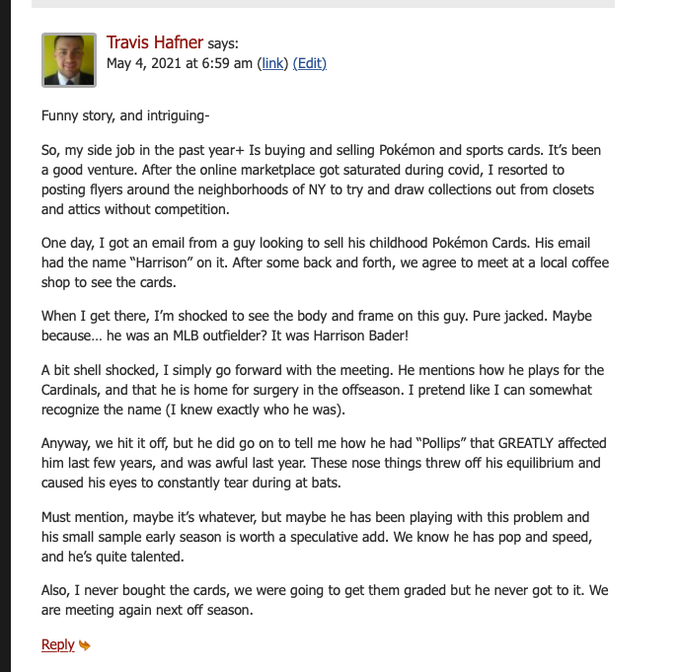
Bader, you see, collected Pokémon cards as a kid. Relevant? Not really. Unless you follow fantasy baseball forums and heard this whopper of a tale early in the season:

I’m not the first person to cover this story. Sami Alsado picked it up in May over at Pitcher List and wondered whether it should inform our opinion of Bader’s start. But it was still early in the year, and besides, Bader himself hadn’t said anything about it yet. Well, that surgery was real, and Bader is in the midst of a breakout offensive season. It’s speculation no longer — Harrison Bader is seeing clearly. Let’s see what removing some nasal polyps can do for you. Read the rest of this entry »


Upcoming Early Baseball Era Committee Ballot Will Give Negro Leagues Candidates Another Shot at Hall of Fame

For the first time since 2006, candidates from the Negro Leagues and pre-Negro Leagues Black baseball are being considered for placement on a Hall of Fame ballot. While the 10-candidate slate to be voted upon later this year by the Early Baseball Era Committee has not yet been finalized, those who were previously shut out by baseball’s shameful color line, and then again by the Hall of Fame following the election of 17 players, managers, and executives by the Special Committee on the Negro Leagues in 2006, are eligible once again.

In a statement to FanGraphs, Jon Shestakofsky, the Hall’s vice president of communications and education, said, “The Hall of Fame’s Early Baseball Committee, which is scheduled to meet for the first time this December, will consider 10 candidates comprised of players, umpires, managers and executives/pioneers who made their greatest impacts in baseball prior to 1950. Negro Leagues candidates will be eligible for consideration as part of this ballot.” Shestakofsky later clarified that the eligibility applies to pre-Negro Leagues Black baseball candidates as well.

At a time when Major League Baseball is in the midst of a long-overdue reckoning with regards to Negro Leagues history, branding and symbolism, and the representation of Black Americans at all levels within the sport, this is good news. It comes a year after the Negro Leagues Centennial Celebration, which has helped to introduce new generations of fans and media members to some often-overlooked greats, an effort that has met with such success that Shohei Ohtani is drawing comparisons not just to Babe Ruth but to Bullet Rogan and Martín Dihigo. It stands to reason that the renewed spotlight on Black baseball would extend to Cooperstown. Read the rest of this entry »


Sunday Notes: Reds Prospect Francisco Urbaez Is Schooling High-A Pitchers

Francisco Urbaez wasn’t sure what to expect when he reported to spring training. Signed by the Cincinnati Reds as a non-drafted free agent in June of last year, the 23-year-old infielder knew only that he was being given an opportunity. To say he’s made the most of it would be an understatement. In 275 plate appearances with the High-A Dayton Dragons, Urbaez is slashing an eyebrow-raising .332/420/.454.

A native of Santo Domingo, Dominican Republic, Urbaez didn’t come to the United States solely to play baseball. The son of a mechanical engineer and a psychologist, he came to earn a degree.

“That was my family’s plan,” explained Urbaez, who spent two years at Chipola Junior College, and two more at Florida Atlantic University. “They were like, “Go to the States and play ball, and whatever happens happens, but you need an education first.”

Already fluent in English when he arrived in the U.S. at age 18, Urbaez was initially an Accounting major, but then changed to International Business, and ultimately to Business. And while baseball wasn’t the priority, it did serve as a catalyst. Former Toronto Blue Jays slugger Jose Bautista is involved with a foundation that helps Latin American student-athletes come to the U.S. via scholarships, and Urbaez was one of the beneficiaries.

Unlike many Dominicans currently playing professional baseball, Urbaez hadn’t attracted a lot of attention while on the island. He received only one offer from an MLB organization, and that was after he’d committed to come Stateside to begin his studies. Teams didn’t exactly knock down his door during his JC tenure, either. It wasn’t until his junior year at FAU that scouts began to take notice. Prominent among them was Andrew Fabian, whose familiarity with Urbaez dated back to his time as a coach at Hillsborough Community College. Now an area scout with the Reds, Fabian saw potential in the under-the-radar second baseman. Read the rest of this entry »


When Will the Cubs Roar Again?

Just as the Joey Gallo trade ended an era of Rangers baseball, the Cubs’ flurry of moves at this year’s trade deadline closed the door on Chicago’s championship core. While Kyle Hendricks, Willson Contreras, and Jason Heyward still remain from the 2016 team, the trades of Javier Báez, Kris Bryant, and Anthony Rizzo send things out with an exclamation point rather than the Texas comma. Five games below .500 and with a much weakened roster, we now project Chicago to finish 74-88; the last time the franchise finished with a worse record was 2014.

In a very real way, the 2010s Cubs did accomplish one very important feat: they won a championship. While I don’t subscribe to the notion that a great run for a team must involve a title, I also have not yet been placed in the role of some brutal autarch who determines how the history books are written. The Cubs won the World Series, and the Rangers did not, and both teams will be remembered differently as a result.

Still, the way it ended leaves a curious dissatisfaction about the Cubs. The dizzying heights of 2016 faded quickly, and the subsequent single NLCS appearance and pair of wild card losses were not the stuff of legend. The sudden turning-off of the cash spigot didn’t help, either; after spending $217 million in free agency after the 2017 season, Chicago has spent a total of $21 million in the offseasons since, or roughly half what the Rays have paid out in that span. (The mid-June 2019 signing of Craig Kimbrel to a three-year, $43 million contract is one of the lone splurges.) In the end, the farm system and those low-key signings couldn’t make up for the attrition elsewhere, and the Cubs’ domination of the NL Central was a brief affair.

Before last winter, team president Jed Hoyer talked about the Cubs going into a retooling phase rather than a full teardown, which left me skeptical. But Chicago still has some advantages that suggest a return to playoff relevance might not be that far away.

Read the rest of this entry »


Bo Bichette Talks Hitting

Bo Bichette is one of the best young hitters in the game. Just 23 years old, the Toronto Blue Jays shortstop has a .299/.345/.509 slash line to go with a 128 wRC+ and 35 home runs — 19 of them coming this season — in 795 big-league plate appearances through Tuesday’s action. Drafted 66th overall in 2016 out of a St. Petersburg high school, the 2021 American League All-Star is the son of former major-league slugger Dante Bichette.

Bichette talked hitting prior to a recent game at Fenway Park.

———

David Laurila: Let’s start with one of my favorite Talks Hitting ice-breaker questions: Do you view hitting as more of an art, or more of a science?

Bo Bichette: “That’s an interesting question. I’d say it’s a combination of both, but I would lean more toward it being an art. I think hitting is more mental than anything, and science kind of equates to mechanics and all that. So I would say art.”

Laurila: Hitting analytics have obviously become a bigger part of the game…

Bichette: “Yes, but for me, no. I think the analytics are more how we’re evaluated as players. Everybody has their own things that click in their head. I haven’t really looked at the analytics all that much. The one thing is that pitchers pitch up in the zone more often, so you definitely practice hitting that pitch a little bit. But I don’t pay attention to my launch angle, exit velocity, and stuff like that.”

Laurila: Is your stroke conducive to hitting the elevated fastball? Read the rest of this entry »


Corollary Damage: Kumar Rocker, the MLB Draft, and a Better Way Forward

On Sunday, the Mets announced that they would not offer a contract to Vanderbilt ace Kumar Rocker. New York had selected the right-hander with the 10th overall pick in the draft just a few weeks earlier, but backed out of a deal upon seeing his medicals. Rocker’s camp was understandably upset. Scott Boras released a statement on his client’s behalf, declaring that Rocker is healthy, ready to pitch, and set to embark on his professional career. It’s a gut-wrenching situation, particularly since no other team is allowed to sign Rocker. He plans to enter the 2022 draft, but for now, he’s in purgatory.

However disappointed Rocker and Mets fans justifiably are, there’s a larger, structural issue at play here, one that overshadows Rocker’s medicals, or even the Mets’ approach to handling them. Steve Cohen violated Rule No. 1 (never Tweet, Steve) but New York isn’t dangling Rocker’s big league dreams for sport: They picked Rocker in good faith and must have really disliked what they saw in his file, particularly since they didn’t have the foresight to take an overslot guy late in the draft as backup. After signing all of their other selections, the Mets wound up leaving more than $1 million in bonus pool money on the table. Nobody wins here.

Like Barret Loux and Brady Aiken before him, Rocker deserves better than to get the rug yanked out from under him like this. I’m sure he has many gripes with how this all played out, but his biggest shouldn’t be with the Mets, but rather with the draft itself. Read the rest of this entry »


Ranking the Prospects Traded During the 2021 Deadline

What a ride this year’s deadline was. All told, we had 75 prospects move in the last month. They are ranked below, with brief scouting reports written by me and Kevin Goldstein. Most of the deals these prospects were a part of were analyzed at length on this site. An index of those pieces can be found here, or by clicking the hyperlink in the “Trade” column below. I’ve moved all of the players listed here to their new orgs over on The Board, so you can click through to see where they rank among their new teammates. Our farm rankings, which now update live, also reflect these changes, so you can see where teams’ systems stack up post-deadline.

A couple of quick notes before I get to the rankings. We’ve included a few post-prospect players here (those marked in blue) so you can get an idea of where we value them now as opposed to where we had them at their prospect peak. Those players, as well as the Compensatory pick the Rockies will receive after they extend Trevor Story a qualifying offer and he signs elsewhere, are highlighted below. We had closer to 40 prospects (and 23 Players to be Named Later) traded last year, with the PTBNL number inflated by 2020’s COVID-related transaction rules. The backfields are not well-represented here, with just four prospects who have yet to play in full-season ball. Two of those are currently in the DSL and have no official domestic pro experience, though Alberto Ciprian has played stateside for instructs/extended spring training. Now on to the rankings. Read the rest of this entry »