Archive for Featured

Snowstorms, Lies, and the Best Game of Baseball Ever Played

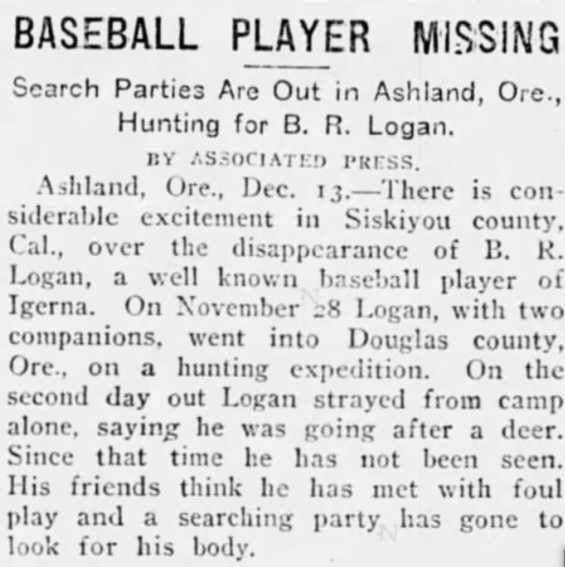
On November 28, 1902, a young man from Igerna, California, headed north with two friends on a hunting trip into the wilderness of southern Oregon. It was an area he would have known fairly well: He often traveled this way on his way to face the baseball nines of various small towns. The young man’s name was B.R. Logan, and he was a baseball player.

On December 1, Logan, outside the cabin where he and his companions were staying, thought he saw a deer. He bade his friends farewell and headed off in pursuit. A day passed. Then another. Then another. His friends began to worry. After two weeks, they began to despair. It was the winter, in the middle of the forest, and there was no sign of their friend.

On December 13, the Associated Press published an item about Logan’s disappearance. “MISSING BASEBALL PLAYER,” it read. By this point, the search party wasn’t looking for Logan. They were looking for his body.


Read the rest of this entry »


Wild(-ish) World Series Tactics: 2007-2009

I’ll level with you. The World Series tactics series has been getting less and less wild as time goes on. That’s not to say it’s getting less and less fun — I’m actually having more fun writing it, because we’ve passed into an era where I remember the games.

It’s a lot more interesting to look for hidden gems when it’s games you’ve already seen, because they’re truly shocking. I’m not surprised that managers were calling for weird bunts in 1990 — the internet barely existed in 1990! A weird bunt or baffling pitching decision is more fun to me in 2005 than 1995, even if there are fewer true howlers. So while these three series might seem dry, remember: these weren’t that long ago! Managers really should have known better.

2007

The Red Sox assembled a lineup that would look right at home in 2020. Two on-base machines, Dustin Pedroia and Kevin Youkilis, occupied the top two spots, feeding David Ortiz, Manny Ramirez, and Mike Lowell. The Rockies weren’t quite with the times — they batted Kaz Matsui, one of their worst hitters, second. But the rest of the lineup was stacked, with Matt Holliday and Todd Helton hitting 3-4.

The last act of Rocktober was nasty and short. Did Colorado leave starter Jeff Francis in too long in the first game? Maybe! But he gave up three runs in the first, trusted reliever Franklin Morales gave up seven in the fifth, and the offense only put up a single run. Maybe you can argue with intentionally walking Manny Ramirez (man on second, two outs, down three in the second), but it hardly matters when you lose by 12 runs.

Okay, fine, maybe the intentional walks were bad. In the fourth, still down three runs, the Rockies intentionally walked Mike Lowell — the man they’d walked Ramirez to face earlier in the contest. Jason Varitek doubled in two runs in the next at-bat. The walks didn’t make the difference in the game, and they weren’t even hugely consequential, but don’t intentionally walk people to face other batters you’re willing to intentionally walk! Read the rest of this entry »


Five-Round MLB Draft a Shortsighted, Pound-Foolish Move

While many have moved on to a potential renegotiated deal between the players and owners to get the season underway, MLB’s decision to stage a five-round amateur draft shouldn’t get lost in the shuffle. On Friday, Jeff Passan and Kiley McDaniel broke the news that this year’s June draft will last just five rounds. The news wasn’t a total surprise given that when the players and owners negotiated back in March, the sides agreed that the draft would be at least five rounds, but would be considerably shortened. However, given the relatively low present and future cost of having even five more rounds, it’s something of a surprise that the owners refused to put down the half a million dollars per team in 2020, with a quarter million dollars more in bonuses payable in 2021 and 2022.

The agreement in March specified that the draft would stick to 2019 slot amounts, saving owners a little over $8 million from what was in the CBA. In addition, teams would have to pay just $100,000 of player’s bonuses now, with the rest of the payments split between 2021 and 2022. In 2020, that means owners will spend around $15 million in signing bonuses, a $300 million reduction from a year ago. Coupled with the delayed international signing date, the owners are seeing $400 million in 2020 savings, with roughly $80 million of those savings permanent. Last year, teams spent $50 million more than their allotted amount on bonuses for players after the 10th round, which won’t happen this year. There’s also $30 million allotted for rounds six through 10, which also won’t happen this year. According to Passan, that decision didn’t sit well with front offices:

Given the $100,000 limit on bonuses to be paid this year, owners opted not to spend half a million per team right now and $1 million spread over the next three years to prevent 150 talented amateurs from turning pro. Teams can sign players after the draft, but undrafted free agents are limited to $20,000 bonuses. The types of players drafted before the 10th round are not the types who agree to $20,000 bonuses unless teams are shifting around money to give other players larger bonuses. The players who would have received decent bonuses in these rounds are now going to stay in school for another year or in the case of high school players, go to college or junior college in the hopes of being drafted in future years. There’s an argument to be made that all of these players will eventually get drafted, so it doesn’t make much of a difference for teams. That argument is not strong. Read the rest of this entry »


The Remaking of a Pitcher in the KBO: A Conversation with Josh Lindblom, Part 1

With so much attention focused upon the Korea Baseball Organization right now, it’s helpful to find points of reference, not only players from major league organizations who have gone over to South Korea to escape the Quad A life of bouncing up and down between the minors and majors but also those who have rejoined MLB. One who has done so while upgrading the quality of his baseball life is Josh Lindblom 린드블럼. A 2008 second-round pick by the Dodgers out of Purdue University, the 6-foot-4, 240-pound righty spent parts of four seasons in the majors (2011-14) with four different teams, albeit with diminishing returns. Twice he was traded for former All-Stars, namely Shane Victorino (in a Dodgers-Phillies deal) and Michael Young (in a Phillies-Rangers swap).

After the 2014 season, Lindblom signed with the KBO’s Lotte Giants, and quickly found a level of success that had eluded him stateside. He went 13-10 with a 3.56 ERA (142 ERA+) and 6.5 WAR in 2015 (advanced stats via Statiz), and while he wasn’t as strong in ’16 (10-13, 5.29 ERA, 99 ERA+, 2.7 WAR), he returned to the States on a minor-league deal with the Pirates. Unfortunately, he scuffled during a brief major league stint, and was released in mid-July. He returned to the Lotte Giants on a midseason deal, and helped the team to its first playoff appearance since 2012 by going 5-3, with a 3.72 ERA (136 ERA+) and 2.3 WAR in 72 innings.

From there, Lindblom landed a one-year, $1.45 million deal with the Doosan Bears and emerged as one of the top pitchers in the entire KBO, going 15-4 with league bests in ERA (2.88), ERA+ (175), and WAR (6.8). After re-signing for $1.77 million for 2019, he followed that up with a similarly outstanding campaign, going 20-3, with a 2.59 ERA (164 ERA+) and 6.9 WAR. The Bears, who finished second in 2018 and lost the Korean Series to the SK Wyverns, won it all in ’19, and Lindblom was voted the league’s MVP; in both years, he won the circuit’s Choi Dong-won Award, as the KBO’s top pitcher. Now 32 years old, he parlayed his success abroad into a three-year, $9.125 million-plus-incentives deal to start for the Brewers — the kind of security he’s never had before. Read the rest of this entry »


Top 47 Prospects: Los Angeles Dodgers

Below is an analysis of the prospects in the farm system of the Los Angeles Dodgers. Scouting reports are compiled with information provided by industry sources as well as my own observations. For more information on the 20-80 scouting scale by which all of our prospect content is governed, you can click here. For further explanation of the merits and drawbacks of Future Value, read this.

All of the numbered prospects here also appear on The Board, a resource the site offers featuring sortable scouting information for every organization. It can be found here.

Dodgers Top Prospects
Rk Name Age Highest Level Position ETA FV
1 Gavin Lux 22.5 MLB 2B 2020 70
2 Dustin May 22.7 MLB RHP 2020 60
3 Josiah Gray 22.4 AA RHP 2022 50
4 Tony Gonsolin 26.0 MLB RHP 2020 50
5 Keibert Ruiz 21.8 AAA C 2020 50
6 Brusdar Graterol 21.7 MLB RHP 2020 50
7 Diego Cartaya 18.7 R C 2023 45+
8 Andy Pages 19.4 R CF 2023 45+
9 Kody Hoese 22.8 A 3B 2022 45
10 Michael Busch 22.5 A 2B 2021 45
11 Miguel Vargas 20.5 A+ 3B 2022 45
12 Jacob Amaya 21.7 A+ SS 2022 45
13 Gerardo Carrillo 21.7 A+ RHP 2022 45
14 Alex De Jesus 18.1 R 3B 2024 45
15 Andre Jackson 24.0 A+ RHP 2021 40+
16 Ryan Pepiot 22.7 A RHP 2022 40+
17 Luis Rodriguez 17.7 R CF 2025 40+
18 Robinson Ortiz 20.4 A LHP 2023 40+
19 Michael Grove 23.4 A+ RHP 2022 40+
20 DJ Peters 24.4 AAA CF 2020 40
21 Jimmy Lewis 19.5 R RHP 2024 40
22 Edwin Uceta 22.3 AA RHP 2021 40
23 Omar Estevez 22.2 AA 2B 2021 40
24 Josh Sborz 26.4 MLB RHP 2020 40
25 Cody Thomas 25.6 AA RF 2021 40
26 Dennis Santana 24.1 MLB RHP 2020 40
27 Victor Gonzalez 24.5 AAA LHP 2020 40
28 Zach McKinstry 25.0 AAA 2B 2020 40
29 Edwin Rios 26.1 MLB 1B 2020 40
30 Mitchell White 25.4 AAA RHP 2020 40
31 Jorbit Vivas 19.2 R 2B 2022 40
32 Carlos Duran 18.8 R RHP 2024 40
33 Cristian Santana 23.2 A 3B 2021 40
34 Jerming Rosario 18.0 R RHP 2024 40
35 Brett de Geus 22.5 A+ RHP 2021 35+
36 Jordan Sheffield 24.9 AA RHP 2020 35+
37 Brandon Lewis 21.6 A 3B 2023 35+
38 Marshall Kasowski 25.2 AA RHP 2020 35+
39 Devin Mann 23.3 A+ 2B 2022 35+
40 Jeren Kendall 24.3 A+ CF 2021 35+
41 Jose Martinez 21.1 A+ RHP 2022 35+
42 Zach Reks 26.5 AAA DH 2021 35+
43 Luke Raley 25.6 AAA 1B 2020 35+
44 Juan Morillo 21.1 R RHP 2021 35+
45 Hyun-il Choi 20.0 R RHP 2024 35+
46 James Outman 23.0 A CF 2022 35+
47 Guillermo Zuniga 21.6 A+ RHP 2021 35+
Reading Options
Detail Level
Data Only
Full
Position Filter
All

70 FV Prospects

1. Gavin Lux, 2B
Drafted: 1st Round, 2016 from Indian Trail Academy HS (WI) (LAD)
Age 22.5 Height 6′ 2″ Weight 190 Bat / Thr L / R FV 70
Tool Grades (Present/Future)
Hit Raw Power Game Power Run Fielding Throw
60/70 65/65 60/70 55/55 50/55 45/45

A highly entertaining example of the timeless “you can’t predict baseball” maxim, in three years Lux has tranformed from a glove-first high school shortstop (there’s a version of reality in which Lux, Bo Bichette, Hunter Bishop, and Spencer Torkelson are all on the same college team, though sadly, it’s not this one) into a superstar offensive talent. If you want a visual example of “twitch,” watch Lux swing. His feet work slowly, and his right knee draws back toward his left hip like the string of a bow (different than his high school swing’s footwork, which was more Sammy Sosa-ish, with ground contact in both directions) while he remains balanced and poised to strike. Then he strides forward, his hips clear, and his hands, which are looser and freer than they were as an amateur, ignite. Once Lux’s hands get going, everything is over very quickly. He’s tough to beat with even premium velocity but also identifies pitch types while they’re in flight and can punish secondary stuff that catches too much of the zone. The other swing changes aside, Lux’s bat path is relatively similar to what it was when he was a skinnier, gap-to-gap hitter with doubles power, except now he’s very strong and balls are leaving the yard. He has pole-to-pole power and is going to get to it in games even though he’s still a relatively low-launch angle hitter (nine degrees in the minors, 13 degrees in a small big league sample).

What happens with Lux defensively is somewhat immaterial. He’s publicly admitted to having the yips, which impacts the accuracy of his throws. Pure arm strength is not really an issue, but if he keeps one-hopping easy throws to first base, he might need to move off the infield. I have the arm graded as a 45 because of the accuracy issues and think there’s some risk Lux needs to move to the outfield, but even if that’s the case, I feel better about him hitting than all but one other prospect in all of the minors.

60 FV Prospects

2. Dustin May, RHP
Drafted: 3rd Round, 2016 from Northwest HS (TX) (LAD)
Age 22.7 Height 6′ 6″ Weight 180 Bat / Thr R / R FV 60
Tool Grades (Present/Future)
Fastball Slider Changeup Cutter Command Sits/Tops
65/65 60/60 45/50 55/60 50/60 93-96 / 98

Once you’ve gotten a look at his stuff, May’s flamboyant ginger curls and Bronson Arroyo-esque leg kick might be the third and fourth most visually captivating aspects of his on-mound presence. His fastballs, both the two and four-seam variants, are parked in the 93-97 range and peak at 99 mph. His low-ish arm slot gives his heater sinker shape, which means it’s more likely to induce weak groundballs than it is to miss a lot of bats, though May occasionally uncorks two-seamers that run off the hips of left-handed hitters and back into the zone like vintage Bartolo Colon. Based on how he worked in the big leagues last year, May’s out-pitch is going to be his low-90s cutter, which he commands to his glove side (he has great east/west command of everything). This is despite the fact that his vertically-breaking slider (May calls it a slider, but it has curveball shape) has one of the better spin rates in the minors and enough vertical depth to miss bats against both left and right-handed hitters. He’s shown an ability to backdoor it to lefties and it was a finishing pitch for him in some of my minor league viewings, but it was de-emphasized in the big leagues, perhaps because it doesn’t pair well with his fastballs. After trying several different changeup grips in 2017, it seems like May is still searching for a good cambio, but his fastball and breaking ball command should suffice against lefties for now, though I’d like to see more backfoot breaking balls against them this year.

This is nit-picky, but May’s leg kick can make him slow to home and he can be vulnerable to stolen bases as a result, which forces him to vary his cadence home in an attempt to stymie runners. Regardless, he projects as an All-Star, mid-rotation starter.

50 FV Prospects

3. Josiah Gray, RHP
Drafted: 2nd Round, 2018 from LeMoyne (CIN)
Age 22.4 Height 6′ 1″ Weight 210 Bat / Thr R / R FV 50
Tool Grades (Present/Future)
Fastball Slider Curveball Changeup Command Sits/Tops
55/60 50/55 50/50 40/50 50/60 92-95 / 96

Gray is an athletic, undersized conversion arm with big time arm-acceleration. His arm action is a little stiff, but it’s fast, and generates a fastball in the 92-96 mph range (mostly 3s and 4s) with riding life. Gray’s size and the drop and drive nature of his delivery combine to create flat plane that plays well up in the zone. He’ll miss bats at the letters with his heater. Thanks to his athleticism, Gray repeats, and throws more strikes than is typical for someone fairly new to pitching who has this kind of stuff, with a notable proclivity for locating his fastball to his arm side.

The slider can slurve out and even get kind of short and cuttery at times, but when it’s well-located and Gray is on top of the ball, it’s a plus pitch. His changeup, which he seldom uses at the moment, is easy to identify out of the hand due to arm deceleration, and is comfortably below average.

Because the strike throwing, fastball efficacy, and ability to spin the breaking ball give him a good shot to play a big league role, I’ve moved Gray up beyond where Kiley and I had him pre-draft. The athleticism, small school pedigree, and position player conversion aspect of the profile indicates there’s significant potential for growth as Gray gets on-mound experience. He projects as a No. 4 starter, with a chance to be more because of his late-bloomer qualities.

Drafted: 9th Round, 2016 from St. Mary’s (LAD)
Age 26.0 Height 6′ 2″ Weight 180 Bat / Thr R / R FV 50
Tool Grades (Present/Future)
Fastball Slider Curveball Splitter Command Sits/Tops
60/60 50/50 55/55 70/70 45/45 91-95 / 98

A two-way college player, Gonsolin was a ninth round senior sign whose velocity spiked in pro ball when he focused on pitching, moved to the bullpen (he has since moved back into the rotation, after he was yo-yo’d back and forth in college), and was touched by the Dodgers’ excellent player dev group. At times his fastball has been in the upper-90s, cresting 100, but last year he was 91-96 from a very deceptive vertical slot.

Gonsolin’s four-pitch mix looks like it was designed in a lab and considering the way his stuff works together, it may have been. He’s an extreme overhand, backspinning four-seam guy, and he works up at the letters with it. It’s complemented by a deep-diving, 12-6 curveball. He’ll also work an upper-80s slider to his glove side and it has shocking, horizontal length considering Gonsonlin’s arm slot. But the headline offering here is the changeup, a split-action cambio that bottoms out as it reaches the plate. Gonsolin uses it against both left- and right-handed hitters and it’s one of the best changeups in the minors. It’s a non-traditional style of pitching for a starter, so some eyeball scouts think he ends up in the bullpen. If so, it’s probably in a valuable multi-inning role.

Signed: July 2nd Period, 2014 from Venezuela (LAD)
Age 21.8 Height 6′ 0″ Weight 200 Bat / Thr S / R FV 50
Tool Grades (Present/Future)
Hit Raw Power Game Power Run Fielding Throw
55/70 50/50 30/35 20/20 50/50 50/50

This was one of the tougher calls on the Top 100. Ruiz is a skills-over-tools catcher, an acquired taste some scouts like and others don’t. The hand-eye coordination and bat-to-ball skills are very strong, but the contact quality is not. Reviews of his defense — in my looks he’s been a good receiver, the game appears slow and comfortable for him, and all of his throws have been right on the bag — have become more mixed over the last year. Catchers with any sort of offensive ability, especially high-end contact skills, are rare, but athletic longevity may be an issue because of Ruiz’s build.

Signed: July 2nd Period, 2014 from Venezuela (MIN)
Age 21.7 Height 6′ 1″ Weight 265 Bat / Thr R / R FV 50
Tool Grades (Present/Future)
Fastball Slider Changeup Command Sits/Tops
70/70 60/60 45/50 40/45 96-99 / 102

Graterol signed for $150,000 in 2014 out of Venezuela and had Tommy John surgery within a year. He popped up on the radar a few seasons later when he was throwing upper-90s gas in Fort Myers during instructs, and only began making noise in full-season ball in 2018 when he pitched well as a teenager at Hi-A.

At that time, it appeared Brusdar had a frontline starter future. He was sitting 96-99, touching 100, his slider was already very good, and he had started to develop changeup feel. Graterol thickened considerably during this stretch and is now listed at 265 pounds after he signed at 170. This, combined with some release point variance and injury hiccups (three IL stints in the last year and a half, including some shoulder stuff), have led to relief risk in the eyes of some clubs. Indeed the Twins put Brusdar in the bullpen late in the year and had publicly declared their intent to put him there again this season before they traded him to the Dodgers (after initially sending him to the Red Sox) as part of the Mookie Betts musical chairs deal.

He de-emphasized the changeup during his 2019 relief stretch, but of course he may be subject to more tweaks with his new org. I think the slider command gives him a puncher’s chance to start even with a limited repertoire, but I think he winds up in high-leverage relief.

45+ FV Prospects

Signed: July 2nd Period, 2018 from Venezuela (LAD)
Age 18.7 Height 6′ 3″ Weight 215 Bat / Thr R / R FV 45+
Tool Grades (Present/Future)
Hit Raw Power Game Power Run Fielding Throw
20/50 50/60 25/55 40/30 40/50 60/60

He’s not an advanced receiver, so a large slice of the confidence that Cartaya will stay behind the plate is derived from the assumption that we will soon have an automated strike zone, but his run-stopping arm strength and accuracy as well as his prodigious field general presence mean he’s likely to have a defensive impact. Cartaya is not afraid to backpick runners, which is rare for a catcher this age, especially when the infielders are typically not reliable recipients of such lasers. For such a large catcher, his exchange is very quick and remarkably consistent. He’s out of his crouch fast and, in one fell swoop, unfurls, releases, and then folds forward, bent at the waist, as the ball sizzles on a line to the base.

Cartaya is also a balanced, explosive hitter with feel for hitting the ball in the air. He expands the zone a bit too much right now, but he has the physical ability to hit and hit for power, which is rare for catchers and catching prospects. The rate of failure for teenage catchers is high but Cartaya has an All-Star ceiling.

8. Andy Pages, CF
Signed: July 2nd Period, 2017 from Dominican Republic (LAD)
Age 19.4 Height 6′ 1″ Weight 195 Bat / Thr R / R FV 45+
Tool Grades (Present/Future)
Hit Raw Power Game Power Run Fielding Throw
20/40 55/60 25/65 50/50 45/50 60/60

There was support for Pages’ inclusion on my overall top 100 list, and he was to be part of the Joc Pederson/Ross Stripling deal with the Angels until, as Arte Moreno has stated publicly, the Angels owner nixed the deal. While his statline was definitely caricatured by the hitting environment in the Pioneer League, Pages does indeed have substantial power and based on his feel to hit the ball in the air, he’s likely to get to it in games. Pages’ average launch angle in 2019 was a whopping 25 degrees, which would be the highest among major league players (Rhys Hoskins‘ averaged an angle of 24 degrees last year) and was in the top five across all of pro baseball last year.

As you would probably expect for a hitter with such a steep swing, Pages strikes out quite a bit. His speed and defensive instincts give him a chance to stay in center field, though, which gives Pages a little more margin for error as a hitter. If he stays in center, he has a star-level ceiling. If not, then he has a whiff-prone, traditional right field profile. Even if the latter occurs, it’s very likely Pages not only gets to all of his raw power but that he might outhit it because of how often he’s able to lift the baseball. He’s a launch angle unicorn with the power to take advantage of it and a non-zero chance of staying at a premium defensive spot (though I don’t think it’s likely).

45 FV Prospects

9. Kody Hoese, 3B
Drafted: 1st Round, 2019 from Tulane (LAD)
Age 22.8 Height 6′ 4″ Weight 200 Bat / Thr R / R FV 45
Tool Grades (Present/Future)
Hit Raw Power Game Power Run Fielding Throw
35/50 50/50 35/55 45/40 45/50 50/50

Every year, a college player who was draft-eligible the year before takes a sudden leap, performs at an elite level, and forces teams to consider whether there’s been a real uptick in his skill or if the player is just beating up on competition, in essence repeating a level. Hoese was the 2019 case. After putting up an .803 OPS in his draft-eligible sophomore year (he went in the 35th round and didn’t sign), he put up a 1.276 OPS in his junior year, with 23 homers and a 38:30 BB/K ratio. He was handled with care by the Dodgers after he signed, spending a lot of time in the AZL and DH’ing due to wrist and forearm tendinitis. He dealt with more wrist trouble this spring and had just been totally cleared and begun throwing to bases a week before the shutdown.

Hoese’s exit velo data was way down in pro ball, something I’m dismissing because of the injury and therefore excluding from The Board (his college avg/max was 88/104, pro was 84/100). He’s not tooled up and doesn’t have huge raw power or bat speed, even with a healthy wrist. Instead he’s a very athletic swinger whose swing is geared for airborne contact. That should help him get to power in games even though there’s not huge raw. Hoese’ll need to get to all of it to profile at third base, but the Dodgers have had internal conversations about trying him at shortstop, which is obviously an easier bar to clear.

Drafted: 1st Round, 2019 from North Carolina (LAD)
Age 22.5 Height 6′ 0″ Weight 207 Bat / Thr L / R FV 45
Tool Grades (Present/Future)
Hit Raw Power Game Power Run Fielding Throw
35/55 60/60 35/55 50/45 30/40 50/50

The Dodgers plan to continue experimenting with Busch as a second baseman. He played the keystone for an extended stretch on the Cape in 2018 but spent his career at North Carolina playing mostly first base and some corner outfield. The Dodgers announced him as a second baseman — other teams considered doing the same thing, and it makes sense that the teams that think he can do it were also the ones who liked Busch most — and that’s all he played for 10 games during the summer before his hand was hit by a pitch, ending his season. He played mostly first in his brief Fall League jaunt and looked bad there, but it was after he had not seen in-game reps for a couple of months, and I think that context is important.

Los Angeles’ plan is to start Busch at second base most the time, but even if he proves passable there with time, he probably won’t play there exclusively as a big leaguer. He’s more likely to be a bat the Dodgers move around depending on matchups the way they do with Max Muncy. And if Busch can’t play second he may just hit enough to profile in an outfield corner or first base, as he’s patient, tracks pitches well, and has big, strength-driven power.

Signed: July 2nd Period, 2017 from Cuba (LAD)
Age 20.5 Height 6′ 3″ Weight 200 Bat / Thr R / R FV 45
Tool Grades (Present/Future)
Hit Raw Power Game Power Run Fielding Throw
35/60 50/55 30/50 45/40 40/45 55/55

On last year’s Dodgers list, I wrote the following:

“So conservative was Vargas’ swing when he first arrived in the States that Dodgers coaches were trying to make adjustments to his lower-half use in the middle of games in the hopes that it would unlock power that was clearly dormant in his hands. He has good control of the strike zone and feel to hit for a teenager but despite playing some second and third, he may ultimately wind up at first base. If that’s the case, a change that enables the power is necessary.”

In an unsurprising development, the Dodgers did just that. Vargas has added a bit of a leg kick and begun hitting the ball in the air a little more often, with his average launch angle moving from 10 degrees to 14. After two and a half months of strong offensive performance at Low-A Great Lakes (where Vargas struggled during a cup of coffee the prior year), he was promoted to Rancho and kept raking. He has terrific hand-eye coordination and bat control, still deriving most of his in-game power from quality of contact rather than big pull and lift. He gets an occasional start at second base but projects to (maybe) play third, and a lot of first. From a raw and game power projection standpoint, I’m not ready to lump Vargas in with the 50 FV first base types at the back of my overall Top 100, but if the hit tool keeps distinguishing itself at Double-A, I will be forced to consider it.

12. Jacob Amaya, SS
Drafted: 11th Round, 2017 from South Hills HS (CA) (LAD)
Age 21.7 Height 6′ 0″ Weight 180 Bat / Thr R / R FV 45
Tool Grades (Present/Future)
Hit Raw Power Game Power Run Fielding Throw
35/60 40/45 30/40 55/55 45/55 50/50

A $250,000 11th rounder from a high school east of Los Angeles, Amaya is a diminutive infielder with excellent secondary skills. Though not especially rangy at shortstop, Amaya has plus hands and actions and enough arm strength to stay on the left side of the infield. On the surface, a lack of power and physical projection makes him appear like he’ll max out as a utility guy, but he makes up some offensive ground because his eye for the strike zone is so good. Instinctive and fundamentally sound, even if Amaya is only a utility type, his chances of getting there are high, and if his secondary skills hold water into the upper levels of the minors perhaps he’ll be more than that.

Signed: July 2nd Period, 2016 from Mexico (LAD)
Age 21.7 Height 6′ 0″ Weight 160 Bat / Thr R / R FV 45
Tool Grades (Present/Future)
Fastball Slider Curveball Changeup Command Sits/Tops
60/65 50/55 55/60 30/40 30/45 93-96 / 99

In my opinion, his posture, violent delivery, and the way it impacts his command make it likely that Carrillo’s destiny lies in high leverage relief. From a pure stuff standpoint, he’s comparable to many of the top college prospects slated to go in the top 20 of June’s draft. It’s a well-comprised four-pitch mix led by two demarcated breaking balls and a hellacious, sinking fastball that was up to 100 in the Fall League.

Signed: July 2nd Period, 2018 from Dominican Republic (LAD)
Age 18.1 Height 6′ 2″ Weight 170 Bat / Thr R / R FV 45
Tool Grades (Present/Future)
Hit Raw Power Game Power Run Fielding Throw
20/50 45/60 20/55 40/30 40/50 55/60

De Jesus signed for $500,000 as a slow-but-graceful big-framed infielder with feel for airborne contact. He became more agile and twitchy between when he signed and when he made his pro debut in the DSL. It was quickly evident that DeJesus was too advanced for the DSL and the Dodgers pushed him Stateside, where his swing decisions were poor. The physical tools and body projection (DeJesus body comps to Manny Machado) are exciting, though. DeJesus has seen early-career time at shortstop, when on the day he signed, it seemed like a foregone conclusion that he’d only play third base. He may end up back at the hot corner eventually but has a fair chance to stay up the middle. If he does, and he grows into all the raw power I think he will, he could be a star. If he kicks to third base, then hopefully the swing and miss rates from the 2019 are only a result of him being 17 rather than a sign of things to come.

40+ FV Prospects

15. Andre Jackson, RHP
Drafted: 12th Round, 2017 from Utah (LAD)
Age 24.0 Height 6′ 3″ Weight 210 Bat / Thr R / R FV 40+
Tool Grades (Present/Future)
Fastball Curveball Changeup Cutter Command Sits/Tops
50/50 50/50 45/50 50/55 40/45 92-96 / 98

Like many of the prospects on this list, Jackson missed time as an amateur due to Tommy John and also entered pro ball under-developed because he played both ways at Utah. Over two pro seasons, Jackson and the Dodgers have moved his repertoire from two viable pitches to four, including a fastball that has been up to 98 and a hard cutter/slider that has quickly developed into Jackson’s best pitch. He projects as a No. 4/5 starter but I’ve rounded his FV down a tad due to his age, though you could argue there are fewer miles on Jackson’s arm and that his relative inexperience means he actually has a better chance of holding his stuff into his 30s than that adjustment assumes.

16. Ryan Pepiot, RHP
Drafted: 3rd Round, 2019 from Butler (LAD)
Age 22.7 Height 6′ 3″ Weight 215 Bat / Thr R / R FV 40+
Tool Grades (Present/Future)
Fastball Slider Curveball Changeup Command Sits/Tops
45/50 45/50 50/55 55/60 40/50 90-94 / 96

After dominating for most of March and April, Pepiot struggled closer to the draft and his stock, which had risen to that point, leveled off. If Pepiot was just gassed and, going forward, is what he was during the breakout, then he could have a pair of out pitches in his changeup and sweeping slider. If not, then he’s more of a fifth starter.

17. Luis Rodriguez, CF
Signed: July 2nd Period, 2019 from Venezuela (LAD)
Age 17.7 Height 6′ 2″ Weight 175 Bat / Thr R / R FV 40+
Tool Grades (Present/Future)
Hit Raw Power Game Power Run Fielding Throw
25/55 20/45 45/55 55/50 40/50 55/55

Rodriguez, who signed for $2.6 million last July, is a feel and instincts center field prospect with advanced feel to hit and a medium frame. Though it caps his power projection, Rodriguez’s modest size gives him a better chance of staying in center field. He has table-setting, leadoff man characteristics, but is probably four or five years away from the big leagues.

Signed: July 2nd Period, 2016 from Dominican Republic (LAD)
Age 20.4 Height 6′ 0″ Weight 190 Bat / Thr L / L FV 40+
Tool Grades (Present/Future)
Fastball Curveball Changeup Command Sits/Tops
50/55 45/55 50/55 30/45 89-94 / 97

Had this list been done last fall, Ortiz would have been toward the middle of the 40 FV tier. Instead, he arrived to spring training with a leaner lower half and was touching 98 in the bullpen before the shutdown. His delivery has been tweaked, his stride direction altered to help him get over his front side and on top of his breaking ball. He appeared to be plateauing as a low-slot changeup guy with stagnant command development, but has a chance to break out now that his curveball has better action and Ortiz can more easily work east and west.

19. Michael Grove, RHP
Drafted: 2nd Round, 2018 from West Virginia (LAD)
Age 23.4 Height 6′ 3″ Weight 200 Bat / Thr R / R FV 40+
Tool Grades (Present/Future)
Fastball Slider Curveball Changeup Command Sits/Tops
50/55 40/45 50/55 40/45 40/50 90-93 / 95

Grove was working 92-96 with a good slider when he blew out his elbow two months into his sophomore season at West Virginia. Aside from some pre-draft bullpens, he didn’t pitch as a junior, and spent the rest of the year finishing rehab and working on secondary stuff in the ‘pen.

In his first year back, the Dodgers sent him straight to Hi-A to work in abbreviated starts over the course of a whole season rather than pitch five-plus innings every start and be shut down mid-year. He was 90-93, touching 95 with the fastball and working with two different breaking balls, a low-80s curveball and an upper-80s slider. It’s not big velocity, but Grove creates weird angle on his fastball and it has near perfect backspin and carry at the top of the zone. At present it’s a fifth starter look, but Grove’s fastball is sneaky and he’s barely back from serious injury, so I think there might still be more in the tank.

40 FV Prospects

20. DJ Peters, CF
Drafted: 4th Round, 2014 from Western Nevada (LAD)
Age 24.4 Height 6′ 6″ Weight 225 Bat / Thr R / R FV 40
Tool Grades (Present/Future)
Hit Raw Power Game Power Run Fielding Throw
30/35 70/70 45/55 60/50 45/50 60/60

Peters is another in a long line of strikeout-prone outfielders with game-changing power and speed. Drew Stubbs, Michael A. Taylor, Carlos Gómez… all are (or were) capable of spectacular plays and displays of power, sometimes for months at a time. Then there are the equally long (seemingly longer) stretches of whiffs and frustration. It’s this type of high-variance big leaguer that Peters projects to be. He has huge power, he hits for it in games, and he is a plus runner underway, which makes him capable in center field. On crowded rosters like the Dodgers’, players like this often end up spilling over to teams that are willing to take a chance that their tools actualize late, the way Toronto has with Derek Fisher-types.

21. Jimmy Lewis, RHP
Drafted: 2nd Round, 2019 from Lake Travis HS (TX) (LAD)
Age 19.5 Height 6′ 6″ Weight 200 Bat / Thr R / R FV 40
Tool Grades (Present/Future)
Fastball Curveball Changeup Command Sits/Tops
50/60 45/55 45/55 35/50 90-92 / 93

Lewis is a classic Texas projection righty: broad-shouldered, sculptable 6-foot-6, with a low-90s fastball and feel for an above average slurve. It’s a report that reads an awful lot like Dustin May’s did when he was drafted, though Lewis’ situation is complicated by a labrum tear that cost him most of 2019.

22. Edwin Uceta, RHP
Signed: July 2nd Period, 2016 from Dominican Republic (LAD)
Age 22.3 Height 6′ 0″ Weight 160 Bat / Thr R / R FV 40
Tool Grades (Present/Future)
Fastball Curveball Changeup Command Sits/Tops
45/45 50/55 50/55 45/55 89-92 / 94

Uceta is already a capable 40-man arm and projects as a No. 4/5 starter. He’s athletic, his delivery is well-balanced, he hides the ball well, commands his fastball to both corners, can both bury his breaking ball and throw it for strikes, and in his best outings, his changeup also has bat-missing fade. Uceta reached Double-A as a 21-year-old and is very likely to be added to the Dodgers 40-man this offseason.

23. Omar Estevez, 2B
Signed: July 2nd Period, 2015 from Cuba (LAD)
Age 22.2 Height 5′ 10″ Weight 185 Bat / Thr R / R FV 40
Tool Grades (Present/Future)
Hit Raw Power Game Power Run Fielding Throw
45/55 50/50 40/45 30/30 40/40 45/45

Barely 22 years old, Estevez has already reached Double-A and posted a .268/.322/.405 career line, and he’s slugged better than that over the last two years. He has had some injuries, including a shoulder issue prior to baseball’s shutdown, and he’s already quite heavy-footed for his age. I have him as a 1-to-2 WAR, bat-first infielder.

24. Josh Sborz, RHP
Drafted: 2nd Round, 2015 from Virginia (LAD)
Age 26.4 Height 6′ 3″ Weight 225 Bat / Thr R / R FV 40
Tool Grades (Present/Future)
Fastball Slider Curveball Command Sits/Tops
60/60 55/55 45/45 50/50 92-95 / 97

Sborz is your typical middle relief prospect. He sits in the mid-90s and benefits from mechanical deception. His primary breaking ball, a mid-80s slider with bat-missing, glove-side action, doesn’t spin a lot but it’s spin-efficient and has depth even though it lived near the top of the zone in Sborz’s brief 2019 big league time. He’ll also occasionally flip a mid-70s curveball into the zone or a strike.

25. Cody Thomas, RF
Drafted: 13th Round, 2016 from Oklahoma (LAD)
Age 25.6 Height 6′ 4″ Weight 215 Bat / Thr L / R FV 40
Tool Grades (Present/Future)
Hit Raw Power Game Power Run Fielding Throw
30/35 60/60 45/55 55/55 50/55 55/55

A two-sport athlete in college, Thomas has really only been playing baseball full-time since 2016, so while he’s advanced in age he isn’t in experience. With that in mind, Thomas’ 20 annual homers despite sky-high strikeout rates are pretty impressive. He has power, he runs well, and he throws well. It’s a traditional right field profile on its face, just one that is behind the developmental curve and of high risk because of the strikeouts. I’m higher on Thomas than is typical for a prospect who was passed over in the Rule 5. He has yet to fail on a baseball field and you could argue his profile is identical to DJ Peters’ and that Thomas’ handedness is more favorable. I like him as a platoon option.

Signed: July 2nd Period, 2012 from Dominican Republic (LAD)
Age 24.1 Height 6′ 2″ Weight 160 Bat / Thr R / R FV 40
Tool Grades (Present/Future)
Fastball Slider Changeup Command Sits/Tops
45/45 60/60 50/50 55/55 90-94 / 96

Post-shoulder injury Santana is a bit of an oddity: a high-spin, low-slot sinkerballer who doesn’t throw all that hard but has great command of his secondary stuff. He was used in a bullpen capacity last year and projects to a middle relief role.

Signed: July 2nd Period, 2012 from Mexico (LAD)
Age 24.5 Height 6′ 0″ Weight 180 Bat / Thr L / L FV 40
Tool Grades (Present/Future)
Fastball Slider Curveball Changeup Command Sits/Tops
50/50 50/50 45/45 50/55 45/50 91-94 / 96

Gonzalez signed at the same time Julio Urías and, for a while, was valued similarly as a prospect until Urias’ stuff blew up and Gonzalez’s did not. He was sitting 88-92 coming out of Tommy John rehab and entered 2019 on the minor league roster bubble. His velocity rebounded, he added a curveball, and Gonzalez had a breakout season, traversing three levels all the way to Triple-A Oklahoma City, where he moved to the bullpen. He profiles as a multi-inning/swingman member of a staff.

Drafted: 33th Round, 2016 from Central Michigan (LAD)
Age 25.0 Height 6′ 0″ Weight 180 Bat / Thr L / R FV 40
Tool Grades (Present/Future)
Hit Raw Power Game Power Run Fielding Throw
50/50 45/45 35/40 55/55 60/60 55/55

He had a significant power production increase last year but McKinstry’s big league role is likely tied to his defensive versatility and excellence, especially at second base, where he’s a plus defender. As a multi-positional lefty stick, he’s a high-probability bench piece who likely doesn’t do enough damage to play every day.

29. Edwin Rios, 1B
Drafted: 6th Round, 2015 from Florida International (LAD)
Age 26.1 Height 6′ 3″ Weight 230 Bat / Thr L / R FV 40
Tool Grades (Present/Future)
Hit Raw Power Game Power Run Fielding Throw
30/30 70/70 55/55 20/20 40/40 60/60

At a hulking 6-foot-3, Rios body comps better to taller NFL running backs like Eddie George than your typical baseball player. He has arguably the most raw power in this system but has struggled to get to it in games because his swing is grooved and he’s a bit of a free swinger. He’ll be a powerful bench bat/corner depth option for the next half decade but likely won’t hit enough to be a regular.

Drafted: 2nd Round, 2016 from Santa Clara (LAD)
Age 25.4 Height 6′ 4″ Weight 207 Bat / Thr R / R FV 40
Tool Grades (Present/Future)
Fastball Slider Curveball Changeup Cutter Command Sits/Tops
55/55 45/45 55/55 40/40 55/60 45/45 93-95 / 97

At times he’ll show you three plus pitches, but White has had fluctuations in stuff and missed lots of time with injury, dating back to his underclass years of college when he had Tommy John. It’s been enough of an issue that it colors how I see his trade/prospect value. He’s a lightning-in-a-bottle sort who may come up and pitch really well for a stretch, but I’m scared of the stuff roller coaster and health track record enough to prefer other arms in the org with slightly inferior stuff.

31. Jorbit Vivas, 2B
Signed: July 2nd Period, 2017 from Venezuela (LAD)
Age 19.2 Height 5′ 10″ Weight 145 Bat / Thr L / R FV 40
Tool Grades (Present/Future)
Hit Raw Power Game Power Run Fielding Throw
25/55 35/40 25/45 45/45 40/50 50/50

Vivas has a strong heuristic profile: he’s a lefty-hitting infielder with advanced feel for contact. He’s also got a swing that is both short and compact (making him tougher to strike out) but also includes some natural lift, giving Vivas a chance to both hit and hit for whatever power he ends up growing into. At a small-framed 5-foot-10, it’s not likely to be much thump. Vivas may be a second base-only defender, which means his only path to a role would be to hit enough to play every day, but early indications are that he may do just that if he grows into more power than I have projected based on his size.

32. Carlos Duran, RHP
Signed: July 2nd Period, 2017 from Dominican Republic (LAD)
Age 18.8 Height 6′ 7″ Weight 250 Bat / Thr R / R FV 40
Tool Grades (Present/Future)
Fastball Curveball Changeup Command Sits/Tops
50/55 55/60 40/50 25/50 89-94 / 96

A teenage Leviathan, Duran has present arm strength (he’ll bump 96) and spins the occasional plus curveball. His arm slot creates sinking movement on his fastball, which should pair well with his change if that becomes more consistent. After he threw a ton of strikes in 2018, his control regressed last year, and his fastball shape doesn’t pair well with his curveball, so there’s more relief stink on the profile now than there was a year ago, but Duran still has rare size, arm strength, and breaking ball talent for a teenager.

Signed: July 2nd Period, 2016 from Dominican Republic (LAD)
Age 23.2 Height 6′ 2″ Weight 190 Bat / Thr R / R FV 40
Tool Grades (Present/Future)
Hit Raw Power Game Power Run Fielding Throw
30/45 60/65 40/55 40/40 50/60 70/70

Several of the next few hitters on this list are talented, if flawed, corner infield bats. Santana’s flaw is his approach, as he’s posting near bottom-of-the-scale walk rates of about 3%. There’s little to no recent precedent for a third baseman who is this aggressive having sustained success as a regular unless they have elite bat-to-ball skills, and while Santana has big time bat speed, he’s not a contact savant. He has shown some ability to make mechanical adjustments, though, much to the chagrin of those entertained by his former cut, which looked like a Vaudeville comedian miming a baseball swing. So hapless is Santana’s current approach that some scouts want to see him put on the mound. He’s a FV tier higher than I typically rank players this age with a flag as red as Santana’s approach because his tools are just so loud, and I’m intrigued by the idea of a conversion.

Signed: July 2nd Period, 2018 from Dominican Republic (LAD)
Age 18.0 Height 6′ 1″ Weight 175 Bat / Thr R / R FV 40
Tool Grades (Present/Future)
Fastball Curveball Changeup Command Sits/Tops
40/50 40/45 50/60 25/50 89-92 / 94

From a present pitch grade standpoint, Rosario is very similar to Hyun-il Choi, a few spots behind him on this list, but he’s two years younger and a superior athlete, which is why I have his fastball projected a little better than Choi’s. He has No. 4/5 starter upside barring a more significant breaking ball/velo uptick than I have projected.

35+ FV Prospects

35. Brett de Geus, RHP
Drafted: 33th Round, 2017 from Cabrillo College (LAD)
Age 22.5 Height 6′ 2″ Weight 190 Bat / Thr R / R FV 35+
Tool Grades (Present/Future)
Fastball Slider Curveball Command Sits/Tops
50/55 45/50 50/55 40/50 92-96 / 98

I like-a de Geus, whose name is sadly not pronounced like “juice” but with a hard “g” and vowel sound like in “geist.” He moved to the bullpen last year and his velo spiked considerably, which, when paired with the work the Dodgers have done on his secondary stuff (cutter/slider and changeup to curveball and slider), now has de Geus profiling as an up/down reliever, one who might be ready for the big leagues in the next year.

Drafted: 1st Round, 2016 from Vanderbilt (LAD)
Age 24.9 Height 5′ 10″ Weight 190 Bat / Thr R / R FV 35+
Tool Grades (Present/Future)
Fastball Curveball Changeup Cutter Command Sits/Tops
60/60 70/70 50/50 50/55 30/30 95-97 / 99

Sheffield has real weapons and among the highest fastball and breaking ball spin rates in all of baseball, but he also has a pretty lengthy injury history (though his 2019 stuff was better than it was in an injury-impacted 2018) and 30-grade control, which led teams to avoid him in the Rule 5 Draft even though he was available.

Drafted: 4th Round, 2019 from UC Irvine (LAD)
Age 21.6 Height 6′ 3″ Weight 215 Bat / Thr R / R FV 35+
Tool Grades (Present/Future)
Hit Raw Power Game Power Run Fielding Throw
30/45 55/60 30/55 30/30 35/45 60/60

Predictably, he had trouble adjusting to advanced rookie and full-season pitching late last summer, but the Dodgers have an interesting late-blooming prospect in Lewis, who has one of the more bizarre amateur career paths in pro baseball. At one point Lewis weighed 285 pounds and struggled to get big programs to even consider him. He reshaped his body and transferred from Pierce College in Los Angeles to UC-Irvine, where he had one very strong year prior to signing with the Dodgers. Though he had a limited statistical track record, Lewis was one of the younger draft-eligible college players in his class, which, combined with his relative inexperience (not only did Lewis not have much high-level experience, he also played two-ways for a while), lets you project more on skill growth than is typical for most college prospects. He’s an interesting third base dev projet for an org that excels at it.

Drafted: 13th Round, 2017 from West Texas A&M (LAD)
Age 25.2 Height 6′ 3″ Weight 215 Bat / Thr R / R FV 35+
Tool Grades (Present/Future)
Fastball Curveball Command Sits/Tops
60/60 55/55 35/35 91-95 / 97

Kasowski’s delivery, which resembles that of former big leaguer and current Auckland Tuatara righty Josh Collementer, is arguably the most deceptive in the minor leagues. The ball just suddenly appears from behind his head, Kasowski’s arm slot almost perfectly vertical, creating bat-missing fastball carry at the top of the zone and making it hard to identify his curveball out of the hand. Kasowski has had injury and strike-throwing issues amid a very strong 107 career innings (177 strikeouts, just 59 hits), otherwise he’d be in the 40 FV tier.

39. Devin Mann, 2B
Drafted: 6th Round, 2018 from Louisville (LAD)
Age 23.3 Height 6′ 3″ Weight 180 Bat / Thr R / R FV 35+
Tool Grades (Present/Future)
Hit Raw Power Game Power Run Fielding Throw
40/50 50/50 40/45 40/40 40/45 50/50

Mann’s swing was altered and he had an unexpected power breakout at Hi-A in 2019, hitting .280/.357/.500 before going down with a mid-July injury. His hands work well, but he’s otherwise a pretty stiff-legged athlete. If he can be an inoffensive defender at second and third, then perhaps Mann can play a Wilmer Flores type of role as a somewhat versatile part-time bat.

Drafted: 1st Round, 2017 from Vanderbilt (LAD)
Age 24.3 Height 6′ 0″ Weight 190 Bat / Thr L / R FV 35+
Tool Grades (Present/Future)
Hit Raw Power Game Power Run Fielding Throw
30/35 55/55 40/45 70/70 55/60 50/50

Kendall repeated Hi-A in 2019 and somehow struck out more often than he did the year before, whiffing 36% of the time. It’s unlikely that he ever hits enough to be the everyday player the industry once projected him as, but Kendall’s tools — his speed, what his speed enables him to do on defense, and his above-average raw power — can still have a situational impact on games, enough that he’s an interesting 26th man candidate.

41. Jose Martinez, RHP
Signed: July 2nd Period, 2016 from Venezuela (LAD)
Age 21.1 Height 6′ 0″ Weight 194 Bat / Thr R / R FV 35+
Tool Grades (Present/Future)
Fastball Curveball Changeup Command Sits/Tops
50/50 40/45 55/60 50/55 91-95 / 97

Martinez fills the zone with three average pitches that lack bat-missing movement, and instead move late enough that hitters often make lousy contact against them, typically on the ground. All the strikes give Martinez a shot to pitch at the back of a rotation if one of his secondaries can become a true out pitch. I think the changeup has the best chance of getting there based on Martinez’s fastball shape. If it can’t, he’s more of a spot start 40-man arm.

42. Zach Reks, DH
Drafted: 10th Round, 2017 from Kentucky (LAD)
Age 26.5 Height 6′ 2″ Weight 190 Bat / Thr L / R FV 35+
Tool Grades (Present/Future)
Hit Raw Power Game Power Run Fielding Throw
45/45 55/55 45/50 45/45 30/30 40/40

Reks has taken a scenic route to the upper levels of the minors. He did not comport himself well as a freshman at Air Force, so he transferred and took two years away from baseball before walking on at Kentucky as a junior. He was the Dodgers’ 10th round senior sign in 2017 and was quickly assigned to Hi-A Rancho Cucamonga, the first of three consecutive, mettle-testing years to which Reks has responded. He hit 28 homers split between Double- and Triple-A in 2019, an uptick in power production that coincided with a multi-year shift in his batted-ball profile, throughout which Reks has more often hit the ball in the air. He really can’t play defense, but I think he has some current trade value as a lefty reserve bat.

Reks’ 40-man timeline makes him a potential churn trade target for teams that, like San Francisco last year, are cycling through older, upper-level performers to see if any are for real.

43. Luke Raley, 1B
Drafted: 7th Round, 2016 from Lake Erie College (LAD)
Age 25.6 Height 6′ 4″ Weight 235 Bat / Thr L / R FV 35+
Tool Grades (Present/Future)
Hit Raw Power Game Power Run Fielding Throw
35/40 60/60 40/45 55/50 45/50 60/60

Raley is a plus runner underway despite his size, and has big raw power the Dodgers did well to tease out of him in games before trading him to Minnesota as part of the 2018 Brian Dozier deal, only to later reacquire him in the awko-taco Kenta Maeda trade. While explosive in some ways, Raley is stiff and unathletic, and at times an adventure on defense. He could end up as a bat-only bench outfielder, or low-end platoon option.

44. Juan Morillo, RHP
Signed: July 2nd Period, 2015 from Venezuela (LAD)
Age 21.1 Height 6′ 1″ Weight 160 Bat / Thr R / R FV 35+
Tool Grades (Present/Future)
Fastball Slider Changeup Command Sits/Tops
50/55 50/55 40/50 35/50 92-94 / 96

The mixture of Morillo’s velo, his fastball’s secondary traits, and his breaking ball give him a good shot to profile in a bullpen, but his 40-man timeline (he needs to be added in December) combined with the shutdown are going to make it hard for him to prove to the Dodgers or any other team that he merits an add.

45. Hyun-il Choi, RHP
Signed: July 2nd Period, 2018 from South Korea (LAD)
Age 20.0 Height 6′ 2″ Weight 200 Bat / Thr R / R FV 35+
Tool Grades (Present/Future)
Fastball Curveball Splitter Command Sits/Tops
40/45 35/45 55/60 35/55 88-92 / 94

Choi’s fastball velo and breaking ball are each below average, and I don’t consider him particularly projectable from either a frame or athletic standpoint, but he does have an out pitch in his nasty, late-biting splitter and he’s an advanced strike-thrower. Many of the pro scouts with AZL coverage thought he was one of the better starting pitching prospects in the league, but unless his curveball gets better I think it’s more likely Choi ends up in a bullpen role, where I think he could live off that splitter.

46. James Outman, CF
Drafted: 7th Round, 2018 from Sacramento State (LAD)
Age 23.0 Height 6′ 3″ Weight 215 Bat / Thr L / R FV 35+
Tool Grades (Present/Future)
Hit Raw Power Game Power Run Fielding Throw
30/35 50/50 35/45 60/60 50/55 55/55

Outman is a pull-and-lift hitter whose best tool is his speed, which helped him swipe 20 bases last year and enables him to play a good center field. His contact issues (a 25.1% strikeout rate as a college-aged hitter in Low-A last year) mean he could bottom out, but he plays a premium position and the lift in his swing should enable him to hit for some power as long as he’s not striking out all the time.

Signed: July 2nd Period, 2016 from Colombia (ATL*)
Age 21.6 Height 6′ 5″ Weight 230 Bat / Thr R / R FV 35+
Tool Grades (Present/Future)
Fastball Slider Changeup Command Sits/Tops
55/60 55/60 40/45 30/40 91-96 / 97

Zuniga is a big-bodied power arm (his velo was actually down a little bit last year, but he still sat comfortably in the mid-90s) with a nasty breaking ball. He’s not athletic enough to project him to have starter command, and probably not enough for a good tertiary pitch, so I have the fastball projected up a half grade based on a move to the bullpen (which Zuniga has to this point been in and out of), where he can work with it and his hard, mid-80s slider.

Other Prospects of Note

Grouped by type and listed in order of preference within each category.

Toolsy Lottery Tickets
Sauryn Lao, 3B
Luis Yanel Diaz, 3B
Carlos Rincon, RF
Yunior Garcia, RF
Leonel Valera, SS

Lao has clumsy-looking bat control similar to Todd Frazier’s, who has made quite a career out of somehow getting the barrel where it needs to be. Lao is a 35/40 at third and probably fits better in 1B/RF, which puts more pressure on his bat than I’m comfortable with to put him on the main section of the list, though I do dig him. Diaz is perhaps the most explosive rotator in the entire system, and he has among its highest exit velos (93 average, 100 max, both incredible for a teenager) but he has very little feel for the game and takes erratic at-bats despite having been in pro ball for a couple years now. Rincon and Garcia are right field power prospects. Rincon, now 22, has reached Double-A, where his approach has now been exposed. He posted a .282 OBP in over two months at Tulsa. Garcia is similar, a strong-bodied, 18-year-old powder keg with plus-plus bat speed and a totally unhinged approach. He walked just once all last year. Valera, 20, has a great build and significant power projection for a shortstop but — you guessed it — is a low-probability prospect because of his hit tool.

Role Players
Hunter Feduccia, C
Eddys Leonard, 2B
Justin Yurchak, 1B
Drew Avans, OF/LHP
Sam McWilliams, 2B
Romer Cuadrado, 1B

There was some support for Feduccia, 22, to be on the main section of the list. He had a strong statistical 2019 but it was at Low-A, a level with pitching worse than what he saw at LSU. He projects as a third catcher for now. Leonard is a stocky, contact-oriented infielder with limited physical projection. He hit .285/.379/.425 in the AZL last year and projects as a bench infielder. Yurchak keeps hitting. He’s 23 and now has a .300/.400/.450 career line in the minors, though he lacks the physical tools typical of big league first basemen. Avans and McWilliams are small school gamers from the swampy southeast. Avans may end up pitching once in a while but mostly he’s a speed and contact outfielder who might play a bench spot. McWilliams is a sleeper second base prospect with lots of average tools. Cuadrado is a 30 athlete with huge power and a swing that the org hasn’t been able to dial in to produce power yet.

Older Pitchers
Jeff Belge, LHP
Jack Little, RHP
Mark Washington, RHP
Mitchell Tyranski, LHP
Zach Willeman, RHP

While he was an amateur Belge dealt with several freak incidents involving his eyes and also had issues throwing strikes at St. John’s, but he’s a lefty up to 96 with a good slider so he has a shot to pitch out of a bullpen. Little is a low slot righty reliever with starter’s command, but his pitches have diminishing utility over multiple looks. Washington, a Lehigh alum, and Tyranski are both backspinning fastball pitchers whose stuff sneaks past hitters. Both have an up/down relief shot. Willeman was a 35+ FV prospect last year, as he was throwing really hard in Arizona while rehabbing from TJ, which cost him much of 2017 and 2018. He was held back to start 2019 and his stuff was down a bit when he returned, more 89-94 than sitting in the mid-90s the way it was the year before.

Younger Pitchers
Reinaldo De Paula, RHP
Jeisson Cabrera, RHP
Melvin Jimenez, RHP
Heisell Baro, RHP
Joan Valdez, RHP
Franklin De La Paz, LHP

De Paula, 21, is a relief-only prospect with a low slot delivery. He’s only up to 95 but his fastball spins at 2700 rpm and has monster tailing action. Cabrera is more of a typical three-pitch look — modest physical projection, up to 96, has a good changeup, fringe breaker. Jimenez has missed a ton of bats — 90 K in 50 IP last year — sitting 88-93 almost entirely because of deception that I think will loose its tooth at upper levels. Baro is an 18-year-old Cuban who sits 86-89 right now but he’s a plus-plus on-mound athlete who gets down the mound and whose arm works really well. He’s not a big-framed guy, I just love the delivery, athleticism, and feel for the breaking ball. Valdez and De La Paz are arm strength-only types up to 96.

System Overview

I don’t have much to say about this system that I haven’t said in the past. The Dodgers draft a lot of pitchers who have fallen due to injury, as if they think all pitchers, presently injured or not, are of equal risk to be hurt in the future. It’s netted them Walker Buehler, Andre Jackson, Michael Grove, Jimmy Lewis, Mitch White, and Marshall Kasowski, as well as lots of players who aren’t on the list because they remain injury-prone, like Texas righty Morgan Cooper, who threw a bullpen for the first time since he signed only recently.

The org also scoops up lots of players with odd career paths, like two-way backgrounds or ones who converted to pitching (Gray, Gonsolin, Brandon Lewis, Jackson again) or who may have been under-scouted because they’re from smaller schools in parts of the country with an over-saturation of talent, like the Southeast and California. The Dodgers are one of the, if not the, teams hurt most by a shortened draft because of how well they’ve done on Day Three under the current regime.

Swing changes? Yup, still a core competency for the Dodgers. It’s a less prominent trait now than in past years, in part because several of the successful swing changers are on the big league roster, but Lux and Vargas are clear examples. Velocity development is also rampant, so much so that several upper-level arms whose fastballs live in the mid-to-upper-90s, like Stetson Allie, Joel Inoa, Yordy Cabrera, Chris Nunn, Nathan Witt, and a host of others were either left off the list due to a combination of age and poor command, or because they were jettisoned to other clubs during the offseason because this org is so flush with pitching at a time when it’s at a premium for everyone else. That’s part of why (at least I like to think) Caleb Ferguson and Ross Stripling kind of slipped through the prospect cracks to some degree; it’s much easier for someone to get lost in the shuffle in an org like this than in a thinner system.



Sunday Notes: Seattle’s Evan White Angles Up (Sort Of)

Evan White was playing in his first full professional season when I interviewed him 24 months ago. I went on to write that White “not only bats right and throws left, he’s a first baseman whose athleticism and offensive skill set are more akin to that of a center fielder.” My esteemed colleague Eric Longenhagen had recently called the University of Kentucky product “perhaps the 2017 draft’s most unique player.”

Two years later, White is No. 4 on our Mariners Top Prospects list, and No. 64 on our 2020 Top 100 Prospects list. Moreover, he’s projected to begin the season — assuming there is a season — in Seattle’s starting lineup. If so, he’ll have leapfrogged Triple-A. White spent last year at Double-A Arkansas where he slashed .293/.350/.488, with 18 home runs in 400 plate appearances.

The introduction to the 2018 interview also included the line, “Last June’s 17th overall pick doesn’t project to hit for much power.” As evidenced by the aforementioned output, that’s now looking to be untrue. White’s swing is proving to be more lethal than expected — this despite his not having retooled it toward that end.

“I’m just continuing to learn, continuing to grow,” White told me prior to spring training’s being shut down. “My approach is the same — it’s to stay middle of the field — but my timing is more consistent. If I’m late, I’ve got to rush, and when I’m rushing I’m not making as good decisions because I’m not seeing the ball as well.”

Seeing the ball has never been much of an issue. Along with possessing solid bat-to-ball skills, the Columbus, Ohio native strives to be a selective hitter. That’s not by chance. As noted in the earlier piece, White has a strong appreciation for what Joey Votto brings to the table in Cincinnati. Read the rest of this entry »


Introducing KBO Stats on FanGraphs!

I’m pleased to announce that FanGraphs now has KBO player stats going back to 2002!

Currently, these stats are available on player pages and include full season stat lines. They will be updated nightly to reflect the previous day’s games.

We’ve integrated a new section into our player search specifically designated for international players. Any player you search for who has played in the KBO will show up in the International section as well as in the Major or Minor League sections if they have MLB-affiliated playing time. Read the rest of this entry »


On Watching KBO Games, in Korean

The start of the KBO season this week has been a joyous occasion for me. The opening night broadcast reminded me of what I’d lost: the crack of the bat, the delightful feeling of not knowing what will happen next, and the thrill of a sudden defensive gem in an otherwise stately-paced game.

But it wasn’t enough. I wanted more. I’ve been vocal about my desire to see Dixon Machado play; shortstop defense is my favorite flavor of baseball, and he’s a wizard with the glove. The Lotte Giants weren’t scheduled for any English language games all week. Something had to give.

Luckily, if you’re willing to hunt around a bit, the English programming schedule is no barrier. The KBO broadcasts all of their games in Korean on Twitch, and so I set out to watch the Giants take on the KT Wiz and enjoy a game that was both very like what I know and utterly foreign.

My initial impression, after fast-forwarding through the pregame show, was one of emptiness:

But of course, that’s simply baseball’s new reality. I’d encountered it already in the opening broadcast, and in the time of COVID-19, it isn’t strange to see empty spaces designed to seat thousands. It was comforting, almost, a reminder that I wasn’t watching to see what was different. It’s all different. Life’s all different. I was watching to see what was the same, to see the central thread of baseball with different trappings. Read the rest of this entry »


Mike Trout and the Greatest Offensive Decades in History

Last week, I noted how in roughly eight seasons, Mike Trout had already put up one of the best 10-year WAR figures in baseball history. Trout’s remarkable run requires more superlatives than my brain can muster, so let’s just agree that Mike Trout is really, really good. WAR combines the offensive and defensive components of the game, but it should not be shocking that Trout’s offensive numbers alone are fantastic. His career batting line of .305/.419/.581 has produced a 172 wRC+ and over his eight-plus seasons in the majors, Trout has been 511 runs better on offense than the average player. While Trout’s 70-plus WAR thus far puts him in rare company over a 10-year period, putting up more than 500 runs above average is even rarer.

Dating back to the start of 1900 season, 22 players have put up 128 10-year periods that resulted in a WAR at the end of that stretch of 70 or greater. During that same time period, only 16 players have combined to make 99 10-year periods over which the player was at least 500 runs above average on offense. In the last 50 years, only Barry Bonds, Albert Pujols, Jeff Bagwell, and Frank Thomas have reached that mark. With two more solid seasons from Trout, only Bonds will have put up a better offensive decade than the one the Angels center fielder will finish in 2021. With even modest production, Trout is likely to be the major league leader in offensive runs above average for another half-dozen years on top of the two years he’s already produced.

Read the rest of this entry »


A Thumbnail Guide to the KBO’s 2020 Season

Like most people who cover Major League Baseball professionally, I am no expert when it comes to the Korea Baseball Organization. However, over the past six weeks — ever since that first flicker of hope glimpsed in the form of a Lotte Giants scrimmage streamed on YouTube, just as the nightmare of the COVID-19 pandemic was getting particularly heavy in New York City — I’ve learned a great deal about the league through conversations with MyKBO’s Dan Kurtz, FanGraphs alumni Josh Herzenberg and Sung Min Kim (both now Lotte Giants employees), and Samsung Lions international scout Aaron Tassano. I’ve read similar lines of inquiry from other baseball-starved scribes as well as English-speaking Korean journalists, dug through Baseball-Reference and Statiz, and delved into the work of my colleagues, particularly Ben Clemens’ two-part rundowns of the league’s foreign-born players, and Dan Szymborski’s ZiPS projections for the league. Along with a similar crash course in Taiwan’s Chinese Professional Baseball League, it’s been a fun project that has helped take my mind off not only the delays and uncertainty regarding the 2020 MLB season but also the grim backdrop of the pandemic in this country.

Spurred by Monday’s news that ESPN will carry English-language broadcasts of one KBO game per day, all the way through the league’s postseason, what follows here is my attempt to digest my KBO crash course into a usable guide for those who are similarly dipping their toes into the league’s waters for the first time. I can’t claim this to be comprehensive, but whether you’re looking to pick a team to root for or simply trying to find a few players to focus upon as you watch live baseball, I hope that it’s helpful.

A few reminders: this is a 10-team league whose team names carry those of the corporations that own them, not the cities they call home; the season is 144 games long; ties are called after 12 innings (15 in the postseason) and don’t count in determining winning percentage; it’s a contact-centric league with lower strikeout and home run rates than MLB, the latter after a conscious effort to de-juice the ball in 2019; and each team is allowed three foreign players. The playoff system is a “step-ladder” where the regular season winner gets a bye all the way to the Korean Series, the fifth- and fourth-place teams square off in a Wild Card round, with the winner facing the third-place team in the best-of-five Semi-Playoffs, the winner of that series playing the second-place team in the best-of-five KBO Playoffs, and that winner facing the top team in the best-of-seven Korean Series. Read the rest of this entry »