Archive for Featured

Sunday Notes: MacKenzie Gore is a Power Pitcher Who Doesn’t Hunt Punchouts

MacKenzie Gore struck me as a straightforward sort when I talked to him in San Diego Padres camp last Sunday. Polite but not loquacious, the 21-year-old southpaw perfunctorily answered each of my inquiries about his repertoire and approach. This is something he’s used to doing. As baseball’s top pitching prospect, Gore gets more than his fair share of media attention.

I didn’t walk into the conversation expecting to glean a boatload of fresh insight. I’m familiar with the scouting reports — all glowing — and as a FanGraphs reader you likely are as well. Even so, an opportunity to hear directly from the horse’s mouth wasn’t something I wanted to pass up.

A look at some numbers before we get to his words. In 20 starts last year between high-A Lake Elsinore (this in the hitter-friendly Cal League) and Double-A Amarillo, Gore logged a 1.69 ERA and won nine of 11 decisions. Moreover — this is the eye-popping part — he had 135 strikeouts, and allowed just 56 hits, in 101 innings.

“I’m a guy who attacks the zone with his fastball,” Gore told me. “I’m going out there looking to throw a lot of innings, so I’m trying to get people out early. I’m trying to throw the least amount of pitches possible.”

Fair enough. But given his explosive fastball and multiple plus secondaries, Gore is clearly blessed with the ability to overmatch. Is he ever on the mound hunting strikeouts? Read the rest of this entry »


More Questions Than Answers as COVID-19 Forces MLB into Holding Pattern

On Thursday, Major League Baseball caught up to the rest of the world of U.S. sports in its response to the novel coronavirus, conceding that public health is the priority by shutting down its spring training schedules in both Arizona and Florida. The start of the regular season, which was slated to begin on March 26, will be delayed by at least two weeks, and if the responses from local officials are anything to go by — such as Illinois governor J.B. Pritzker banning gatherings of more than 1,000 people until May 1 and urging that those of 250 or more people be postponed — that period could run longer.

It’s the governmental restrictions on large gatherings — first in Seattle an San Francisco, and since put into effect in Illinois, New York, and Ohio — that forced the hands not only of MLB but other leagues and organizations when it came to canceling games. As previously noted (this bears repeating), such social distancing measures have been proven to slow the spread of a virus — to “flatten the curve” in order to avoid overwhelming health care systems and force grim decisions on triage — that has shown a 33% daily rise in the cumulative number of cases, and that may ultimately infect 70 million to 150 million people in the U.S. amid this pandemic.

At this point there are still more questions than answers as to where things go from here for MLB, which like just about everybody else, is working without a roadmap. Per the New York Post’s Joel Sherman, the league passed along the recommendation of health experts that players remain in camps:

Read the rest of this entry »


Games Called on Account of COVID-19

After a whirlwind 24-hour period in which the National Basketball Association, the National Hockey League, and Major League Soccer all announced suspensions of their regular season games in the wake of local restrictions on the size of mass gatherings as a means of slowing the spread of the novel coronavirus, Major League Baseball has followed suit. Following a conference call involving commissioner Rob Manfred and the 30 team owners, the league has shut down its spring training schedules in both Arizona and Florida and will delay the start of the regular season, which was scheduled to begin on March 26, by at least two weeks.

Here’s the statement from MLB:

This is the first time since 1995 that the start of the season has been delayed; that year, following the resolution of the strike that wiped out the 1994 World Series, the schedule was shortened to 144 games. MLB’s two-week assessment should be taken with a grain of salt given the fluidity of the situation; just two days ago, the aforementioned leagues banded together to issue a joint statement regarding the closure of locker rooms and clubhouses to the media, a comparatively minor deviation from business as usual. The situation escalated rapidly on Wednesday, as the World Health Organization officially declared the COVID-19 outbreak a pandemic and a top U.S. health official (Dr. Anthony Fauci, the director of the National Institute of Allergy and Infectious Diseases) recommended against the assembly of large crowds for sporting events. It took around two hours between the revelation that an NBA player (Utah Jazz center Rudy Gobert) had tested positive and the league’s decision to suspend play due to the need to quarantine players or advise those who had been exposed to Gobert to self-quarantine. The NBA reportedly told teams on Thursday that its suspension would last for a minimum of 30 days.

Via the New York Post’s Joel Sherman, the expectation is that MLB teams will ask players to remain at spring sites, where they have access to team medical personnel and can continue to work out; however, players can go as they please. Dodgers manager Dave Roberts told reporters that players will be allowed to continue training at their Camelback Ranch facility but that the pace of workouts would be dialed back, and players could go home if they choose. The Brewers are hosting optional workouts for players on Friday and Monday but not over the weekend, and there will be no media availability until Monday. Meanwhile, the Yankees’ current plan is to remain in Tampa, and potentially play intra-squad or simulated games, though that may also change.

Schedule-wise, while nothing official has been announced, The Athletic’s Zach Buchanan reported via Twitter, “Diamondbacks CEO Derrick Hall said the idea now is to pick up the season at whatever point on the schedule play resumes. If only a short time has been missed, MLB could add those games on the back end.” Such a situation would be similar to how MLB handled the 2001 season following September 11, when a week’s worth of games was postponed and then made up after the previously scheduled end of the regular season, such that all teams except the Yankees and Red Sox completed 162-game schedules.

Such policies have not been announced officially, however, and a host of other unanswered questions involving salaries for major and minor leaguers (none of whom get paid during spring training, except per diem meal money), and service time, also loom. Per the Associated Press’ Ronald Blum:

If regular-season games are lost this year, MLB could attempt to reduce salaries by citing paragraph 11 of the Uniform Player’s Contract, which covers national emergencies. The announcement Thursday said the decision was made “due to the national emergency created by the coronavirus pandemic.”

“This contract is subject to federal or state legislation, regulations, executive or other official orders or other governmental action, now or hereafter in effect respecting military, naval, air or other governmental service, which may directly or indirectly affect the player, club or the league,” every Uniform Player’s Contract states.

The provision also states the agreement is “subject also to the right of the commissioner to suspend the operation of this contract during any national emergency during which Major League Baseball is not played.”

Ugh. Obviously, this is sad news for the sport we love and the season we’re hotly anticipating, but those concerns are secondary in the face of a public health crisis during which schools and other institutions have been closed and people have become sick or died; the worldwide confirmed case count as of Wednesday is upwards of 127,000 as of Wednesday, and the death toll is approaching 5,000. We can hope that the games return to us in short order, but right now, nobody really knows what’s in store.


As COVID-19 Dominoes Fall, MLB Must Soon Decide Its Course for 2020 Season

On Wednesday, the dominoes began falling across the landscape of US sports with respect to the spread of the novel coronavirus. A day that included the World Health Organization officially declaring the COVID-19 outbreak a pandemic, and a top U.S. health official telling a Congressional committee, “Bottom line, it’s going to get worse,” saw leagues and organizations take unprecedented steps in order to comply with governmental restrictions on large gatherings. Such social distancing measures have been proven to slow the spread of a virus — to “flatten the curve” in order to avoid overwhelming health care systems and force grim decisions on triage — that has shown a 33% daily rise in the cumulative number of cases, and that may ultimately infect 70 million to 150 million people in the U.S. alone, one for which a vaccine is at least a year away.

Where on Tuesday Major League Baseball’s closure of locker rooms and clubhouses went into effect, by late Wednesday that measure and the concerns that surrounded it looked like small potatoes compared to the NCAA’s announcement that its signature basketball tournament would proceed without spectators, and the NBA’s indefinite suspension of its season following a player testing positive for the virus. While MLB began addressing its most acute situations in Seattle and San Francisco on Wednesday due to decisions made by local authorities, it’s now quite apparent that the league will soon need to move beyond piecemeal solutions and be forced to make a choice between delaying its March 26 Opening Day or playing games behind closed doors. Reporters such as ESPN’s Jeff Passan and MLB Network’s Jon Heyman have suggested that spring training could soon be suspended.

[UPDATE: Via Passan, MLB is expected to suspend spring training after a conference call among owners on Thursday afternoon, and the league “likely will delay the beginning of the regular season as well.” Passan quoted Dodgers pitcher David Price, “”It’s gotta happen. This is so much bigger than sports. I’ve got two kids.”]

As noted previously, such measures are hardly the biggest sacrifice to be made at a time when schools and other institutions are being closed and people are becoming sick or even dying amid an epidemic whose worldwide confirmed case count is upwards of 127,000 as of Wednesday, and whose death toll is approaching 5,000. Read the rest of this entry »


Breaking News: Strikeouts Are Bad

When I first learned about a mysterious cabal of smart nerds who were analyzing baseball, I took the words I got from them as though passed down from heaven. I read Moneyball, of course. But I also read about DIPS theory, wOBA, and whatever else I could get my hands on. I read The Book so many times I wore it out and had to buy a new copy. It felt like there were cheat codes just under the surface of the sport that someone was highlighting for me.

Many of those lessons from 15 years ago are still kicking around in my head. I’m skeptical of BABIP-driven hitters, perhaps more skeptical than I should be. I dismiss batters with anomalous platoon splits, even if there’s something about them that really does make them unique. And recently I realized that I might be misunderstanding the signaling value of strikeout rate.

Back in the early 2000s, batters who struck out more hit better. That sounds counterintuitive, because strikeouts are bad. It’s actually not that weird though. Barry Bonds struck out more than Ozzie Smith in his career, just to pick two illustrative examples. Bonds isn’t even a great example, because his batting eye was otherworldly. Alex Rodriguez struck out twice as often as Omar Vizquel.

The popular opinion was that strikeouts weren’t really a negative indicator. A strikeout was bad, sure, but it was often a hidden indicator of some positive process under the hood. No one would say that being sore is good for your health, and yet people in great shape are probably sore more often than sedentary types, what with all the exercising. Amount of time spent being sore very likely has a positive correlation with health.
Read the rest of this entry »


Coronavirus Concerns Reach the Majors

Like a fast-moving prospect, the novel coronavirus — or rather, concerns about what precautions to take in order to protect players amid the epidemic caused by its spread — has reached the majors. No games have been canceled yet, but on Monday, after a conference call with all 30 team owners, Major League Baseball announced its plans to join forces with the National Basketball Association, the National Hockey League, and Major League Soccer in limiting media access to players due to concerns about the COVID-19 outbreak. As of Tuesday, locker rooms and clubhouses have been temporarily closed to news media and any non-essential personnel, with media access to uniformed personnel shifted to designated locations, and barriers have been put in place to enforce a minimum distance of six feet between reporter and subject.

Admittedly, this is hardly the biggest sacrifice to be made at a time when schools and other institutions are being closed, and people are getting sick or even dying amid an epidemic that has infected over 113,000 people in 110 countries and appears to be rapidly advancing in the US, with 647 confirmed cases and 25 deaths spread across 35 states as of Tuesday afternoon (the estimated total number of people infected in the US may be an order of magnitude higher, but a shortage of tests is slowing the pace of confirmations). Yet it’s a move that should hit home to anybody reading this, not only because the quality of the coverage will suffer but because the decision highlights the tension between for-profit leagues and public health concerns. It also raises questions about the steps that the league has not yet taken and what could happen if even more drastic measures are required. Read the rest of this entry »


Top 38 Prospects: Toronto Blue Jays

Below is an analysis of the prospects in the farm system of the Toronto Blue Jays. Scouting reports are compiled with information provided by industry sources as well as my own observations. For more information on the 20-80 scouting scale by which all of our prospect content is governed, you can click here. For further explanation of the merits and drawbacks of Future Value, read this.

All of the numbered prospects here also appear on The Board, a resource the site offers featuring sortable scouting information for every organization. It can be found here.

Blue Jays Top Prospects
Rk Name Age Highest Level Position ETA FV
1 Nate Pearson 23.6 AAA RHP 2020 60
2 Simeon Woods Richardson 19.5 A+ RHP 2023 50
3 Jordan Groshans 20.3 A 3B 2023 50
4 Orelvis Martinez 18.3 R SS 2023 50
5 Alek Manoah 22.2 A- RHP 2022 45+
6 Alejandro Kirk 21.3 A+ C 2022 45+
7 Gabriel Moreno 20.1 A C 2021 45
8 Anthony Kay 25.0 MLB LHP 2020 45
9 Thomas Hatch 25.5 AA RHP 2020 40+
10 Miguel Hiraldo 19.5 A 3B 2022 40+
11 Rikelvin de Castro 17.1 R SS 2024 40+
12 Adam Kloffenstein 19.5 A- RHP 2023 40
13 Kendall Williams 19.5 R RHP 2024 40
14 Dasan Brown 18.5 R CF 2024 40
15 Griffin Conine 22.7 A RF 2022 40
16 T.J. Zeuch 24.6 MLB RHP 2020 40
17 Alberto Rodriguez 19.4 R OF 2022 40
18 Kevin Smith 23.7 AA SS 2021 40
19 Leonardo Jimenez 18.8 A SS 2022 40
20 Eric Pardinho 19.2 A RHP 2022 40
21 Estiven Machado 17.4 R 2B 2024 40
22 Julian Merryweather 28.4 AAA RHP 2020 40
23 Reese McGuire 25.0 MLB C 2020 40
24 Otto Lopez 21.4 A SS 2021 40
25 Joey Murray 23.5 AA RHP 2022 40
26 Yennsy Diaz 23.3 MLB RHP 2020 40
27 Riley Adams 23.7 AA C 2021 40
28 Will Robertson 22.2 A- RF 2023 40
29 Jackson Rees 25.6 A+ RHP 2020 40
30 Curtis Taylor 24.6 AA RHP 2020 35+
31 Javier D’Orazio 18.2 R C 2023 35+
32 Patrick Murphy 24.8 AA RHP 2020 35+
33 Roither Hernandez 22.0 R RHP 2021 35+
34 Anthony Alford 25.6 MLB CF 2020 35+
35 Chavez Young 22.7 A+ CF 2021 35+
36 Tanner Morris 22.5 A- LF 2023 35+
37 Naswell Paulino 19.9 A LHP 2023 35+
38 Hector Perez 23.8 AA RHP 2020 35+
Reading Options
Detail Level
Data Only
Full
Position Filter
All

60 FV Prospects

Drafted: 1st Round, 2017 from Central Florida JC (FL) (TOR)
Age 23.6 Height 6′ 6″ Weight 245 Bat / Thr R / R FV 60
Tool Grades (Present/Future)
Fastball Slider Curveball Changeup Command Sits/Tops
80/80 60/60 50/55 55/60 45/50 95-100 / 102

Finally, a healthy season from Pearson who had yet to throw more than 20 pro innings in a season until 2019, when he threw 101 across 25 starts. I wasn’t worried about Pearson being a true injury risk because his maladies (an intercostal strain, a fractured ulna due to a comebacker) have been unrelated to the typically concerning elbow and shoulder stuff. Instead, I wanted to see if he could hold his elite velo under the strain of a full-season workload, and what his secondary stuff would be like when he was forced to pitch through lineups multiple times. Not only did the velo hold water but Pearson’s repertoire is very deep. Yes, he’ll chuck 101 past you, but he’ll also pull the string on a good changeup that runs away from lefty hitters, dump a curveball in for strikes to get ahead of you before gassing you with two strikes, and tilt in one of the harder sliders on the planet, a pitch I’ve personally seen him throw at 95 mph and that regularly sits in the low-90s. Does he need to throw well above 100 innings to be a true front-end arm? Yes, but that he was able to retain his stuff amid a huge innings increase in 2019 is a sign he’ll be able to do so with even more innings folded in. A source with offseason intel tells me Pearson also remade his body and has gotten a little leaner. We won’t truly know until he reports to camp, but if that’s true, it bolsters my confidence in him sustaining this level of stuff for several years.

50 FV Prospects

Drafted: 2nd Round, 2018 from Kempner HS (TX) (NYM)
Age 19.5 Height 6′ 3″ Weight 210 Bat / Thr R / R FV 50
Tool Grades (Present/Future)
Fastball Curveball Changeup Cutter Command Sits/Tops
55/55 55/55 45/55 45/55 45/55 92-94 / 97

An athletic, outwardly competitive two-way high schooler, Woods Richardson would also have been a prospect as a power-hitting third baseman were he not so good on the mound. His vertically oriented release point makes it hard for him to work his fastball east and west, and several teams had him evaluated as a future reliever before the draft because they saw a lack of fastball command. But this vertical release also enables him to effectively change hitters’ eye level by pairing fastballs up with breaking balls down, and he has a plus breaking ball.

Woods Richardson works so quickly that it often makes hitters uncomfortable, though scouts love it. He’s developed a better changeup in pro ball, pronating really hard to turn the thing over and create tailing movement. Though he was one of the 2018 draft’s youngest prospects, his frame is pretty mature, so this is a player who might look a little too good on a pro scouting model.

Drafted: 1st Round, 2018 from Magnolia HS (TX) (TOR)
Age 20.3 Height 6′ 4″ Weight 190 Bat / Thr R / R FV 50
Tool Grades (Present/Future)
Hit Raw Power Game Power Run Fielding Throw
30/50 60/65 30/55 55/50 45/50 60/60

Groshans immediately stood out to scouts on the showcase circuit, looking like a Josh Donaldson starter kit with similar swing mechanics, plus raw power projection, a plus arm, and a third base defensive fit. He comported himself well during a 23-game jaunt in the Midwest League (.337/.427/.482) before he was shut down with a left foot injury that kept him away from baseball activity until just after the New Year. The mystery and severity of the injury, combined with Lansing’s tendency to caricature hitter’s stats, has much of the industry in wait-and-see mode here, though the power is for real.

Signed: July 2nd Period, 2018 from Dominican Republic (TOR)
Age 18.3 Height 6′ 1″ Weight 190 Bat / Thr R / R FV 50
Tool Grades (Present/Future)
Hit Raw Power Game Power Run Fielding Throw
20/45 50/60 20/50 45/40 30/45 50/55

Martinez was one of the most explosive talents in the 2018 July 2nd class, getting the second highest bonus at $3.5 million, behind only 22-year-old Marlins center fielder Víctor Víctor Mesa. We ranked him behind a number of players in his class because of concerns about his contact skills, and those remain due to wild variation in the way Martinez’s lower half works during his swing. His footwork is all over the place and he takes a lot of ugly hacks. But the bat speed, Martinez’s ability to rotate, is huge. He projects for at least 60 raw power, and he should stick somewhere in the infield, but this is a kid with a high-variance hit tool.

45+ FV Prospects

5. Alek Manoah, RHP
Drafted: 1st Round, 2019 from West Virginia (TOR)
Age 22.2 Height 6′ 6″ Weight 250 Bat / Thr R / R FV 45+
Tool Grades (Present/Future)
Fastball Slider Changeup Command Sits/Tops
60/60 60/70 40/50 40/45 94-97 / 98

Manoah is a big-bodied late bloomer from South Florida who wasn’t a top notch recruit out of high school, but developed into an elite prospect throughout his sophomore year in Morgantown. Once softer and relatively unathletic, he’s transformed himself from a high-effort relief type into a possible workhorse mid-rotation starter.

Manoah still leads with his fastball/slider combo, and remains hulking and somewhat stiff-looking. That power fastball/slider approach to pitching and the Sal Romano body comp creates an air of bullpen risk, but that was the case with Nate Pearson once upon a time, and isn’t anymore. Manoah can back foot his slider against lefties and his changeup flashed averge in college, so he has platoon-fighting weapons at his disposal. He showed no ill effects from a big innings increase from 2018 to 2019 and was still 93-96 with his heater late in the summer after he signed. Changeup and command consistency will reinforce the mid-rotation forecast, which is currently a right-tail outcome rather than the likeliest one.

Signed: July 2nd Period, 2016 from Mexico (TOR)
Age 21.3 Height 5′ 9″ Weight 265 Bat / Thr R / R FV 45+
Tool Grades (Present/Future)
Hit Raw Power Game Power Run Fielding Throw
35/60 50/50 30/40 20/20 40/45 55/55

A Jeremy Brown situation is brewing here, as Kirk has several elite statistical markers (a tiny 5% swinging strike rate, more career walks than strikeouts, power production in the FSL) and strong TrackMan data (a 91 mph average exit velo, a 48% hard hit rate), but also generates skepticism among eyeball scouts looking at athletes and bodies. Kirk is built like Chris Farley and, like Farley, has moments of surprising grace and athletic brilliance despite his size. But there’s no precedent for someone this big having a robust major league career. The closest comp I could find from a height/weight standpoint is José Molina, who was listed at 6-feet, 250 pounds late in his career. Molina was nearly 40 then, while Kirk — 5-foot-8, 265 pounds — is only 21, and it’s hard to predict what will happen to his build and agility as he ages into his 20s, because pro athletes like this (John Daly, maybe?) don’t really exist.

His age makes the statistical track record even more impressive, though, especially when you consider that Kirk missed a year due to a hand injury and has been young for every level at which he’s raked. He has an all-fields, doubles-oriented approach that prioritizes contact and walks. He’s a 20-grade waddler from base to base, and even visual evaluations of his swing (which features conservative footwork) are mixed despite his numbers. He can turn on balls in and hit balls hard the other way, but this isn’t like Andrew Vaughn, who scouts will acknowledge has defensive limitations and whose mobility they’ll knock, but about whose athleticism in the batter’s box they all rave. This is a weird one, perhaps a prospect who will be aided by coming changes to the way balls and strikes are called in the event that he begins a physical regression very early, as most scouts believe he will.

45 FV Prospects

Signed: July 2nd Period, 2016 from Venezuela (TOR)
Age 20.1 Height 5′ 11″ Weight 170 Bat / Thr R / R FV 45
Tool Grades (Present/Future)
Hit Raw Power Game Power Run Fielding Throw
25/50 45/50 30/45 45/40 45/55 55/55

Lansing is the most hitter-friendly park in the Midwest League and it aided Moreno’s 2019 power output. You can’t fake an 11% strikeout rate, though, which was especially impressive considering Moreno made that much contact as a teenager in full-season ball. Even though he is young, it’s relatively unlikely that he develops much more raw power, both because catching takes such a physical toll on the body that it often dilutes offensive production, and because Moreno is a smaller-framed young man. But I think there’s a chance for relevant game power if he can rotate a little better, which might be accomplished if his stride were a little longer and enabled his front side to have more flex.

Right now, Moreno’s all hand-eye/bat-to-ball, punching airborne contact to all fields and running unusually well for a catcher. He has a shot to be a well-rounded, everyday backstop based on the contact and defensive projection (Moreno converted to the position around when he signed and hasn’t been doing it for very long), even more so if he makes an adjustment that helps create more pop.

8. Anthony Kay, LHP
Drafted: 1st Round, 2016 from UConn (NYM)
Age 25.0 Height 6′ 0″ Weight 218 Bat / Thr L / L FV 45
Tool Grades (Present/Future)
Fastball Curveball Changeup Command Sits/Tops
50/50 50/55 50/55 50/55 91-94 / 96

Twenty-one months elapsed between when Kay signed his pro contract and when he finally threw a pitch in affiliated ball. UConn rode him hard during his junior year in Storrs. He faced 36 hitters in a March game the Huskies won 18-1. During conference tournament play, Kay threw a complete game, then pitched again during the tournament on three days rest; he threw 90 pitches amid an hour-long lightning delay. That heavy usage made it unsurprising when he blew out in the fall of 2016.

When Kay finally returned, he looked markedly different than he did in college, when he was a lefty changeup monster with mediocre velocity. Kay’s fastball ticked up and now sits at about 93 mph instead of peaking there, and his two-plane curveball got better. His once-dominant changeup regressed but is still comfortably average, and he has great feel for locating it down, and to his arm side. He was shut down late last year with a back/side issue, so perhaps there’s some extra injury risk here, but otherwise this is a major league-ready, strike-throwing No. 4/5 starter look.

40+ FV Prospects

9. Thomas Hatch, RHP
Drafted: 3rd Round, 2016 from Oklahoma State (CHC)
Age 25.5 Height 6′ 1″ Weight 195 Bat / Thr R / R FV 40+
Tool Grades (Present/Future)
Fastball Changeup Cutter Command Sits/Tops
55/55 50/55 50/55 50/55 91-94 / 96

Hatch started using a cutter more (or perhaps he was altering his slider’s shape) later in his Cubs tenure, then upped his changeup usage after he was acquired from Chicago for David Phelps ahead of the 2019 deadline. He has premium fastball spin, and his heater’s performance might take a leap with a slight axis change. I had previously misevaluated Hatch’s control/command, which is clearly in a fairly stable, starter-friendly realm. He’s also been remarkably durable. He repeated Double-A as a 24-year-old last year and his age dilutes his FV by a shade, but there are several major league-quality pitches here and evidence Hatch can handle the workload. He’s a No. 4/5 starter with heightened risk of hitting his decline phase during his arb years.

Signed: July 2nd Period, 2017 from Dominican Republic (TOR)
Age 19.5 Height 5′ 11″ Weight 170 Bat / Thr R / R FV 40+
Tool Grades (Present/Future)
Hit Raw Power Game Power Run Fielding Throw
25/55 50/55 20/50 50/40 40/45 55/55

After his dominant 2018 in the DSL, the Blue Jays pushed the physically mature Hiraldo right past the GCL and sent him to the Appy League at age 18; there he hit .300/.348/.481 with 28 extra-base hits in 56 games. He has a short, high-effort swing, and his hands load high and take a curt, direct path to the ball with plus bat speed that Hiraldo generates with effort and violence. It’s a swing-happy, pull-heavy approach to contact that would ideally become more polished, but there’s rare bat speed and vertical plate coverage here, so Hiraldo has a talent-based shot to both hit and hit for power.

Hiraldo is stocky and strong in general, let alone for his age, and even though he’s playing lots of shortstop right now, I think he’ll end up as a shift-aided second or third baseman at physical maturity. He has physical ability to profile every day in that sort of role but the approach needs to develop.

11. Rikelvin de Castro, SS
Signed: July 2nd Period, 2019 from Dominican Republic (TOR)
Age 17.1 Height 6′ 0″ Weight 160 Bat / Thr R / R FV 40+
Tool Grades (Present/Future)
Hit Raw Power Game Power Run Fielding Throw
20/50 30/45 20/35 60/55 45/60 50/55

All of de Castro’s defensive attributes (his range, footwork, hands, and actions) are fantastic, and he has a chance to be a spectacular, athletic defensive shortstop at maturity. All of what he ends up doing with the bat depends on how his body develops. Right now, like most fresh-faced prospects about to embark on their first pro season, de Castro has room on the frame for 20 or 30 pounds. His swing has good foundation, from both a mechanical and a timing standpoint, but he has to get stronger or that’s not going to matter very much. There’s plenty of time for that, and a chance for an everyday role if it happens.

40 FV Prospects

Drafted: 3rd Round, 2018 from Magnolia HS (TX) (TOR)
Age 19.5 Height 6′ 5″ Weight 243 Bat / Thr R / R FV 40
Tool Grades (Present/Future)
Fastball Slider Curveball Changeup Command Sits/Tops
45/50 50/55 40/45 40/50 40/50 88-92 / 94

Some of my and Kiley’s sources projected huge increases in fastball velocity for Kloffenstein while he was a high school prospect, and just a year removed from his draft, he’s now relatively filled out and working with heavy sink in the low-to-mid-90s. There are definite starter components here, led by two breaking balls with different velocities (their shapes are relatively similar) and some nascent changeup feel. The changeup development will be of particular importance because of how it will pair with the sinking action on most of Kloffenstein’s fastballs. Because he doesn’t generate big-breaking spin, Kloffenstein’s slider and curve will depend on his ability to locate them. He’s looking like a backend sinker/slider guy.

Drafted: 2nd Round, 2019 from IMG Academy HS (FL) (TOR)
Age 19.5 Height 6′ 6″ Weight 190 Bat / Thr R / R FV 40
Tool Grades (Present/Future)
Fastball Curveball Changeup Command Sits/Tops
50/55 45/55 45/50 35/45 90-93 / 96

Williams had one of the biggest frames among the high school prospects from the 2019 draft, standing in at a very projectable-looking 6-foot-6. He was much older than the typical high school prospect (he and Adam Kloffenstein, who was drafted the year before, were born nine days apart), and that colors the fastball projection, but what is lost there might be gained through a better delivery. Williams had some cross-bodied mechanical violence as an amateur that might be ironed out in pro ball, and already may have been. He had a Mike Clevinger look in the bullpen this spring.

Whether or not more velo comes, Williams is already a big, strong kid whose fastball has been up to 96, and he creates vertical depth on his breaking ball. There’s sizable relief risk here because of the delivery, but No. 4 starter ceiling if that’s corrected or overcome.

14. Dasan Brown, CF
Drafted: 3rd Round, 2019 from Abbey Park HS (CAN) (TOR)
Age 18.5 Height 5′ 11″ Weight 170 Bat / Thr R / R FV 40
Tool Grades (Present/Future)
Hit Raw Power Game Power Run Fielding Throw
20/45 40/45 20/35 80/80 40/60 50/50

Perhaps the industry opinion of his ability to hit is warped by the context of its looks (the Canadian Junior National Team often plays advanced competition), but, like a lot of northern high schoolers, Brown has raw feel for contact and is viewed as a high-risk prospect as a result. He does have many electric, catalytic qualities, though. Brown is twitchy and has elite speed, and his swing is compact and has a chance to enable a contact-oriented leadoff skillset if Brown matures as a hitter. His speed gives him a shot to be an absolute black hole in center field, which would take a lot of pressure off the bat.

Drafted: 2nd Round, 2018 from Duke (TOR)
Age 22.7 Height 6′ 1″ Weight 195 Bat / Thr L / R FV 40
Tool Grades (Present/Future)
Hit Raw Power Game Power Run Fielding Throw
30/35 70/70 35/60 45/40 45/50 60/60

Conine looked like a sure first round pick after an exceptional 2017 sophomore year and subsequent wood-powered summer on Cape Cod. During his .330/.406/.537 tear on the Cape, he started to strike out more often. That carried into his junior year at Duke in very concerning fashion, as his strikeout rate spiked from 16% the year before to a whopping 26%, a rate that most teams consider a red flag, putting hitters on the wrong side of binary hit tool evaluation.

The strikeouts continued in Low-A but, boy, does Conine have mood-altering power. His exit velos and hard hit rate were on par with Yordan Alvarez’s last year, though Conine is older than Alvarez and played several levels below him. This performance — .283/.371/.576 with 22 homers, 19 doubles, and a 36% strikeout rate — came in just 80 games because Conine was popped for PED’s (ritalinic acid, a stimulant) and served a 50-game suspension to start 2019. He has 35-plus homer power if he hits enough, but typically guys who strike out this much don’t.

16. T.J. Zeuch, RHP
Drafted: 1st Round, 2016 from Pittsburgh (TOR)
Age 24.6 Height 6′ 7″ Weight 220 Bat / Thr R / R FV 40
Tool Grades (Present/Future)
Fastball Slider Curveball Changeup Command Sits/Tops
55/55 40/45 50/55 45/50 55/60 90-93 / 94

Zeuch doesn’t have dominant stuff but he’s a keen sequencer with a firm grasp on how best to deploy his pitches to efficiently tally outs. He mostly pitches to contact with a low-90s sinker that has very steep downhill plane thanks to his height and fairly upright delivery. It has helped him generate groundball rates near 60% as a pro. Both of his breaking balls survive because Zeuch locates them. He’ll get ahead of hitters with his curveball and keep his slider just off the plate away from righties. He may be a candidate for a true splitter, or a modified version of it, rather than a straight changeup if the Jays want to try to turn him into Doug Fister, with whom Zeuch shares several other traits. Barring something unforeseen, like a new grip giving Zeuch a dominant secondary pitch, he projects as a backend innings eater.

Signed: July 2nd Period, 2017 from Dominican Republic (TOR)
Age 19.4 Height 5′ 11″ Weight 180 Bat / Thr L / L FV 40
Tool Grades (Present/Future)
Hit Raw Power Game Power Run Fielding Throw
25/55 45/50 25/50 45/40 40/45 50/50

A physical, lefty corner bat with some thump, Rodriguez generated average big league exit velos as a teenager in the GCL last year. Some of his swings are beautiful, left-handed uppercut hacks. He’s not all that projectable and will have to have a potent hit/power combo to profile. That appears to be in play.

18. Kevin Smith, SS
Drafted: 4th Round, 2017 from Maryland (TOR)
Age 23.7 Height 6′ 1″ Weight 188 Bat / Thr R / R FV 40
Tool Grades (Present/Future)
Hit Raw Power Game Power Run Fielding Throw
30/35 55/55 45/50 55/55 40/45 55/55

Though not remotely similar to him as a prospect, Smith projects to produce similarly to Freddy Galvis on offense. He has above-average raw power and speed, a rare combo at short, with the thump created by really explosive, lift-friendly hitting hands. But Smith’s grooved swing limits his ability to make contact. He’ll hit for power but be a low average, low OBP middle infielder without the excellent glove work of Galvis, who has been a 45-grade big leaguer.

Signed: July 2nd Period, 2017 from Panama (TOR)
Age 18.8 Height 5′ 11″ Weight 170 Bat / Thr R / R FV 40
Tool Grades (Present/Future)
Hit Raw Power Game Power Run Fielding Throw
25/55 40/45 20/30 50/50 45/55 55/55

A heady, workmanlike multi-positional infielder, Jimenez comported himself well in the Appy League last year, hitting an empty .298 with a BABIP-aided .377 OBP. He’s a polished defender with advanced feel for contact, but he lacks an impact offensive tool and there’s not much frame-based projection on the power. Unless he out-hits my projection on the contact skills, he profiles as a utility infielder.

20. Eric Pardinho, RHP
Signed: July 2nd Period, 2017 from Brazil (TOR)
Age 19.2 Height 5′ 10″ Weight 170 Bat / Thr R / R FV 40
Tool Grades (Present/Future)
Fastball Slider Curveball Changeup Command Sits/Tops
40/50 45/50 50/55 45/50 45/55 90-93 / 94

Famous at 15 thanks to his World Baseball Classic performance, Pardinho later signed with much fanfare and the second largest bonus among his class’ pitching peers, behind only Shohei Ohtani. At that time, he was more present stuff (he was into the mid-90s at the WBC, which is why he went viral) than physical projection, an atypical look for the J2 market. Based on this, Toronto pushed him to an affiliate quickly, and he pitched at Bluefield as a 17-year-old in 2018, his first pro summer. He dealt with injuries throughout 2019 and his stuff was very average, with the fastball resting in the 90-93 range. He had elbow soreness during the spring of 2019, pitched in Extended for a while, got to Lansing late, made seven starts, then was shut down in mid-August. His elbow barked at him again this spring and Pardinho had Tommy John in mid-February.

What made Pardinho appealing as an amateur — his polish and potential to move quickly — is now gone after the two years impacted by injury, and it’s been a while since his stuff was exciting. What his body and stuff look like coming out of rehab could wildly alter his standing in the prospect landscape in either direction.

21. Estiven Machado, 2B
Signed: July 2nd Period, 2019 from Venezuela (TOR)
Age 17.4 Height 5′ 10″ Weight 170 Bat / Thr S / R FV 40
Tool Grades (Present/Future)
Hit Raw Power Game Power Run Fielding Throw
25/60 30/40 20/30 55/55 45/60 50/50

Machado is a very flashy, very compact middle infielder with precocious barrel feel for a young hitter, let alone one who switch-hits. The contact ability and defense may need to carry the whole profile because Machado is a smaller-framed player.

Drafted: 5th Round, 2014 from Oklahoma Baptist (CLE)
Age 28.4 Height 6′ 4″ Weight 215 Bat / Thr R / R FV 40
Tool Grades (Present/Future)
Fastball Slider Curveball Changeup Command Sits/Tops
60/60 40/40 45/45 60/60 50/50 95-97 / 98

He had a breakout 2017, then needed surgery before the 2018 season began, but Merryweather was back late in 2019 and looked ready to make an immediate bullpen impact. He has an unusually deep coffer of pitches for a reliever, and both the fastball and changeup will miss bats. His FV is punished by his age but teams have traded big prospects for high-leverage relievers with lots of team control left, and Merryweather might have proven to be one quite soon.

Drafted: 1st Round, 2013 from Kentwood HS (WA) (PIT)
Age 25.0 Height 6′ 1″ Weight 195 Bat / Thr L / R FV 40
Tool Grades (Present/Future)
Hit Raw Power Game Power Run Fielding Throw
45/50 45/45 20/35 30/30 50/60 60/60

McGuire projects as a glove-first backup catcher (his 45-game big league statline is impressive, but the visual evaluations still indicate a defense-oriented profile) who might steal a start from Danny Jansen here and there because of his handedness. He has a mid-March court date following an arrest during spring training for misdemeanor exposure of sexual organs, which GM Ross Atkins has said will not impact McGuire’s standing with the team.

24. Otto Lopez, SS
Signed: July 2nd Period, 2016 from Dominican Republic (TOR)
Age 21.4 Height 5′ 10″ Weight 160 Bat / Thr R / R FV 40
Tool Grades (Present/Future)
Hit Raw Power Game Power Run Fielding Throw
35/55 40/45 20/30 60/60 40/45 50/50

Curiously, the Blue Jays narrowed Lopez’s defensive responsibilities from six different positions (all but catcher and first base) to just three (2B/SS/LF), with most of the reps coming at short, where Lopez is below average. Yes, his numbers were likely aided by Lansing to some degree, but you can’t fake a 12% strikeout rate, which is in line with Lopez’s career rates. Lacking impact power at present and the physical projection to anticipate it in the future, Lopez’s realistic future role is that of a contact-oriented, multi-positional role player. It means Lopez will have to become a playable defender at short and (hopefully) center field, because without more power, he’ll end up in the Eric Young Jr. roster fringe area.

25. Joey Murray, RHP
Drafted: 8th Round, 2018 from Kent State (TOR)
Age 23.5 Height 6′ 2″ Weight 195 Bat / Thr R / R FV 40
Tool Grades (Present/Future)
Fastball Slider Curveball Changeup Command Sits/Tops
50/55 50/55 50/55 40/45 45/50 88-91 / 93

A high spin rate, backspinning axis and flat approach angle give Murray’s fastball big time carry in the zone, and it blows past hitters even though it only sits in the 88-91 range. It has enabled Murray to reach the upper-levels of the minors in just one year, and he finished 2019 having made eight good starts at Double-A. He can pair the fastball with both breaking balls, and he throws a lot of strikes. I’m skeptical of it working in a rotation but a Yusmeiro Petit sort of relief role has precedent.

26. Yennsy Diaz, RHP
Signed: July 2nd Period, 2014 from Dominican Republic (TOR)
Age 23.3 Height 6′ 1″ Weight 160 Bat / Thr R / R FV 40
Tool Grades (Present/Future)
Fastball Curveball Changeup Command Sits/Tops
60/60 50/55 40/45 40/45 93-96 / 98

The continued development of Diaz in the rotation has improved his changeup enough that it’s a viable third offering on the eve of three-batter minimums. Otherwise Diaz has the look of your standard fastball/breaking ball middle reliever. He held mid-90s heat over a 140-inning workload last year and should live there out of the ‘pen, while his upper-70s curveball has average movement, but plays well because of how Diaz hides the ball.

Drafted: 3rd Round, 2017 from San Diego (TOR)
Age 23.7 Height 6′ 4″ Weight 225 Bat / Thr R / R FV 40
Tool Grades (Present/Future)
Hit Raw Power Game Power Run Fielding Throw
30/40 60/60 40/50 30/30 40/45 55/55

At a chiseled 6-foot-4, Adams has a rare catcher’s build both in terms of sheer size and in body composition. This creates some issues for him — the lever length has led to strikeouts, and Adams can be slow out of his crouch when throwing to second — but it bolsters confidence in his durability and athletic longevity. I think it’s possible for Adams to simplify his swing in a way that looks like what Alec Bohm has done, which is a contact-oriented approach that derives power from the hitter’s strength rather than a lot of movement. I have him projected as a bat-first backup.

Drafted: 4th Round, 2019 from Creighton (TOR)
Age 22.2 Height 6′ 1″ Weight 210 Bat / Thr L / L FV 40
Tool Grades (Present/Future)
Hit Raw Power Game Power Run Fielding Throw
30/50 60/60 30/50 40/35 40/50 50/50

You can compare Robertson’s 2018 wood bat Cape statline — .300/.380/.435 — to his mid-major, composite bat power output at Creighton — .307/.401/.560 — and get a feel for what the performance drop-off is like when smaller-school mashers face cream of the crop pitching with pro-style bats. He has corner-worthy power, but Robertson’s swing and general stiffness detract from the confidence that he’ll tap into it in pro ball. He has a 1B/LF/RF platoon projection.

29. Jackson Rees, RHP
(TOR)
Age 25.6 Height 6′ 4″ Weight 210 Bat / Thr R / R FV 40
Tool Grades (Present/Future)
Fastball Curveball Command Sits/Tops
50/50 70/70 45/45 91-94 / 95

Injured several times as an amateur, Rees bounced from a California JUCO to Hawaii, where he had two vanilla seasons as a starter. Undrafted, he signed with Toronto, raised him arm slot, moved to the bullpen, and now has a deception/curveball combo that’s very difficult for hitters to parse in one-inning stints. He’s a likely relief piece.

35+ FV Prospects

30. Curtis Taylor, RHP
Drafted: 4th Round, 2016 from British Columbia (ARI)
Age 24.6 Height 6′ 6″ Weight 215 Bat / Thr R / R FV 35+
Tool Grades (Present/Future)
Fastball Slider Changeup Command Sits/Tops
60/60 55/60 45/50 40/45 93-97 / 98

Taylor has now been traded twice — the Rays acquired him from Arizona for Brad Boxberger then flipped him to the Jays for Eric Sogard — amid a quick climb to Double-A (the Rays moved him quickly after they acquired him) and intermittent elbow soreness. Taylor was shut down and given a PRP injection to remedy a UCL strain without surgery and didn’t pitch the second half of last year. Before he was shelved and traded, he was typically throwing 35 to 50 pitches once every three to five days, seemingly in preparation for some kind of multi-inning role. He works in the mid-90s, generates huge extension, and bends in some above-average sliders.

Signed: July 2nd Period, 2018 from Venezuela (TOR)
Age 18.2 Height 6′ 1″ Weight 175 Bat / Thr R / R FV 35+
Tool Grades (Present/Future)
Hit Raw Power Game Power Run Fielding Throw
25/55 45/50 20/45 35/30 40/50 45/50

D’Orazio is a lean, projectable catcher with advanced feel for contact. He received a mid-season promotion from the DSL to the GCL and his production sputtered, but I’m in on the frame and bat-to-ball skills.

Drafted: 3rd Round, 2013 from Hamilton HS (AZ) (TOR)
Age 24.8 Height 6′ 4″ Weight 220 Bat / Thr R / R FV 35+
Tool Grades (Present/Future)
Fastball Curveball Changeup Command Sits/Tops
60/60 50/50 40/45 45/45 93-97 / 99

After a totally healthy 2018 (he’s endured myriad severe injuries dating back to high school), it seemed like Murphy would finally reach the big leagues and enjoy the spoils of his perseverance last year. But in June, the Umpire’s Association ruled that his delivery was illegal (his front leg would kick up, then come all the way down and make contact with the mound and the front of the pitching runner before he’d stride toward home), and Murphy’s performance fell apart as he tried to make an adjustment that would satisfy them. And that was before he got hurt again (shoulder). Healthy Murphy pounds the zone with upper-90s fastballs and breaks off an occasionally nasty curveball. He profiles in middle relief.

Signed: July 2nd Period, 2016 from Dominican Republic (TOR)
Age 22.0 Height 6′ 4″ Weight 185 Bat / Thr R / R FV 35+
Tool Grades (Present/Future)
Fastball Slider Changeup Command Sits/Tops
60/65 45/55 30/40 30/40 95-98 / 99

Hernandez is an arm strength-only, 22-year-old relief prospect with a shot to develop a viable, bat-missing slider.

Drafted: 3rd Round, 2012 from Petal HS (MS) (TOR)
Age 25.6 Height 6′ 1″ Weight 215 Bat / Thr R / R FV 35+
Tool Grades (Present/Future)
Hit Raw Power Game Power Run Fielding Throw
35/35 60/60 40/40 70/70 50/55 40/40

The sexy, fantasy baseball-relevant tools remain (power and speed), but Alford’s strikeouts, injury history, and inability to get to his power in games continues to be a problem. He’s now 25 and the two-sport late-bloomer cuckoo clock is nearly at midnight.

35. Chavez Young, CF
Drafted: 39th Round, 2016 from Faith Baptist HS (FL) (TOR)
Age 22.7 Height 6′ 0″ Weight 195 Bat / Thr S / R FV 35+
Tool Grades (Present/Future)
Hit Raw Power Game Power Run Fielding Throw
30/50 40/45 50/50 55/55 45/50 60/60

As is typical of hitters transitioning from Lansing to Dunedin, Young’s surface-level production declined significantly in 2019, but his .247/.315/.347 line was still average for the Florida State League. A lack of pop will likely be a barrier to regular playing time, but Young has rosterable bench outfielder traits. He’s a switch-hitter (better left than right) who can pinch run and play all three outfield positions well (an instincts-driven center field, plus defense in a corner).

Drafted: 5th Round, 2019 from Virginia (TOR)
Age 22.5 Height 6′ 2″ Weight 190 Bat / Thr L / R FV 35+
Tool Grades (Present/Future)
Hit Raw Power Game Power Run Fielding Throw
35/60 50/50 30/40 40/40 40/45 40/40

Morris’ track record of hitting well dates back to high school and he had more walks than strikeouts in his two years at Virginia (he was a draft-eligible sophomore). He doesn’t really have a position — he played shortstop all through college but fits in left field athletically — and lacks impact power, which puts a ton of pressure on the hit tool and plate discipline to carry the freight of Morris’ offensive production. To this point, he’s performed as if they may.

Signed: July 2nd Period, 2016 from Dominican Republic (TOR)
Age 19.9 Height 5′ 11″ Weight 160 Bat / Thr L / L FV 35+
Tool Grades (Present/Future)
Fastball Curveball Command Sits/Tops
40/55 45/55 35/45 88-91 / 93

Paulino is a converted outfielder currently sitting in the low-90s with big time carry on his fastball. He’s a smaller-framed guy, but is loose, and I think there’s a chance more arm strength comes with maturity. His breaking ball has bat-missing action at times but needs to become more consistent. He’s a long-term bullpen prospect.

38. Hector Perez, RHP
Signed: July 2nd Period, 2014 from Dominican Republic (HOU)
Age 23.8 Height 6′ 3″ Weight 190 Bat / Thr R / R FV 35+
Tool Grades (Present/Future)
Fastball Slider Curveball Splitter Command Sits/Tops
60/70 50/60 45/50 40/55 30/35 91-95 / 96

Toronto ran Perez out as a Double-A starter in 2019, his first option year on the 40-man, but he continues to project in relief because of control issues. Curiously, while he has several traits indicative of an effective fastball (its spin rate is above average, and it has backspin and plus-plus vertical movement), his heater only generated a 6% swinging strike rate last year. He’s lost a tick on his heater each of the last two seasons and has gone from sitting 93-97 to sitting 91-96, but again this has been as a starter rather than in the short-outing, piggyback-style usage Perez enjoyed before Houston traded him to the Jays in the Roberto Osuna deal. The velo might come back if Perez ends up in relief, but he still probably needs to throw more strikes to stick in the bullpen permanently rather than be shuttled back and forth from Triple-A.

Other Prospects of Note

Grouped by type and listed in order of preference within each category.

Young Pitching
Emanuel Vizcaino, RHP
Alejandro Melean, RHP
Sem Robberse, RHP
Jiorgeny Casimiri, RHP
Winder Garcia, RHP
Michael Dominguez, RHP
Yunior Hinojosa, RHP
Luis Quinones, RHP
Jol Concepcion, RHP

Vizcaino, 20, must have gotten hurt at the end of Extended Spring Training last year because he pitched into late-June but never threw a pitch at an affiliate. He’s a lanky relief prospect with a good three-pitch mix, and his heater was in the low-90s when healthy. Melean is advanced from a body and stuff perspective, sitting 90-94 at age 19, but his strike-throwing did not progress last year. Robberse and Casimiri are both medium-framed 18-year-olds from the Netherlands. Both sit in the low-90s; Robberse’s breaking ball has better natural shape and snap. Winder Garcia is a 5-foot-10 18-year-old up to 94, and has an average slider. Michael Dominguez is a physically mature 19 and only sits in the low-90s, but his fastball has plus spin and vertical movement. Hinojosa is similar but he’s 20, sitting 89-93. Quinones, 22, has one of the highest-spinning heaters in the entire org and struck out a lot of guys in Vancouver last year. He needs a grade and a half of command improvement to be a reliever. Concepcion is 22 and has big arm strength (92-96), but little else right now.

Bench/Role Players
Ryan Noda, 1B/LF
Josh Palacios, RF
Santiago Espinal, INF
Forrest Wall, CF
Kevin Vicuña, INF

Noda has elite walk rates, his exit velos are very strong, and he’s hit for power at every level of the minors. He also strikes out a lot for someone older than is usual for his level, which I think is evidence he’ll fall on the wrong side of the Quad-A bubble. Palacios is a lefty stick tweener outfield type who runs well, takes good at-bats, and has doubles pop. Espinal is a multi-positional infielder with below-average power. He might be a 25th or 26th man, but I think the lack of offensive impact means he’s closer to replacement level than above it. Wall can really run and has some contact skills. Vicuña has contact skills and can play all over but is a few years away from a bench infielder role.

Stiff-bodied, Older Relief Types
Maximo Castillo, RHP
Jackson McClelland, RHP
Ty Tice, RHP
Brad Wilson, RHP

Castillo pitched pretty well in a rotation last year. He’s a bowling ball with an upright delivery and two above-average pitches in his heater and split. His slider/cutter is fine, too, but he has a relief-only mechanical and physical look. McClelland throws really hard (up to 100), and also has a good split, but 30 control. Tice and Wilson are both fastball/slider relief sorts. Wilson is up to 96, Tice up to 97.

System Overview

Almost every pitcher the Blue Jays have acquired via trade over the last year or so has had a high spin rate fastball, at or above 2400 rpm. It’s clearly something teams are selecting for more often in general, but not with the same amplitude as Toronto. Hatch, Kay, Juan De Paula (not on the list), Perez, and even some of their waiver tries, like David Garner, have been up there. This proclivity has not been true of the amateur department, which has drafted and signed athletes with good frames, and college hitters with measurable power.

A lot of the relievers in their mid-20s actually need to see big league time this year. From among that unusually large group should emerge the short-term core of Jays bullpen and probably a trade chip or two, especially if Merryweather pitches like I expect he will.

There are lots of changeups and splits in this org, though it hasn’t been one that’s had success developing breaking balls. The org has also had trouble finding complementary pieces to fit around the young core of Bichette, Guerrero, and Biggio (who, as an aside, I was light on — his approach is elite, and he should’ve been on my Top 100 when he was eligible), though the team’s strategy has been clear. The Jays are everyone’s place to ship toolsy, frustrating upper-level players who are squeezed off better rosters, with Socrates Brito and Derek Fisher the new models.


A Brighter Future in Miami?

“We feel like we’ve got starting pitching depth, we have impactful championship caliber players at every position that will allow us to compete for multiple championships.” — Marlins president Michael Hill

***

This isn’t a bad time for Marlins fans. There aren’t many organizations you could credibly make that claim about following a 105-loss campaign and consecutive last place finishes, but this is Miami, where the standards are comparatively low.

Much of the positivity stems from an absence of negatives: Jeffrey Loria isn’t the owner, there’s no fire sale in progress or on the horizon, no scam contract extension on the books, no stars desperate for greener pastures, no silly stories about management bilking fans out of their premium parking spaces. This franchise usually trades in disappointment, and there are comparatively few sources of it right now.

There are also a few actively good signs. The club has cobbled together a functional pitching staff from spare parts, and have turned Brian Anderson and Sandy Alcantara into, if not building blocks, then at least the kind of productive players who wouldn’t look out of place in a contender’s lineup. The farm system itself seems rejuvenated: The Fish landed seven prospects on our most recent Top 100 list, most of whom already have Double-A experience. The organization as a whole is teeming with depth for the first time in ages, and they’ll add more impact talent in June’s draft. Read the rest of this entry »


Sunday Notes: Nick Madrigal Doesn’t Try To Hit Home Runs Anymore

There’s no question that Nick Madrigal can hit. The Chicago White Sox drafted the sweet-swinging infielder fourth-overall in 2018 after he slashed .361/.422/.502 at Oregon State University — and he’s continued to rake. Last year, Madrigal put up a tasty .311/.377/.414 slash line between three levels, reaching Triple-A in his first full professional season.

Few doubt that the just-turned-23-year-old will be a solid big-leaguer, as his bat-to-ball skills come with strong defense at the second base position. The question is whether he’ll ever produce more than a modicum of in-game power. Madrigal stands 5’ 7”, and he’s gone deep just four times in 705 minor-league plate appearances.

Could he one day display pop? Mindful that 5’ 6” Jose Altuve homered 31 times last year, I asked Madrigal how much raw power he actually has.

“I have some in my swing,” Madrigal told me on Friday. “I’m getting stronger and stronger every year, so I do think power could be part of my game. I’m not too worried about it, though. People say, ‘When will you start doing that?’ or ‘When will you start doing this?’ But I know what kind of player I am. My job is to get on base. I can drive the ball, but I’m not going to go up there trying to hit home runs, or anything like that.”

Once upon a time, he did go for the downs. Read the rest of this entry »


Updated Player Pages Are Here!

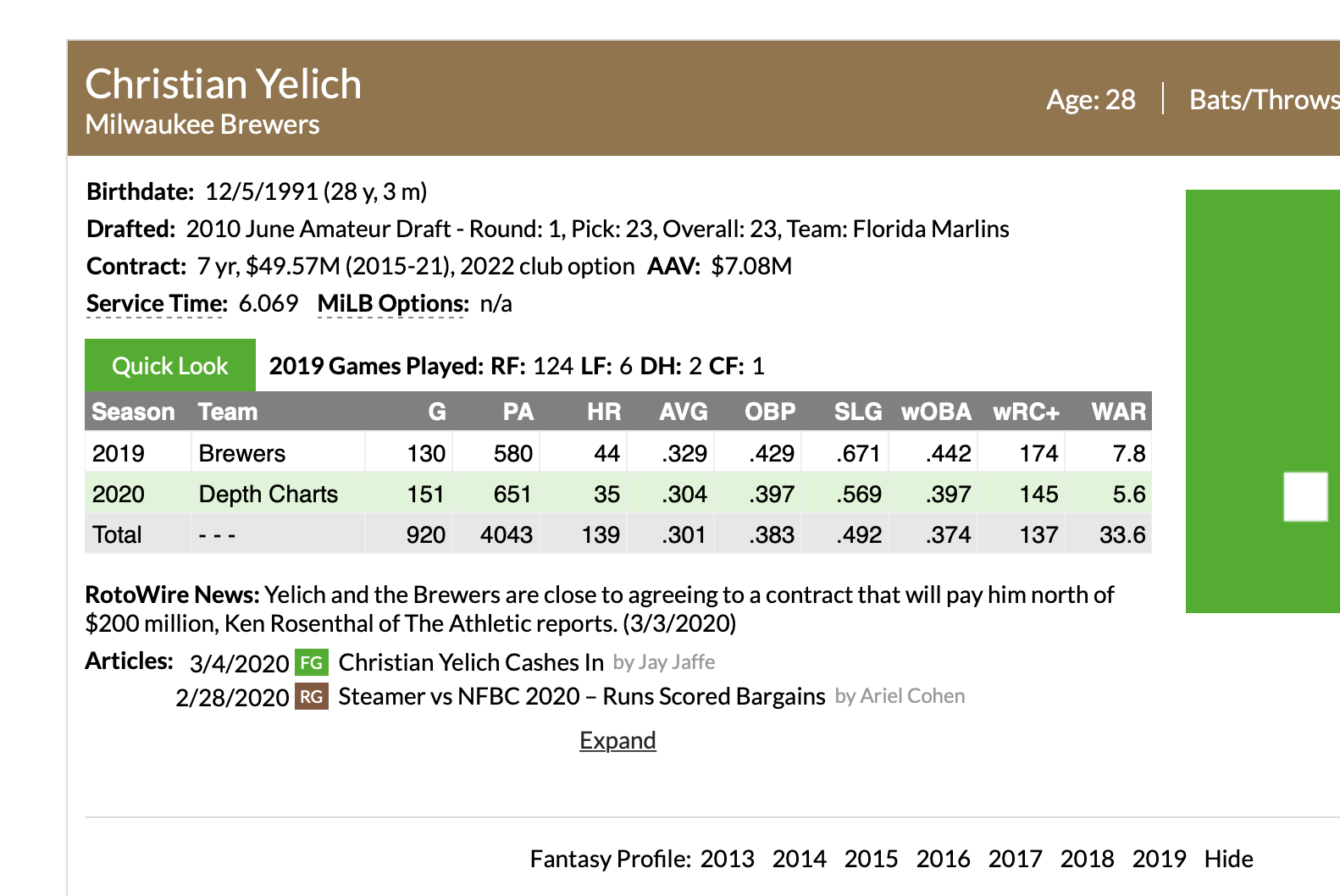
We just updated our player pages! The pages might not look that different, but we’ve redone everything under the hood. We did this to achieve responsive player pages, and it also comes with improvements in speed and a better platform to develop new features in the future.

Quick Look

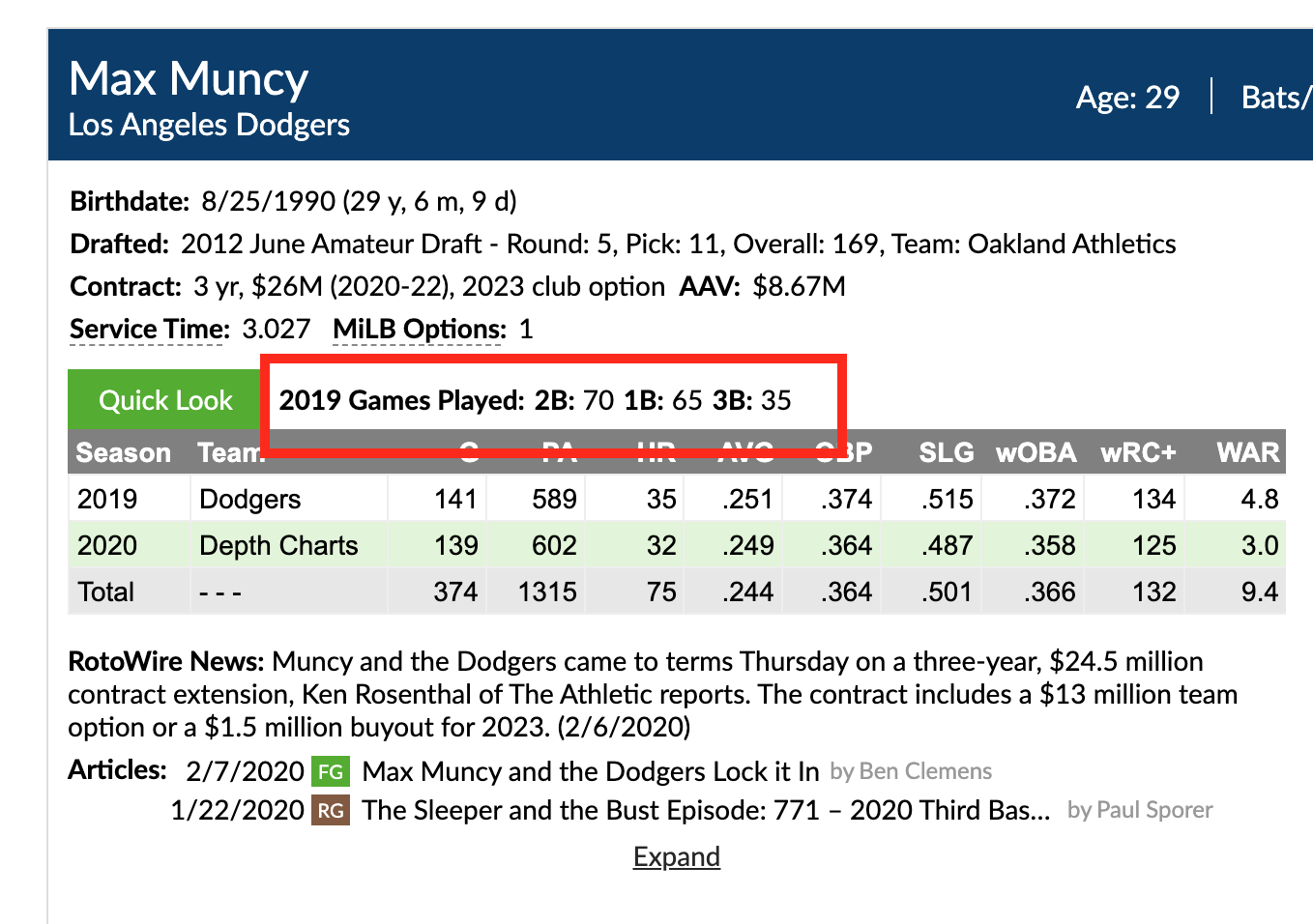
If you are on a desktop computer, the most noticeable difference on the new pages is the Quick Look section we’ve added to the very top of the page. These will have some popular stats for the player’s major league career and the current or most recent season. Retired players will only have their career stats.

For position players, we’ve also provided a summary of how many major league games the player played at each position, while a pitcher’s Quick Look will show their pitch repertoire. The position breakdown will double count games a player played at two or more positions, and does not include pinch-hitters or pinch-runners, so those values might not add up to games played. We display the Pitch Info classifications for the pitches where usage is 5% or greater for the season. Once again, these will only show for the current or most recent season.

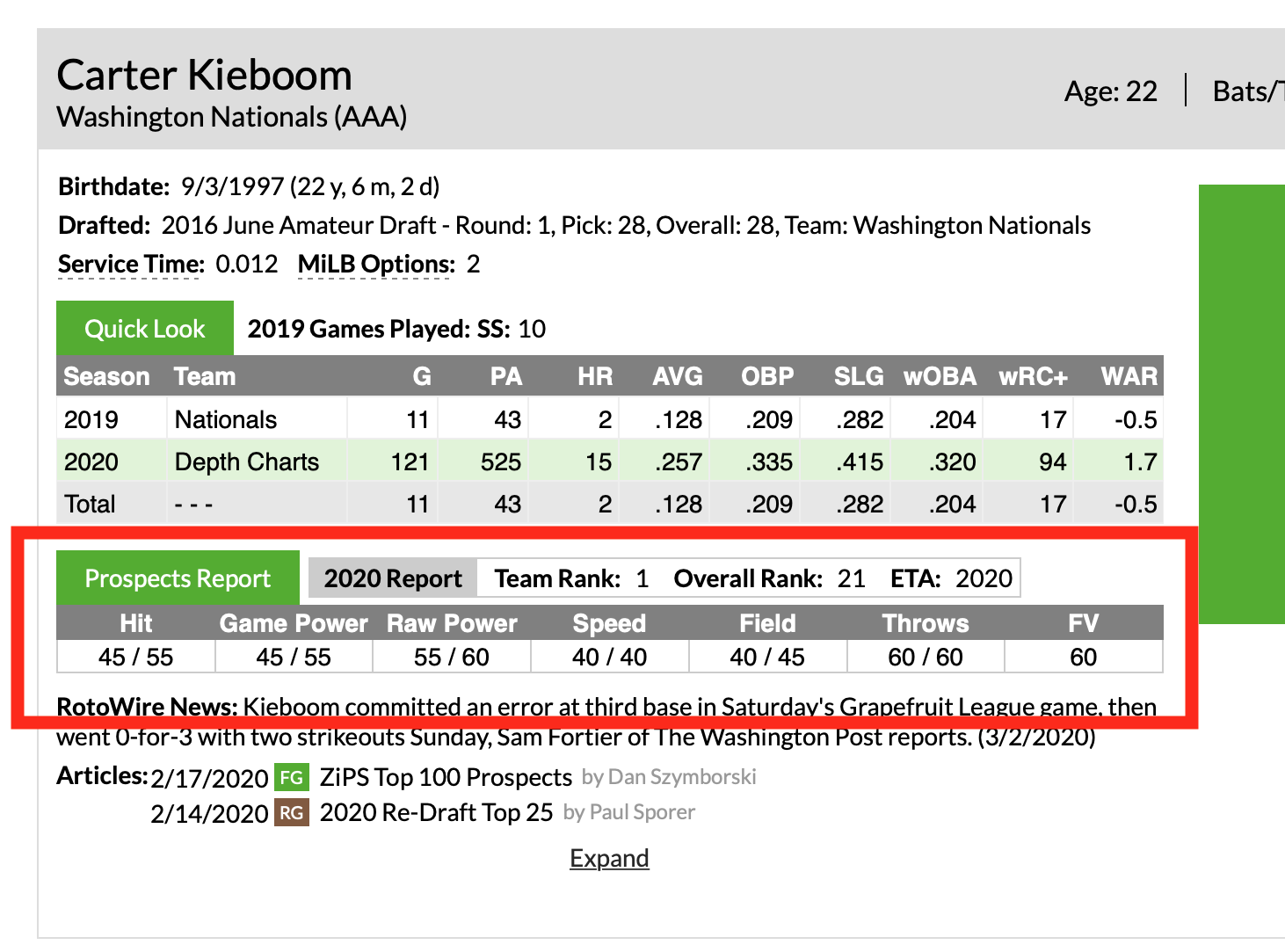
Prospects and players who were recently prospects have their most recent scouting grades and team rankings from the prospect team shown. The report year those grades and rankings come from is shown and also serves as a link to The Board, allowing you to see that report’s entire class. Any in-season rankings are denoted with a (U) for Updated.

Table View Options and Minor League Stats

Minor league stats are no longer shown by default for every player. We do, however, show them for players who:

  • Do not have any major league stats.
  • Current players who have less than two years of service time.
  • Retired players who have minor league stats in our database, but played fewer than three seasons in the majors.

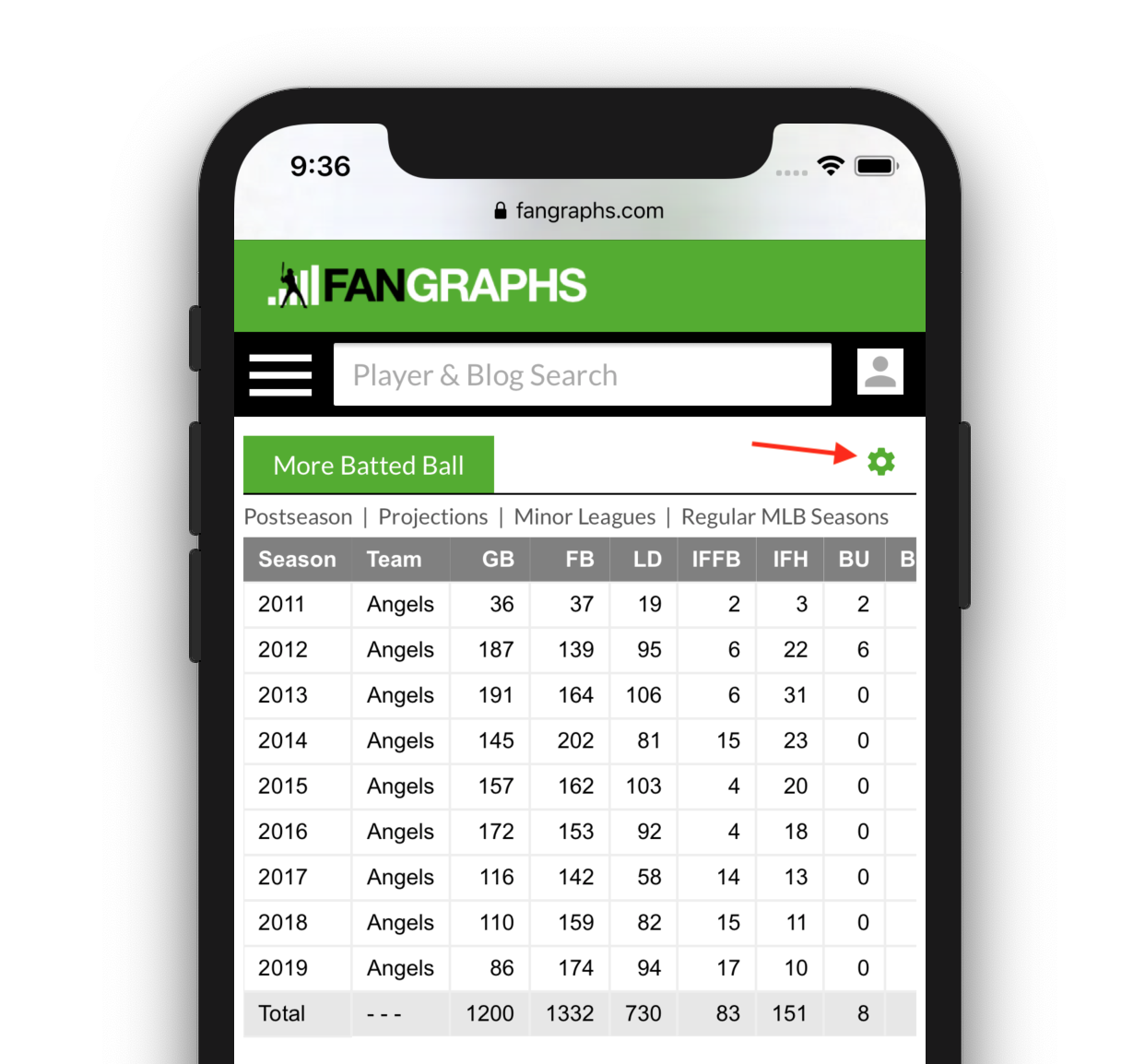
You can toggle the minor league stats into view as always, with the table options between the table header and the data grid.

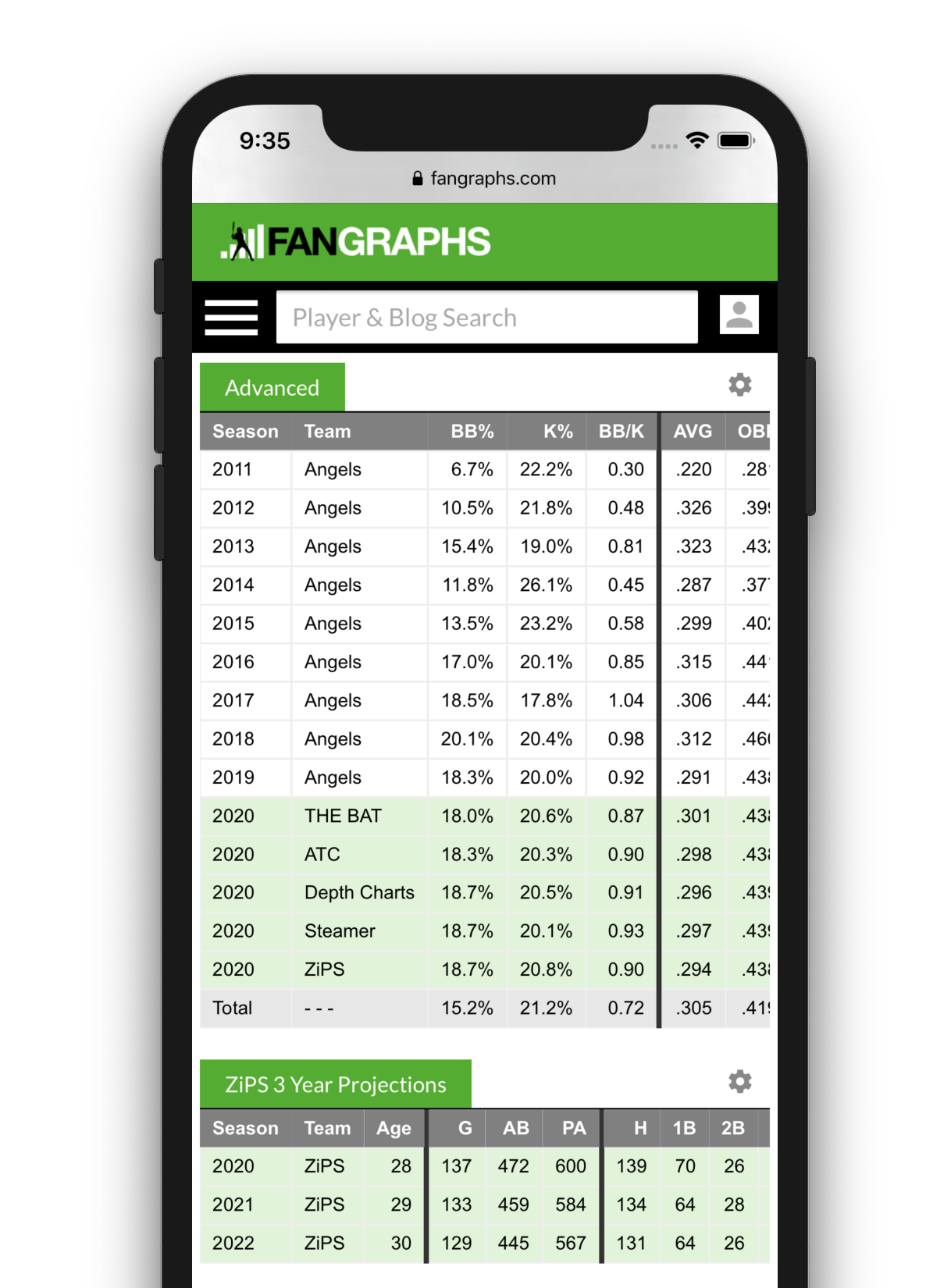
On mobile, those table view options are hidden but are accessible via the settings gear on the top-right of the table.

Game Logs

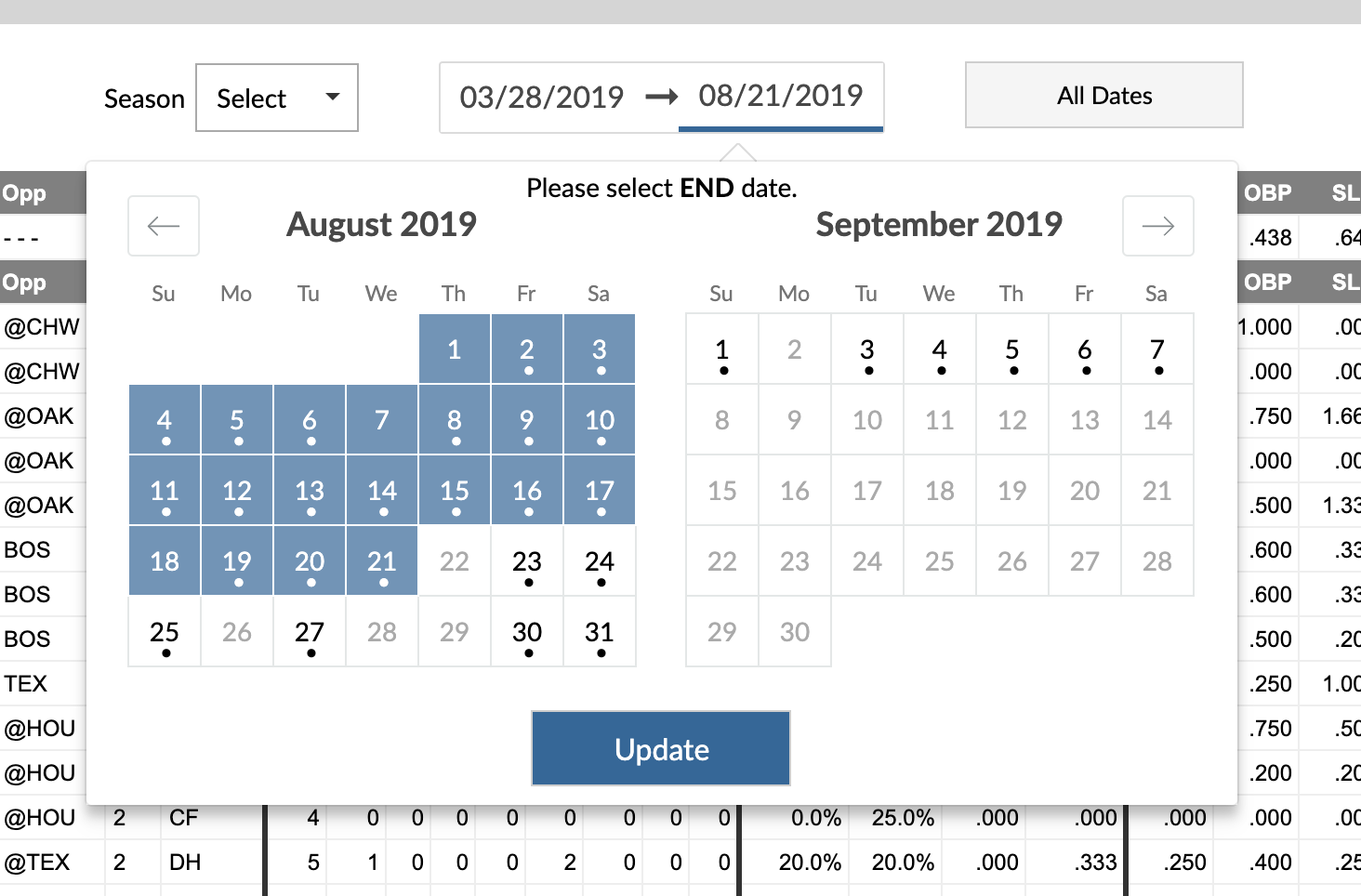
The game log calendar has been updated as well. Days when the player played a game are shown in black and have a dot underneath the date. Clicking update will load the new date range. You are also able to select an entire season or all games that we have available. If you select a very long range, it might take a while to load.

We also now have game logs and play logs available for players who played from 1974 to 2002. These behave just like the game logs and play logs of current players. 1974 is as far back as our play-by-play data currently goes.

Mobile

We made the data grid pages responsive. Much like The Board or the minor league leaderboards, you are able to scroll across the table while the season for the row is fixed in the left column.

For the moment, the visualization-based pages still require the full desktop view to use. We hope to move everything over to a responsive view soon.

Other Notes

Fantasy Player Profiles are still in the process of being written and will be available soon. The placement of the profiles on the player pages haven’t changed.

Back in January, we announced the creation of legacy pages for all players pages. The HTML structure on those has not changed. However, they are not meant as a fully-featured alternative, so navigation might not work and new features we develop in the future will not be added to them. This is meant as a stop-gap for any research tools you might have that rely on the HTML structure.

As always if you find any issues or bugs, please let us know in the comments!