Archive for Featured

The Dodgers Have Rented the Market’s Only Superstar

Among qualified hitters, Manny Machado currently ranks eighth in baseball in wRC+. He ranks 12th in baseball in WAR, despite some ugly defensive numbers that might not reflect his actual talent. This isn’t just a flash in the pan, either; the projections the rest of the way have Machado as a top-ten value. Which is all to say, Manny Machado is all kinds of good. He’s an incredible player months away from becoming a free agent, and it’s been clear he’d be traded since shortly after the season began. It was only a question of where, and for how much. Today we have our answers.

Machado plays for the Dodgers now. The Dodgers had been thought of as a favorite from the moment they lost Corey Seager. They held off for a while — maybe the Orioles couldn’t pull the trigger, or maybe the Dodgers thought they might clever their way in another direction. We are, though, where many people assumed we would eventually be. The Dodgers have rented a new superstar, and the Orioles’ rebuild is finally underway. It will never hurt worse than it hurts at this instant.

Dodgers get:

  • Manny Machado

Orioles get:

With the trade, we learn more about the price of a star-level rental. Let it not be suggested the Dodgers got Machado for cheap. You could see all five of the players going the other way reaching the majors. In rumors, Machado had been linked to teams like the Phillies, Brewers, and Diamondbacks. That’s undoubtedly part of the whole idea.

Read the rest of this entry »


Manny Machado Is Now Obviously a Dodger

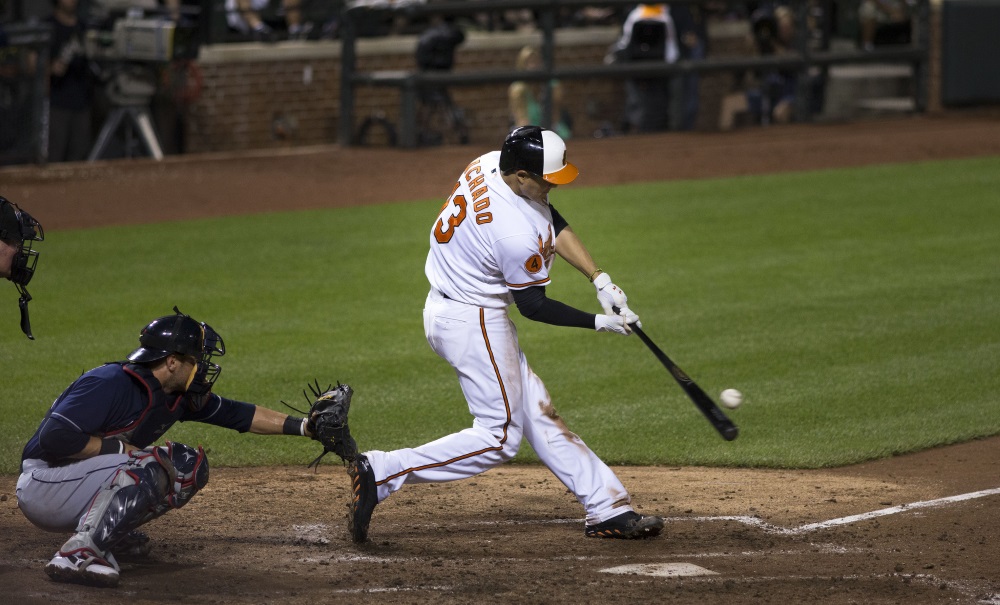
Manny Machado has to get a new uniform from someone.
(Photo: Keith Allison)

After a few days of something more substantive than speculation, the Baltimore Orioles and Los Angeles Dodgers appear finally to have conducted official business with each other. Eduardo A. Encina and Ken Rosenthal outline the particulars of that business via social-media platform twitter dot com:

At the very center of the trade, of course, is Manny Machado, one of the best major leaguers currently authoring one of his best major-league seasons. Machado will help the Dodgers address a shortstop position that has created uncertainty for the club ever since starter Corey Seager was forced to undergo Tommy John surgery at the beginning of May. Machado is projected for slightly more than two wins over the rest of season — about a win more than Chris Taylor (who’s received most of the starts at short in Seager’s absence) and also about a win more than a combination of Cody Bellinger, Enrique Hernandez, and Joc Pederson (who’ve received most of the center-field starts with Taylor at short).

Read the rest of this entry »


2018 Trade Value: #21 to #30

Noah Syndergaard’s velocity is a mixed blessing in terms of long-term value.
(Photo: Keith Allison)

As is the annual tradition at FanGraphs, we’re using the week of the All-Star Game — while the industry pauses to take a metaphorical breather — to take stock of the top-50 trade assets in the sport. For more context on exactly what we’re trying to do here, see the honorable-mentions post linked at the top of the page.

For this post and the others in this series, I’ve presented a graphic (by way of the wizard Sean Dolinar) breaking down each player’s objective skill level (represented, in this case, by a five-year WAR projection from ZiPS), contract/team-control details, rank in last year’s series, and then year-by-year details of age/WAR/contract through 2023, although a couple players have control beyond those five years. For those readers who are partial to spreadsheets rather than blocks of text, I’ve also included all the players we’ve ranked so far are in grid format at the bottom of the post.

The ZiPS WAR forecasts did influence the rankings a bit: for players who were bunched together, it acted as an impartial tiebreaker of sorts, but the industry opinions I solicited drove the rankings.

With that said, let’s get to the next 10 spots on the Trade Value list this year.

Five-Year WAR +20.8
Guaranteed Dollars –
Team Control Through 2023
Previous Rank –
Year Age Projected WAR Contract Status
2019 25 +3.1 Pre-Arb
2020 26 +4.0 Pre-Arb
2021 27 +4.3 Arb1
2022 28 +4.6 Arb2
2023 29 +4.8 Arb3
Pre-Arb
Arb

Ohtani was ticketed before the season to appear much higher than this, but some concern about an imperfect UCL has now turned to what most feel is an inevitable Tommy John surgery at some point during the course of his six controlled years. If you remove much of this year on the mound from his cost-controlled seasons, take away another 12-18 months for surgery, and add to that some uncertainty about whether the stuff/feel/stamina comes all the way back, and we’re now talking about three or four years of a premium but somewhat risky talent. If you look around, that’s roughly where he’s landed as far as comps. While the expectation of health has shifted south a bit since Opening Day, the evaluation of his talent has moved north a bit, both as a pitcher and hitter, following his uneven looks in spring training.

Read the rest of this entry »


The Futures Game Was Black

Because they feature such a high concentration of pitching talent and because everyone’s stuff plays up in short stints, Futures Games are often fast-moving, low-scoring affairs. Since the game’s inception in 1999, for example, a team has scored three or fewer runs on 18 occasions. That was not the case on Sunday, however, as baseball’s top prospects combined for eight home runs. In the end, Team USA defeated Team World by a score of 10 to 6.

The end result of a prospect showcase like the Futures Game is essentially meaningless. Batting practice and infield/outfield drills, which occur before the cameras even turn on, are more informative. But, to me, the scouting-related feats of strength and athleticism seen throughout Sunday’s festivities (which I promise to address further down) were secondary to another development — namely, the number of and the performances by the game’s African-American players.

Only 7% of big leaguers are African-American, which is way down from about 27% during much of the 1970s. Articles about the declining number of black athletes in baseball have been written so frequently over the last half-decade that I assume readers are at least somewhat familiar with the issue, but if you’d like background, USA Today conducts the annual census. Like any shift of this magnitude, a confluence of variables is probably at the heart of what has caused this decline. Some of those are probably cultural, and this aspect of the decline is one about which people are quick to speculate , but, as a 29-year-old white guy, I’m not exactly qualified to discuss the African-American experience and how it does or does not intersect with baseball.

But I know the scouting process and, like many systems and processes in the United States, it has grown increasingly less suited for economically disadvantaged people — and people of color in this country are disproportionately poor. Showcases and travel ball are becoming a more significant aspect of scouting and player development in youth baseball. These cost money for the participants — to say nothing of flights to and from places like Florida and Arizona for several tournaments a year, mandated hotels in these locations, and the cost of breakable wood bats and other equipment. To take one example, each of the 328 teams participating in this week’s 2021 Class/Under 15 World Wood Bat Association Championship in Atlanta had a $2,500 entry fee, and it costs spectators $55 for a tournament pass and $5 to park. Baseball is a skill-based game and those skills are best refined against high levels of competition, but it’s expensive for an individual kid to play the kind of high-level baseball that helps develop those skills.

When I broach this subject with people in baseball, I’m met with some resistance from individuals who think the game is incentivized to mine as much talent as possible and that, poor or not, talent will be discovered. And while I agree with this premise, I think there are young athletes in this country who have the physical capability to play professional baseball but whom the scouting industry will never discover because that talent is never cultivated.

Read the rest of this entry »


2018 Trade Value: #31 to #40

Jose Altuve will not be constrained by your “aging curves.”
(Photo: Keith Allison)

As is the annual tradition at FanGraphs, we’re using the week of the All-Star Game — while the industry pauses to take a metaphorical breather — to take stock of the top-50 trade assets in the sport. For more context on exactly what we’re trying to do here, see the honorable-mentions post linked at the top of the page.

For this post and the others in this series, I’ve presented a graphic (by way of the wizard Sean Dolinar) breaking down each player’s objective skill level (represented, in this case, by a five-year WAR projection from ZiPS), contract/team-control details, rank in last year’s series, and then year-by-year details of age/WAR/contract through 2023, although a couple players have control beyond those five years. For those readers who are partial to spreadsheets rather than blocks of text, I’ve also included all the players we’ve ranked so far are in grid format at the bottom of the post.

The ZiPS WAR forecasts did influence the rankings a bit: for players who were bunched together, it acted as an impartial tiebreaker of sorts, but the industry opinions I solicited drove the rankings.

With that said, let’s get to the next 10 spots on the Trade Value list this year.

Five-Year WAR +14.5
Guaranteed Dollars –
Team Control Through 2024
Previous Rank –
Year Age Projected WAR Contract Status
2019 23 +2.8 Pre-Arb
2020 24 +3.0 Pre-Arb
2021 25 +3.0 Arb1
2022 26 +2.8 Arb2
2023 27 +2.9 Arb3
Pre-Arb
Arb

I feel like I’m supposed to kick this off with a Ferris Bueller reference, but I couldn’t come up with anything fitting. Walker is one of the rare prospects who gets the coveted “has a chance to become be an ace” label that’s only true of a handful of pitchers on Earth at a given time. For all the (rightful) handwringing about how scouts don’t truly understand upside when guys like Joses Altuve or Ramirez can emerge as the best hitters in the game after never appearing on a top-100 list, the group of aces who weren’t at some point described as a potential ace is basically just Cliff Lee, and he was touted in the minors.

Read the rest of this entry »


How Realignment Could Improve the All-Star Game

During FanGraphs’ editorial weekend in Denver last month, this correspondent excused himself to spend some time in the Rockies clubhouse and Coors Field press box. There I found MLB.com Rockies beat writer Thomas Harding realigning baseball in his reporter’s notebook.

This contributor finds playing expansion czar to be an interesting thought exercise. Soon that afternoon, some Mets beats writers also joined the discussion, sharing their thoughts. Anytime there is a realignment-based post on this Web site or elsewhere, it tends to generate interest. Many of us like to play commissioner.

We’re almost certainly headed toward a future of 32 teams. MLB is in its longest expansion drought in the modern era. Rob Manfred has expressed a desire to expand — and preferably to add at least one international location. One of the major benefits Manfred has cited in the move to 32 teams is the ease of scheduling it would create. Namely, the game would not have to schedule a constant, rotating interleague series.

In fact, it would allow MLB to dramatically reduce the need for interleague play altogether.
Read the rest of this entry »


The American League’s All-Star Roster Has More Talent

The National League has won more games than the American League this season in interleague play, but you wouldn’t know it by looking at our individual leaderboards. The top seven position players by WAR this season reside in the American League and 10 of the best 11 — as long as Manny Machado remains in the AL — also play in that league. The parity when it come to interleague record is more likely a function of the National League’s relative parity, while the American League is very top and bottom heavy. The best teams in the AL can only do so much, as the bulk of the NL overwhelms the bottom-feeders in the opposite league.

As for the All-Star rosters, they more closely resemble the leaderboards. The graph below shows the WAR totals for every player on the All-Star Game roster, including those on the active roster but excluding those who have been replaced due to injury or a Sunday start.

Last year, both leagues featured a collective WAR similar to the NL’s mark this season, though the AL was missing Mike Trout. This year, Trout is back and acting like himself, while Mookie Betts and Jose Ramirez seem to be acting a lot like Trout, as well. If we removed the top three players from each roster, the collective WAR totals would be pretty close. That said, the All-Star Game would be also be less entertaining.

Read the rest of this entry »


2018 Trade Value: #41 to #50

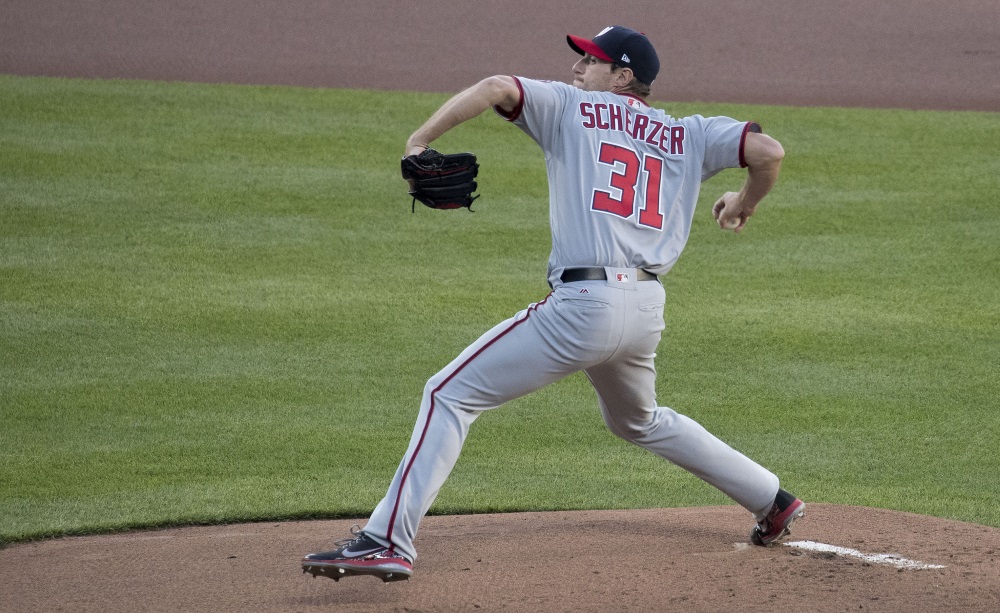
Max Scherzer’s contract renders him an option only for big-market clubs.
(Photo: Keith Allison)

As is the annual tradition at FanGraphs, we’re using the week of the All-Star Game — while the industry pauses to take a metaphorical breather — to take stock of the top-50 trade assets in the sport. For more context on exactly what we’re trying to do here, see the honorable-mentions post linked at the top of the page.

For this post and the four to follow, I’ll present a graphic (by way of the wizard Sean Dolinar) breaking down each player’s objective skill level (represented, in this case, by a five-year WAR projection from ZiPS), contract/team-control details, rank in last year’s series, and then year-by-year details of age/WAR/contract through 2023, although a couple players have control beyond those five years. For those readers who are partial to spreadsheets rather than blocks of text, I’ll also include all the players we’ve ranked so far are in grid format at the bottom of the post.

The ZiPS WAR forecasts did influence the rankings a bit: for players who were bunched together, it acted as an impartial tiebreaker of sorts, but the industry opinions I solicited drove the rankings.

With that said, let’s get to the final 10 spots on the Trade Value list this year.

Five-Year WAR +16.3
Guaranteed Dollars –
Team Control Through 2024
Previous Rank –
Year Age Projected WAR Contract Status
2019 22 +2.2 Pre-Arb
2020 23 +3.0 Pre-Arb
2021 24 +3.7 Pre-Arb
2022 25 +3.7 Arb1
2023 26 +3.7 Arb2
Pre-Arb
Arb

This last spot, as I’m sure was true on all of the versions of the list Dave did, was a tough to decide upon. As you can see from the honorable mentions, basically every type of player has a solid candidate for this spot. One could argue on behalf of Matt Olson, for example, that he’s a similar player to Tucker, has just one fewer year of control, and has already posted 3.6 WAR in his first 167 games. That said, Tucker seems to get a bit of a boost from the industry because of his recent call-up and that isn’t all nonsense: calling a top prospect up to a contending team before there’s any incentives by way of service time suggests the things non-Astros people know about Tucker (mental makeup, etc.) are positive.

Read the rest of this entry »


2018 Trade Value: Honorable Mentions

The industry places Javy Baez and Manny Machado just outside the top-50 players by trade value.
(Photo: Keith Allison)

All-Star week has arrived, which means a lot of things, like that the races for the 2018 postseason have begun to take shape (at least in the NL, where postseason races exist) and also that many of those who work in baseball are currently taking rushed, abbreviated vacations. Around here, though, it marks the time for a different tradition — namely, the start our annual Trade Value series.

The inimitable Dave Cameron did this list for 13 years, 10 of them for this website. He’s now moved on the Padres, though, and FanGraphs has somehow ended up with me in his place. This list wouldn’t be possible without the model established by Cameron, nor the help of Sean Dolinar, Dan Szymborski, and Carson Cistulli in putting together this year’s series. A special thanks is also due to industry friends who put up with much rougher early versions of this list, were generous with their time, and helped whip it into shape.

For those new to the series, it marks an attempt to answer the question “Who would bring back the most in trade if he were put on the market before the deadline?” What’s notable about this list — as opposed to the prospect types I assemble with Eric Longenhagen — is that it’s the only one for which my opinion doesn’t matter. The goal here isn’t for me to project anybody’s future value but rather to capture the opinions of the industry and how they value players in reality, right now.

Read the rest of this entry »


Mike Matheny Fired by the Cardinals

“And just like that, as mysteriously as he arrived, he was gone.”

– Oscar Martinez, The Office

It wasn’t quite Nixon’s Saturday Night Massacre, but after the Cardinals lost to the Cardinals 8-2 Saturday night, dropping to just a skosh above .500 at 47-46, manager Mike Matheny was dismissed from his managerial duties. The Cardinals remain in the playoff race, but it’s been a tumultuous month behind the scenes in St. Louis, from normal run-of-the-mill struggles to public friction with right fielder Dexter Fowler to the latest report — written by the tireless Mark Saxon of The Athletic — of Bud Norris’s old-school clubhouse antics with rookie reliever Jordan Hicks.

While Matheny’s role in the Norris-Hicks situation probably wasn’t the main factor behind his dismissal, I have few doubts that it was a contributing factor. Saxon received a lot of pushback publicly about his reporting on the issues, but these types of wagon-circling denials from teams when a story becomes embarrassing isn’t just common, it’s practically de rigueur. That doesn’t necessarily negate the veracity of the original reports.

In the end, though, it usually comes down to winning. Like most managers, Matheny lived by the win before he died by the win, the extremely successful Cardinal seasons at the start of Matheny’s tenure making him as unassailable at the time as he was vulnerable by 2018.

In a piece for ESPN in 2013, Anna McDonald reported on the relationship between the analytics-friendly front office headed by then-general manager John Mozeliak (who’s since been promoted to team president) and the more traditional Matheny.

“I believe how [Matheny] puts a lineup together is that he is utilizing things we give him from upstairs, but we don’t want to bury him with having to overthink things. Most importantly, we hire a manager to make that lineup. I do think one thing that Mike and his staff have done a very good job of is embracing anything we can put together as far as advanced scouting for them. Trying to eliminate small sample sizes and make them accept larger ones for probabilities has been helpful. Mike, he is a young manager that is very interested at looking at the best ways to be successful, so that’s always a good sign when you have that in an employee.”

Few analytics types, myself included, really thought much of Matheny as an in-game tactician. But that’s only part of the job of a manager. I’ve talked a lot about admiring Joe Torre as a manager for the Yankees not because of his in-game acumen but simply because, unlike a lot of managers, he didn’t stand in the way of his team’s success. Sometimes, keeping the team from killing each other is what a manager is there for, which is why I praised Dusty Baker’s hiring by the Washington Nationals as the right move at the right time for that particular club.

Read the rest of this entry »