Archive for Prospects

Another Draft Rankings Update

It’s not as significant as the Week One update, but we have about another dozen or so players that have moved around since we last updated THE BOARD. Here are some quick notes covering the most notable movers in the 2019 list, with trend arrows for all of these names and more available on THE BOARD:

  • Texas Tech 3B Josh Jung and Vanderbilt RF J.J. Bleday both have some buzz in the industry as being in the mix to be the third-best college bat behind Oregon State C Adley Rutschman and Cal 1B Andrew Vaughn (both recent risers themselves); Jung and Bleday have moved up to reflect this. Bleday is off to a quick start and looks more athletic than he has in the past, while Jung is a hit-first type who could improve considerably with more loft in his swing in pro ball, but compares favorably to some recent top-10 overall college bats. Others college bats in that mix are UNLV SS Bryson Stott, North Carolina LF Michael Busch, and the big riser in the last update, Missouri RF Kameron Misner.
  • North Carolina State SS Will Wilson is also a rising player, as a potential 5 hit, 5 power middle infielder who likely ends up at second base. Some scouts see plus makeup and versatility with a chance that he may end up catching in pro ball and being an Austin Barnes or Will Smith type who can play every position on the field. Wilson’s polish, performance, and fit in today’s game could push him into the top 15 picks.
  • Clemson SS Logan Davidson and UNC-Wilmington SS Greg Jones each face questions about their hit tool, but Jones stays slightly ahead of Davidson because his upside is still much higher. On the flip side, Arizona State LF Hunter Bishop has 7 raw power and 6 speed and is hitting much better this year, so he’s rising until further notice.
  • Duke LHP Graeme Stinson looked like the clear top pitcher in the class when the college season was set to start, with scouts having confidence that his mid-90s fastball and 70 slider could transition to starting full-time. He’s performed well, but the velocity has kept creeping down — he was into the 80s this weekend — to the point where scouts are openly questioning if there’s an arm problem or if Stinson simply can’t start and needs to be seen as a reliever going forward. Even a worst-case scenario still has him in the top 30 picks or so, but his stock has dipped a good bit.

There was further movement lower in the rankings, and some light changes in the 2020 and 2021 classes. A few fun notes on those future classes — for instance, fourth-ranked 2020 prospect Georgia RHP Cole Wilcox was 95-99 mph this weekend after a tough college debut, Florida State 2021 RF Robby Martin has really impressed scouts early, and 2020 Mississippi State RHP J.T. Ginn is showing more starter traits than he did in high school — have been folded into the rankings, as well.


Top 30 Prospects: Oakland Athletics

Below is an analysis of the prospects in the farm system of the Oakland Athletics. Scouting reports are compiled with information provided by industry sources as well as from our own (both Eric Longenhagen’s and Kiley McDaniel’s) observations. For more information on the 20-80 scouting scale by which all of our prospect content is governed you can click here. For further explanation of the merits and drawbacks of Future Value, read this.

All of the numbered prospects here also appear on The Board, a new feature at the site that offers sortable scouting information for every organization. That can be found here.

Athletics Top Prospects
Rk Name Age Highest Level Position ETA FV
1 Jesus Luzardo 21.4 AAA LHP 2019 55
2 Sean Murphy 24.4 AAA C 2019 55
3 A.J. Puk 23.9 AA LHP 2019 55
4 Austin Beck 20.3 A CF 2021 45
5 Jorge Mateo 23.7 AAA SS 2019 45
6 Jameson Hannah 21.6 A- CF 2021 45
7 Lazaro Armenteros 19.8 A LF 2021 40+
8 Sheldon Neuse 24.2 AAA 3B 2019 40+
9 Jeremy Eierman 22.5 A- SS 2021 40+
10 Nick Allen 20.4 A SS 2022 40
11 James Kaprielian 25.0 A+ RHP 2019 40
12 Daulton Jefferies 23.6 A+ RHP 2020 40
13 Grant Holmes 22.9 AA RHP 2019 40
14 Marcos Brito 19.0 A- 2B 2022 40
15 Parker Dunshee 24.1 AA RHP 2019 40
16 Luis Barrera 23.3 AA CF 2019 40
17 Skye Bolt 25.1 AA CF 2019 40
18 Jordan Diaz 18.6 R 3B 2022 40
19 Greg Deichmann 23.8 A+ RF 2020 40
20 Kevin Merrell 23.2 A+ 2B 2021 40
21 Brian Howard 23.9 AA RHP 2019 40
22 Miguel Romero 24.9 AA RHP 2019 40
23 Gus Varland 22.3 A RHP 2021 40
24 Alfonso Rivas 22.5 A- 1B 2021 35+
25 Dalton Sawyer 25.3 AAA LHP 2019 35+
26 Hogan Harris 22.2 R LHP 2020 35+
27 Jhoan Paulino 17.7 R SS 2024 35+
28 Alexander Campos 19.0 R 2B 2023 35+
29 Lawrence Butler 18.6 R RF 2023 35+
30 Jose Mora 21.4 A- RHP 2021 35+
Reading Options
Detail Level
Data Only
Full
Position Filter
All

55 FV Prospects

Drafted: 3rd Round, 2016 from Stoneman Douglas HS (FL) (WAS)
Age 21.4 Height 5′ 11″ Weight 209 Bat / Thr L / L FV 55
Tool Grades (Present/Future)
Fastball Slider Changeup Command Sits/Tops
55/55 55/60 50/60 45/55 92-95 / 98

The summer before his senior year of high school, Luzardo looked like a relatively unprojectable pitchability lefty, albeit an advanced one. His fastball was only in the 88-92 range at Area Codes, though his changeup and curveball were each above-average. He did not throw during the fall and instead devoted more time to working out. The following spring, with a new physique, Luzardo’s stuff was way up across the board, his fastball now sitting comfortably in the mid-90s, touching 97. Four starts into his senior season, Luzardo tore his UCL and need Tommy John.

After most of the first three rounds of the 2016 draft had come and gone it seemed as though Luzardo might end up at the University of Miami. Four outings (including the one during which he broke) was not enough time for many teams to have high-level decision makers in to see him and take him early, but the Nationals (who have a history of drafting pitchers who have fallen due to injury) called his name and signed him for $1.4 million, a bonus equivalent to an early second rounder. Luzardo rehabbed as a National and continued to strengthen his body. When he returned the following summer, his stuff had completely returned. He made just three starts for the GCL Nats before he was traded to Oakland as part of the Sean Doolittle/Ryan Madson deal.

He has quickly climbed Oakland’s minor league ladder and reached Triple-A at age 20 in 2018. Those crafty pitchability traits from high school are still extant. Luzardo will vary the shape of his breaking ball — he can throw it for strikes to get ahead of hitters, he back foot it to righties — and he uses his changeup against lefties and righties. His delivery is a bit violent but it doesn’t inhibit his command, and Luzardo’s musculature seems better able to deal with the effort than it was when he was in high school. His fastball, which has been up to 97 in his big league appearances this spring, may not play like a mid-90s heater because he is undersized and a short-strider, but he locates it well enough to avoid getting hurt.

He has mid-rotation upside and is abnormally polished. We may see him in Oakland this year.

Drafted: 3rd Round, 2016 from Wright State (OAK)
Age 24.4 Height 6′ 3″ Weight 215 Bat / Thr R / R FV 55
Tool Grades (Present/Future)
Hit Raw Power Game Power Run Fielding Throw
40/55 55/55 40/50 20/20 50/55 70/70

Once a walk-on at Wright State, Murphy has become one of the more well-rounded catching prospects in the minors. He has always had near elite arm strength but because he didn’t catch much pro-quality stuff in college, his receiving and ball-blocking were undercooked for a college prospect when he first entered pro ball. Those aspects of his defense have vastly improved, and he’s now an average defender with a chance to be above, and his arm douses opposing baserunners.

Murphy also has plus raw power, though he hasn’t typically hit for it in games for various reasons. In college, a broken hamate likely masked his power and was part of the reason he fell to the 2016 draft’s third round. In pro ball, his swing has been very compact, relying on Murphy’s raw strength rather than efficient biomechanical movement to deliver extra-bases. He broke his other hamate last year. Murphy’s nearly .500 SLG at Double-A Midland is above what we expect moving forward, and instead think Murphy will be a high-contact bat with doubles power, which would be an above-average regular behind the plate.

3. A.J. Puk, LHP
Drafted: 1st Round, 2016 from Florida (OAK)
Age 23.9 Height 6′ 7″ Weight 230 Bat / Thr L / L FV 55
Tool Grades (Present/Future)
Fastball Slider Curveball Changeup Command Sits/Tops
60/65 60/60 50/55 55/60 45/50 93-96 / 97

It’s counterintuitive to call a lefty with a plus slider and mid-90s velocity a ‘breakout’ candidate, but that’s exactly what Puk looked like during 2018 Spring Training before he tore his UCL and needed Tommy John. Puk was soft-bodied and relatively unathletic as an amateur, but he arrived to Mesa in good shape and his landing leg was more stable throughout his delivery, leading to superior command than he had had at Florida. Additionally, Puk dusted off his high school curveball and reintroduced it to his repertoire. His feel for it returned very quickly, and it was comfortably average near the end of spring and gave him a fresh way of starting off at-bats the second and third time through a lineup. His changeup was also better than it had been in college, and looked like a potential plus pitch.

Scouts thought he had a chance to reach Oakland by year’s end, and a surprisingly competitive Oakland club would have been motivated to move him quickly. Puk has recently begun throwing bullpens and should be going full-tilt later in the spring. He appeared to have No. 2 or 3 starter upside before his injury.

45 FV Prospects

Drafted: 1st Round, 2017 from North Davidson HS (NC) (OAK)
Age 20.3 Height 6′ 1″ Weight 200 Bat / Thr R / R FV 45
Tool Grades (Present/Future)
Hit Raw Power Game Power Run Fielding Throw
30/45 60/65 30/55 60/55 40/50 60/60

Beck was a name in the back pocket of area scouts in the Carolinas entering the winter of his draft year. Then word started to trickle out that the kid who had missed the summer and fall showcases with an ACL tear had turned into a completely different player, one who now had 70 bat speed. Early in the spring, videos of his first few majestic homers led to a rush of national crosscheckers and scouting directors getting in to see Beck, as most of them never had before. It’s rare for a prep hitter to land in the first 10 picks with only one spring of looks and data, none of it on TrackMan, and almost none of it against pro-quality pitching, but Beck’s tools were just that loud: 70 bat speed, easy plus raw power, plus speed, and a plus arm.

It’s similar to how Clint Frazier looked at the same stage, though Frazier had a long summer of production, faced strong prep competition, and still only went fifth overall. Beck’s pro debut revealed some weaknesses that aren’t evident against mediocre prep pitching and he was clearly overmatched in the AZL during his first pro summer and often visibly frustrated. He was 19 in Low-A last year and was able to hit for average, but very little power. Like Frazier, Beck has a good chance to lose a step as his body matures, and move to right field as a result, so pressure is on the bat. Pro scouts don’t see the impact power that amateur scouts saw. We’re cautiously optimistic that improved strength and swing work will tease out more game power during his age-20 season in the hitter-friendly Cal League.

Signed: July 2nd Period, 2011 from Dominican Republic (NYY)
Age 23.7 Height 6′ 0″ Weight 188 Bat / Thr R / R FV 45
Tool Grades (Present/Future)
Hit Raw Power Game Power Run Fielding Throw
35/40 55/55 40/45 80/80 45/50 55/55

Not only was Mateo unable to carry his torrid 60-game offensive stretch at Double-A into 2018 (half with New York before the 2017 Sonny Gray trade, half with Oakland after it), but he had his worst statistical season to date, as he reached base just 28% of the time.

He remains one of the more physically gifted players not only in this system, but in all of the minor leagues. He is a no-doubt 80 runner who circled the bases during an inside-the-park home run in the Dominican this winter in just 14.40 seconds. That’s approaching Byron Buxton territory even though Mateo paused on his way to first and slowed up as he approached and needlessly slid in to home. He also has above-average raw power that he has never manifested in games due to a variety of issues that make it unlikely he ever will. His lower half usage in the box is sub-optimal, he too often expands the zone, and he frequently settles for middling, opposite-field contact.

These have been Mateo’s issues for over seven years now, and with each passing season, they’re less and less likely to improve. But because Mateo has such prodigious athletic gifts and is going to play somewhere up the middle (he has the physical tools for shortstop and has looked fine there in big league trials this spring, but remains procedurally immature), he’s likely to force his way on the field somehow, and he has a better chance of making a big league impact than everyone below him on this list. That’s probably as a low-end regular or utility type, with a dwindling chance for stardom if the tools suddenly actualize.

Drafted: 2nd Round, 2018 from Dallas Baptist (OAK)
Age 21.6 Height 5′ 11″ Weight 190 Bat / Thr L / L FV 45
Tool Grades (Present/Future)
Hit Raw Power Game Power Run Fielding Throw
35/55 45/45 30/45 60/60 45/50 40/40

Hannah had three remarkably consistent years at Dallas Baptist and ended his college career with a .340 average. He has excellent hitter’s timing and bat control, and his swing is athletic but compact, enabling not only high rates of contact, but also promising contact quality. That’s not to say Hannah will have in-game power. He’s a line drive hitter, an old school, two-hole type of hitter, the kind who’s sort of an endangered species in the current big league hitting environment. Some teams considered Hannah’s lack of power to be a bit of an issue in their pre-draft evals and thought he was more of a tweener fourth outfield type, a projection echoed by pro scouts who saw Hannah in the summer and fall.

He has plus speed, speed that Hannah exhibited during instructional league even after he had been shut down for the summer with a foot injury. His frame is maxed out and he can’t afford to slow down much and still be viable in center field every day, but while this creates some long term risk for his profile, he’s fine out there right now. His most likely path to a sizable everyday role involves Hannah out-hitting what we currently have projected for his bat.

40+ FV Prospects

Signed: July 2nd Period, 2016 from Cuba (OAK)
Age 19.8 Height 6′ 0″ Weight 182 Bat / Thr R / R FV 40+
Tool Grades (Present/Future)
Hit Raw Power Game Power Run Fielding Throw
20/45 55/60 30/50 60/55 40/50 40/40

One of the last teenage Cuban prospects to leave the island before a new CBA implemented a hard-slotted international bonus system, Lazarito remains a polarizing and volatile prospect. Teams left his amateur workouts with widely varying opinions about his talent, especially his defensive future, and the situation became more unsettled when his American agent had to cut ties with him after receiving death threats from Lazarito’s Latin American trainer/investor. Once that situation resolved, Armenteros signed for $3 million, then came stateside and looked concerningly raw, but clearly talented. His timing and breaking ball recognition were especially poor, but he hadn’t seen live pitching for a long time, meaning it could have been due to rust. As the spring and summer of 2017 wore on, he started to develop a much better feel at the plate and by the fall of 2017, was hitting lasers to all fields off of curated instructional-league pitching.

The Athletics pushed him to Low-A as a 19-year-old in 2018 and Armenteros posted a serviceable .277/.374/.401 line while striking out at a disquieting 34% clip. The K% is less worrisome because of his age, but he does have a bat path that limits the scope of his contact and some kinetic connectivity issues that cause him to rely solely on his dynamic hand speed to generate power. His arm limits him to left field, and he needs to rake to hit enough for that. He has the physical talent to do so, but there are some mechanical and statistical indications that he may not.

Drafted: 2nd Round, 2016 from Oklahoma (WAS)
Age 24.2 Height 6′ 0″ Weight 195 Bat / Thr R / R FV 40+
Tool Grades (Present/Future)
Hit Raw Power Game Power Run Fielding Throw
35/40 60/60 35/50 40/40 45/50 60/60

A college shortstop and closer, Neuse was viewed by the amateur arm of the scouting body as a third base prospect with big power. He was Washington’s 2016 second rounder, then was traded the following summer as part of the Luzardo/Doolittle/Madson deal. He wrapped his 2017 season with short, statistically insignificant stints in Hi-A, Double-A, and the Arizona Fall League, but he performed at each stop, so combined there was confidence that Neuse’s early-season showing was for real despite his relatively advanced age.

He was sent right to Triple-A to start 2018 and flopped, hitting just .263/.304/.357 and striking out a concerning 32% of the time. Neuse has also thickened a bit, so while he’s still an arm-reliant fit at third, he’s trending more toward 3B/1B, and maybe right, than the SS/3B looks Washington gave him early in his career. The combination of the 2018 struggles and somewhat shaky standing on the defensive spectrum makes it imperative that Neuse have a bounce back 2019 performance. He’s a baseball rat and younger than similarly-skilled players we’ve written up so far (like Mets third baseman J.D. Davis), so we’re a little more bullish on a rebound here than we are elsewhere. If he struggles again it’s perhaps worth considering two-way duty. Neuse was up to 96 in our looks at him in college.

Drafted: 2nd Round, 2018 from Missouri State (OAK)
Age 22.5 Height 6′ 1″ Weight 195 Bat / Thr R / R FV 40+
Tool Grades (Present/Future)
Hit Raw Power Game Power Run Fielding Throw
30/45 60/60 35/50 50/45 40/45 60/60

Eierman’s older brother Johnny was a third round pick of Tampa Bay in 2011 and his father, John, played A-ball for the Red Sox in the mid-90s. Jeremy was a solid prep prospect, but not the type who gets a big bonus and signs out of high school, so he ended up at Missouri State and had a breakout sophomore year. He was often seen by high-level decision makers during that breakout because he was playing alongside first round third baseman Jake Burger, and he had 2018 first round buzz by the end of the college postseason because scouts thought he could be a passable shortstop with all-fields power, and analytics folks liked his huge sophomore season and higher-than-you’d-expect exit velos.

Then Eierman had an inconsistent summer with Team USA and his draft spring was a bit of a letdown. He plateaued, arguably had a worse statistical season, and suddenly there were doubts about his approach and ultimate defensive home. He fell to Oakland at 70th overall last summer. Oakland has been a bit more open to non-traditional fits at shortstop recently and they clearly think that with more reps there, Eierman can stick. He may be a 45 hitter who gets to his raw power in games and passes at short, along the lines of currently projected mid-first-round 2019 draft prospect Logan Davidson at Clemson. Pro scouts think he moves to third base, at least, which makes the hit tool look a little flimsy on paper.

40 FV Prospects

10. Nick Allen, SS
Drafted: 3rd Round, 2017 from Francis Parker HS (CA) (OAK)
Age 20.4 Height 5′ 9″ Weight 155 Bat / Thr R / R FV 40
Tool Grades (Present/Future)
Hit Raw Power Game Power Run Fielding Throw
35/50 30/30 20/30 50/50 55/70 60/60

Even among a historically talented group of SoCal shortstops (Hunter Greene, Royce Lewis, Brice Turang), Allen was clearly the most gifted defender of the group and the best defensive high school infielder a lot of scouts have ever seen. He has 80 hands, above-average range, a plus arm, and an intoxicating flare and confidence not typical of humans of this stature. Allen’s size, or lack there of, is why he fell to the draft’s third round, as there was concern he would not have the requisite physicality to hit big league pitching. After a few years of pro ball, scouts think his wrists and forearms are strong enough to put viable contact in play, but probably not with enough force to truly profile as an everyday shortstop.

Sources who have seen Allen and other punchless leatherwizards think the likes of Jose Iglesias and Freddy Galvis had more thump than Allen does at the same age. That’s not to say that they don’t think Allen is a big leaguer, as everyone thinks he’s going to have a very long big league career as an elite defensive shortstop and infield utility man a la Jack Wilson or Adam Everett. That type of player is going away, but we think Allen is exceptional.

Drafted: 1st Round, 2015 from UCLA (NYY)
Age 25.0 Height 6′ 4″ Weight 200 Bat / Thr R / R FV 40
Tool Grades (Present/Future)
Fastball Slider Curveball Changeup Command Sits/Tops
40/60 55/60 45/50 55/60 45/50 89-93 / 98

Kaprielian had a velo spike in pro ball (he was 89-94 at UCLA, and 94-97 after he had been with NYY for a while), then started getting hurt. Acquired by Oakland in the 2017 Sonny Gray deal, he still hasn’t thrown a single inning for an A’s affiliate. Let’s go over the injury history: Kap missed nearly all of 2016 due to a flexor-tendon strain, but his stuff was great when he returned for the 2016 Fall League. He blew out his UCL during 2017 spring training and needed Tommy John. In Eric’s looks at Kaprielian as he rehabbed back from TJ during extended spring of 2018, he was 91-94 instead of 94-97, then was shut back down with shoulder soreness. Up again during 2018 instructional league, his fastball was 88-91. He is again day-to-day with shoulder soreness as this list goes to press.

Healthy Kaprielian will touch 99 and show four impact pitches, including a plus slider and changeup. His pitch grades are nearly identical to A.J. Puk’s. Even if his stuff comes back this spring, we’ll be hesitant to move him up beyond the 45 FV tier due to the threat of injury recurrence, a specter that could cause Oakland to push him quickly if his stuff bounces back, which means he could feasibly make a big league impact this year if he could just get healthy.

Drafted: 1st Round, 2016 from Cal (OAK)
Age 23.6 Height 6′ 0″ Weight 180 Bat / Thr L / R FV 40
Tool Grades (Present/Future)
Fastball Curveball Changeup Cutter Command Sits/Tops
55/55 45/50 55/60 50/55 50/60 91-94 / 96

Another exciting arm talent who cannot stay healthy, Jefferies has thrown just 20 innings in parts of three pro seasons. His injury issues date back to his college days at Cal when he had shoulder trouble that the coaching staff initially said was hamstring tightness. An excellent on-mound athlete with advanced command, Jefferies was 91-93 the summer after he signed, then 92-95 with a reshaped array of secondary offerings the following spring. He looked likely to be a quick-mover, someone who might reach Double-A in his first full season. Alas, his UCL did not cooperate and Jefferies had Tommy John a week after James Kaprielian did. Jefferies returned during 2018 extended spring training and his velocity had totally returned. He was 92-93 early in rehab outings, then 91-95 in his first official AZL game back from surgery, but it would be his last in-game outing of the summer as he was shelved for the remainder of the regular season by a setback.

Healthy Jefferies has surgical command of a low-90s heater and plus power changeup. So firm is Jefferies’ cambio that TrackMan units often mistakenly classify it as a sinker as it resides in the mid-to-upper 80s. It bottoms out late and hard, and is Jefferies’ best secondary pitch. His breaking stuff has evolved since college and at last look, he was throwing a fringy curveball that is effective because of his ability to locate it, and an average upper-80s cutter. He’s a potential fourth starter with a value-altering injury history.

13. Grant Holmes, RHP
Drafted: 1st Round, 2014 from Conway HS (SC) (LAD)
Age 22.9 Height 6′ 1″ Weight 215 Bat / Thr R / R FV 40
Tool Grades (Present/Future)
Fastball Slider Changeup Command Sits/Tops
50/50 55/55 40/45 40/45 92-94 / 97

Wire-to-wire shoulder issues kept Holmes off the field for nearly all of the 2018 regular season. He was limited to fastball/changeup-only bullpens in the spring but didn’t really got going until late in the summer, when he made two starts in August and showed stuff that was slightly beneath where he was earlier in his career, with his fastball residing in the 92-94 range. Poised to pick up innings in the Arizona Fall League, Holmes once again had shoulder discomfort and was shut down for the year. The A’s still felt compelled to add him to the 40-man this offseason rather than let another team take a $100,000 flier on him in the Rule 5 and hope his fastball/slider combination stuck in their bullpen.

At his absolute best, Holmes will sit 93-96 with a plus slider and average-flashing changeup, a No. 4 or 5 starter if his change and command improve. Of this triumvirate of injured arms, Holmes is the most likely to be a reliever, but his injury history is the least lengthy. He was on the same bullpen schedule as Jesus Luzardo early in camp but still hasn’t pitched in a spring training game.

Signed: July 2nd Period, 2016 from Dominican Republic (OAK)
Age 19.0 Height 6′ 0″ Weight 160 Bat / Thr S / R FV 40
Tool Grades (Present/Future)
Hit Raw Power Game Power Run Fielding Throw
25/60 30/40 20/35 55/50 45/55 55/55

A skills-over-tools prospect, Brito is the most well-rounded, technically advanced player of Oakland’s splashy 2016 international signees, and the org saw fit to send him to the New York-Penn League as an 18-year-old last summer, where Brito was three years younger than the average regular.

Brito has enough range for the middle infield and magician’s hands around the bag at second base, and while he lacks the max-effort arm strength for shortstop, he throws darts from second to first with a flick of the wrist. His ball/strike recognition is mature for his age and Brito has above-average bat control and hand-eye coordination, but the way his body develops is going to dictate much of what he’s capable of doing offensively. He needs to get stronger to be more than a utility option at best. He’s a switch-hitting middle infield fit with feel for contact, and that alone makes him one of the more interesting prospects in this system, but there’s a sizable gap between where his physicality is now and where it reasonably needs to be for him to punish big league pitching in a meaningful way.

Drafted: 7th Round, 2017 from Wake Forest (OAK)
Age 24.1 Height 6′ 1″ Weight 205 Bat / Thr R / R FV 40
Tool Grades (Present/Future)
Fastball Slider Curveball Changeup Command Sits/Tops
55/55 45/45 50/50 50/55 50/60 89-92 / 94

Dunshee flew under the radar at Wake Forest, opting not to sign his junior year as a 14th rounder, then going in the seventh round as a priority senior sign to Oakland in 2017. He didn’t have huge stuff then and still doesn’t, with everything consistently grading a 50 and flashing 55s at times. But the 55s are showing up with a little more regularity, the command has gone from average to plus, and he knows exactly how to use the many pitches he has. Scouts think he’s now a high probability back-end starter who outperforms his raw stuff in the minors and may continue to do so in the majors.

He should start 2019 in Triple-A and will likely have a few chances to fill in on the big league roster in 2019.

Signed: July 2nd Period, 2012 from Dominican Republic (OAK)
Age 23.3 Height 6′ 0″ Weight 205 Bat / Thr L / L FV 40
Tool Grades (Present/Future)
Hit Raw Power Game Power Run Fielding Throw
40/45 50/50 40/45 70/70 55/60 70/70

A likely bench outfielder, Barrera projects to be an uncommonly toolsy one. He’s a high-end speedster with a cannon for an arm, and while he’s got a long minor league track-record of hitting, his aggressive approach might create issues against big league pitching. He often settles for sub-optimal contact, typically resulting in groundballs, and even though he takes some occasional max-effort hacks that tease the raw power, he’s not likely to hit for much of it in games. His speed enables viability in center, but he’s just okay out there, and it’s not enough to override the offensive issues and enable an everyday role. He projects as a high-end pinch runner and corner outfield defensive replacement, but there’s a chance he ends up as the larger half of a center field platoon.

17. Skye Bolt, CF
Drafted: 4th Round, 2015 from North Carolina (OAK)
Age 25.1 Height 6′ 3″ Weight 190 Bat / Thr S / R FV 40
Tool Grades (Present/Future)
Hit Raw Power Game Power Run Fielding Throw
40/45 50/50 40/50 60/60 45/50 55/55

Bolt was notable early in his prep career not only for his meteorological name, but also for his talent. He developed tools early — average raw power, plus speed, a good swing from both sides — and had a projectable body that enabled a favorable extended forecast for those tools. But scouts didn’t always see the performance they wanted from him during his developmental stage in high school or his maturation phase early in his college career at North Carolina, even though the tools were consistently there. His BB/K ratio was fine in college, but his BABIP was very low, due in part to weaker contact and a slow first step out of the box, but also some bad luck. He’s progressed offensively in pro ball and his power has finally begun to show up in the stat line.

He’s fringy in center field and now has a textbook fourth outfielder profile. Some teams prefer his switch-hitting bat and power to Barrera’s; others would rather have Barrera’s wheels and superior feel for contact, but they have similar likely future roles.

18. Jordan Diaz, 3B
Signed: July 2nd Period, 2016 from Colombia (OAK)
Age 18.6 Height 5′ 10″ Weight 175 Bat / Thr R / R FV 40
Tool Grades (Present/Future)
Hit Raw Power Game Power Run Fielding Throw
25/55 50/55 25/45 45/40 40/45 50/50

Diaz signed for $275,000 in the 2016 signing period and has steadily progressed to be among the best homegrown Latin prospects Oakland has, arguably with Armenteros and Brito for some observers. There’s a shot for average all-around offense, and most see Diaz as a hit-over-power prospect, evident through the high-contact numbers he showed 2018 in the AZL, while some see potential above-average power and that Diaz will prioritize over contact down the road. He’s also a good enough athlete to stick at third base at the moment, though that may change depending on how his body matures. Diaz was already pretty filled out at 16 and may outgrow third. The offense will dictate his future and there are some exciting elements already present, especially for a lower-bonus prospect who signed just two years ago.

Drafted: 2nd Round, 2017 from LSU (OAK)
Age 23.8 Height 6′ 2″ Weight 190 Bat / Thr L / R FV 40
Tool Grades (Present/Future)
Hit Raw Power Game Power Run Fielding Throw
30/45 65/65 40/50 50/45 40/45 55/55

Deichmann has long been on the national scouting radar, standing out as a prep underclass third baseman in Louisiana, but his age and contact issues pushed him to LSU. He barely played as a freshman, was solid as a sophomore, then broke out as a 22-year-old junior, hitting 19 homers en route to a .996 OPS while also posting top-of-the-scale amateur exit velocities as he grew into easy plus raw power.

Since he signed as a 22-year-old and is a corner-based, power-over-hit bat, Deichmann needed to perform quickly but a broken hamate limited his 2018 and may keep him from getting to that power in games until later in 2019. He is a fine right fielder and good athlete, but is just fringy defensively, so the pressure is on for his age-24 season, with only 47 career games at full-season levels.

Drafted: 1st Round, 2017 from South Florida (OAK)
Age 23.2 Height 6′ 1″ Weight 180 Bat / Thr L / R FV 40
Tool Grades (Present/Future)
Hit Raw Power Game Power Run Fielding Throw
35/55 40/40 20/30 80/80 40/45 55/55

Merrell was a sleeper prep prospect as a 70 runner without much else in terms of present tools to offer, so he headed to South Florida, where he blossomed in his draft year. He’s now an 80 runner but still doesn’t quite have the hands or actions for the infield; he could work his way into being a passable second baseman, but we would guess center field is where he lands. His approach is solid but not great, in part because he has above average bat control and, obviously, the speed to outrun softly-hit balls. There’s enough power to hit homers to the pull side when he gets ahold of a fastball in, but not much in way of home run potential. He’s gotten a little too pull-heavy in pro ball and should use more of an all-fields approach to have a shot to develop the contact skills he needs to turn into a low-end regular.

21. Brian Howard, RHP
Drafted: 8th Round, 2017 from TCU (OAK)
Age 23.9 Height 6′ 9″ Weight 185 Bat / Thr R / R FV 40
Tool Grades (Present/Future)
Fastball Curveball Changeup Cutter Command Sits/Tops
50/50 45/50 45/50 50/55 50/55 89-91 / 93

Howard was a $40,000 senior sign in the eighth round of the 2017 draft and spent half of 2018 pitching well at Double-A. His stuff is pretty generic — 89-93 with an average cutter and curveball — but Howard’s size (he’s 6-foot-9) creates a unique angle on his pitches that hitters clearly aren’t comfortable with. He also has remarkable control for a pitcher of this size. It’s fifth or sixth starter stuff, which would already be a great outcome for a high-priority senior sign, and we’re inclined to round to the top of that range based on the weirdness created by Howard’s height.

22. Miguel Romero, RHP
Signed: July 2nd Period, 2016 from Cuba (OAK)
Age 24.9 Height 6′ 2″ Weight 180 Bat / Thr R / R FV 40
Tool Grades (Present/Future)
Fastball Slider Changeup Command Sits/Tops
55/55 55/60 50/50 45/50 94-97 / 98

Romero experienced an unexpected velocity spike as a 24-year-old, his heater creeping into the 93-97 range after it was 92-94 the year before. He also drastically improved his slider, which he lacked feel for just after signing, and he now looks like a standard fastball/slider middle relief prospect in most outings, though remember that Romero also throws a knuckle changeup — coined ‘The Critter’ by Mat Latos, the only other guy we know who throws it — which he has de-emphasized as the slider has emerged.

23. Gus Varland, RHP
Drafted: 14th Round, 2018 from Concordia (OAK)
Age 22.3 Height 6′ 1″ Weight 205 Bat / Thr L / R FV 40
Tool Grades (Present/Future)
Fastball Slider Curveball Command Sits/Tops
50/55 50/55 45/50 40/50 92-94 / 95

We knew nothing of Varland until he threw after the draft, and now we think he’s at least a good relief prospect with a chance to be more. Thick and physical throughout the torso and thighs, Varland has a lightning-quick arm that generates mid-90s velocity at peak. His fastball has bat-missing life, and both his breaking balls have sufficient bite to avoid barrels as well, especially when they’re well-located. He was pushed to the Midwest League fairly quickly after signing and carved up the Penn League in three and four-inning stints. It may be worth trying to start him but he could move pretty quickly as a reliever.

35+ FV Prospects

Drafted: 4th Round, 2018 from Arizona (OAK)
Age 22.5 Height 5′ 11″ Weight 180 Bat / Thr L / L FV 35+

At 6-foot-1, 180, Rivas would look out of place in a team photo of big league first basemen, full of big-bodied mashers and explosive rotational athletes. He lacks prototypical first base pop but there’s a non-zero chance he makes enough contact to balance the offensive scales sufficiently to profile as a platoon 1B/LF or low-end regular. His 2018 post-draft showing in the NYPL was impressive from a bat-to-ball standpoint and he took great at-bats and made hard contact during instructional league, though that was all against pitching comparable to what he saw in college. He’s a sleeper bat we like but it’s a tough profile, one he’ll have to hit his way to.

25. Dalton Sawyer, LHP
Drafted: 9th Round, 2016 from Minnesota (OAK)
Age 25.3 Height 6′ 5″ Weight 210 Bat / Thr L / L FV 35+

Tommy John surgery sank Sawyer’s 2018 season and he’s now a 25-year-old who has yet to pitch a meaningful slate of innings above A-ball. He also only throws in the low-90s/upper-80s, but he locates it in spots that make it difficult for hitters to punish, and his funky, low-3/4s arm slot disorients them, especially lefties. His delivery, fastball command, and ability to dump his curveball in for strikes should be enough for him to deal with lefties and Swayer’s best pitch, a late-sinking, bat-missing changeup, could be enough to keep righties at bay. The report reads like a that of fifth starter, a 40 FV. But Sawyer’s age and what might be an innings limit coming off of surgery are at odds with one another, and ideally we’d like a pitcher firmly in his mid-20s to be a big league lock for 2019, so we’ve shaded down his FV beneath his true evaluation.

26. Hogan Harris, LHP
Drafted: 3rd Round, 2018 from Louisiana Lafayette (OAK)
Age 22.2 Height 6′ 3″ Weight 230 Bat / Thr R / L FV 35+

Harris broke onto the national scene in the summer of 2015, working 90-94 with an above average slurve but well below average command due in part to an extreme crossfire delivery. He was a version of this for a few years, then made some adjustments in college to develop more starter traits and throw strikes with the sort of stuff he showed before his senior year in high school. He’ll run it into the mid 90s at times and flashes three above average pitches, but had an oblique injury kept him from playing after signing and the stuff still waxes and wanes.

Signed: July 2nd Period, 2017 from Dominican Republic (OAK)
Age 17.7 Height 6′ 1″ Weight 176 Bat / Thr R / R FV 35+

Paulino had an impressive fall instructional league during which he showed uncommon power for a teenage infield prospect. He’s somewhat physically mature and soft-bodied, but is likely to grow into at least a little more raw power as he matures and though he may not be a long-term fit at shortstop, he does have infield actions and arm strength. He won’t turn 18 until June, and will be one of the more interesting prospects on Oakland’s AZL team. For now, he simply has an intriguing combination of power and defensive profile, very little is actually in focus.

Signed: July 2nd Period, 2016 from Venezuela (SEA)
Age 19.0 Height 6′ 0″ Weight 178 Bat / Thr R / R FV 35+

Campos was acquired from Seattle in the Ryon Healy deal before he had even set foot on American soil for an affiliated game. He posted a statistically impressive season in the DSL, but struggled in his first attempt at rookie ball in the States. Campos is very physically mature for his age, his build that of a high school fullback. He’s not a long term shortstop due to arm strength and needs to keep his frame in check to retain sufficient range for second, but the bat speed alone is worth a mention here, as is his early-career feel for the strike zone.

Drafted: 6th Round, 2018 from Westlake HS (GA) (OAK)
Age 18.6 Height 6′ 4″ Weight 200 Bat / Thr L / R FV 35+

Butler emerged late in the 2018 draft, first getting national scouting attention in the spring at a high school in the Atlanta suburbs. He’s a prototypical projection prospect, with a great frame, solid average present power, and athletic actions. Scouts who are optimistic see the components of a 45 or 50 hit tool and 60 or more future raw power in an everyday right field profile. Since Butler is somewhat raw and hasn’t faced a lot of high level pitching, there are concerns that the hit tool never materializes enough to get to the rest of his tools.

30. Jose Mora, RHP
Signed: July 2nd Period, 2014 from Dominican Republic (OAK)
Age 21.4 Height 6′ 3″ Weight 185 Bat / Thr R / R FV 35+

Mora often struggled to throw strikes after he was sent from extended spring training to Vermont, and he likely fits in relief, long-term due to command. Mora has a well-balanced lower half through release, but he lacks tactile feel for release. His upper body rotates in unison like a tilt-a-whirl, and his low 3/4s arm slot generates mediocre angle on his fastball, but he throws pretty hard, in the 90-94 range, and will flash an above-average slider. He’s only ever thrown from the stretch in Eric’s looks, reinforcing our relief projection, but he may end up as a good three-pitch one.

Other Prospects of Note

Grouped by type and listed in order of preference within each category.

Kyler Murray
Kyler Murray, CF

Murray is a supreme athlete who was a top-10 draft talent after having not played baseball full-time for several years. He has 70 speed, 55 raw power, and plus bat speed that played surprisingly well in games given the layoff. Last fall, the whole sport-watching world got to see how good of an athlete he is on the football field, and it now looks unlikely that Murray will have a baseball career of any consequence due to his preference for football. We had a 45 FV on Murray before the draft, and he’d be fourth or fifth on this list if he’d have stuck with baseball. But part of what we think about when we FV someone is their trade value, and because it doesn’t seem likely that he returns to baseball (and if he does his chances of success are low due, again, to the layoff), that trade value is akin to other 35 FVs at this point. Murray had a good chance to turn into a 50 FV by midseason if he had shown some progress with pitch selection in a hypothetical 2019 Hi-A campaign.

Exciting Longshot Arms
Eric Marinez, RHP
Wandisson Charles, RHP
Ismael Aquino, RHP

Marinez is a converted third baseman who threw just two innings last year but was pumping mid-90s gas with ease in those two innings (and during instructs), and he has nascent breaking ball feel. He’s a sleeper to develop into a good two-pitch reliever. Charles is a 6-foot-6, 220 pound beast with elite arm strength (95-98, touching at least 99) but zero feel for pitching. He’ll snap off the occasional plus slider in the 86-90 mph range, but he’s relatively undercooked for 22. Aquino is 20 and sits 93-96, but it’s a relief-only delivery.

Possible Role Players
Cobie Vance, UTIL
Tyler Ramirez, LF
Dairon Blanco, CF
Luke Persico, 1B/OF

Vance is an athletic multi-positional player with max-effort 55 bat speed. He made several highlight reel defensive plays in the fall. Ramirez has performed at Double-A for multiple years but we think he’s limited to left field and lacks the bat to profile there. He might hit enough to prove us wrong but we think it’s more likely he becomes a star in NPB or the KBO one day. Blanco is an 80 runner and potential fifth outfielder. Persico has good feel for the zone and some contact skills. He’s not a great fit at third base but has played there and might be a righty bench bat who can play the corner positions.

Young Latin American Talent
Danny Bautista, Jr., OF
Yerdel Vargas, SS
Kevin Richards, CF
George Bell, Jr., OF

Bautista is the most well-rounded of this group but doesn’t have any plus tools and might max out as a bench outfielder. Vargas was once a strong 40 FV on here but hasn’t developed as hoped, in part due to injury. Richards is carpaccio raw but is a 70 runner with a good frame. He might fill out and suddenly have some pop. Bell is similar to Richards but has less speed.

Pitching Inventory
Brady Feigl, RHP
Kyle Finnegan, RHP
James Naile, RHP
Norge Ruiz, RHP
Clark Cota, RHP

Feigl has solid average stuff and some feel, and is likely a long relief type but has some chance to be a backend starter. Finnegan throws in the mid-90s and has an above-average split and could be a middle reliever. Fastball and curveball spin rates are usually correlated with one another but Naile has a low-spinning, sinking heater and a 2800 rpm curveball, so who knows what going on there. He could be a middle reliever. Ruiz is a kitchen sink righty with average stuff, sometimes cruises in the high-80s, works backwards, and is generally a bit of an enigma but could be an inventory multi-inning piece. Cota has a Mark Melancon looking delivery, a fastball/curveball/changeup pupu platter repertoire, and surprising feel that could lead to him being a solid middle reliever.

System Overview

In the Moneyball days, Oakland pressed a market inefficiency in the draft, generally scooping up under-tooled college prospects with higher probabilities of success and lower upside. Over time, they’ve slowly shifted to favoring upside with their biggest amateur expenditures. They took prep righty Trevor Cahill in the second round in 2006 and signed Michael Ynoa, a 16-year-old righty, for a then-record $4.25 million bonus in 2008. One could argue that they should value upside as much as any club, as their small payroll means that a couple of stars emerging at once could open a window that causes them to push their chips in for a multi-year run, whereas one or two stars doesn’t change the Yankees’ team-building calculus as dramatically.

Their 2017 first rounder, sixth overall pick Austin Beck, was arguably the highest risk/upside proposition yet, a prep hitter with the shortest track record of any of his peers, taken at a pick where anything short of a multi-year regular is a failure. Oakland is also tied to top players in the 2019 and 2020 July 2nd classes, in Dominican shortstop Robert Puason and Dominican center fielder Pedro Pineda, respectively. Even in the universe of 15- and 16-year-olds, these two are seen as top-of-the-market talents because of their upside, with more risk and upside than other elite peers according to most scouts. Lefties A.J. Puk and Jesus Luzardo are elite prospects who are close to the big leagues right now, but also came with their own risk factors, as Puk, the sixth overall pick in 2016, was maddeningly inconsistent and appeared headed in the wrong direction as the draft approached before needing Tommy John early last season, while Luzardo is a shorter lefty with a Tommy John surgery as a high schooler. Two of the three pieces in the Sonny Gray haul — Jorge Mateo (consistency, makeup) and James Kaprielian (injuries) — were also seen as upside/risk types and haven’t returned value yet, but 2019 will go a long way to defining that trade. It has been a slow but interesting shift for the club most closely associated with one extreme of the acquisition spectrum to have moved almost as far to the other end.

Why Not Both? THE BOARD: Scouting + Stats!

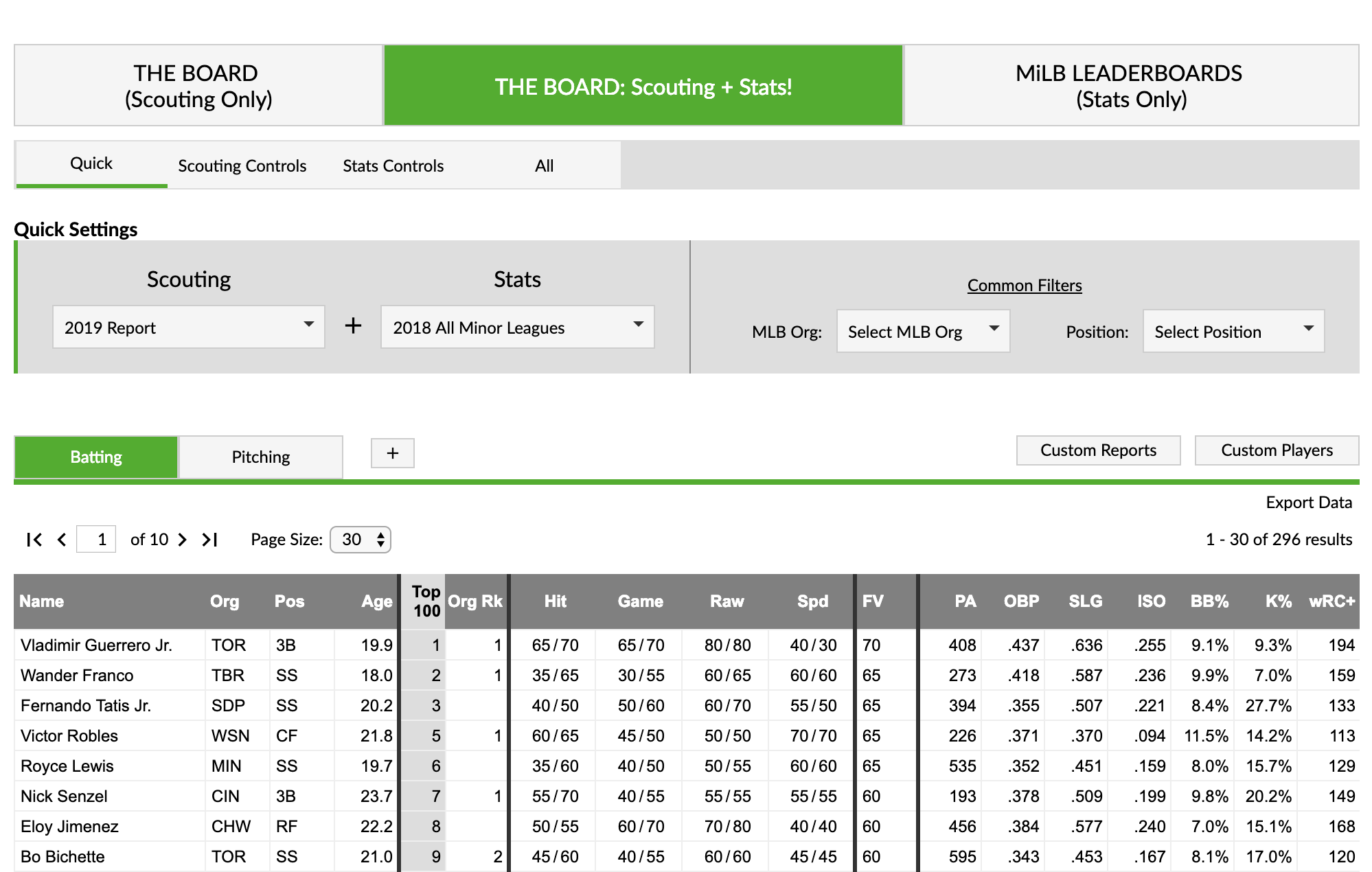
We decided to make a leaderboard that combines THE BOARD! with our Minor League Leaderboards. There are a ton of new features to review, but if you are the type of person that attempts to assemble furniture without reading the instructions, here’s the link:

https://www.fangraphs.com/prospects/the-board-scouting-and-stats

If you are still with us, we have a lot to cover. This combined leaderboard is similar to a feature we tested on our prospects landing page where the prospect list that Eric and Kiley have compiled is joined with our minor league stats.

Here’s a list of the new features:

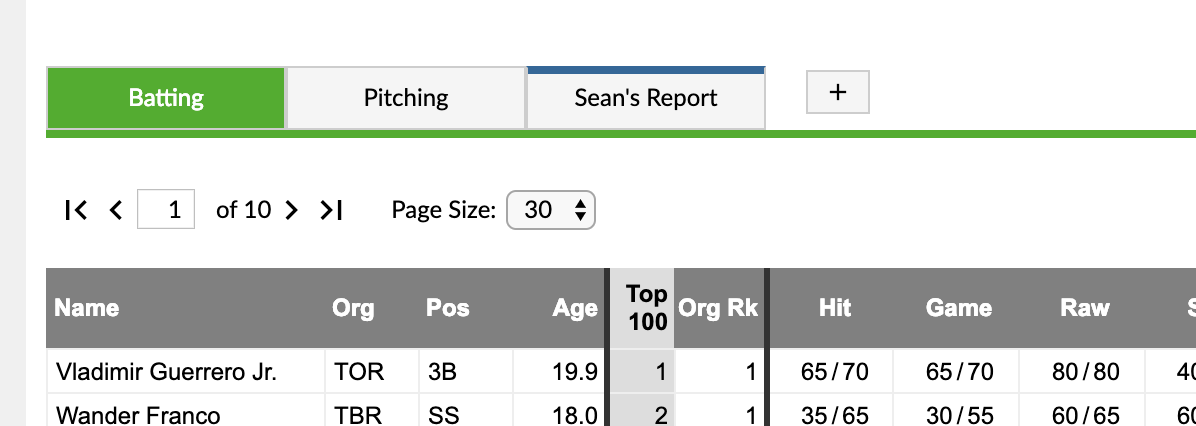
  • THE BOARD: Scouting + Stats!
  • Revamped Minor League Leaderboards
    • Added the ability to select multiple seasons
    • Added the ability to filter by organization
    • Added three new league filters: Upper (AAA/AA), Mid (A+/A), and Low Levels (A-/R)
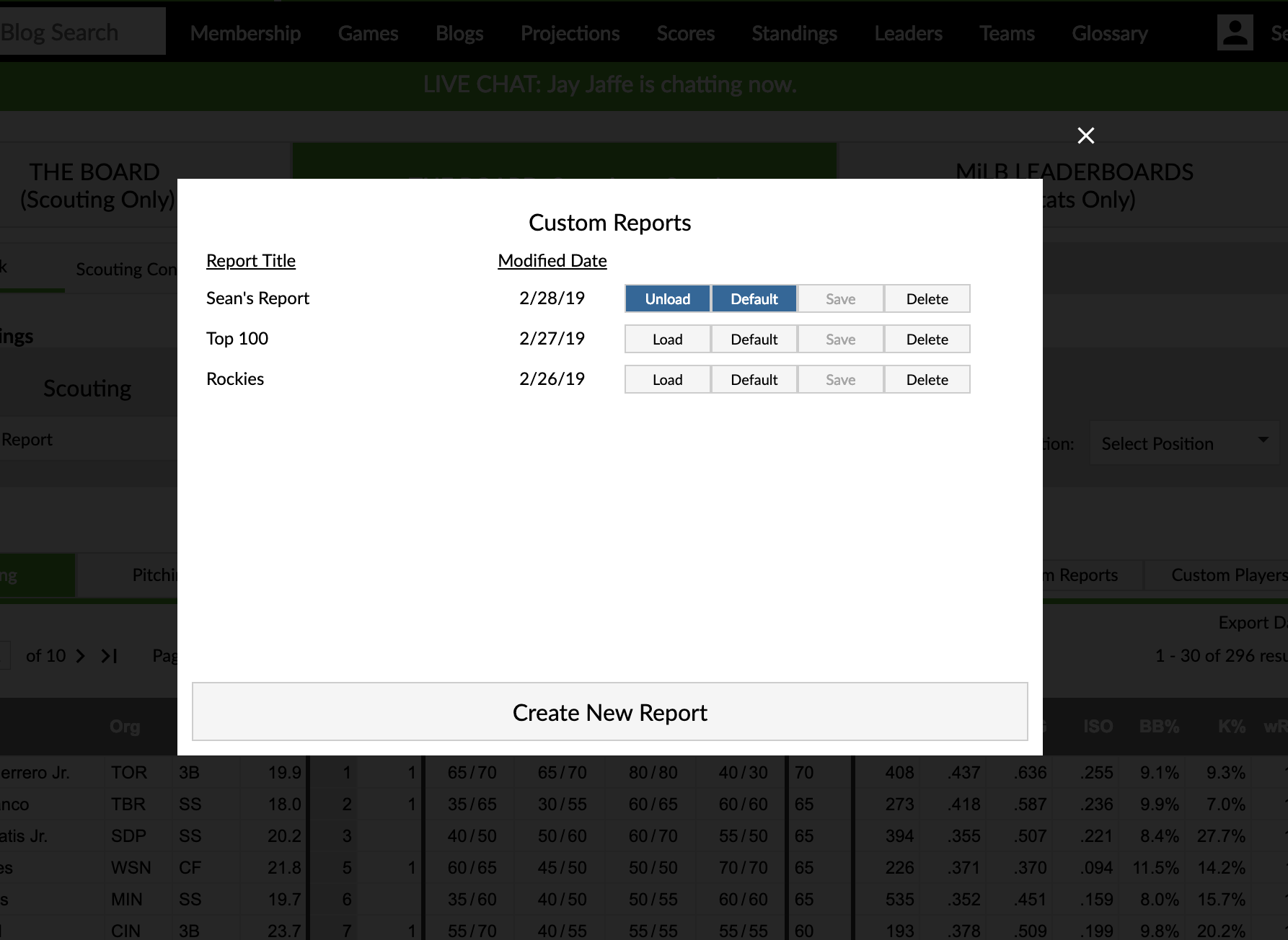
  • Revamped Custom Reports
    • Your custom reports can be displayed as a tab (blue instead of green) on the leaderboard.
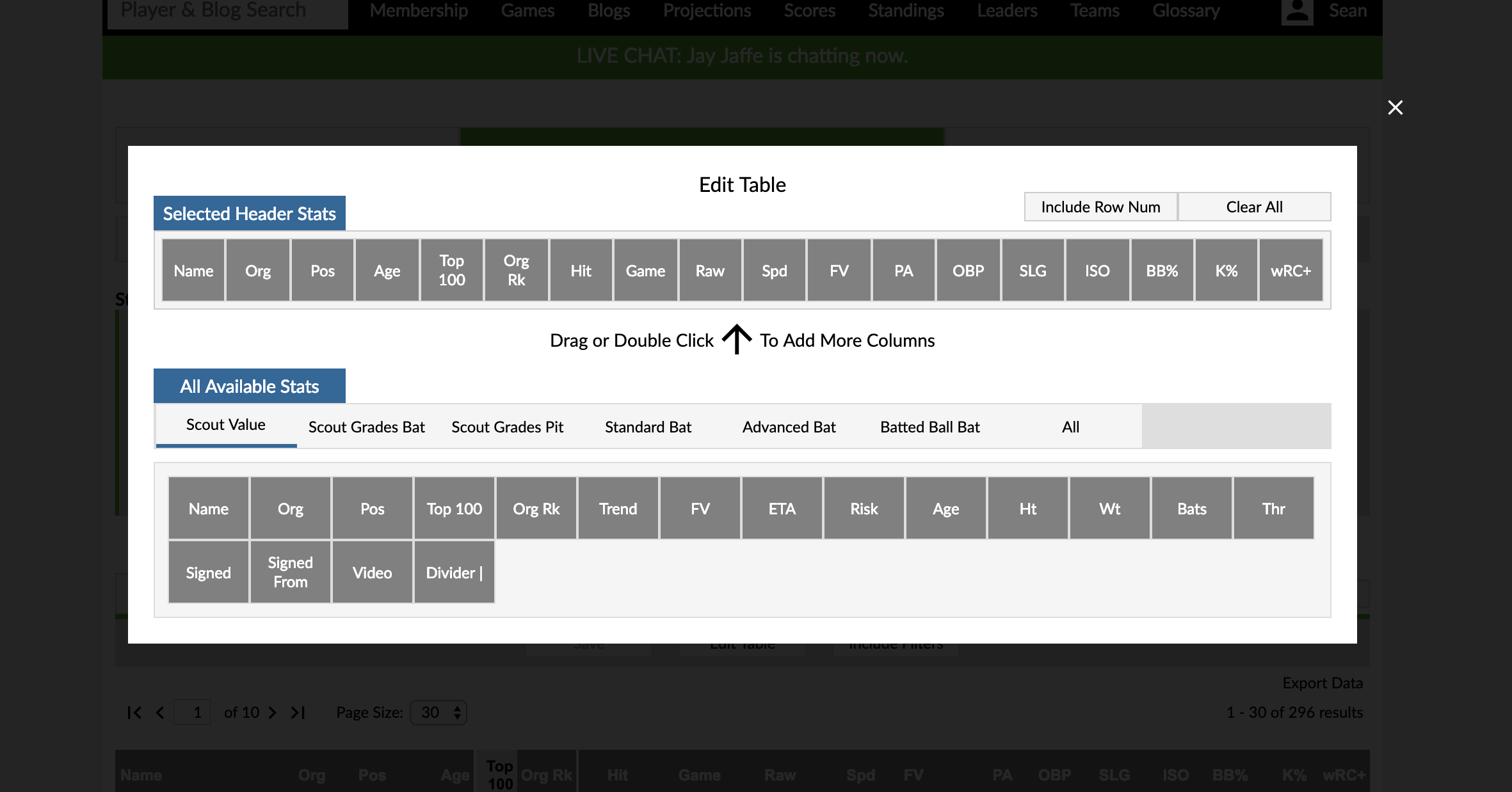
    • The interface to add and change stat columns is all-new.
    • You can choose to include row numbers in your report.

THE BOARD: Scouting + Stats!

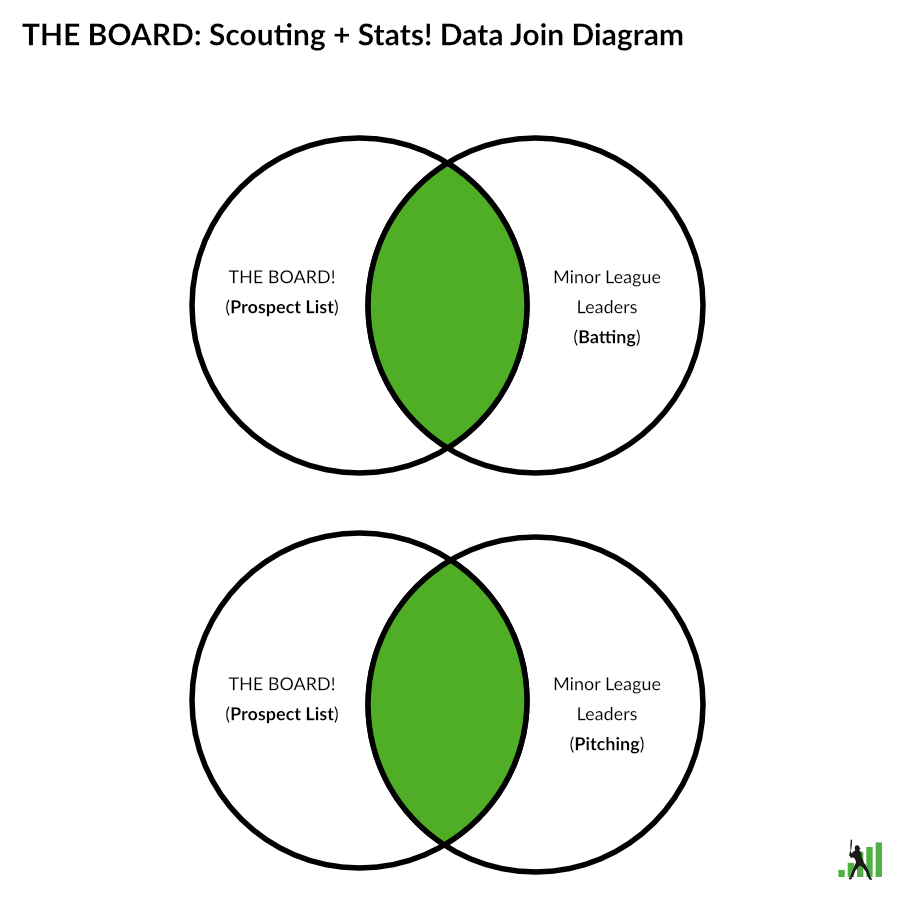
You can think of the combined leaderboard as a Venn diagram or a SQL inner join. Minor league players who are not in the selected prospect list will not appear on the combined leaderboards. Likewise, players without any minor league stats (Shohei Ohtani) are not available on this leaderboard.

Unforunately, you also can’t mix batting and pitching stats on the same leaderboard; these are still different data sets (pictured in the above data join diagram). The scouting report data is position agnostic, but the stats data still behaves like our traditional leaderboards, so you can only combined one stat data set with the scouting data set.

The filters are organized by the source of data they control. For example, scouting grade filters are on the scouting tab, while the playing time filter appears on the stats tab.

Since there is the possibility of duplicate filters for position and organization, we have those two filters located under common filters. Both filters use data from the scouting data set, so you could look at the stats of a traded prospect regardless of what system he accrued those stats. The position filter uses Eric and Kiley’s classification, instead of what position our leaderboards have for a player. This might change in the future if we deploy more advanced control options.

Important Notes:

  • A leaderboard can only contain either batting or pitching stats.
  • Right now, we are only including scouting information from prospect lists. There are plans to include draft and international players in the future.

Minor League Leaderboards

The Minor League Leaderboards have been redesigned, and we added a few new features. We added the ability to select multiple seasons and either aggregate them (default option) or have them split into multiple years. The “Split Seasons” option splits the player’s stat line by both season and team. An organization filter has been added so you can group stats across levels by the MLB organization instead of just being able to filter using the affiliate teams. We also included a few new league filters that groups tiers of levels: Upper (AAA/AA), Mid (A+/A), and Low Levels (A-/R). These will allow you to aggregate stats across those tiers.

We don’t always carry legacy tools, but we are keeping the old minor league boards around at least for a bit. These will be available in the leaders menu, but they won’t be the main link. You should be aware these might not always exist, and we are not going to continue developing them. If you are using them as a data source for research, please considering migrating to the new Minor League Leaderboards.

Custom Reports

The Custom Reports for the combined leaderboard and the Minor League Leaderboards are all-new. While FanGraphs has well-established stat groups: Standard, Advanced, and Batted Ball, combining scouting and stats data left us with too many combinations to include everything; this is where the new custom reports come in.

Like the old custom reports you are able to create a leaderboard with your choice of stat columns, filters, and players, but now they can be displayed as blue tabs on the leaderboard for quicker access. You can create a new report by clicking the plus button.

All of your reports for the specific leaderboard are housed in the Custom Reports dialog box accessible from the Custom Reports button on the data grid. In that dialog box, you can manage your reports including loading them into the tab bar and making them load in to the tab bar by default.

The interface to change the stat columns on the table is also completely new. You can either double click (long press on mobile) or drag/drop stats to customize your report. The columns are organized by the default tab they appear in. Once again, you can’t mix batting and pitching stats, but mixing scouting columns is cool.

Important notes:

  • Each report has an owner.
  • The owner is the only one who can modify, save, or delete that report.
  • You also must be signed into your FanGraphs account to modify, save, or delete any report.
  • However, every report is viewable by anyone if you have the URL with the report id in it.
  • You can create a copy of a report by viewing it and clicking to create a new report.
  • “Edit Table” allows you to choose different columns on the table.
  • Turning off the “Include Filters” button allows you to create a report that is agnostic to filters including custom players. This can be used if you want to create a tab with certain stats acting like native tabs.
  • Your older minor league reports are still available, though you won’t be able to save them.

Future Notes

  • We are in the process of determining how to handle the “current” level for prospects. It’s an addition we want to add to THE BOARD, but it’s not ready for this update.
  • While these tools are conceptually connected, they don’t share data between them, so going from the Minor League Leaderboards to THE BOARD: Scouting + Stats! won’t retain settings and filters.
  • Custom Reports “belong” to the tool you created them in, so you can’t make one in the leaderboards and use it with the combined leaderboard. This might change in the future, but it’s a restriction for now.

Eric Longenhagen Chat – 2/28/19

2:00
Eric A Longenhagen: Howdy everyone, let’s dive right in so I can finish the A’s list after we’re done.

2:00
JD: I’m sure it’s different from position to position, but if you had to put an overall defensive grade on a player, how would you weigh their arm and field tools?

2:02
Eric A Longenhagen: Arm is it’s own thing, though I’d like to break defense into multiple categories — hands, feet, range, maybe actions too if you consider those separate from hands. You could look at those categories and know which positions a player is athletically capable of playing and how well instead of getting confused by the way different tools impact others like…

2:02
Darren: Normally, speed guys are supposed to be good defenders. What keeps a guy like CJ Abrams at a 50 FV as a fielder?

2:04
Eric A Longenhagen: We have Abrams evaluated at SS right now but he has issues throwing from those weird athletic platforms that shortstops need to be able to throw from to be really good there. So he has elite range, his hands are fine, his windup/max effort arm strength is good, but he still may not be all that great at short because he can’t make these types of throws

2:05
Santa’s Reindeer: When’s your first mock draft coming out?

Read the rest of this entry »


Kiley McDaniel Chat – 2/27/19

12:15

Kiley McDaniel: Hello from ATL, perched on the couch with Scout on her bed, keeping an eye out for chipmunks to chase. To your questions:

12:15

Finally Happy Padres Fan: Please tell me the Padres won’t be upstaged with an LA Bryce Harper signing. PLEASE!

12:16

Kiley McDaniel: Sounds like some California clubs are taking a long look. Time to get in the bidding, Oakland!

12:16

Darren: Draft question: how would you describe the plate discipline of Witt and Abrams?

12:16

Kiley McDaniel: Abrams about average, Witt maybe a hair below, but they’re pretty close

12:17

Adam: Are we far enough away from the 2016 draft to say that the Padres executed their plethora of picks and pool space poorly?

Read the rest of this entry »


Angels Prospect Brett Hanewich’s Fastball Is Different From Other Fastballs

Brett Hanewich opened a lot of eyes last year in his first full professional season. Thanks largely to a take-notice fastball, the 24-year-old right-hander logged a 2.61 ERA, and fanned 74 batters in 69 relief innings, between Low-A Burlington and Hi-A Inland Empire. The Los Angeles Angels took Hanewich in the ninth round of the 2017 draft out of Stanford University, where he graduated with an engineering degree.

Command is his biggest question mark. Hanewich issued six free passes every nine innings last season, and his walk rate as a collegian wasn’t anything to write home about either. A max-effort delivery is part of the reason, and therein lies a conundrum. Hanewich believes that his delivery — a byproduct of a summer spent with a former Cy Young Award winner — is partially responsible for his plus velocity.

———

Hanewich on his heater: “I have a heavy fastball. That’s what everybody who catches me calls it. It feels like a bowling ball as opposed to, say, a Whiffle ball. I think it has to do with spin rate. My spin rate is anywhere between 2,300 and 2,400, which is above major league average.

“Another thing that makes my fastball different is my motion. I get very good extension. It’s somewhere between seven and eight feet, which is way above average. The way I throw, the ball jumps on the hitter — there’s more life to it because of the extension. The plate is sixty feet six inches from the mound, so a pitcher with a six-foot extension is throwing 54 feet six inches from where the ball is being released. There’s a thing called perceived velocity. The ball looks like it’s coming in faster than what it actually is. My perceived velocity is a plus, and the fact that I throw hard to begin with is obviously a factor as well. Read the rest of this entry »


Top 31 Prospects: Los Angeles Angels

Below is an analysis of the prospects in the farm system of the Los Angeles Angels. Scouting reports are compiled with information provided by industry sources as well as from our own (both Eric Longenhagen’s and Kiley McDaniel’s) observations. For more information on the 20-80 scouting scale by which all of our prospect content is governed you can click here. For further explanation of the merits and drawbacks of Future Value, read this.

All of the numbered prospects here also appear on The Board, a new feature at the site that offers sortable scouting information for every organization. That can be found here.

Angels Top Prospects
Rk Name Age Highest Level Position ETA FV
1 Jo Adell 19.9 AA RF 2021 60
2 Jose Suarez 21.1 AAA LHP 2019 50
3 Brandon Marsh 21.2 A+ CF 2020 50
4 Griffin Canning 22.8 AAA RHP 2019 50
5 Jahmai Jones 21.6 AA 2B 2021 50
6 Jordyn Adams 19.4 R CF 2023 45+
7 Luis Rengifo 22.0 AAA 2B 2019 45
8 Jeremiah Jackson 18.9 R 3B 2022 45
9 Matt Thaiss 23.8 AAA 1B 2019 45
10 Jose Soriano 20.3 A RHP 2022 45
11 Chris Rodriguez 20.6 A RHP 2021 45
12 D’Shawn Knowles 18.1 R CF 2023 40+
13 Trent Deveaux 18.8 R CF 2023 40+
14 Ty Buttrey 25.9 MLB RHP 2019 40+
15 Kevin Maitan 19.0 R 3B 2022 40+
16 Patrick Sandoval 22.4 AA LHP 2021 40
17 Leonardo Rivas 21.4 A 2B 2020 40
18 Michael Hermosillo 24.1 MLB RF 2019 40
19 Livan Soto 18.7 R SS 2022 40
20 Luis Madero 21.9 A+ RHP 2020 40
21 Stiward Aquino 19.7 R RHP 2022 40
22 Aaron Hernandez 22.2 R RHP 2021 40
23 William English 18.2 R RHP/DH 2023 40
24 Jack Kruger 24.3 AA C 2020 40
25 Jake Jewell 25.8 MLB RHP 2019 40
26 Kyle Bradish 22.5 R RHP 2020 35+
27 Alexander Ramirez 16.5 R RF 2023 35+
28 Travis Herrin 23.8 A+ RHP 2021 35+
29 Jared Walsh 25.6 AAA 1B/OF/LHP 2019 35+
30 Luis Pena 23.5 AAA RHP 2019 35+
31 Daniel Procopio 23.4 AA RHP 2020 35+
Reading Options
Detail Level
Data Only
Full
Position Filter
All

60 FV Prospects

1. Jo Adell, RF
Drafted: 1st Round, 2017 from Ballard HS (KY) (LAA)
Age 19.9 Height 6′ 3″ Weight 215 Bat / Thr R / R FV 60
Tool Grades (Present/Future)
Hit Raw Power Game Power Run Fielding Throw
30/50 70/70 50/70 60/55 50/55 50/50

Adell played across three levels last year and reached Double-A at age 19. The swing and miss issues he exhibited in high school led many to assume his development might be slow, but after a month of vaporizing Low-A pitching at Burlington, he was quickly sent to the Cal League, where he’d spend most of the year. At Inland Empire, Adell continued to perform, and the Angels pushed him to Double-A Mobile in August, where he was finally forced to deal with some adversity, and struck out 31% of the time.

Several prospects of recent memory (Byron Buxton, Domonic Brown, and Brandon Wood to name a few) have possessed such titanic physical gifts that they essentially weren’t challenged until they reached the big leagues, and some people in baseball posit that it can be psychologically taxing to deal with growing pains in that bright of a spotlight, with the hopes of a franchise and its fans on one’s shoulders. Adell is that kind of physical talent. He has a rare blend of power and speed, speed that he has retained since high school even though he has added about 20 pounds. He’s now a better bet to stay in center field during his prime than he was in high school, when scouts assumed he’d slow down as he added weight. His feel for going back on balls in center is pretty good and some of the arm strength that Adell (who was once into the mid-90s on the mound) suddenly lost in high school has returned.

His breaking ball recognition and bat control will continue to be tested by upper-level pitching, and if they start to show improvement, it’s not only a sign that Adell is adjusting but that he has the capacity to do so in the future. At that point, we’re talking prime Andrew McCutchen and Grady Sizemore-type tools.

50 FV Prospects

2. Jose Suarez, LHP
Signed: July 2nd Period, 2014 from Venezuela (LAA)
Age 21.1 Height 5′ 10″ Weight 180 Bat / Thr L / L FV 50
Tool Grades (Present/Future)
Fastball Curveball Changeup Command Sits/Tops
50/50 55/55 50/60 45/55 92-94 / 95

Squat little pitching prospects aren’t supposed to suddenly throw three ticks harder than they did the year before, but Suarez went from sitting 89-92 to sitting 92-94, and rose three levels last year. The feel Suarez developed for his changeup and curveball while he had a 40 fastball was necessary for his survival at that time. Now, they’re out pitches after he gets ahead of hitters with this new heat. There’s some risk that this fastball backs up, as upticks in velocity are sometimes fleeting and pitchers soon return to what they’ve been for most of their careers. So long as that doesn’t happen, Suarez projects as a good fourth starter and should help the big league club this year.

Drafted: 2nd Round, 2016 from Buford HS (GA) (LAA)
Age 21.2 Height 6′ 2″ Weight 200 Bat / Thr L / R FV 50
Tool Grades (Present/Future)
Hit Raw Power Game Power Run Fielding Throw
35/55 55/60 40/50 60/55 40/50 60/60

A two-sport star in high school, Marsh’s pro baseball career was in doubt for a moment when the Angels discovered a stress fracture in his back during his physical after the draft. After the issue was resolved, Marsh took things slow for a while at the Angels complex in Tempe, limited to activities like BP while others played in actual games. The sound of the ball off his bat during those BP side sessions was very distracting. Marsh stayed in Arizona during the spring of 2017 and was much more physical than most of his rookie-level peers. Marsh had statistical success in the Pioneer League and in the Midwest League the following spring, before finally scuffling at Hi-A.

Though he has above-average raw power, Marsh’s in-game cut is more contact-oriented, geared for contact to the opposite field and back up the middle. During instructional league, Marsh was awkwardly swinging without a stride, likely not a swing change, but perhaps an exercise that forces him to clear his hips and improve his ability to pull the ball with power. There’s a non-zero chance Marsh stays in center field but it’s more likely that he moves to a corner. He has the physical ability to profile as a regular there.

Drafted: 2nd Round, 2017 from UCLA (LAA)
Age 22.8 Height 6′ 1″ Weight 170 Bat / Thr R / R FV 50
Tool Grades (Present/Future)
Fastball Slider Curveball Changeup Command Sits/Tops
55/55 55/60 50/50 45/55 45/55 92-96 / 97

Canning was used very heavily at UCLA and would sometimes throw in excess of 120 pitches during his starts, even as an underclassman. The Angels shelved him for the rest of the summer after they drafted him, and it paid off. Canning came out the following spring throwing harder than he had in college, his fastball sitting 94-97 for most of his starts. He held that velo throughout 2018 and reached Triple-A in his first pro season. He’s a No. 4 starter on the cusp of debut.

Drafted: 2nd Round, 2015 from Wesleyan HS (GA) (LAA)
Age 21.6 Height 5′ 11″ Weight 210 Bat / Thr R / R FV 50
Tool Grades (Present/Future)
Hit Raw Power Game Power Run Fielding Throw
40/55 50/50 40/45 60/60 40/45 45/45

The Angels invited Jones to big league camp last spring, but he looked overmatched and a bit lost in center field, so he was sent back to minor league camp to begin a transition to second base. His footwork and actions around the bag can be clumsy (part of why Jones, who played some infield in high school, was initially put in the outfield as a pro), but he has plenty of lateral quickness and range, his hands are fine, and he has high-end makeup, which leads clubs to believe he’ll do the work necessary to be viable there. Mostly though, Jones is good because he makes lots of hard, line drive contact and is a plus runner. After struggling to lay off of breaking balls early in 2017, he has become more patient, and his walk rate was much higher last year. Even though he didn’t hit for much power in the Cal League, the Angels promoted him to Double-A for the last two months of the season, then gave him some run in the Arizona Fall League.

Jones’ general lack of performance last year should not yet concern readers, as he went through several swing changes, with the Angels constantly tweaking how and where his hands set up. He projects as a high-contact second baseman with doubles power unless one of these tweaks unlocks more in-game pop.

45+ FV Prospects

Drafted: 1st Round, 2018 from Green Hope HS (NC) (LAA)
Age 19.4 Height 6′ 2″ Weight 180 Bat / Thr R / R FV 45+
Tool Grades (Present/Future)
Hit Raw Power Game Power Run Fielding Throw
20/50 50/60 20/50 80/80 45/60 45/50

Adams was seen as a football-first prospect until late March 2018. He’d played at a couple of showcase events in the summer of 2017 and had some raw tools, but he wasn’t yet under consideration for the top few rounds of the baseball draft. He was, however, a top 100 football recruit, set to head to North Carolina to play wide receiver, where his father was on the coaching staff. Then in March, Adams had a coming out party at the heavily-scouted NHSI tournament near his high school, fulfilling the rosiest hopes some had of him eventually putting it together on the baseball field, as multiple scouts from all 30 teams watched him against strong competition for a few days. Scouts were hesitant at first, worried they might be overreacting, but eventually came to think that Adams’ only athletic peer in recent draft history was Byron Buxton.

Adams is a true 80 runner with raw power who projects to be a 60, and who flashed body and bat control that reminded scouts of Royce Lewis. All of this excitement came with almost zero track record, and Adams didn’t face much strong competition after NHSI, meaning drafting him would be based purely on old-school scouting, as there weren’t years of video of and performance from this flourishing incarnation of Adams. Once teams became enthused enough that multiple millions of dollars were in play, it appeared clear that baseball could overtake football. Several GMs, including the Angels’ GM Billy Eppler, were in after NHSI to see Adams for themselves, and after Adell and Adams were their top pick in consecutive years, rival executives now view this risk/upside kind of prospect as Los Angeles’ type. That trend appears to be more the result of opportunistic good fortune than a deliberate strategy, since there’s an argument to be made that Austin Beck (who went to Oakland sixth overall in 2017) had less upside and a similar performance record to Adams; if the industry had simply seen Adams play in an NHSI-style setting for a couple more weeks, he could have been a top five pick candidate, just like Royce Lewis or Byron Buxton were after a strong summer of performance. This is all to say that the sky is the limit for Adams, and if he performs well in Low-A in 2019, he’ll shoot up this list.

45 FV Prospects

7. Luis Rengifo, 2B
Signed: July 2nd Period, 2013 from Venezuela (SEA)
Age 22.0 Height 5′ 10″ Weight 165 Bat / Thr S / R FV 45
Tool Grades (Present/Future)
Hit Raw Power Game Power Run Fielding Throw
50/55 45/45 40/45 55/55 45/50 50/50

The Mariners traded Rengifo to Tampa Bay in an August 2017 waiver deal, and he only played in 23 games as a Rays farmhand before he was sent to Anaheim as the PTBNL in the C.J. Cron swap. He had a breakout 2018, traversing three levels to the tune of a .299/.399/.451 line, while tallying as many walks as strikeouts, 50 extra-base hits, and 41 steals. So judicious is Rengifo’s eye for the plate that if he were cloned 15 times and each clone forced to be an umpire, there might be a lot less talk of electronic strike zones. He identifies balls and strikes early in flight, and often relaxes before balls have even entered the catcher’s mitt. There’s a chance that Rengifo’s lack of power (he has more from the right side) limits the way his eye for the zone plays in the big leagues, since pitchers will be more likely to attack him without fear of him doing damage on his own. Most of his doubles come by slashing balls down either baseline, or when he turns gappers into extra bases because of his speed. We think there’s enough bat to retain most of the on-base ability Rengifo has shown so far and that, combined with his multi-positional versatility, could yield super-utility value.

Though he spent all of last year playing either second base or shortstop, Rengifo also has experience in both outfield corners and at third base. The Angels added Rengifo to the 40-man this offseason and while they’re well-stocked on the infield (Simmons, La Stella, Fletcher, Cozart), they’re rather thin in the outfield, and very right-handed. As such, Rengifo’s first opportunity could come as an injury replacement out there, or he may fall into a Chone Figginsy utility role. Eventually though, he may end up as the regular second baseman.

Drafted: 2nd Round, 2018 from St. Luke’s Episcopal HS (AL) (LAA)
Age 18.9 Height 6′ 0″ Weight 175 Bat / Thr R / R FV 45
Tool Grades (Present/Future)
Hit Raw Power Game Power Run Fielding Throw
25/55 50/55 20/50 55/55 40/50 55/55

Progressive clubs want to draft toolsy prep players, as that is the most common demographic among current All-Stars, but they like to have data to back up their scouting reports. Collecting detailed stats from summer showcase events, or even spring games when prep hitters face pro-quality pitching, is one way to pinpoint how advanced a prospect is beyond a pure scouting report, and is something almost no clubs did systematically until the last half dozen years or so. Jackson is a perfect example of the limitations of this practice.

He stood out on the showcase circuit with an infielder’s footwork and actions (though his hands were inconsistent) and potentially above-average offense. But Jackson’s performance was generally below average in this setting and he struck out a lot, so he was shifted into the fourth to fifth round area that often sends this sort of player to college. In the spring, Jackson was going off against poor competition in South Alabama and we were hesitant to shift his grade on that basis until we were told that he got glasses to correct some vision issues that had contributed to his summer disappointment. Now, his spring performance could still end up meaning little, but there was a shot he was a new prospect, and we never got a pre-draft opportunity to see him against good pitching. With that optimism in mind, we ranked him 31st in the 2018 draft class but the Angels were able to get him at 57th overall, as many clubs now run their draft off of models that lean heavily on summer performance when there’s bulk and Jackson was at almost every event.

Jackson hit seven homers with above average production across the board in 43 pro games after signing, and it’s looking like he may have been underrated by a purely numbers-based approach to the draft. We see a potential 50 or 55 on every tool and at least a third base fit in pro ball, if not a chance to play middle infield, which translates to a strong regular.

Drafted: 1st Round, 2016 from Virginia (LAA)
Age 23.8 Height 5′ 11″ Weight 197 Bat / Thr L / R FV 45
Tool Grades (Present/Future)
Hit Raw Power Game Power Run Fielding Throw
50/55 50/50 45/50 30/30 45/50 50/50

Thaiss is one for whom a 2018 swing change is more relevant because a lack of in-game power was the primary barrier between him and the offensive output approaching that which typically profiles at first base. A college catcher, Thaiss walked more than twice as much as he struck out as a junior at Virginia. Though almost nobody thought he’d be able to catch in pro ball, he was viewed as a safe, fast-moving draft prospect, albeit one with a limited ceiling due to defensive limitations. Thaiss was exactly as advertised for the first two years of his pro career, and reached Double-A during his first full pro season though, as predicted, he hit for very little power, including a paltry .399 SLG% in the offensive paradise that is the Cal League.

In 2018, Thaiss added a more exaggerated leg kick and began lifting the ball more. A 45% ground ball rate at Double-A in 2017 turned into a 31% rate at Mobile the following year. He was eventually promoted to Triple-A Salt Lake and ended up with more 2018 homers (16) than he had had in his previous two years combined. Will the change be enough? It’s going to be close. Thaiss posted a 102 wRC+ in 85 games as a 23-year-old at Triple-A; the big league average at first base last year was 105. We have him projected as a low-end regular there, which might make him a viable alternative to Justin Bour and Albert Pujols fairly soon.

10. Jose Soriano, RHP
Signed: July 2nd Period, 2015 from Dominican Republic (LAA)
Age 20.3 Height 6′ 3″ Weight 168 Bat / Thr R / R FV 45
Tool Grades (Present/Future)
Fastball Curveball Changeup Command Sits/Tops
55/60 50/55 30/50 40/50 92-96 / 98

Soriano struggled to harness his newfound velocity in 2018. The year before, he was a skinny 18-year-old sitting just 87-92. When he arrived in the spring of 2018, he had added sculpted muscle mass to a prototypical frame, and his fastball was humming in at 94-97 early during spring outings. After some time in extended spring training, Soriano spent the end of last summer in Low-A as a 19-year-old, and had issues with walks. Though his delivery is devoid of violence, he struggles with release consistency and has scattershot fastball control as a result. Soriano’s feel for locating his terrific curveball is often superior to his fastball command, and while this approach is becoming more acceptable in the majors, ideally he’d refine the latter.

It’s odd to look at Soriano’s numbers and argue that he took a step forward last year, but he accomplished a third of the things we hoped he’d develop — more velocity, better command, and a better changeup or some other third offering — before turning 20. If either of the last two components fails to progress, Soriano will end up in the bullpen. If they both do, he’ll be a mid-rotation starter.

Drafted: 4th Round, 2016 from Monsignor Pace HS (FL) (LAA)
Age 20.6 Height 6′ 1″ Weight 185 Bat / Thr R / R FV 45
Tool Grades (Present/Future)
Fastball Slider Curveball Changeup Cutter Command Sits/Tops
60/60 60/60 55/55 40/50 50/55 40/50 93-96 / 97

A stress reaction in his back cost Rodriguez all of 2018 and his return to action has been slow; last we were updated before publication, he was still limited to fastball-only bullpens and flat ground sessions. Prior to Rodriguez’s shutdown, he had experienced a velo spike (93-97, up from 91-94 the year before) and lowered his arm slot. Both of his breaking balls were excellent, but his changeup had regressed a bit compared to his first year (or at least, he lacked feel for it the last time Eric saw him). The injury adds fuel to the speculative fire that Rodriguez’s violent delivery will eventually limit him to the bullpen. It didn’t prohibit him from having starter control, but scouts were concerned about injury. Now, there has been one. If health eventually moves Rodriguez to the bullpen, he has high-leverage stuff. If not, and his changeup returns, he could be a No. 3 or 4 starter.

40+ FV Prospects

Signed: July 2nd Period, 2017 from Bahamas (LAA)
Age 18.1 Height 6′ 0″ Weight 165 Bat / Thr S / R FV 40+
Tool Grades (Present/Future)
Hit Raw Power Game Power Run Fielding Throw
20/45 45/50 20/45 70/70 45/55 45/50

Knowles was still just 16 when he came stateside for his first pro instructional league. He was 17 for the entirety of his first pro season, and one of the few bright spots on an underperforming AZL Angels team. A sizable chunk of Knowles’ AZL power output was BABIP-driven (his speed is especially meaningful against rookie-level defenses), but despite his measureables, he does have some pop thanks to his explosiveness and ability to rotate, enough that there’s little concern about him lacking big league physicality. His footspeed enables projection in center field and while he’s had early-career issues with strikeouts, he’s not one to expand the zone and instead has the bat-control issues that are typical of early-career switch hitters. Though his bat-to-ball future is cloudy, Knowles’ slashing, doubles power as a teen combined with the likelihood he can play center field give him a shot to be an everyday player if he develops as a hitter. If not, he’d be a pretty toolsy fourth outfielder.

Signed: July 2nd Period, 2017 from Bahamas (LAA)
Age 18.8 Height 6′ 2″ Weight 160 Bat / Thr R / R FV 40+
Tool Grades (Present/Future)
Hit Raw Power Game Power Run Fielding Throw
20/45 45/55 30/50 70/70 40/55 50/55

After an exciting showing during minor league spring training, Deveaux struggled throughout the summer as he made swing change after swing change after swing change. It makes much more sense to tinker and find the right swing sooner rather than later, but Deveaux hit just .199 as he was asked to bring his side work onto the field during the summer. He had no fewer than four different cuts during 2018, and at times seemed so out of whack that pro scouts in Arizona began to actively steer clear of Tempe Diablo to avoid falling out of love with a player they were so enamored with during the spring. That player took your breath away when he’d hit his stride going from first to third, looked like he might be a black hole defender in center field because of his range, and was going to have power once the swing was refined.

If evaluating purely on physical ability, Deveaux belongs up near Jordyn Adams and Jeremiah Jackson in this system, but his 2018 was a bit of a red flag and he’s probably going to be a long-term developmental project.

14. Ty Buttrey, RHP
Drafted: 4th Round, 2012 from Providence HS (NC) (BOS)
Age 25.9 Height 6′ 6″ Weight 230 Bat / Thr R / R FV 40+
Tool Grades (Present/Future)
Fastball Curveball Changeup Command Sits/Tops
70/70 55/55 60/60 45/45 94-98 / 101

Somewhat surprisingly, our pitch classifications indicate Buttrey threw his low-spin breaking ball more often than his obviously nasty changeup in a sizable big league sample last year. Buttrey’s weirdo breaking ball, which can be hard to distinguish visually from his changeup, is also effective and may give him a pitch mix sufficient to enable him to close. His stuff exploded after the Red Sox moved him to the bullpen in 2016; they eventually traded him in the 2018 Ian Kinsler deal. He’ll likely be a significant part of the Angels’ bullpen this season and may have too tight a grip on late-inning duties to relinquish them to Keynan Middleton once the latter returns from Tommy John.

Signed: July 2nd Period, 2016 from Venezuela (ATL)
Age 19.0 Height 6′ 2″ Weight 190 Bat / Thr S / R FV 40+
Tool Grades (Present/Future)
Hit Raw Power Game Power Run Fielding Throw
25/45 55/60 30/45 40/40 40/50 60/65

Maitan was one of the most celebrated international amateur prospects in a decade and was even written up as a 14-year-old on this site when, upon asking international scouts in the fall of 2014 for the best players in the 2015 international class, we were told that Maitan, a 2016-eligible player, was better than all of them. In retrospect that looks a little silly, as the 2015 class included Vladimir Guerrero, Jr., Juan Soto, Fernando Tatis, Jr., Cristian Pache, and Andres Gimenez, but that opinion was the consensus amongst many top evaluators; those five superior prospects all received lower bonuses than Maitan for a reason.

Maitan signed with Atlanta as the clear top prospect in his class, and the clear top prospect to emerge in many years. Then things took a turn for him as a pro. Maitan added some natural strength and bulk soon after signing (which many scouts anticipated, projecting him to a corner), then started adding some bad weight, lost his swing mechanics, and started tinkering. Things snowballed from there, ending in a disappointing debut season with Atlanta. After that season, the Braves international scandal hit, and Maitan became a free agent. He kept his original $4.25 million bonus (widely reported to have been topped by multiple clubs late in the process, though he and his family chose to honor their word to Atlanta) and hit the open market, where he received $2.2 million amid some scouts’ suggestions that he wasn’t even the best of the Braves’ prospects to be cut loose.

The same issues continued with Los Angeles in 2018, and Maitan had another disappointing season, with a worrisome physique and an evolving swing. The raw tools that originally got scouts interested — raw power you can project to a 70, a 65-grade arm, infield hands, feel to hit — still appear to be in there and Angels sources indicate Maitan spent the offseason getting in better shape, a process they anticipated would be slow from the onset, hopefully foreshadowing a breakout year. The organization is excited about what could happen in 2019, with Maitan as part of an exciting Low-A Burlington club that should include him, Jeremiah Jackson, and Livan Soto in the infield and Jordyn Adams, D’Shawn Knowles, and Trent Deveaux in the outfield. We have Maitan here on pedigree, as pro socuts outside the org who had no context for their eval barely considered him a prospect last year.

40 FV Prospects

Drafted: 11th Round, 2015 from Mission Viejo HS (CA) (HOU)
Age 22.4 Height 6′ 3″ Weight 190 Bat / Thr L / L FV 40
Tool Grades (Present/Future)
Fastball Slider Curveball Changeup Command Sits/Tops
50/50 50/55 55/60 40/50 40/45 88-92 / 94

An 11th rounder in 2015, Houston signed Sandoval away from a USC commitment with a $900,000 bonus. Before the Angels acquired him from the Astros for Martin Maldonado, Sandoval struck out 97 hitters in 88 innings split between Low- and Hi-A while also reducing his walk rate (4.3%) to half of what it had been the previous year (8.5%). After the trade, his walk rate regressed to his career norm, but he continued missing bats and struck out 35% of opposing hitters.

Sandoval’s fastball sits 88-92 and will top out around 94. He can really spin a 12-6 curveball, one that’s above average when he is getting on top of it. Effectively, Sandoval has an almost perfectly vertical arm slot, but the way he gets there is somewhat odd, and there’s some skepticism among scouts as to the sustainability of last year’s uptick in strike-throwing. But his current delivery enables him to effectively work up and down with his fastball and curveball in sequence, so nobody suggests he change it. There’s enough of a changeup here for continued development in a rotation and if everything clicks, Sandoval will be a No. 4 or 5 starter. If not, he’s a lefty with a good breaking ball and is a fine bullpen candidate, which is a pretty good return for a backup catching rental.

Signed: July 2nd Period, 2014 from Venezuela (LAA)
Age 21.4 Height 5′ 10″ Weight 150 Bat / Thr S / R FV 40
Tool Grades (Present/Future)
Hit Raw Power Game Power Run Fielding Throw
35/50 35/40 20/30 70/70 45/50 50/50

It’s very possible that Rivas’s elite feel for the strike zone won’t translate to upper-level play. He owns a 16% career walk rate, but Rivas and his childlike, Lilliputian frame lacks even a modicum of over-the-fence power, and advanced pitching may choose to attack him rather than nibble and let the speedy Rivas reach without putting the ball in play. Even if his walk rate comes down, Rivas does enough other stuff to contribute to a big league roster. He won’t hit homers, but he stings high-quality line drive contact to all-fields and can slash doubles down the third base line. He has sufficient speed and range for the middle infield, and has experience at every position but first base and catcher, though he hasn’t played the outfield since 2015. Rivas’ most realistic path to everyday production involves him retaining something close to his current walk rate, but he’s more likely to become a valuable utility man who can play all over the field, and is a fairly high-probability prospect in that regard.

Drafted: 28th Round, 2013 from Ottawa HS (IL) (LAA)
Age 24.1 Height 5′ 10″ Weight 190 Bat / Thr R / R FV 40
Tool Grades (Present/Future)
Hit Raw Power Game Power Run Fielding Throw
40/45 50/50 40/45 65/65 50/55 50/50

It took a $100,000 bonus to sign Hermosillo away from a football scholarship to Illinois. Understandably raw when he entered pro ball (what with two-sports and a cold-weather background), it took Hermosillo three years of adjustments before he finally experienced a statistical breakout in 2016. Since then, he has continued to make mechanical tweaks to reshape his skillset, and was rewarded with a brief major league debut in 2018.

Once in possession of ugly bat control that enabled him to put lots of balls in play but not with any real impact, Hermosillo’s most recent swing adjustment has him trading some of that contact for power. As Hermosillo’s leg kick grew bigger and slower, his ground ball rate shrunk. A 45% roller ratio in 2017 became 31% in 2018, and Hermosillo set a career-high in homers (12) in the friendly confines of the PCL. Though he didn’t perform during a 30-game big league look, Hermosillo’s athleticism and ability to make adjustments bode well for his future. His baseball instincts aren’t great, but he has some pop that he’s started to get to, he can fly, and he may get lots of playing time due to the Angels’ fairly thin outfield situation. Realistically, he projects as a good bench outfielder, but he has several late-bloomer traits and may continue to develop into a low-end regular if he falls into regular big league reps and gets sufficient at-bats.

19. Livan Soto, SS
Signed: July 2nd Period, 2016 from Venezuela (ATL)
Age 18.7 Height 6′ 0″ Weight 160 Bat / Thr L / R FV 40
Tool Grades (Present/Future)
Hit Raw Power Game Power Run Fielding Throw
25/55 35/40 20/30 55/55 50/55 50/50

Soto was part of the Braves’ 2016 pool-busting haul of players who later became free agents due to the sanctions levied against Atlanta. Soto got a $1 million bonus the first time around, then another $850,000 from Los Angeles, signing along with fellow former-Brave and Venezuelan Kevin Maitan. It’s a cliche in scouting to call a player a ‘Venezuelan-style shortstop,’ but Soto fits that to a T: smaller, without big tools, but with an advanced feel to play, and a gritty, high-effort style. He had about 30-grade raw power when he signed, and his exit velos were topping out in the mid-90s in the GCL for Atlanta, but he’s now hitting a quarter of his balls in play in the 90s and looks like he’ll be able to avoid being so weak that pitchers can knock the bat out of his hands. Soto is a roughly average runner with a roughly average arm, but both tools play up due to his instincts and strong internal clock, so he’s a potential above average shortstop. He also has advanced feel to hit, with above average bat control and a self-aware approach at the plate. There’s a road to a Jose Iglesias-type regular here, but it’s more likely Soto lands in the utility range, with maybe a season or two where he’s starting quality.

20. Luis Madero, RHP
Signed: July 2nd Period, 2013 from Venezuela (ARI)
Age 21.9 Height 6′ 3″ Weight 175 Bat / Thr R / R FV 40
Tool Grades (Present/Future)
Fastball Curveball Changeup Cutter Command Sits/Tops
45/50 55/60 45/50 50/55 50/55 89-94 / 96

In possession of one of the looser, more aqueous deliveries in the minors, Madero experienced a velocity spike in 2018 and ended up on the Angels 40-man in November. Instead of 87-92, Madero’s fastball resided in the 90-94 range throughout 2018, and he retained his trademark advanced command of four pitches. The best of those pitches is his curveball, which flashes big depth and snap, and which he sometimes decelerates his arm to baby into the strike zone, something big league hitters will pick up on. Further changeup develop will be important for Madero as his low arm slot enables lefty hitters to see the ball out of his hand quite early. A better change will help keep them honest against his heater. Still lithe and skinny for his age, there’s a chance Madero grows into some velo as he continues to fill out. He profiles as a fifth starter and may be up at some point this year, though the Angels’ many veteran pitching additions make it less likely.

Signed: July 2nd Period, 2016 from Dominican Republic (LAA)
Age 19.7 Height 6′ 6″ Weight 190 Bat / Thr R / R FV 40
Tool Grades (Present/Future)
Fastball Curveball Changeup Command Sits/Tops
50/60 50/55 50/60 40/50 87-93 / 96

Aquino missed all of 2018 due to a February Tommy John from which he’ll likely return sometime during extended spring training. Tall and projectable, Aquino was already touching 96 as an 18-year-old before he blew out his UCL. He’s athletic for his size but perhaps not exceptionally athletic in a vacuum, his forearms appear shorter than is typical for someone his size, and his stride home is very abbreviated. His velocity and changeup quality were both well ahead of what is typical for a pitcher this age before Aquino got hurt, and he has one of the more intriguing ceilings in the system if those things return after surgery.

22. Aaron Hernandez, RHP
Drafted: 3rd Round, 2018 from Texas A&M Corpus Christi (LAA)
Age 22.2 Height 6′ 2″ Weight 175 Bat / Thr R / R FV 40
Tool Grades (Present/Future)
Fastball Slider Curveball Changeup Command Sits/Tops
60/60 50/50 45/55 40/50 35/45 91-95 / 97

One of the least experienced and more polarizing college pitchers available in the 2018 draft, Hernandez has an electric, four-pitch mix and several developmental hurdles ahead of him. At a skinny 6-foot-1, there are scouts who doubt he can start based solely on his frame, though Hernandez held mid-90s velocity deep into games as a junior at Corpus Christi. If amateur scouts are to be believed, any of the following aspects of Hernandez’s current profile could change: his stride direction, his arm slot, his breaking ball usage (he has two that bleed together), and the movement profile of his fastball.

Hernandez was academically ineligible as a sophomore and only started 19 games in three years of college, so there’s at least a reason he’s behind his peers from a developmental standpoint. He has unteachable arm speed and feel for spin and even if he just ends up as a big league reliever, something that seems pretty reasonable given his talent, it would be a strong outcome for a third round pick. Like Aquino, Hernandez may move up this list quickly with refinement, but we’d like to see it fairly soon given his age.

23. William English, RHP/DH
Drafted: 5th Round, 2018 from Detroit Western Int’l HS (MI) (LAA)
Age 18.2 Height 6′ 3″ Weight 185 Bat / Thr R / R FV 40
Tool Grades (Present/Future)
Hit Raw Power Game Power Run Fielding Throw
20/40 45/55 20/50 55/50 40/50 70/70
Fastball Slider Changeup Command Sits/Tops
45/55 40/50 45/55 30/50 87-91 / 93

Many teams considered English to be one of, if not the best on-mound athletes among high schoolers in the 2018 draft, but many of them also thought he was sushi raw as both a hurler and an outfielder, and that he would end up at the University of Tennessee. A $700,000 bonus brought him to Tempe for a summer free of pitching in games, an approach the Angels have taken with several recent draftees. English did hit, though. While he struggled to perform on paper, he has a pro-quality power and speed combination that enabled him to play center field in high school. He was drafted and will be developed as a two-way player, likely pitching once a week while playing in the outfield once or twice a week and DH’ing the rest of the time as a way to manage fatigue. He arrived for camp having added about 25 pounds of muscle and is one of the more interesting prospects in baseball, let alone in this system, because he’s just a very athletic, untouched mass of clay for Angels player development to sculpt.

24. Jack Kruger, C
Drafted: 20th Round, 2016 from Mississippi State (LAA)
Age 24.3 Height 6′ 1″ Weight 200 Bat / Thr R / R FV 40
Tool Grades (Present/Future)
Hit Raw Power Game Power Run Fielding Throw
45/50 50/50 30/35 45/40 50/55 50/50

Kruger is a high-probability backup catching prospect with more speed and athleticism than is typical for the position. Though he has a power-hitter’s leg kick, his bat head drags into the zone, causing him to push a lot of contact the other way, and this, combined with his fringy bat speed, limits his power output. He has good barrel control, though, and is a solid-average receiver and ball-blocker with an average arm. He’s going to stay back there, and he’s uncommonly nimble and lean for a catcher, so he should retain those skills deep into his career. He reached Double-A last year and is on pace to debut in 2020.

25. Jake Jewell, RHP
Drafted: 5th Round, 2014 from Northeast Oklahoma JC (OK) (LAA)
Age 25.8 Height 6′ 3″ Weight 200 Bat / Thr R / R FV 40
Tool Grades (Present/Future)
Fastball Slider Changeup Command Sits/Tops
60/60 60/60 40/40 40/45 94-97 / 98

After yo-yoing back and forth between the bullpen and rotation since college, Jewell was finally ‘penned in 2018 and had a two-inning sip of coffee with the Halos last June before he fractured his right fibula during a play at the plate. He would need season-ending surgery. Jewell’s command has long foreshadowed an eventual permanent move to the bullpen, but he has the stuff to accrue big league outs. He can alter the shape of his mid-90s fastball to sink or cut, has a fine mid-80s curveball, and a power changeup that averages 90mph. He didn’t throw his hard cutter/slider during his short appearances with the Angels last year, but we’re unsure if the pitch has actually be scrapped. It’s an unusually deep repertoire for a reliever, probably one better suited for inducing ground balls than strikeouts, but is possibly enough for Jewell to go for four or more outs at a time.

35+ FV Prospects

26. Kyle Bradish, RHP
Drafted: 4th Round, 2018 from New Mexico State (LAA)
Age 22.5 Height 6′ 4″ Weight 190 Bat / Thr R / R FV 35+
Tool Grades (Present/Future)
Fastball Slider Curveball Changeup Command Sits/Tops
45/55 50/55 55/60 40/50 40/45 90-94 / 96

It’s exciting to consider how Bradish’s stuff might play in the bullpen, as his max-effort delivery and the way it detracts from his command will likely prevent him from starting for long in pro ball. His arm action has gorgeous efficiency and it, plus Bradish’s full-body thrust towards the plate, helped him generate the occasional mid-90s fastball early in his college starts, before he’d settle in the low-90s and upper-80s in the later innings. His breaking ball has bat-missing vertical action and is hard for hitters to differentiate out of Bradish’s hand, in part because his delivery causes the ball to suddenly appear out from behind his head, which some hitters struggle to adjust to. Most of these traits would seem to play best in short stints, and we have Bradish projected as a good middle reliever, though if his fastball ticks up in single-inning outings he could be a high-leverage option.

27. Alexander Ramirez, RF
Signed: July 2nd Period, 2018 from Dominican Republic (LAA)
Age 16.5 Height 6′ 2″ Weight 180 Bat / Thr R / R FV 35+

So young is Ramirez that he had to wait almost two months after the July 2 signing day to turn 16 and become eligible to put pen to paper on his pro contract, which included a $1 million bonus. He’s a typical, frame-based projection outfield prospect at a lean, high-waisted, broad-shouldered 6-foot-2. His upright swing is currently suited for high-ball contact but, based on the Angels propensity for enacting swing changes, that will likely change pretty quickly. As he grows into his body and better incorporates his lower half into his swing, he could have serious in-game power at maturity. Likely a long-term developmental project, Ramirez may not be stateside for actual games until the 2020 AZL.

28. Travis Herrin, RHP
Drafted: 18th Round, 2015 from Wabash Valley JC (IL) (LAA)
Age 23.8 Height 6′ 2″ Weight 220 Bat / Thr R / R FV 35+
Tool Grades (Present/Future)
Fastball Slider Curveball Changeup Command Sits/Tops
45/50 50/55 50/50 40/50 40/50 90-93 / 96

Herrin made a few late-season Tommy John rehab appearances last August and September, and his stuff had not only returned, but improved. He has a starter’s mix led by two quality breaking balls, his fastball will creep into the mid-90s, and his changeup has some armside fade. It’s No. 4 or 5 starter stuff, a pitch mix that belongs ahead of Luis Madero on this list. But Herrin turns 24 in April, has yet to pitch above A-ball, and only showed this quality stuff in short, 20 or 30-pitch outings. He’s a candidate to be pushed quickly if he continues to throw like this, though he may be on an innings limit this year, his first full slate back from injury. We like him as a sleeper breakout prospect in this system.

29. Jared Walsh, 1B/OF/LHP
Drafted: 39th Round, 2015 from Georgia (LAA)
Age 25.6 Height 6′ 1″ Weight 210 Bat / Thr L / L FV 35+
Tool Grades (Present/Future)
Hit Raw Power Game Power Run Fielding Throw
40/40 55/55 45/50 45/45 55/60 60/60
Fastball Curveball Command Sits/Tops
45/45 50/50 45/50 89-92 / 93

Walsh’s primary responsibilities vacillated between the mound and the batter’s box while he was in college. He did more pitching as a freshman and junior, more hitting as a sophomore and senior. Now it appears he may do a little bit of both in the big leagues, as last year he stepped on a pro mound for the first time, touching 93 with his fastball, and showing an average curveball on occasion. He also had a breakout offensive season, though 13 of his 29 home runs came in the Cal League, which, especially at age 24, should cause some skepticism as to how much it reflects true talent. Walsh does have some power and he lifts the baseball consistently, so while he doesn’t have a hit/power combination fit for profiling at any of the defensive spots he’s capable of playing, he could run into some bombs in a pinch-hitting role. He’s also a better runner and first base defender than is typical for his position and may contribute in those areas, as well. Walsh has an interesting, multi-faceted skillset and could be used as a Swiss Army Knife bench piece, if a bit of a blunt one, who allows flexibility on other parts of the roster.

30. Luis Pena, RHP
Signed: July 2nd Period, 2013 from Dominican Republic (LAA)
Age 23.5 Height 5′ 11″ Weight 190 Bat / Thr R / R FV 35+
Tool Grades (Present/Future)
Fastball Slider Changeup Command Sits/Tops
40/50 55/60 50/55 40/40 88-93 / 94

The Angels continued Peña’s development as a starter last year even though his wildness will likely relegate him to the bullpen eventually. His low-90s fastball plays up because his gargantuan stride creates big extension and two extra ticks of perceived velo. So extreme is Peña’s leap off the mound that it appears to detract from his command because it’s so hard to harness. His slider and changeup both flash plus, and he arbuably has better feel for locating either of those than his fastball. He has No. 4 or 5 starter stuff, but issues with fastball location make him too inefficient to start. He reached Triple-A last year but struggled, and was passed over in the Rule 5; he’s a candidate to bounce back.

31. Daniel Procopio, RHP
Drafted: 10th Round, 2017 from Niagara (LAA)
Age 23.4 Height 6′ 0″ Weight 190 Bat / Thr R / R FV 35+

Procopio was a solid senior sign in the 10th round in 2017 as a Friday starter for Niagara. In that role, he had a TrackMan-friendly rising fastball that sat 90-93 and hit 95 mph occasionally, and he relied heavily on an above average-flashing breaking ball, fringy command, and average control to post numbers against weaker competition. After signing, the Angels put him in the bullpen and his velocity immediately ticked up in shorter stints, working 94-96 and hitting 99 mph. His control and command got a bit worse, and he hasn’t quite struck the balance in his delivery and approach between newfound power stuff and control, but he could find himself on the shortlist for big league bullpen contention if and when he does.

Other Prospects of Note

Grouped by type and listed in order of preference within each category.

Current Pitching Depth
Jeremy Beasley, RHP
Miguel Almonte, RHP
Brett Hanewich, RHP
Williams Jerez, LHP

All of these guys are between 23 and 26 years old, and could contribute to the big club in some capacity this year or next. Beasley has the best long-term prognosis as a potential fifth starter. His splitter is plus, the rest of his stuff average. Almonte debuted way back in 2015 but injuries have kept him list-eligible. He has a plus curveball and fastball velo but the injuries and command issues are worrisome, and he was unclaimed after being DFA’d fairly recently. Hanewich is a one-pitch guy but it’s a great pitch. His fastball is 97-99 with plus-plus extension but his delivery is erratic and his secondaries are inconsistent, though his change plays well off the heater when he locates it competitively. Jerez is a mid-90s lefty with a good splitter and 40 control, and might be a reliever if the command improves.

Some Younger Sleepers
Robinson Pina, RHP
Hector Yan, LHP
Julio De La Cruz, INF
Sadrac Franco, RHP

All of these prospects are about 19 years old and currently in the lower levels of the minors. Pina sits 91-94 with 7-foot-2 of extension, and has an above-average slider. He may end up as a late-inning arm but looks more like a reliever who’ll take a few years. Yan is a lefty with presently average velo and an arm action that promises more. He has feel for a curveball that could be plus at peak but he’s probably also reliever due to a lack of changeup feel. De La Cruz isn’t a good defensive infielder but he has 55 bat speed and pull-side power; he’s a 50 runner with a 55 arm. He may end up in right field, but if the glove improves, he’ll be quite interesting. Franco will flash a plus curveball and he also sits about 90-94, but he’s less projectable than the typical 19-year-old due to a smaller frame.

Old Friends and Long Shots
Michael Santos, RHP
Mayky Perez, RHP
Adrian Almeida, LHP
Oliver Ortega, LHP
Adrian De Horta, RHP

Santos was a favorite of ours when he was a Giants AZL arm. He was part of Tampa’s return for Matt Moore but had a shoulder injury and was released. When healthy, he was 91-94 with a bevy of average secondaries and a chance one of the breaking balls would be above at peak. Perez was a hard-throwing, big-bodied relief type who was released by prospect-laden San Diego. Almeida was a minor league Rule 5 pick a few years ago. He sits 93-96 and has a plus curveball but 30 control. Ortega and De Horta both throw hard, peaking in the 95-96 range. All of these arms are age 22 to 24.

System Overview

Once clearly the worst system in baseball, this group is now pretty exciting, if somewhat monochromatic. There are some clear trends at play, the first being that the club’s draft strategy has taken on a toolsier, more athletic vibe in recent years, with several high picks spent on splashy high schoolers like Adell, Adams, and English. The club has also targeted versatile defenders with good plate discipline on the pro side, yielding Rengio and Soto, while doing everything it can to hoard pitching depth behind what has been a snake-bitten big league staff, even at the expense of some interesting young arms like Elvin Rodriguez, who would have fairly prominent placement in the 40 FV tier on this list had he not be dealt for Ian Kinsler (though Buttrey would rank higher). The Angels clearly have a type or two now, but they’re types we like.

The player development arm of the org is one of the more aggressive groups in the league, and is unabashed about mechanical tinkering. Trent Deveaux’s multitude of swings look bad because he has struggled so mightily, but there have been more prospects improved by the changes than there have been players who have gone backwards. Taylor Ward graduated off the list, but he made positive alterations before his call-up, and the changes made by Walsh, Thaiss, and Hermosillo have all been clear improvements, while the jury is still out on Jahmai Jones’ tweaks. Brandon Marsh may show a dramatic shift this year as the gap between his BP raw power and in-game approach to contact is quite, quite vast.

Another trend on this list: lots of pitchers throwing harder. Canning throws harder now than he did in college, Suarez and Madero had velo spikes last year, and Soriano’s uptick, while predictable because of his build, came sooner than expected. The scouting staff has given what appears to be a good player dev group lots of malleable athletes to work with and, so far, results have been positive even though most of the guys we’re excited about haven’t done anything in the big leagues yet.


Updated 2019, 2020 and 2021 Draft Rankings on THE BOARD

We’ve updated our 2019 MLB Draft rankings in a big way, moving a couple dozen players after two weeks of games, expanding to list 200 players total, and adding trend arrows. We also made some slight tweaks to the 2020 and 2021 rankings. Here’s a quick rundown of what we saw and heard over the last few weeks to prompt us to move some players into the top half of the first round on the 2019 list:

1. Adley Rutschman, C, Oregon State
After Eric watched him go off again this weekend, we’ve upgraded him to a 60 FV and would have him right behind Keibert Ruiz at 16 on the Top 100. He’s creating more distance between himself and the field for the top pick.

2. C.J. Abrams, SS, Blessed Trinity HS (GA)
The next couple players behind Rutschman are still pretty tightly packed, but Abrams looks stronger (55 present raw power) and is still a 70 runner, though scouts are still split on his best long-term positional fit. He appears to be solidly in every club’s top five, and is now the industry consensus for the Royals at pick number two.

9. Kameron Misner, RF, Missouri
We had Misner in a “wait and see” bucket after he skipped the summer, and the early returns are very positive. Scouts who generally hadn’t seen him other than in scrimmage looks in the fall are dropping 70 raw power grades on him, and think he’ll work his way into the conversation for the best college bat behind Rutschman, with some clubs in the top 10 rumored to have him on their shortlist already, including the White Sox at three.

12. Shea Langliers, C, Baylor
Langliers broke his hamate bone and will miss a few weeks. He likely won’t show much game power before the draft, so he may slide even lower than this after the prospects rising behind him have a chance to string together a month of performance at their new levels.

14. George Kirby, RHP, Elon
Kirby dealt in his first outing, delivering on the first round rumors we heard entering the spring. The stuff is above to plus and there are starter traits present.

15. Matthew Allan, RHP, Seminole HS (FL)
We noted last week in print and on the podcast that Allan was up to 97 and flashed a plus curveball in his season debut.

Other Movers

Jackson Rutledge and Alek Manoah both look more starter-ish and have maintained their plus stuff. Graeme Stinson’s velo was down in his starting debut and scouts are concerned. Logan Davidson’s hit tool has always been a question and it still is. Michael Toglia was too passive in Kiley’s look this weekend and his righty swing leaves a lot to be desired. J.J. Bleday looks more athletic than some expected. Hunter Barco has a higher slot and firmer stuff. Seth Johnson was up to 98 mph in his season debut and many think he can start. Carter Stewart had a really rough start after a couple that were fine. J.J. Goss has had better velocity and consistency than teammate Matthew Thompson.

Hunter Bishop, Brett Baty and Rece Hinds have all hit more than expected and all have huge power; one likely ends up in the first round. Hunter Gaddis is generating buzz early, showing both above average stuff and feel. Brandon Williamson and Drey Jamison were mentioned last week in Eric’s Arizona looks as deserving of the Top 100; Grant Gambrell was the top new arm he saw this week. Tyler Dyson and Ryan Zeferjahn have both come out of the gate slowly; Dyson is joined in that regard by teammates Austin Langworthy and Wil Dalton. JuCo righty Orlando Ribalta has been up to 97 and shown starter traits, gaining steam with scouts despite not pitching last season.


FanGraphs Audio Presents: The Untitled McDongenhagen Project, Ep. 10

UMP: The Untitled McDongenhagen Project, Episode 10
This is the 10th episode of a mostly weekly program co-hosted by Eric Longenhagen and Kiley McDaniel about player evaluation in all its forms. The show, which is available through the normal FanGraphs Audio feed, has a working name but barely. The show is not all prospect stuff, but there is plenty of that, as the hosts are Prospect Men.

We used to include timestamps so you could skip around by topic, but this episode has just one topic: the 2019 MLB Draft. If you’re not into that, we bet you’ll like the new into/outro music or the opening few minutes about non-baseball topics.

Among the draft subjects sampled on this podcast: the current state of our top five overall before next week’s re-ranking, what teams seem to be already zeroing in on which players with the top picks, which players made themselves into first rounders in the opening weekend, the Andrew Vaughn valuation dichotomy, prospects we think are moving down early on, our high variance picks for the guys who could jump way up THE BOARD by draft day, whom we saw last weekend, what happened in some games that happened literally hours ago, whom we’re seeing this weekend, and finally, tips for how to win an election for state office in Arizona.

Don’t hesitate to direct pod-related correspondence to @kileymcd or @longenhagen on Twitter or at prospects@fangraphs.com.

You can subscribe to the podcast via iTunes or other feeder things.

Audio after the jump. (Approximately 41 min play time.)

Read the rest of this entry »


Eric Longenhagen Chat- 2/21/19

2:00
Eric A Longenhagen: Hey everyone, looks like they’re gonna try to play this A’s/Mariners game so this may be a shorter chat, but after last week’s marathon I’m sure you’re all cool with that.

2:00
Trent: What would it take for the Cubs to get into the top half of MLB farm systems this year? A miracle?

2:01
Eric A Longenhagen: It probably means Roederer and Davis take huge steps forward, maybe one of the young pitching prospects, too. That’s a good start toward a climb.

2:01
Tommy N.: Where would Tatis and Machado rank in the best SS/3B combos in baseball?

2:02
Eric A Longenhagen: Probably top 5 once Tatis is fully formed, right? Turner/Rendon, Ramirez/Lindor, Correa/Bregman, Arenado/Story…kinda run out of obvious ones in tthat area after that.

2:03
Twitter Handle: If you had to choose one of the Padres pitching prospects likely to turn into a 1/2; who would it be? Gore, Morejon, Paddack, Patino, other

Read the rest of this entry »