Archive for Prospects

Eric Longenhagen Chat – 3/22/19

12:01
Eric A Longenhagen: Howdy howdy, let’s chat

12:01
GPT: Have you had the opportunity to see Giants spring training yet, any standouts if so?

12:02
Eric A Longenhagen: yes was there yesterday, actually. Sean Hjelle looks pretty good, certainly the fastball does. 92-94 with tough angle and some life. Gregory Santos was 93-95 yesterday, some plus sliders. Marco Luciano looks incredible but we knew that already.

12:02
David: More total future value: The three first-rounders the Padres signed in 2016 (Quantrill, Potts, Lauer), or the three future first-rounders (Rolison, Bishop, Bleday) they called but didn’t sign on day three?

12:02
Eric A Longenhagen: the latter group

12:02
Edgar: Is late 2020 a feasible debut for Andrew Vaughn? Despite height, can he be a 25 HR guy?

Read the rest of this entry »


Rays Extend Rookie Brandon Lowe

Late Tuesday night, Ken Rosenthal reported that the Tampa Bay Rays had agreed to a six-year, $24 million contract extension with 24-year-old second baseman and outfielder Brandon Lowe. Lowe is our 46th overall prospect, the top one in the 50 FV tier, and the No. 5 prospect in a loaded Rays system.

According to the Tampa Bay Times’ Marc Topkin, the deal also includes two club option years, which, along with incentives, could bring the total value to $49 million; if those options are exercised, Lowe will be 32 when the deal ends. Lowe will now obviously be making much more during his pre-arb seasons than he would have with standard contract renewals, but the possibility of overarching changes to baseball’s compensation structure in the next CBA currently make it impossible to evaluate the latter parts of the deal on Lowe’s end.

If he becomes the type of player I expect him to be — Lowe has power, walks at an above-average clip, and plays several positions including a passable second base, all of which makes me think he’s a two to three win player — a $4 million average annual value would make Lowe a bargain for the Rays. Based on Craig Edwards’ work at our site (and Driveline Baseball’s recent attempt to refine that research), 50 FV position player prospects like Lowe should be valued at $28 million, quite close to the value of his deal, excluding of the team option years. The AAV of the two option years, which would encompass Lowe’s age-31 and 32 seasons, is $12.5 million, almost exactly what D.J. LeMahieu received this offseason (age 30, two years, $24 million), and LeMahieu has been what we’d call a 50 in prospect parlance, as he was on average about a two win player during his tenure with Colorado. Read the rest of this entry »


Kiley McDaniel Chat – 3/20/19

2:10

Kiley McDaniel: Coming to you live from ATL a little later than usual because I’m moving onto my third contractor now. Scout has chased all the squirrels and chipmunks and is taking a nap next to me. On to your questions:

2:10

Ben M: It feels like to date we aren’t getting the same type of negative reports on the high schoolers that caused players like gorman to slide last year. Is that accurate?

2:12

Kiley McDaniel: Not a question I get very often. I think Gorman may have stood out more because he was a top 10 overall prospect for us wire to wire but had some clear deficiencies that got a little worse during the spring

2:12

Kiley McDaniel: That said, we kept him in the top 10 (we settled on him at 7th, he went 19th overall) because we thought those things were fixable and the strengths were too good to pass up

2:13

Kiley McDaniel: So I wouldn’t say that was a unique amount of negative info on a top prospect. We have said Abrams probably can’t play SS longterm, Witt has real hit tool questions, Espino has a really long arm stroke and may throw too hard too early, etc. which is on par with the Gorman stuff

2:13

shf9: What’s going on with Carter Stewart?  He’s falling fast down your draft rankings.

Read the rest of this entry »


We Added Minor League Level to THE BOARD!

We’ve added a column on THE BOARD called “Current Level” displaying the most recent minor league level the prospect has played at or has been transacted to.

The process of programmatically determining a prospect’s current level is slightly less straight forward than it might seem. For example, Vladimir Guerrero Jr. is currently a Blue Jays non-roster invitee, so his Minor League Baseball stat page has him listed as Blue Jay, but he hasn’t played a MLB game.

To mitigate problems like this, we are using a combination of our game logs and MLB’s transaction list, along with some logic to determine the prospect’s level. Here’s the summary of the logic:

  • If the prospect hasn’t played in the majors, he cannot have the majors as his level.
  • We look at the most recent minor and major league games the player has played and find the game with the most recent date.
  • We look at the most recent transaction MLB has listed.
  • We compare the transaction and last game to determine which is more recent and use that for level, with consideration of the MLB debut.

This logic will prevent prospect non-roster invitees in Spring Training from displaying as being at the major league level. The transaction and game log approach will provide some robustness against any errant transaction data. Since this is programmatic, there isn’t any judgement on whether an assignment is temporary, like a rehab stint would be.

If you notice any errors, there could be a delay because the data processing runs overnight, but if it persists, please let us know.


Eric Longenhagen Chat – 3/15/18

12:02
Eric A Longenhagen: Hi everyone. Links to all the prospect stuff can be found at fangraphs/com/prospects so let’s get started. This will be my new chat time for a while since it doesn’t conflict with minor league spring training.

12:02
Mike from Tempe: I’m going to go to Giants minor league spring training games next weekend, at their facility. Any advice on where to sit or any other pro-tips? Also when does BP happen? 1.5 hrs before game? Thank you Eric!

12:03
Eric A Longenhagen: My advice is to not go to the Giants facility for their minor league spring games. It’s not a viewer-friendly place to watch games for you or I, I’m just staying away. Go to their road games.

12:03
Santa’s Reindeer: You guys listed Josiah Gray and Michael Grove as potential top 100 guys on next year’s list. What’s the biggest thing you guys are looking for from each/both of them this year that would move them up?

12:04
Eric A Longenhagen: Gray would be development of a third impact pitch, Grove is a blind dart throw based on LA’s track record with injured college arms.

12:04
Anthony: Did you read Ben’s piece on the old Reds scouting reports? If so, how different do you think current scouting infrastructures look now than they did 20 years ago?

Read the rest of this entry »


Top 39 Prospects: Houston Astros

Below is an analysis of the prospects in the farm system of the Houston Astros. Scouting reports are compiled with information provided by industry sources as well as from our own (both Eric Longenhagen’s and Kiley McDaniel’s) observations. For more information on the 20-80 scouting scale by which all of our prospect content is governed you can click here. For further explanation of the merits and drawbacks of Future Value, read this.

All of the numbered prospects here also appear on The Board, a new feature at the site that offers sortable scouting information for every organization. That can be found here.

Astros Top Prospects
Rk Name Age Highest Level Position ETA FV
1 Forrest Whitley 21.5 AA RHP 2019 65
2 Kyle Tucker 22.2 MLB RF 2019 60
3 Corbin Martin 23.2 AA RHP 2019 50
4 J.B. Bukauskas 22.4 AA RHP 2019 50
5 Joshua James 26.0 MLB RHP 2019 50
6 Cionel Perez 22.9 MLB LHP 2019 50
7 Yordan Alvarez 21.7 AAA DH 2020 50
8 Freudis Nova 19.2 R SS 2022 45
9 Bryan Abreu 21.9 A RHP 2020 45
10 Brandon Bielak 22.9 AA RHP 2020 45
11 Luis Santana 19.6 R 2B 2022 40+
12 Rogelio Armenteros 24.7 AAA RHP 2019 40+
13 Jairo Solis 19.2 A RHP 2022 40+
14 Tyler Ivey 22.8 A+ RHP 2020 40+
15 Ronnie Dawson 23.8 AA CF 2020 40+
16 Manny Ramirez 19.3 A- RHP 2023 40
17 Myles Straw 24.4 MLB CF 2019 40
18 Seth Beer 22.5 A+ DH 2021 40
19 Abraham Toro-Hernandez 22.2 AA 3B 2021 40
20 Peter Solomon 22.6 A+ RHP 2020 40
21 Brandon Bailey 24.4 AA RHP 2019 40
22 Framber Valdez 25.3 MLB LHP 2019 40
23 Alex McKenna 21.5 A CF 2022 40
24 Jonathan Arauz 20.6 A+ 2B 2021 40
25 Garrett Stubbs 25.8 AAA C 2019 40
26 Cristian Javier 22.0 A+ RHP 2020 40
27 Jayson Schroeder 19.3 R RHP 2023 40
28 Enoli Paredes 23.5 A+ RHP 2020 40
29 Joe Perez 19.6 R 3B 2022 35+
30 J.J. Matijevic 23.3 A+ 1B 2021 35+
31 Carlos Sanabria 22.1 A+ RHP 2020 35+
32 Ross Adolph 22.2 A- CF 2022 35+
33 Deury Carrasco 19.5 A- SS 2023 35+
34 Jeremy Pena 21.5 A- SS 2022 35+
35 Osvaldo Duarte 23.2 A+ SS 2020 35+
36 Reymin Guduan 27.0 MLB LHP 2019 35+
37 Dean Deetz 25.3 MLB RHP 2019 35+
38 Angel Macuare 19.0 R RHP 2022 35+
39 Kit Scheetz 24.8 AA LHP 2019 35+
Reading Options
Detail Level
Data Only
Full
Position Filter
All

65 FV Prospects

Drafted: 1st Round, 2016 from Alamo Heights HS (TX) (HOU)
Age 21.5 Height 6′ 7″ Weight 225 Bat / Thr R / R FV 65
Tool Grades (Present/Future)
Fastball Slider Curveball Changeup Cutter Command Sits/Tops
70/70 60/65 60/60 60/70 50/55 40/50 93-99 / 100

Whitley was listed at 235 pounds on the 2015 Area Code Games roster but was tipping the scales at 260 not long before that. At that event, he was sitting in the 90-92 range with feel for locating a solid-average curveball. He looked like a mature-bodied pitchability prospect whose stuff might be done improving. During that fall and winter, though, Whitley began to reshape his physique. He dropped about 50 pounds and came out the following spring with much better stuff, his fastball creeping into the 93-95 range and touching 97.

Whitley and his stuff have continued to improve, though he had a somewhat chaotic 2018. He missed the season’s first 50 games due to a suspension for the use of an unknown stimulant, then had his season debut pushed back due to a lat strain. He finally toed the rubber at Double-A Corpus Christi in June and made five four-inning starts before he was removed in the first inning of his sixth outing and placed on the IL with an oblique strain. He missed a little over a month, then made two more starts in August before feeling lat discomfort warming up for what would have been a third. He was shut down as a precaution and sent to the Arizona Fall League to pick up innings.

His stuff was wholly intact in Arizona, as Whitley sat 93-97 and touched 99. His apparitional changeup haunts both left and right-handed hitters, disappearing beneath barrels as it approaches the plate. Whitley’s array of breaking stuff is well-designed. His power 12-6 curveball honors his Texas heritage but has been de-emphasized as an out pitch in deference to his tilting, mid-80s slider. He has the best collection of stuff in the minor leagues, and might have been in the big leagues last year if not for various setbacks. He may be on somewhat of an innings limit this year because he didn’t pitch all that much in 2018, but barring that, we expect he’ll help the Astros cause at some point in 2019.

60 FV Prospects

Drafted: 1st Round, 2015 from Plant HS (FL) (HOU)
Age 22.2 Height 6′ 4″ Weight 200 Bat / Thr L / R FV 60
Tool Grades (Present/Future)
Hit Raw Power Game Power Run Fielding Throw
50/60 60/60 50/60 40/40 40/50 55/55

A very divisive amateur prospect, some scouts were put off by Tucker’s unique swing, while it reminded others of Ted Williams’. The Astros have parlayed his natural bat control into more power. Tucker has gotten stronger and more physically mature, his lower half is better incorporated into his swing than it was in high school, and in 2017, he began lifting the ball more as his ground ball rate dropped from 42% to 34%. With that additional lift has come in-game power and Tucker has slugged well over .500 during each of the last two seasons, and hit about 25 homers during each campaign. He had a horrendous 28-game big league debut but his long track record of hitting suggests that should be heavily discounted.

Though Tucker spent much of his minor league career in center field, he’s a below average runner who is ticketed for an outfield corner, probably in right. He’s an opportunistic base stealer but almost all of his value is tied to his bat, and we think he eventually ends up as a middle of the order bat with a dynamic hit/power combination.

There are still detractors who don’t like Tucker’s motor, or his swing, but on the low end he projects somewhere in the Max Kepler/Nomar Mazara area, and that still plays everyday.

50 FV Prospects

3. Corbin Martin, RHP
Drafted: 2nd Round, 2017 from Texas A&M (HOU)
Age 23.2 Height 6′ 2″ Weight 200 Bat / Thr R / R FV 50
Tool Grades (Present/Future)
Fastball Slider Changeup Command Sits/Tops
55/55 55/60 45/55 40/50 93-95 / 96

Martin was a solid two-way performer in high school who hadn’t quite grown into his frame yet when he got to Texas A&M. By the summer after his sophomore year, Martin was flashing three TrackMan-friendly plus pitches and starter traits in the Cape Cod League, but he only started 16 games in College Station due to a deep veteran staff and his own inconsistency. The Astros popped him in the second round in 2017, hoping to tease out the guy they saw on the Cape and in the last 18 months, they’ve done just that.

Martin sits in the mid-90s, mixes in a plus slider, with an above average changeup and average command. He still doesn’t post the strikeout rates that you’d assume from a possible No. 2 or 3 starter in the Astros farm system, which annually leads the minors in strikeouts in part because they know how to coach pitchers to make the most of their stuff. Sources with knowledge in this area indicate that Martin should see more K’s in 2019 if he can make a couple subtle adjustments to how he uses his pitches and fully unlock his potential, which could lead to a big league look at the end of 2019 if the vaunted Astros pitching staff has an open spot.

Drafted: 1st Round, 2017 from North Carolina (HOU)
Age 22.4 Height 6′ 0″ Weight 196 Bat / Thr R / R FV 50
Tool Grades (Present/Future)
Fastball Slider Changeup Cutter Command Sits/Tops
60/60 60/70 55/60 55/55 45/50 92-97 / 98

Bukauskas took time off from pitching and got in the weight room as a high school underclassman, and emerged the following spring with four or five more ticks on his fastball. He then reclassified and was suddenly on track to graduate and be draft eligible a year early, meaning every decision-making amateur evaluator in the country had to get in quickly to see a pitcher who had all this new velocity but with whom scouts had very little history. Then Bukauskas asked not to be drafted (he was, late, and didn’t sign) so he could go to North Carolina. After a middling freshman year, he was dominant as a sophomore and in the early part of his junior year before his stuff was depressed during North Carolina’s postseason games. It inflamed perviously held concerns that durability issues resulting from his size and a violent delivery might push Bukauskas to the bullpen.

After parts of two pro seasons, we still don’t have great feel for how Bukauskas will hold up under a pro workload. He hasn’t had any arm issues, but missed two months due to a slipped disk in his thoracic spine, an injury he suffered in a car accident. Bukauskas was electric when he returned and became increasingly dominant towards the end of the summer before his stuff was seen by the entire industry in the Arizona Fall League.

He’ll flash 70-grade changeups and sliders on occasion, bump 98, and has added a cutter. His stuff would lose some zip late in Fall League outings, and he may be more of a 120-inning starter than true workhorse, which would cap his value at around 2.5 annual WAR.

5. Joshua James, RHP
Drafted: 34th Round, 2014 from Western Oklahoma JC (HOU)
Age 26.0 Height 6′ 3″ Weight 205 Bat / Thr R / R FV 50
Tool Grades (Present/Future)
Fastball Slider Changeup Command Sits/Tops
70/70 55/55 55/55 40/45 94-99 / 102

James’ fastball velocity has climbed each of the last three years and is now in the upper-90s. He struck out 171 hitters in 114 innings at Triple-A Fresno in 2018 before the Astros brought him to the big leagues for six appearances (some out of the bullpen, some as a starter), and he struck out more than a batter per inning there, as well. He was slated to compete for a spot in Houston’s rotation during the spring but was sidelined with a quad strain, and may begin the regular season rehabbing or in a lesser role due to the late start.

James’ secondaries can sometimes be easy to identify out of his hand, but purely based on movement, they’re both plus. His command may limit him to a relief role, or at least a starting role that carries fewer innings than is typical, but he has high-leverage big league stuff, and was perhaps 2018’s biggest prospect surprise.

6. Cionel Perez, LHP
Signed: July 2nd Period, 2016 from Cuba (HOU)
Age 22.9 Height 5′ 11″ Weight 170 Bat / Thr L / L FV 50
Tool Grades (Present/Future)
Fastball Slider Curveball Changeup Command Sits/Tops
55/60 55/60 55/60 40/45 40/45 92-96 / 98

The Astros initially agreed to sign Perez for $5 million but found something they didn’t like during a physical, voided his deal, then renegotiated his bonus down to $2 million. Perez has traversed the minors injury-free and reached Houston last year in just his second pro season in the U.S. All of Perez’s pitches have great action on them, including the changeup, which Perez just doesn’t have feel for locating yet. For now, he relies heavily on mid-90s heat and two good breaking balls, the best of which is a hard, upper-80s slider.

He had weird usage patterns last year and it’s not clear if Houston is developing him as a true starter or not, though lots of scouts see his skinny build and project him to the bullpen. He has multi-inning stuff if that move occurs.

Signed: July 2nd Period, 2015 from Cuba (LAD)
Age 21.7 Height 6′ 5″ Weight 225 Bat / Thr L / L FV 50
Tool Grades (Present/Future)
Hit Raw Power Game Power Run Fielding Throw
45/55 65/65 30/55 45/40 30/40 45/45

The Dodgers signed Alvarez for $2 million just before the clock struck midnight on the 2015-2016 International Free Agent signing period, then traded him to Houston for Josh Fields a few weeks later, before Alvarez had even played a pro game. Houston took things slow for the first year 10 months, and left Alvarez in the DSL in 2016 and in Extended Spring Training to start 2017, but he has moved very quickly since then, climbing to a new minor league level every half season. And he has performed. Alvarez is a career .301/.381/.507 hitter in the minors, has always been young relative to his level, and reached Triple-A last year shortly after he turned 21. He has big, all-fields raw power, and balls he mis-hits will often still find their way to the warning track. While Alvarez has good natural timing in the box and isn’t often fooled by breaking stuff, he does have limited bat control and we anticipate his batting averages will be lower in majors than they have been thus far.

Athletic for his size, Alvarez has mostly played left field as a pro and he’s a 40 runner underway, but he appeared to stiffen last year and most teams have him projected to first base or DH. That will limit his overall value and makes his lack of bat control a little scary, but we still think Alvarez will become an average regular, and possibly get an opportunity quite soon.

45 FV Prospects

8. Freudis Nova, SS
Signed: July 2nd Period, 2016 from Dominican Republic (HOU)
Age 19.2 Height 6′ 1″ Weight 180 Bat / Thr R / R FV 45
Tool Grades (Present/Future)
Hit Raw Power Game Power Run Fielding Throw
25/60 50/60 35/55 60/50 40/45 55/55

The Marlins backed out of a $2.5 million agreement with Nova after he tested positive for PEDs as an amateur. He eventually came to a $1.5 million deal with Houston, which was reduced to $1.2 million after his physical. While there’s creeping doubt about his ability to stay at shortstop — some scouts have gone so far as to say he appears wholly disinterested in defense — there’s confidence in Nova doing well-rounded damage on offense. He’s an athletic swinger with plus bat speed and bat control, and is especially adept at impacting pitches in the bottom of the strike zone.

For now, Nova’s approach is rather hedonistic, and he’s talented enough to make that work, at least for a while. Though this feature adds some approach-related risk to his profile, there’s huge ceiling if Nova remedies his defensive shortcomings and becomes more selective, and it’s probably a strong everyday role if just one of those things happens.

9. Bryan Abreu, RHP
Signed: July 2nd Period, 2013 from Dominican Republic (HOU)
Age 21.9 Height 6′ 1″ Weight 175 Bat / Thr R / R FV 45
Tool Grades (Present/Future)
Fastball Slider Curveball Changeup Command Sits/Tops
55/55 55/60 60/60 40/45 40/45 93-96 / 97

The origin of Abreu’s superficially surprising 40-man add was the glacial pace at which the Astros moved him through the system during his first several seasons. He spent four years at various levels of rookie ball and barely pitched, only throwing about 40 affiliated innings per year on average. The 38 innings he threw at Low-A to round out 2018 were dominant, as Abreu recorded 68 strikeouts, most of which were accrued with either of his two excellent breaking balls, which he has better feel for locating than he does his mid-90s fastball.

There’s considerable industry doubt regarding Abreu’s ability to start, the result of several factors. The lack of total innings creates reasonable doubt about him handling a 140-plus inning workload, and the lack of fastball command, along with Abreu’s mediocre changeup, are also cited as pitfalls. As long as Abreu’s breaking ball command refines though, he may have the tools to attack lefties and get ahead of hitters even if these other components are sub-optimal. His 40-man addition makes it more likely that he spends the early part of his big league career in the bullpen, but he may be a dominant multi-inning piece and could evetually transition into the rotation. Despite some clear present issues, we’re betting heavily on the stuff here.

Drafted: 11th Round, 2017 from Notre Dame (HOU)
Age 22.9 Height 6′ 1″ Weight 210 Bat / Thr R / R FV 45
Tool Grades (Present/Future)
Fastball Slider Curveball Changeup Command Sits/Tops
50/50 50/55 55/60 45/50 45/55 91-94 / 96

Bielak was one of several talented Notre Dame pitchers who had an uneven college career during ’15-’17. Bielak’s control issues were quickly remedied in pro ball, and his pitch utility improved. He can pitch backwards and consistently locates both of his breaking balls to his glove side; Bielak often sets up one with the other. He checks an awful lot of boxes; there’s a starter’s repertoire depth and pitch quality, starter’s command, good raw spin, and he performed and reached Double-A in his first full year. We think he’s a No. 4 or 5 starter and could be ready in 2020.

40+ FV Prospects

11. Luis Santana, 2B
Signed: July 2nd Period, 2016 from Venezuela (NYM)
Age 19.6 Height 5′ 8″ Weight 175 Bat / Thr R / R FV 40+
Tool Grades (Present/Future)
Hit Raw Power Game Power Run Fielding Throw
25/60 40/45 20/40 50/50 40/50 50/50

The Astros acquired Santana from the Mets for J.D. Davis when Santana was coming off a domestic debut at advanced rookie-level Kingsport, where he hit .348/.446/.471 with more walks than strikeouts.

A curvaceous 5-foot-8, Santana crowds the plate so much that he’s practically straddling it, and his idiosyncratic, low-ball swing enables him to impact pitches that cross the plate beneath his chest as he leans over it. It’s weird, but it works, and Santana looks like he’s going to be a plus hitter who also has a discerning eye for the strike zone, and whose plate crowding gets him hit by pitches so often that it actually matters. He has been hit in 4% of his 611 career plate appearances, which is nearly twice the career rate of active big league HBP leader Shin-Soo Choo (132 HBP, 1.9%) who became the active leader when Chase Utley (204 HBP, 2.5%) retired.

Athletically, Santana fits at second and third base. His body is pretty maxed out and he’s not likely to grow into sizable raw power, but he runs well, has infield-worthy hands, and an average arm. The combination of his defensive profile and promising feel to hit make him a potential regular. The bat control may be obscuring poor pitch selection.

Signed: July 2nd Period, 2014 from Cuba (HOU)
Age 24.7 Height 6′ 1″ Weight 215 Bat / Thr R / R FV 40+
Tool Grades (Present/Future)
Fastball Slider Changeup Command Sits/Tops
45/45 45/50 60/60 50/55 87-90 / 92

Though it seems like Arementeros was more inclined to nibble with his fringy fastball in the hitter’s paradise of the PCL, he was still pretty successful and of interest to teams ahead of the trade deadline. His fastball plays because he hides the ball well, it has some life at the top of the zone, and he works it up around the hands of righties, causing significant discomfort. His command enables his milquetoast breaking ball to play, but his dastardly changeup, which Armenteros uses against hitters of both handedness, is clearly his best pitch. The deception may not play multiple times through a batting order if Armenteros ends up in a traditional starting role. Instead we think he fits best in a role like Chris Devenski, who has similar stuff.

13. Jairo Solis, RHP
Signed: July 2nd Period, 2016 from Venezuela (HOU)
Age 19.2 Height 6′ 2″ Weight 160 Bat / Thr R / R FV 40+
Tool Grades (Present/Future)
Fastball Curveball Changeup Command Sits/Tops
55/60 55/65 45/55 35/45 92-95 / 97

If not for a very unfortunately timed Tommy John — which will keep him out until 2020 — Solis would have been several spots higher on this list. Among the non-Top 100 types of arms in this system, he not only has one of the better chances of remaining a starter but also has the best stuff among those who do, led by a plus-flashing curveball that he has great feel for locating. Solis also has a great arm for a 19-year-old and may still throw harder as he matures, with his fastball already sitting in the viable low-to-mid 90s. There’s some changeup feel here, too, and teams think Solis has mid-rotation ceiling so long as his command continues to progress.

The Astros will need to make a Rule 5 protection 40-man decision on him after the 2020 season, a decision that will be made easier if Solis hits the ground running after rehab.

14. Tyler Ivey, RHP
Drafted: 3rd Round, 2017 from Grayson County JC (TX) (HOU)
Age 22.8 Height 6′ 4″ Weight 195 Bat / Thr R / R FV 40+
Tool Grades (Present/Future)
Fastball Slider Curveball Changeup Cutter Command Sits/Tops
50/55 45/50 60/60 45/50 40/45 45/50 90-94 / 96

The way Ivey’s jersey billows down from his long, skinny limbs throughout an eccentric, slowly-paced windup makes him look like a backup dancer in some kind of vampire musical. Despite the head whack that comes at the end, he’s able to throw strikes with his fastball and has a sufficiently deep repertoire for starting. He is the Astros’ type, possessing a fastball/curveball combination that plays well in sequence at the top and bottom of the strike zone. The rest of his stuff is just okay but enables Ivey to attack hitters in various ways, either by working his cutter in on the hands of lefties or by dipping his slider beneath the zone. He has a No. 4 or 5 starter’s mix or could end up a dynamic multi-inning reliever.

Drafted: 2nd Round, 2016 from Ohio State (HOU)
Age 23.8 Height 6′ 2″ Weight 225 Bat / Thr L / R FV 40+
Tool Grades (Present/Future)
Hit Raw Power Game Power Run Fielding Throw
40/45 55/55 45/50 55/55 45/50 55/55

A multi-sport high schooler, Dawson drew some Division I football interest from MAC teams like Bowling Green but transitioned to baseball full time after suffering a torn ACL late in his high school career. In every regard he became a contextually toolsy outfielder at Ohio State, possessing a power/speed blend that’s rare for prospects in college baseball, let alone the Big Ten.

While Dawson ran well for a hefty, 230 pound former linebacker/fullback, it was assumed that his size would prohibit long term play in center field and that his arm strength would limit him to left. He has worked doggedly to improve both those issues. Weighted ball work has helped improve his arm, and he’s now considerably leaner than he was in college. He’s also faster, and shags batting practice fly balls with intense focus. He’s willed himself to become viable in center field, which gives him a real shot at becoming an everyday player because Dawson has more raw juice than is typical for center fielders. More likely he’s the larger half of an outfield platoon or a strong fourth outfielder, but he has already surpassed developmental expectations and may continue to do so.

40 FV Prospects

16. Manny Ramirez, RHP
Signed: July 2nd Period, 2017 from Dominican Republic (HOU)
Age 19.3 Height 5′ 11″ Weight 170 Bat / Thr R / R FV 40
Tool Grades (Present/Future)
Fastball Curveball Changeup Command Sits/Tops
55/60 50/60 40/50 35/50 92-95 / 97

Ramirez wasn’t a hyped international prospect and it’s easy to see why. As a 5-foot-11, 170 pound righty, he would need to have electric stuff to be a real prospect, stuff he didn’t have when he signed for $50,000 in the 2017 class. This year, that stuff materialized with a mid-90s fastball and plus-flashing curveball, along with a changeup that shows average at times. The future scouting grades add up to a potential mid-rotation starter, but Ramirez is still just 19, with no full-season minor league experience, a frame that likely isn’t conducive to starter bulk innings, and a ways to go to even reach those projected future grades. With a realistic outcome of multi-inning power reliever, Ramirez joins a number of power arms the Astros have been developing at a greater than usual rate.

17. Myles Straw, CF
Drafted: 12th Round, 2015 from St. John’s River JC (FL) (HOU)
Age 24.4 Height 5′ 10″ Weight 180 Bat / Thr R / R FV 40
Tool Grades (Present/Future)
Hit Raw Power Game Power Run Fielding Throw
50/55 30/30 20/20 70/70 60/60 55/55

One of the more unusual players in the minors, Straw has long been considered a likely bench outfielder due to his complete lack of power, but his other tools may prove to be so strong that he finds his way into an everyday role for someone.

Straw has one of the lowest Pull% in pro baseball, as only 27% of balls he puts in play are to his pull side. His 70-grade speed plays like an 80 from home to first, as his swing has a natural jailbreak that gets him out of the box very quickly. He lead the minors with 70 stolen bases last year, his closing speed is very valuable in center field, and Straw is a tough out thanks to his feel for the strike zone and bat control. Players like this occasionally turn into Michael Bourn or Ender Inciarte and provide sizable everyday value. Straw’s skillset indicates this sort of future is a possibility, but not a likelihood, and chances are he’s either a low-end regular in center or good fourth outfielder.

18. Seth Beer, DH
Drafted: 1st Round, 2018 from Clemson (HOU)
Age 22.5 Height 6′ 3″ Weight 195 Bat / Thr L / R FV 40
Tool Grades (Present/Future)
Hit Raw Power Game Power Run Fielding Throw
35/40 70/70 40/55 20/20 30/40 45/45

Beer was on the scouting radar very early as a prep underclassman who was old for his year but had tools, performed, and was a decorated swimmer. Instead of reclassifying and enter the 2015 draft as an 18-year-old, Beer skipped his high school senior year completely and early-enrolled in January at Clemson. He wasn’t on the radar for the top couple rounds, so scouts weren’t sure he’d perform well, but Beer went on to have one of the best freshman years in college baseball history: .369/.535/.700 with 18 homers, 62 walks, and 27 strikeouts.

The pessimistic view is that Beer is a player with old skills that peaked that season, as his stats regressed a bit from historic to merely among the best. The optimistic view is that Beer has impact plus-plus raw power, a long track record of production and will fit as an everyday 1B/DH type. We’re a bit on the pessimistic side, as Beer is a 20 runner whose athleticism has backed up. He may only fit at DH now and we worried his swing was grooved enough that the hit tool may only be a 40, but with plenty of walks and power. The slippery slope to platoon DH is in sight, so we’d like to see some higher minors performance before we adjust our projections.

His pro debut was strong and he’ll likely spend this year at Hi- and/or Double-A at age 22, age-appropriate for prospects, which will show us where he is on the spectrum of expected performance from Dan Vogelbach to Nate Lowe, or maybe Rhys Hoskins at the very high end.

Drafted: 5th Round, 2016 from Seminole State JC (OK) (HOU)
Age 22.2 Height 6′ 1″ Weight 190 Bat / Thr S / R FV 40
Tool Grades (Present/Future)
Hit Raw Power Game Power Run Fielding Throw
40/45 50/50 40/50 50/50 45/50 70/70

Perhaps the most divisive prospect in this system, some clubs believe Toro has a chance to play third base everyday while others see a bench bat ceiling on a player who has yet to prove he can handle other positions. He’s a switch-hitter with feel for lifting the baseball from both sides of the plate, makes hard contact, and has plus-plus arm strength when he’s able to step into his throws. But Toro struggles to make throws from athletically challenging platforms, which leads some onlookers to question whether he’s actually a good fit there, and his one-note, pull-heavy approach to contact may be less successful in the big leagues than it has in the lower levels of the minors.

The median opinion has Toro pegged as a switch-hitting bench piece, but he’ll need to learn to play other positions before that can become a reality. Houston briefly tried him at catcher but that experiment ended quickly. The outfield corners are logical avenues to explore.

20. Peter Solomon, RHP
Drafted: 4th Round, 2017 from Notre Dame (HOU)
Age 22.6 Height 6′ 4″ Weight 200 Bat / Thr R / R FV 40
Tool Grades (Present/Future)
Fastball Slider Curveball Changeup Cutter Command Sits/Tops
55/55 50/50 55/55 40/45 40/45 40/45 92-94 / 96

Solomon’s stuff garnered sizable hype when he was in college but he was not a competent strike-thrower and ended up walking 77 hitters in 110 career innings. He has become more mechanically consistent as a pro and now has an improved chance of starting.

He has plus fastball rise, two good breaking balls, and a changeup and cutter in their nascent stages of development. Houston has had success turning college arms like this into good starting pitching prospects, and Solomon’s 2018 was a step in that direction. He has No. 4 or 5 starter stuff if the metamorphosis continues, and either his changeup or breaking ball command sharpen.

21. Brandon Bailey, RHP
Drafted: 6th Round, 2016 from Gonzaga (HOU)
Age 24.4 Height 5′ 10″ Weight 175 Bat / Thr R / R FV 40
Tool Grades (Present/Future)
Fastball Slider Curveball Changeup Cutter Command Sits/Tops
50/50 45/50 55/55 55/60 50/50 40/45 89-93 / 94

In a prospect pool increasingly full of TrackMan darlings, Bailey might be Grace Kelly. His fastball has premium life, his once-stigmatized stature helps create a flat approach angle that enables his fastball to play at the top of the strike zone, and it helps set up his knee-buckling, 12-6 curveball. His changeup will flash plus and he can vary his breaking ball shape with a slider and relatively new cutter to give hitters different looks. All of these components allow Bailey to strike out lots of batters without big velocity, but his approach to pitching is not conducive to efficient strike-throwing. This, combined with his size, has teams projecting him to the bullpen. He threw 122 strong, albeit walk-heavy, innings last year as an old-for-the-level Carolina Leaguer, often with extended rest. We tend to think he’ll end up in a multi-inning relief role, especially since the tricks that enable his fastball to play may have diminishing returns the second and third time through the order.

22. Framber Valdez, LHP
Signed: July 2nd Period, 2014 from Dominican Republic (HOU)
Age 25.3 Height 5′ 11″ Weight 180 Bat / Thr L / L FV 40
Tool Grades (Present/Future)
Fastball Curveball Command Sits/Tops
55/55 60/60 40/45 89-94 / 97

Though he may be used as a short term rotation patch, Valdez’s future is likely in the bullpen due to his repertoire depth. Both his two-seamer and curveball induce lots of groundballs (Valdez has a 58% career GB%) and the curve can miss bats when it’s properly set up by the four-seamer. But that’s the whole show and while Valdez has plus velo and nearly elite curveball spin, that may not play for four or five innings at a time. Instead he profiles as a good middle reliever. There are very few lefties on the Houston 40-man, so Valdez will likely play a sizable role on the big league club in 2019.

23. Alex McKenna, CF
Drafted: 4th Round, 2018 from Cal Poly (HOU)
Age 21.5 Height 6′ 2″ Weight 200 Bat / Thr R / R FV 40
Tool Grades (Present/Future)
Hit Raw Power Game Power Run Fielding Throw
35/45 55/55 30/50 55/55 45/50 50/50

McKenna had a solid Cape Cod League, putting him on the radar for the top couple rounds, but some scouts thought his lack of patience could be his undoing going forward. McKenna is somewhere around the somewhat classic profile of a power-over-hit center fielder with more tools than skills, but that archetype is in demand now more than ever. McKenna has above average raw power and speed and enough hitting skills to get to around average offensively, and around average defensively in center field.

At times, he’s shown a flat-planed swing that doesn’t tap into his power and other times he’s over-aggressive, but Houston thinks they can tap into this skillset and thought he was a nice value with performance and low-end regular upside in the fourth round.

Signed: July 2nd Period, 2014 from Panama (PHI)
Age 20.6 Height 6′ 0″ Weight 150 Bat / Thr S / R FV 40
Tool Grades (Present/Future)
Hit Raw Power Game Power Run Fielding Throw
35/55 35/40 20/30 45/45 50/55 55/55

Long in possession of one of the prettier swings in the minors, Arauz had a strong, BABIP-aided first two months (.299/.392/.471) at Low-A and was promoted to Hi-A as a 19-year-old, where he struggled. He’s a switch-hitting middle infielder with above-average bat control, so there are all sorts of exciting hit/power/defensive profile mixes in play, depending on how Arauz develops physically. He has filled out a bit since he first signed (he was acquired from Philly in the Ken Giles deal) but scouts had mixed feelings about his body composition last year, and largely have him projected to second base. If that’s the case, ideally there will be more power than there is right now, and it’s fair to project some based on Arauz’s age.

For now, though, he has very little strength and at times appears to struggle to rip the barrel through the top of the zone and instead is adept at letting the bat do most of the work on pitches near his knees. The lift this creates is intriguing, but there needs to be more raw power if it’s going to matter. He has an outside shot to be a regular at second base but may just end up as a switch-hitting bench infielder.

Drafted: 8th Round, 2015 from USC (HOU)
Age 25.8 Height 5′ 10″ Weight 185 Bat / Thr L / R FV 40
Tool Grades (Present/Future)
Hit Raw Power Game Power Run Fielding Throw
50/55 45/45 30/40 50/50 55/55 55/55

After a dour, injured 2017 season, Stubbs had a bounce back 2018 and hit .310/.382/.455 at Triple-A. He spent the offseason adding mass to his little frame, a body scouts have long been skeptical about being able to weather the full-season storm of catching. These doubts have been reinforced by Stubbs’ semi-frequent injury issues, which led him to focus on weight gain during the offseason.

His athletic capabilities are clear though, and Stubbs is a good ball blocker, an excellent catch-and-throw guy, and his passable framing may benefit from altering the depth at which he sets up. From a skills standpoint, totally ignoring the issue of durability, he looks like a potential everyday catcher. There has been some industry sentiment that Stubbs would be best deployed as a multi-positional bat, perhaps playing third base and the outfield corners as well as catcher. He hasn’t played other positions in games but has worked with Matt Chapman at third during the offseason, so perhaps he will be allowed to try new things once the season starts.

We have him projected as a contact-oriented, multi-positional bench piece.

26. Cristian Javier, RHP
Signed: July 2nd Period, 2014 from Dominican Republic (HOU)
Age 22.0 Height 6′ 1″ Weight 170 Bat / Thr R / R FV 40
Tool Grades (Present/Future)
Fastball Slider Curveball Changeup Cutter Command Sits/Tops
45/50 45/50 55/60 45/50 40/45 40/45 89-94 / 95

Javier’s fuzzy shock of hair is the best in the system, and he’s one of the more creative sequencers among Houston farmhands as well. His front side flies way open during disconnection, and the dramatic manner in which his limbs bandy about during his delivery limit his fastball command, but also help create a weird angle on his stuff, which is quite good. He’ll sit in the low-90s, his curveball has premium spin, and Javier can manipulate the shape of his fastball and multiple breaking balls. There’s a chance he ends up in a rotation so long as the command progresses a little bit, and Javier’s feel for pitching is promising in this regard. If it doesn’t, he could be an excellent multi-inning reliever.

Drafted: 2nd Round, 2018 from Juanita HS (WA) (HOU)
Age 19.3 Height 6′ 2″ Weight 200 Bat / Thr R / R FV 40
Tool Grades (Present/Future)
Fastball Curveball Changeup Command Sits/Tops
50/55 50/55 40/50 35/50 89-93 / 94

Schroeder was a pocket follow for most scouts, then his velo spiked in the spring at a Washington state high school, sitting 92-95, and hitting 97 mph, and flashing an above average breaking ball at his best. That often came with some head violence at release, so the Astros tried to calm down his delivery a bit, which led to more average stuff in instructional league, so pro scouts getting first looks weren’t encouraged by what they saw from the second rounder. Being a cold weather velo spike arm, we think there’s a happy medium with back-end starter potential, but prep arms are often a rollercoaster and there was a bit of a dip after the draft.

28. Enoli Paredes, RHP
Signed: July 2nd Period, 2014 from Dominican Republic (HOU)
Age 23.5 Height 5′ 11″ Weight 165 Bat / Thr R / R FV 40
Tool Grades (Present/Future)
Fastball Slider Curveball Changeup Cutter Command Sits/Tops
60/60 40/45 60/70 45/55 45/50 35/40 92-96 / 97

Little Enoli’s arm is so fast that it threatens to break the sound barrier and generates a lively mid-90s fastball. Everything about Paredes’ delivery involves max effort, which limits his command but also makes his stuff hellacious and unpredictable in a way that makes him a very uncomfortable at-bat. Not only does he throw hard, but his power curveball has big, bat-missing depth and competes for swings and misses in the zone. His arm speed enables very favorable changeup projection and Paredes already flashes some plus cambios on occasion. He can shorten the curveball into a slider or add cut action to his fastball, but the other three pitches should be sufficient for him to play a strikeout-heavy relief role.

We don’t stick many 23-year-old A-ball relievers on the 40 FV tier of lists, but Paredes only signed at age 19 and hasn’t had as much pro development as other same-aged Latin American players, and he’s not yet occupying a 40-man spot. He has considerable appeal as a trade target and a chance to be a rare 45 FV reliever on this list next year.

35+ FV Prospects

29. Joe Perez, 3B
Drafted: 2nd Round, 2017 from Archbishop McCarthy HS (FL) (HOU)
Age 19.6 Height 6′ 2″ Weight 215 Bat / Thr R / R FV 35+

Perez was on the scouting radar for his upper-90s fastball, occasionally plus slider, and easy plus raw power at the plate. He was seen primarily as a pitcher who, while raw, also could show you BP power until he broke out with the bat in the spring. He blew up Twitter with a number of tape measure shots and looked like he had a chance to play third base, as well, though there’s questions about his lateral quickness.

After going in the second round in 2017, Perez required Tommy John surgery but the Astros drafted him as a hitter, believing they could tap into the raw power in games more often and that the bat offered more upside than the likely reliever profile. Perez got into games late in 2018 and scouts who saw him in the instructional league weren’t enthusiastic, but it’s still early.

Drafted: 2nd Round, 2017 from Arizona (HOU)
Age 23.3 Height 6′ 0″ Weight 206 Bat / Thr L / R FV 35+

Announced as a second baseman when the Astros drafted him, and deployed primarily in left field as a pro, Matijevic’s stiffness and immobility will likely limit him to first base, where he played in college. He has sufficient power to profile there but there have been questions about the contact since high school. He clubbed 22 homers in 2018, mostly at Hi-A, and will force some re-evaluation if he has a big year at Double-A. For now, he projects as a bench bat with limited defensive flexibility.

31. Carlos Sanabria, RHP
Signed: July 2nd Period, 2013 from Venezuela (HOU)
Age 22.1 Height 6′ 0″ Weight 165 Bat / Thr R / R FV 35+

Sanabria was moved to the bullpen in 2018 but a lot of teams think he has the repertoire depth and command to start, assuming he retains the same quality stuff for multiple innings. The sizable strikeout totals Sanabria has posted come from his ability to locate his slider and changeup rather than from high-quality stuff, and he’d likely max out as a fifth starter if re-introduced to the rotation.

32. Ross Adolph, CF
Drafted: 12th Round, 2018 from Toledo (NYM)
Age 22.2 Height 6′ 1″ Weight 203 Bat / Thr L / R FV 35+

Adolph is an interesting small-school sleeper who hit .322/.445/.654 as a junior at Toledo, then signed for $125,000 as the Mets’ 2018 12th rounder. He continued to rake at short-season Brooklyn after signing, hitting .276/.348/.509 and swiping 14 bases (on 17 attempts) in 60 games. He’s an above-average runner with good instincts in center field, and there’s a chance he can stay there. He could be a 50 bat with gap power who is playable in center, which would make him at least a viable big league fourth outfielder. We whiffed on him pre-draft, but our sources who saw him in pro ball raved, and the industry’s error bars on small school bats are pretty large due to the quality of pitching they face.

Signed: July 2nd Period, 2016 from Dominican Republic (HOU)
Age 19.5 Height 5′ 9″ Weight 165 Bat / Thr L / R FV 35+

Carrasco is a common type among middle bonus international signees: the skinny, speedy shortstop with some present skills. He signed for $480,000 and performed well as an 18-year-old in the GCL in 2019, with a short taste of short-season ball. He has very little present strength and only has gap power in games, but he has above average contact skills, plus speed, arm strength, and defensive ability, so there’s a chance for some real ceiling if and when the physicality comes along, though it’s more likely he becomes an athletic utility infielder.

34. Jeremy Pena, SS
Drafted: 3rd Round, 2018 from Maine (HOU)
Age 21.5 Height 6′ 0″ Weight 180 Bat / Thr R / R FV 35+

Pena was widely considered to be the best collegiate defensive shortstop in the 2018 draft but despite his picturesque swing, he made very little offensive impact against out-of-conference pitching and with woods bats during the summer. The lack of offense likely caps Pena’s ceiling in the bench infielder area, but he has added about 20 pounds of muscle over the offseason and is also a sleeper breakout candidate if it makes a meaningful impact on his contact quality.

Signed: July 2nd Period, 2013 from Dominican Republic (HOU)
Age 23.2 Height 5′ 9″ Weight 160 Bat / Thr R / R FV 35+

Duarte is an energetic, multi-positional speedster with an infectious style of play. He’s an aggressive hitter who strikes out a ton, but he played everywhere but first base and catcher last year and could find a big league role as a versatile bench piece.

36. Reymin Guduan, LHP
Signed: July 2nd Period, 2009 from Dominican Republic (HOU)
Age 27.0 Height 6′ 4″ Weight 205 Bat / Thr L / L FV 35+

There are moments when Guduan looks like one of the more dominant lefty relievers in baseball. He’ll touch 100, his fastball spins and has life, his slider is consistently plus, and he hides the ball well. At other times he’s unplayably wild. The early parts of Guduan’s 2019 spring were encouraging but, at age 27, it’s unlikely the issues that have plagued him for years have suddenly been remedied. He’ll likely be a scintillating and terrifying low-leverage relief piece.

37. Dean Deetz, RHP
Drafted: 11th Round, 2014 from NE Oklahoma A&M JC (HOU)
Age 25.3 Height 6′ 1″ Weight 195 Bat / Thr R / R FV 35+

Deetz is a pretty standard two-pitch, lowish slot middle relief prospect. He has a good curveball and is a dead ringer for Jason Ritter. We typically 40 FV this role, but Deetz is already 25 and has had a PED suspension, so we rounded down a tad.

38. Angel Macuare, RHP
Signed: July 2nd Period, 2016 from Venezuela (HOU)
Age 19.0 Height 6′ 2″ Weight 188 Bat / Thr R / R FV 35+

Signed for just south of $700,000 out of Venezuela, Macuare was a polished amateur arm who has been as advertised in two years of pro ball. He has good command of mostly average stuff as a 19-year-old, so there’s a chance he either grows into better stuff through physical maturation, or develops such special command that he doesn’t have to. In either case, he’s got a shot to be a No. 4 or 5.

39. Kit Scheetz, LHP
(HOU)
Age 24.8 Height 5′ 10″ Weight 185 Bat / Thr L / L FV 35+

Signed as an undrafted free agent out of Virginia Tech, Scheetz has reached Double-A and performed at each stop, accumulating a 140:26 strikeout-to-walk ratio in 115 pro innings. He’s a low slot lefty with below-average velocity, on the surface appearing to be of the LOOGY endangered species. But Scheetz can really spin a breaking ball, and has a four-pitch mix that you could argue plays like a six-pitch mix because he likes to vary his arm slot. He could be a non-traditional bullpen mainstay.

Other Prospects of Note

Grouped by type and listed in order of preference within each category.

Pitching Staff Caboose Types
Jose Luis Hernandez, RHP
R.J. Freure, RHP
Cody Deason, RHP

Hernandez has a plus changeup and plus command. He’s 23 and is a classic spot starter who’ll be in pro ball forever, like a righty Tommy Milone. Freure and Deason are vertical arm slot righties with vertical breaking balls. They were both mid-round 2018 draftees and are likely future relievers.

The Carrying Tool Group
Enmanuel Valdez, INF
Carlos Machado, OF
Chuckie Robinson, C
Scott Manea, C

Valdez, 20, has some pop and feel for contact, as well as good infield hands and actions. He has limited lateral quickness and his frame is pretty maxed out, so it’s hard to say where exactly he’ll fit defensively. Machado has hit a pretty quiet .312 with a .362 OBP over four pro seasons and he does have feel for the barrel. He may not have the power to profile in a corner but the contact feel is promising and he is only 20. If it turns out that he’s an elite contact guy, the power won’t necessarily need to come, but he’s a good-framed 20-year-old, so it might. Robinson and Manea are big-bodied catchers with power who most of the industry thinks can’t catch. Manea, 23, was an undrafted free agent who the Mets sent to Houston in the J.D. Davis trade. Robinson, 24, was a small school guy who hit for big power in 2017, then scuffled at Hi-A last year.

System Overview

This will be Houston’s first full calendar year with a scouting staff comprised largely of in-office analysts who break down high-quality video and integrate their assessments with a slew of data from TrackMan and other cutting edge evaluation technologies. Houston let go of most of their scouts in two waves over two years, and now sends individuals with Edgertronic cameras to amateur games in lieu of traditional area scouts. While this style of scouting has yielded stylistic uniformity across Houston’s prospect population — they almost invariably acquire high-spin, four-seam/curveball pitchers with a 12:30 spin axis, most of whom are adding cutters early in pro ball, while targeting college bats who have performed on paper and have big exit velos — it has also yielded a bunch of talented players, and further use of the tech on the player development side has made those players better.

This is a good farm system even though there are some clear potential long-term pitfalls from having narrow criteria for the players the org targets. For one, the types of pitchers Houston seems to like are becoming more sought after by other teams as a better understanding of how pitching works permeates baseball. Fewer pitchers of this type will be available to Houston as a result, but of course, Houston is likely also identifying players who can be altered to become this type of pitcher, even if they aren’t one yet. One day, there might be repercussions for having a staff full of very similar pitchers, but there’s no way of knowing that.

The Astros are clearly ahead of other teams around the league in some other areas, too. In some ways, it’s becoming easier for those lagging behind to catch up because they can also look to Baltimore and Atlanta, both of which have former Houston employees in prominent roles, to spot trends. In other ways, it’s getting harder to learn about Houston from the outside, as paranoia and acrimony have begun to impact industry discourse about the Astros in a way that makes it difficult to know which rumors about them are true and which are BS. Some of the things that have been mentioned consistently, and which seem plausible and interesting, include experimentation with visual machine learning and work with topical substances to improve pitch spin/movement. Of course, all the Rapsodo and Motus sleeve stuff is already widely known or knowable with quick use of Google.

Expect the 40-man crunch to continue apace here as teams gobble up the overflow of Astros pitching that can’t quite crack their roster.


More 2019 Draft Rankings Updates

Eric and I didn’t think that there would be weekly updates for the draft side of THE BOARD this early, but the information keeps rolling in. The latest updates are almost all 2019 in nature, though 2020 prep LHP Lucas Gordon was added and 2021 Florida State RF Robby Martin continues to rise. More players have been added to the others of note section at the bottom of the 2019 rankings, pushing us to well over 200 players total, but here are some notes on the ranked portion of the 2019 list:

  • Andrew Vaughn is now solidly No. 2 on the list and we’ve added a Top 100 ranking for him (52nd, just behind Mets 1B Peter Alonso). Vaughn has a little less raw power than Alonso, but the hit tool, frame, and defense are all superior, to go along with Vaughn being younger and also having comparable-to-better pitch selection. We still have Oregon State C Adley Rutschman solidly at No. 1 and well ahead of Vaughn (Rutschman would be 17th on the top 100), but catchers’ development paths are notoriously non-linear, so there is a little more uncertainty with Rutschman.
  • We were the high guys on UNLV SS Bryson Stott after a down summer because we saw him dominate in the previous spring. That faith has been rewarded with Stott’s hot start, so he’s stayed steady on our board at No. 5, just behind the top four players, though he’s rising for some in the industry with less history. There’s a similar story for Orlando-area prep RF Riley Greene, who showed more swing and miss late in the summer for some scouts, but has been blazing hot early and has an improved physique. He’s rising for many scouts but doesn’t have much further up to go for us.
  • The second tier of college bats behind Rutschman, Vaughn, and Stott is coming into focus, with North Carolina LF Michael Busch and Texas Tech 3B Josh Jung holding their spots, UCLA 1B Michael Toglia falling dramatically, Baylor C Shea Langeliers breaking his hamate, and Missouri RF Kameron Misner joining Vanderbilt RF J.J. Bleday in taking their spots. Bleday and Misner both have the look of above average regulars, with Bleday having more hit tool and Misner with more raw power.
  • On my current trip, I saw Arizona State LF Hunter Bishop twice. He has been going insane at the plate. He’s now solidly in the first round, with a chance to move into the top half if he continues at this rate (.414/.534/.948, 8 HR in 15 games) because the tools are real (65 raw power, 60 speed). Tonight, I’ll see Houston-area prep RHP Matthew Thompson, who is trending up after a velo dip, and was 93-96 mph in his last start. Wednesday, I’m planning to see dual-sport prep CFs Maurice Hampton and Jerrion Ealy in a tournament in Biloxi, Mississippi, where Hampton hit a homer on his first swing of the season. On Thursday (crosses fingers), there’s a great triple-up back in Houston, with JuCo RHP Jackson Rutledge at 2 pm, popup prep RHP Josh Wolf at 5 pm, and Thompson’s teammate RHP J.J. Goss at 7 pm; all three are projected for the top 50 picks right now. Wolf isn’t a new name, but his velo has spiked and he’s now just behind Thompson and Goss in the Houston prep arm hierarchy.
  • Other risers of note include Georgia prep SS Nasim Nunez, California preps 3B Keoni Cavaco and SS Kyren Paris, and Louisville 1B Logan Wyatt. Nunez has continued performing and is now seen as a potential plus hitter, runner, defender, and thrower, so his stature and lack of power are less of a negative. Cavaco popped up in the last few weeks and is getting top-two round buzz thanks to average to above tools across the board. Paris is the youngest player on THE BOARD and, as you may guess, is developing physically later than his class peers, but just in time to rise up the rankings. Wyatt is a totally different type of player but is a draft model darling with performance, tons of walks, and low-end everyday first base tools.
  • Well-known collegiate arms like Kentucky LHP Zack Thompson and TCU LHP Nick Lodolo are ticking up just a bit, but we knew they would rank in the late first/comp round area if they performed well. Some popup college arms are making bigger jumps behind them: UAB RHP Graham Ashcraft, Butler RHP Ryan Pepiot, Ball State RHP Drey Jamison, and Xavier RHP Connor Grammes. Ashcraft has developed more feel since high school and post-Tommy John, and is now showing starter traits and huge spin rates on his fastball and curve. Pepiot has a chance to start and is into the mid-90s. Jamison flashes three plus pitches at times but is still learning to harness them. Grammes was very strong (94-97 touching 98 mph with occasional plus life, a 60-flashing slider, and decent strikes) for a few innings against Arizona State until Bishop took him deep. Grammes’ arm action likely limits him to relief, but he’s a fresh-armed conversion case.
  • Auburn 2B Edouard Julien was ruled eligible by MLB last week, after it appeared he wouldn’t be. On draft day, he’ll be a 20-year-old sophomore, but he had a post-grad year in Québec at age 18 that counts as a year beyond high school. With so few Québécois in college baseball, this situation hadn’t arisen much in the past. Julien has plus raw power and a late-count approach, but may be a 40-45 bat and is fringy in the infield, so could move to LF/1B.
  • Another interesting eligibility case came to light yesterday in Maine prep CF Tre Fletcher. He’s transferred high schools and is set to graduate this year, but MLB hasn’t ruled on his 2019 draft eligibility yet, though he’s expected to get that soon. Fletcher repeated 9th grade, so he would be back on track for a traditional prep career with a reclassification, with a near-class-average 18.1 age on 2019 draft day should he be eligible. It’s unclear if Fletcher is reclassifying just to get to Vanderbilt a year early or to also enter the draft process, but he’ll be a tough evaluation for scouts. He was nationally scouted over the summer, standing out for his tools at East Coast Pro, but scouts weren’t bearing down on him and he’ll face very weak competition that will start in mid-April in Maine, so there won’t be a ton of certainty around his hit tool. Fletcher is similar to Rays 2015 1st round pick CF Garrett Whitley in that he has a strong frame, plus bat and foot speed, above average power potential and some questions on his hit tool. Fletcher is a high variance, high-end 40 FV for us, likely in the 50s or 60s in the overall rankings if eligible, somewhere at the end of round two, until we can learn more.

Kiley McDaniel Chat – 3/6/19

12:18

Kiley McDaniel: Hello from ATL where Scout is laying on her bed but you can tell she’s gonna pop up and ask to go outside as soon as the neighbor dogs start barking

12:19

Kiley McDaniel: and if you’re in Phoenix this weekend, come meet the FG Staff https://blogs.fangraphs.com/fangraphs-meetup-scottsdale-march-8/

12:20

Mark: Any high school pitchers that you think can jump into the top 5?

12:20

Kiley McDaniel: Feels like there will be a lot of draft questions today, so here’s our updated rankings for those interested, and the dropdown at the top brings you to 2020 and 2021 rankings as well: https://www.fangraphs.com/prospects/the-board/2019-mlb-draft?sort=-1,1…

12:23

Kiley McDaniel: Daniel Espino is the top prep arm right now but has his first real game this weekend. Buzz has been positive about progress with feel, but he’s also a shorter prep righty where velocity is still a big part of the package and the arm swing is really long.  Doesn’t mean he won’t be really good, but teams are really wary of prep RHP and to take one that high, you need it all to line up. Add that with the recent track record of prep arms that sit 95+ not being very positive in terms of health/development and I can’t see him getting to top 5, maybe 8-10 if he really shoves all spring. Matt Allan is in the discussion right behind him, then there’s a pretty big dropoff.

12:25

Kiley McDaniel: Matt Manning went late top 10 and had a really good frame, top end athlete, two 65-70 grade pitches and even some teams wouldn’t take him up there.

Read the rest of this entry »


Top 25 Prospects: Seattle Mariners

Below is an analysis of the prospects in the farm system of the Seattle Mariners. Scouting reports are compiled with information provided by industry sources as well as from our own (both Eric Longenhagen’s and Kiley McDaniel’s) observations. For more information on the 20-80 scouting scale by which all of our prospect content is governed you can click here. For further explanation of the merits and drawbacks of Future Value, read this.

All of the numbered prospects here also appear on The Board, a new feature at the site that offers sortable scouting information for every organization. That can be found here.

Mariners Top Prospects
Rk Name Age Highest Level Position ETA FV
1 Justus Sheffield 22.8 MLB LHP 2019 50
2 Yusei Kikuchi 27.7 MLB LHP 2019 50
3 Jarred Kelenic 19.6 R CF 2021 50
4 Justin Dunn 23.5 AA RHP 2019 50
5 Evan White 22.9 AAA 1B 2020 50
6 Shed Long 23.5 AA 2B 2019 50
7 Julio Rodriguez 18.2 R RF 2022 45+
8 Logan Gilbert 21.8 None RHP 2020 45+
9 Kyle Lewis 23.6 AA RF 2020 45
10 Noelvi Marte 17.4 None SS 2023 40+
11 Cal Raleigh 22.3 A- C 2021 40+
12 Erik Swanson 25.5 AAA RHP 2019 40+
13 Sam Carlson 20.3 R RHP 2022 40+
14 Braden Bishop 25.5 AA CF 2019 40
15 Wyatt Mills 24.1 AA RHP 2020 40
16 Jake Fraley 23.8 A+ LF 2020 40
17 Dom Thompson-Williams 23.9 A+ LF 2021 40
18 Juan Querecuto 18.5 R SS 2022 40
19 Gerson Bautista 23.8 MLB RHP 2019 40
20 Matthew Festa 26.0 MLB RHP 2019 40
21 Joey Gerber 21.8 A RHP 2021 40
22 Anthony Misiewicz 24.3 AA LHP 2019 40
23 Jorge Benitez 19.8 A- LHP 2022 35+
24 Luis Liberato 23.2 AA CF 2020 35+
25 Ricardo Sanchez 21.9 AA LHP 2019 35+
Reading Options
Detail Level
Data Only
Full
Position Filter
All

50 FV Prospects

Drafted: 1st Round, 2014 from Tullahoma HS (TN) (CLE)
Age 22.8 Height 5′ 10″ Weight 195 Bat / Thr L / L FV 50
Tool Grades (Present/Future)
Fastball Slider Changeup Command Sits/Tops
55/55 55/60 50/55 45/50 91-96 / 97

Sheffield has now been traded twice: once from Cleveland to New York for Andrew Miller, and then from New York to Seattle for James Paxton. Except for his 2017 Fall League excursion, during which Sheffield had the best stretch of command he’s ever had, he’s had issues throwing strikes. This, combined with some injuries (an oblique strain in 2017, shoulder stiffness in 2018) and the way Sheffield’s body has thickened, has led some scouts to conclude that Sheffield will eventually be a reliever, albeit a very good one due to the quality of his stuff. We don’t think his fastball is going to miss as many bats as you might expect given its velocity. It’s a mid-90s bowling ball sinker with well-below average spin rate. This should pair well with Sheffield’s changeup, but it may not effectively set up his slider, which on its own is excellent. He’s more likely to end up a league-average starter than a middle or top of the rotation type, and he might be a dynamic, multi-inning reliever.

(SEA)
Age 27.7 Height 6′ 0″ Weight 194 Bat / Thr L / L FV 50
Tool Grades (Present/Future)
Fastball Curveball Splitter Cutter Command Sits/Tops
50/50 60/60 55/55 55/55 45/45 91-95 / 96

One could argue the 27-year-old Kickuchi doesn’t belong on a prospects list, but he’s not even the oldest player on The Board, and you’d probably like to know more about him, so here we go. MLB teams had interest in Kikuchi when he was a teenager and several of them courted him before he was drafted into NPB. Though minor ailments limited his early-career workload, he’s been one of the better starters in Japan for the last six years and has been especially good for the last two, before Saitama posted him. He started getting into pitch design after his parent club installed a TrackMan unit in 2016.

Like a lot of Japanese pitchers, Kikuchi has a kitchen sink repertoire that features a splitter and various breaking balls. Everything is above-average, except for Kikuchi’s fastball. Mechanically, Kikuchi is similar to MacKenzie Gore, although his stride direction is more direct to the plate and his delivery has a brief intermission as his landing leg descends (pause) then everything comes home. His arm action is efficient and Kikuchi’s slot is vertical, something it seems that more analytically inclined teams prefer. He sounds like a mid-rotation starter who, for our purposes, will enter his decline phase earlier than everyone else on this list because of his age.

Drafted: 1st Round, 2018 from Waukesha West HS (WI) (NYM)
Age 19.6 Height 6′ 1″ Weight 196 Bat / Thr L / L FV 50
Tool Grades (Present/Future)
Hit Raw Power Game Power Run Fielding Throw
25/60 55/55 20/50 55/50 45/50 60/60

Kelenic was one of four prep hitters in the 2018 class — along with Brice Turang, Alek Thomas, and Mike Siani — who played together in the Team USA pipeline for years; all got top-two round money in the draft. Kelenic is the best of the group because he offers the best contact skills while also being tied for having the most raw power, speed, and defensive value. His well-rounded skillset enticed the Mets to take him sixth overall, but he was then traded by new GM Brodie Van Wagnen as the headliner to acquire Robinson Cano and Edwin Diaz. Kelenic is an intense competitor who works tirelessly, to the point that some teammates and scouts think he should reel it back in a bit at times, though they point out they’d rather have a guy who’s too dedicated than one who’s not enough. He’s a plus straight-line runner but more of a 55 on the field, and thus isn’t a slam dunk to stick in center. But he has 55 raw power, so there’s enough thump to profile if he ends up sliding over to right field, where his plus arm would also fit.

4. Justin Dunn, RHP
Drafted: 1st Round, 2016 from Boston College (NYM)
Age 23.5 Height 6′ 2″ Weight 210 Bat / Thr R / R FV 50
Tool Grades (Present/Future)
Fastball Slider Curveball Changeup Command Sits/Tops
55/55 55/60 45/50 50/55 45/50 92-95 / 97

A college reliever until midway through his junior year at Boston College, Dunn’s repertoire has developed quickly and he now has four above-average pitches. Both of his breaking balls (a slider in the mid-80s and an upper-70s curve) work because he has terrific command of both, almost always locating them down and to his glove side in places that are enticing but unhittable. This wanes when he’s pitching from the stretch. His fastball command is below average but he throws hard enough to get away with mistakes, sitting 92-95 and touching 97. His changeup came on late in the year and will flash plus. It’s firm, 85-88mph, but some of them have a lot of arm side movement and will still miss bats. Dunn finished 2018 at Double-A and has a shot to debut next year, but more likely sees Safeco in 2020.

5. Evan White, 1B
Drafted: 1st Round, 2017 from Kentucky (SEA)
Age 22.9 Height 6′ 3″ Weight 205 Bat / Thr R / L FV 50
Tool Grades (Present/Future)
Hit Raw Power Game Power Run Fielding Throw
35/55 50/50 40/50 60/55 60/70 55/55

We now have a full season of data to help us figure out whether Evan White’s weird profile is going to play. A plus-running, backwards guy (he bats right and throws left, a generally unfavorable combination due to the defensive limitations and platoon issues caused by both) who plays plus defense at first base, White was slugging .391 at the start of August, which is rather uninspiring for a college hitter in the Cal League. By the end of the month, however, White had 30 hits in 90 plate appearances and was slugging .763.

He has made subtle changes to his lower half, drawing his front knee back toward his rear hip more than he did at Kentucky, and taking a longer stride back toward the pitcher. White is more often finishing with a flexed front leg, which has helped him go down and lift balls in the bottom part of the strike zone by adjusting his lower half instead of his hands. White looked good during the Arizona Fall League, too, squelching some concern that he was just a polished college hitter beating up on Cal League pitching. He’s one of the more bizarre players in the minors.

6. Shed Long, 2B
Drafted: 12th Round, 2013 from Jacksonville HS (AL) (CIN)
Age 23.5 Height 5′ 8″ Weight 180 Bat / Thr L / R FV 50
Tool Grades (Present/Future)
Hit Raw Power Game Power Run Fielding Throw
40/45 55/55 40/50 55/55 40/45 50/50

After a bad 42-game initial foray into Double-A in 2017, Long’s BABIP and overall statline rebounded in his 2018 full season campaign at Pensacola, where he hit .261/.353/.412 with 12 homers and 19 steals. A converted catcher, with rare straight-line speed for a backstop but the stereotypically excellent catcher makeup, Long is still not a very good second baseman and has below average hands and clunky footwork. He has now been playing there regularly for three and a half seasons, and his development has plateaued. We still have him projected as a 45 defender at second base but also think there’s an increased chance that he eventually moves to the outfield. It would be much easier for Long to profile were he to stay at second base, where big leaguers slashed a collective .254/.317/.395 (good for a 93 wRC+) in 2018. The outfield corners are not so kind. Ultimately, Long has some power and his thunderous uppercut swing is going to enable him to get to it in games, even if his contact profile is fringy. That will play everyday at second base so long as he can. Since acquiring him, the Mariners have used Shed at second, third, and in left field. He’s looked pretty good at third for not having played there and he’s hit well in big league spring training games.

45+ FV Prospects

Signed: July 2nd Period, 2017 from Dominican Republic (SEA)
Age 18.2 Height 6′ 3″ Weight 205 Bat / Thr R / R FV 45+
Tool Grades (Present/Future)
Hit Raw Power Game Power Run Fielding Throw
25/55 55/65 30/60 45/40 40/50 55/60

It isn’t often that people in baseball begin recounting their thoughts on a player as talented as Rodriguez with fawning anecdotes about the player’s maturity, but that is almost always what happens when scouts talk about Julio. He is an old, reflective soul with an adolescent’s enthusiasm for baseball in the body of a Division I tight end. Because Rodriguez spent his 2018 summer in the DSL (which isn’t heavily scouted) and Seattle eschews game action during instructional league, if people in baseball wanted a look at Rodriguez they sought out the highlight clips he would upload to his Instagram account. He hit .315/.404/.525 in the DSL, so there were plenty of those. His feed is also full of group photos with other young prospects and several big leaguers, all of whom Rodriguez is taller than.

The convergence of his physical, technical, and seeming emotional maturity have caused Seattle to publicly consider skipping Rodriguez over the AZL and Northwest League in favor of sending him right to their new Low-A affiliate in Charleston, West Virginia as a young 18-year-old. The cultural assimilation curve may be steep, but Rodriguez is talented enough to have on-field success there. His approach is quiet and would appear contact-oriented if not for his prodigious natural strength, which turns would-be flare singles into gap doubles, and causes mis-hit flyouts to threaten the warning track. He could end up with a plus bat and plus power, plenty to profile in an outfield corner, hit in the middle of a good order, and perhaps be a perennial All-Star. The Kelenic/Rodriguez duo is refined enough that they each might be promoted at a pace that more closely mimics college players than recently-acquired teenagers, which would enable them to have more big league overlap with the crop of twenty-somethings the org acquired in the Paxton/Diaz deals.

8. Logan Gilbert, RHP
Drafted: 1st Round, 2018 from Stetson (SEA)
Age 21.8 Height 6′ 5″ Weight 195 Bat / Thr R / R FV 45+
Tool Grades (Present/Future)
Fastball Slider Curveball Changeup Command Sits/Tops
50/60 45/50 50/55 45/50 45/55 87-92 / 96

We don’t typically project such a strong post-draft uptick in velocity for a college starter, but Gilbert was worked so hard during his junior year at Stetson that we believe the velo he showed last year was beneath what we’ll see with a more regimented workload as a pro. He was sitting 92-96 as a rising sophomore on Cape Cod, but often sat 90-94, and sometimes 88-91, throughout his starts the following spring. While we anticipate a rebound — and Gilbert has been 94-97 in bullpens and simulated environments this spring — college starters often experience a slight downturn in velo because they’re being asked to go every fifth day for five months instead of once a week for three and a half. While there’s a wide array of potential outcomes for Gilbert’s fastball, his command, breaking ball quality, prototypical frame, and mechanical consistency have been stable. He at least profiles as a quick-moving backend starter, but could be a mid-rotation arm if the velo comes back, and he’s a good bet to be on our mid-year top 100 update.

45 FV Prospects

9. Kyle Lewis, RF
Drafted: 1st Round, 2016 from Mercer (SEA)
Age 23.6 Height 6′ 4″ Weight 210 Bat / Thr R / R FV 45
Tool Grades (Present/Future)
Hit Raw Power Game Power Run Fielding Throw
35/40 60/65 45/55 50/45 45/50 60/60

We still know less about Lewis than is typical of a 23-year-old prospect, largely due to the significant time he missed because of a 2016 ACL tear suffered just a month after his pro debut. The injury washed away the rest of 2016 and essentially all of 2017, as a visibly hobbled Lewis stopped and started baseball activity several times due to ongoing issues with the knee. He even began 2018 with a month-long stay on the injured list because he wasn’t a full go when spring training began. He was healthy for the rest of 2018 but his performance was mixed, and his tools beneath where they were in college. He was clearly less explosive than most of his peers at the Futures Game were, but of course at that point he had only been playing healthy, regular baseball for about two months.

This spring, the physical ability that had scouts calling Lewis the most talented prospect on Cape Cod — and that drove him to near the top of 2016 draft boards — has returned. That injured right knee looks healthy as it twists and bends through contact. It’s shouldering more of a mechanical burden now than it was in 2017, certainly, and Lewis is taking healthy but comfortable hacks with the same natural flyball loft he exhibited in college. He’s hit a few impressive spring training homers but has also swung through quite a few fastballs in the zone, some in the 90-92 mph range. Teams were concerned about potential strikeout issues in college, concerns that were exacerbated by the small-school competition he faced, which served to limit the confidence teams had in his performance. This year is not only important for Lewis’ development but for the industry’s understanding of his profile. He finally appears healthy and he has heart-of-the order offensive talent so long as he doesn’t have severe contact issues.

40+ FV Prospects

10. Noelvi Marte, SS
Signed: July 2nd Period, 2018 from Dominican Republic (SEA)
Age 17.4 Height 6′ 1″ Weight 180 Bat / Thr R / R FV 40+
Tool Grades (Present/Future)
Hit Raw Power Game Power Run Fielding Throw
20/50 50/60 20/55 45/40 40/50 45/50

Marte, who signed for $1.5 million last July, was one of the more exciting power hitters in the class. For the second straight year, the Mariners’ top international signee was a strong-bodied prospect more physically mature than the typical teenager. With broad, tapered shoulders and a sizable lower half, he body comps to Jonathan Schoop and like Schoop, he projects to move off of shortstop at some point. His size prohibits projection at the position on its own, and Marte’s hands were also inconsistent as an amateur; some international scouts thought he might move to the outfield.

But Marte has the thunderous, pull-side power to profile just about anywhere, especially if he can stay on the dirt. He should end up with plus raw power at peak, perhaps more. He has a long, slow leg kick that doesn’t add much to his swing efficacy right now, as most of Marte’s power comes from pure hand speed and strength, but that will likely improve with reps. He’s a volatile, exciting young prospect who may be on the Julio Rodriguez development track, which would mean we likely won’t see him play much in the U.S. until 2020.

Drafted: 3rd Round, 2018 from Florida State (SEA)
Age 22.3 Height 6′ 3″ Weight 225 Bat / Thr R / R FV 40+
Tool Grades (Present/Future)
Hit Raw Power Game Power Run Fielding Throw
35/45 55/55 40/55 45/40 40/50 55/55

Raleigh switched his college commitment from Clemson to Florida State late when the Clemson head coach was fired after the season, freeing up signees to move. One other Clemson signee, current Royals right-handed pitcher Jackson Kowar, switched to Florida and cost the Tigers two solid three-year contributors. Raleigh had a big bonus number out of high school and was well-rounded, but had enough questions that clubs didn’t feel comfortable going well past the $1 million mark.

At Florida State, he developed skills that work best in today’s game: he’s not seen as a lock to stick at a catcher but has above average arm strength to work with and is a plus framer according to some clubs’ metrics. He’s seen as a below average hit, above average power type at the plate and with the sorry state of big league catching, that adds up to a regular if things continue developing in this way. We’ve heard of at least two other clubs that attempted to get Raleigh to their pick in the draft for an overslot bonus when Seattle stepped in and ruined those plans — the best way to confirm that a player has industry trade value — so we’ve moved him up just a bit since our draft day 40 FV grade.

12. Erik Swanson, RHP
Drafted: 8th Round, 2014 from Iowa Western JC (IA) (TEX)
Age 25.5 Height 6′ 3″ Weight 235 Bat / Thr R / R FV 40+
Tool Grades (Present/Future)
Fastball Slider Changeup Command Sits/Tops
60/60 45/50 45/50 50/55 91-95 / 96

Swanson’s fastball exhibits several of the nuanced traits that aid velocity in missing bats. For one, his heater has a 12:30 spin axis, which means it has nearly perfect backspin, better enabling fastball rise. It also has an approach angle that plays well at the top of the strike zone, which, in combination with the rise and velocity, makes it the archetypal modern fastball. His secondary stuff is quite average but as long as he is locating his mid-80s slider and changeup — something he has struggled with in his big league appearances this spring — he should at least be a good backend starter or multi-inning reliever, and it’s possible the secondary fastball characteristics are so strong that we’re underselling him a little bit.

13. Sam Carlson, RHP
Drafted: 2nd Round, 2017 from Burnsville HS (MN) (SEA)
Age 20.3 Height 6′ 4″ Weight 195 Bat / Thr R / R FV 40+
Tool Grades (Present/Future)
Fastball Curveball Changeup Command Sits/Tops
55/60 45/50 50/60 40/55 89-93 / 94

Carlson has thrown just three pro innings since signing, as the minor flexor strain that shelved him after his draft turned out to be a prelude to surgery. He was given a PRP injection in an attempt to avoid Tommy John, but it was unsuccessful and he went under the knife in early July of 2018. The timing of the surgery may keep Carlson out for all of 2019. When he finally returns, he’ll be a 21-year-old with less developmental polish than a lot of teenage prospects from year-round baseball areas like Florida and Texas, as a former a two-way, cold-weather high schooler who will have missed about 30 consecutive months of reps.

The summer before his senior year, Carlson was 88-92 with better command and changeup feel than is typical for a northern prep arm. His velocity ticked up the following spring and he was touching 96, then sat 92-95 in his few pro innings before his injury. If his stuff comes back, he has No. 4 starter upside.

40 FV Prospects

Drafted: 3rd Round, 2015 from Washington (SEA)
Age 25.5 Height 6′ 1″ Weight 190 Bat / Thr R / R FV 40
Tool Grades (Present/Future)
Hit Raw Power Game Power Run Fielding Throw
35/40 50/50 40/40 70/70 70/70 55/55

Bishop’s 2018 season ended in July when he was hit by a pitch and suffered a fractured forearm. Though he has made swing tweaks that have dropped his groundball rate from a whopping 60% to 48% (which is still greater than league average), he is unlikely to do much offensive damage, and probably not enough to profile as an average everyday player. But he can really go get it in center field, and could turn into a Kevin Pillar type of regular who ends up playing every day simply because of how good he is in the field. A plus-plus runner with expansive range at the position, Bishop is capable of turning would-be extra-base hits into outs, and his speed and instincts on the basepaths will make him a dynamic pinch running option if he ends up in a bench outfield role, which most teams believe to be his median outcome. He’ll likely spend most of 2019 in Tacoma but could be up in September.

15. Wyatt Mills, RHP
Drafted: 3rd Round, 2017 from Gonzaga (SEA)
Age 24.1 Height 6′ 3″ Weight 175 Bat / Thr R / R FV 40
Tool Grades (Present/Future)
Fastball Slider Changeup Command Sits/Tops
60/60 60/60 45/55 50/55 92-94 / 95

Mills has several traits that are atypical not only of side-arm relievers, but of relievers in general. For one, he throws harder than most side-armers and will have outings where he sits comfortably in the 93-95 range with his fastball, while dropping down into the 91-94 range in others. He also throws an unusually high ratio of strikes for a bullpen arm; 70% of his 2018 fastballs went for strikes. In addition to his dastardly slider, Mills also has a pretty good changeup, which helps to mitigate platoon issues that might otherwise be worse given his arm slot. In our estimation, the strike-throwing and changeup give Mills a better chance of playing a high-leverage or multi-inning role than the other relief-only prospects in this system. A caveat here is that Mills did not throw on back-to-back days in 2018 and often had several days of rest between appearances, so we’re not sure how his stuff might respond to the more varied usage necessitated by the big league environment.

16. Jake Fraley, LF
Drafted: 2nd Round, 2016 from LSU (TBR)
Age 23.8 Height 6′ 0″ Weight 195 Bat / Thr L / L FV 40
Tool Grades (Present/Future)
Hit Raw Power Game Power Run Fielding Throw
45/50 45/45 35/45 55/55 50/55 40/40

Fraley went 77th overall in 2016, in the comp round after the second round. That’s right around the range in the draft where the college hitters come with some warts and project more as role players than potential regulars. Fraley was a plus runner who projected in center field as an amateur but he has lost a step in pro ball and profiles as more of a tweener now, with offensive skills that don’t overwhelm, so the outcome is most likely bench outfielder of some stripe. There’s a shot he can stay healthy, add some loft to his swing, maintain some contact skills, and end up as a Ben Gamel-esque soft 50 FV for a couple seasons, but he’s more likely to fall in the Jake Cave or Billy McKinney region where a swing change ensures a big league role.

Seattle acquired Fraley from the Rays, their best friend from trade camp, in the Mike Zunino/Mallex Smith swap this winter. Needs lined up, as Seattle was looking for cheap potential MLB contributors in the next season or two, and Tampa has a never-ending 40-man crunch to manage.

Drafted: 5th Round, 2016 from South Carolina (NYY)
Age 23.9 Height 6′ 0″ Weight 190 Bat / Thr L / L FV 40
Tool Grades (Present/Future)
Hit Raw Power Game Power Run Fielding Throw
30/40 50/50 35/50 55/55 50/55 50/50

In addition to his high school baseball stardom, Thompson-Williams was a good wide receiver and safety in Sioux City, Iowa. It’s rare that an athlete like this gets to college at all, let alone a junior college, but DTW spent the first two years of his college career at Iowa Western JC, then transferred to South Carolina, where he answered any lingering questions about whether he could translate his raw athleticism into on-field performance against pro-level competition.

He had a breakout 20/20 season at Hi-A last year, albeit as a 23-year-old. He has big raw power but there are questions about how readily he’ll be able to get to it in games, and teams have varying opinions about whether or not he can stay in center field. There’s low-end everyday upside if things continue to come together at the plate the way they did in 2018. More likely, Thompson-Williams is a useful platoon at multiple outfield spots, or as a player who can provide some thump and speed off the bench. Given his shorter track record and age, that’s a 40 FV for now with a chance to turn into a 45 FV with upper-level performance, which would reinforce notions that his 2018 on-paper production was real.

Signed: July 2nd Period, 2017 from Venezuela (SEA)
Age 18.5 Height 6′ 2″ Weight 175 Bat / Thr R / R FV 40
Tool Grades (Present/Future)
Hit Raw Power Game Power Run Fielding Throw
20/55 40/45 20/40 45/50 45/50 55/60

Querecuto suffered a torn meniscus in February, but his physical immaturity almost certainly had him ticketed for the AZL, so while he may be brought along slowly as minor league spring training gets underway, he should be fine for game action during extended spring training, and when rookie ball starts in June. He’s a graceful but unexplosive shortstop, with a limber, projectable frame. His arm and body control are clean fits at short, though his first step leaves a bit to be desired. He may grow into some power as his body matures, which may enable him to play every day, but it’s more likely that he becomes a utility type.

Signed: July 2nd Period, 2012 from Dominican Republic (BOS)
Age 23.8 Height 6′ 4″ Weight 195 Bat / Thr R / R FV 40
Tool Grades (Present/Future)
Fastball Slider Changeup Command Sits/Tops
70/70 50/50 45/45 40/40 92-97 / 99

Bautista was part of Seattle’s return in the Diaz/Cano trade (the Mets acquired him from Boston for Addison Reed at the 2017 trade deadline). He’s an arm strength-dependent reliever who’ll likely lose list eligibility sometime this season. He throws really hard and has been in the 96-97 mph range in his big league outings this spring while showing a slightly improved slider. It doesn’t move much, but it moves quite a bit considering how hard it is, sitting in the 86-87 mph range this spring. It has mostly horizontal action when Bautista is locating it to his glove side but has more vertical action to it when it’s closer to the middle of the plate. The secondary stuff for high-leverage duty probably isn’t here, and we have Bautista projected as a middle reliever.

20. Matthew Festa, RHP
Drafted: 7th Round, 2016 from East Stroudsburg (SEA)
Age 26.0 Height 6′ 2″ Weight 195 Bat / Thr R / R FV 40
Tool Grades (Present/Future)
Fastball Slider Curveball Command Sits/Tops
50/50 55/55 50/50 45/50 92-94 / 96

The movement profiles on Festa’s four and two-seam fastballs are sufficiently different that he’s one of the few prospects for whom we wish we had separate columns on The Board for each fastball classification. It’s imperative that Festa not only vary the shape of his fastball but that he work with his slider often because for a reliever, he doesn’t throw especially hard. His repertoire depth is a significant part of why he’s likely to be successful in the big leagues. Both his heavily-used slider and curveball are of big league quality and can miss bats when located, and Festa has a serviceable changeup. He’ll probably be the first East Stroudsburg University alum to log significant big league time in over a century and will likely graduate off this list in 2019.

21. Joey Gerber, RHP
Drafted: 8th Round, 2018 from Illinois (SEA)
Age 21.8 Height 6′ 4″ Weight 215 Bat / Thr R / R FV 40
Tool Grades (Present/Future)
Fastball Slider Changeup Command Sits/Tops
60/65 50/55 40/50 40/45 92-95 / 96

Gerber was 104th in our pre-draft rankings, and Seattle ended up popping him in the eighth round, 238th overall, in what looked immediately like a great value for a slipped-through-the-cracks prospect. Gerber was widely scouted, but clubs often start saving money by taking seniors around the fifth round, lining up 11th round picks to spend their savings on and scooping up the last signable prep prospects, or generally looking for upside and/or low cost players. In those situations, potential middle relievers who sign for about slot can sometimes be overlooked, although the 2017 version was Pirates seventh rounder Jared Oliva, a tools-over-performance corner outfielder, another demographic clubs are hesitant to take in the 5th-8th rounds. Gerber sits 92-95 and hits 96 mph with above average life, and mixes in an above average slider, a changeup that flashes average, and a combination of tempo and deception that keeps hitters off balance. He’s probably not a setup man or a closer but he’s not that different than Giants third rounder Jake Wong, who signed for $850,000, while Gerber went five rounds later and signed for $167,400, and may move even faster through the system. These are the kind of small edges a rebuilding system needs to grab when they’re available.

Drafted: 18th Round, 2015 from Michigan State (SEA)
Age 24.3 Height 6′ 1″ Weight 190 Bat / Thr R / L FV 40
Tool Grades (Present/Future)
Fastball Slider Curveball Changeup Command Sits/Tops
45/45 50/55 55/60 45/45 45/50 91-94 / 95

Part of the growing support group of players who have been traded and then reacquired by Jerry Dipoto, Misiewicz made just five starts for the Rays before they shipped him back to Seattle after the 2017 season. He’s an athletic lefty with a bevy of average or better pitches that should enable him to operate as a fifth starter or multi-inning reliever. Though his fastball plays up a little bit due to extension and occasionally has bat-missing movement, it’s fairly hittable when left in the strike zone and Misiewicz will likely have to make frequent use of his changeup and breaking ball. It’s unclear if he has two separate breaking balls or if Misiewicz is simply adept at subtle speed/shape manipulation of the same pitch, but the utility of each version is different enough that we have it graded as two different pitches. Regardless, there’s sufficient fifth starter stuff here, especially if there’s a way to alter his fastball shape and usage in a way that makes it less vulnerable in the strike zone.

35+ FV Prospects

23. Jorge Benitez, LHP
Drafted: 9th Round, 2017 from Leadership Christian HS (PR) (SEA)
Age 19.8 Height 6′ 2″ Weight 155 Bat / Thr L / L FV 35+

A good get for $150,000 in the ninth round of his draft, Benitez is a slightly atypical teenage projection arm with feel for spin. Similar to the way Triston McKenzie was viewed by a minority of teams, some clubs thought Benitez’s measurables were misleading as to his projectability and that his frame was so slight that there was nowhere to put extra mass. So far Benitez’s fastball is up a little bit from high school but still south of the average big league heater, and we now have quantifiable verification that he can spin his breaking ball well (about 2500 rpm on average). If the velocity suddenly pops, he’ll shoot up past the relief-only types on this list as Benitez will have a better chance of starting.

Signed: July 2nd Period, 2013 from Dominican Republic (SEA)
Age 23.2 Height 6′ 1″ Weight 175 Bat / Thr L / L FV 35+

Though he posted the lowest strikeout rate of his career in 2018 amid a minor swing change, Liberato still did not perform in a semi-repeat of Hi-A. His stance has closed off but there’s still a lot of noise in his hands and he only does damage on balls down and in; there’s a lot of work to be done if Liberato is going to hit enough to play everyday, despite his physical talent. He still has bench outfielder tools. There’s some pull-side power here, a plus arm, and the speed to play center when Liberato is healthy, which he really wasn’t last year. He was left back in extended spring training until late May with hamstring soreness and saw more time in left field than in center for the first time in his career. Never an efficient base stealer, Liberato was successful in just two of his seven attempts and didn’t even try to swipe a bag after June. He was running better in the Dominican Winter League and we still like his chances of bouncing back and finding his way onto a big league bench, though there are now several other left-handed hitting outfielders ahead of him in this system.

Signed: July 2nd Period, 2013 from Venezuela (LAA)
Age 21.9 Height 5′ 11″ Weight 215 Bat / Thr L / L FV 35+

21-year-old lefties who can spin a breaking ball don’t often end up in DFA limbo, but the Braves glut of talented young pitchers forced the developmentally stagnant Sanchez off the 40-man this past winter. He has been pretty much the same pitcher since he was 19-years-old, possessing enviable stuff but never the mechanical consistency to harness it. Sanchez has had a low-90s fastball (that will touch as high as 95 early in outings) and good lefty curveball since before Anaheim sent him to Atlanta for Kyle Kubitza back in 2015, and that combination drives a perfectly fine lefty relief profile, especially if Sanchez can air it out for an inning at a time and adds a few ticks to his fastball as a result. He’s only 22 and will have ample opportunity to make relevant tweaks and adjustments against big league hitters on a quickly rebuilding Seattle club.

Other Prospects of Note

Grouped by type and listed in order of preference within each category.

Corner Hitters With Fringy Offensive Profiles
Joe Rizzo, 3B
Dan Vogelbach, DH
Joey Curletta, 1B
Eric Filia, 1B/RF
Keegan McGovern, 1B
Ariel Sandoval, RF

We’ve never been huge on Rizzo despite his obvious feel for contact because his frame has been maxed out since high school and we weren’t sure where sufficient power was going to come from, especially if he were to ever move off of third base. He’s still just 20 and had respectable peripherals at Hi-A last year, so we’ll continue to keep tabs on him despite our skepticism. Vogelbach and Curletta might each see big league time this year. Vogelbach’s approach prioritizes contact over the type of selectivity he’d need to have to get to all his power. His bat control makes this approach viable, but it may not generate offense that clears the bar at 1B/DH. He may be a good buy low target for an NL team trying to get ahead of the universal DH implementation. Like a lot of Dodgers and ex-Dodgers, Curletta’s batted ball profile has shifted and become flyball heavy over the course of several years. He did have 23 dingers last year, though he was a 24-year-old in Double-A and struck out quite a bit. Those two are both younger than Filia, who has raked for his entire college and pro career amid several off-field issues and a trade that fell through due to a medical red flag. He may fall into a late-career Lenny Harris type role if a team has enough defensive flexibility elsewhere on its roster. McGovern was a high-priority senior sign who remade his physique and had a tool uptick. He’s 23 and will need to move quickly. Sandoval has big power and runs well, but the 33% strikeout rate is ominous.

Sleeper Arms
Sam Delaplane, RHP
Deivy Florido, RHP
David McKay, RHP
Brayan Perez, LHP

Delaplane has a 2700 rpm curveball and low-90s sinker, and he hides the ball pretty well and K’d 100 hitters in 60 innings at Low-A last year. Because he’s a cold-weather college arm, it’s a little more acceptable that he performed that way at 23, and we think he’s an interesting sleeper who might get pushed quickly this year. Florido will be 18 all year. He sits 87-89, has modest physical projection, advanced fastball control, and feel for spin. McKay was part of a group of minor league players the Mariners acquired from the Royals for cash early in 2018, presumably for minor league depth reasons. Seattle ‘penned him, and it turns out McKay is actually a decent fastball/slider middle relief prospect. Perez is an 18-year-old pitchability lefty who threw well in the DSL; his stuff is currently a bunch of 45s and 50s and his arm action is good, but the frame limits projection.

Older Relievers
Nick Rumbelow, RHP
Art Warren, RHP
Brandon Brennan, RHP

These are all relief or depth types in the age 25-27 range. Seattle gave up Juan Then to acquire Rumbelow from the Yankees and he barely pitched last year due to a nerve issue in his neck. When healthy, he’s 92-95, and touches 97, with an above-average changeup and slider. Warren pared his repertoire down and is now a fastball/slider middle relief prospect of somewhat advanced age. Brennan was the team’s Rule 5 pickup; his report is available here.

System Overview

This list, of course, looks much different than last year’s iteration, which was arguably the saddest list we’ve ever done, the Charlie Brown Christmas tree of prospect lists. Of course, stocking this system with several of the high-profile names now present cost Seattle 2018’s best reliever, a shortstop with a 70 bat, a Dominican icon, an emerging if perhaps unassuming face of the franchise, and Mike Zunino.

Most of the prospects Seattle acquired in return are relatively close to the majors, supporting the front office’s public assertions that this will be a short-term rebuild. Additionally, the two teenagers in the system most likely to be stars (Rodriguez and Kelenic) are quite advanced for their age, and could be on an accelerated developmental path that enables them to overlap for a while in the big leagues with the other 50 FV prospects in the system, even though they are about four or five years older than Kelenic and Rodriguez on average.

There will be prospect entropy — J.P. Crawford, who doesn’t look so great thus far in the spring, is a great example of this. Not all of these guys will end up as good as we and the Mariners currently project them to be, and this system is still pretty thin beyond the names who were brought on this offseason. The structure of the rebuild indicates intelligent design, but chaos and entropy will play their role. Mitch Haniger (who looks like a star), Domingo Santana (who has the talent to be one), and the charismatic Mallex Smith (who may sneakily already be one) will be fun to watch while the kids grow up.

We still don’t know a lot about this org’s player development. The swollen physiques of the Jack Zduriencik era seem to be a thing of the past as the strength and conditioning program has improved, but this group really hasn’t had much talent to mold, let alone enough to draw results-based conclusions about the player dev approach, and the cement is pretty dry on the 50 FV prospects listed above.

How much better is this system now than at the end of the year? It was last by a good bit in Craig’s end-of-season analysis and, while we consider re-working our math, it has currently moved up into the 14-19 range in all of baseball.


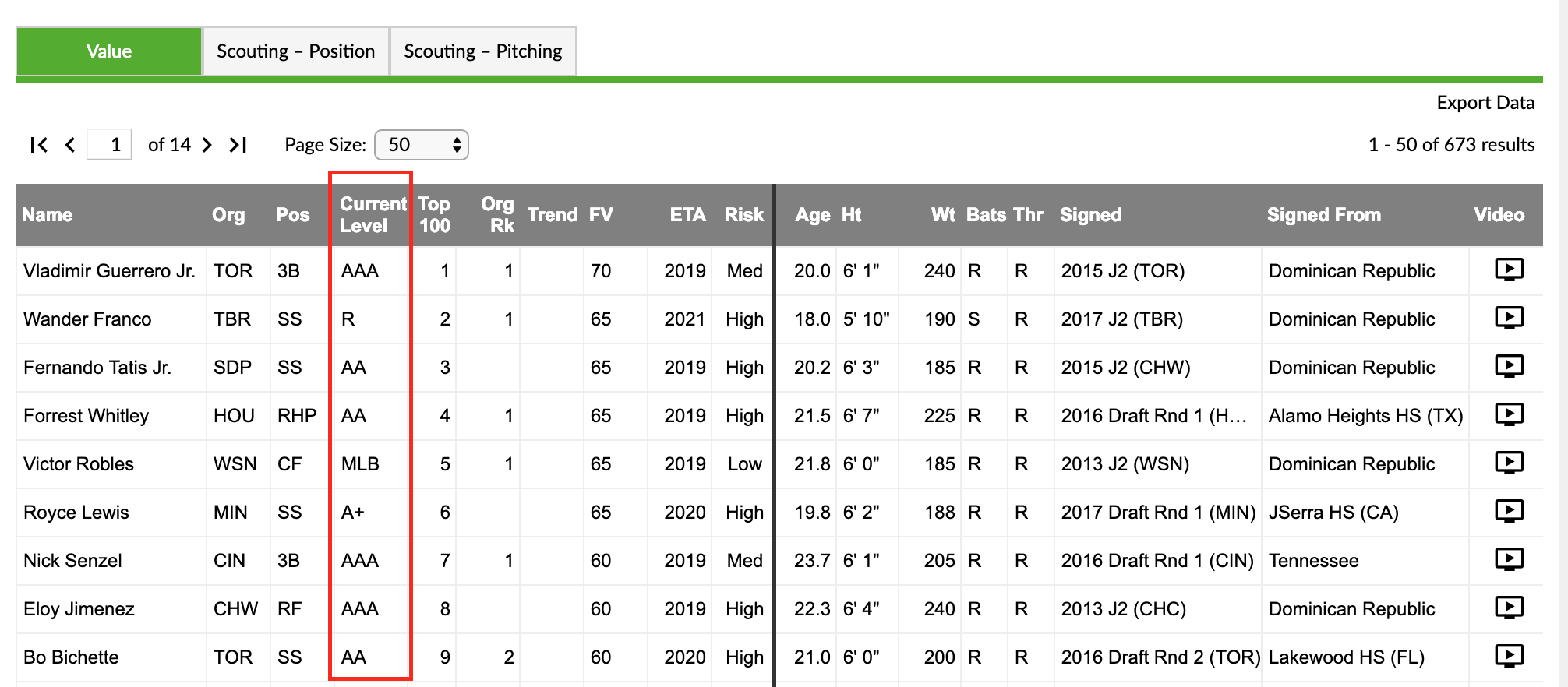
Another Draft Rankings Update

It’s not as significant as the Week One update, but we have about another dozen or so players that have moved around since we last updated THE BOARD. Here are some quick notes covering the most notable movers in the 2019 list, with trend arrows for all of these names and more available on THE BOARD:

  • Texas Tech 3B Josh Jung and Vanderbilt RF J.J. Bleday both have some buzz in the industry as being in the mix to be the third-best college bat behind Oregon State C Adley Rutschman and Cal 1B Andrew Vaughn (both recent risers themselves); Jung and Bleday have moved up to reflect this. Bleday is off to a quick start and looks more athletic than he has in the past, while Jung is a hit-first type who could improve considerably with more loft in his swing in pro ball, but compares favorably to some recent top-10 overall college bats. Others college bats in that mix are UNLV SS Bryson Stott, North Carolina LF Michael Busch, and the big riser in the last update, Missouri RF Kameron Misner.
  • North Carolina State SS Will Wilson is also a rising player, as a potential 5 hit, 5 power middle infielder who likely ends up at second base. Some scouts see plus makeup and versatility with a chance that he may end up catching in pro ball and being an Austin Barnes or Will Smith type who can play every position on the field. Wilson’s polish, performance, and fit in today’s game could push him into the top 15 picks.
  • Clemson SS Logan Davidson and UNC-Wilmington SS Greg Jones each face questions about their hit tool, but Jones stays slightly ahead of Davidson because his upside is still much higher. On the flip side, Arizona State LF Hunter Bishop has 7 raw power and 6 speed and is hitting much better this year, so he’s rising until further notice.
  • Duke LHP Graeme Stinson looked like the clear top pitcher in the class when the college season was set to start, with scouts having confidence that his mid-90s fastball and 70 slider could transition to starting full-time. He’s performed well, but the velocity has kept creeping down — he was into the 80s this weekend — to the point where scouts are openly questioning if there’s an arm problem or if Stinson simply can’t start and needs to be seen as a reliever going forward. Even a worst-case scenario still has him in the top 30 picks or so, but his stock has dipped a good bit.

There was further movement lower in the rankings, and some light changes in the 2020 and 2021 classes. A few fun notes on those future classes — for instance, fourth-ranked 2020 prospect Georgia RHP Cole Wilcox was 95-99 mph this weekend after a tough college debut, Florida State 2021 RF Robby Martin has really impressed scouts early, and 2020 Mississippi State RHP J.T. Ginn is showing more starter traits than he did in high school — have been folded into the rankings, as well.