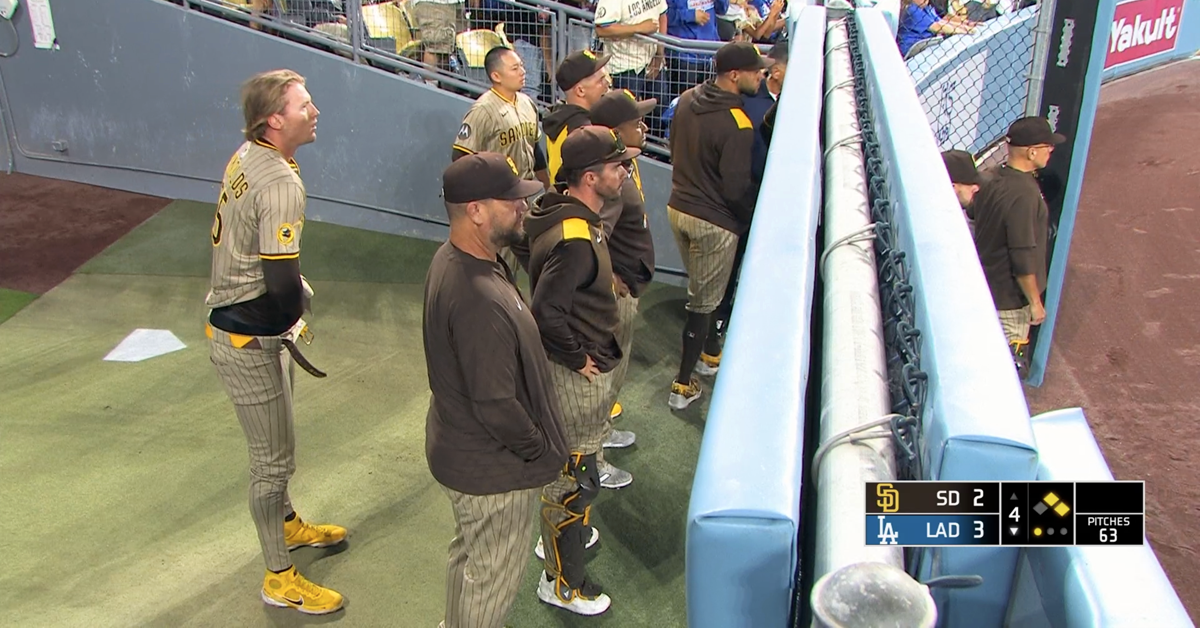
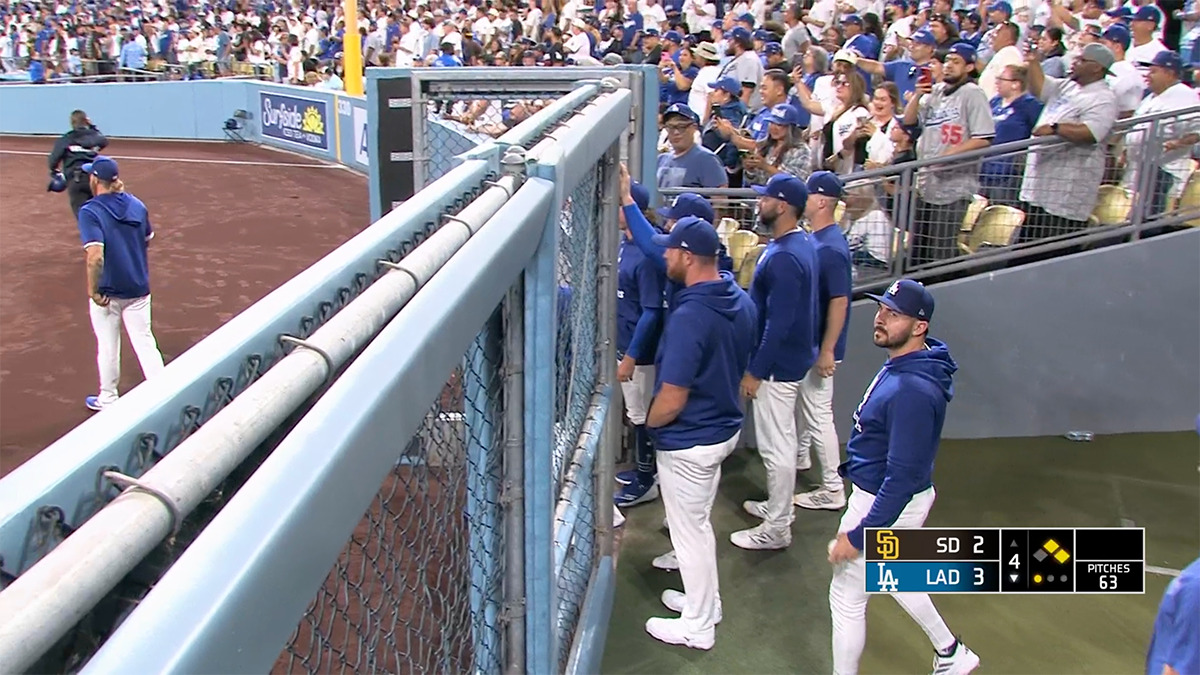
Alright, Dodgers bullpen! This is what we’ve been training for. They hit our guy. This is not a drill. I know it was an accident. I know it would have been the world’s worst time to throw at a hitter, down by a run in the fourth inning, a runner already on base, ahead in the count with the platoon advantage, unprovoked. But none of that matters right now. It’s time to look tough.
Everybody crowd up against the fence like you can’t wait to burst through the door. Time to posture. Strike a pose. This moment right here? This is the reason we watched The Warriors so many times. It’s time to get mean. It’s time to maybe, possibly, not really but you never know just in case, shove somebody a bit. We’re ready to jog out there. We’re ready to flex. Everybody ready for a fight?
Welcome to another edition of Five Things I Liked (Or Didn’t Like) This Week. I took a week off to indulge in a little French Open binge-watching, and after one of the greatest finals of my lifetime, I was ready to charge back into baseball. That feeling – charging ahead – has been something of a theme across baseball of late. You want speed? Chaos? Huge tools and do-or-die choices? This week’s list is for you. It starts, as usual, with a nod to Zach Lowe of The Ringer for originating this format. It also starts, as everything seems to these days, with a green-and-gold blur.
1. The Flash
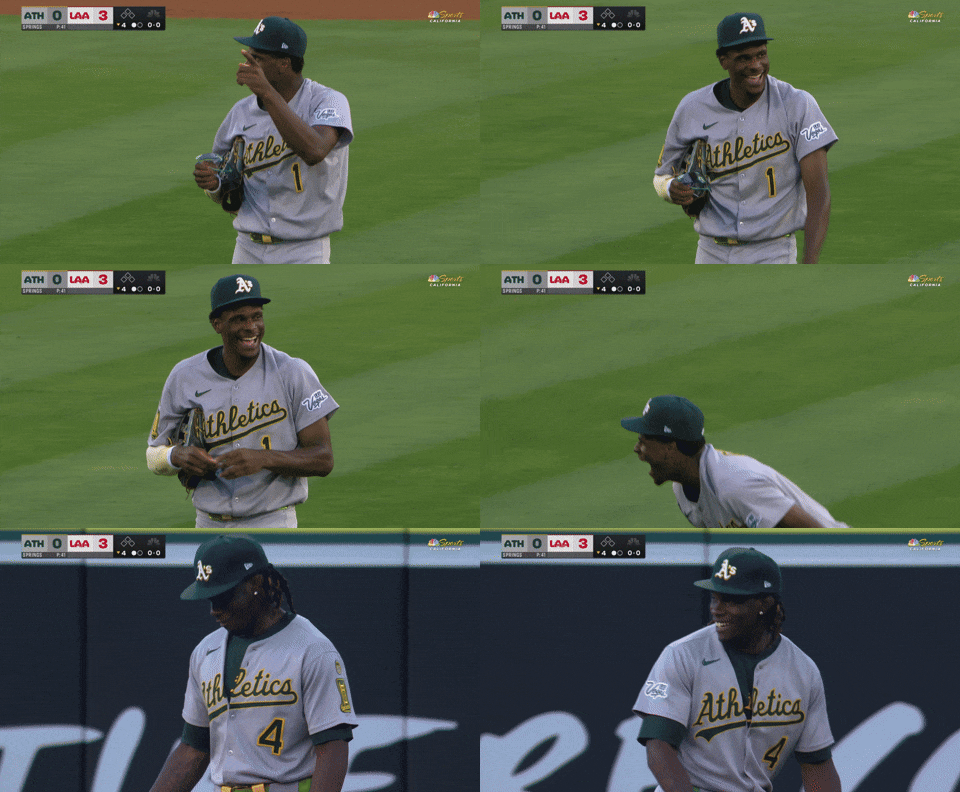
If you turn on a random A’s game of late, you’re liable to see something like this:
And if you’re lucky, something like this afterward:
Denzel Clarke is on quite the heater right now. That spectacular play doesn’t even come close to his greatest major league feat, this absurd home run robbery:
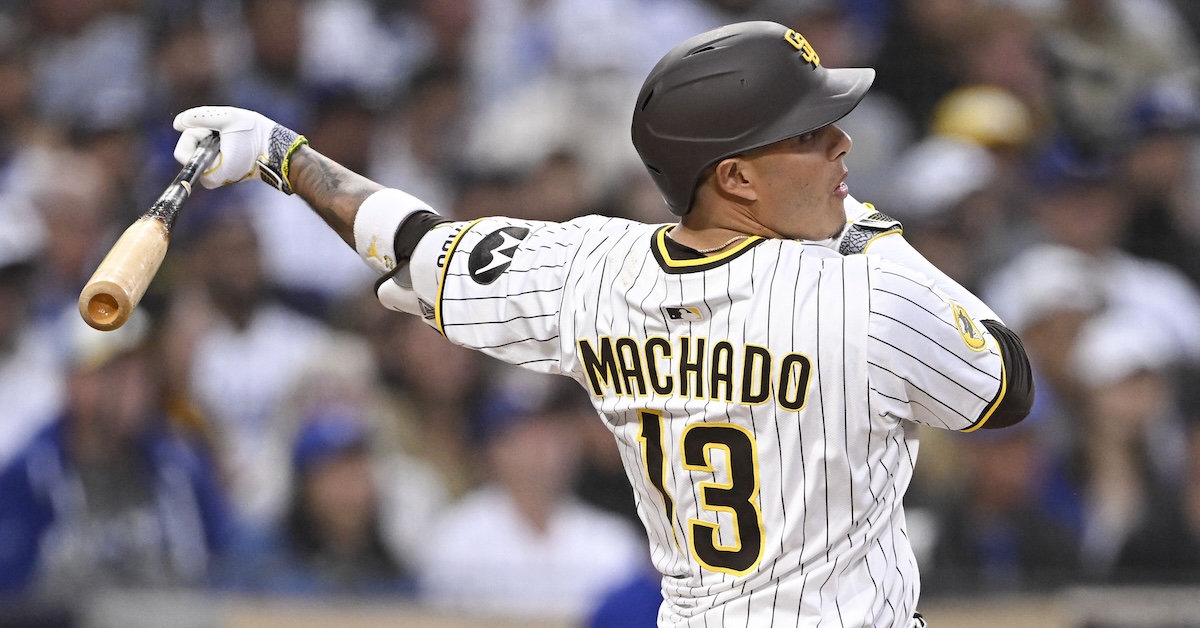
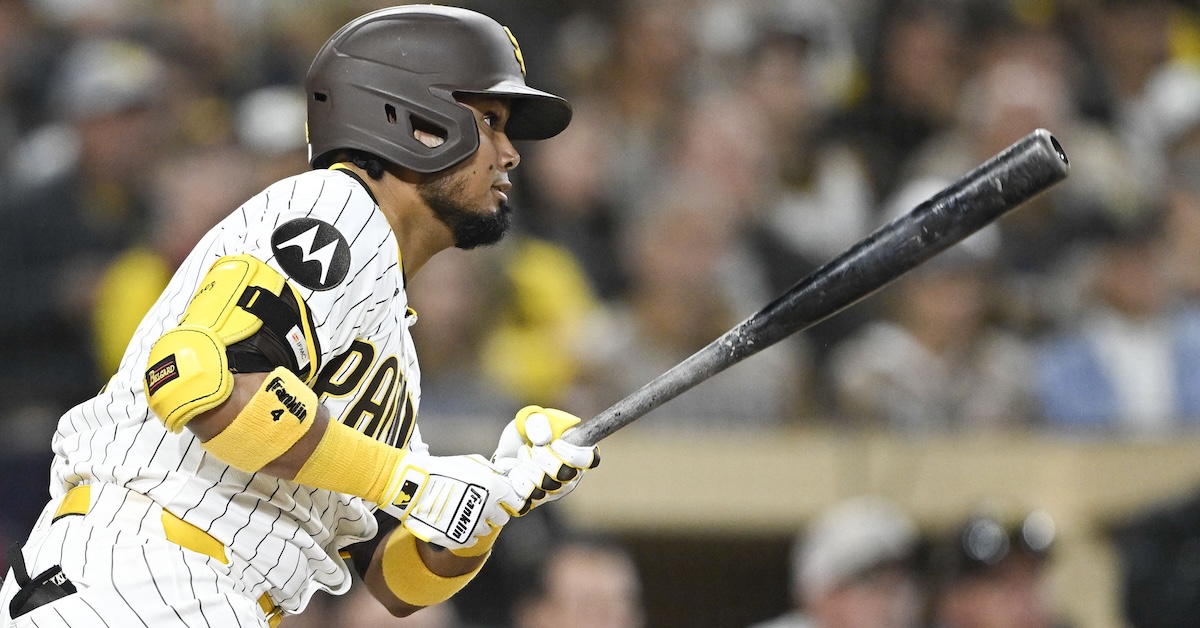
Though the Padres have largely been treading water for the past six weeks while using a rather makeshift rotation — a situation not unlike that of the Dodgers, albeit with fewer ex-Rays (and probably X-rays) — that description does not extend to Manny Machado. The 32-year-old third baseman, who went 3-for-5 while driving in five runs during an 11-1 romp over the Dodgers on Tuesday, has been red-hot lately. Indeed, he’s putting together one of the best seasons of his 14-year career while doing his best to keep the NL West race a tight one.
Admittedly, Machado did not face the Dodgers’ best pitching on Tuesday. The Padres’ NL West rivals are without starters Blake Snell, Tyler Glasnow, Roki Sasaki, and Tony Gonsolin, the last of whom landed on the injured list earlier this week due to discomfort in his surgically repaired elbow. On Tuesday, they used an opener, Lou Trivino, who retired Machado on a routine grounder in the first inning. In Machado’s next three trips to the plate, he faced bulk guy Matt Sauer, against whom he connected for RBI singles in the third (88 mph) and fifth (77.8 mph). Sauer, a thrice-optioned righty who was forced to Wear One on behalf of a gassed staff — he gave up 13 hits and nine runs in 4 2/3 innings — finally retired Machado on a grounder in the sixth, but even that drove in a run to give the Padres a 7-0 lead. Read the rest of this entry »
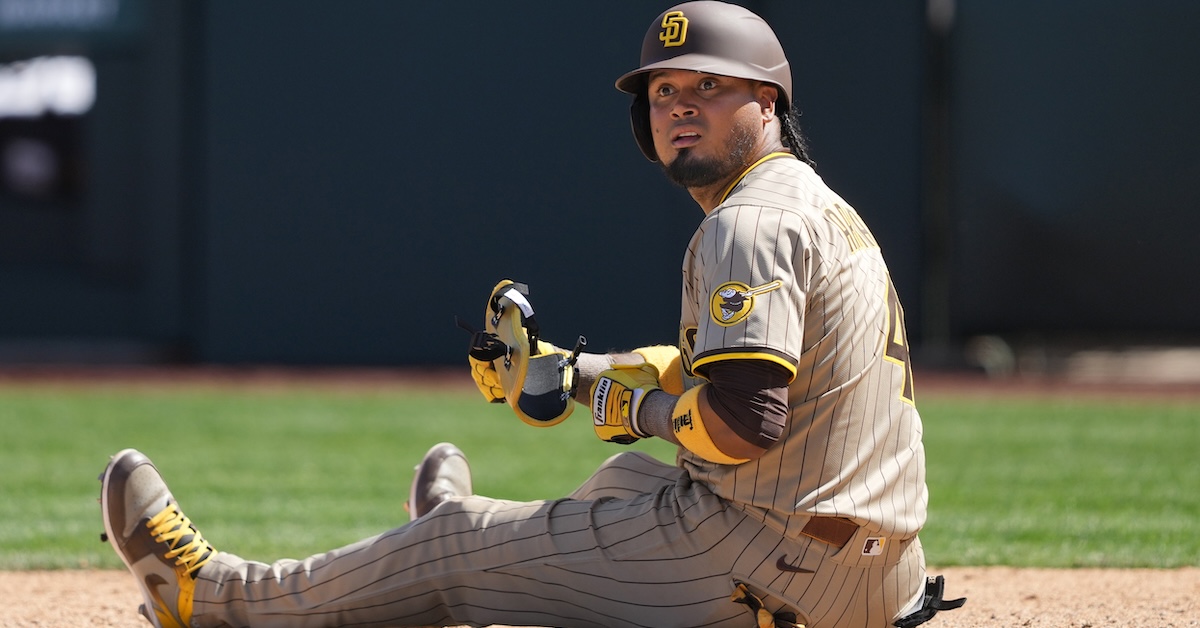
One of the many common themes in mythology, across myriad cultures, is the tragic tale of a protagonist who is undermined and ultimately defeated by the original source of their strength. Oedipus was brought down by his search for truth, Karna by his generosity, and Cú Chulainn by his obligations to his code of honor. Luis Arraez isn’t the hero in an ancient tale, but his ability to hit baseballs at will is the stuff of a modern baseball legend. And like those heroes and heroines in lore, his greatest strength is contributing to his downfall.
Arraez is so fun because he defies an unfortunate aspect of today’s game, what I’ve referred to in the past as its “Anna Karenina problem.” Every lousy lineup seems incompetent in their own way, while most great lineups are nearly indistinguishable from the others. It certainly feels like there’s less run-scoring variety than there was when I was young, a concerningly long time ago. Nobody could possibly mistake Arraez for the greatest player in baseball, but he has won three straight batting titles despite being so very different than the type of player you would see on the cover of a Modern Hitter magazine. He doesn’t work counts to draw walks or pull a bunch of barrels into the stands. Instead, he can turn nearly any pitch into a line drive hit, leading to high batting averages in an era when that has become a relative rarity. In 2025, Arraez has struck out only five times; there are five players this season who have done that in a single game, including former MVP Jose Altuve and two young phenoms, Dylan Crews, Jackson Chourio.
Without boasting the traditional markers of a valuable offensive player, Arraez has nonetheless been one since he broke into the league with the Twins in 2019. He entered this season with a career 120 wRC+ across nearly 3,000 plate appearances, even though he’d hit just 28 home runs. Still, that doesn’t mean Arraez has maintained the same level of nonconformity throughout his career. He remains a contact extraordinaire without much power, but some of his defining characteristics have become more extreme as his career has progressed. With a 103 wRC+, Arraez is having his weakest offensive season, and it’s largely because his signature formula for success isn’t quite mixing the way it did before. Read the rest of this entry »
Ethan Salas Photo Credit: Joe Camporeale-Imagn Images
Below is an analysis of the prospects in the farm system of the San Diego Padres. Scouting reports were compiled with information provided by industry sources as well as my own observations. This is the fifth year we’re delineating between two anticipated relief roles, the abbreviations for which you’ll see in the “position” column below: MIRP for multi-inning relief pitchers, and SIRP for single-inning relief pitchers. The ETAs listed generally correspond to the year a player has to be added to the 40-man roster to avoid being made eligible for the Rule 5 draft. Manual adjustments are made where they seem appropriate, but we use that as a rule of thumb.
A quick overview of what FV (Future Value) means can be found here. A much deeper overview can be found here.
All of the ranked prospects below also appear on The Board, a resource the site offers featuring sortable scouting information for every organization. It has more details (and updated TrackMan data from various sources) than this article and integrates every team’s list so readers can compare prospects across farm systems. It can be found here. Read the rest of this entry »
Spencer Schwellenbach had just two big-league games under his belt when he was featured here at FanGraphs early last June. The most recent of them had come a few days earlier at Fenway Park, where he’d allowed six runs and failed to get out of the fifth inning. Two starts into his career, the Atlanta Braves right-hander was 0-2 with an 8.38 ERA.
Those initial speed bumps quickly became a thing of the past. Schwellenbach allowed three runs over his next two outings, and by season’s end he had made 21 appearances and logged a 3.35 ERA and a 3.29 FIP. Counting this years’s 10 starts, the 24-year-old Saginaw, Michigan native has a 3.41 ERA and a 3.41 FIP over 185 innings. Moreover, he has a 23.5% strikeout rate and just a 4.7% walk rate. Relentlessly attacking the zone with a six-pitch mix, Schwellenbach has firmly established himself as a cog in Atlanta’s rotation.
On the eve of his returning to the mound in Boston last Sunday, I asked the 2021 second-round pick out of the University of Nebraska what has changed in the 11-plus months since we first spoke.
“Honestly, when we talked last year I was just throwing the ball to the catcher,” claimed Schwellenbach, who was a shortstop in his first two collegiate seasons and then a shortstop/closer as a junior. “It was really only my second year as just a pitcher, so I was very young-minded with how I pitched. Now that I’ve got 30 or so starts, I have an idea of what I’m trying to do out there. Being around guys like Max Fried, Charlie Morton, and Chris Sale last year was obviously big, too. I learned a lot from them, as well as from [pitching coach] Rick Kranitz.”
Morton, who is now with the Baltimore Orioles, helped him improve the quality of his curveball. Their mid-season conversation was the genesis of a more efficient grip. Read the rest of this entry »
Brooks Baldwin doesn’t profile as a future star, but that doesn’t mean he won’t have a long and productive major league career. Versatility is a big reason why.
A poor man’s Ben Zobrist, the 24-year-old switch-hitter has played every defensive position besides first base, catcher, and pitcher since debuting with the Chicago White Sox last summer. It may be only a matter of time before those three are added to his résumé. Counting his days as a North Carolina prep and a UNC-Wilmington Seahawk, there isn’t anywhere he hasn’t played.
The versatility dates back to his formative years.
“I’ve been playing all over the field since I was 10 years old,” explained Baldwin, who was announced as a third baseman when the White Sox selected him in the 12th round of the 2022 draft. “It’s something my dad instilled in me, not restricting myself to one position. He played pro ball a little bit [in the Cleveland Guardians system], and before that in college at Clemson. He did the same thing.”
Chuck Baldwin’s son has seen time at first base in the minors, and the other two missing positions at the major league level are ones he’s well acquainted with. The chip off the old block caught “pretty often” in his freshman and sophomore years of high school, and pitched all four years. Primarily a starter, he had a fastball in the upper-80s as a senior.
Baldwin has been switch-hitting since he was eight or nine years old. His father’s high school coach, Linwood Hedgepeth, made the suggestion. After watching the naturally-left-handed hitter in the batting cage, the member of the North Carolina Baseball Hall of Fame told the elder Baldwin,’This kid can switch it.’” Read the rest of this entry »
Penn Murfee was mentioned in the interview with Trent Blank that ran here at FanGraphs on Friday. Discussing pitch profiles, Seattle’s director of pitching strategy recalled the erstwhile Mariners reliever being “a guy who had cut-ride” on his four-seam fastball.
Murfee is now with the White Sox, and Chicago’s South Side club is in Boston for a weekend series, so I took the opportunity to get his own perspective on the offering. What I learned talking to him at my home base of Fenway Park is that the movement he gets on his heater is circumstantial. Moreover, it’s legal.
“Back in 2021, in [Triple-A] Sacramento, my pitch profile changed from a running arm-side fastball,” explained Murfee, who was in the Seattle system from 2018-2023, the last year-plus of that span in the majors. “For whatever reason, I started choking the ball a little tight, and began throwing what was classified as a cutter. It went to zero inches of horizontal movement. My pitching coach at the time said, ‘Whatever you changed, don’t change it back.’ He said that I went from having a very average fastball to something unique.”
When the Padres signed Nick Pivetta to a four-year, $55 million deal in mid-February, it marked an awakening from a sleepy and disappointing winter. With ownership embroiled in a battle over who would control the team in the wake of Peter Seidler’s death, San Diego had let several key free agents from last year’s 93-win Wild Card team depart, including Jurickson Profar and Ha-Seong Kim, but hadn’t spent more than $3.5 million or issued a contract longer than a year when it came to restocking. Pivetta was the exception, and while he was signed to be the fourth starter behind Dylan Cease, Michael King, and Yu Darvish, so far he’s been the stingiest rotation member on the hottest team in baseball.
On Wednesday afternoon at Petco Park, Pivetta spun six innings of one-run ball against the Cubs, allowing just four hits and striking out six, while Manny Machado and Fernando Tatis Jr. each drove in a pair of runs. Though reliever Wandy Peralta served up a solo homer to Pete Crow-Armstrong in the eighth inning — the rare lapse by a bullpen that’s been lights out so far — the Padres won 4-2. After beginning the season with seven straight wins over the Braves and Guardians, and winning their first 11 games at home before losing to the Cubs on Tuesday, they’re now a major league-best 15-4, outdistancing the world champion Dodgers, who have played just .500 ball since opening the season 8-0.
Though San Diego swept the Braves in the Wild Card Series last year and then went the distance with the Dodgers in the Division Series before getting eliminated, this season’s club wasn’t expected to be a particularly strong one in light of its offseason inactivity, which also included losing reliever Tanner Scott and catcher Kyle Higashioka to free agency. The Padres replaced Profar — who had followed up a career-worst season with a career-best one that earned him his first All-Star selection — in left field with a platoon built around 35-year-old Jason Heyward, whom they signed for one year and $1 million. They went light at catcher following Higashioka’s departure, cobbling together a tandem of Elias Díaz and Martín Maldonado, two backstops who were released by their respective teams last summer; San Diego had added Diaz after he was dropped by the Rockies in August, then retained him on a one-year, $3.5 million deal. The Padres appeared so geared toward reining in spending that the Pivetta move was initially presumed to be a precursor to trading Cease. Read the rest of this entry »
At risk of stating the obvious, Luis Arraez doesn’t strike out often. Since 2022, his first full season and the year he won his first batting title, Arraez has struck out 5.5% of the time. Let me put that into context. As of this morning, the Padres have a 6.0% chance to win the NL West. That means they are more likely to upset the baseball-ruining Dodgers than Arraez is to strike out in any given plate appearance. And that might be underselling his skills. In the second half of 2024, he reduced his strikeout rate even further, going down on strikes just five times over his final 57 games. That included baseball’s first 30-game strikeout-less streak in 20 years. Since the 2024 All-Star break, Arraez has struck out in 1.9% of his trips to the plate. Meanwhile, San Diego’s odds of winning the World Series currently sit at 2.2%. A pessimist might use that comparison to demonstrate that the Padres are long shots; 17 teams have a better chance to win it all. An optimist would counter that every time Arraez strikes out, it’s a reminder that the Padres are still World Series contenders. If that’s the way you see it, well, boy did the Padres get one heck of a reminder on Wednesday afternoon. For the first time all season, Arraez struck out.
It was the top of the ninth. The Padres were up 2-1. The inning began with a base hit by Martín Maldonado. That itself is a rare enough event. No other batter in recorded major league history has taken as many plate appearances as Maldonado (3,888) and has such a low batting average (.204) to show for it. Adding to the unlikelihood of Maldonado’s single, the batted ball had a mere .100 expected batting average, a 1-in-10 chance to be a hit. Yet, third baseman Max Schuemann, who entered the game that inning as a defensive replacement, flubbed the play. The ball slipped right out of his glove. As I watched his ill-fated attempt to retrieve the ball, I couldn’t help but think of my 6-year-old self trying to crossover dribble like Allen Iverson. Neither of us had any control of the ball:
With Maldonado on first, Arraez stepped up to the dish. He was already 0-for-4 with three fly outs, a strange enough day for a player who rarely hits fly balls. Since the day of his debut in 2019, Arraez has taken 2,916 plate appearances. Thirty-nine others have taken as many or more plate appearances in that time. None of them has a lower fly ball rate. But I’m getting off track. We aren’t here to talk about fly balls.
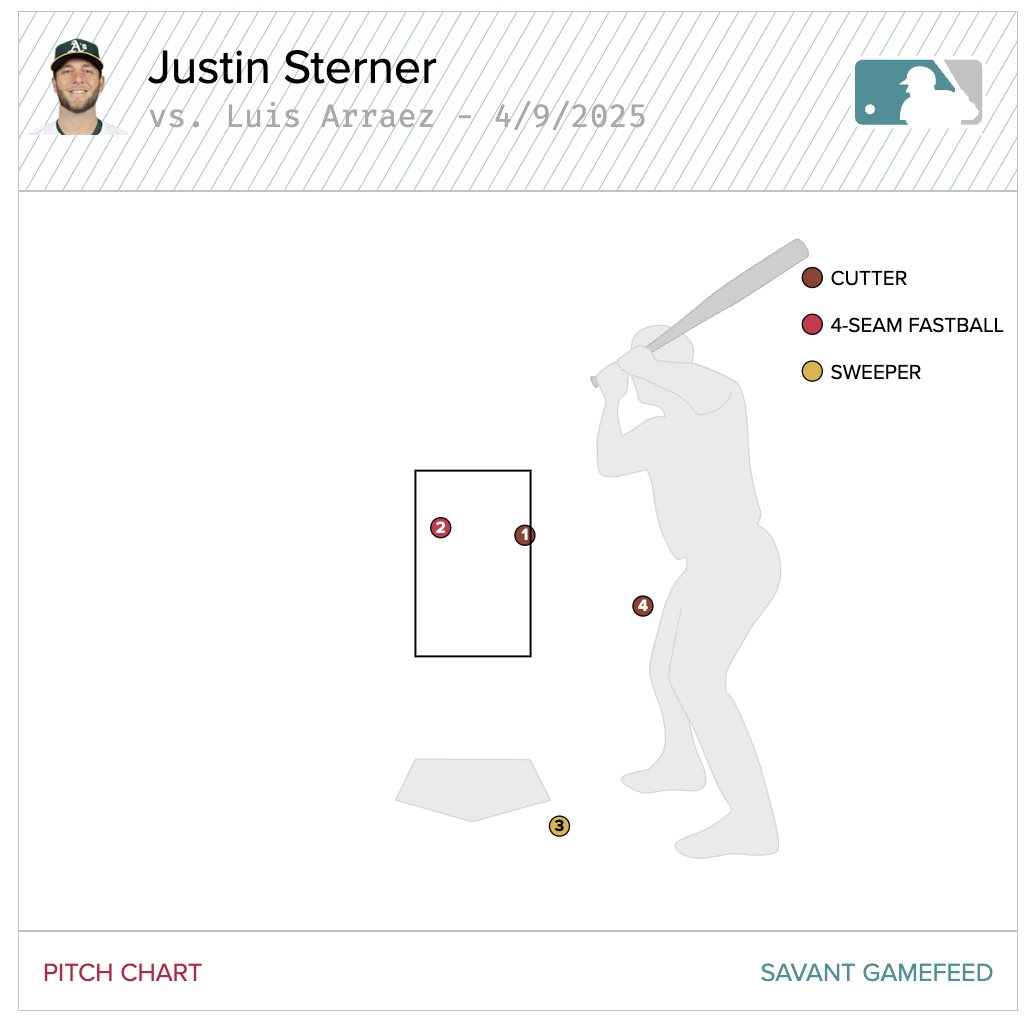
The pitcher on the mound was Justin Sterner, who somehow isn’t the A’s player with the closest-sounding name to a current or former Dodgers third baseman. Sterner, an offseason waiver claim from the Rays, has looked sharp so far in seven games for his new team. He entered this contest with nine strikeouts through his first six appearances. His 10th would be his most impressive yet. Arraez took Sterner’s first pitch, an 88-mph cutter on the upper-inside corner, for a strike. The count was 0-1:
Pitch number two was a 94-mph fastball that Arraez sent straight back into the crotch of catcher Shea Langeliers:
Is it funny when a man gets hit in the family jewels? I’ll let you decide for yourself. What I like so much about this moment isn’t the slapstick, but rather the subtle humor of how awkwardly Arraez behaves in the aftermath. One of my favorite bits from the little-known television comedy Friends is the scene where Ross picks up a lamp. That’s the first thing I thought of when I saw Arraez pick up that baseball. Why was his first instinct to pick up the ball as quickly as possible? I’m truly not sure. Was he worried someone would trip on it? Was he trying to hide the weapon? Or did he simply feel a need to do something, and picking up the ball was the first idea that popped into his head? He’s like a well-meaning but clueless husband trying to offer support while his wife is in labor. But instead of running for ice chips, he decided to pick up a baseball.
Arraez’s next move made more sense, as he went to pat Langeliers on the back. However, the consequences of his earlier actions soon returned to haunt him. He was still holding that damn baseball:
It became something of a dance for Arraez, who went back and forth between comforting Langeliers and dealing with the ball. It’s funny to watch because we’ve all been in that position before, facing a situation where we feel like we should help but there really isn’t much we can do. It’s even funnier in juxtaposition to the physical comedy of a man getting bopped in the beans. It’s certainly funnier than the A’s TV broadcaster suggesting they call the catcher “Shea Pain-geliers,” though perhaps not quite as funny as the Padres announcer blurting out, “They call him Langy!” in response to absolutely nothing (unless he was listening to the A’s broadcast). He just seemed to be reading the name plate on Langeliers’ chest protector because, much like Arraez, he wasn’t sure what else to do.
The third pitch of the at-bat was an 81-mph sweeper in the dirt. It never came close to Arraez, and indeed, he watched it bounce. Yet, seemingly still spooked by what happened on the previous pitch, he made a delayed effort to avoid getting hit. Maybe Arraez thought the ball was going to bounce off Langeliers and hit him in an act of swift poetic justice. That would explain why he shielded his face with his hand as he spun almost 360 degrees to avoid a projectile that did not come anywhere close to his body:
At long last, you’re all caught up on the series of incidents that set the stage for the strikeout. With a 1-2 count, Sterner threw another inside cutter, much like the first pitch of the at-bat. This time, however, he missed his spot badly:
The pitch hit Arraez squarely on his left thigh. Home plate umpire James Hoye called it strike three. The call was correct:
Indeed, there wasn’t anything controversial about it. Even as Arraez stood up and started walking to first base, and even when Mike Shildt came out to discuss the call, I don’t believe either was strong in his convictions. Simply put, it wasn’t close. This wasn’t a case of a batter accidentally bringing his bat around as he tried to avoid a missile hurtling toward him. Arraez began his swing with intention and didn’t even start to pull it back until the ball had already made contact with his body. Some umpires might be holding a grudge against Arraez for disparaging comments he made in spring training, but that’s not what this was. This was a strike:
Throughout his career, Arraez has only swung and missed at 16 of the 930 (1.7%) pitches he’s seen in the waste zone (per Statcast). That’s one-third of the league-average rate. Of the 257 batters who have seen at least 500 waste zone pitches since 2019, only five have a lower swing-and-miss rate than Arraez. It’s not often you’ll see him fail to make contact so miserably. In fact, having watched all 16 of his waste-zone whiffs, I could argue this was the single worst swing decision (category: context neutral) of his career.
Perhaps there was something in the air in Sacramento that day. After all, Maldonado got a hit, and Arraez did not. If that’s not a sign of the apocalypse, I don’t know what is. Supernatural or not, this strange, funny, and painful sequence of events that finally led to Arraez’s first strikeout is exactly why I love writing about baseball.