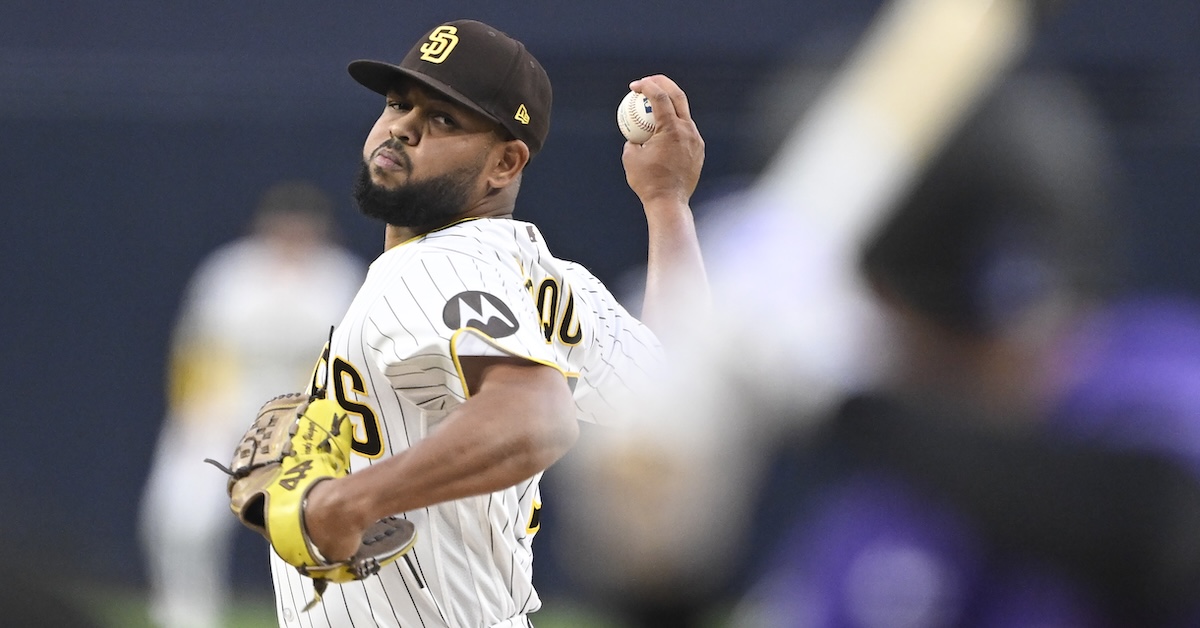
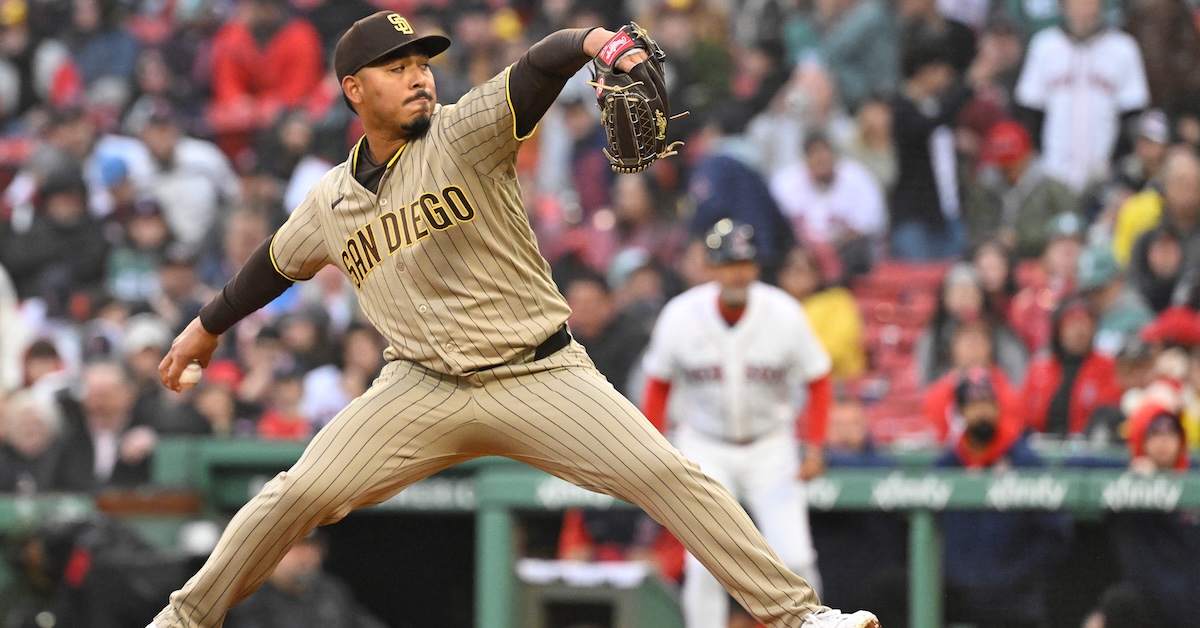
Randy Vásquez has struck out 19 batters in his first three starts of 2026. He didn’t record his 19th strikeout in 2025 until May 14, in the third inning of his ninth start.
Vásquez has simply dominated in the earliest days of the new season. He opened the year with six shutout innings against the Tigers, striking out eight. He picked up a mere three strikeouts in his second start against the Red Sox, but his stuff was just as good, generating whiffs on 32.6% of swings. And then he picked up eight more strikeouts on Thursday against the Rockies. He now has a 1.02 ERA, a 2.57 FIP, a 27.5% strikeout rate and a 5.8% walk rate, pitching like a top 20 starter in the majors to begin 2026.
Weird, right?
It’s not that Vásquez was terrible before this year. He posted a 3.70 ERA and 4.96 FIP across 26 starts in 2025, and his performance was similar in the two seasons prior. That’s a pitcher who can stick in the backend of most rotations and serve as useful depth. But it wasn’t clear what Vásquez did well, or how he might take the next step to becoming a true mainstay in the majors. He walked more batters than average. He didn’t really limit hard contact. And his 14.8% strikeout rate was the lowest among any starting pitcher with at least 200 innings from 2023 through 2025. He was just kind of there. Read the rest of this entry »
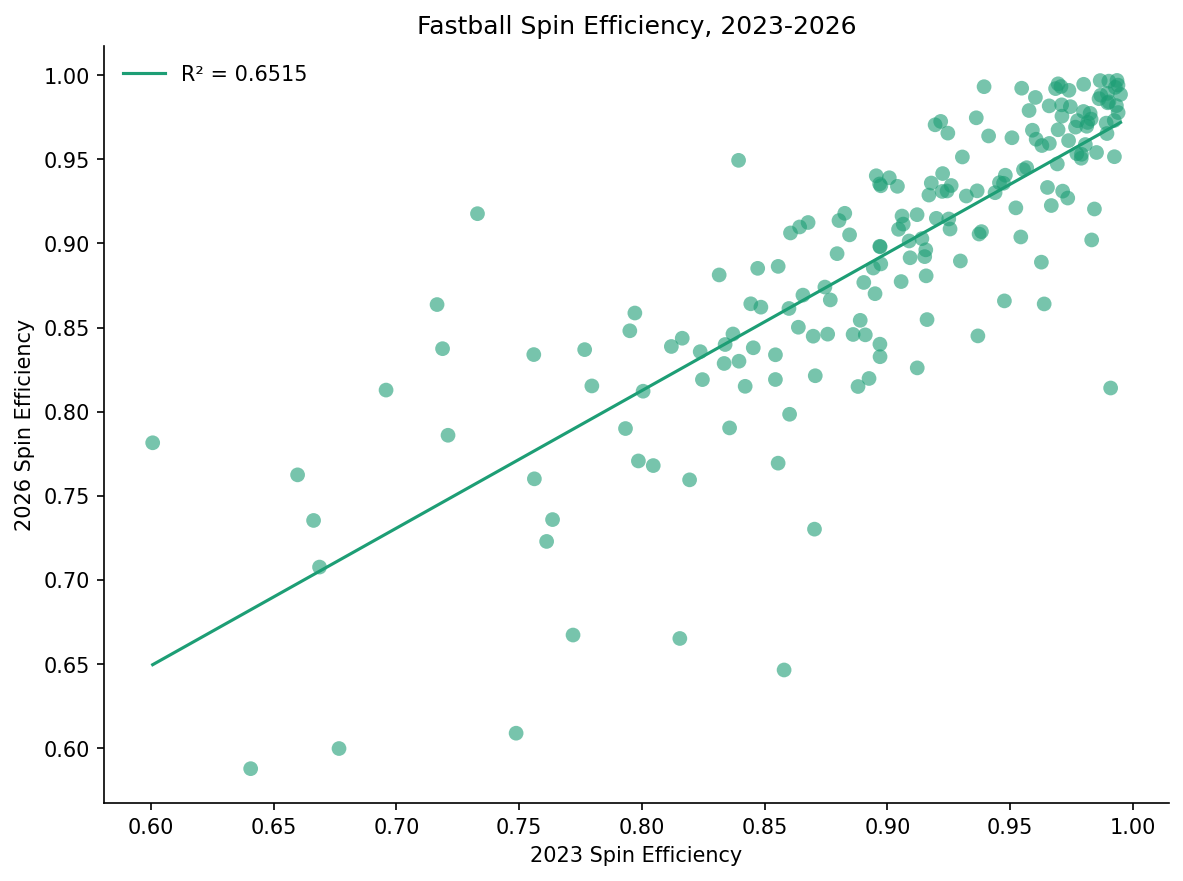
Pitchers can do all sorts of things to change their lot in life — launch plyo balls, rig up a Trackman, add a kick change — but motor preferences tend to be a fixed fact. Most pitchers fall into one of two buckets: pronator or supinator. Pitchers with high spin efficiency (say, 95% and up) on their four-seam fastball belong to the pronator class, while those below 90% can be considered supinators. (As a reminder, spin efficiency is the measure of how much spin is “useful;” a fastball thrown with perfect backspin would have 100% spin efficiency.) These mechanical biases tend to remain constant throughout a career. I took 185 pitchers who threw at least 25 fastballs in both 2023 and 2026; over that three-year span, the r-squared between their spin efficiency was 0.65.
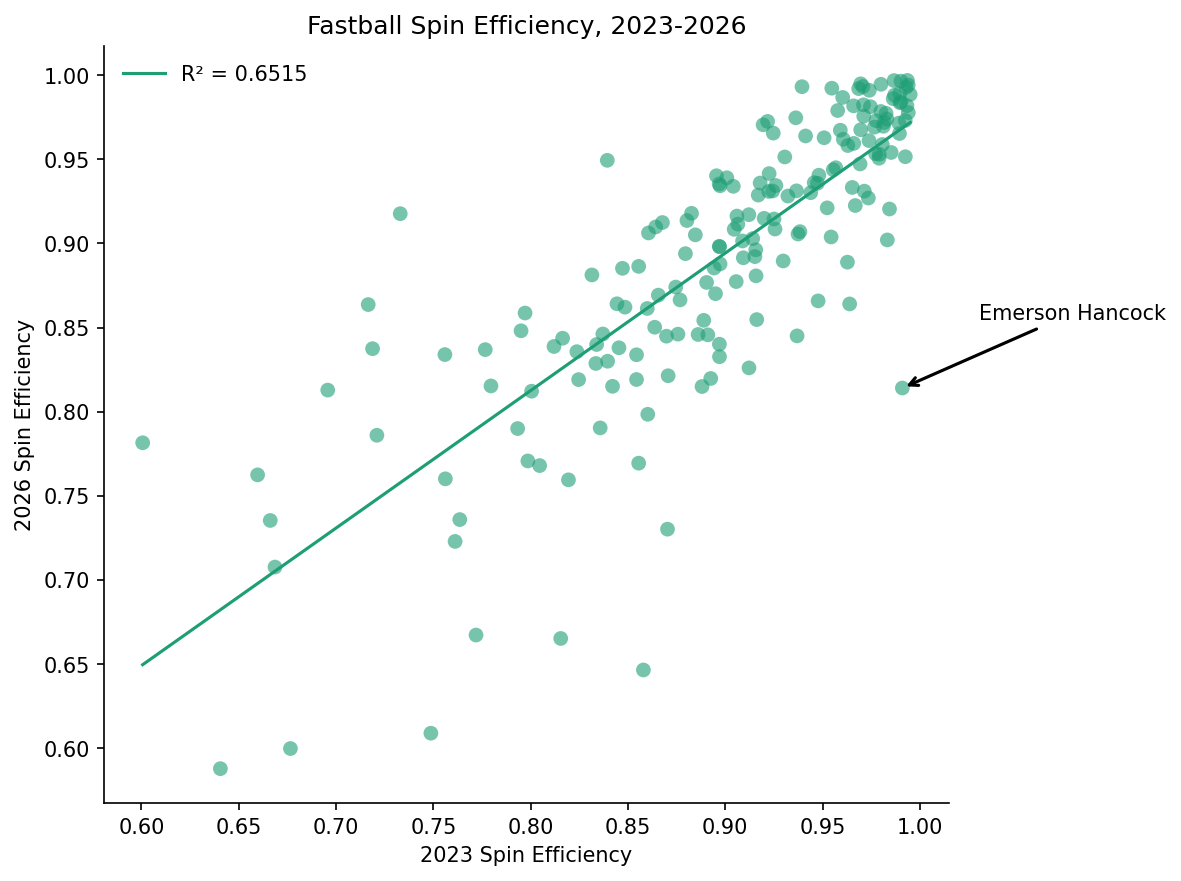
On that plot above, you’ll see, as there always are, a few outliers. One is Joe Boyle. The tale of Boyle is relatively well known at this point, at least in certain social media pitching circles. Over the last three years, Boyle went from throwing from an over-the-top arm angle (53 degrees) to a distinct side-arm slot (26 degrees.) The arsenal, in turn, transformed alongside it. This dramatic slot change coincided with his fastball spin efficiency declining from 86% in 2023 to 67% in 2026, one of the largest drops in that span.
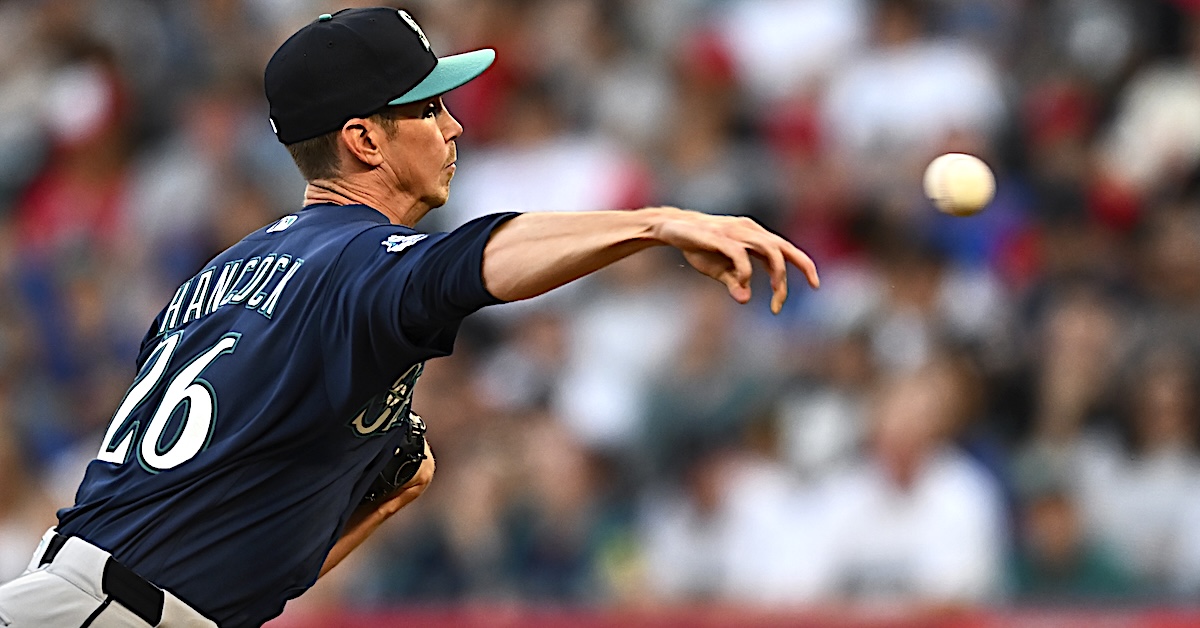
Boyle belongs to that collection of dots on the left of the plot that went from low spin efficiency to even lower spin efficiency. And then there’s one little dot all alone on the right side of the plot. That’s Emerson Hancock.
Below is an analysis of the prospects in the farm system of the Texas Rangers. Scouting reports were compiled with information provided by industry sources as well as my own observations. This is the sixth year we’re delineating between two anticipated relief roles, the abbreviations for which you’ll see in the “position” column below: MIRP for multi-inning relief pitchers, and SIRP for single-inning relief pitchers. The ETAs listed generally correspond to the year a player has to be added to the 40-man roster to avoid being made eligible for the Rule 5 draft. Manual adjustments are made where they seem appropriate, but we use that as a rule of thumb.
A quick overview of what FV (Future Value) means can be found here. A much deeper overview can be found here.
All of the ranked prospects below also appear on The Board, a resource the site offers featuring sortable scouting information for every organization. It has more details (and updated TrackMan data from various sources) than this article and integrates every team’s list so readers can compare prospects across farm systems. It can be found here. Read the rest of this entry »
Jacob Misiorowski has a fastball that consistently reaches triple digits, and he augments it with an effective curveball-slider combination. Usage-wise, the 24-year-old Milwaukee Brewers right-hander is throwing his high-octane heater at a 62.3% clip, while his breaking-ball percentages are 16.6 and 17.3 respectively. Given the lethality of those pitches — his xBA is a paltry .168, and his K-rate an MLB-best 41.8% — he has little need for a changeup…
… but there is one in his arsenal. From time to time, he will even show it to a batter. Of the 289 pitches Misiorowski has delivered so far this season, 11 (3.8%) have been changeups. The story behind his only-sporadically-used weapon?
“I’ve had a changeup my whole career,” Misiorowski told me prior to throwing three of them in a 101-pitch start at Fenway Park on Tuesday. “That was one of the first pitches I truly learned. But then as I started throwing harder, I began going away from it, and it obviously got worse and worse the less I threw it. By the time I got drafted [63rd overall in 2022], I basically didn’t have a changeup any more. I had to relearn it, re-figure it out. So, yeah, it’s always been there, but it hasn’t always been there.”
Misiorowski went on to tell me the grip was originally a more conventional four-seam circle, but that he now has his pointer and middle fingers together, and his thumb underneath. He also said that he likes the amount of horizontal he gets on it, which is generally around 18 inches and has been up to 20. When I told him that the movement profile sounds a little like a two-seam sinker, he agreed that it does.
A few more things Misiorowski told me about the pitch are unfortunately lost, due to glitches I’ve recently encountered on my iPhone’s recording app (I mentioned this teeth-gnashing, hopefully-resolved-soon, issue in Monday’s piece on Padres’ broadcaster Mark Grant.) Fortunately, I was able to grab a few minutes with Brewers pitching coach Chris Hook, who made up for the missing words with his own perspective.
Braden Nett’s path to prospect prominence was anything but ordinary. Not only was he working at a Home Depot when he signed with the Padres in 2022 as a non-drafted free agent, but he also had barely played in college. What he lacked in conventional experience, he made up for with a promising arm. San Diego saw him pitching in the MLB Draft League, gave him a chance, and what’s transpired since is bordering on storybook. Initially from Troy, Missouri — with a short stop as a St. Charles Community College Cougar — the 23-year-old right-hander has progressed to the point where he is now ranked seventh on our newly released Athletics Top Prospects list, with a 45 FV.
His change of address came at last summer’s trade deadline. Intrigued by his promising-but-unpolished toolbox, the Athletics acquired Nett as part of the six-player deal centered around Mason Miller and Leo De Vries. On the season, Nett notched 116 strikeouts while logging a 3.75 ERA and a 3.77 FIP over 105 2/3 innings between a pair of Double-A outposts.
Currently sidelined with a rotator cuff issue — he’s on roster of the Triple-A Las Vegas Aviators, but has yet to appear in a game — Nett has a mid-to-upper-90s fastball when healthy. As I learned talking to him during spring training, he also has a wide-ranging arsenal. Read the rest of this entry »
Welcome to a new season of Five Things I Liked (Or Didn’t Like) In Baseball This Week. After a slow, veteran-who-signed-late-this-spring style warmup to the year, it’s time for another dive into the little details that catch my eye each week. It’s the perfect time of year for it. Beautiful weather, early-season optimism, overheard conversations about who should bat third and who’s a bum – it all fuses together to make this one of my favorite parts of the baseball calendar. And even though the WBC whetted my appetite for the spectacular somewhat, there’s really no replacing major league games for the sheer variety of entertainment. I’m sure that Zach Lowe of The Ringer, whose old NBA column format I’ve borrowed, would say the same thing about the basketball regular season. Let’s talk baseball.
1. Ricochets
If you share my baseball consumption habits, it might seem like every weekday offers a Royals game, a Guardians game, or a Royals-Guardians game. And I love it! I’ll take any excuse to watch Maikel Garcia continue his ascent from contact hitter to do-it-all superstar, a kind of modern-day José Ramírez. And I get to watch the actual José Ramírez too? And Bobby Witt Jr.? And Steven Kwan, Vinnie Pasquantino, Bo Naylor, and old favorite Michael Wacha? Both of these teams are sneaky fun, and their series this week didn’t disappoint. Witt might be having a slow start on offense, but he’s still a defensive genius:
Lots of shortstops – pretty much every other shortstop, even – would get only one out, somewhere, on that play. But two?! Ludicrous. When Garcia’s lunging attempt caromed toward Witt, he turned from interested observer to protagonist so smoothly that it looked like he was planning on doing it the whole time. It started with his feet. Instead of charging the ricochet, Witt timed his steps to hop to a stop and get his body in as good a throwing position as he could:
Below is an analysis of the prospects in the farm system of the Athletics. Scouting reports were compiled with information provided by industry sources as well as my own observations. This is the sixth year we’re delineating between two anticipated relief roles, the abbreviations for which you’ll see in the “position” column below: MIRP for multi-inning relief pitchers, and SIRP for single-inning relief pitchers. The ETAs listed generally correspond to the year a player has to be added to the 40-man roster to avoid being made eligible for the Rule 5 draft. Manual adjustments are made where they seem appropriate, but we use that as a rule of thumb.
A quick overview of what FV (Future Value) means can be found here. A much deeper overview can be found here.
All of the ranked prospects below also appear on The Board, a resource the site offers featuring sortable scouting information for every organization. It has more details (and updated TrackMan data from various sources) than this article and integrates every team’s list so readers can compare prospects across farm systems. It can be found here. Read the rest of this entry »
Jeremiah Estrada’s path to big league success was bumpy. Drafted out of Palm Desert High School in California in 2017, the now-27-year-old right-hander battled multiple injuries, including one that required Tommy John surgery in 2019. There was non-health-related adversity as well. Estrada spent his first seven professional seasons in the Chicago Cubs organization, and he didn’t always see eye to eye with the club’s pitching coordinators and coaches. They were occasionally at cross purposes when it came to optimizing his repertoire.
Estrada reached the big leagues with Chicago in 2022, although it wasn’t until two years later that he found much success. Cast aside by the Cubs, with whom he’d thrown just 16 1/3 big league innings over parts of two seasons, he has thrived since being claimed off waivers by the San Diego Padres prior to the 2024 campaign. Over 145 appearances, Estrada has logged a 3.35 ERA, a 2.85 FIP, and a 36.1% strikeout rate over 139 2/3 frames. His Friars ledger also includes four saves and an 11-9 won-lost record.
Estrada discussed his nonlinear, and often frustrating, path to big league success over a pair of conversations. The first came in early March at the Padres’ spring training complex, while the second was conducted at Fenway Park this past weekend.
———
David Laurila: How much have you changed since coming to pro ball?
Jeremiah Estrada: “I’d say a lot, and not just what happens on the field. With the baseball side, you learn what’s important and what’s not important, but that’s pretty much like life. Right? Life starts to kick in. Even though many of our lives are different, we worry about the same things. Read the rest of this entry »
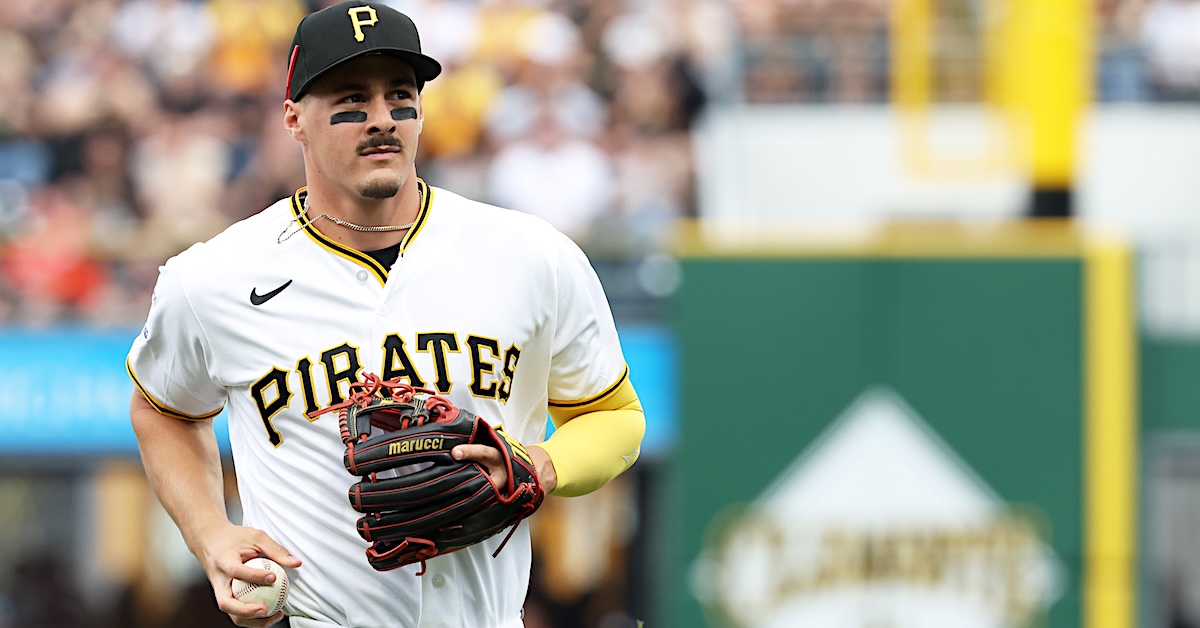
I’m a fan of gallows humor, and I think that fans of the Pirates need to be as well. The Pirates have developed their share of stars over the years, but for fans, there’s always the slight bit of dread that once their young talent starts getting paid commensurate with their production, they’ll be swapping the black-and-gold for Dodger blue or pinstripes. So it’s a good time for Yinzers and the Allegheny-adjacent community, as shortstop Konnor Griffin and the team agreed to a nine-year, $140 million contract that would keep him in town until after the 2034 season.
As contracts go, this is a rather straightforward one. While MVP incentives can bring up the deal by a modest $10 million, to $150 million, that’s just about the only complexity present. There is no deferred money to eat away at the present value of the contract, no option years for the Pirates to lock in at the end, and no opt-out provision that could get Griffin to free agency a year or two early. The deal includes a $12 million signing bonus, which will be doled out over the next three years, certainly helpful to Griffin in that he’ll still get a nice chunk of cash even if the seemingly inevitable lockout drags into the 2027 season.
The Pirates have a real up-and-down history with contracts, so it’s always nice to see them spend on franchise talent rather than spread things around on third-tier free agents. They managed to keep Andrew McCutchen a few years past his free agent eligibility, but for the last 50 years, most of the stars who started out in Pittsburgh became better associated with other teams. Players ranging from Barry Bonds and Bobby Bonilla to Aramis Ramirez and Gerrit Cole, a group that could include Paul Skenes in a few years. Some of the deals the Pirates did sign haunt the dreams of Gen X and millennial Pirates fans (Pat Meares! Kevin Young! Derek Bell!). The Pirates signed Andy Van Slyke and paid him more than the Giants paid Bonds during the latter’s first years in San Francisco.
Griffin was basically everyone’s top-ranked prospect coming into this season, and it’s not hard to see why. He has more tools than can be found at a Florida spring break kegger, and in his first professional season, he terrorized minor league pitchers to the tune of a .333/.415/.527, 165 wRC+ line across three levels, including a 175 wRC+ in his month at Double-A. That would be a drool-worthy performance if he were a 23-year-old first baseman, but he did all of that as a teenage shortstop. He still doesn’t hit the big two-oh for a couple of weeks. Griffin’s one of the few prospects you can plausibly compare to A-Rod at a similar stage in his career without the listener rolling their eyes and saying, “Who, Aurelio?”
A few weeks ago, I did my annual look at contracts I’d like to will into existence, and ZiPS suggested an eight-year, $142 million contract for Griffin. So getting a ninth year is even better!
ZiPS Projection – Konnor Griffin
Year
BA
OBP
SLG
AB
R
H
2B
3B
HR
RBI
BB
SO
SB
OPS+
WAR
2026
.261
.330
.400
532
93
139
23
3
15
83
35
151
30
102
3.6
2027
.265
.335
.418
558
102
148
25
3
18
90
38
149
32
108
4.3
2028
.264
.336
.420
584
109
154
27
2
20
98
42
148
32
108
4.6
2029
.265
.338
.428
601
114
159
28
2
22
105
45
147
32
111
5.0
2030
.265
.341
.434
599
116
159
28
2
23
107
47
142
30
114
5.3
2031
.265
.343
.436
597
117
158
29
2
23
107
49
138
27
115
5.4
2032
.268
.346
.444
597
118
160
29
2
24
109
49
138
27
118
5.6
2033
.268
.346
.444
597
118
160
29
2
24
110
49
138
26
118
5.6
2034
.270
.349
.446
596
118
161
29
2
24
111
50
139
25
119
5.8
That ninth year is pretty darn valuable, and ZiPS would be quite happy to give Griffin $40 million more in order to secure the 2034 projection. ZiPS, like most projection systems, does not generally have fits of irrational exuberance, for the simple fact that it’s well aware about how risky players are. Griffin is not a 5-WAR player yet, so there is risk involved, but that’s true of all players, whether they’re elite prospects or superstars in the middle of their careers. Albert Pujols and Miguel Cabrera were obviously far more “proven” when they signed their biggest deals than Griffin is now, but the Angels and Tigers paid handsomely for that so-called proof, and as should be clear now, there was a lot of downside involved there, too.
A $140 million contract isn’t a mega-deal in the typical baseball sense, but for the Pirates, Griffin’s contract represents the biggest financial commitment they’ve ever made to a player. They’re all-in when it comes to the Konnor Griffin business. Both team and player are now spared things like years of speculation about future trades or service-time games should Griffin struggle in April. Remember the time the Pirates offered Gerrit Cole $538,000, and when he turned it down, they apparently wouldn’t budge past $541,000, and threatened to pay him the league minimum if he refused? Cheap-bush league shenanigans are now out of the question with Griffin, and the focus can be on the actual baseball.
Even if Griffin isn’t immediately a megastar, he makes the Pirates meaningfully better, and they know it. He really did look raw at times in the spring, to the level that sending him down was excusable, even understandable, unlike when the Chicago Cubs in 2015 decided they needed precisely 20 days some additional time to figure out if Kris Bryant was a better option at third base than Mike Olt. Griffin did get five games with the Triple-A Indianapolis Indians, and it certainly looked like, in a small sample size, that he wasn’t really anything new against minor league pitching. But that’s not the point. The Pirates are true NL Central or Wild Card contenders, and they are much better off with Griffin as their starting shortstop, even if it takes him some time to adjust to the majors, than a decent role player like Jared Triolo. (Triolo has since been placed on the injured list with a patellar tendon injury in his right knee.)
With the long-bubbling Griffin contract negotiations finally complete, now the Bucs can worry about the rest of the team, and making the Cubs and Brewers feel uncomfortable for the rest of 2026.
It would border on being grotesquely premature to talk in too-concrete terms about a 19-year-old Griffin and the possibility of him one day having a Hall of Fame plaque in Cooperstown. But at least if such an object should ever come into existence, there’s now a realistic chance that it could have a “P” on the cap. That’s enough to make this a good week for Pirates fans.
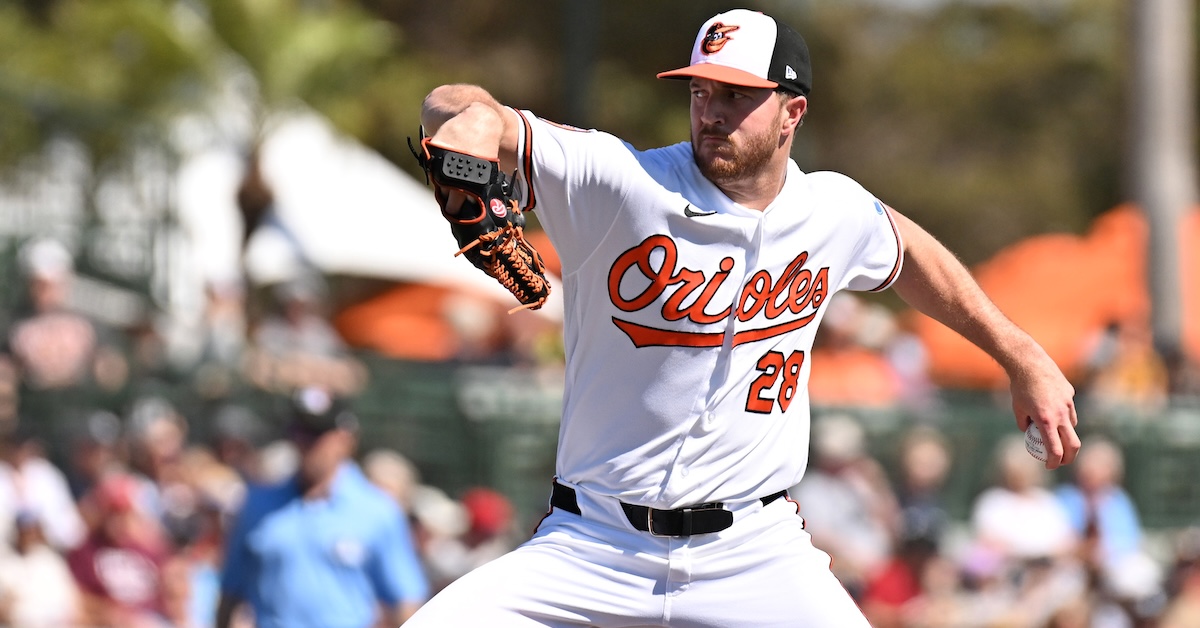
Last week, I did a radio hit in Baltimore to talk about the Orioles’ five-year extension for right-handed starter Shane Baz. As you might expect, I got asked for my general impressions of the Orioles’ rotation, and I gave an answer I did not expect to be controversial: I like Baltimore’s rotation, and I’m quite fond of Trevor Rogers and Kyle Bradish, the top two starting pitchers. That said, the Orioles don’t have a clear no. 1-quality starter, which could end up as a weakness in a playoff series.
“Ace” and its synonyms are fuzzy in meaning, so I’ll define my terms as clearly as I can: I meant that the Orioles don’t have a starting pitcher who can be expected to go up against one of the top pitchers in the league and fight him to a draw for six innings. I’ll give an example from last year’s World Series: I think Yoshinobu Yamamoto is a better pitcher than Kevin Gausman — and sure enough, Yamamoto beat Gausman twice in as many attempts — but the difference isn’t so great that you’d be able to tell over one start.
I got some pushback on social media — some of it quite intense — from Orioles fans who like their chances with Rogers against Tarik Skubal. Every sports fan thinks they’re the center of the universe these days, and accordingly that everything about their team is better than the biased national media will give them credit for. (Except White Sox and Twins fans, who think everything about their team is even worse than the biased national media realizes.) Even if that weren’t true, I would ordinarily never admit to treating randos on X, the Everything App, like an assignment editor. That way lies madness. Read the rest of this entry »