Archive for Teams

Atlanta’s Risky Rotation Imperils the Team’s Comeback Arc

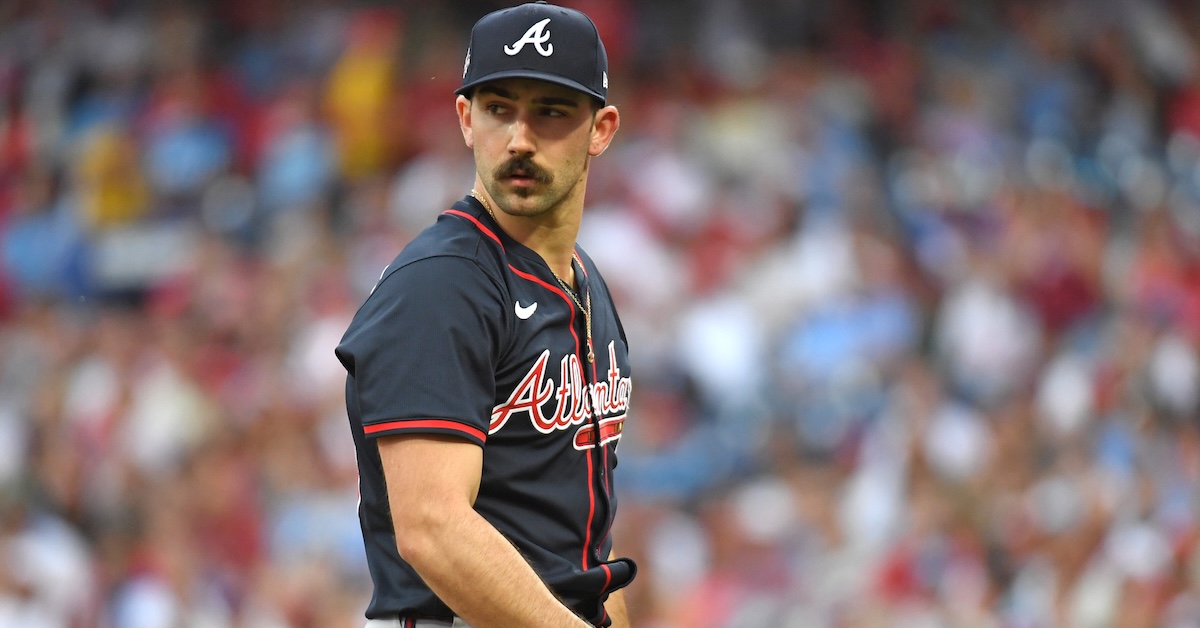
Robert Edwards and Dale Zanine-Imagn Images

The Atlanta Braves opened spring training with the hopes of getting a healthier season out of their starting rotation this year. While it took a lot of things going wrong to drop the Braves to a 76-86 record in 2025, their worst record since 2017, the myriad injuries suffered by the starting pitching played an outsized role in their misfortune. Unfortunately, the Braves didn’t even get to the first exhibition game before the news broke that two of their starting pitchers, Spencer Schwellenbach and Hurston Waldrep, would have to undergo elbow surgery, with no estimated timeline for their returns.

If there’s a silver lining to manager Walt Weiss’s uncertainty about whether either Schwellenbach or Waldrep would pitch this year, it’s that neither surgery is of the Tommy John flavor, which would pretty much guarantee that both would miss the entire season. Instead, both surgeries are to remove loose bodies from their throwing elbows; Schwellenbach had his procedure on Wednesday, while Waldrep’s is scheduled for Monday. Yes, removing loose bodies sounds like the job description of a bouncer at a hot nightclub, but in this case it refers to the removal of small fragments of bone and cartilage present in the joint.

Regardless, both pitchers are bound to be out for an extended period of time, and their absences will surely be felt in Atlanta. Waldrep was solid for the Braves in 2025, putting up a 3.21 FIP in nine starts, and Schwellenbach looked well on target for a 4-WAR season before an elbow fracture ended his season in late June. Read the rest of this entry »


In Limbo: A Post-Prospect Look at Kristian Campbell

John Jones-Imagn Images

We’re putting a bow on Prospect Week with a post-hype look at one of last season’s top farmhands, Kristian Campbell. This time last year, Campbell was the biggest riser on prospect lists across the industry, a consensus top 10 player who had gone from relative obscurity to the cusp of the big leagues in just a year. Now, as we head into the spring’s first contests, he’s fallen out of the lineup and is likely to begin the 2026 season in Triple-A. His career path serves as a good reminder that growth isn’t linear, and that a player’s development path doesn’t conclude when he reaches the majors or exhausts his status as a rookie.

After playing just one season of college baseball, Boston selected Campbell in the fourth round of the 2023 draft as a toolsy player with contact skill but also a quirky, choppy swing. He put on 15-20 pounds of muscle that offseason, which helped spark an offensive explosion. His power shot from average to plus overnight, and he started lifting the ball more, both of which he managed without ballooning his whiff rates out of proportion. He posted a 178 wRC+ across three levels that season, with 20 homers and a sub-20% strikeout rate. Though little about his operation in the box looked conventional, plenty of evaluators — including, critically, the Red Sox brass — fully bought in. The Red Sox put Campbell on the Opening Day roster and then inked him to an eight-year, $60 million extension less than a week into the season.

Initially, all went well. Campbell won AL Rookie of the Month honors in April after hitting .301/.407/.495 with four homers. His strikeout rate crept north of 25%, which wasn’t itself alarming, as it came with power and a 15% walk rate; it’s perfectly normal for rookies to swing and miss a bunch as they adjust to the league anyway. Defensively, Campbell was primarily playing second base while also filling in left and center. He didn’t look great at the keystone, and the jury was still out on his long-term defensive home, but if nothing else, his versatility was itself a boost for the ballclub.

On April 30, Campbell went 0-4 in a game against the Blue Jays, and then missed the next three games with rib discomfort. We can’t know to what extent that injury bothered him. Campbell, for his part, said it wasn’t an issue by late May: “No. That’s all clear. There was just a little side discomfort, but it’s all good.” Regardless, it was a turning point in his season:

April Flowers and May Showers
BA OBP Slugging K% BB% ISO wRC+
March-April .301 .407 .495 26% 15.4% .194 150
May-June .159 .243 .222 28.5% 7.1% .063 30

By mid-June, the Red Sox had seen enough and sent Campbell to Triple-A for the remainder of the season. Critically, his dip in production coincided with a sudden and complete inability to pull the ball.

April:

May:

Campbell wasn’t mauling good velo over the Green Monster even in April, but he did hit some heaters hard to the left of second base and had no trouble driving spin out to left. He got back to that in Triple-A, though somewhat troublingly all of his pull-side damage came on hanging breaking balls. As Campbell gutted through an unspectacular summer in Worcester — 118 wRC+, 26.7% strikeout rate — the Red Sox lineup hummed without him. A mix of players capably filled in at second, Romy Gonzalez most notably among them, while Boston had more good outfielders than room to play them. All over the headlines in March and April, Campbell ended the 2025 campaign a forgotten man.

Even at his peak, Campbell was a somewhat divisive player. While some scouts were willing to overlook his unorthodox swing, others were apprehensive about his mechanics. He had a double toe tap and then a big front hip leak that worked in part because he has huge hip-shoulder separation and was able to keep from flying open even as his lower half crept toward third base. The upper half was also concerning for some evaluators, as Campbell’s violent and rotational hack came with a lot of head movement and often left him off balance. Plus bat speed and good hand-eye coordination helped, but not everybody loved what they saw.

Having literally bought the breakout, it’s fair to wonder if Boston is now taking the collapse at face value as well. There are signs, if you want to look at it that way. The Red Sox sent Campbell to winter ball this offseason, hoping that quieter movements in the box will again let him get to his power. Between those adjustments, the trade for Caleb Durbin, and unsettled defensive plans that initially seemed to focus on the outfield but then made room for him to take groundballs once back in camp (all of this just a few months removed from when he started working in at first base), you’d be forgiven for thinking that he’s not in the club’s immediate plans. Fair enough, given last season’s production and this season’s lineup.

But all of the tinkering raises more questions than it answers. Were Campbell’s struggles last May and June really the inevitable result of an unconventional swing? Is it possible that the league’s adjustments to the young upstart, possibly combined with a nagging rib issue, did a number on a rookie already shouldering a difficult defensive load after very little collegiate and minor-league seasoning? You can make arguments for, against, or in between on those questions; the guy is in limbo, after all.

Last year, just after Campbell’s demotion, Eric wrote, “I, like most everyone, entered 2025 convinced that this weirdo swing would work for Campbell even though it’s unconventional. Though he was demoted shortly before [list] publication, I still think it will… two years ago, this guy was playing in his lone college baseball season and now he’s facing the best pitchers in the world. He deserves time to adjust and hopefully get stronger so it doesn’t take his entire body winding up for him to swing hard.”

I’ll sign on to that idea, and the comment about increased strength in particular. It’s a long season, and all the moving parts in Campbell’s swing mean that a minor disruption to one area of the body might just throw off the whole operation; having the strength to withstand the rigors of the schedule is important for everyone, but perhaps him especially. And let’s not lose sight of the talent here. However unusual, Campbell’s bat speed, short swing, and good approach were, for a time, effective. The history of this sport is full of guys who went the other way with fastballs and tugged breaking balls, and for a month it looked like Campbell had found a way to follow those footsteps. I still think he can; whether or not he will is for us to find out.


Mitch Garver Returns to Seattle

Steven Bisig-Imagn Images

On Wednesday, catcher Mitch Garver agreed to a minor league deal to remain with the Mariners in 2026. He reported to camp for a physical on Thursday, and should he make the major league roster, he’ll earn a prorated $2.55 million for any time he spends with the big club. Because of his veteran status, Garver will have the ability to opt out and look for a job elsewhere, in late March, on May 1, or June 1 if he remains in the minors. We don’t often devote entire articles to minor league deals, but I wanted to highlight this one, because the 35-year-old Garver has had such an interesting career and such a dramatic turnaround over the past two years.

A bit over two years ago, Garver signed a very different contract with Seattle. It was a two-year deal for $24 million, nearly five times as much per year as his new one. He was coming off a 2023 season in which he launched 19 home runs and finished with a 142 wRC+ despite an April knee sprain that knocked him out for more than two months. It was just the 18th time this century a catcher that had put up such a good offensive line over at least 300 plate appearances, and it wasn’t even Garver’s best season. He debuted at age 26 in 2017, and over the first seven years of his career, he ran a 124 wRC+. If you go to our leaderboards and rank catchers through their age-32 seasons, that mark ties him with Hall of Famer Gary Carter and Mickey Tettleton for 32nd all-time (just behind his teammate Cal Raleigh’s 126).

That’s not to say that Garver was on pace to be one of the best catchers ever. Thanks to a wide variety of injuries, he’d only reached 80 games played in a season three times. And because of both the injuries and his very poor defense, he’d spent more than 40% of his time at first base or DH. Despite being one of the best hitting catchers in the game, he had just 8.3 WAR to his name. Still, the bat was so undeniable that he became the first non-pitcher Jerry Dipoto had ever signed to a multi-year contract while leading the Mariners. The move carried risk, but that risk was about whether Garver would stay healthy, about whether his bat would play up enough if, as expected, he spent the vast majority of his time as a DH. Read the rest of this entry »


Logan Webb’s Backwards Sweeper

Neville E. Guard-Imagn Images

I’ve been playing around with the new FanGraphs Lab tools a lot recently. At first, it was bug testing, but it pretty quickly turned into fun. One minute, you’re making sure that sliders show up correctly. Next minute, you’re wondering about Logan Webb’s backwards slider. See, Webb throws a big-bending sweeper instead of a gyro slider, but it doesn’t behave at all how you’d expect: It’s good against lefties and bad against righties.

In 2025, Webb put up 5.5 WAR, a career-high mark and his fifth straight season of four or more wins. He used his sweeper a lot to get there. Webb was one of the most frequent right-on-left sweeper users in the majors, and also one of the best. Measured by run value added per 100 pitches, he was 11th in baseball among all righties who threw even 100 such sweepers – and he threw 400 of them. He was 15th in whiff rate for good measure. He was as effective as Paul Skenes was in this situation while going to the pitch three times as often.

But while he was lights out with the pitch against lefties, it fared quite poorly against righties. He was below average, and by a lot. Ninety-one pitchers threw 100 or more right-right sweepers; Webb finished 75th in run value added (or lost, in this case) per 100 pitches. While the league gets about 25% more whiffs with the platoon advantage, his whiff rate with his sweeper was the same against righties and lefties. This all sounds very strange. But when I dug into it, I got some answers. Read the rest of this entry »


Can Justin Crawford Get off the Ground, and Stay off the Ground?

Kim Klement Neitzel-Imagn Images

I’m of the opinion that you usually don’t learn much from watching spring training. It’s glorified practice, with inconsistent quality of competition even before you consider the fact that some guys are going all-out while others are working on a specific issue rather than trying to win the game. This is especially true for position players who came into camp with at least an inside track on a starting job. It’s why I pay more attention to college baseball during February and March. Hell, the new season of Love Is Blind is out and I need to catch up so I can see if there are any ex-college ballplayers in the cast.

One exception to the rule that you don’t learn much from spring training: Justin Crawford. Read the rest of this entry »


Effectively Wild Episode 2442: Season Preview Series: Tigers and Athletics

EWFI
Ben Lindbergh and Meg Rowley banter about a generous podcast listener, Bruce Meyer’s elevation to interim executive director of the MLBPA, his framing of the sport’s competitive challenges, media messaging vis-à-vis the owners’ and players’ potential responsibility for missed games in 2027, and the creep of pitch-calling from the dugout, then preview the 2026 Detroit Tigers (53:35) with The Athletic’s Cody Stavenhagen, and the 2026 Athletics (1:31:28) with A’s on SI’s Jason Burke.

Audio intro: Harold Walker, “Effectively Wild Theme
Audio interstitial 1: Liz Panella, “Effectively Wild Theme
Audio interstitial 2: Dave Armstrong and Mike Murray, “Effectively Wild Theme
Audio outro: Alex Ferrin, “Effectively Wild Theme

Link to Reddit comment
Link to “meatspace” explainer
Link to “meatbag” explainer
Link to Meyer comments 1
Link to Meyer comments 2
Link to BP on competitive balance
Link to Drellich on Meyer
Link to Passan on the MLBPA
Link to Crizer on dugout pitch-calling
Link to EW on 2025 dugout pitch-calling
Link to Bendix comments
Link to Giants pitch-calling article
Link to Vitello comments
Link to Rockies article
Link to Ben on in-game interviews
Link to team payrolls page
Link to Tigers offseason tracker
Link to Tigers depth chart
Link to catcher WAR leaderboard
Link to Cody’s author archive
Link to Cody’s podcast
Link to Athletics offseason tracker
Link to Athletics depth chart
Link to FG top 100
Link to Vegas promotions
Link to Sacramento jerseys
Link to Jason’s author archive

 Sponsor Us on Patreon
 Give a Gift Subscription
 Email Us: podcast@fangraphs.com
 Effectively Wild Subreddit
 Effectively Wild Wiki
 Apple Podcasts Feed 
 Spotify Feed
 YouTube Playlist
 Facebook Group
 Bluesky Account
 Twitter Account
 Get Our Merch!


Fun With Meaningless Splits: Half Edition

David Banks-Imagn Images

“I will start with the easy answer:” wrote Jeff Zimmerman back in 2014. The next part was bolded: “No, first and second half stats are not as important as the entire season for pitchers and hitters.” Jeff was talking about fantasy baseball, and whether you should consider a particularly strong or weak second half more relevant to a player’s future performance, but the lesson was clear. Overall stats tell you a lot more about a player than half a season of stats.

The same lesson is true over the course of a career. Since 1933, the year of the first All-Star Game, Stathead says that 2,146 players have made at least 900 career plate appearances in both the first half and the second half. Just under 93% of those players have a second half OPS that’s within 10% of their first half OPS. (We’re using percentages here rather than raw points in order to create a level playing field for players of varying skill levels. I calculated them by subtracting each player’s first half OPS from their second half OPS, then dividing the difference by their first half OPS.) Only 15 players – again, that’s 15 players out of a sample of 2,146 – saw their second half OPS differ from their first half OPS by more than 20%.

All of this makes sense. There’s no reason that a batter should be consistently better at the beginning or end of the season. As Eno Sarris once reminded us, seasons themselves are arbitrary endpoints. Most of the 15 outliers I mentioned in the previous paragraph are the results of short, noisy samples, either because they had short careers or they’re still in the early stages of their career right now. The longer your career, the more likely that your true talent level will shine through, regardless of the date on the calendar. Read the rest of this entry »


Pablo López Probably Needs a New Elbow

Peter Aiken-Imagn Images

We know the steps to the annual spring dance by now: Pitcher appears for spring training, pitcher suffers minor injury or discomfort during practice, America holds its collective breath and hopes that barking elbow will just resolve itself.

Unfortunately, that hope is all too rarely vindicated, as imaging quickly confirms said pitcher has torn an essential bit of connective tissue.

The Twins speed-ran this dance this week with their no. 1 starter, Pablo López. The veteran right-hander cut short a bullpen session on Monday after feeling soreness in his elbow. Minnesota GM Jeremy Zoll announced Tuesday that López had torn an elbow ligament and that season-ending surgery was “very much on the table.” Read the rest of this entry »


Daylight Guys: Prospects We Disagree About

Junfu Han-USA TODAY NETWORK via Imagn Images and Mark J. Rebilas-Imagn Images

No two scouts or evaluators are going to agree on everything, and we’re no exception. We get asked all the time about who liked which player more, or who was more lukewarm on this guy versus that one — not to mention the steady stream of “Outlet A ranked Player B here, but you had him there, what gives?” questions that populate our chats. These are especially compelling and relevant inquiries this time of year, because inevitably we had to resolve a degree of disagreement as we compiled our list of the Top 100 prospects in baseball.

This year, we’ve decided to address those questions head on. Throughout our list-building process, we came to similar, or similar enough, conclusions about most players. Oftentimes Eric was a tick higher on one player here, or Brendan the high man there, and usually a quick back and forth was enough to bridge any gaps. In a couple cases though, we didn’t reach consensus. There were a handful of players that Brendan was happy to rank, but Eric would have preferred to leave off, and vice versa. We think offering a peek into those discussions will prove insightful for readers. These back and forths highlight the types of players who are generally more difficult to evaluate, as well as the metrics and scouting practices that guide decision-making when you have to make a call one way or the other. Through it all, we hope you’ll arrive at a conclusion that most scouts and analysts eventually reach: That spirited debate is a healthy part of the evaluative process, and disagreements without clean resolution are occasionally the cost of doing business in an uncertain world.

Kendry Chourio, RHP, Kansas City Royals

Brendan: Let’s start with a pitcher who ultimately didn’t make our list. I never caught Kendry Chourio live, but I adored his stuff when I put on the tape. He throws hard, I see a path to a plus curve and changeup, and he’s advanced for someone who played all of last season as a 17-year-old. The Royals rightly promoted him off of the Dominican complex, and then he dominated in Arizona to the point that he actually wound up in Low-A down the stretch. And you can see why: For his age, his ability to command the ball and execute his secondaries stands out immediately. His line – 51.1 innings, 63 strikeouts, 0.95 WHIP, just five walks – was incredible. I think we both agree that there are a lot of good things going on here. Can you elaborate on why you were still a little skeptical of him when it came time to build the list? Read the rest of this entry »


Arizona Diamondbacks Top Prospect Ryan Waldschmidt Is a Student of the Art of Hitting

Jordan Prather-USA TODAY Sports

Ryan Waldschmidt is ranked 35th on our newly-released 2026 Top 100 Prospects list, and his right-handed stroke is a big reason why. Along with assigning him a 50 FV, our prospect team wrote that the 23-year-old outfielder in the Arizona Diamondbacks system “does just about everything you want at the plate and he looks the part of a bat-first future regular in the box.” Drafted 31st overall in 2024 out of the University of Kentucky, Waldschmidt is coming off of a 2025 season in which he put up a .289/.419/.473 slash line with 18 home runs and a 142 wRC+ between High-A Hillsboro and Double-A Amarillo.

The way he goes about his craft differs somewhat from his contemporaries. Waldschmidt’s setup is unorthodox, and his swing isn’t exactly what you would draw up in the lab. When it comes to mechanics, the 6-foot-2, 215-pound Sarasota native isn’t a poster child for the science of hitting, but rather an advocate of the art of hitting. Fitting a paint-by-numbers mold isn’t his goal, squaring up baseballs is — and that’s precisely what he does. As evidenced by his track record and presence in the top half of our Top 100, Waldschmidt’s way works just fine.

Waldschmidt discussed his atypical hitting profile earlier this month.

———

David Laurila: Your hitting mechanics have been described as “low maintenance.” What does that mean to you, and how long have your mechanics been in place?

Ryan Waldschmidt: “Throughout my whole entire life, I’ve had a pretty similar variation of what I do now. I mean, there was a time when I was younger that I had a little bit of a pick-it-up, put-it-back-down stride. Once I got to college… my freshman year, I even had a stride at Charleston Southern. Then once I got to Kentucky [as a sophomore] is when I kind of tapped into the no-stride from my setup. Read the rest of this entry »