The Toronto Blue Jays have two of the best pitchers in baseball this season. Kevin Gausman possesses a 3.00 ERA and a 1.99 FIP to go with 116 strikeouts in 99 innings. Alek Manoah boasts a 2.24 ERA and a 3.34 FIP with 110 strikeouts in 120.2 innings. The latter pitched a scoreless inning in last week’s All-Star Game; the former, who surprisingly was not named to the squad, has arguably out-performed his teammate.
Each of the two garnered wins over the weekend. On Friday, Gausman ran his hard-luck record to 7–7, fanning 10 batters over five innings in Toronto’s 28–5 rout of the Red Sox at Fenway Park. On Saturday, Manoah allowed one run over six innings, striking out seven Boston batters along the way, to raise his record to 11–4.
On Sunday, I asked the right-handers about each other. In short, why is the other one of the best pitchers in baseball?
“I would say his character,” Manoah said of Gausman. “His character, his competitiveness, the way he goes about his work every day. He’s had his teeth punched out before, and he’s found ways to get back to the top. So I think his resilience is big. There’s also his ability to adjust from pitch to pitch, from lineup to lineup. He’s very strategic. Read the rest of this entry »
In what has been a relatively quiet July so far on the trade front, the Mets made two minor trades over the weekend, both with the Pirates. First, they picked up designated hitter Daniel Vogelbach in return for reliever Colin Holderman. In a separate transaction, Pittsburgh also sent catcher Michael Perez to Queens in return for the team’s favorite kind of player: cash.
As a power-and-walks hitter without much defensive value, Vogelbach was not a favorite of prospect-watchers, but the internet at least partially fell in love with him due to his Rubens-esque proportions. While his major league career hasn’t exactly resulted in any Large Adult MVP memes, he’s established himself in the big leagues as a power-hitting DH, albeit one with a fairly limited role. You don’t want him in a game against a left-handed pitcher, and ideally, you don’t want him standing in the field with a glove, either. If you need a part-time DH who can also come off the bench and ruin a right-handed reliever’s evening, though, then Vogelbach is your man. His .228/.338/.430 triple-slash in Pittsburgh is hardly eye-popping, but in 2022, that’s enough to get you a perfectly serviceable wRC+ of 118.
As a Met, Vogelbach’s line should look even better than that, as he’s joined a team that has less of a reason to let him face lefties. With an extremely thin roster, the Pirates started him 14 times against left-handed starters, about 40% of the time. They had no lefty-masher on hand to serve as a complement to Vogelbach, and when he wasn’t starting, they regularly turned to Yoshi Tsutsugo, another left-handed hitter, or used the position to rest other players. The Mets, on the other hand, are quite content to use J.D. Davis against lefties — he’s started all 35 games against them — and appear to have finally decided that his best position is DH. If Dominic Smith had been hitting at all, a trade like this would not have been necessary, but with a .560 OPS this year after last year’s .667, the team is basically at wits’ end when it comes to getting consistent production out of him. I’d actually be surprised if Smith is on the roster after the deadline, and at this point, a divorce may be best for both parties. Read the rest of this entry »
The trade deadline is nearly here and once again, team behavior will be affected by 40-man roster dynamics. Teams with an especially high number of currently-rostered players under contract for 2023 and prospects who need to be added to the 40-man in the offseason have what is often called a 40-man “crunch,” “overage,” or need to “churn.” This means the team has incentive to clear its overflow of players by either packaging several to acquire just one in return, or by trading for something the club can keep — international pool space, comp picks, or, more typically, younger players whose 40-man clocks are further from midnight — rather than do nothing and later lose some of those players to waivers or in the Rule 5 Draft. Teams can take care of this issue with transactions between the end of the season and the 40-man roster deadline in November, but a contending team with a crunch has more incentive to do something before the trade deadline so the results of those deals can bolster the club’s ability to reach the postseason.
In an effort to see whose depth might influence trade behavior, I assess teams’ 40-man futures every year. This exercise is done by using the RosterResource Depth Chart pages to examine current 40-man situations, subtracting pending free agents using the Team Payroll tab, and then weighing the December 2022 Rule 5 eligible prospects (or players who became eligible in past seasons and are having a strong year) to see which clubs have the biggest crunch coming. I then make an educated guess about which of those orgs might behave differently in the trade market as a result.
Some quick rules about 40-man rosters. Almost none of them contain exactly 40 players in-season because teams can add a player to the 40 to replace one who is on the 60-day injured list. In the offseason, teams don’t get extra spots for injured players and have to get down to 40 precisely, so if they want to keep some of their injury fill-ins, they have to cut someone else from the 40-man to make room. Read the rest of this entry »
Hunter Mense had some talented teammates during his relatively brief playing career. None were more talented than a teenager who went by one of his middle names. Now the assistant hitting coach for the Toronto Blue Jays, Mense played alongside Giancarlo Cruz Michael Stanton during their time together as Florida Marlins farmhands.
“I knew him as Mike,” Mense said of the the 2022 All-Star Game MVP, who began going by his given first name after reaching the big leagues. “I remember reading about, and him telling me that he could have played D1 basketball or D1 football. He looked more like a D1 football player than he’s ever looked like a baseball player.”
It goes without saying that the Brobdingnagian superstar is a stupendously good baseball player. According to Mense, who doubles as Toronto’s minor-league hitting coordinator, Stanton’s work ethic was off the charts. Wanting to improve defensively, the 6-foot-6, 245-pound outfielder would often “drag a coach out to the field” and have him hit balls in his dirction before batting practice.
With the All-Star break in the rear-view mirror, the eyes of the baseball world turn to the upcoming trade deadline, which is now less than two weeks away. Juan Soto’s sudden availability is dominating the headlines, pushing the rest of the field to the back burner with the focus on the possible blockbuster deal. Still, for the majority of teams who are priced out of the Soto sweepstakes, there’s no shortage of interesting trade candidates to go after over the next few weeks.
For teams looking for pitching help, the top option on the market is almost certainly Luis Castillo. A pair of shoulder injuries to the two other top targets has thrown a wrench into the market; Frankie Montas threw three innings yesterday in his first start since July 3, and Tyler Mahle is scheduled to make his first start off the IL on Sunday. It’s certainly possible either Montas or Mahle (or both) will be dealt in the next few weeks, but teams will understandably be more cautious with them.
Castillo dealt with his own shoulder injury this spring which held him back from making his season debut until May. He wasn’t all that sharp through his first four starts, but he’s turned it on since then, averaging more than six innings per start since and allowing just three total runs across his last four turns. During this recent hot streak, he’s struck out 33 batters (a 30.8% strikeout rate) in 27 innings. In his final start before the midseason break, Castillo held the Yankees to a single run in seven innings, allowing two hits and four walks and striking out eight.
Well known for his fantastic changeup, that pitch hasn’t been nearly as effective as it has been in the past. Over the first five seasons of his career, he ran a 41.2% whiff rate with the pitch, the fifth-highest whiff mark for a changeup during that period. This year, that has fallen to just 25.1%, a career low and the third year in a row it’s dropped. It’s still an effective pitch at limiting hard contact (.305 xwOBAcon), but batters simply aren’t swinging and missing at it as much as they used to.
To combat the slow decline of his changeup, Castillo has turned to his four-seam fastball, throwing his heater more often than his cambio for the first time since 2018:
It’s still a bit of a surprise to see him turn away from his changeup despite its lackluster results this year. That pitch has been such a dominant weapon for him, and he’s relied on it as his primary out pitch for the last three seasons. The biggest reason why he’s turned away from it, though, isn’t because of its loss of effectiveness; it’s because his four-seamer has been better than ever before. Read the rest of this entry »
In a race for a playoff spot, every edge matters. Yet all too often, for reasons that extend beyond a player’s statistics, managers and general managers fail to make the moves that could improve their teams, allowing subpar production to fester at the risk of smothering a club’s postseason hopes. In Baseball Prospectus’ 2007 book It Ain’t Over ‘Til It’s Over, I compiled a historical All-Star squad of ignominy, identifying players at each position whose performances had dragged their teams down in tight races: the Replacement-Level Killers. I’ve revisited the concept numerous times at multiple outlets and have presented it at FanGraphs in an expandedformatsince2018.
When it comes to defining replacement level play, we needn’t be slaves to exactitude. Any team that’s gotten less than 0.6 WAR from a position to this point — prorating to 1.0 over a full season — is considered fair game. Sometimes, acceptable or even above-average defense (which may depend upon which metric one uses) coupled with total ineptitude on offense is enough to flag a team. Sometimes a team may be well ahead of replacement level but has lost a key contributor to injury; sometimes the reverse is true, but the team hasn’t yet climbed above that first-cut threshold. As with Supreme Court Justice Potter Stewart’s definition of hardcore pornography, I know replacement level when I see it.
For this series, I’ll go around the diamond, pointing out the most egregious examples of potential Killers at each position among contenders, which I’ll define as teams who are above .500 or have playoff odds of at least 10.0%. That definition covers 17 teams, all of which have odds above 25% thanks to the new playoff structure (thanks for not saving me any work, Rob Manfred). And while I may mention potential trade targets, I’m less focused on these teams’ solutions than I am the problems, because hey, human nature.
This first installment will cover first basemen. All statistics within this piece are through July 20. Read the rest of this entry »
David and Ellen begin by discussing the All-Star Game and Home Run Derby, the controversial uniformity of the uniforms, mic’d up pitchers, and which Phillies were missing from the festivities. We also hear about Dick Allen’s absence from the Hall of Fame, how the Phillies have changed course following the firing of Joe Girardi, and the inner conflict associated with still rooting for a player that has been traded away. Finally, the duo opens a fresh pack of baseball cards and discusses players such as Darick Hall, Bryce Harper, Matt Vierling, and “Big Ed” Delahanty.
To purchase a FanGraphs membership for yourself or as a gift, click here.
To donate to FanGraphs and help us keep things running, click here.
Don’t hesitate to direct pod-related correspondence to @dhhiggins on Twitter.
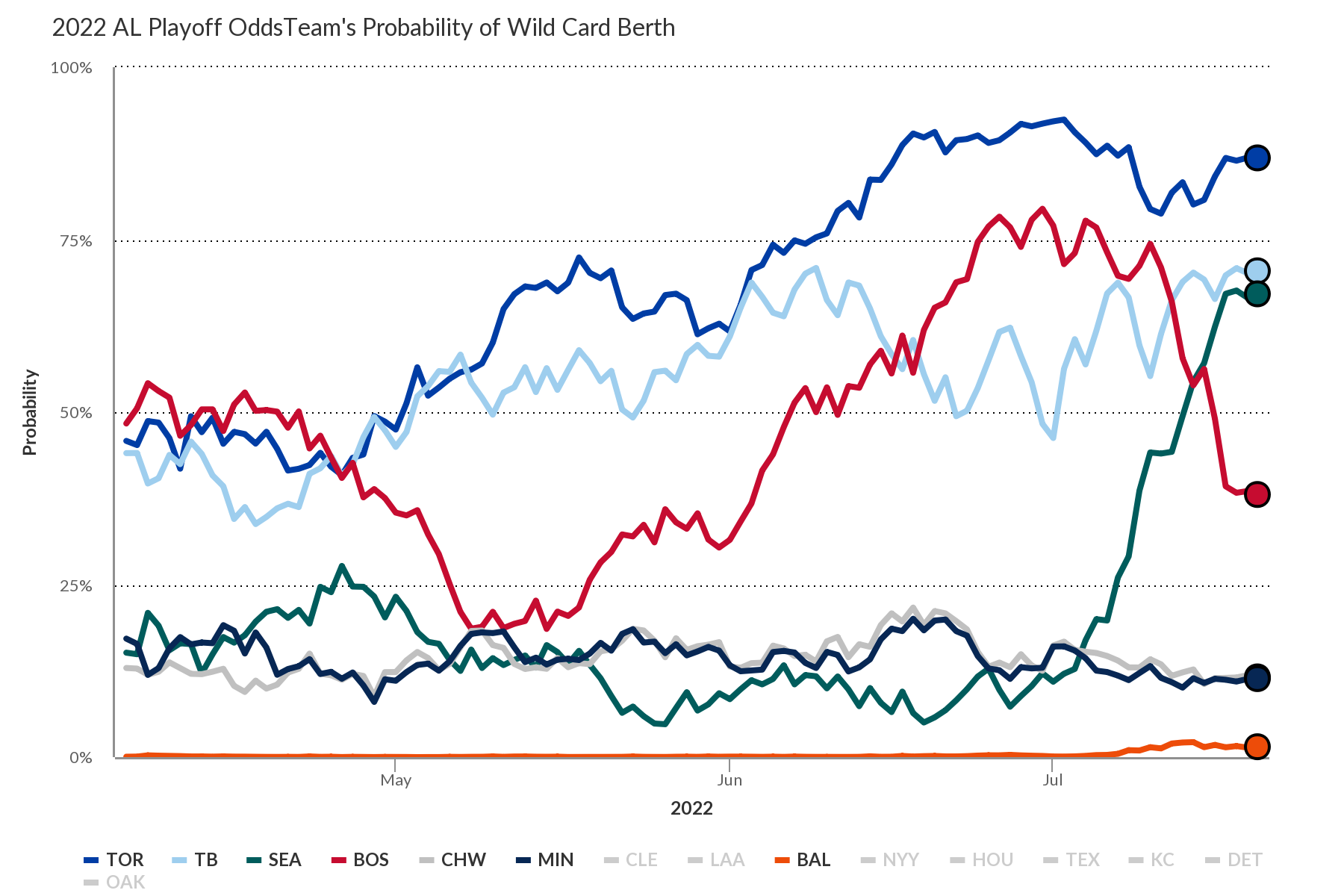
After taking their quest to end their 20-year playoff drought down to the final day of the 2021 season, the Mariners had high hopes for this year, but they mostly sputtered during the first two and a half months of the season, squandering an 11-6 start with separate 1-10 and 2-8 skids. Since June 19, when they were 10 games under .500, they’ve caught fire, winning 22 out of 25 games and entering the All-Star break riding a 14-game winning streak, one that has pushed them into the second American League Wild Card slot with a 51-42 record.
The Mariners aren’t the only AL team that will start the second half with renewed optimism. The Orioles, who have lost at least 108 games in a season three times since 2016, their last season above .500, and appeared headed for another triple-digit loss total through the first quarter of the season, went on a 10-game winning streak starting on July 3, briefly nosing them above .500 for the first time this year. They entered the break 46-46, tied with the White Sox at 3.5 games out of the third Wild Card spot.
The two teams have surged while the Blue Jays and Red Sox have stumbled. While Toronto is still clinging to that last Wild Card spot, at the very least the race has become a four-team fight instead of simply a three-team one, with the AL Central’s second- and third-place teams (the Guardians are only two games behind the Twins, the White Sox three) lurking in the weeds as well, and the Orioles at least showing a pulse. A picture is worth a thousand words:
Matt Vierling has been a versatile player for the Philadelphia Phillies this season. Primarily a center fielder, the 25-year-old University of Notre Dame product has also seen action in the outfield corners, as well as at first, second, and third base. He’s also capable with the bat. While not yet fully established against big league pitching, Vierling has a 95 wRC+ in 229 plate appearances with the NL East club, plus the potential to produce at a higher level as he matures.
Vierling discussed his simple-meets-cerebral approach, and how he’s evolved since entering pro ball as fifth-round draft pick four years ago, during spring training.
———
David Laurila: Let’s start with one of my favorite Talks Hitting openers. Do you approach hitting as more of an art, or as more of a science?
Matt Vierling: “I would lean more towards art, although I see both sides. It’s definitely science with the mechanics; if you don’t make the right swing, there’s a mechanical reason why. But when you’re up there and in the flow of things, it’s more like an art. I’d have to lean more in that direction.”
Laurila: This is maybe a hard question to answer, but how would you describe your art?
Vierling: “That is a hard one. I guess it would be being in rhythm — a lot of rhythm and a lot of timing. It’s not so much dancing with the pitcher, but kind of just being in his rhythm, being on time with him.” Read the rest of this entry »
Ty France was named to the American League All-Star team this past Sunday. Added when Mike Trout bowed out due to injury, the Seattle Mariners first baseman didn’t simply merit the honor, his addition was overdue. Statistically the best hitter on baseball’s hottest team — 14 straight wins heading into the break! — France is slashing .308/.376/.470, with club-bests in both wOBA (.369) and wRC+ (148).
He’s not a flash in the pan. A 34th-round pick by the San Diego Padres in 2015 out of San Diego State University, France has long shown an ability to square up baseballs. A .300/.388/.463 hitter over all professional levels, all he’s really needed was the opportunity.
“That’s really all it is,” France said prior to a game at Fenway Park in late May. “Honestly, it’s being able to play every day — being in the lineup and getting those consistent reps — more than anything else. This game is a lot of ups and downs, and the more comfortable you can be, the more you’re going to find yourself in a good spot.” Read the rest of this entry »