Archive for Teams

Domingo German Is Finding Consistency

The Yankees haven’t been able to catch many breaks to start the season. They have an insalubrious number of starters on the injured list with everything from a small labrum tear, to a strained oblique, to a left biceps strain, to a left ankle injury, to a grade 2 lat strain. Despite all that, the team itself, at least when it comes to the standings, isn’t doing badly. They just won nine out of their previous 10 games and are one and a half games back from the Tampa Bay Rays. As of April 29, the Yankees are currently tied with the Astros for the fifth-best winning percentage in the majors (.607).

In the middle of all that is Domingo German, who’s off to a stellar start. We at FanGraphs have noted his talent before, citing his arsenal, his ability to throw strikes, get whiffs, and more. We’re talking about a guy who can make hitters look like this:

Or like this:

But his 2018 left a lot of questions about his future. As a 26-year old, German put up a 5.57 ERA and a 4.39 FIP in 85.2 IP across 21 games (14 starts). True, there were some encouraging numbers — a 27.2% strikeout rate and 14.9% swinging strike rate, for instance — but the Yankees had to have hoped for more. Read the rest of this entry »


Tyler Glasnow on Embracing (and Controlling) the Cut

Tyler Glasnow has a plus fastball — a somewhat-unique plus fastball — and he relies on it heavily. The Tampa Bay Rays righty is throwing it 66% of the time, the fourth-highest rate among qualified pitchers. A four-seamer delivered from Glasnow’s towering 6-foot-8 frame, the offering has an average velocity of 96.6 mph. It’s the pitch you’re going to read about here.

When I approached him on Saturday, I’d actually been thinking about his changeup. While it’s a pitch Glasnow throws infrequently, the always-insightful Daniel Russell wrote about it recently at Drays Bay, and I was intrigued. When I’d spoken to Glasnow last August, we talked primary breaking balls; his seldom-used change-of-pace wasn’t even mentioned.

Glasnow threw me a changeup on Saturday. When I suggested it as a topic, he said we should talk about his fastball instead, for the aforementioned reason: he rarely throws his changeup.

The following day, Glasnow threw nine of them in a dominating performance against the Red Sox at Fenway Park. That’s as many changeups as he’d thrown in his first five starts combined; hence his subterfuge. It was part of the plan going in.

Is it also his plan going forward? I asked that question following the game. Read the rest of this entry »


Guessing the Fate of April’s Underachieving Hitters

For the first month of every baseball season, I’m a bit notorious for simply answering “April” as the convenient, one-stop-shop for questions relating to why someone’s favorite player is hitting .150. Once we start heading into May, telling people to be patient when 1/6th of the season is already over becomes an increasingly unujustifiable task. While rebuilding teams are in a place at which they can be patient, avoiding judgment is tricky for contenders, especially when every division leader is in first place by fewer than three games.

So let’s get out the guillotine and guess who can be saved and who is a lost cause.

Ryan Braun, Milwaukee Brewers

I remain quite torn about the state of doneness of the Hebrew Hammer. On one hand, he can still hit the ball with authority as seen by the fact that his average exit velocity, dipping under 90 mph, isn’t all that different from the numbers in 2016 and 2017, years in which Braun was still a contributor offensively. If you dig deeper into his pitch-by-pitch stats, Braun appears to be going dead-red for fastballs, and despite a career-low contact rate, he is actually making contact with fastballs at better-than-career-average rates (14.6% whiff/swing rate in 2019 vs. 19.8% career). But other than fastballs, he’s making much worse contact, missing almost half the changeups and sliders he’s offered at (career rate under 30%).

It makes me wonder about Braun’s bat speed. To my naked eye, it looks like he’s trying to compensate for decreased bat speed by making contact with his bread-and-butter pitch (Braun was one of the best fastball hitters in baseball in his prime). He also suggested he was changing his swing in order to hit more home runs. It’s unfortunate that swing speed isn’t one of the things you can get easily, but Alex Chamberlain identified stats that correlate with swing speed when reverse-engineering the scanty data available a few years ago. Isolated power, xwOBA, and contact rate all have a relationship, and in each of the three, Braun is at his career’s nadir.

I think there’s still hope for Braun, but if his bat is slowing down, I wonder if he’s taking the wrong approach in trying to hit for more power. A player with slower bat speed but who is also pulling the ball more (57% compared to 38% career) seems like one trying to cheat on the fastballs. I don’t think Braun’s as doomed as some on this list, but I think that he’d be better off not trying to capture his early-career power because it’s making him a one-dimensional hitter. Read the rest of this entry »


Victor Robles Can’t Stop, Won’t Stop Bunting

2018 wasn’t supposed to be the year of Juan Soto in Washington. It was supposed to be the year of Victor Robles. Robles, the consensus No. 1 outfield prospect in the Nats system and probably the No. 2 outfield prospect in all of baseball behind Ronald Acuña, was ready for the majors. Only a hyperextended elbow kept Robles from making an impact in the majors last year, but in abbreviated playing time in August and September, he looked like he was making up for lost time (.288/.348/.525, 131 wRC+).

Robles’ 2019 hasn’t been quite as impressive, but you can see in his performance why he’s such an exciting talent. Even while running a 30.5% strikeout rate and walking only 4.8% of the time, Robles has put up a league-average batting line (.265/.308/.480, 102 wRC+). Watch Robles play, and you can immediately see what the hype is about. He’s electric both at the plate and in the field. With all that said, I’m not here today to talk to you about Robles’ tremendous potential or his jaw-dropping athleticism. I’m here for the bunts.

Victor Robles leads the major leagues in bunt singles this year (he’s actually tied for the lead with teammate Adam Eaton). It’s a good thing, too, because he’s also first in bunts (fair balls that were bunted — it’s hard to get a good count of foul bunt attempts). If that seems weird to you, you’re not alone. We’re talking about a guy with non-negligible power — the FanGraphs prospect team graded him at 50 raw power this offseason. He has four home runs so far this year, and he ran a .157 ISO in the minor leagues, which isn’t Joey Gallo level or anything, but is certainly not poor.

Take a look at this list of players with the most bunts per plate appearance since 2017, Robles’ first playing time in the majors. I liberally filtered out pitchers and people with less playing time than Robles:

Frequent Bunters, 2017-2019
Player Bunt/PA Career ISO
Magneuris Sierra 9.1% .014
Delino DeShields 7.5% .097
Alejandro De Aza 7.2% .136
Carlos Tocci 6.7% .058
Hanser Alberto 6.2% .044
Victor Robles 6.2% .221
Garrett Hampson 5.7% .108
Jarrod Dyson 5.7% .095
Roman Quinn 5.3% .113
Andrew Stevenson 5.1% .051

Robles sticks out like a sore thumb on this list. Magneuris Sierra literally had a zero ISO in 64 plate appearances in 2017. He’s never hit more than four home runs in a season, minors or majors. Delino DeShields hit six home runs in 440 plate appearances in the bigs — once. Robles has four this year already. Depth Charts projects him for another 11 over the balance of the year. Heck, he had three homers in 66 PA last year when he was called up. Maybe he’s not a power hitter, but he’s certainly not a slap hitter either. What’s up with the love for bunts? Read the rest of this entry »


Kris Bryant May Have Turned the Corner

The past weekend was a very good one for Kris Bryant. While helping the Cubs take two games out of three in Arizona, he sandwiched his second and third home runs of the season around a rally-sparking double. It’s the first time in nearly a year that the former MVP has connected for extra-base hits in three straight games, and after a season marred by left shoulder woes, a possible sign that his power is returning.

Facing the Diamondbacks’ Robbie Ray in the third inning on Friday night, Bryant hammered a 3-2 fastball over the left centerfield wall for a two-run homer:

The home run went an estimated 444 feet and had an exit velocity of 111.1 mph according to Statcast, making it Bryant’s hardest-hit homer since July 16, 2017 (113.0 mph off Ubaldo Jimenez). It’s also the third ball this year that Bryant has hit with an exit velocity of at least 110 mph, two more than all of last season, the least productive of his career.

Bryant’s second homer, a two-run opposite field shot off Luke Weaver, was less majestic (102.0 mph and an estimated 374 feet), but every bit as necessary in the Cubs’ 15-inning, 6-5 win:

The last time Bryant collected extra-base hits in three straight games was May 16-19 of last year, the last a date that figures prominently in our story. He had just two other streaks running at least that long in 2018, compared to six in each of the previous two seasons.

To review: from 2015-17, Bryant was one of the majors’ top players, batting .288/.388/.527; his slugging percentage and 94 homers both ranked 16th in the majors, while his 144 wRC+ ranked 12th, and his 20.6 WAR was third behind only Mike Trout (25.8) and Josh Donaldson (21.8). During that time, he won the NL Rookie of the Year and an MVP award, and helped the Cubs to three straight postseason appearances, including their first championship since 1908.

The first seven weeks of 2018 surpassed even that high standard (.305/.427/.583, 169 wRC+, eight homers), but Bryant’s production took a downturn after suffering a bone bruise in his left shoulder, which is believed to have happened when he slid headfirst into first base (!) on May 19 (not the first time he’s injured himself in such fashion). Though it would be just over a month before he went on the disabled list for the first of two stays totaling 57 days, he hit just .252/.338/.382 (96 wRC+) with five homers in 272 PA from May 20 onward, decidedly non-Bryant-like numbers. By Dr. Mike Tanner’s calculations, from the point of that May 19 date, Bryant’s exit velocity dipped by five miles per hour, and his average fly ball distance decreased by 28 feet.

After rest and rehab for his shoulder, Bryant declared in February, “I’m back to who I am,” but until he got to Arizona, his power and overall production had been similarly meager (.232/.364/.366, 102 wRC+). Even now, his .229/.353/.417 (108 wRC+) line isn’t particularly robust. He’s walking more often relative to last year’s overall numbers (12.1%, up from 10.5%) while suffering a fall-off in batting average on balls in play (.264, down from .342). His exit velocity — never his strong suit despite his power — is up relative to last year, but so is his groundball rate:

Kris Bryant via Statcast
Season GB/FB GB% FB% EV LA Hard Hit%
2015 0.76 34.2% 45.2% 89.6 19.4 43.3
2016 0.67 30.5% 45.8% 89.3 20.9 38.9
2017 0.89 37.7% 42.4% 87.1 16.9 36.4
2018 0.84 34.0% 40.7% 85.8 17.7 33.5
2019 1.00 40.0% 41.3% 88.8 16.7 34.7
SOURCE: Baseball Savant

Thus far in 2019, Bryant has produced 75 batted balls, five short of the point where the stat starts to stabilize, so we can’t make definitive assertions, but one thing that stands out is that while his pull rate is about the same as last year, an increasing percentage of those pulled balls have been grounders, which are far less productive than pulled fly balls:

Kris Bryant When Pulling the Ball
Season BBE Pull% wOBA Pull-GB% wOBA Pull-FB% wOBA
2015 365 41.6% .596 21.4% .246 9.0% 1.095
2016 452 46.7% .579 20.4% .193 13.9% .969
2017 427 41.2% .542 23.9% .211 7.5% 1.086
2018 285 48.1% .503 24.6% .222 9.5% .936
2019 75 46.7% .297 30.7% .097 5.3% .494

Even when Bryant does pull fly balls, he’s not getting typical results, though since we can literally count those times on one hand thus far — four of them according to our splits, which are based on Sports Info Solution data, but only three via Statcast’s data — that’s less important than the sheer drop in frequency. That two of those pulled fly balls were in Arizona, namely the homer off Ray and Sunday’s sacrifice fly off Matt Andriese, may be a sign he’s coming around.

Bryant has gone to the opposite field with more frequency and productivity than before, at least in the air, though it hasn’t come close to matching his results when he pulls the ball:

Kris Bryant When Going Oppo
Season BBE Oppo% wOBA Oppo-GB% wOBA Oppo-FB% wOBA
2015 365 23.8% .330 3.0% .320 18.4% .279
2016 452 19.7% .174 2.0% .293 14.4% .090
2017 427 22.5% .280 2.6% .239 17.3% .192
2018 285 20.0% .303 3.9% .273 11.9% .195
2019 75 32.0% .406 5.3% .219 24.0% .425

A few weeks ago, The Athletic’s Sahadev Sharma noted that Bryant’s mechanics were out of whack, quoting scouts describing him as “lunging,” with one saying, “He’s falling all over the plate.” Via Sharma, from the start of 2016 to the day of the aforementioned shoulder injury, Bryant had slugged .731 on pitches Statcast defines as being over the heart of the plate (I get .728 using the same parameters). For the remainder of the 2018 season through April 25, the point prior to the Arizona series, he slugged just .474 on such pitches. With this weekend’s pair of homers, he raised that nearly-yearlong figure to .514; separating his full 2018 and ’19 seasons, the numbers are .558 and .615, respectively.

Beyond that, while he whiffed on 3.4% of such pitches last year, he’s up to 4.8% this year, 0.1% off the career high from his rookie season, before he successfully tamed his swing, but only one of this year’s 21 swings and misses from the heart of the plate has taken place since April 19, yet another good sign.

It would be premature to say that Bryant is back to where he was as a hitter, and it’s probably worth noting that even with Chase Field’s humidor in place, fly balls are traveling farther there this year than last (331 feet, up from 329), and farther than at Wrigley Field in either season (321 this year, 315 last year). Still, for a Cubs team that has been scoring 5.5 runs per game but is struggling to escape the pull of .500, the possibility that he’s turned the corner could be a major key in the NL Central race.



Texas’ Pitching Lags Behind Its Bats

The Rangers beat the Mariners 15-1 on Saturday, and then — as if afraid it wouldn’t stick — 14-1 on Sunday. On the season, Texas has scored 162 runs, which is more than any club except those hapless Mariners and the powerhouse Dodgers, and their .342 wOBA is also among the 10 best in the game. The problem in Texas has not been the bats. The problem that has kept the Rangers just barely above .500 and battling the As for third place in the AL West has been the pitching.

Nineteen pitchers have taken the mound for the Texas Rangers in 2019, and as a group they have performed substantially less effectively than reasonable observers might have hoped for coming into the season. Our preseason depth charts had the Texas rotation pegged for a 4.82 FIP (23rd overall) and the bullpen for a 4.40 mark (12th). Texas’s actual performance to date has been among the poorest in the game. So far in 2019, Rangers starters have a better FIP (5.50) than only the Orioles, Angels, and Cardinals, and the bullpen’s identical mark is better only than Baltimore. Something, clearly, is going wrong. But what?

The obvious answer is that the Rangers are walking far too many hitters (11.3% of batters faced, which is the second-worst mark in the league) and not striking out all that many opponents, either (19%; also second-worst, this time to a different team). No team has a K/BB worse than the Rangers’ 1.68. No team, in fact, even comes all that close. The Rangers have been bad at striking hitters out and have also been bad at not putting them on base via the free pass. Those are bad things to be bad at. But this is a little bit like saying that a house is on fire because it’s burning. We know — but what started the fire? Read the rest of this entry »


Kevin Gausman, Bob Scanlan, and Matt Shoemaker Reflect on Their Splitters

Pitchers learn and develop different pitches, and they do so at varying stages of their lives. It might be a curveball in high school, a cutter in college, or a changeup in A-ball. Sometimes the addition or refinement is a natural progression — graduating from Pitching 101 to advanced course work — and often it’s a matter of necessity. In order to get hitters out as the quality of competition improves, a pitcher needs to optimize his repertoire.

In this installment of the series, we’ll hear from three pitchers — Kevin Gausman, Bob Scanlan, and Matt Shoemaker — on how they learned and developed their splitters.

———

Kevin Gausman, Atlanta Braves

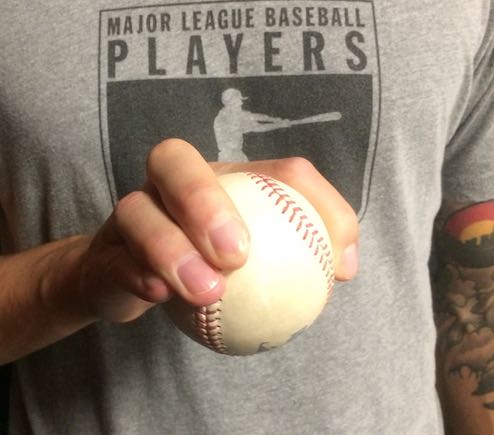
“I want to say I started throwing it my sophomore year of high school. I had a coach at the time who had pitched — his name is Chris Baum — and he had been trying to teach me a circle changeup. I couldn’t really figure it out, so he showed me this fosh, this split-change, that I throw now.

Kevin Gausman splitter grip.

“It was a pretty frustrating pitch at first, because it’s tough to gain consistency with. He kind of told me from Day One, ‘Hey, if you keep throwing it, you’ll eventually have a feel for it.’ I trusted him, and he was right. It’s a big weapon for me.

“The only thing I’ve really changed is where my thumb is on the ball. I’ll kind of mess around with it when I want to throw a strike, or when I don’t want to throw a strike. Moving the thumb affects the speed, and how much break, and tilt, you get on the pitch. If my thumb is under it, it’s going to be a little bit straighter. When my thumb is on the side of it, it might be a little bigger, with more fading action. Read the rest of this entry »


Sunday Notes: Daniel Norris is Missing One of His Friends

Daniel Norris has a lot of friends. They include a fastball, a slider, a changeup, and a curveball. The Detroit Tigers southpaw doesn’t actually converse with them — not in the way that Mark “The Bird” Fidrych once talked to the baseball — but they are nonetheless part of his coterie. They are his compadres. His amigos.

Norris is known for his unconventional ways. A few years back he gained a certain amount of notoriety for living in a VW van. His beard — since shorn — is often bushy, his soliloquies on life thoughtful. Moreover, his responses to reporters’ questions have rarely been of the paint-by-numbers variety. A few hours before he fanned the first big-league batter he faced — David Ortiz, in September 2014 — I happened to ask Norris if he’s imagined what his debut would feel like. His response was, “I have, and it will be like that times 10.”

A few days ago, I asked the now-26-year-old about his arsenal. The answer I received didn’t disappoint. Read the rest of this entry »


Joey Gallo Is Really Scalding the Ball

Roughly one month into the 2019 season, we’re still in Weird Stats territory. So long as we are, it’s worth appreciating the extreme numbers some players are putting up before they vanish into the ether, and few players are more reliably extreme than Joey Gallo. I checked in on him in last week’s visit to the furthest reaches of hitter performance, but since then, something else he’s doing — not unrelated — has captured my attention.

While it seems that Gallo has been around forever — he was a first-round pick in 2012, made his first top-100 lists in ’14, and debuted in June of the following year — he’s still just 25 years old and has two full seasons and some fragments under his belt. In both of those seasons (2017 and ’18), he reached the 40-homer level, struck out about 36% of the time (with over two Ks for every hit), walked a good deal, and finished with batting averages in the low .200s. For all of the extremes, he produced WARs of 2.8 in both seasons, with better defense as a near-full-time outfielder in the latter season (as opposed to shaky third base play in the former) which offset his wRC+ drop from 121 in 2017 to 110 in ’18. That’s a solidly above-average player before you factor in the added entertainment value he brings with his light-tower power. Here, have a 442-foot homer:

In this young season, Gallo has been something quite a bit more than solidly above average, hitting .284/.393/.689 through Wednesday. He entered Thursday ranked second in the AL in slugging percentage, tied for fifth in homers (eight), sixth in wRC+ (172), and tied for 11th in WAR (1.0). I’ll get to some of the less flashy particulars below, but what drew me in last week was his 62.5% home run-to-fly ball ratio, more than double a 2017-18 rate (28.8%) that ranked fourth in the majors; he’s since dropped to 50.0%, and will continue to fall even if he does remain the highest among qualifiers. What caught my eye in following up was his average exit velocity to date: 99.1 mph, tops in the majors.

2019 Average Exit Velocity Leaders
Rk. Player BIP LA EV FB/LD EV GB EV
1 Joey Gallo 44 19.0 99.1 102.7 91.0
2 Aaron Judge 48 12.6 97.9 99.7 96.2
3 Nelson Cruz 45 19.4 96.1 97.6 94.2
4 Carlos Santana 60 6.9 95.2 95.3 95.7
5 Yoan Moncada 71 12.3 95.2 98.7 91.8
6 Franmil Reyes 52 14.6 95.2 97.7 90.0
7 Christian Walker 55 15.2 95.0 99.0 90.6
8 Christian Yelich 74 14.8 95.0 98.9 92.6
9 Anthony Rendon 57 20.0 94.8 97.7 92.2
10 Josh Donaldson 55 9.5 94.5 100.3 90.3
SOURCE: Baseball Savant
Stats through April 24. Minimum 40 balls in play

Admittedly, exit velocity is not the be-all and end-all of Statcast measures. Launch angle matters, for one thing; 99 mph with a 15 degree launch angle, for example, produces an expected batting average of .726, while 99 mph with a -15 degree launch angle produces an average of .206. A writer-friend who knows much more about Statcast than I do suggested that hard hit rate (balls with an EV of 95 mph or above) might be a more useful gauge of Gallo’s current hot streak, but intuitively, it’s more difficult to grasp what a 50% hard hit rate means, or, in Gallo’s case, a 65.9% rate, without additional context (it’s second in the majors). A 99.1 mph average exit velo? That’s a lot of smoked baseballs. In Gallo’s case, 25 of his 44 balls in play have been hit at 105 mph or higher. Read the rest of this entry »


The Yankees, Dellin Betances, and Informed Consent Laws

Unless you’re a time-traveling visitor from 900 years in the future, you’ve probably heard that the Bronx Bombers have been struck by a rash of injuries early on this season. Among the more eyebrow-raising of those maladies was the revelation that key setup reliever and very tall human Dellin Betances had been sidelined with a bone spur. As Randy Miller reported for NJ.com:

What’s really interesting about Betances’ ordeal this week – his setback in Tampa, return to New York and second MRI – is Friday night’s revealing that he’s been pitching with a bone spur in his throwing shoulder since high school that never has affected his pitching.

More interesting, GM Brian Cashman said on Friday night that the Yankees have known about the bone spur since Betances had an MRI before signing his first pro contract as a teen in 2006 … and Betances saying Saturday morning that he first heard of it on Friday night.

That’s right – it appears the Yankees knew for over a decade that their right-handed relief ace had a bone spur, and they didn’t tell said right-hander about it.

“I guess from the previous MRIs I’ve always had it,” Betances said Saturday. “I didn’t know about it until now. But, yeah, I’ve always had it. I always come into spring and I feel, I guess .. a little stiff, But for me it usually gets better and this time it wasn’t. That’s pretty much what happened.”

Why did the Yankees never tell Betances about his bone spur?

“He hasn’t had the inflammation before,” Cashman said. “On the various testing we’ve done since we signed him … (After) drafting (Betances) I gave him a $1 million to sign rather than go on to college, and you do a physical and there’s an MRI, and right away that was (a bone spur that was) an incidental incident, meaning it’s not affecting him.

“There is something there. It’s inconsequential, non-symptomatic. He hasn’t had to deal with this. It’s had no affect on his game or pitching in anyway shape or form. The various times we imaged him, if it was for insurance or whatever reason, it’s always been there, but it’s never been something that’s caused a problem.”

There’s a lot to unpack here, but let’s start with this: the Yankees not only knew that Betances had a bone spur, they imaged it for insurance purposes. At the same time, they didn’t tell Betances because, as Cashman put it, it was “incidental” and largely asymptomatic. The uniform Major League Baseball contract required Betances to warrant that he has “no physical or mental defects” that would “prevent or impair” his ability to play baseball. The Yankees knew Betances had such a defect, and didn’t tell him. Worse, they had a number of contentious arbitration hearings with the right-hander. In hindsight, Randy Levine’s comments that Betances was “a victim” of his agent’s “overreach,” and comparison of Betances to an astronaut, seem even worse when one considers that the Yankees knew Betances had a medical condition and had seemingly disclosed that to insurance companies but not the player himself. Read the rest of this entry »